Section I: The Nature of the Buddha and Enlightenment
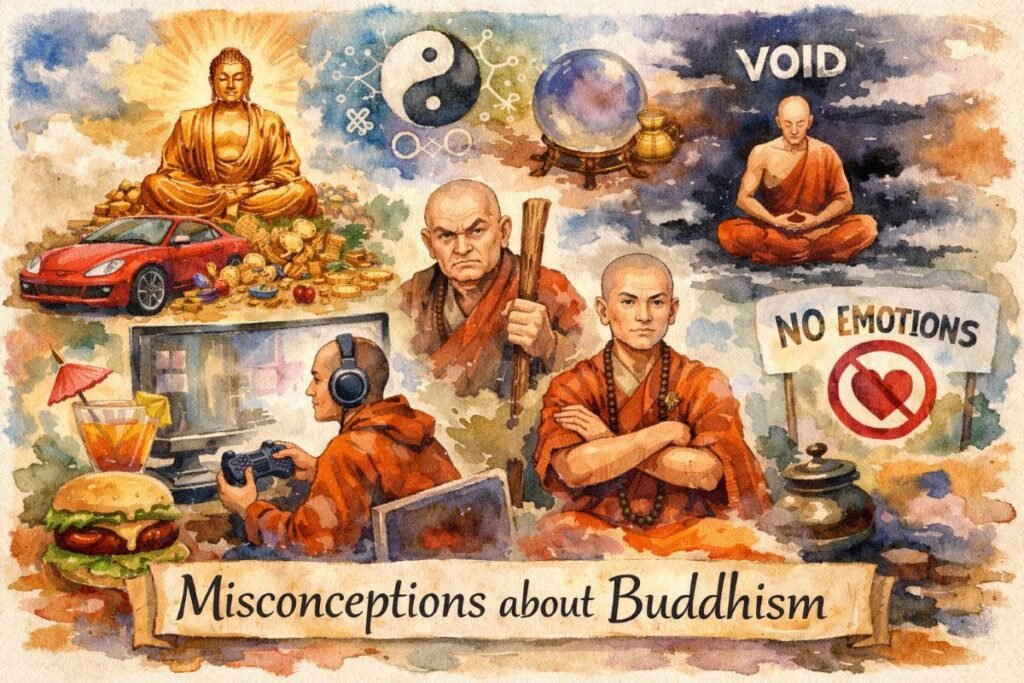
1. The Buddha is a god.
- The Misconception: Because devotees bow, offer incense, and chant before statues of the Buddha, casual observers often conclude that he is worshipped as a supreme creator deity or savior figure analogous to the gods of Western monotheistic faiths.
- Origin & Appeal: It is natural for those from non-Buddhist backgrounds to map unfamiliar devotional practices onto familiar religious frameworks, assuming any centralized icon represents a divine entity.
- Doctrinal Clarification: The historical Buddha, Siddhattha Gotama, was a human being who attained full awakening (sammā-sambodhi) through his own meditative efforts, discipline, and intellectual penetration of reality. In canonical discourses like the Doṇa Sutta (AN 4.36), when explicitly asked if he was a god, a heavenly being, or a human, the Buddha rejected these divine categorizations, stating he was simply “awakened” (buddho). He serves as an archetype, a teacher, and a guide who pointed to a path that others can walk, rather than an entity who grants salvation or creates universes.
2. Buddhism is a pessimistic religion obsessed with suffering.
- The Misconception: Because the First Noble Truth declares that life is intimately bound up with dukkha, critics frequently dismiss Buddhism as a bleak, life-denying philosophy that wallows in misery and discourages joy.
- Origin & Appeal: Early Western translations frequently rendered dukkha strictly as “suffering,” which strips the term of its philosophical nuance and leaves a stark, gloomy impression.
- Doctrinal Clarification: Dukkha is a multi-layered term encompassing gross physical pain, the subtle unsatisfactoriness of change (vipariṇāma-dukkha), and the structural instability of conditioned phenomena (saṅkhāra-dukkha). The Buddha acted as a spiritual physician: diagnosing a systemic illness does not make a doctor a pessimist. The matrix of the Four Noble Truths moves directly from diagnosis to a cure—asserting that the complete cessation of dukkha (nirodha) is entirely achievable in this lifetime, making the framework fundamentally pragmatic and deeply optimistic.
3. There is no self, so nothing exists.
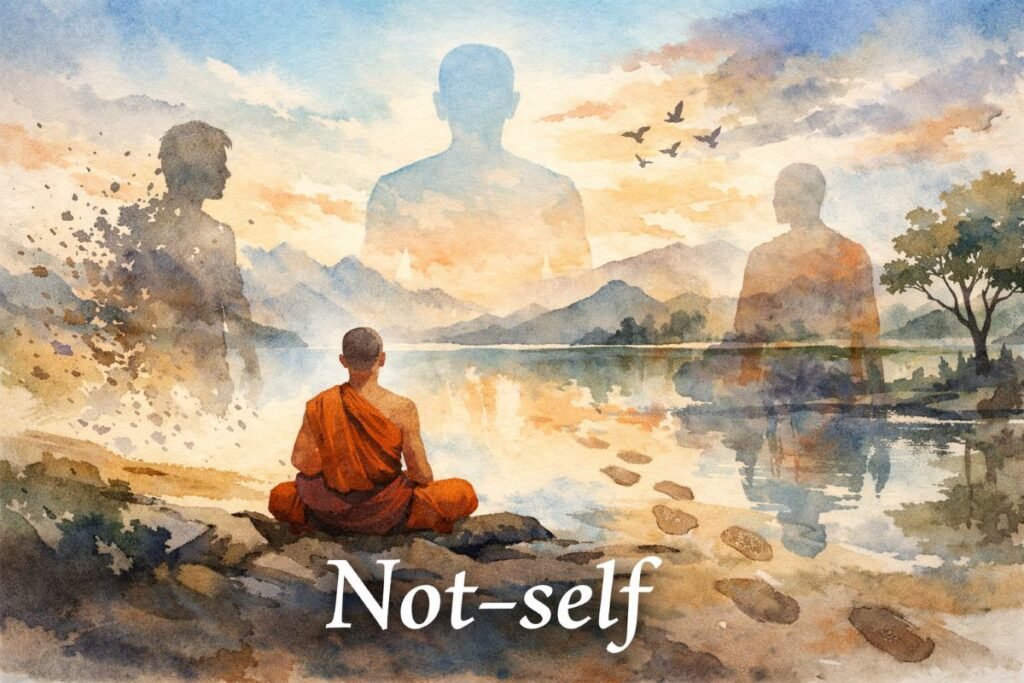
- The Misconception: The cornerstone doctrine of anattā (not-self) is routinely misinterpreted as a radical form of nihilism, suggesting that individual people do not exist, human experiences are completely unreal, and actions have no agent.
- Origin & Appeal: The intellectual leap from “there is no permanent soul” to “nothing exists at all” is a common philosophical trap for those accustomed to binary frameworks of absolute eternalism versus absolute annihilationism.
- Doctrinal Clarification: The Buddha did not deny the conventional existence of the empirical individual, functional personality, or the mind-body process. Instead, anattā asserts that if you analyze human experience, broken down into the five aggregates (khandhas: form, feeling, perception, mental formations, and consciousness), you will find no permanent, unchanging, independent essence or soul (ātman) within them. Phenomena exist dependently and dynamically; they are real as processes, not as static substances. The Middle Way avoids both eternalism and annihilationism.
4. Karma is fate or predestination.
- The Misconception: People often use the phrase “that’s just my karma” to express a fatalistic resignation to bad luck, viewing karma as an inescapable cosmic ledger or a rigid destiny written in stone.
- Origin & Appeal: This reading simplifies a complex psychological law into a cosmic system of reward and punishment, mirroring Western concepts of divine retribution or mechanical predestination.
- Doctrinal Clarification: In Buddhist doctrine, kamma literally translates to “intentional action.” It is a dynamic law of cause and effect operating in the realm of volition. While past actions certainly condition the present moment, they do not dictate how one must respond. The Samaṇamaṇḍikā Sutta (MN 78) highlights that our present choices, tempered by mindfulness and wisdom, constantly reshape our trajectory. If the present were entirely determined by the past, spiritual liberation would be a mechanical impossibility.
5. Rebirth means a soul transmigrates.
- The Misconception: It is commonly assumed that Buddhist rebirth functions identically to Hindu reincarnation, featuring a distinct, immortal soul (ātman) that discards an old body and steps into a new one like a person changing clothes.
- Origin & Appeal: The idea of a continuous “soul-passenger” is highly intuitive and easy to visualize, making it a default assumption when discussing any Eastern doctrine of multiple lifetimes.
- Doctrinal Clarification: Because Buddhism teaches anattā, there is no permanent soul to migrate. Rebirth is described as a causal stream of consciousness (viññāṇa-sota) carrying habit-energies and karmic tendencies forward. The classic scriptural analogy is that of a flame passing from one candle to another: the second flame is lit because of the first, yet it is not the exact same physical flame, nor is it entirely independent. It is a continuous process of conditioned causality.
6. Buddhism teaches that desire should be completely suppressed.
- The Misconception: Since craving is identified as the root of suffering, many believe that a practicing Buddhist must aggressively crush all desires, goals, and emotional drives, reducing themselves to a state of total apathy.
- Origin & Appeal: This stems from a linguistic flattening of different types of desire into a single English word, ignoring the subtle distinctions present in scriptural languages.
- Doctrinal Clarification: Buddhism explicitly distinguishes between taṇhā (blind, unquenchable craving or clinging) and chanda (wholesome desire, zeal, or intention). Wholesome desire is an absolute necessity on the path; without the chanda to practice, cultivate ethics, and seek liberation, no spiritual progress could ever occur. The path transforms and channels desire toward awakening rather than violently suppressing human volition.
7. Nirvana is eternal annihilation.
- The Misconception: Because the literal etymology of nirvana (nibbāna) means “unbinding” or “blowing out,” early Western commentators frequently described it as a spiritual black hole, the absolute destruction of the person into a state of non-existence.
- Origin & Appeal: The concept of an unconditioned state that transcends sensory experience is incredibly difficult to frame using dualistic language, making it easy to mistake for total non-being.
- Doctrinal Clarification: The Buddha explicitly rejected the view of annihilationism (uccheda-diṭṭhi). What is “blown out” or extinguished in nirvana is not existence itself, but the fires of greed (lobha), hatred (dosa), and delusion (moha). In texts like the Aggi-Vacchagotta Sutta (MN 72), the Buddha explains that terms like “exists” or “does not exist” fail to capture the nature of an awakened mind, as it is free from the conditioned limitations of linguistic categories. Nirvana is a liberated dimension beyond linguistic proliferation, not a black hole of nothingness.
8. Meditation means emptying the mind of all thought.
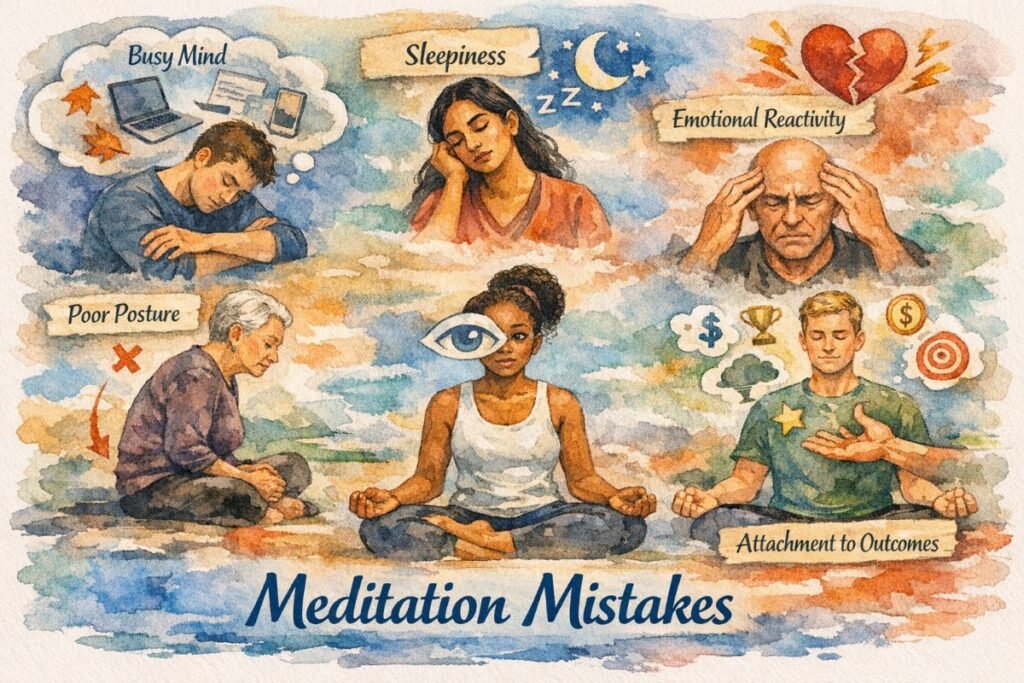
- The Misconception: Newcomers often abandon meditation practice out of frustration because they cannot stop their minds from producing thoughts, believing that true meditation requires a state of completely blank mental vacuum.
- Origin & Appeal: Popular media often portrays meditators in a state of absolute, unblinking trance, contributing to the romanticized ideal of a thought-free mind achieved through sheer force of will.
- Doctrinal Clarification: Meditation (bhāvanā, meaning cultivation) focuses on changing one’s relationship to thoughts, not forcibly stopping them. While deep states of concentration temporarily suppress discursive thinking, Buddhist meditation is primarily about cultivating mindful awareness, insight, and wholesome mental qualities. Trying to forcefully blank out thoughts creates aversion and tension; the practice is to understand thoughts’ nature without clinging, not to make the mind a vacuum.
9. All Buddhists must be vegetarians.
- The Misconception: Given the foundational commitment to non-violence (ahiṃsā) and the First Precept against taking life, many assume that a plant-based diet is an absolute, non-negotiable rule for anyone calling themselves a Buddhist.
- Origin & Appeal: The ethical alignment between compassion and vegetarianism makes this assumption highly appealing, bolstered by specific dietary restrictions found in East Asian Mahayana traditions.
- Doctrinal Clarification: The historical Buddha did not mandate vegetarianism for his followers. According to the Vinaya (monastic code), monastics were mendicants who had to accept whatever food was dropped into their alms bowls, including meat, provided the animal was not specifically slaughtered for them (known as the rule of “triple purity”). While certain Mahayana texts like the Laṅkāvatāra Sūtra strongly champion vegetarianism as an expression of universal compassion, it remains an encouraged ideal rather than a universal commandment across all schools; different traditions place stronger or weaker emphasis on this ideal.
10. Buddhism is a philosophy, not a religion.
- The Misconception: Rationalist and secular practitioners often insist that Buddhism is strictly an analytical philosophy or a psychological system, discarding its ritual, cosmological, and devotional elements as superstitious cultural accretions.
- Origin & Appeal: This view emerged strongly during the 19th-century colonial encounter, where Western scholars sought to rescue a highly intellectual “pure Buddhism” from what they perceived as corrupt, ritualistic lived practices in Asia.
- Doctrinal Clarification: While Buddhism possesses an incredibly rigorous philosophical and psychological framework, it has historically operated as a comprehensive religious tradition for over two millennia. It includes faith (saddhā), devotion, monastic rules, cosmology, and practices aimed at a transcendent goal. Calling it only a philosophy ignores its lived religious dimension of practice, ethics, and sacred refuge.
11. The Dalai Lama is the head of all Buddhism.
- The Misconception: Due to his immense global prominence, media presence, and Nobel Peace Prize, the Dalai Lama is frequently viewed as the absolute spiritual leader of the global Buddhist population, a role akin to a Buddhist Pope.
- Origin & Appeal: Western observers naturally look for a singular, centralized authority figure to represent an entire world religion, mapping the hierarchical structure of Catholicism onto a deeply decentralized tradition.
- Doctrinal Clarification: The Dalai Lama is specifically a high-ranking lama within the Gelug school of Tibetan Buddhism. He has never held administrative or spiritual authority over other Tibetan lineages (such as the Nyingma, Kagyu, or Sakya), nor does he command any authority over the vast Theravada traditions of Southeast Asia or the Zen and Pure Land schools of East Asian Mahayana. Buddhism is structurally decentralized, comprising distinct lineages with their own governing bodies and elders.
12. The Buddha was born into Hinduism and merely reformed it.
- The Misconception: Textbooks routinely claim that Buddhism began as a protest movement or a minor reformist offshoot within historical Hinduism, similar to how Protestantism branched off from Catholicism.
- Origin & Appeal: This narrative simplifies complex historical timelines and retroactively projects modern, consolidated definitions of “Hinduism” back into ancient Indian history.
- Doctrinal Clarification: According to many modern historical scholars, “Hinduism” as a singular, consolidated religion did not exist during the 5th century BCE. The religious landscape of ancient India was deeply fragmented, split between the orthodox Vedic priesthood and the heterodox śramaṇa (wandering ascetic) movements. The Buddha belonged to the śramaṇa camp. He explicitly rejected the divine authority of the Vedas, discarded the spiritual validity of the caste system, denied the efficacy of animal sacrifice, and challenged the core concept of a permanent soul (ātman), establishing a fundamentally distinct spiritual paradigm. Later Hindu traditions retrospectively claimed the Vedic heritage, but Buddhism represented a radical, separate departure.
13. The term “Hinayana” refers to Theravada Buddhism.
- The Misconception: Academic and popular texts sometimes use the terms “Hinayana” and “Theravada” interchangeably when categorizing the major divisions of Buddhism alongside Mahayana and Vajrayana.
- Origin & Appeal: Early Western translations uncritically adopted certain polemical frameworks from Mahayana Sanskrit texts without recognizing their specific historical and rhetorical contexts.
- Doctrinal Clarification: “Hinayana” (literally “Lesser Vehicle”) is a rhetorical, polemical category coined by early Mahayana writers to critique a variety of early, now-extinct schools regarding their views on the bodhisattva path. Theravada is an independent school descended from the ancient Vibhajjavāda lineage, possessing its own unique history and scriptural corpus. It is the sole surviving lineage of the early schools but was not the historical target of those polemics. Applying the label “Hinayana” to Theravada is both historically inaccurate and pejorative.
14. Enlightenment is a permanent state of blissed-out ecstasy.
- The Misconception: Popular culture visualizes an enlightened person as someone existing in a perpetual state of emotional high, completely spaced out, smiling vacantly, and detached from physical realities.
- Origin & Appeal: The human tendency to conceptualize liberation as the ultimate escalation of ordinary worldly happiness leads to viewing enlightenment through the lens of emotional ecstasy.
- Doctrinal Clarification: The Buddha described the mind of an arahant (an awakened one) not as ecstatic or euphoric, but as profoundly peaceful, stable, and characterized by unshakeable equanimity (upekkhā). An awakened person still experiences the world, senses physical pain, and undergoes natural human encounters, but they possess zero internal reactivity. The underlying mental defilements: greed, hatred, and delusion, have been permanently uprooted, resulting in a clear, grounded freedom rather than an emotional high.
15. Buddhist non-attachment means you stop caring about people.

- The Misconception: The emphasis on non-attachment (anupādāna) causes critics to argue that Buddhism fosters coldness, apathy, and emotional isolation, requiring practitioners to treat loved ones with detached indifference.
- Origin & Appeal: This view stems from confusing the psychological state of non-clinging with the defensive emotional mechanism of dissociation or intellectual coldness.
- Doctrinal Clarification: Non-attachment is not the absence of love; it is the absence of clinging, possessiveness, and fear. When love is bound up with attachment, it becomes neurotic, demanding, and highly conditional, driven by the ego’s need for security. By dismantling the illusion of a permanent self, a practitioner can cultivate boundless loving-kindness (mettā) and compassion (karuṇā) that flow freely to all beings without expecting anything in return. True caring is free from possessiveness; you love beings with a mind free from clinging, which actually enables a purer, more selfless love.
Section II: Karma, Rebirth, and Dependent Origination
16. Suffering is caused only by attachment to material things.
- The Misconception: People often assume that if they simply sell their luxury possessions, adopt a minimalist lifestyle, and avoid material greed, they will fully eliminate suffering from their lives.
- Origin & Appeal: Material renunciation is highly tangible and visible, making it far easier to conceptualize and practice than deep psychological deconstruction.
- Doctrinal Clarification: Material objects themselves are not the source of dukkha. The root cause is taṇhā (craving), which operates across three distinct dimensions: craving for sensory pleasures (kāma-taṇhā), craving for becoming or identity (bhava-taṇhā), and craving for non-existence or annihilation (vibhava-taṇhā). A practitioner can live in a completely bare cave and still be consumed by intense craving for spiritual status, abstract philosophies, or praise, which are equally potent sources of psychological suffering.
17. Buddhism denies the existence of the external world.
- The Misconception: Certain philosophical arguments, particularly within the Yogācāra or “Mind-Only” tradition, are often misinterpreted as a form of absolute Western solipsism, claiming that physical reality is a complete illusion existing solely inside an individual’s head.
- Origin & Appeal: The complex epistemological deconstructions used in Buddhist philosophy can easily sound like radical idealism to those unfamiliar with the systematic refutation of ontological extremes.
- Doctrinal Clarification: The vast majority of Buddhist schools do not deny the presence of an external reality. Instead, they argue that we have zero access to an unmediated, objective world outside of our sensory apparatus and mental processing. Our experience of the world is thoroughly constructed by our cognitive faculties, past conditioning, and karmic imprints. The focus is epistemological (how we know what we know) rather than ontological (denying the existence of matter).
18. You must become a monk or nun to attain enlightenment.
- The Misconception: Because the monastic community (Saṅgha) is heavily prioritized in traditional Buddhist texts, it is widely believed that laypeople are structurally barred from achieving significant spiritual realization.
- Origin & Appeal: Monastic life provides an idealized, highly visible environment for intense spiritual practice, leading to the assumption that it holds an absolute monopoly on the ultimate goal.
- Doctrinal Clarification: While the Buddha praised the monastic life as the most direct and unencumbered environment for practice, the Pali Canon documents numerous instances of lay followers achieving profound stages of awakening. Figures like the householder Citta and the laywoman Khujjuttarā achieved advanced realizations. The householder path is demanding but fully capable of leading to high levels of realization; the primary requirements are the quality of one’s mind rather than the style of one’s clothing.
19. The Buddha taught that women are inferior.
- The Misconception: Skeptics point to specific patriarchal passages in late canonical texts and the institutional subordination of nuns to monks as clear proof that Buddhism inherently considers women spiritually inferior to men.
- Origin & Appeal: Institutional inequalities in historical Buddhist cultures have frequently obscured the radical egalitarian core of the foundational teachings.
- Doctrinal Clarification: The Buddha explicitly affirmed that women possess the exact same capacity for full awakening (arahantship) as men. He took the radical step in ancient India of establishing the bhikkhunī saṅgha (the order of fully ordained nuns), giving women an autonomous institutional space for spiritual practice outside the traditional constraints of Vedic patriarchy. While he navigated the intense social prejudices of 5th-century BCE India by adding protective institutional rules, and whatever the later editorial history or authenticity of the eight garudhammas may be according to modern critical scholarship, the core doctrine maintains that gender is an empty, conditioned phenomenon completely irrelevant to liberation.
20. Karma justifies blaming victims for their suffering.
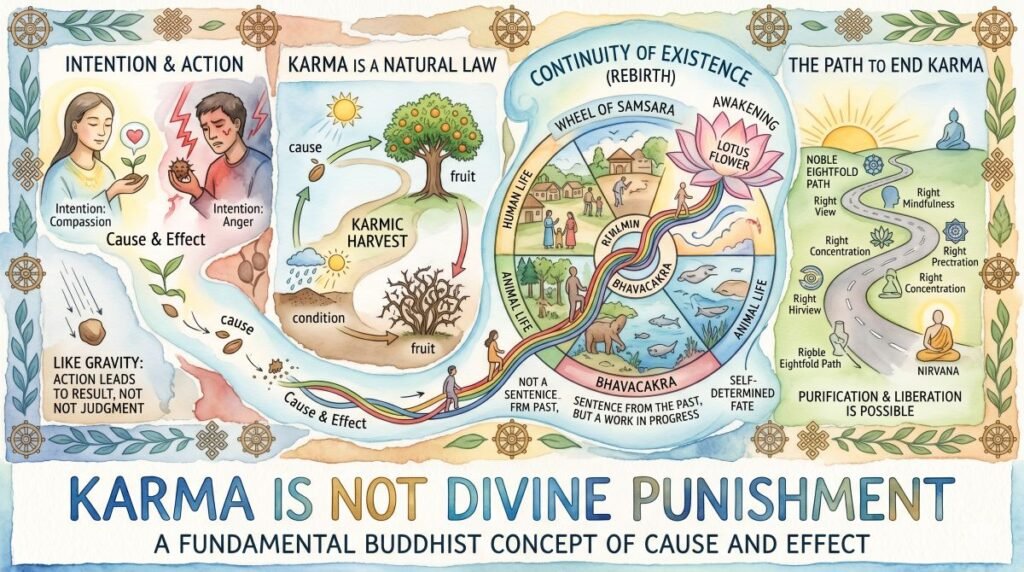
- The Misconception: A crude understanding of karma leads people to view victims of poverty, disease, assault, or systematic oppression as simply receiving what they deserve for transgressions committed in past lives.
- Origin & Appeal: This misinterpretation satisfies a psychological desire for a simple, orderly world where everyone gets what they deserve, providing an easy excuse to avoid systemic social issues.
- Doctrinal Clarification: The Buddha strongly refuted the idea that every single experience is the direct result of past karma (a wrong view known as pubbekatahetu). In the Sivaka Sutta (SN 36.21), he clearly explains that human experiences can be caused by physical biological imbalances, environmental factors, seasonal changes, and the direct, unprovoked actions of other human beings. Using karma to mock or dismiss the suffering of others violates the absolute requirement for compassion (karuṇā), which demands immediate, unconditioned action to relieve distress.
21. Zen is beyond all scriptures and study.
- The Misconception: Zen is frequently romanticized as a chaotic, anti-intellectual lifestyle where practitioners completely throw away books, burn scriptures, and rely solely on spontaneous, erratic insights.
- Origin & Appeal: Famous Zen phrases like “a special transmission outside the scriptures” were popularized by Western counter-culture figures in the mid-20th century to justify a rebellion against formal academic and religious structures.
- Doctrinal Clarification: Traditional Zen masters have historically been exceptionally well-read scholars who spent decades studying major Mahayana texts like the Laṅkāvatāra, Diamond, and Heart sutras. The phrase “outside the scriptures” means that intellectual, conceptual study alone cannot substitute for the direct, non-conceptual realization of reality (kensho). Study provides the foundational map; meditation is the actual journey.
22. The mantra “Om Mani Padme Hum” asks for material wishes.
- The Misconception: Travelers and casual practitioners often treat this famous Tibetan mantra as a magical wishing formula, reciting it primarily to secure wealth, health, or good fortune in worldly matters.
- Origin & Appeal: The universal human tendency to convert religious practices into transactional, petitionary prayers for material security makes this a common default behavior.
- Doctrinal Clarification: This profound mantra is explicitly dedicated to Avalokiteśvara (Chenrezig), the Bodhisattva of Infinite Compassion. Each of the six syllables is doctrinally tied to the purification of a specific mental defilement and the closure of a corresponding realm of cyclical existence (saṃsāra). Reciting the mantra is a contemplative method designed to transform the practitioner’s mind, actively awakening innate altruism and the supreme motivation of bodhicitta, rather than a tool for acquiring material wealth.
23. Buddhism rejects all rituals and ceremonies.
- The Misconception: Because the Buddha warned against “clinging to rites and rituals” (sīlabbata-parāmāsa) as a fetter to liberation, many assume that any form of bowing, chanting, or ceremony is entirely un-Buddhist.
- Origin & Appeal: This perspective is highly attractive to modern, secular Westerners who carry a strong historical aversion to institutional religious rituals and seek a purely rationalist practice.
- Doctrinal Clarification: The fetter of sīlabbata-parāmāsa specifically refers to the mistaken belief that performing mechanical rituals alone, without internal mental transformation, can grant spiritual liberation. When performed with clear comprehension and mindfulness, rituals like bowing, making offerings, and chanting serve as powerful skillful means (upāya). They ground the body, express deep gratitude, calm the nervous system, and actively condition the subconscious mind toward wholesome qualities.
24. The Buddha taught that life is an illusion.
- The Misconception: Popular books frequently state that Buddhism considers the physical universe, our bodies, and our daily activities to be a literal optical illusion or a collective hallucination with zero reality.
- Origin & Appeal: This misinterpretation arises from confusing the specific ontological arguments of Advaita Vedānta philosophy (regarding māyā) with the distinct teachings of the Buddhist tradition.
- Doctrinal Clarification: The Buddha did not teach that reality is an illusion; he taught that phenomena are like an illusion. In texts such as the Pheṇapiṇḍūpama Sutta (SN 22.95), he compares the five aggregates to a mirage, a bubble, or a phantom. The point of the metaphor is that while these phenomena definitely appear to our senses, they lack the solid, permanent, independent, and uniform essence that our minds automatically attribute to them. They are real, but they exist dependently and ephemerally.
25. All Buddhist meditation is mindfulness of breathing.
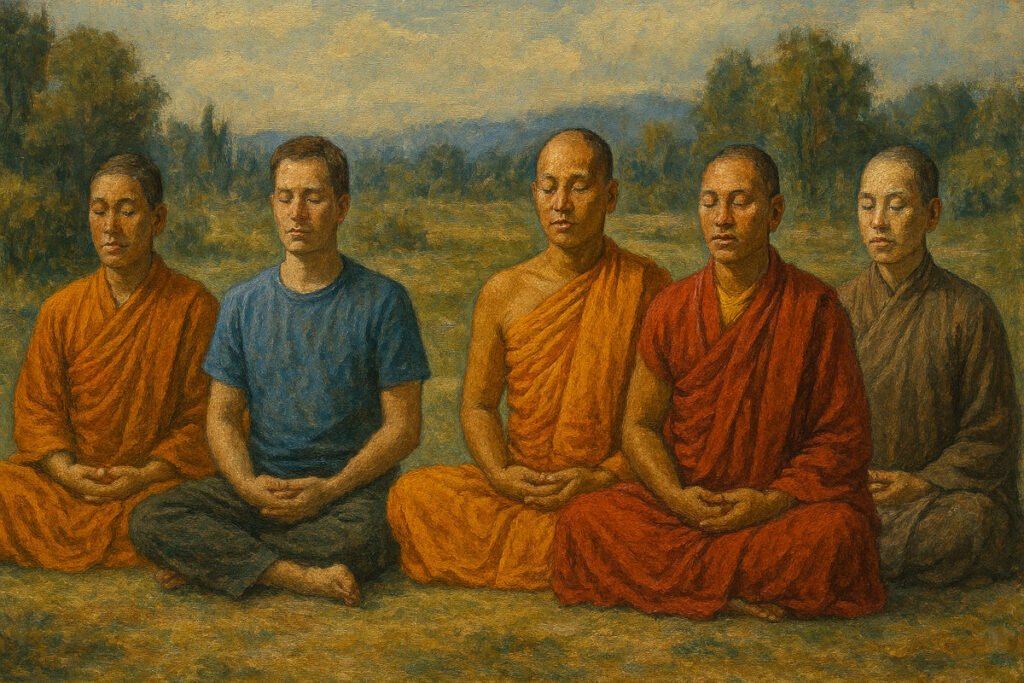
- The Misconception: The overwhelming contemporary global popularity of secular mindfulness and ānāpānasati has led many to believe that Buddhist meditation consists exclusively of sitting still and watching the breath.
- Origin & Appeal: Breath meditation is highly accessible, culturally neutral, and clinically effective for stress reduction, causing it to eclipse a vast meditative ecosystem.
- Doctrinal Clarification: Mindfulness of breathing is merely one technique within a comprehensive array of contemplative practices. The classical texts detail at least forty unique meditation objects (kammaṭṭhāna), including the systematic cultivation of the four immeasurables (brahmavihāras), the structural analysis of the four physical elements, recollections of the Buddha’s virtues, and advanced non-dual awareness practices like Dzogchen and Mahamudra.
26. Bodhisattvas delay their own enlightenment to save others.
- The Misconception: A widely repeated Mahayana narrative describes the bodhisattva as a heroic figure who intentionally stands outside the gates of nirvana, refusing to cross over until every single sentient being has been liberated first.
- Origin & Appeal: This romantic, self-sacrificing imagery carries immense emotional and poetic resonance, appealing deeply to altruistic ideals.
- Doctrinal Clarification: This description is a poetic, pedagogical device emphasizing the radical scale of the bodhisattva’s compassion. Doctrinally, one cannot truly free others from delusion while remaining personally deluded. A bodhisattva seeks the perfect, complete Buddhahood (samyaksambodhi), which requires the realization of the ultimate nature of reality. Traditional devotional stories speak in “standing at the gate” terms as an inspirational tool, but their realization is profound and birth in saṃsāra becomes voluntary and non-afflictive.
27. The four noble truths are the only basic teaching.
- The Misconception: People often treat the Four Noble Truths as a brief, self-contained introductory pamphlet, assuming that once they memorize the four basic bullet points, they have fully mastered the core of Buddhist doctrine.
- Origin & Appeal: The neat, structured presentation of the four truths makes them easy to summarize in introductory textbooks, which can obscure their true depth.
- Doctrinal Clarification: The Four Noble Truths serve as an expansive master framework that contains the entirety of the Dhamma. To fully comprehend the First Truth, one must deeply penetrate the five aggregates; the Second Truth requires mastering the twelve links of dependent origination; the Third Truth demands direct realization of the unconditioned (nibbāna); and the Fourth Truth unfolds into the lifelong cultivation of the Noble Eightfold Path. They are an inexhaustible depth, not a beginner’s pamphlet.
28. Buddhism teaches that desire is the root of all evil.
- The Misconception: Moralistic summaries frequently state that Buddhism views desire as an inherent cosmic evil or sin, framing the spiritual life as an intense moral warfare against dark temptations.
- Origin & Appeal: This projects familiar Western monotheistic moral binaries of absolute good versus absolute evil onto a tradition that operates on an entirely different ethical paradigm.
- Doctrinal Clarification: Buddhism does not possess a concept of absolute cosmic evil or sin. Instead, it identifies three unwholesome roots (akusala-mūla): greed (lobha), hatred (dosa), and delusion (moha). Craving (taṇhā) is one expression. Actions are categorized as unwholesome (akusala) if they are born from these roots because they inevitably produce painful results. The problem with craving is not that it is “evil,” but that it is a profound functional mistake based on an incorrect view of reality.
29. Nirvana is a heaven realm.
- The Misconception: Due to its status as the ultimate spiritual goal, nirvana is commonly envisioned as a celestial paradise, a physical place in the sky populated by liberated souls enjoying eternal happiness.
- Origin & Appeal: Human beings naturally conceptualize afterlife destinations through spatial metaphors, mapping nirvana onto familiar concepts of heaven or the Elysian fields.
- Doctrinal Clarification: In Buddhist cosmology, heaven realms (devalokas) definitely exist, but they are completely distinct from nirvana. Heaven realms are impermanent, conditioned places within saṃsāra; a being can be born there due to immense merit, but once that karmic energy is exhausted, they die and fall back into lower realms. Nirvana is explicitly unconditioned (asaṅkhata), transcending all spatial dimensions, temporal boundaries, and locations.
30. The Buddha starved himself to gain spiritual power.
- The Misconception: Iconic artistic depictions of a radically emaciated Siddhartha Gautama lead many to believe that Buddhism champions extreme physical self-mortification, fasting, and bodily punishment as the key to spiritual breakthrough.
- Origin & Appeal: Asceticism has a powerful, dramatic mystique, and the image of the “starving Buddha” is highly memorable, often confusing the pre-awakened seeker’s journey with his final discovery.
- Doctrinal Clarification: The period of radical starvation occurred before Siddhartha attained enlightenment. For six years, he practiced extreme asceticism, eventually realizing that reducing his body to a near-death state (attakilamathānuyoga) utterly failed to generate wisdom, only succeeding in exhausting his mind. He intentionally abandoned this extreme, accepted food, and subsequently formulated the Middle Way (majjhimā paṭipadā), which avoids both sensual indulgence and self-mortification as equally useless.
Section III: Core Philosophical Principles and the Three Marks
31. Buddhism is incompatible with psychotherapy.
- The Misconception: Some traditionalists view modern psychology as a superficial, secular distraction, while some clinical psychologists dismiss Buddhism as an ancient, unscientific mysticism that has no place in evidence-based therapy.
- Origin & Appeal: The historical gap of two millennia and different vocabularies can obscure the deep systemic commonalities between the two fields.
- Doctrinal Clarification: Buddhism and modern psychotherapy share an identical core motivation: the systematic reduction of human psychological suffering. The Buddha’s Abhidhamma is an exceptionally sophisticated map of human cognition, mental factors, and behavioral patterns. Modern modalities like Cognitive Behavioral Therapy (CBT), Dialectical Behavior Therapy (DBT), and Acceptance and Commitment Therapy (ACT) explicitly utilize Buddhist concepts of mindfulness and cognitive defusion to treat clinical distress.
32. You have to believe in rebirth to practice.

- The Misconception: Secular seekers often turn away from Buddhism because they assume they must force themselves to accept the literal reality of multiple past and future lifetimes on day one of their practice.
- Origin & Appeal: The demand for uncritical ideological alignment is a hallmark of many dogmatic traditions, leading people to expect the same entry barrier in Buddhism.
- Doctrinal Clarification: The Buddha did not demand blind dogma or unverified belief. In the Kālāma Sutta (AN 3.65), he explicitly encourages a pragmatic approach, outlining a series of solaces that apply regardless of whether an afterlife exists. A practitioner can remain completely agnostic regarding rebirth and still derive immense, transformative benefits from cultivating ethics and mindfulness in the immediate here and now.
33. The term “Buddha” refers only to Siddhartha Gautama.
- The Misconception: People widely treat “Buddha” as if it were the personal last name of a single historical individual who lived in ancient India, rather than an earned title.
- Origin & Appeal: This mirrors the common Western usage of “Christ” as a singular name rather than a theological title meaning “Anointed One.”
- Doctrinal Clarification: “Buddha” is a descriptive title meaning “Awakened One.” Siddhartha Gautama was simply the specific historical Buddha of our current cosmic epoch. The canonical discourses record a long lineage of past Buddhas and explicitly predict future Buddhas, highlighting the universal potential for awakening inherent in all sentient life.
34. All Buddhists pray to statues.
- The Misconception: Seeing practitioners prostrate themselves three times before a bronze image of the Buddha leads outside observers to accuse Buddhists of primitive idol worship, assuming they believe the statue is a living deity that can hear prayers.
- Origin & Appeal: This superficial interpretation relies entirely on external behavior, failing to query the internal psychological state and intention of the practitioner.
- Doctrinal Clarification: A Buddhist statue (buddharūpa) functions as a visual and psychological focal point for reflection (buddhānussati). Prostration is an act of deep humility that actively subdues the ego, expresses profound gratitude to the historical teacher, and serves to internalize the qualities of supreme wisdom, calm, and compassion that the statue physically embodies. The practitioner is not asking the stone or bronze for a favor.
35. Samsara is a physical place you escape.
- The Misconception: Saṃsāra is frequently spoken of as if it were a literal, physical universe or an earthly dimension that a practitioner physically breaks out of upon achieving enlightenment, flying off to a separate cosmic realm.
- Origin & Appeal: Spatial metaphors are deeply embedded in human language, making it much easier to think of liberation as a geographical relocation rather than a psychological transformation.
- Doctrinal Clarification: Saṃsāra is not a physical location; it is a process. The word literally means “wandering on.” It is the continuous, compulsive cycle of taking birth, aging, dying, and rebirth across conditioned states of mind, driven entirely by underlying ignorance (avijjā) and craving (taṇhā). When these unwholesome mental driving forces are completely uprooted through wisdom, the cycle ceases.
36. Monks and nuns must beg because they are lazy.
- The Misconception: Western observers viewing the daily morning alms round in Southeast Asian countries sometimes classify monastics as professional beggars or freeloaders who refuse to perform honest manual labor.
- Origin & Appeal: Modern economic frameworks evaluate human worth almost exclusively through material productivity and financial output, leaving little room for spiritual or contemplative value.
- Doctrinal Clarification: Monastics do not beg; they walk on piṇḍapāta (alms round). They are strictly forbidden from asking for food; they stand in dignified silence, allowing laypeople the opportunity to practice generosity (dāna). This establishes a profound, symbiotic relationship: the laity provides basic physical sustenance (food, robes, medicine), while the monastics provide spiritual guidance, teaching, and an uncorrupted ethical example.
37. Buddhist ethics is just a list of rigid rules.

- The Misconception: The extensive lists of rules, the Five Precepts for laypeople and the hundreds of Vinaya rules for monastics, can easily look like a system of rigid, deontological commandments that must be followed under threat of cosmic punishment.
- Origin & Appeal: Legalistic frameworks are common in religious ethics, making it easy to project an authoritarian model onto the Buddhist training guidelines.
- Doctrinal Clarification: The precepts are not commandments; they are sikkhāpada, which translates to “training steps” voluntarily undertaken by the practitioner. They are grounded in pragmatic, psychological cause and effect. Breaking a precept is not a “sin” that angers a deity; it is an unwholesome act (akusala) that generates immediate psychological remorse, agitates the mind, harms others, and disrupts the mental stillness necessary for deep meditation.
38. Vipassana is the only way to gain insight.
- The Misconception: Certain modern meditation movements isolate Vipassanā as a specific, proprietary technique that can be practiced completely divorced from tranquility meditation, framing it as the sole vehicle for realization.
- Origin & Appeal: The modern desire for rapid results drives the popularity of direct, technique-focused protocols that promise quick insight without the heavy investment required for deep concentration.
- Doctrinal Clarification: In the canonical discourses of the Buddha, samatha (tranquility) and vipassanā (insight) are not described as two separate, competing techniques, but rather as two inseparable, complementary qualities of an awakened mind. The Yuganaddha Sutta (AN 4.170) clearly explains that liberation requires the cultivation of both. Samatha provides the razor-sharp stability, clarity, and stillness of the instrument; vipassanā is the actual application of that stable mind to penetrate reality.
39. Faith in Buddhism is exactly like blind faith in Abrahamic religions.
- The Misconception: Skeptics argue that because Buddhism includes devotion and demands confidence in things like rebirth or enlightenment, it relies on the exact same structure of dogmatic, unquestioning faith found elsewhere.
- Origin & Appeal: The English word “faith” carries heavy cultural connotations of believing in things despite a total lack of evidence, a definition that is unthinkingly applied across all traditions.
- Doctrinal Clarification: The Buddhist term translated as faith is saddhā, which more accurately means “confidence,” “trust,” or “placed conviction.” It is an experiential trust modeled on how one views a highly skilled physician. A patient has initial confidence in a doctor’s diagnosis based on their reputation, but that confidence is only verified when the patient takes the prescribed medicine and personally experiences healing. Saddhā is an entry point meant to be systematically replaced by direct, empirical knowledge (ñāṇa).
40. Dependent origination is a theory of the origin of the universe.

- The Misconception: Because the twelve links of dependent origination (paṭicca-samuppāda) start with “ignorance” and progress sequentially through multiple stages, people mistake it for a chronological creation myth describing how the physical universe first began.
- Origin & Appeal: Human cultures universally seek linear narratives to explain the cosmic beginning of time, leading readers to interpret this profound philosophical formula as a historical timeline.
- Doctrinal Clarification: Paṭicca-samuppāda is a profound phenomenological analysis of how dukkha arises, moment to moment and lifetime to lifetime, based on specific structural conditions. It describes the causal matrix of consciousness, sensory contact, feeling, and craving. The Buddha consistently stated that the absolute chronological beginning of the physical cosmos is inconceivable and irrelevant to the immediate task of psychological liberation, focusing his entire teaching on the mechanics of suffering here and now.
The Structural Core of Suffering: The twelve links explain the dynamic mechanics of dependency, demonstrating that nothing arises out of a vacuum. Each link is completely dependent upon the conditions established by the link preceding it.
          [ THE TWELVE LINKS OF DEPENDENT ORIGINATION ]

   (1) Ignorance ----> (2) Formations ----> (3) Consciousness
                                                    |
   (6) Contact   <---- (5) Six Senses  <---- (4) Mind-Body
        |
        v
   (7) Feeling  ----> (8) Craving     ----> (9) Clinging
                                                    |
   (12) Suffering <--- (11) Birth      <---- (10) Becoming
41. Emptiness means everything is meaningless.
- The Misconception: The core Mahayana doctrine of emptiness (śūnyatā) is routinely attacked or embraced as a philosophical validation of nihilism, asserting that reality is empty of value, purpose, or objective presence.
- Origin & Appeal: A literal, unnuanced translation of “emptiness” easily conjures images of a void, nothingness, and absolute meaninglessness, appealing to existential dread or postmodern skepticism.
- Doctrinal Clarification: Śūnyatā does not mean that things do not exist or that life lacks meaning. It explicitly means that all phenomena are empty of inherent, independent, and unconditioned existence (svabhāva). Because everything arises dependently upon causes and conditions, nothing possesses a solid, isolated core. As the great philosopher Nāgārjuna demonstrated, emptiness is actually what makes change, ethical growth, cause-and-effect, and spiritual liberation possible; if things were not empty, they would be eternally fixed and unalterable.
42. Buddhists believe in an eternal soul that gets reincarnated.
- The Misconception: Many New Age interpretations synthesize Eastern philosophies by claiming that Buddhism teaches the evolution of an immortal, individual “higher self” that travels through multiple bodies to learn karmic lessons.
- Origin & Appeal: The desire for personal immortality makes the survival of a unique, continuous identity through death deeply comforting, leading readers to project this view onto Buddhist texts.
- Doctrinal Clarification: This is the precise formulation of eternalism (sassata-diṭṭhi) that the Buddha spent his entire life refuting. The mind-body continuum is a fluid process; the “relinking consciousness” (paṭisandhi-citta) that arises in a new life is conditioned by the final moments of the previous life, but it changes completely from one split second to the next. There is no permanent “higher self” or eternal soul supervising or navigating this process.
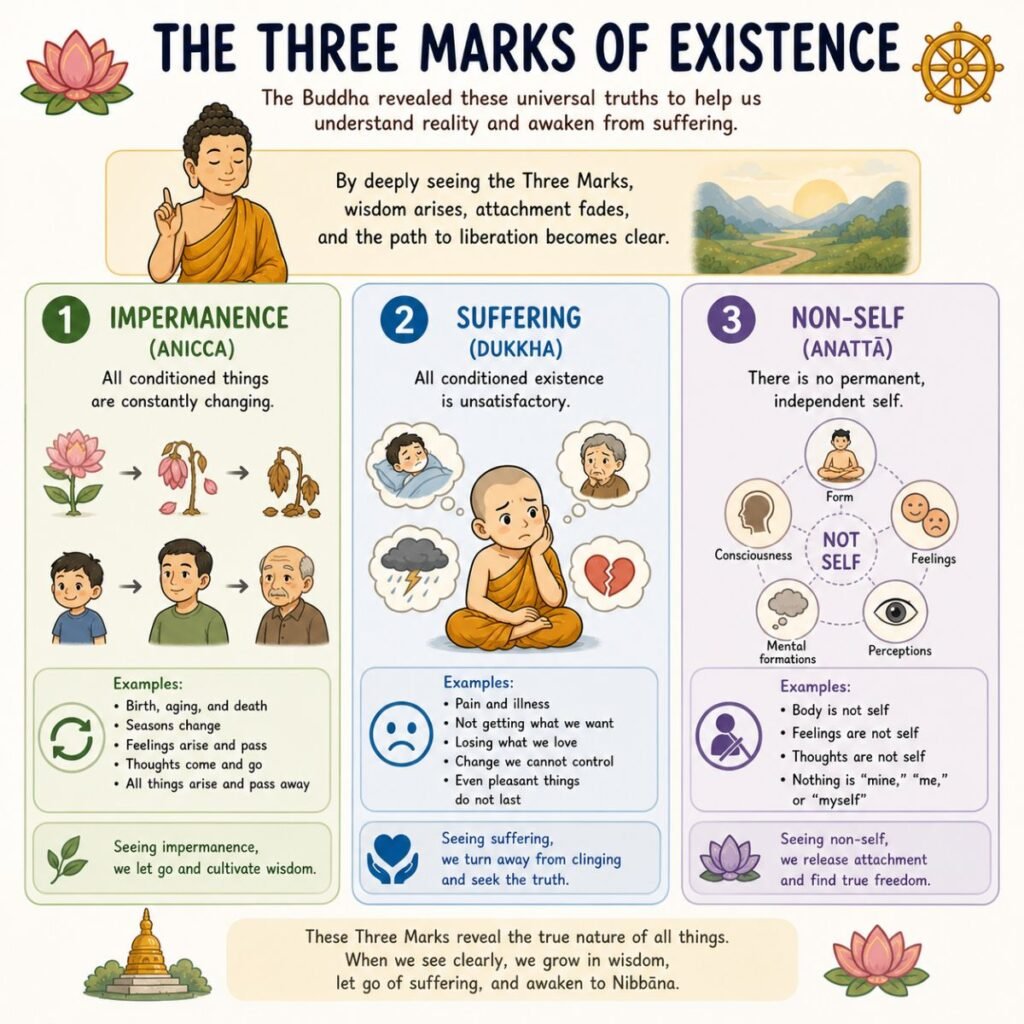
43. The Three Marks of Existence are independent, disconnected ideas.
- The Misconception: Practitioners frequently study impermanence (anicca), unsatisfactoriness (dukkha), and not-self (anattā) as completely separate, self-contained modules that have no internal operational overlap.
- Origin & Appeal: Standard academic curricula typically present doctrinal lists as distinct, disconnected bullet points to simplify memorization for examinations.
- Doctrinal Clarification: The Three Marks of Existence (tilakkhaṇa) are deeply integrated, overlapping facets of a single reality. The Buddha demonstrates their direct structural interplay in texts like the Anattalakkhaṇa Sutta (SN 22.59): Because things are impermanent (anicca), they are structurally unstable and prone to changing in ways we cannot control, which makes them inherently unsatisfactory (dukkha) if clung to for lasting security. Because they are impermanent and unsatisfactory, they cannot be claimed as a solid, controllable, independent self or possession (anattā). Penetrating one mark automatically illuminates the other two.
44. Consciousness survives untouched as a universal cosmic background.
- The Misconception: Many contemporary spiritual teachers claim that while the body, emotions, and thoughts are impermanent, the fifth aggregate, consciousness (viññāṇa), is an unchanging, eternal, cosmic background field that represents our true immortal identity.
- Origin & Appeal: This reading provides a comfortable halfway house for those trying to accept the doctrine of not-self while secretly maintaining a permanent refuge for the ego.
- Doctrinal Clarification: The Buddha explicitly rejected the idea of an unchanging consciousness. In the Mahātaṇhāsaṅkhaya Sutta (MN 38), a monk named Sāti is severely reprimanded for teaching that the exact same consciousness transmigrates unchanged. The Buddha demonstrates that consciousness arises exclusively dependent on conditions—specifically sensory organs encountering sensory objects (e.g., eye-consciousness arises dependent on the eye and a visual form). Consciousness is completely impermanent, flashing in and out of existence moment by moment.
45. Ultimate reality is a state of absolute non-dual oneness where all distinctions disappear.
- The Misconception: Popular accounts of enlightenment describe it as a mystical state of consciousness where all specific conventional boundaries, physical forms, and functional distinctions are completely obliterated into a flat, uniform cosmic oneness.
- Origin & Appeal: The psychological experience of deep meditative dissolution can feel so vast that the intellect automatically conceptualizes it as a literal dissolution of the external universe into a singular cosmic substance.
- Doctrinal Clarification: The Buddha avoided the extreme of non-dual monism (universal oneness) just as aggressively as he avoided dualism. The Middle Way demonstrates that while conventional distinctions (such as individual people, trees, and choices) lack an inherent, independent core, they still function dynamically and distinctly on a relative level. Enlightenment clarifies our perception of these conventional distinctions without reifying them or clinging to them, maintaining an understanding of both the relative (sammuti-sacca) and ultimate (paramattha-sacca) truths without collapsing one into the other.
Section IV: The Noble Eightfold Path and Ethics
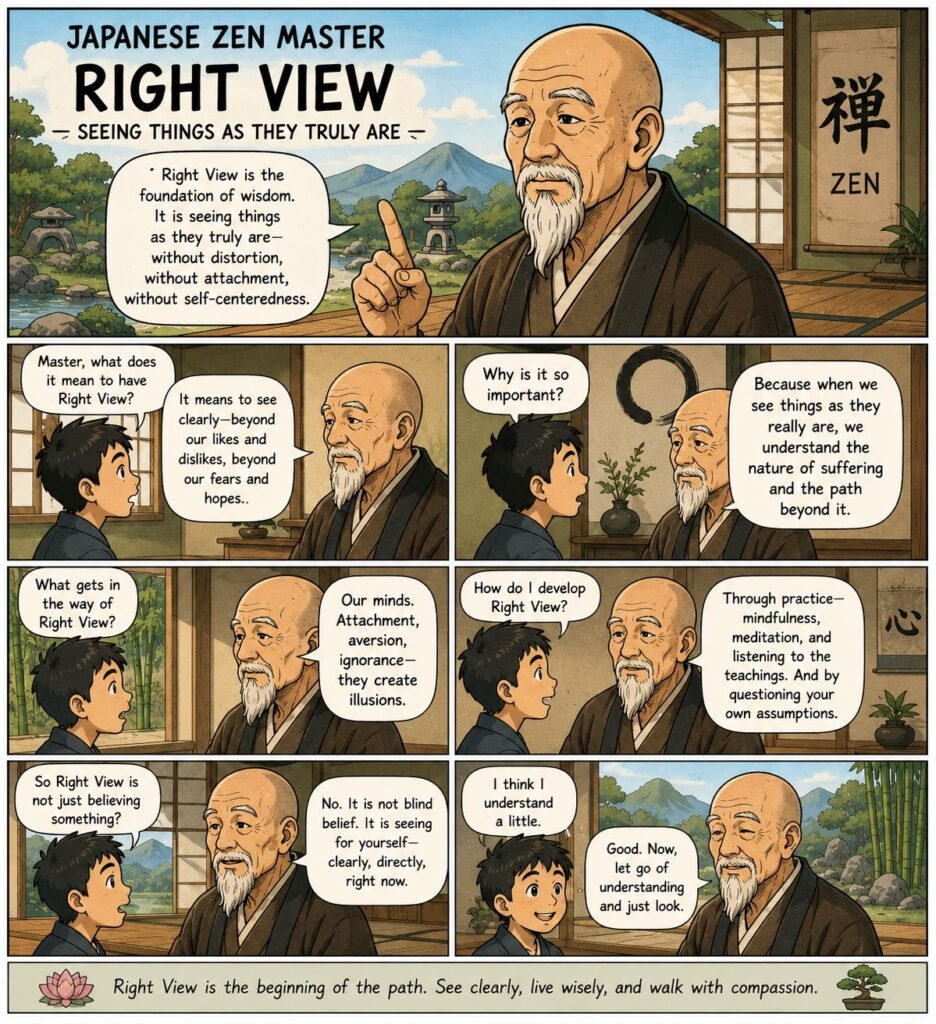
46. Right View is just an intellectual collection of correct opinions.
- The Misconception: People often assume that achieving Right View (sammā-diṭṭhi) simply requires memorizing the correct list of Buddhist doctrines and intellectually agreeing with them.
- Origin & Appeal: This reduces a profound transformative process into a simple, cognitive test, mirroring Western concepts of theological orthodoxy.
- Doctrinal Clarification: Right View is divided into two operational levels in the Mahācattārīsaka Sutta (MN 117): mundane Right View, which involves an intellectual understanding of karma and ethics, and supramundane Right View, which is not an opinion at all. Supramundane Right View is the direct, experiential flash of penetrative insight (paññā) that actually sees the four noble truths operating in real-time. It is a way of seeing reality directly, free from the distorting filters of conceptual projections.
47. The Eightfold Path is a passive, listless surrender that eliminates personal initiative.
- The Misconception: Critics argue that because Buddhism focuses on letting go and uprooting desire, the path results in a passive, listless compliance that strips an individual of critical thinking, creativity, and social drive.
- Origin & Appeal: Misunderstanding phrases like “non-striving” can lead people to view meditation as a form of self-induced psychological paralysis or absolute submissiveness.
- Doctrinal Clarification: The factor of Right Effort (sammā-vāyāma) demands immense, active, and creative personal initiative. It requires a practitioner to maintain an unblinking internal vigilance to prevent unwholesome states from arising, abandon existing unwholesome states, cultivate unarisen wholesome states, and maintain existing wholesome states. This requires a sharp, active, and independent intellect operating with immense energy (viriya), making the path a deeply proactive discipline.
48. Right Livelihood only applies to monastics or spiritual professions.
- The Misconception: Laypeople frequently assume that Right Livelihood (sammā-ājīva) is an elite requirement meant exclusively for monks and nuns, or for people working directly inside meditation centers and charities.
- Origin & Appeal: It is easier to compartmentalize one’s spiritual life away from their daily professional career, avoiding the challenging work of aligning business practices with ethical vows.
- Doctrinal Clarification: Right Livelihood is an absolute requirement for all lay practitioners. The Buddha explicitly detailed specific businesses that laypeople must completely avoid because they cause systemic harm to sentient beings: trading in weapons, human beings, meat production, intoxicants, and poisons. It requires an active examination of how one’s daily professional labor impacts the wider ecosystem, making economic ethics central to the path.

49. Engaged Buddhism is a modern, inauthentic corruption of traditional practices.
- The Misconception: Traditional purists sometimes dismiss the contemporary movement of “Engaged Buddhism“, which applies Buddhist principles to social justice, environmental activism, and political critique, as a modern Western political corruption of an originally purely internal, world-denying meditation path.
- Origin & Appeal: This view relies on an idealized, colonial-era image of the monk as a completely isolated, disembodied contemplative who has zero interest in societal well-being or institutional ethics.
- Doctrinal Clarification: From its absolute historical beginnings, Buddhism has always been deeply engaged with social and structural ethics. The Buddha actively intervened to prevent wars, advised kings on economic policies to reduce poverty, and structurally challenged the spiritual legitimacy of the caste system. The Sigālovāda Sutta (DN 31) outlines clear social responsibilities for family life, employment, and community care. Modern Engaged Buddhism simply translates these foundational principles of compassion and interdependence into contemporary social systems.
50. Intentionality means that physical actions do not matter as long as your heart is good.
- The Misconception: Because the Buddha defined karma as intention (cetanā), some practitioners conclude that as long as they maintain a vague internal feeling of love or goodwill, they can violate ethical precepts, lie, or act recklessly without generating negative consequences.
- Origin & Appeal: This rationalization provides a convenient escape route for the ego, allowing individuals to avoid the demanding discipline of physical self-restraint while maintaining a self-image of high spirituality.
- Doctrinal Clarification: True internal intention is not a vague emotional feeling; it is the absolute driving force that shapes physical behavior. In the Ambalatthika-Rahulovada Sutta (MN 61), the Buddha uses the analogy of a mirror to instruct his son Rāhula to meticulously examine his physical actions, verbal speech, and mental thoughts before, during, and after execution. If a physical action causes harm to oneself or others, the underlying intention was corrupted by delusion, regardless of whatever emotional justification the mind invents. Physical ethics (sīla) provide the essential, concrete proof of a purified mind.
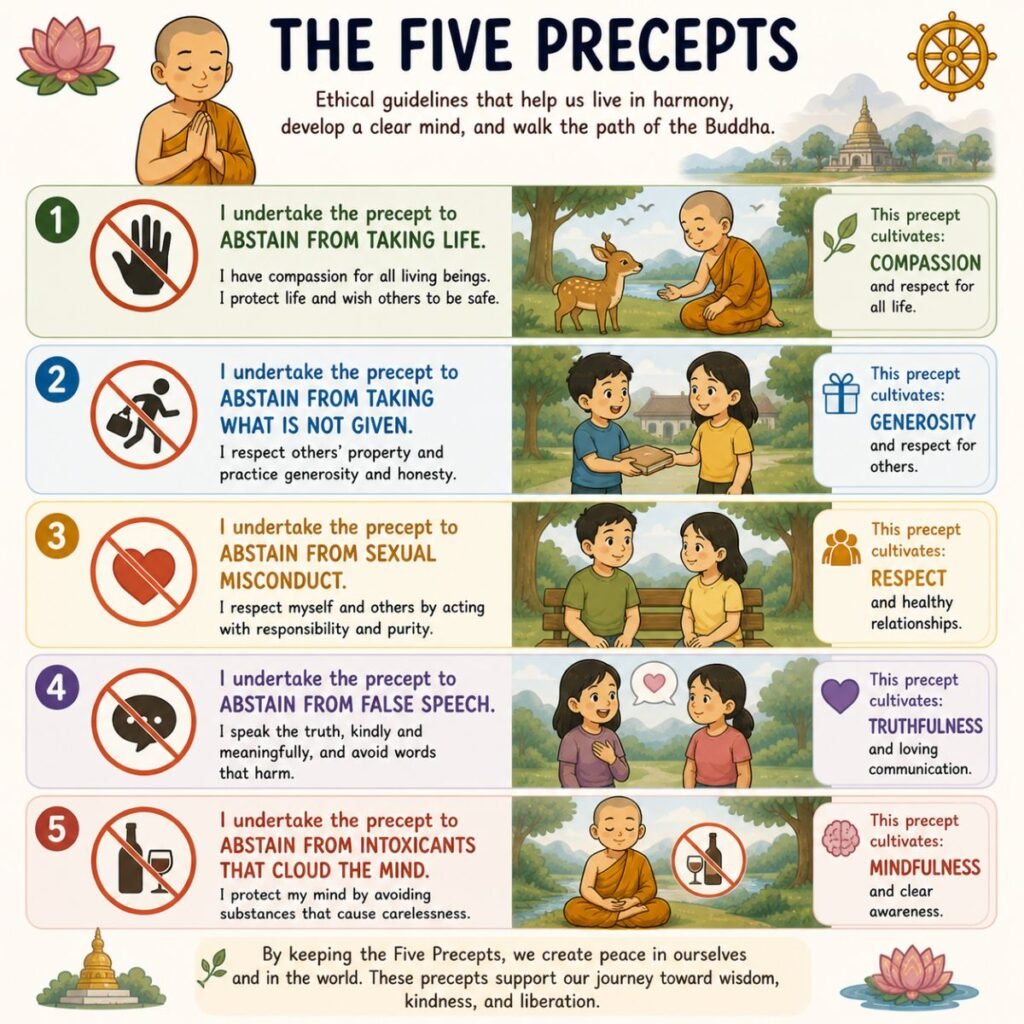
51. The Five Precepts are a set of legalistic rules designed to restrict personal freedom.
- The Misconception: Newcomers often look at the Five Precepts (refraining from killing, stealing, sexual misconduct, lying, and intoxication) as a set of restrictive prohibitions that limit spontaneous joy and personal liberty.
- Origin & Appeal: This views ethical guidelines through an authoritarian framework where rules are imposed by an external judge to restrict individual desire.
- Doctrinal Clarification: The precepts are explicitly described as gifts of absolute safety to the world. In the Abhisanda Sutta (AN 8.39), the Buddha explains that by refraining from killing, stealing, or harming others, a practitioner grants freedom from fear, animosity, and oppression to countless sentient beings, and inherently reaps a share of that universal safety themselves. They are training steps voluntarily undertaken to protect the mind from remorse, cultivate mindfulness, and establish the essential psychological baseline required for deep meditation.
52. Equanimity is identical to psychological dissociation or indifference.
- The Misconception: Critics frequently confuse equanimity (upekkhā) with a state of cold emotional numbness, assuming that a practicing Buddhist must look at global crises, systemic injustice, or personal tragedy with total, unfeeling indifference.
- Origin & Appeal: This stems from a superficial reading of non-reactivity, confusing a deep state of mental stability with the defensive psychological mechanism of emotional dissociation or apathy.
- Doctrinal Clarification: Equanimity is the absolute pinnacle of emotional development, working in inseparable tandem with loving-kindness and compassion. While compassion is the heart’s immediate response to suffering, equanimity provides the vast, steady container of wisdom that prevents compassion from collapsing into personal despair or burning out. It allows a practitioner to look at suffering clearly without being blinded by rage or overwhelmed by panic, providing the mental steadiness needed to act with maximum efficacy.
53. Spiritual progress automatically erases all conventional social responsibilities.
- The Misconception: Some practitioners believe that as they deepen their meditation practice and gain insight into emptiness, they can legitimately abandon their conventional duties as parents, citizens, or employees, viewing these roles as low-level worldly illusions.
- Origin & Appeal: This represents a classic form of spiritual bypassing, where abstract philosophical concepts are used to escape the messy, demanding realities of daily interpersonal relationships.
- Doctrinal Clarification: The Buddha consistently taught that spiritual maturity is demonstrated precisely by how effectively and righteously one fulfills their conventional responsibilities. In the Mahāmaṅgala Sutta (Sn 2.4), supporting one’s parents, cherishing one’s spouse, and engaging in peaceful, responsible occupations are explicitly listed as the supreme blessings of life. True insight into emptiness reveals our deep interdependence with all beings, which heightens, rather than obliterates, our commitment to fulfilling our daily social duties with care.
54. The practice of generating merit is only for uneducated laypeople.
- The Misconception: Highly analytical Western practitioners often dismiss the traditional practice of creating merit (puñña) through generosity, ritual service, and community support as a low-level, superstitious distraction meant for uneducated laypeople who cannot handle meditation.
- Origin & Appeal: The intellectual ego prefers to jump directly to abstract, high-level philosophies, viewing physical acts of service and humble generosity as beneath its capacity.
- Doctrinal Clarification: The Buddha emphasized that merit is another name for mental cultivation and goodness, describing it as the essential engine that drives all spiritual breakthrough. In the Puññakiriyavatthu Sutta (AN 8.36), the cultivation of merit through giving and ethical discipline is shown to provide the vital psychological stability, joy, and freedom from remorse that are absolute prerequisites for entering deep states of concentration. Attempting to practice insight meditation without a solid foundation of merit is like trying to build a massive stone skyscraper on top of wet sand.
55. Radical acceptance means refusing to resist systemic injustice.
- The Misconception: Skeptics argue that because Buddhism emphasizes accepting the current moment as it is, the philosophy functions as a tool of political appeasement that prevents people from actively resisting oppressive governance or corporate greed.
- Origin & Appeal: Oppressive structures throughout history have occasionally attempted to weaponize distorted versions of spiritual acceptance to encourage passive compliance among subject populations.
- Doctrinal Clarification: Buddhist acceptance is not a moral validation of injustice; it is a clear-sighted acknowledgement of factual reality as it exists in the immediate present. You cannot transform a situation if you are busy denying its presence or reacting with blind panic. Acceptance means seeing the current injustice clearly, diagnosing its specific causes and conditions without delusion, and then using that accurate information to organize effective, strategic resistance born of wisdom and compassion, rather than blind, destructive hatred.
Section V: Meditation, Mindfulness, and Mental Cultivation
56. Secular mindfulness is the complete and authentic equivalent of canonical Buddhist meditation.
- The Misconception: The widespread clinical and corporate popularity of secular mindfulness programs has led many to believe that practicing simple stress-reduction exercises is the exact equivalent of the full path of Buddhist mental cultivation.
- Origin & Appeal: Extracting mindfulness from its traditional religious and ethical frameworks makes it highly marketable, comfortable, and applicable to modern corporate optimization.
- Doctrinal Clarification: Secular mindfulness represents a useful but highly incomplete extraction of a single faculty from an integrated, eightfold path. In the Mahāsatipaṭṭhāna Sutta (DN 22), mindfulness (sati) never operates in isolation. It works in inseparable tandem with Right View (wisdom), Right Intention (renunciation, non-ill will), and Right Livelihood (ethics). Using mindfulness strictly as a “stress hack” to optimize performance while ignoring the ethical precepts and the goal of ending craving is a functional misuse of the tool.
57. Meditation requires a complete suppression of all sensory inputs.
- The Misconception: Newcomers often assume that to meditate successfully, they must retreat into an environment of absolute sensory isolation, believing that hearing a dog bark, smelling food, or feeling a breeze automatically ruins their practice.
- Origin & Appeal: Sensory inputs can initially feel like intense distractions to a scattered mind, leading seekers to assume that the external world is the problem.
- Doctrinal Clarification: The Buddha taught that sensory organs encountering sensory objects is the very laboratory where meditation must take place. In the Satipaṭṭhāna Sutta, the practitioner is instructed to maintain clear mindfulness exactly when hearing a sound, seeing a form, or feeling a physical sensation, noticing how the mind automatically projects craving or aversion onto that raw data. The goal is to break our reactive relationship to sensory inputs, not to run away from them or pretend they do not exist.
58. The Jhanas are dangerous traps that must be avoided completely.
- The Misconception: Some modern insight meditation lineages warn students against practicing deep concentration states (jhānas), claiming they are dangerous, addictive traps that cause people to become stuck in blissful attachments forever.
- Origin & Appeal: Practitioners who experience deep concentration can occasionally develop an attachment to that profound peace, leading some teachers to overcorrect by banning the practice entirely.
- Doctrinal Clarification: The Buddha explicitly included the four jhānas as the definitive canonical definition of Right Concentration (sammā-samādhi) in the Eightfold Path. In texts like the Latukikopama Sutta (MN 66), the Buddha states that the bliss of the jhānas is a wholesome, spiritual pleasure born of renunciation that should be cultivated and fully enjoyed, as it provides the essential, unified mind necessary to penetrate reality. It is not a trap to be feared, but a vital engine for generating insight.
59. Walking meditation is a low-level relaxation exercise to rest between sitting sessions.

- The Misconception: Retreatants often treat walking meditation as a casual break or a low-intensity stretching exercise designed simply to give their legs a rest before returning to the “real” practice on the cushion.
- Origin & Appeal: Sitting still looks far more dramatic and traditionally spiritual, leading people to value it above moving postures.
- Doctrinal Clarification: Walking meditation (caṅkama) is a profoundly intense, high-level insight practice capable of leading to full awakening. The Buddha emphasized that the mindfulness developed during walking meditation is exceptionally resilient, long-lasting, and highly effective for dispelling sleepiness. In the Caṅkama Sutta (AN 5.29), it is shown to develop physical endurance and deep mental concentration, serving as a vital bridge for maintaining uninterrupted awareness throughout all daily movements.
60. Loving-kindness meditation is just a sentimental emotional projection.
- The Misconception: Analytical practitioners sometimes view loving-kindness meditation (mettā-bhāvanā) as a superficial, soft exercise that relies on generating sentimental emotions, rather than a rigorous, transformative cognitive training.
- Origin & Appeal: Western concepts of love are highly bound up with romantic sentimentality and personal attachment, leading people to project those definitions onto mettā.
- Doctrinal Clarification: Mettā is a highly rigorous, disciplined deconstruction of our psychological boundaries. It is defined as the active aspiration for the well-being of all sentient life, entirely free from personal attachment or selfish demands. In the Karaṇīyamettā Sutta (Kp 9), it requires a systematic expansion of focus from loved ones, to neutral people, and finally to enemies, uprooting our automatic habits of tribalism, aversion, and bias. It is a profound restructuring of the cognitive apparatus, not a sentimental daydream.
61. True mindfulness means never making plans for the future.
- The Misconception: People often interpret the instruction to “stay in the present moment” as a literal command to live a completely chaotic, short-sighted existence where planning for future eventualities is seen as a sign of delusion.
- Origin & Appeal: The psychological relief that comes from dropping chronic, neurotic worry about the future makes the absolute rejection of future-oriented thinking look like ultimate spiritual freedom.
- Doctrinal Clarification: The Buddha did not advocate for structural irresponsibility. Mindfulness (sati) literally means “recollection” or “memory.” True presence involves knowing exactly what is appropriate in the current moment. If the current moment requires making a wise budget for the upcoming year or reflecting on a past mistake to avoid repeating it, doing so with clear comprehension and without emotional reactivity is a highly mindful act. The goal is to eliminate compulsive rumination and anxiety, not functional intelligence.
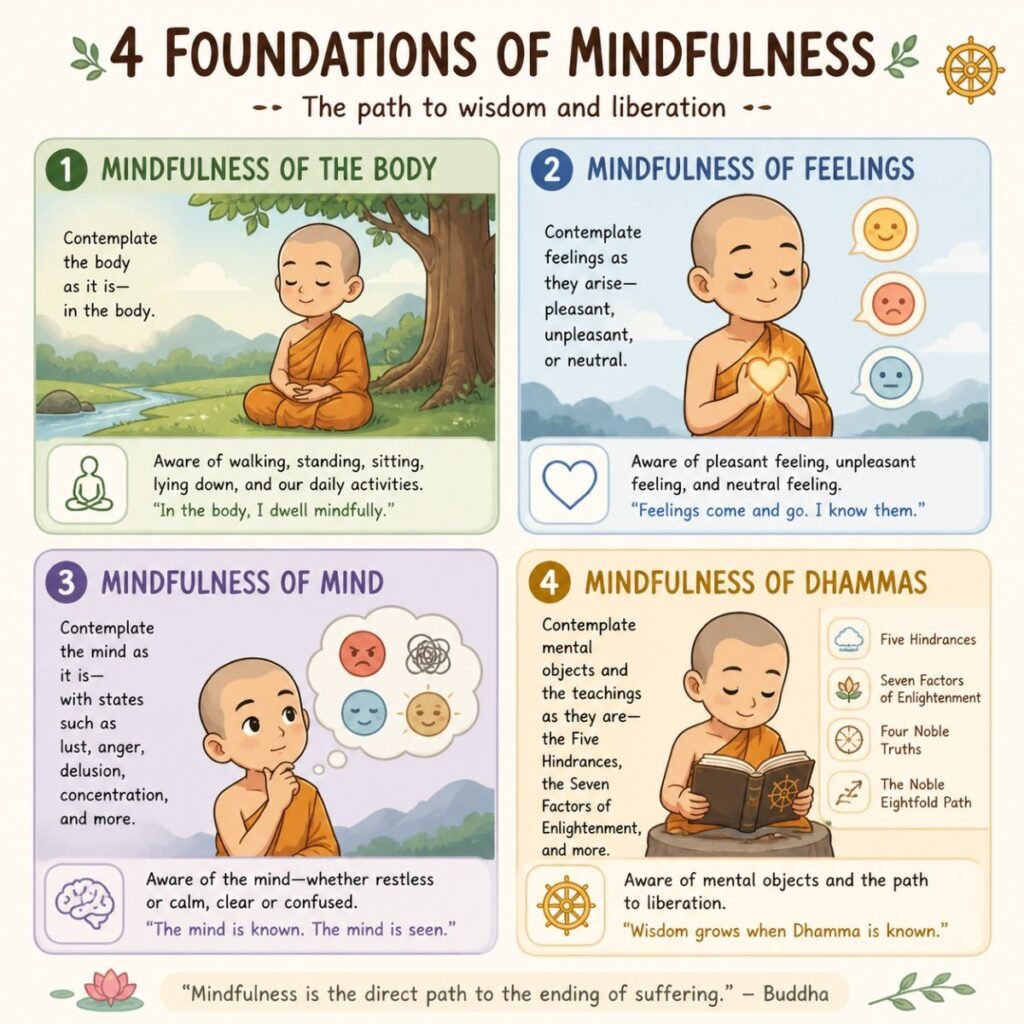
62. Visualization practices in Tantra are just a form of creative daydreaming.
- The Misconception: Skeptics look at Vajrayana deity visualization practices and dismiss them as simple, imaginative fantasies or creative visualization exercises designed to build basic artistic focus.
- Origin & Appeal: This reading strips an advanced, esoteric technology of its psychological framework, mapping it onto familiar Western concepts of self-help visualization or guided imagery.
- Doctrinal Clarification: Tantric visualization is a highly sophisticated cognitive methodology known as the Generation Stage (kyerim). It requires a practitioner to systematically dissolve their ordinary, distorted self-image into emptiness, and then re-emerge from that emptiness manifesting as a specific enlightened archetype (a deity representing infinite compassion or wisdom). This process is designed to dismantle the subconscious habit of ego-grasping, allowing the practitioner to rapidly activate their own innate, pure qualities of mind within a highly disciplined ritual framework.
63. Zen meditation requires a student to solve kōans like intellectual riddles.
- The Misconception: Analytical thinkers approach Zen kōans as if they were clever, philosophical puzzles that can be solved using advanced logic, literary critique, or wordplay.
- Origin & Appeal: The academic ego prefers to treat spiritual mysteries as intellectual challenges to be mastered, avoiding the painful necessity of dropping conceptual control.
- Doctrinal Clarification: A kōan is specifically constructed to be completely immune to rational logic and intellectual analysis. It acts as a Zen barrier that deliberately jams the gears of discursive thinking. The correct response to a kōan is not a clever verbal explanation, but a direct, non-conceptual demonstration of awakened presence presented to the master in a private interview, showing that the practitioner has stepped beyond the dualism of language.
64. Pure Land chanting is a mechanical mantra with zero internal requirements.
- The Misconception: Critics argue that because Pure Land Buddhism emphasizes reciting the name of Amitābha Buddha (Nianfo / Nembutsu), it functions as a mechanical, low-level ritual that requires zero meditative depth or philosophical understanding.
- Origin & Appeal: This misinterpretation arises from observing the practice from the outside and assuming that vocal repetition lacks internal psychological nuance.
- Doctrinal Clarification: Pure Land practice requires a profound, concurrent harmonization of three essential internal pillars: Faith (saddhā), Vow (praṇidhāna), and Practice (caryā). The vocal repetition of the Buddha’s name must be executed with a deeply concentrated, unified mind (ekacitta), where every single repetition becomes a direct meditation on the unconditioned nature of consciousness itself. It is a highly sophisticated method designed to anchor attention, calm the nervous system, and dissolve the illusion of separation between the practitioner and the enlightened state.
65. Meditative insights can substitute for regular ethical discipline.
- The Misconception: Some practitioners fall into the trap of believing that because they have experienced profound insights into emptiness during a retreat, they have transcended the need to follow basic ethical rules in their daily life.
- Origin & Appeal: This serves as a common manifestation of spiritual narcissism, where advanced meditative experiences are weaponized to justify a rebellion against conventional moral accountability.
- Doctrinal Clarification: In the Buddha’s path, insight (paññā) and ethics (sīla) are completely inseparable. In the Soṇadaṇḍa Sutta (DN 4), the Buddha states that wisdom is purified by virtue, and virtue is purified by wisdom; they are like two hands washing one another. Any insight that claims to transcend the need for basic compassion, honesty, and self-restraint is a deluded projection of the ego, not a genuine realization of ultimate truth.
Section VI: Monasticism vs. Lay Practice and Gender
66. Monastic life is an act of selfish social abandonment.
- The Misconception: Secular critics frequently accuse monastics of being intensely selfish individuals who turn their backs on their families, economic duties, and societal problems to sit quietly in comfortable monasteries.
- Origin & Appeal: Modern hyper-capitalist cultures measure a human being’s worth almost exclusively by their material productivity and financial consumption, viewing contemplative isolation as an economic loss.
- Doctrinal Clarification: Monastic renunciation is an act of profound social service. By entering the Saṅgha, a monk or nun preserves, studies, and lives the Dhamma, ensuring that this liberating psychological technology remains accessible to humanity. They provide an uncorrupted ethical anchor for the wider community, offer free spiritual guidance to thousands of laypeople, and manage extensive social welfare systems throughout Asia. They abandon the pursuit of personal wealth to become a public resource for universal well-being.
67. Laypeople can never achieve the ultimate goal of full liberation.
- The Misconception: A superficial reading of early texts leads many to assume that lay followers are structurally blocked from ever achieving full awakening (arahantship), restricted to merely generating good karma for a future monastic life.
- Origin & Appeal: The heavy institutional prioritization of the monastic code in canonical literature can easily obscure the deep realizations achieved by householders throughout history.
- Doctrinal Clarification: The historical record preserves numerous instances of lay followers achieving advanced stages of awakening. While the monastic environment is highly optimized for full-time practice because it eliminates daily domestic and economic distractions, the quality of a person’s realization depends entirely on the cultivation of their mind. A layperson who masters mindfulness, discipline, and insight can achieve profound liberation while remaining engaged in family and professional life.
68. The institutional inequality of nuns proves the Buddha was a product of his time.
- The Misconception: Some modern scholars argue that because the Buddha added the garudhammas (eight heavy rules) that place nuns under the authority of monks, he inherently viewed women as spiritually or institutionally inferior.
- Origin & Appeal: This projects contemporary flat, non-hierarchical organizational models back into ancient patriarchal cultures without understanding the structural protections required for institutional survival.
- Doctrinal Clarification: The Buddha took the radical step in ancient India of establishing an autonomous institutional space for women by creating the bhikkhunī saṅgha. He explicitly affirmed that women possess the exact same capacity for full awakening as men. The garudhammas served as a highly sophisticated diplomatic concession designed to secure the survival of the order within an intensely hostile patriarchal Vedic society. They provided a protective framework that allowed women to pursue full spiritual liberation safely, rather than signaling an inherent spiritual inequality.
69. Traditional Buddhist cultures view the household life as an inherent spiritual failure.
- The Misconception: Seekers assume that Buddhism treats marriage, parenting, and career building as a low-level, unwholesome failure of renunciation that anchors a person to saṃsāra.
- Origin & Appeal: Ascetic language in monastic texts can sound highly condemning of domestic realities when read without understanding the intended audience of those specific discourses.
- Doctrinal Clarification: The Buddha highly honored the lay life, describing a righteous householder as a pillar of cosmic and social virtue. In the Sigālovāda Sutta, he details how a layperson can convert their home into a sacred space by treating family relationships, employment, and community service as a profound field of spiritual practice. The household life is not a failure; it is an alternative, highly demanding laboratory for cultivating patience, generosity, and ethical discipline.
70. Guru-yoga requires a student to tolerate unethical behavior from an authorized teacher.

- The Misconception: Some contemporary Vajrayana practitioners believe that the doctrine of viewing the guru as a literal Buddha means they must silently tolerate financial exploitation, emotional manipulation, or sexual abuse from an authorized lineage holder.
- Origin & Appeal: Authoritarian leaders use this narrative to insulate themselves from public accountability, exploiting their students’ genuine devotion to maintain power.
- Doctrinal Clarification: Traditional Vajrayana texts explicitly state that if a teacher acts in direct violation of the foundational ethical precepts or teaches doctrines that contradict the Buddha’s words, a student must respectfully object. The Kālāma Sutta confirms that no lineage title can substitute for real ethical purity. A student is doctrinally required to maintain a sharp, critical intelligence, protecting their own sanity and the ethical integrity of the lineage by refusing to comply with unwholesome demands.
71. The ordination of women is a modern, non-traditional Western invention.
- The Misconception: Conservative traditionalists sometimes argue that full female ordination (bhikkhunī) is an artificial modern invention propagated by Western feminists, with no legitimate place in traditional Asian lineages.
- Origin & Appeal: Patriarchal structures within historical institutions have occasionally resisted the revival of the nuns’ lineage to maintain control over monastic governance and resources.
- Doctrinal Clarification: The bhikkhunī saṅgha was founded directly by the historical Buddha himself at the request of his stepmother, Mahāpajāpatī Gotamī. It flourished for centuries across India, Sri Lanka, and China. While historical disruptions caused the lineage to break in certain regions, the textual basis and historical precedent for full female ordination are entirely foundational to the tradition. Contemporary revivals are acts of restoration based on canonical records, not modern political inventions.
72. Ascetic renunciation requires a total destruction of all emotional capacity.
- The Misconception: People often look at images of ascetic monks and assume that the goal of renunciation is to completely freeze the heart, turning oneself into a cold, unfeeling robot that experiences zero affection or warmth.
- Origin & Appeal: This stems from a shallow reading of monastic rules regarding celibacy and non-attachment, confusing a deep state of mental restraint with emotional deadness.
- Doctrinal Clarification: Renunciation (nekkhamma) is not about destroying the heart’s emotional capacity; it is about liberating it from the painful constraints of possessive craving. An ascetic uproots the narrow, ego-driven attachments that cause personal suffering, allowing their capacity for loving-kindness and compassion to expand into a boundless, universal state that embraces all sentient life equally. They feel deeply without suffering from the reactive fear of loss.
73. Lay practitioners should attempt to live exactly like monastics while at home.
- The Misconception: Devout laypeople often feel immensely guilty about their domestic lives, trying to force themselves to follow monastic schedules and protocols while managing families and jobs.
- Origin & Appeal: The assumption that the monastic lifestyle is the only authentic style of practice can lead lay followers to devalue their own unique path.
- Doctrinal Clarification: The Buddha formulated distinct training frameworks optimized for different lifestyles. Laypeople are encouraged to focus heavily on the pillars of generosity (dāna), everyday ethics (sīla), and regular mental cultivation, rather than attempting to mechanically superimpose monastic rules onto a household environment. Forcing an unnatural lifestyle mismatch generates intense internal tension and family conflict, which runs counter to mindfulness.
74. Cultural customs in Asian Buddhist countries are entirely identical to the core Dhamma.
- The Misconception: Newcomers traveling to Asian countries often confuse regional cultural customs, folk superstitions, and local traditions with the essential, liberating psychological core of the Buddha’s teachings.
- Origin & Appeal: Lived religions are always deeply interwoven with local folkways, making it difficult for an outside observer to separate the core philosophy from its cultural packaging.
- Doctrinal Clarification: The Buddha’s core teachings on the Four Noble Truths and the Eightfold Path are completely universal, transcending any specific regional culture. Over two millennia, as the Dhamma migrated across Asia, it adapted to local folk traditions, incorporating elements of indigenous ancestor worship, animism, and cultural etiquette. A practitioner must utilize deep analytical discernment to separate these regional cultural accretions from the essential, universally applicable tools of mental transformation.
75. The concept of spiritual friendship is just a casual social dynamic.
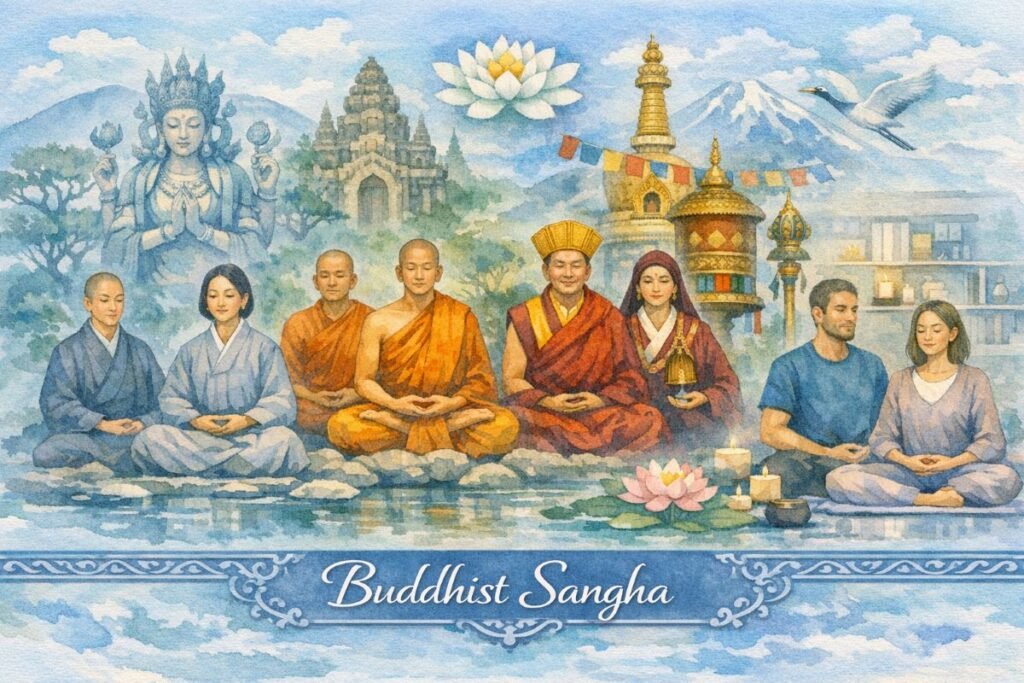
- The Misconception: People assume that “spiritual friendship” simply refers to having a casual chat with other friendly people after a meditation session over tea and biscuits.
- Origin & Appeal: Modern hyper-individualism minimizes the structural importance of community, viewing spiritual practice as an exclusively private journey inside one’s own head.
- Doctrinal Clarification: In the Upadha Sutta (SN 45.2), when Ānanda suggests that spiritual friendship (kalyāṇa-mittatā) represents half of the holy life, the Buddha famously corrects him, stating that admirable friendship represents the entirety of the holy life. A true spiritual friend is not just a casual social companion; they are an essential mirror that models ethical discipline, provides gentle accountability, and challenges our blind spots. The community (Saṅgha) is an active, structural requirement for the path, providing the necessary relational safety container for deconstructing the ego.
Section VII: Sectarian Differences, Lineages, and Textual Traditions
76. Pure Land Buddhism is an anomalous, un-Buddhist distortion of the original path.
- The Misconception: Secular critics often dismiss Pure Land traditions as an unauthentic corruption that smuggled external concepts of theistic grace into Buddhism, completely discarding the Buddha’s prime directive of self-reliance.
- Origin & Appeal: A superficial reading of Pure Land practices can look identical to Western models of petitionary prayer, leading secular rationalists to reject it as a low-level superstition.
- Doctrinal Clarification: Pure Land Buddhism is a deeply sophisticated Mahayana methodology grounded in the core principles of emptiness and mind-only philosophy. The Pure Land is not a physical heaven; it is an unconditioned, highly optimized state of consciousness created by the visualization and karmic vows of Amitābha Buddha. Reciting the name of the Buddha functions as an intense practice of mindfulness (buddhānussati), designed to unify attention, dissolve ego boundaries, and reveal that the practitioner’s innate mind is fundamentally identical to the enlightened archetype.
77. Vajrayana is a form of primitive magic completely separate from Mahayana philosophy.
- The Misconception: Early European commentators classified Tibetan Vajrayana as a corrupt form of primitive sorcery, demon worship, and magical ritualism that had completely abandoned the rational ethics of early Buddhism.
- Origin & Appeal: The exotic iconography, wrathful deities, and complex ritual instruments used in Tibetan temples can look highly bizarre and alarming to those unfamiliar with their precise symbolic meaning.
- Doctrinal Clarification: Vajrayana is an advanced extension of Mahayana philosophy, structurally grounded in the foundational practices of ethics (sīla), concentration (samādhi), and the deep realization of emptiness (śūnyatā). It uses complex ritual arts, geometric mandalas, and somatic energy exercises as highly accelerated skillful means to convert ordinary physical and emotional habits directly into enlightened qualities, maintaining a rigorous grounding in the canonical sutras.
78. Zen Buddhism rejects all traditional ethical rules in favor of spontaneous freedom.
- The Misconception: Counter-culture figures often portray Zen as an entirely wild lifestyle where true masters can drink heavily, lie, or act recklessly because they have transcended all conventional boundaries of morality.
- Origin & Appeal: This misinterpretation appeals to a romantic, anti-authoritarian narcissism that seeks the prestige of spiritual liberation without the demanding discipline of daily self-control.
- Doctrinal Clarification: Zen monastic life is characterized by an exceptionally rigid, meticulous commitment to ethical rules and organizational discipline. The spontaneous freedom celebrated in Zen literature is the direct fruit of decades spent mastering these precise ethical guidelines, which serve to completely wear down the ego’s personal preferences. A genuine Zen breakthrough naturally heightens a person’s compassion and commitment to non-violence; using Zen stories to excuse real-world harm is a severe distortion of the lineage.
79. The Abhidhamma is a dry, speculative philosophy that has no practical relevance to meditation.
- The Misconception: Meditators frequently avoid studying the Abhidhamma (the third basket of the canon), dismissing it as a collection of dry, over-analytical lists and speculative scholasticism that has zero practical relevance to real practice.
- Origin & Appeal: The highly technical vocabulary and dense classification systems used in these texts can feel incredibly intimidating to a newcomer, leading them to look for simpler, technique-focused manuals.
- Doctrinal Clarification: The Abhidhamma is a highly sophisticated, phenomenological map of human experience designed directly to support advanced insight meditation. Far from being speculative, it strips away our habitual, deluded narratives and breaks human consciousness down into its microscopic, real-time components (mental factors, sensory events, and processing states). Studying this system provides a practitioner with the precise analytical tools needed to recognize mental states during meditation without identifying with them, accelerating the realization of not-self.
80. The Theravada tradition lacks universal compassion.
- The Misconception: Polemical histories often claim that Theravada Buddhism is an individualistic path that lacks the universal compassion of Mahayana traditions, focusing exclusively on a small elite of monastics striving for personal liberation.
- Origin & Appeal: This misinterpretation was historically propagated by early polemical texts to elevate newer traditions by characterizing older schools as lacking universal compassion.
- Doctrinal Clarification: Theravada is a vibrant, multi-layered tradition that supports an expansive ecosystem of lay devotion, communal ethics, social welfare, and deep philosophical study. The cultivation of loving-kindness (mettā) is foundational, practiced daily by millions of lay followers. While it maintains the historical arahant ideal as its primary scriptural benchmark for full liberation, it concurrently preserves the bodhisatta path as an acknowledged spiritual option and actively emphasizes community well-being.
81. Tantric yābm-yūm iconography represents literal sexual indulgence.
- The Misconception: Observers looking at Tibetan paintings depicting deities in passionate physical embrace conclude that Tantra is a highly sexualized philosophy designed to integrate hedonistic physical indulgence into the path.
- Origin & Appeal: The commercial exploitation of esoteric imagery has successfully commodified a highly misunderstood aspect of Vajrayana iconography to appeal to contemporary Western sexual consumerism.
- Doctrinal Clarification: Yab-yum iconography is a profound, symbolic visual language that has zero relationship to ordinary physical lust. The male figure represents skillful means (upāya) and infinite compassion, while the female figure represents supreme wisdom (prajñā). Their embrace represents the absolute, non-dual union of these two qualities within an enlightened mind. It is a visual map of internal psychological integration used in deep visualization practices, not a justification for physical hedonism.
82. The Mahayana Sutras are completely historical transcripts of Siddhartha Gautama’s daily speech.
- The Misconception: Traditional fundamentalists sometimes insist that massive Mahayana texts like the Lotus Sutra or the Avatamsaka Sutra are direct, word-for-word historical transcripts recorded by standard scribes during the 5th century BCE in India.
- Origin & Appeal: This stems from a need to establish a literal, historical validation for scriptural authority, mirroring Western models of biblical fundamentalism.
- Doctrinal Clarification: Modern critical scholarship and traditional commentaries clarify that the Mahayana sutras emerged over centuries as visionary, meditative, and philosophical re-elaborations of the core Dhamma. They are textually distinct from the early historical materials preserved in the Pali Nikāyas and Chinese Āgamas. They are considered authentic expressions of the Buddha’s enlightened mind because they unfold the deeper implications of emptiness and compassion, not because they are literal audio recordings of his historical speech.
83. The Pali Canon has remained completely untouched and free from editorial adjustments since day one.
- The Misconception: Conservative practitioners often claim that the Pali Canon was frozen in time at the First Buddhist Council immediately following the Buddha’s death, remaining completely untouched by any historical or editorial adjustments.
- Origin & Appeal: This fundamentalist reading provides an absolute, unshakeable source of scriptural security, insulating the practitioner from the messy realities of textual transmission.
- Doctrinal Clarification: While the Pali Canon represents our oldest, most authentic record of the historical Buddha’s teachings, it was transmitted orally for over four centuries before being committed to writing in Sri Lanka during the 1st century BCE. Textual critics have demonstrated that the canon underwent a long process of editing, cataloging, and minor additions by monastic elders over generations. Recognizing its historical evolution does not diminish its profound spiritual value; it highlights the immense human care involved in preserving the Dhamma.
84. The distinction between conventional and ultimate truth is an absolute dualism.
- The Misconception: Students often treat the two truths framework as an absolute, permanent separation between two distinct worlds, viewing the conventional world as a complete lie and the ultimate world as a separate paradise.
- Origin & Appeal: The human intellect naturally defaults to dualistic binaries, finding it far easier to split reality into absolute opposites than to hold a complex paradox.
- Doctrinal Clarification: The Two Truths (saccadvaya) do not describe two separate realities; they describe two ways of looking at the exact same reality. Conventional truth (sammuti-sacca) describes how reality functions through language, labels, and individual entities (e.g., a person, a table, a choice). Ultimate truth (paramattha-sacca) describes how that exact same experience exists when analyzed deeply: as a fluid, dependently arisen stream of empty phenomena. They are completely interdependent, not a dualistic separation.
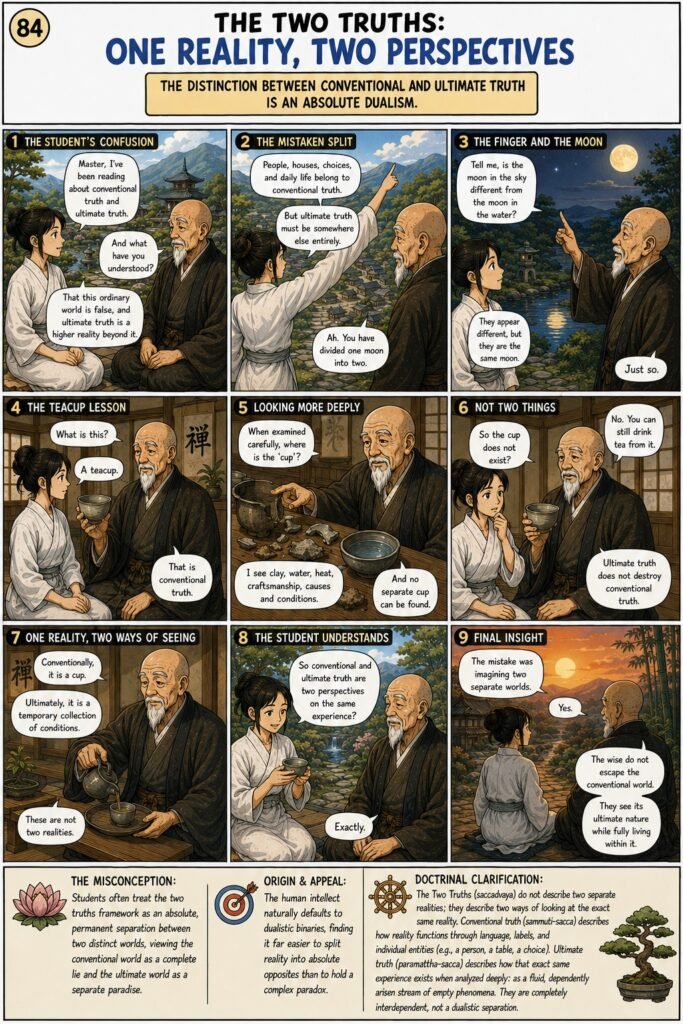
85. The Huayan metaphor of Indra’s Net describes a physical cosmic matrix.
- The Misconception: New Age interpretations frequently use the famous Huayan metaphor of Indra’s Net to argue that Buddhism discovered a physical, holographic cosmic matrix or a literal quantum physics field.
- Origin & Appeal: This projects contemporary science fiction tropes and pop-quantum mechanics onto an ancient Eastern metaphor to give it a trendy, modern scientific veneer.
- Doctrinal Clarification: Indra’s Net is a profound philosophical metaphor designed to illustrate the total, unhindered interpenetration and mutual containment of all phenomena (shishi wu’ai). It demonstrates that every single dependently arisen phenomenon contains the conditions of the entire universe within itself, and is simultaneously contained by all other phenomena. It is a tool for deconstructing our habits of isolating things into fixed categories, operating as a phenomenological insight, not a materialist description of physical geography.
86. Zen lineages operate on an infallible, telepathic connection between master and student.
- The Misconception: People often imagine “Dharma Transmission” in Zen as a magical, telepathic event where an enlightened master instantly shoots their realization into a student’s head like a cosmic laser beam.
- Origin & Appeal: This romantic, magical view avoids the demanding, unglamorous reality of long-term institutional verification and human relationship building.
- Doctrinal Clarification: Dharma transmission is a formal, historical ritual recognition that a student has demonstrated a profound, stable understanding of Zen practice over decades of training. It is an institutional mechanism designed to preserve the continuity of the lineage, authorize a student to teach, and verify their ethical maturity. It occurs through long-term, daily human interaction and formal examination, not through an infallible, telepathic shortcut.
87. The Tibetan practice of recognizing Tulkus is completely infallible.
- The Misconception: Devotees frequently assume that the institutional system of identifying reincarnate lamas (Tulkus) is an absolute, spiritually infallible process that guarantees every recognized child will grow up to be a perfect saint.
- Origin & Appeal: This satisfies a deep psychological need for an infallible spiritual aristocracy that can guarantee uncorrupted lineage continuity across generations.
- Doctrinal Clarification: Traditional Tibetan masters emphasize that the Tulku system is a highly complex, humanly managed institutional method that incorporates spiritual signs, historical tests, and political considerations. While many Tulkus do grow up to be extraordinary masters due to intense monastic training, the recognition itself does not guarantee automatic enlightenment or ethical perfection. A recognized lama must still do the hard work of practicing, studying, and maintaining their vows; evaluating a teacher must always be based on their current behavior, not their historical pedigree.
88. Sāriputta was an un-awakened intellectual inferior to Mahayana figures.
- The Misconception: Readers opening Mahayana texts like the Vimalakīrti Nirdeśa Sūtra see the great disciple Sāriputta being constantly outwitted and corrected by advanced Bodhisattvas, concluding that he was an un-awakened, narrow-minded intellectual.
- Origin & Appeal: This literal reading misses the specific rhetorical and dramatic genre of Mahayana literature, which uses established canonical figures as pedagogical foils to introduce newer, expansive concepts.
- Doctrinal Clarification: In the early historical canons, Sāriputta is celebrated as the absolute pinnacle of wisdom, second only to the Buddha himself, having achieved full, unshakeable arahantship. In Mahayana literature, his traditional character is used skillfully as a literary device to represent the foundational monastic paradigm, allowing the text to create a dramatic, engaging contrast with the universal householder ideals of the Bodhisattva path. It is a pedagogical narrative strategy, not an accurate historical assessment of his realization.
89. The Chinese Āgamas are a late, inauthentic corruption of the Pali Nikāyas.
- The Misconception: Theravada purists sometimes dismiss the Chinese Āgamas as a late, untrustworthy Mahayana corruption of the original teachings, believing that only the Pali Canon preserves authentic early material.
- Origin & Appeal: Linguistic tribalism and sectarian loyalty can drive practitioners to value texts written in their preferred scriptural language while ignoring parallel traditions preserved elsewhere.
- Doctrinal Clarification: The Chinese Āgamas represent translations of early Sanskrit discourses preserved by various parallel early schools (such as the Sarvāstivāda and Dharmaguptaka). Modern textual scholars have demonstrated that the Āgamas are exceptionally ancient, corresponding precisely to the core doctrinal structures found in the Pali Nikāyas. Comparing the Nikāyas and Āgamas allows scholars to identify the absolute earliest common core of historical Buddhism, making them an invaluable, authentic resource for all traditions.
90. Traditional Buddhist scholasticism is identical to Western dogmatic theology.
- The Misconception: Secular critics look at the massive collections of commentaries, sub-commentaries, and dense philosophical debates across Buddhist history and dismiss them as a form of dogmatic, circular theology designed to protect rigid religious dogmas.
- Origin & Appeal: This projects the historical conflicts between Western science and Christian scholasticism onto an Eastern tradition that operates on an entirely different epistemological framework.
- Doctrinal Clarification: Traditional Buddhist scholasticism (śāstra literature) is fundamentally analytical and experiential. Unlike Western dogmatic theology, which prioritizes defending unalterable divine revelations, Buddhist philosophical treatises are designed to provide a logical, systematic analysis of the human mind and perception. They use rigorous debate to challenge our automatic assumptions about reality, inviting the reader to verify the philosophical claims within their own meditative laboratory.
Section VIII: Contemporary Adaptations and Deeper Clarifications
91. The concept of “Bhavacakra” (Wheel of Life) illustrates an inescapable trap.
- The Misconception: Looking at the terrifying figure of Yama holding the Wheel of Life leads people to conclude that Buddhism visualizes existence as a hopeless trap controlled by a demonic entity where escape is virtually impossible.
- Origin & Appeal: The dramatic, gothic visual style of traditional thangkas can initially evoke Western imagery of hell and damnation, obscuring the liberating purpose of the painting.
- Doctrinal Clarification: The Bhavacakra is an intensely practical diagnostic mirror designed directly to show the path to freedom. Yama does not represent a demon punishing sinners; he represents Impermanence and Time, which naturally encompass all conditioned states. In the outer rim of the wheel, the painting details the twelve links of dependent origination, demonstrating exactly how ignorance fuels the entire process. By illustrating the specific causal mechanics of suffering, the wheel reveals that by dismantling ignorance, the entire wheel reverses, leading directly to absolute liberation.
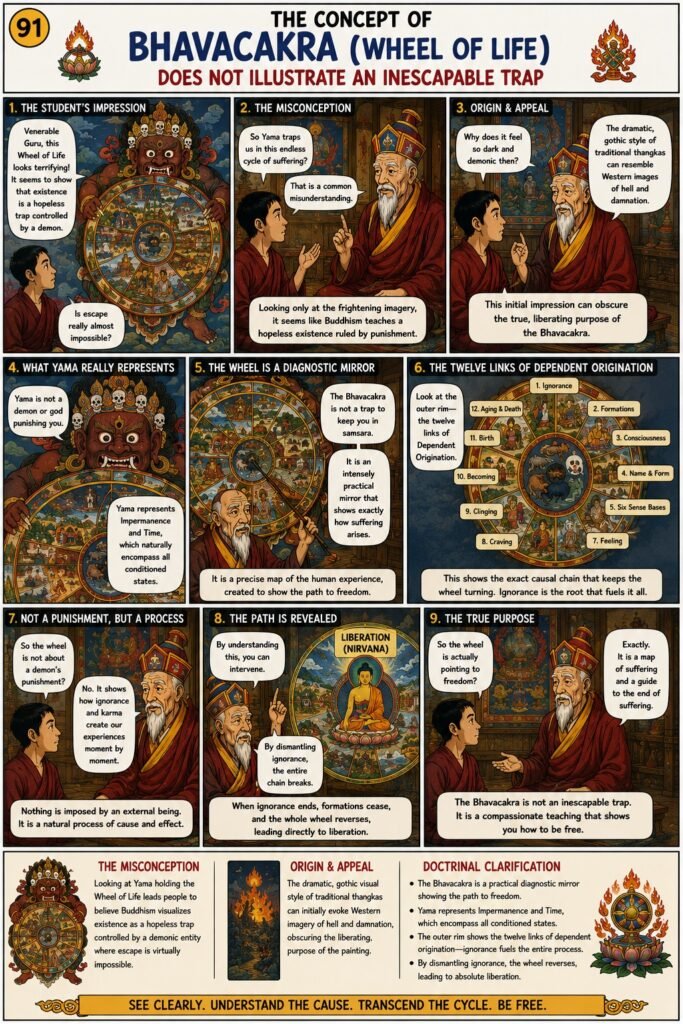
92. Mindfulness is a morally neutral instrument that can be used for any purpose.
- The Misconception: The corporate and military extraction of mindfulness implies that awareness is a morally neutral cognitive tool that can be used to optimize the performance of corporate executives or military snipers.
- Origin & Appeal: This allows secular institutions to adopt a highly effective focus technique without forcing their members to undergo an internal ethical transformation or challenge systemic greed.
- Doctrinal Clarification: In the Buddha’s framework, true mindfulness (sammā-sati) is structurally incapable of operating in a moral vacuum. It is defined as a wholesome mental factor that co-arises with an innate sense of conscience (hiri) and moral dread of causing harm (ottappa). A sniper focusing on a target is practicing deep, one-pointed concentration (samādhi), but their mind is bound up with aversion, delusion, and intent to kill, meaning that mindfulness is functionally absent. True mindfulness automatically clarifies and enforces ethical restraint.
93. True non-attachment means refusing to experience any human grief.
- The Misconception: Practitioners often try to violently suppress their natural human grief when a loved one dies, believing that feeling deep sadness is absolute proof of a failed practice and a toxic attachment.
- Origin & Appeal: This represents a classic form of emotional suppression under a spiritual mask, where non-attachment is used as a shield to protect oneself from the painful realities of human vulnerability.
- Doctrinal Clarification: The Buddha did not teach emotional suppression. When his chief disciple Sāriputta died, the historical records show that Ānanda experienced deep, profound physical and emotional grief. The Buddha used the event to gently remind the community of the universal truth of impermanence, showing that feeling the natural, poignant sadness of loss is a normal human process. Non-attachment means that the mind does not collapse into neurotic panic, anger at reality, or chronic despair; it allows grief to flow freely through the body without converting it into suffering.
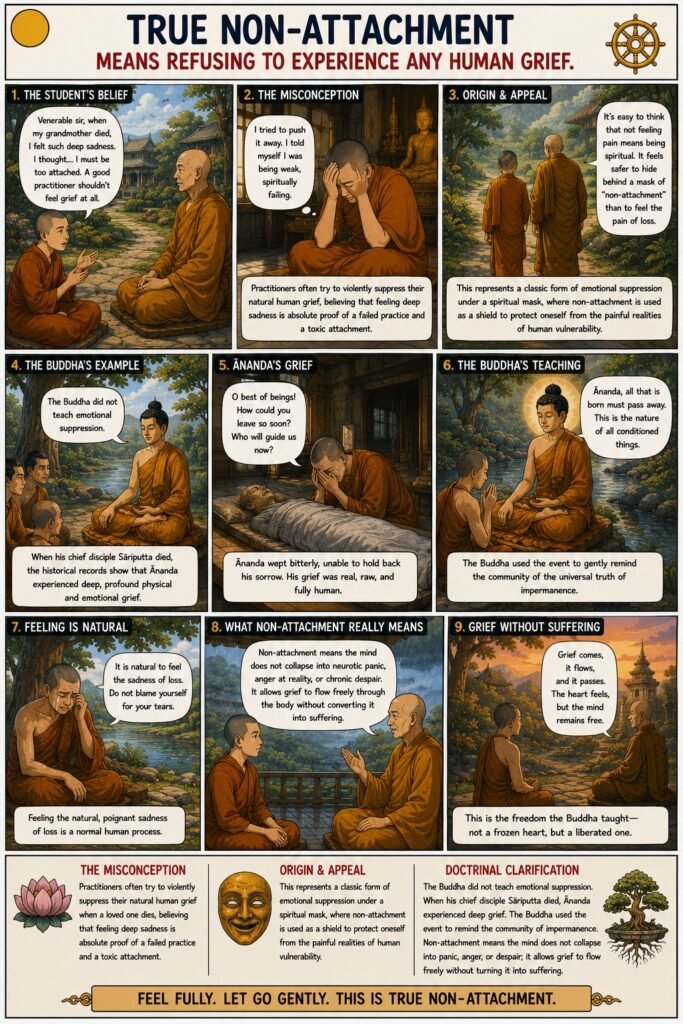
94. The goal of the path is to merge into a blank cosmic void.
- The Misconception: Because texts describe ultimate reality as empty, critics claim that the final goal of Buddhism is to turn yourself into a blank, unfeeling stone, completely wiping out all creative intelligence and awareness.
- Origin & Appeal: This projects a dead, materialist concept of a physical vacuum onto a philosophical term that describes a state of unburdened potential.
- Doctrinal Clarification: The unconditioned state of nirvana is not a dead, dark void; it is characterized by supreme, unclouded awareness, creative intelligence, and boundless compassion. It is empty of defilements, ego-grasping, and suffering, not empty of life. An awakened individual operates with heightened cognitive clarity, deep artistic sensitivity, and fluid responsiveness, experiencing reality with total vitality precisely because they have dropped the heavy weight of the ego.
95. The historical Buddha was a complete vegetarian who condemned all meat consumption.
- The Misconception: Animal rights activists sometimes assert that the Buddha was a strict vegetarian who absolutely forbade his followers from ever swallowing a single piece of meat under any circumstances.
- Origin & Appeal: This stems from a desire to claim the absolute moral authority of the Buddha to support contemporary, highly valid animal welfare campaigns.
- Doctrinal Clarification: The historical record shows that the Buddha explicitly rejected a proposal by his cousin Devadatta to make vegetarianism a mandatory rule for the monastic community. As mendicants, monks had to remain completely humble, accepting whatever food was dropped into their bowls. The Buddha formulated the rule of “triple purity”: a monastic can consume meat provided they did not see, hear, or suspect that the animal was slaughtered specifically for them. While individual traditions emphasize vegetarianism as a compassionate ideal, it is not a historical commandment.
96. The concept of “Anattā” implies that you lack an everyday conventional personality.
- The Misconception: People try to speak without using the words “I” or “me,” attempting to eliminate their normal everyday personality to prove they are practicing the doctrine of not-self.
- Origin & Appeal: This reduces a deep, philosophical insight into a superficial, mechanical performance of speech, often creating awkward social interactions.
- Doctrinal Clarification: Anattā does not destroy your conventional personality, your name, your memories, or your functional legal identity. It simply reveals that this personality is a fluid, dependently arisen collection of habits and processes, rather than a solid, eternal, unchanging soul entity hidden inside your skull. You continue to use the words “I” and “me” as necessary conventional tools for communication, just without the deep illusion of ownership and insecurity that normally distorts human life.
97. Traditional Buddhist temples function exactly like Western commercial businesses.
- The Misconception: Rationalist critics look at major temples charging money for specific blessings, amulets, and ceremonies and dismiss the entire institution as a corrupt, commercial business designed to exploit naive devotees.
- Origin & Appeal: This projects modern capitalist frameworks onto ancient, traditional merit economies, failing to understand how communities support spiritual infrastructure.
- Doctrinal Clarification: While commercial corruption can occur in any human institution, traditional temple economies operate on a structural baseline of mutual, voluntary generosity (dāna). The temple provides an open, non-transactional spiritual sanctuary, free education, and community care to all people, regardless of their financial status. Lay followers offer donations, buy symbolic amulets, and fund rituals to generate merit and express gratitude, sustaining the physical infrastructure through a voluntary, communal merit economy.
98. The practice of mindfulness means never analyzing your past.
- The Misconception: Meditators often refuse to engage in psychological reflection or process childhood trauma, believing that thinking about their past violates the core rule of staying firmly anchored in the present moment.
- Origin & Appeal: Running away from painful historical memories is highly tempting; framing this avoidance as a high-level meditation practice provides a convenient spiritual excuse.
- Doctrinal Clarification: The Buddha frequently reflected on his past lives and encouraged his students to analyze their past actions to learn valuable ethical lessons. Mindfulness (sati) requires maintaining a clear, non-reactive presence while observing a memory arise in the present moment. True insight involves looking at historical patterns, processing trauma, and understanding conditioning with the clear, non-judgmental eyes of wisdom, rather than obsessively running away from the past.
99. The ideal of the Bodhisattva completely replaces the ideal of the Arahant in Mahayana Buddhism.
- The Misconception: Scholars often set up an absolute, hostile wall between traditions, assuming that Mahayana Buddhism completely throws away the concept of the Arahant, viewing it as a toxic, selfish error.
- Origin & Appeal: This simplifies highly complex, nuanced theological developments into a dramatic, black-and-white sectarian conflict to streamline academic categorization.
- Doctrinal Clarification: High-level Mahayana commentaries clarify that arahantship is a profound, necessary stage of realization that uproots the foundational mental defilements. The Lotus Sutra demonstrates that the Buddha guides students to arahantship to give them a vital rest stop from suffering, before subsequently revealing that their path continues onward toward full, universal Buddhahood. It is a structural evolution and expansion of the ideal, not a hostile rejection of foundational realization.
100. Radical non-clinging means you cannot maintain any political or social convictions.
- The Misconception: People assume that to be a non-attached Buddhist, you must remain completely neutral during major political crises, refusing to take a firm stand against fascism, racism, or corporate violence.
- Origin & Appeal: This provides a highly comfortable, quietist escape route for privileged individuals who wish to protect their comfort by avoiding messy political conflicts.
- Doctrinal Clarification: Non-clinging operates at the level of egoic identification and aversion, not at the level of moral clarity. A practitioner can maintain a razor-sharp conviction that an oppressive policy is unwholesome and must be resisted, and can organize intense public campaigns to dismantle it. The critical difference is that their activism is born from a clear, compassionate commitment to justice, rather than a toxic attachment to personal prestige, tribal identity, or blind hatred for the enemy.
101. The practice of prostration is a humliating act of personal submission.
- The Misconception: Modern Westerners often experience an intense psychological resistance to bowing or prostrating before an altar, viewing it as a humiliating, primitive act of submission that destroys personal dignity.
- Origin & Appeal: Hyper-individualistic cultural conditioning values pride and self-assertion above all else, viewing any act of bowing as a toxic loss of personal power.
- Doctrinal Clarification: Prostration is a highly deliberate, therapeutic act of psychological detoxification designed directly to conquer pride (māna), the most stubborn, deeply rooted fetter of the human mind. By physically placing the head on the ground, a practitioner uses their body to perform a profound act of humility, actively softening the rigid boundaries of the ego. It is not an act of submission to an external dictator, but a liberating surrender of our own internal arrogance.
102. The concept of “Buddha-Nature” guarantees automatic awakening without effort.
- The Misconception: Students sometimes use the doctrine of inherent Buddha-Nature (tathāgatagarbha) to justify total spiritual laziness, assuming that since they are already fundamentally awakened, they do not need to follow precepts or meditate.
- Origin & Appeal: This classic antinomian confusion provides a highly sophisticated, philosophical excuse to protect our ordinary unwholesome habits from the demands of daily discipline.
- Doctrinal Clarification: Buddha-Nature is defined as the potential for awakening, specifically the emptiness and natural cognitive clarity of the mind. To convert that potential into factual reality, a practitioner must systematically clear away the temporary adventitious defilements (āgantuka-kleśa) that currently obscure it. Claiming you do not need to practice because you have Buddha-Nature is like refusing to dig for water because you know an underground spring exists; the potential is real, but you will remain thirsty until you do the actual digging.
103. Traditional Buddhist teachers are completely infallible telepaths who know your thoughts.
- The Misconception: Newcomers often behave with extreme anxiety around high-ranking monks or lamas, believing that the teacher can constantly read their minds and possesses absolute, infallible omniscience regarding every aspect of life.
- Origin & Appeal: This projects an idealized, omnipotent parental archetype onto a spiritual teacher, seeking absolute psychological security by surrendering personal critical judgment.
- Doctrinal Clarification: While highly concentrated masters can develop refined levels of intuitive empathy, traditional texts consistently clarify that teachers are human beings who possess specific fields of expertise. Treating a lineage holder as an infallible oracle who can never make an administrative, historical, or personal mistake is a recipe for dependency and community crisis. A teacher should be respected as an expert guide, while the student retains full responsibility for their own rational critical judgment.
104. The preservation of lineage transmission is an empty, bureaucratic hierarchy.
- The Misconception: Secular practitioners often dismiss the traditional requirement for lineage authorization and transmission as an artificial, bureaucratic power structure designed simply to protect institutional monopolies.
- Origin & Appeal: This projects modern anti-institutional skepticism onto an ancient contemplative tradition, preferring a highly privatized model of spiritual authority.
- Doctrinal Clarification: Lineage transmission is a vital quality-control mechanism that has preserved the psychological efficacy of the Dhamma across two thousand years. It ensures that a person teaching meditation has had their realization rigorously examined, verified, and authorized by a living master who underwent the exact same training. It prevents individuals from fabricating their own idiosyncratic, deluded versions of practice and marketing them as the Buddha’s path, protecting the integrity of the tradition.
105. Renouncing sensory indulgence requires a complete hatred of physical pleasure.
- The Misconception: People turn away from the practice of renunciation because they assume it requires them to look at a piece of fruit, a comfortable bed, or a warm shower with intense, emotional hatred and moralistic disgust.
- Origin & Appeal: This projects a Western puritanical framework of sin and physical self-hatred onto a pragmatic path of cognitive training.
- Doctrinal Clarification: The Buddha did not advocate for hatred of physical pleasure; aversion is just as unwholesome and binding as craving. The training of renunciation (nekkhamma) involves seeing the limitations of sensory pleasure clearly, specifically its fleeting nature and its structural inability to deliver lasting security. You appreciate a pleasant sensation as a temporary, conditioned event, without converting it into a demanding addiction or falling into panic when it inevitably changes.
106. The foundational teachings are fundamentally separate from modern daily social activism.
- The Misconception: Activists sometimes claim that traditional Buddhism is too focused on passive interior peace, arguing that to build a just society, one must discard canonical meditation and focus exclusively on secular materialist politics.
- Origin & Appeal: This stems from observing quietist behavior in certain historical institutions, assuming that physical stillness inside a meditation hall equals a lack of commitment to societal change.
- Doctrinal Clarification: The foundational teachings demonstrate that interior mental purification is the absolute, indispensable condition for sustainable, uncorrupted social activism. Any political movement that is organized by minds consumed by greed, hatred, and tribal delusion will inevitably reproduce oppressive structures under a new political flag. By using meditation to uproot internal defilements first, a practitioner can organize social movements that operate with genuine non-violence, boundless compassion, and strategic wisdom, creating systemic change that lasts.
107. The transition between different lifetimes is an instant, unconditioned leap.
- The Misconception: People imagine that the moment a physical body dies, the consciousness instantly jumps into a new womb across the universe with zero intermediate transition or causal process.
- Origin & Appeal: This simplifies a highly complex, dynamic continuum into a simple, instantaneous jump cut, making it easier to conceptualize in a linear narrative.
- Doctrinal Clarification: Different schools detail complex causal frameworks for this transition. The Tibetan tradition details the Bardo (intermediate state), where the subtle mental continuum experiences a visionary, transitional phase conditioned entirely by their past karma. The Theravada school details a seamless, instantaneous relinking consciousness (paṭisandhi-citta), but emphasizes that this process is thoroughly governed by specific conditions, habit-energies, and immediate causal laws. It is a highly fluid, conditioned process, not an uncaused, instantaneous miracle.
108. The Buddha’s last words invite a morose surrender to an empty abyss.
- The Misconception: The final words of the historical Buddha preserved in the Mahāparinibbāna Sutta (“All conditioned things are of a nature to decay, strive on with diligence”) are frequently cited by critics as a bleak, nihilistic finale that encourages a morose surrender to an empty abyss.
- Origin & Appeal: Closing an epic spiritual biography with an unvarnished reminder of death and decay can shock those accustomed to grand, triumphalist religious narratives that promise immediate personal immortality.
- Doctrinal Clarification: The final statement of the Buddha is the ultimate call to radical personal responsibility. By reminding his disciples that all conditioned formations (saṅkhāras) are structurally subject to dissolution, he was actively warning them against the dangers of complacency, procrastination, and blind reliance on an external guru. The command to strive on with heedfulness (appamāda) is an urgent, ringing alarm designed to inspire practitioners to use their fleeting, highly precious human life to realize the unconditioned, timeless freedom of awakening here and now. It is the definitive affirmation of human potential operating through rigorous, disciplined effort.
The Path of Discernment: Ultimately, exploring these 108 common misunderstandings reveals that Buddhism is neither a pessimistic flight from reality nor a dogmatic system of blind belief. It operates as an intensely practical, clear-sighted, and compassionate science of the human mind, inviting every individual to test its principles within the laboratory of their own lived experience.