Key Takeaways
- Spontaneous presence, what modern discourse often calls “just being present,” is the practice of open, non-judgmental awareness of the present moment. It is a foundational quality, but on its own can lack direction.
- A structured path, such as the Noble Eightfold Path, provides a clear framework of ethical guidelines, mental training, and wisdom practices. It gives depth and direction to spiritual life, but can become rigid if not informed by flexible awareness.
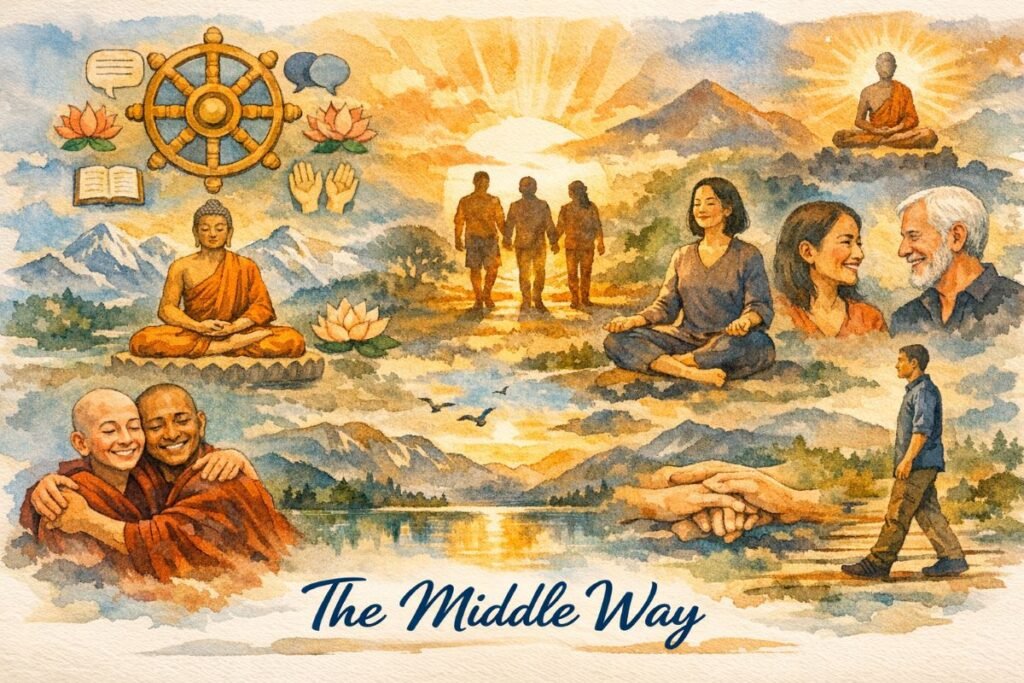
- The Buddha’s Middle Way (Majjhima Patipada) is the timeless principle of avoiding extremes. In practice, this means balancing the fluidity of presence with the discipline of a structured path.
- These two approaches are not in opposition. Mindfulness (Sati), concentration (Samadhi), and insight (Paññā) form an interdependent trio that naturally integrates spontaneous awareness with intentional effort.
- Understanding the Four Noble Truths provides the “why” behind the practice, while the Noble Eightfold Path provides the “how.” Presence without this context can be pleasant but may not lead to lasting liberation from suffering (Dukkha).
- A balanced approach is sustainable. It prevents the burnout that can come from striving too rigidly and the stagnation that can come from a passive, unstructured approach.
- This article primarily uses Pali terms, the language of the earliest recorded Buddhist canon, with Sanskrit equivalents provided in parentheses where helpful. The English translations will be used consistently for ease of reading.
Introduction
In the modern world, the invitation to “just be present” is everywhere. It appears on magazine covers, in guided meditation apps, and in wellness advice. It promises a respite from the relentless pace of life, a way to step off the hamster wheel of rumination and worry. This call to presence is a beautiful and essential teaching, offering a taste of the peace that comes from simply resting in the here and now.
At the same time, Buddhism offers a vast and detailed structured path. This path, articulated most clearly in the Buddha’s first sermon, the Dhammacakkappavattana Sutta (SN 56.11) (Setting in Motion the Wheel of the Dhamma), provides a comprehensive map for human development. It includes ethical precepts, detailed meditation instructions, and profound philosophical insights. For a newcomer, this structure can seem complex, even overwhelming. For a seasoned practitioner, it provides an indispensable framework for navigating the depths of the mind.
This article explores the dynamic relationship between these two approaches. Are they in conflict? Is one more advanced than the other? How can a modern person integrate the simplicity of “just being” with the complexity of a complete spiritual path? The answer lies in the Buddha’s own foundational teaching: the Middle Way. We will see that spontaneous presence and a structured path are not opposites, but two wings of a single bird, both necessary for a balanced and fulfilling flight towards freedom from suffering.
1. Understanding “Just Be Present”: The Quality of Open Awareness
1.1 Defining Presence in a Modern Context
To just be present is to arrive fully in the current moment. It is the experience of dropping the stories about the past and the worries about the future to simply witness what is. This might be the sensation of your breath, the sounds of traffic outside the window, or the feeling of your feet on the floor. It involves an attitude of allowing, letting experiences arise and pass away without clinging to the pleasant ones or pushing away the unpleasant ones.
In popular culture, this is often equated with mindfulness. It is presented as a tool for stress reduction, increased focus, and emotional regulation. While these are valuable benefits, this secular understanding often stops there.
1.2 Mindfulness (Sati) in the Early Buddhist Teachings
In the Buddhist context, this quality of presence is much deeper. The Pali word for mindfulness is Sati (Sanskrit: Smriti). While it indeed means awareness and attention, its root meaning is “to remember” or “to recollect.” But what is it that we remember? We remember to pay attention. We remember the instructions of the teacher. We remember our intention to cultivate wholesomeness and abandon unwholesomeness. As the scholar and monk Bhikkhu Analayo notes in his study of the Satipaṭṭhāna Sutta (MN 10) (The Discourse on the Establishing of Mindfulness), Sati brings the objects of experience into focus, making them clear and present.
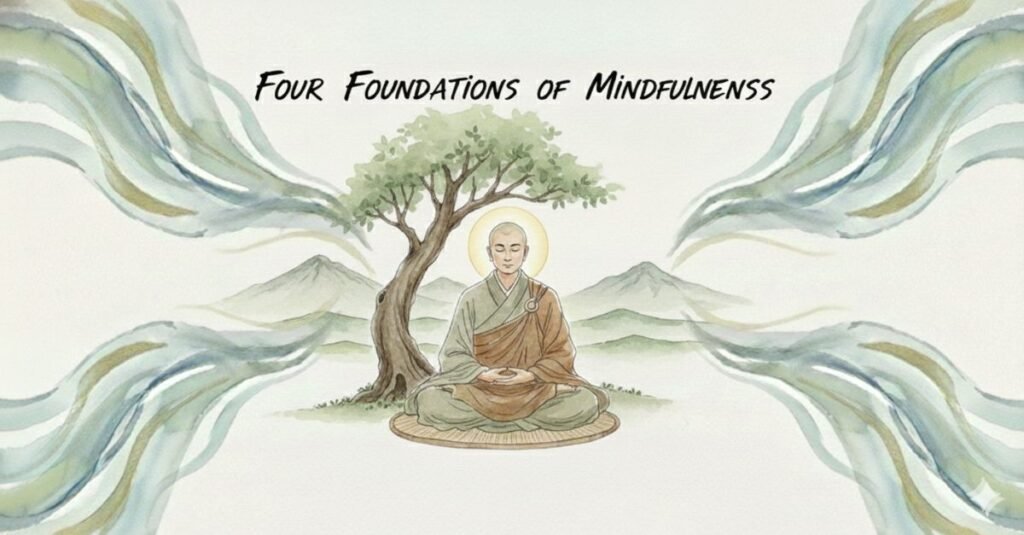
The Buddha taught that mindfulness is not just a passive observation. It is an active quality of mind that brings a clear, penetrating, and balanced attention to four main areas, known as the Four Foundations of Mindfulness (Satipaṭṭhāna) :
- Mindfulness of the Body (Kāyānupassanā): This includes awareness of the breath (ānāpānasati), postures (walking, standing, sitting, lying down), clear comprehension of daily activities, and contemplation of the body’s material nature.
- Mindfulness of Feelings (Vedanānupassanā): This refers to the direct experience of feelings as pleasant, unpleasant, or neutral. It is not about emotions, but the raw “feeling tone” that arises with every experience.
- Mindfulness of the Mind (Cittānupassanā): This is observing the quality of the mind itself, whether it is with or without lust, with or without anger, with or without delusion, whether it is contracted or distracted, developed or undeveloped.
- Mindfulness of Dhammas (Dhammānupassanā): This is the most comprehensive foundation, involving the contemplation of key teachings that shape our experience. This includes the Five Hindrances, the Five Aggregates of Clinging, and the Seven Factors of Awakening (mindfulness, investigation, energy, joy, tranquility, concentration, equanimity).
When the Buddha promised that this practice is a “direct path” to liberation, he was referring to this complete and thorough cultivation of Sati, not just a casual awareness of the moment. The simple act of “being present” is the seed, but it needs the soil of these teachings to grow into a tree of liberation.
2. Understanding the Structured Path: The Noble Eightfold Path

2.1 The Dhamma as a Map
If “just being present” is the experience of walking through a forest, the structured path is the map. The map does not replace the walk, but it prevents you from getting lost. It shows you the terrain, the potential pitfalls, and the clearest route to the mountain peak. For Buddhists, this map is the Noble Eightfold Path (Ariya Aṭṭhaṅgika Magga) . It is not a series of steps to be mastered one after another, but eight interconnected dimensions of practice to be developed simultaneously. They are often grouped into three essential trainings:
- Wisdom (Paññā / Prajñā): The conceptual and experiential understanding that shapes our direction.
- Right View (Sammā Diṭṭhi): This is the foundation of the entire path. It means understanding the Four Noble Truths and the principle of kamma (intentional action and its results). It is seeing things as they truly are, not as we wish them to be.
- Right Intention (Sammā Saṅkappa): This is the quality of mind that, guided by Right View, is directed towards renunciation (letting go of sense desires), good-will (loving-kindness), and harmlessness (compassion).
- Ethical Conduct (Sīla): The practical foundation of a balanced life. It is living in a way that creates peace rather than conflict, both internally and externally.
- Right Speech (Sammā Vācā): Speaking truthfully, kindly, helpfully, and at the right time. It means abstaining from lying, divisive speech, harsh words, and idle chatter.
- Right Action (Sammā Kammanta): Acting in a way that is ethical and non-harmful. This is classically expressed as abstaining from killing, stealing, and sexual misconduct.
- Right Livelihood (Sammā Ājīva): Earning a living in a way that does not cause harm to others. The Buddha specifically mentioned trading in weapons, living beings, meat, intoxicants, and poisons as wrong livelihood (AN 5.177).
- Mental Discipline (Samādhi): The cultivation of the mind’s power to focus and see clearly.
- Right Effort (Sammā Vāyāma): This is the conscious and balanced application of energy. It has four aspects: preventing unwholesome states from arising, abandoning those that have arisen, cultivating wholesome states that have not yet arisen, and maintaining those that have. Right Effort is the engine of the path. As one modern teacher puts it, it is about finding the balance between “not trying too hard” and “not stopping trying completely,” a playful yet persistent energy.
- Right Mindfulness (Sammā Sati): This is the quality of Sati described above, now placed within the context of the entire path. It is the clear, receptive awareness that notes what is happening without grasping or aversion.
- Right Concentration (Sammā Samādhi): This refers to the deep unification of the mind, traditionally developed through practices like mindfulness of breathing. It is a state of collectedness, often associated with the four jhānas (meditative absorptions), where the mind is fully absorbed in its object, free from distraction.
2.2 The Interdependence of the Path’s Elements
It is crucial to see these eight factors not as a checklist, but as a dynamic system. They support and strengthen one another. For example:
- Right View gives direction to Right Effort. You know what to strive for and what to abandon because you understand the goal and the causes of suffering.
- Right Mindfulness observes how your Right Speech is affecting yourself and others, allowing you to refine it.
- Right Concentration provides the powerful, stable mind needed for Right View to transform from an intellectual concept into a deep, embodied wisdom.
When you follow a structured path, you are not just “being present”; you are actively and intelligently cultivating the causes of freedom.
3. The Middle Way: The Art of Balancing Presence and Structure
3.1 The Buddha’s Own Discovery
The concept of the Middle Way (Majjhima Paṭipadā) is the very cornerstone of the Buddha’s teaching. He discovered it through his own experience. As the prince Siddhartha, he first lived a life of extreme self-indulgence and luxury. After renouncing that, he spent six years practicing extreme asceticism, nearly starving himself to death. He realized that both paths were dead ends. Self-indulgence kept one trapped in the cycle of craving, while self-mortification weakened the mind and body, making clarity impossible.
He then remembered a moment of spontaneous meditative absorption from his childhood and understood that the path to awakening lay in a balanced approach, which he compared to tuning a lute in the Soṇa Sutta (AN 6.55). If the strings are too loose, they make no sound. If they are too tight, they snap. The path is played on a well-tuned instrument. This principle was first articulated in his very first sermon, the Dhammacakkappavattana Sutta (SN 56.11).
3.2 Applying the Middle Way to Our Practice
How does this ancient wisdom apply to the modern tension between “just being present” and following a structured path?
- The Extreme of “Just Being Present” (Passive Presence): When taken as a complete practice in itself, this approach can become a form of spiritual bypassing. It might involve sitting and observing thoughts and feelings without ever addressing the underlying causes of unskillful behavior. It can lack the ethical foundation of Sīla. One might feel very peaceful on the cushion but still speak harshly to a partner or engage in harmful livelihood. Without the structure of the path, presence can become a passive, and ultimately stagnant, state.
- The Extreme of a Rigid Structured Path (Striving and Clinging): On the other hand, a practitioner can become overly fixated on the structure. They might become a “meditation accountant,” counting their minutes on the cushion or their prostrations, driven by ambition rather than wisdom. This approach, devoid of the open, allowing quality of presence, can lead to burnout, rigidity, and even a subtle form of spiritual pride. It becomes another form of clinging, a new identity to protect. The Buddha himself warned against clinging even to the Dhamma itself, using the famous simile of the raft in the Alagaddupama Sutta (MN 22) (the Discourse on the Simile of the Water-Snake). The raft is for crossing over, not for holding onto. The teachings are tools to be used and, ultimately, let go of.
3.3 The Middle Way as an Integrated Practice
The Middle Way is not a compromise between these two; it is a synthesis. It means bringing the spacious, allowing quality of presence to the disciplined, intentional work of the path. It means:
- Practicing Right Effort with a light touch, knowing when to apply more energy and when to relax, like a musician feeling the rhythm.
- Cultivating Right Mindfulness that is both precise and open, observing the breath while also holding awareness of the ethical quality of one’s thoughts.
- Developing Right Concentration not as a forced, trance-like state, but as a natural collectedness that arises from letting go of distractions, guided by a mind that is both steady and gentle.
This principle of balance was later extended and developed philosophically in the Mahāyāna tradition by the great Buddhist philosopher Nāgārjuna (c. 150–250 CE), whose Mādhyamaka (Middle Way) school explores the middle path between the extremes of metaphysical assertion, such as eternalism and nihilism. While this is a profound and valuable philosophical development, it is distinct from the practical, lived Middle Way of the Noble Eightfold Path that is the focus of this article. For our purposes, the Middle Way remains the path of dynamic, aware, and compassionate action, free from attachment to results.
4. Common Misunderstandings and Clarifications
4.1 Misunderstanding Presence as a Goal
One common confusion is to see “just being present” as the ultimate goal of Buddhism. While presence is a vital quality, the goal of the Buddha’s path is not simply to be present, but to be free. Freedom from suffering (Dukkha) comes from uprooting the causes of suffering, craving, aversion, and ignorance. Presence is the tool, the microscope that allows you to see these defilements clearly, but the work of uprooting them requires the full structure of the path, including ethical living and the cultivation of wisdom.
4.2 Misunderstanding the Path as a Chore
Another common misunderstanding is to see the structured path as a set of rigid rules, a kind of spiritual homework. This misses the point entirely. The path, as the Buddha presented it, is a description of how a wise and compassionate being naturally lives. The precepts are not commandments from a divine authority; they are training principles we voluntarily undertake because we see for ourselves that they lead to our own and others’ well-being. Right Speech, for example, is not about being “good” for an external judge; it is a practical guideline for creating harmonious relationships and a peaceful mind.
5. Practical Application: Integrating Presence and Path in Daily Life
The true test of any teaching is its application in the messy, wonderful, and challenging reality of everyday life. How do we dance between the spontaneous and the structured? Let us explore this through three practical examples.
5.1 Example: Sarah and Work Stress
The Situation: Sarah is a project manager facing a critical deadline. Her team is behind schedule, her boss is demanding updates, and she feels a knot of anxiety in her stomach. Her habitual reaction is to push harder, work through lunch, and snap at anyone who interrupts her.
- The Unbalanced “Just Be Present” Response: Sarah remembers she should be mindful. She takes three deep breaths at her desk. She notices the anxiety in her stomach and the tension in her shoulders. She feels a moment of calm, and then returns to her email, reacting just as habitually as before. The presence was a brief pause, but it did not change the underlying pattern of stress and reactivity.
- The Unbalanced “Structured Path” Response: Sarah decides to be a “good Buddhist.” She tries to meditate for an hour after work but is so agitated she cannot focus. She then mentally scolds herself for her lack of concentration and poor meditation session, adding guilt to her stress. The structure becomes another source of self-judgment.
- The Skillful, Middle Way Response:
- Moment of Presence: Sarah feels the anxiety arise. Instead of pushing it away, she pauses for thirty seconds. She places a hand on her stomach, feeling the physical sensation directly, without the story about the deadline. This is Right Mindfulness of the body.
- Applying Right Effort: She acknowledges the feeling. “This is stress. This is dukkha.” She remembers her intention (Right Intention) to act with kindness. She does not try to force the stress to disappear. Instead, she makes a balanced effort to not let it dictate her actions. She chooses not to work through lunch, knowing that a short, mindful walk will actually make her more productive. This is the fourfold Right Effort in action, preventing the unwholesome habit of snapping at people, and cultivating the wholesome state of self-care.
- Taking Wise Action: Back at her desk, she drafts an honest email to her boss, outlining the challenges (a form of Right Speech and Right Livelihood). She is engaged and focused, bringing the collected quality of mind from her brief pause (Right Concentration) to her work.
5.2 Example: Michael and a Family Conflict
The Situation: Michael is at a family dinner. His brother makes a critical comment about Michael’s life choices. Michael feels a familiar flash of anger. His old pattern would be to fire back a sarcastic retort, leading to a tense silence.
- The Unbalanced “Just Be Present” Response: Michael notices the anger. He watches the heat in his face, the racing thoughts. He is fully present with his anger, and then he lets it rip. He was present, but that presence was not guided by wisdom or ethics. It became a passive allowance for reactivity.
- The Unbalanced “Structured Path” Response: Michael remembers the precept of Right Speech. He clenches his jaw and stays completely silent, fuming inside. He thinks, “A good Buddhist would not say anything.” He has followed the letter of the precept but broken its spirit, cultivating resentment instead of goodwill.
- The Skillful, Middle Way Response:
- Noticing with Mindfulness: The moment the comment lands, Michael feels the flare of anger. His mindfulness (Sati) is strong enough to notice it immediately. He notes internally, “anger, anger.” He does not judge the anger; he just acknowledges its presence. This is Mindfulness of Mind (Cittānupassanā) .
- Applying Wisdom (Right View): In that micro-moment, Michael remembers the teaching. He knows that if he speaks now, he will cause harm. He also knows that suppressing the anger will also cause harm. He sees the anger not as “me” or “mine,” but as a conditioned, impermanent mental state (Anattā). This moment of clear seeing is Right View.
- Choosing Skillful Action: He takes a breath. He then says, “You know, you might be right. I have made some unconventional choices. Pass the potatoes, please?” He does not engage. He has used Right Speech not by being silent, but by choosing words that de-escalate rather than inflame. He has protected both himself and his brother. Later, when the anger has subsided, he might find a private moment for a more honest conversation, but in the heat of the moment, the path showed him the way to peace.
5.3 Example: Elena and the “Boring” Meditation
The Situation: Elena has been meditating daily for six months. Recently, her sits have felt dull and uninspired. Her mind wanders constantly. She is bored and starting to doubt the whole practice.
- The Unbalanced “Just Be Present” Response: Elena thinks, “Just be with the boredom.” So she sits, bored, for twenty minutes. She is present with boredom, but she is not learning anything from it. The practice has become a chore.
- The Unbalanced “Structured Path” Response: Elena doubles down. She forces herself to sit for longer periods. She strains to focus, battling her wandering mind. This leads to headaches and a deep aversion to her meditation cushion. Her effort is not “right effort”; it is rigid, striving effort.
- The Skillful, Middle Way Response:
- Investigate with Mindfulness: Instead of just enduring the boredom, Elena brings a quality of gentle, curious investigation to it. “What does boredom actually feel like in the body? Is it a heaviness? A restlessness?” This shift from being bored to investigating boredom is the application of the second factor of awakening, investigation of dhammas (Dhamma-vicaya) .
- Applying Balanced Effort: She recognizes that her effort is out of tune. Like the Buddha’s lute in the Soṇa Sutta (AN 6.55), her effort strings are too tight. She consciously relaxes her focus. She might shift her meditation object from the subtle breath to a broader awareness of the whole body sitting, or even to listening to sounds. This is Right Effort as a tuning process.
- Learning from the Experience: Through this investigation, she might see that boredom is a subtle form of aversion to what is. It is the mind wanting something more exciting. This insight, born from bringing structured investigation to a state of open presence, is far more valuable than a “good” meditation where the mind was calm but unexamined. This is the path leading to freedom, not just a pleasant state.
6. A Summary for Daily Practice: Why, What, How, and When
| Question | The Middle Way Answer |
|---|---|
| Why practice this way? | To cultivate a life of genuine peace and freedom. To move from reactive patterns to wise, compassionate responses. To make the path sustainable and joyful, avoiding the extremes of burnout and laziness. |
| What should I practice? | Practice the integration. Bring the four foundations of mindfulness (body, feelings, mind, dhammas) into your experience of the eightfold path. Practice being fully present with your ethical actions, your effort, and your moments of concentration. |
| How do I practice it? | With a light touch. Like a gardener who tends the soil, plants the seeds, and then trusts the natural process, you provide the conditions for awakening (Sīla, Samādhi) and then rest in open awareness, allowing insight to ripen in its own time. |
| When should I practice? | In every moment. On the cushion during formal meditation, and off the cushion while washing dishes, talking with a friend, or sitting in traffic. Every moment is an opportunity to practice the Middle Way. |
Glossary of Key Terms
| English Term | Pali / Sanskrit | Explanation |
|---|---|---|
| Concentration | Samādhi (Pali & Skt) | The state of a collected, unified mind. It is the stable focus that arises from sustained attention, free from distraction. |
| Ethical Conduct | Sīla (Pali) / Śīla (Skt) | The principle of moral virtue and harmony. It is the foundation of the path, expressed through precepts of non-harming. |
| Middle Way | Majjhima Paṭipadā (Pali) / Madhyamā-pratipad (Skt) | The Buddha’s teaching of avoiding extremes. It is a path of balance between sensual indulgence and self-mortification, and more broadly, a principle of moderation in all things. |
| Mindfulness | Sati (Pali) / Smṛti (Skt) | The quality of remembering to pay attention to the present moment with clarity and ethical purpose. It is a lucid, non-judgmental awareness. |
| Path | Magga (Pali) / Mārga (Skt) | The way of practice leading to liberation. Most famously articulated as the Noble Eightfold Path. |
| Suffering / Unsatisfactoriness | Dukkha (Pali) / Duḥkha (Skt) | A multi-layered term referring to physical and mental pain, the dissatisfaction of change, the stress of clinging, and the fundamental unreliability and insubstantiality of all conditioned things. |
| Wisdom / Insight | Paññā (Pali) / Prajñā (Skt) | The penetrative understanding that sees the true nature of reality, specifically the three marks of existence: impermanence (Anicca), unsatisfactoriness (Dukkha), and not-self (Anattā). |
Additional Resources for Further Exploration
Sutta Study
- Dhammacakkappavattana Sutta (SN 56.11) – The Buddha’s first sermon, introducing the Four Noble Truths and the Noble Eightfold Path.
- Satipaṭṭhāna Sutta (MN 10) – The foundational discourse on the four establishments of mindfulness.
- Ānāpānasati Sutta (MN 118) – The discourse on mindfulness of breathing, a complete path of practice in itself.
- Soṇa Sutta (AN 6.55) – The simile of the lute, teaching the importance of balanced effort in meditation.
- Alagaddupama Sutta (MN 22) – The simile of the water-snake and the raft, warning against grasping even the Dhamma.
- Mahāsatipaṭṭhāna Sutta (DN 22) – A longer version of the foundational mindfulness discourse with expanded detail.
- Anattalakkhaṇa Sutta (SN 22.59) – The discourse on the characteristic of not-self, a key teaching for developing insight.
Recommended Books
- Mindfulness in Plain English by Bhante Henepola Gunaratana
- The Heart of the Buddha’s Teaching by Thich Nhat Hanh
- What the Buddha Taught by Walpola Rahula
- Satipaṭṭhāna: The Direct Path to Realization by Bhikkhu Analayo
Online Articles and Resources
- Access to Insight – A vast library of translated suttas and Theravada teachings.
- SuttaCentral – The most comprehensive resource for Buddhist texts in multiple languages.
- Tricycle: The Buddhist Review – A modern magazine offering accessible dharma articles and teachings.
- Buddhistdoor Global – An online resource for Buddhist news, teachings, and features from all traditions.
Audio and Video Dharma Talks
- Dharma Seed – A large archive of thousands of dharma talks from Insight Meditation teachers.
- Audio Dharma – Talks by Gil Fronsdal and other teachers from the Insight Meditation Center.
- YouTube: Search for talks by prominent teachers such as Thanissaro Bhikkhu, Joseph Goldstein, and Ajahn Brahm for accessible and practical guidance.
Conclusion
The invitation to “just be present” offers a valuable entry point to mindfulness and awareness, encouraging openness and acceptance of the present moment. However, without the guidance of a structured path, this presence can lack direction and depth. Conversely, a rigid, overly structured approach can become mechanical and discouraging.
The Middle Way provides a balanced framework that integrates spontaneous presence with intentional, ethical, and insightful practice. By understanding and applying this balance, practitioners can cultivate a sustainable, compassionate, and wise approach to life and spiritual development. Like a bird needs two wings to fly, the spiritual life needs both the openness of presence and the discipline of the path to soar towards genuine freedom.
This balanced approach honors the richness of Buddhist teachings and supports practical, meaningful transformation in everyday life. It is a path of discovery, of gradually uncovering the peace and wisdom that are available to us when we learn to see clearly and act with kindness.
This article is offered for contemplative study and practical application. May it be of benefit.