Key Takeaways
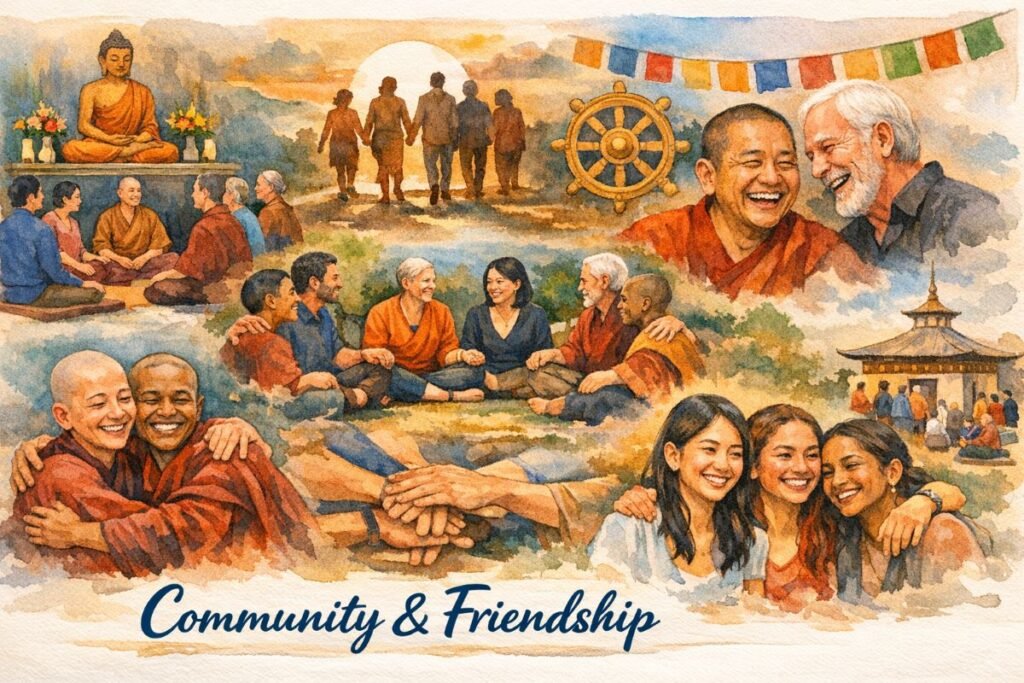
- Sangha (Community) is a Foundation: In Buddhism, the Sangha, the community of practitioners, is one of the Three Jewels (Tiratana), a vital refuge alongside the Buddha (the Awakened One) and the Dharma (his teachings). It is not an optional extra, but a cornerstone of the path. Taking refuge in the Sangha means placing trust in the living community as a guide and support.
- Spiritual Friendship Provides Essential Conditions: The quality of our relationships, especially with spiritual friends or kalyāṇa-mittatā (good friendship), creates the indispensable conditions for developing the Noble Eightfold Path. The Buddha taught that admirable companionship is the whole of the holy life because it leads to the arising and cultivation of every factor of the path.
- A Supportive Ecosystem for Practice: The Sangha provides a unique environment of mutual support, accountability, and encouragement. It acts as fertile soil in which our individual practice can take root and flourish, helping us maintain momentum and navigate challenges. When we stumble, the community offers a steady hand; when we soar, it celebrates with us.
- Community Embodies Core Teachings: The Sangha is a living expression of non-self (anattā) and interdependence. By practicing together, we directly experience how our well-being is connected to the well-being of others, moving beyond a self-centered view. The boundaries between self and other begin to soften and dissolve.
- Practical and Accessible for All: Engaging with Sangha doesn’t require ordination. It can be as simple as finding a local meditation group, forming a small study circle with friends, or consciously cultivating spiritual friendships in daily life. It is about learning the art of being a good friend and building a “we” on the path.
- A Resource for Modern Life: In a world often marked by isolation and division, the principles of Sangha offer a blueprint for building resilient, kind, and purposeful communities. It provides a practical way to counter loneliness and find belonging through shared values. The need for genuine connection has never been greater.
Introduction: Why “We” Matters on a Path Walked Alone
At first glance, Buddhism might seem like a solitary pursuit. We hear stories of the Buddha sitting alone under the Bodhi tree, vowing not to rise until he had penetrated the nature of reality. We read teachings that emphasize personal meditation, individual responsibility, and the inner journey toward liberation. The path does require us to look inward, to sit with our own minds, to examine our own hearts. This is true. But this is only one half of the picture.
From its very beginning, the Buddha’s approach was a communal one. After his awakening beneath the Bodhi tree, he did not remain in solitary bliss. He walked to the Deer Park in Sarnath to find his five former companions. He didn’t keep his insight to himself; he shared it. He offered them what he had discovered, and a community was born. This pattern would repeat itself countless times over the following decades of his teaching life. The Buddha gathered people around him. He encouraged them to gather with each other. He saw that the path, though walked by individuals, could only be walked well together.
This community, the Sangha, is the third and essential jewel in which Buddhists take refuge. It is the living container for the Dharma, the place where teachings are kept alive not just on palm leaves or in digital archives, but in the hearts, words, and interactions of living, breathing human beings. The Sangha is where the Dharma becomes warm, where it touches us directly through the eyes of another practitioner, where we see the teachings embodied in someone else’s patience, kindness, or wisdom.
This article explores the deep meaning of Sangha, from its formal definitions to its most intimate expression: spiritual friendship. We will look at why this community is so vital, how it supports our practice, common misunderstandings about it, and most importantly, how we can cultivate its principles in our own lives to find strength, belonging, and a shared path toward peace. Whether you are new to Buddhism or have been practicing for years, the invitation of Sangha is always open. It asks only that we show up, that we be willing to connect, and that we offer ourselves and others the gift of presence.
1. Understanding the Heart of Community: Sangha and Spiritual Friendship
To truly grasp the importance of community in Buddhism, we need to start with a clear understanding of its two most central concepts: the Sangha itself and the quality of spiritual friendship that brings it to life. These are not abstract ideas. They are living realities that have sustained the Buddhist tradition for over two and a half millennia.
1.1 What is Sangha? The Meaning of Community
The word Sangha comes from Sanskrit and Pali, the ancient languages of the Buddhist scriptures. It simply means “group,” “assembly,” or “community.” But in the Buddhist context, it carries layers of meaning that have unfolded over centuries. Understanding these different layers helps us appreciate the richness of what Sangha offers.
The Conventional Sangha (Samuti Sangha): This refers to the community of ordained monks (bhikkhus) and nuns (bhikkhunis) who have dedicated their lives to full-time practice and to preserving the Buddha’s teachings. They live according to a detailed code of discipline called the Vinaya, which governs everything from ethical conduct to the proper way to eat, sleep, and relate to one another. This monastic order has been a largely continuous lineage for over 2,500 years, acting as a guardian of the Dharma. When you see a monk or nun in their robes, you are seeing a living link to the time of the Buddha himself. In this sense, the Sangha is a formal institution, a vessel that has carried the teachings across oceans and centuries.
The Noble Sangha (Ariya Sangha): This refers to the community of all beings, whether monastic or lay, who have attained a significant degree of awakening, at least the first stage of enlightenment, known as stream-entry (sotāpanna). This is the invisible, spiritual community of noble ones who have touched the deathless. They may live anywhere, in any culture, in any century. You might pass one on the street and never know it. This Sangha is not bound by robes or rituals but by the common attainment of genuine insight into the nature of reality. They are the silent guardians of the deepest teachings.
The Sangha in Contemporary Context: In many modern Buddhist settings, especially in the West, the term Sangha has broadened to include any community of practitioners, laypeople and monastics alike, who come together to study, meditate, and support each other on the path. This contemporary understanding of community reflects the Sangha of your local meditation hall, your weekly study group, the online forum where you find encouragement, or the small gathering of friends who sit together in someone’s living room. This is the Sangha that most of us will encounter directly. It is warm, accessible, and imperfect. And it is no less precious for its imperfection.
Regardless of the definition, the Sangha serves as a living example of the Dharma in action. It is a place where ideals like kindness, patience, generosity, and wisdom are practiced not in isolation, but in the sometimes-messy, sometimes-glorious reality of human relationships. In the Sangha, we get to see what the teachings look like when they walk and talk and breathe.
1.2 Spiritual Friendship: Kalyāṇa-mittatā
The heartbeat of any Sangha is spiritual friendship, known in Pali as kalyāṇa-mittatā (good friendship). This term is often translated as “admirable friendship,” “virtuous friendship,” or “spiritual companionship.” It is far more profound than casual socializing. A kalyāṇa-mitta (spiritual friend) is someone who supports and encourages our highest aspirations, who sees our potential even when we cannot, and who walks beside us without trying to lead or control.
The Buddha placed an extraordinary emphasis on this kind of relationship. In the Upaddha Sutta (SN 45.2), his attendant Ananda remarked, “This is half of the holy life, Lord: admirable friendship, admirable companionship, admirable camaraderie.” The Buddha corrected him, saying, “Don’t say that, Ananda. Don’t say that. Admirable friendship, admirable companionship, admirable camaraderie is actually the whole of the holy life. When a monk has admirable people as friends, companions, and comrades, he can be expected to develop and pursue the noble eightfold path.”
The Buddha’s meaning here is profound. Spiritual friendship is not merely a helpful support; it is the complete framework within which the path unfolds. Why? Because when we are surrounded by wise and kind companions, we naturally absorb their qualities. We learn by association. We are gently nudged away from unskillful habits and toward wholesome ones. We have mirrors that reflect our blind spots. We have encouragement when the path feels steep. Spiritual friendship provides the essential conditions for every factor of the Noble Eightfold Path to arise and mature.
A true spiritual friend:
- Inspires us to be our best: Not through pressure or expectation, but through the simple power of their example. When we see someone else practicing patience, we are inspired to be patient. When we witness another’s generosity, our own hearts open.
- Offers gentle and honest feedback when we stray: This is perhaps the greatest gift. A true friend does not just tell us what we want to hear. With great kindness and skill, they might say, “I’ve noticed you seem a bit lost lately. Is everything okay?” This is not criticism; it is care.
- Shares their own experiences and insights: They do not hold themselves above us. They share their struggles and their breakthroughs, reminding us that we are all on the same path, all learning, all growing.
- Provides encouragement during times of doubt or difficulty: When we want to give up, they are there. Not to fix us, but to sit with us in our confusion and remind us that this too will pass.
- Celebrates our progress without envy: They rejoice in our successes as if they were their own. There is no competition, only mutual uplift.
Such friendships are rare and precious. They are worth seeking out, cultivating, and protecting.
1.3 The Three Jewels: Buddha, Dharma, and Sangha

To understand the weight of Sangha, we must see it as one of the Three Jewels (Tiratana), the three things a Buddhist takes as their ultimate refuge. The other two are the Buddha (the Awakened One, both the historical figure and the potential for awakening within all of us) and the Dharma (his teachings, the truth about how things are). The Ratana Sutta (Sn 2.1) is a beautiful poem traditionally recited as a protective chant, praising the qualities of these three jewels as the highest refuge.
Taking refuge in the Sangha means placing trust in the community as a guide and support. Why is this necessary? Because the Dharma, while profound, can be difficult to understand and apply on our own. Our own minds are skilled at deluding us. We can read a thousand sutras and still miss the point because our interpretations are filtered through our own greed, aversion, and ignorance.
The Sangha acts as a mirror, reflecting our practice back to us. It provides the context where the words of the Buddha become a living, breathing reality. In the Sangha, we see the teachings embodied. We see patience in the person who listens without interrupting. We see generosity in the person who offers their time to set up the meditation hall. We see wisdom in the person who responds to conflict with compassion rather than blame.
Without the Sangha, the Dharma risks becoming just another philosophy, an interesting set of ideas to ponder. With the Sangha, it becomes a path walked by many, together. It becomes warm, alive, and transformative.
2. Buddhist Traditions and Schools Emphasizing Sangha
The concept of community is central to all schools of Buddhism, though its emphasis and interpretation can vary. These variations are not contradictions but rather different facets of a single jewel, reflecting the richness and adaptability of the tradition.
2.1 Early Buddhism and the Formation of Sangha
The very first Sangha was the group of five ascetics who heard the Buddha’s first sermon, the Dhammacakkappavattana Sutta (SN 56.11). In that moment, as the Buddha set the wheel of Dharma in motion, a community was born. It was not yet a formal institution with rules and regulations. It was simply a group of people who had heard the truth and were committed to walking the path together.
As the Buddha’s following grew over the following decades, he established a code of rules, the Vinaya, to govern the monastic community. According to the tradition, these rules arose in response to specific situations, each one designed to maintain harmony, prevent conflict, and create optimal conditions for practice. The Vinaya covers everything from how to resolve disputes to how to eat mindfully. It is a remarkable document, a testament to the Buddha’s practical wisdom.
This early community became the repository of the teachings. In an age without printing, the monks and nuns memorized the Buddha’s discourses, reciting them together to ensure their accuracy. They were, in effect, living libraries, carrying the Dharma in their hearts and passing it on to the next generation. The communal effort of these early practitioners is the reason these teachings have come down to us today.
2.2 Theravada Tradition
In Theravada Buddhism, which is prevalent in Sri Lanka, Thailand, Myanmar, Laos, and Cambodia, the Sangha primarily refers to the monastic community. The monks and nuns are seen as fields of merit, as their dedicated practice and simple lifestyle make them worthy recipients of generosity (dana). Laypeople support the monastics with food, shelter, medicine, and robes. In return, the monastics preserve the teachings and offer guidance.
This reciprocal relationship is the bedrock of Theravada societies. It creates a symbiotic connection between those who have chosen the homeless life and those who live in the world. The laity gain confidence and inspiration through their generosity, which is understood to create the conditions for future well-being. The monastics gain the material support they need to continue their practice. Both benefit.
In this tradition, the ideal of spiritual friendship is often found in the relationship between a layperson and a monastic teacher. The monastic, with their years of training and practice, can offer guidance that cuts through confusion. The layperson, in turn, offers the monastic a connection to the world and an opportunity to practice compassion.
2.3 Mahayana and Vajrayana Traditions
Mahayana Buddhism, dominant in East Asia (China, Japan, Korea, Vietnam), broadens the concept of Sangha significantly. The ideal is no longer just the arhat (one who has attained enlightenment for themselves) but the bodhisattva, a being dedicated to attaining full awakening for the benefit of all beings. This is a radical expansion of the path.
In this context, the Sangha includes all beings who are on the bodhisattva path, working for the awakening of everyone. The community is not just a support for individual practice; it is the very field in which compassion is cultivated. The Heart Sutra, a key Mahayana text, embodies the wisdom of emptiness. Avalokiteshvara, the bodhisattva of compassion, appears in this sutra, reminding us that wisdom and compassion are inseparable. The community becomes a training ground for developing these boundless qualities.
Vajrayana Buddhism (Tibetan Buddhism) places immense emphasis on the guru (teacher) and the spiritual community. The Sangha here includes the lineage of teachers stretching back to the Buddha and the community of practitioners who engage in advanced practices together. The support of the community is considered essential for navigating the complexities of the tantric path, where the practitioner works directly with powerful energies and subtle states of mind.
2.4 Modern and Western Buddhism
In the West, the Sangha has taken on new and evolving forms. With few monasteries and a strong lay culture, meditation centers and Dharma groups have become the primary form of community. These groups are often democratic, inclusive, and focused on making the practice accessible to householders with jobs, families, and other responsibilities.
This evolution is part of a long history of Buddhism adapting to new cultures. Just as it transformed when it moved from India to China, from China to Japan, from Tibet to Mongolia, it is now transforming as it takes root in the West. Throughout these transformations, the joy of community has remained a constant. The forms may change, but the need for connection, support, and shared purpose endures.
3. Why Sangha Is Important in Buddhism
Why is this community considered a jewel? What practical and spiritual benefits does it offer that make it not just helpful but indispensable? The answers to these questions touch the very heart of Buddhist practice.
3.1 Support for Spiritual Growth
The path of practice involves uprooting deeply ingrained habits of mind. We are working with patterns that have been reinforced for years, sometimes for a lifetime. We are learning to let go of greed, aversion, and delusion, the three poisons that have caused us and others so much suffering. This is difficult work, and trying to do it alone can be discouraging.
The Sangha provides a supportive environment where we can be honest about our struggles. When we see others working with similar challenges, anger, restlessness, doubt, loneliness, we feel less alone. Their progress inspires us. Their setbacks remind us to be patient with ourselves. Their presence reassures us that the path is real and that others are walking it too.
The presence of wise and compassionate guides and peers is invaluable. A good teacher can point out what we cannot see. A good friend can listen when we need to speak. The Sangha holds us when we cannot hold ourselves.
3.2 Transmission of the Dharma
The Dharma is not just information; it is a way of being. We learn to be kind not just by reading about kindness, but by being in the presence of kind people. We learn patience by interacting with patient people. We learn wisdom by observing how wise people respond to difficulty.
The Sangha is the vessel through which the living Dharma is transmitted from heart to heart. It provides the interpersonal laboratory where we can practice mindfulness, speech, and ethical conduct with real people. In the Sangha, we get immediate feedback on our practice. If we speak harshly, we see the effect on others. If we act with generosity, we feel the warmth it creates. This is learning that no book can provide.
3.3 Positive Peer Influence
The Buddha recognized the power of association. In the Dighajanu Sutta (AN 8.54), he advises the householder Dighajanu that four things lead to a layperson’s well-being and happiness in this very life: accomplishment in effort, accomplishment in protection, admirable friendship, and balanced living. Admirable friendship here is listed alongside diligent work, protecting one’s possessions, and living within one’s means as a practical support for a good life.
This is simple psychology: we become like those we spend time with. In a wholesome community, the prevailing norms are those of kindness, generosity, and ethical awareness. This creates a gentle but powerful influence to live up to those values. Not pressure in the sense of coercion, but the natural effect of being surrounded by people who embody what we aspire to. We are naturally influenced by those around us, so choosing a community of admirable friends is a wise and practical spiritual strategy.
3.4 Embodiment of Non-Self and Compassion
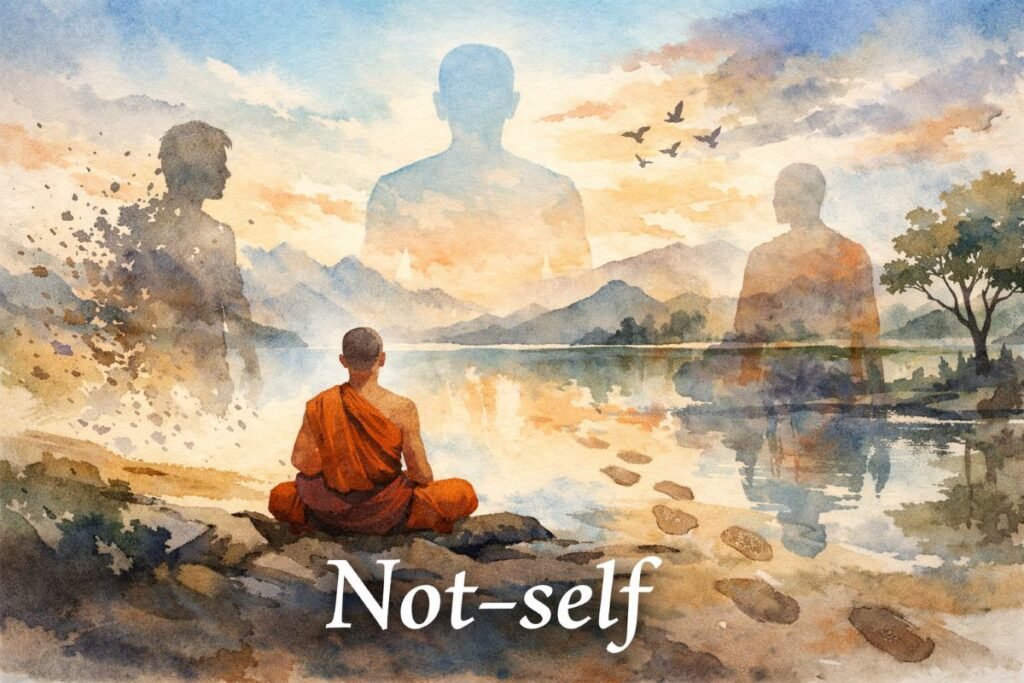
The very existence of a healthy Sangha is a direct challenge to the notion of a solid, separate self. In a community, we see how our actions affect others. We learn to coordinate, to compromise, to consider the needs of the group. We practice giving and receiving. We experience that our well-being is intertwined with the well-being of others.
This daily dance of interdependence makes the abstract concept of anatta (non-self) a tangible reality. We feel it in our bones. The boundaries between self and other begin to soften. We see that the suffering of another is not separate from our own suffering, and their joy is not separate from our joy.
The Kakacupama Sutta (MN 21), the “Simile of the Saw,” teaches the ultimate in patience and loving-kindness. The Buddha says that even if bandits were to saw you limb from limb with a two-handled saw, anyone who let their heart get angry would not be following his teaching. This is an extreme example, but it points to a profound truth: the mind of loving-kindness can remain undisturbed even in the most difficult circumstances. Such a quality can only truly be tested and cultivated in relationship with others. The Sangha is the perfect place to cultivate these boundless qualities, one small interaction at a time.
3.5 Preventing Spiritual Isolation and Burnout
Without a community, it is easy for practice to become dry or self-centered. We can get lost in our own heads, mistaking our interpretations for the truth. We can become discouraged when we hit obstacles, believing we are the only ones who struggle.
A good friend in the Dharma can gently challenge us, offer a different perspective, or simply listen. This connection prevents the spiritual path from becoming a lonely, and sometimes misguided, journey. It brings joy, humor, and a sense of shared purpose back into practice. In the Sangha, we remember that we are not alone.
4. Common Misunderstandings and Challenges
To engage with Sangha skillfully, it is helpful to be aware of some common pitfalls and misunderstandings. These are not reasons to avoid community, but invitations to approach it with wisdom and care.
4.1 Sangha as Only Monastics
A very common misconception is that the Sangha refers exclusively to monks and nuns. While the ordained community is a crucial part of the Sangha, it is not the whole of it. As we have seen, the Noble Sangha includes awakened laypeople, and the contemporary understanding of Sangha includes all sincere practitioners.
Thinking of Sangha only as monastics can make laypeople feel like second-class citizens in their own spiritual tradition. It can lead to the mistaken belief that serious practice is only possible for those who have left the world behind. This overlooks the vital role that lay practitioners play in supporting the Dharma and practicing it in the world. The householder’s life, with all its challenges and responsibilities, is a powerful field for practice.
4.2 Overemphasis on Individual Practice
In some modern cultures, there is a strong bias toward individualism and self-reliance. This can lead to the view that group practice is a distraction or a crutch, and that a “real” practitioner should be able to do it all alone.
While solitude has its place and can be profoundly beneficial, the Buddha’s own words in the Upaddha Sutta (SN 45.2) directly counter this view. Community is not a distraction; it is the very context that makes deep practice possible. The idea that we can do it all alone is itself a manifestation of the self-clinging that the practice is meant to uproot.
4.3 Idealization vs. Reality
It is easy to idealize the Sangha, imagining it as a place of perfect harmony and enlightened beings. But any human community is made up of imperfect people with different backgrounds, personalities, and blind spots. Conflicts can arise. Power dynamics can play out. People can get hurt.
The key is not to expect perfection, but to use the inevitable difficulties as part of the practice. When conflict arises, we have an opportunity to practice patience, forgiveness, and compassionate communication. When we see someone else’s flaws, we are reminded of our own. The Sangha becomes a place to practice making friends on the Buddhist path, not just with others, but with ourselves and our own imperfections.
4.4 Misapplication of Sangha Principles
Sometimes, group dynamics can become unhealthy. A community can develop a rigid group-think, where questioning authority or expressing a different view is discouraged. The teachings can be used to enforce conformity rather than to encourage genuine inquiry. Individuals can become dependent on the group or its leaders in unhelpful ways.
A healthy Sangha safeguards against this by encouraging open dialogue, respecting diverse perspectives, and grounding itself in the primary authority of the Buddha’s teachings rather than any single individual’s interpretation. The Mahaparinibbana Sutta (DN 16) records the Buddha’s final instructions. He told the community that after his passing, they should take the Dharma and Vinaya as their teacher. This is a powerful safeguard against dogmatic dependence on any person.
5. Practical Applications: How to Engage with Sangha in Daily Life
The teachings on Sangha are not just lofty ideals; they are meant to be lived. Here are practical ways to bring the spirit of community into your life, whether you live near a major meditation center or in a place with no visible Buddhist presence.
5.1 Finding or Building a Sangha
- Start Local: Search online for “Buddhist meditation [your city]” or “Dharma study group [your area].” You might find a Theravada monastery, a Zen center, a Tibetan Buddhist group, a secular insight meditation community, or a small group meeting in someone’s home. Visit a few times with an open mind. Notice how the community feels. Do people seem kind and genuine? Is there a sense of warmth and acceptance? Trust your intuition.
- Create Your Own Circle: If there is no formal group nearby, consider starting one. This is more common than you might think. You can invite a few friends who are interested in meditation or Buddhist teachings to meet weekly. You don’t need a teacher or a formal structure. You can read a sutta together, listen to a Dharma talk on loving-kindness, sit in silent meditation together, and then share a cup of tea. A small, sincere group meeting regularly is a powerful Sangha.
- Engage Online Mindfully: Online communities can be a valuable resource, especially for those in remote areas or with limited mobility. They offer connection, support, and access to teachings that might otherwise be unavailable. However, it is important to balance online engagement with real-world practice. The screen can create a sense of distance that makes it harder to be truly vulnerable and present. Use online communities as a supplement to, not a replacement for, embodied connection.
5.2 Cultivating Spiritual Friendship One-on-One
Sangha is built on the foundation of one-to-one relationships. These intimate connections are the threads from which the larger tapestry of community is woven. Here is how to cultivate spiritual friendship with others:
A Story of Two Friends:
Sarah had been feeling restless and doubtful about her meditation practice. She had been sitting daily for years, but lately it felt like she was just going through the motions. The joy had gone out of it. She noticed her friend David, who also meditated, seemed calm and consistent. He wasn’t flashy or dramatic in his practice, but there was a grounded quality to him that she admired.
One day, she took a risk. She invited him for a walk in the park and said, “David, I’ve been struggling with my practice lately. It feels like I’m just going through the motions. Have you ever felt that way?”
David didn’t jump in with advice. He didn’t try to fix her. He walked beside her in silence for a few moments, and then said, “Of course. It comes and goes for me too. Sometimes I just focus on the feeling of my breath for one single breath, and let go of the pressure to be ‘good’ at meditating. Want to sit for ten minutes together now?”
They found a quiet bench and sat together in silence. It wasn’t a long meditation, but something shifted for Sarah. She felt seen. She felt understood. She felt less alone.
This simple act of listening, sharing, and inviting shared practice was a perfect expression of spiritual friendship. David didn’t need to be a master. He just needed to be present.
Key Qualities to Practice in Spiritual Friendship:
- Deep Listening: Listen not to reply, but to understand. Put aside your own agenda, your own stories, your own advice. Truly hear what the other person is saying, and what they might not be saying. Listen with your whole body, with your whole heart.
- Honest and Kind Feedback: A true friend doesn’t just tell us what we want to hear. When appropriate, and with great kindness, they might gently point out a blind spot. “I’ve noticed you seem a bit harder on yourself lately. Is everything okay?” This is not criticism; it is a gift. It is offered with care and usually received with openness.
- Shared Practice: Suggest doing a practice together, even for a short time. This could be sitting meditation, a walking meditation in nature, reading a short sutta and discussing it, or simply sharing a meal in mindful silence. Shared practice deepens connection in ways that conversation alone cannot.
- Celebrating the Good: Don’t just commiserate over struggles. Actively notice and celebrate your friend’s good qualities, efforts, and moments of insight. “I noticed how patient you were with your child today.” “That was a kind thing you said to the cashier.” This reinforcement of the positive is a powerful support on the path.
- Confidentiality and Trust: Create a container of safety. What is shared in confidence stays in confidence. This allows both of you to be vulnerable without fear.
5.3 Participating in Group Practices
Engaging in group activities is the lifeblood of the Sangha. These collective practices create a shared energy that supports and deepens individual practice.
- Group Meditation: The energy of many people sitting together with the same intention is palpable and supportive. When your mind is scattered, the collective stillness can help settle it. When you feel lazy, the presence of others can inspire effort. Group meditation is not about being seen by others; it is about being supported by them.
- Dharma Study: Studying the suttas with a group allows for multiple perspectives and a richer understanding. Questions arise that you might not have thought of alone. Insights are shared that illuminate the text in new ways. The Metta Sutta (Sn 1.8) on loving-kindness, for example, takes on new depth when discussed with others who are also trying to cultivate this quality in their lives.
- Rituals and Ceremonies: Participating in ceremonies, whether full moon observances, chanting, or simple offerings, can connect us to the lineage and to the countless beings who have practiced before us. Ritual need not be superstition; it is a way of expressing gratitude, renewing intention, and marking the sacred in our lives. It connects us to something larger than ourselves.
- Working Together (Karma Yoga): Volunteering to help with cleaning, gardening, cooking, or organizing at a meditation center is a powerful form of practice. It is mindfulness in action. It is a direct way to support the community and to practice generosity without attachment to reward. Washing dishes together after a potluck can be as profound as sitting meditation, if done with presence.
5.4 Supporting Ethical Conduct and Accountability
The Sangha provides a gentle accountability structure. Knowing that we will see our spiritual friends at the next gathering can motivate us to be mindful of our actions and speech. This is not about shame or fear of judgment. It is about the natural human tendency to want to show up as our best selves for those we respect and care about.
If we make a mistake, if we speak harshly, act unkindly, or break a precept, the Sangha can be a safe place to acknowledge it, reflect on it, learn from it, and recommit to ethical living. A wise community holds our missteps with compassion, not condemnation. It understands that falling down is part of learning to walk.
5.5 Practicing Generosity and Service
Generosity (dana) is the first parami (perfection) in the Buddhist list of perfections. It is the foundation of all other qualities. In the context of Sangha, generosity can take many forms:
- Offering time to set up for a meeting or clean up afterward.
- Bringing snacks or food to share.
- Offering financial support to a teacher or center, according to your means.
- Offering a listening ear to a fellow practitioner who is struggling.
- Offering your skills, whether in gardening, accounting, web design, or cooking, to support the community.
Every act of generosity, no matter how small, strengthens the bonds of community and dissolves the sense of a separate self. In giving, we receive. In serving, we are served.
5.6 Balancing Solitude and Community
A wise practitioner honors both solitude and community. They are not opposites but complementary aspects of a balanced life.
Solitary practice allows us to go inward, to sit with our own minds without distraction, to develop the deep concentration that comes from sustained, uninterrupted attention. It is essential for penetrating the depths of our own being.
Community practice brings us back out, challenging us to apply our insights in relationship and reminding us of our interconnectedness. It prevents the inward turn from becoming self-absorption.
Like the two wings of a bird, both are necessary for a balanced and sustained flight on the path. It is not a matter of choosing one over the other, but of finding the rhythm that works for you at different stages of your life. Some periods may call for more solitude; others, for more community. The key is to remain aware of what is needed and to respond with wisdom.
6. Understanding Key Terms
To make these teachings accessible, it helps to be clear about the key Pali and Sanskrit terms. Language carries meaning, and understanding these terms in their original context deepens our appreciation of the teachings.
| English Term | Pali/Sanskrit Term | Explanation |
|---|---|---|
| Community | Sangha (Pali/Sanskrit) | Literally means “group” or “assembly.” In Buddhism, it refers to the community of practitioners. It can mean the monastic order, the community of enlightened beings, or the wider community of all practitioners. It implies a group united by a common spiritual goal and living in harmony. The word carries a sense of warmth and mutual support. |
| Spiritual Friendship | Kalyāṇa-mittatā (Pali) | Translated as “spiritual friendship” or “good friendship.” It comes from kalyāṇa (beautiful, wholesome, auspicious) and mitta (friend). It describes a relationship based on mutual support for ethical and spiritual development, going far beyond casual social friendship. It is friendship with the highest good in mind. |
| Non-Self | Anattā (Pali) / Anātman (Sanskrit) | Often translated as “non-self” or “not-self.” This is a core Buddhist doctrine that there is no permanent, unchanging, independent self or soul residing within a person. What we call “self” is a constantly changing collection of five aggregates (form, feeling, perception, mental formations, consciousness). This is not a negation of personhood but a description of how things actually are. |
| Compassion | Karuṇā (Pali/Sanskrit) | “Compassion.” It is the heartfelt wish that all beings be free from suffering and the causes of suffering. It is not passive pity but active engagement. It is one of the four “divine abodes” (Brahmaviharas) and a key quality to cultivate on the path. When compassion is present, the suffering of another moves us to respond. |
| Loving-Kindness | Mettā (Pali) / Maitrī (Sanskrit) | “Loving-kindness” or “benevolence.” It is the sincere wish for the happiness and well-being of oneself and others, without clinging or expectation. It is the foundation for compassion and the first of the four divine abodes. It is a warm, inclusive, and unconditional friendliness toward all beings. |
| Bodhisattva | Bodhisattva (Sanskrit) / Bodhisatta (Pali) | A being dedicated to the attainment of full awakening for the benefit of all beings. In Mahayana Buddhism, this is the supreme ideal. A bodhisattva compassionately works for the liberation of all, understanding that individual liberation is inseparable from the liberation of all. The word means “enlightenment being.” |
| Dharma | Dharma (Sanskrit) / Dhamma (Pali) | This word has many meanings. It can refer to the cosmic law and order, the teachings of the Buddha, the truth about the way things are, or simply “phenomena.” As one of the Three Jewels, it is the body of teachings that point the way to liberation. It is both the path and the destination. |
| Vinaya | Vinaya (Pali/Sanskrit) | The monastic discipline. It is the detailed code of conduct for monks (bhikkhus) and nuns (bhikkhunis), covering rules for harmonious living, ethical behavior, and the proper way to practice and teach. It is a framework for creating optimal conditions for practice. |
7. Conclusion: The Heart of the Path
The path of the Buddha is a path of awakening, and awakening is not a solitary affair. It happens in and through relationship. The Sangha, the community of practitioners, is the living heart of Buddhism. It provides the support, the challenge, the inspiration, and the loving-kindness that make sustained practice possible. It is in the Sangha that the beautiful ideals of the Dharma, patience, generosity, compassion, and wisdom are tested, refined, and realized in the context of our daily interactions.
Whether it is the profound connection of a single spiritual friendship, the energy of a small study group meeting in someone’s living room, or the ancient lineage of the monastic order stretching back to the time of the Buddha, the Sangha is a refuge. It is a place where we are reminded that we are not alone on this path. It is a place where we learn to see ourselves in others and others in ourselves. It is a place where we can be imperfect and still welcomed, where we can struggle and still be supported, where we can grow at our own pace and still feel part of something larger.
To engage with Sangha is to open our hearts to the strength and beauty of a “we” that is far greater than the sum of its parts. It is to take one of the most practical and powerful steps we can take on the journey toward peace, for ourselves, for those we love, and for all beings.
The invitation is always open. The community is always waiting. You need only show up, with an open heart and a willingness to connect. In doing so, you will discover that the path, though walked alone, is never walked alone. And that is perhaps the most profound teaching of all.
Resources for Further Exploration
Sutta References (Click to Read)
- Upaddha Sutta (SN 45.2) – On Spiritual Friendship
- Ratana Sutta (Sn 2.1) – On the Three Jewels
- Kakacupama Sutta (MN 21) – The Simile of the Saw
- Metta Sutta (Sn 1.8) – On Loving-Kindness
- Mahaparinibbana Sutta (DN 16) – The Buddha’s Final Teachings
- Dhammacakkappavattana Sutta (SN 56.11) – The First Sermon
- Dighajanu Sutta (AN 8.54) – Advice to Householders
- Sigalovada Sutta (DN 31) – Advice to Laypeople
- Mangala Sutta (Sn 2.4) – On Highest Blessings
- Anapanasati Sutta (MN 118) – On Mindfulness of Breathing
Books for Deeper Study
- The Heart of the Buddha’s Teaching by Thich Nhat Hanh
- Living, Dreaming, Dying by Rob Nairn
- The Miracle of Mindfulness by Thich Nhat Hanh
- What the Buddha Taught by Walpola Rahula
- After the Ecstasy, the Laundry by Jack Kornfield
Online Dharma Talks
- Loving-Kindness Meditation with Thich Nhat Hanh
- Qualities of a Good Teacher with Ajahn Mudito
- Talks available on Dharma Seed (dharmaseed.org)
- Talks available on Audio Dharma (audiodharma.org)
Websites for Continued Learning
- Access to Insight (accesstoinsight.org)
- SuttaCentral (suttacentral.net)
- Buddhistdoor Global (buddhistdoor.net)
- Lion’s Roar (lionsroar.com)
- Tricycle: The Buddhist Review (tricycle.org)