Key Takeaways
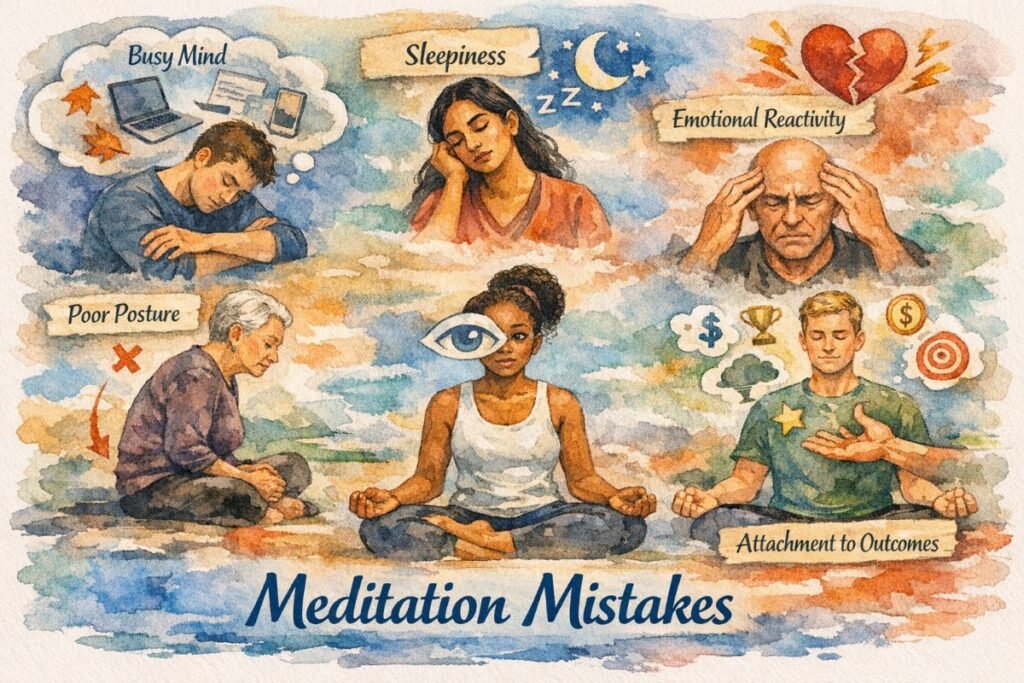
- A busy mind is not a failure: Thoughts arising during meditation are normal. The practice is not about stopping thoughts but about knowing them as they are and returning to the breath.
- Effort needs balance: Too much effort leads to tension and burnout; too little leads to dullness. The middle way is gentle, persistent attention – like tuning a lute string.
- Ethical conduct supports meditation: Without basic kindness and honesty, the mind remains agitated. Meditation and ethical living are not separate.
- The Five Hindrances are the core obstacles: Sensual desire, ill will, sloth-and-torpor, restlessness-and-worry, and doubt – recognising them is half the correction.
- Consistency matters more than duration: Regular short sessions are more valuable than occasional long sessions.
- Clarity is required, not fog: A hazy, sleepy state is not deep concentration. True meditation is alert and bright.
1. Introduction: Why Understanding Mistakes Helps Your Practice
Meditation is often described as simple, but simple does not mean easy. Many people begin meditating with enthusiasm, only to become discouraged when their minds wander, their bodies ache, or they feel they are “doing it wrong.” These difficulties are not signs of failure. In fact, they are the very raw material of the practice.
The Buddha taught meditation as part of the Noble Eightfold Path, specifically under Right Mindfulness [Sammā Sati] and Right Concentration [Sammā Samādhi]. These teachings have been preserved and developed across the major Buddhist traditions: Theravāda (the School of the Elders), Mahāyāna (the Great Vehicle), and Vajrayāna (the Diamond Vehicle). While the methods may vary slightly, the fundamental challenges – and their corrections – are remarkably consistent.
This article is not a complete meditation manual. Rather, it is a map of common obstacles, drawn from the Buddha’s own discourses and from generations of meditation teachers, along with gentle, practical ways to navigate them. No prior knowledge is assumed. Every term is explained simply. The aim is to help you sit down on your cushion (or chair) with less confusion and more kindness toward yourself.
2. The Buddhist Traditions That Inform This Teaching
The instructions in this article draw primarily from the Theravāda tradition, which preserves the earliest recorded discourses of the Buddha in the Pali language. Theravāda emphasizes the systematic development of mindfulness and concentration through practices such as mindfulness of breathing [Ānāpānasati] and the establishment of mindfulness [Satipaṭṭhāna].
However, the core principles of balancing effort, working with distractions, and cultivating a kind attitude toward the mind are common to all Buddhist schools. Mahāyāna traditions, including Zen and Tibetan Buddhism, offer rich teachings on the nature of mind and the importance of compassion in meditation. Zen (Chan) emphasises direct experience and the futility of striving for “special states.” Where appropriate, insights from these traditions are included, always grounded in the foundational teachings of the Buddha.
3. The Purpose of Meditation: A Quick Reminder
Before exploring mistakes, it helps to recall why we meditate. The Buddha did not teach meditation as a relaxation technique, though relaxation can be a pleasant side effect. Nor did he teach it as a way to attain psychic powers or to feel special. In the Maha-satipatthana Sutta (DN 22), he explained that the purpose of establishing mindfulness is “for the purification of beings, for the overcoming of sorrow and lamentation, for the disappearance of pain and grief, for the attainment of the true way, for the realisation of Nibbāna.”
In simple terms: meditation helps us see things as they really are – impermanent, unsatisfactory, and not-self. This seeing gradually loosens the grip of craving and clinging, leading to greater peace and freedom. When we forget this purpose, we are more likely to fall into common mistakes, such as striving for blissful states or judging ourselves harshly when the mind wanders.
4. The Five Hindrances: The Core Framework for Understanding Mistakes
Before we list specific mistakes, it is helpful to know the five broad obstacles the Buddha identified. These are called the Five Hindrances [Nīvaraṇa]. Almost every meditation mistake relates to one or more of them.
| Hindrance | What It Feels Like | Common Mistake |
|---|---|---|
| 1. Sensual desire | Craving for pleasant sights, sounds, tastes, smells, or physical sensations | Seeking special experiences or bliss |
| 2. Ill will | Aversion, anger, irritation, or dislike (including toward yourself) | Self-criticism or resentment toward distractions |
| 3. Sloth and torpor | Dullness, heaviness, sleepiness, foggy mind | Mistaking dullness for calm |
| 4. Restlessness and worry | Agitation, anxiety, mental scanning, regret | Trying to force the mind to be still; over-efforting |
| 5. Doubt | Uncertainty about the practice, the teacher, or your own ability | Giving up too soon; jumping between methods |
In the Samaññaphala Sutta (DN 2), the Buddha describes how a monk abandons these five hindrances, comparing them to common similes: sensual desire to borrowing money, ill will to a disease, sloth and torpor to being imprisoned, restlessness to being enslaved, and doubt to a dangerous desert journey. When these hindrances are absent, joy, happiness, and concentration arise naturally.
As you read through the specific mistakes below, you can notice which hindrance is at play. This awareness itself is a powerful correction.
5. Misconceptions About the Mind
Mistake 1: Believing the goal is to stop all thoughts
Many beginners think that a successful meditation session is one in which no thoughts arise. They strive for “radio silence” and feel frustrated when thoughts appear.
Correction: The immediate goal is not to suppress thoughts but to know them as they are and to abandon unwholesome thinking. In the Vitakkasanthana Sutta (MN 20), the Buddha gives five methods for dealing with distracting thoughts – replacing them, reflecting on their danger, ignoring them, calming the thought formation, or firmly restraining the mind. None of these methods involves believing thoughts should never arise. Deep concentration may naturally quiet thought, but that is a result, not a starting demand.
Example: David sits down to meditate. Within seconds, he remembers an email he forgot to send. His old habit would be to think, “I’m so bad at this. My mind is a mess.” Instead, he now says to himself, “Ah, a thought about email. Noticing.” He does not push the thought away. He simply returns his attention to the breath. That moment of noticing and returning – that is the meditation.
Mistake 2: Fighting with thoughts
Some meditators approach their minds like wrestlers entering a ring. They clench their jaws, furrow their brows, and try to “battle” the wandering mind. This approach creates tension and exhaustion.
Correction: Allow the mind to settle through patient observation, not through force. Think of a muddy pond. If you stir it with a stick, it becomes cloudier. If you simply sit still, the mud gradually settles on its own. The Upakkilesa Sutta (MN 128) describes how the Buddha dealt with obstructions by recognizing them, not by fighting them. (Note: This sutta primarily discusses imperfections in meditative light and visions, but the principle of recognition over reaction applies more broadly.)
Example: Maria notices her mind racing with plans for the weekend. Instead of tensing up, she softens her belly and exhales slowly. She mentally says, “Restless. Letting go.” She does not engage the thoughts. Within a few breaths, the restlessness subsides – not because she fought it, but because she stopped feeding it with attention.
Mistake 3: Thinking a busy mind is a failure
When meditators experience many thoughts, they often conclude that they are “bad at meditating.” This belief can lead to discouragement and eventually to giving up.
Correction: A busy mind is not a barrier to meditation; it is the raw material of meditation. The Buddha taught that we should know a distracted mind as distracted, not as a failure. In the Satipatthana Sutta (MN 10), he instructs: “When the mind is distracted, he knows: ‘The mind is distracted.’” That simple knowing is already mindfulness. This corrects the hindrance of doubt.
Example: Tom sits for ten minutes. His mind is a whirlwind of worries about work, memories of past arguments, and fantasies about a vacation. Instead of judging himself, he silently notes each mental event: “Worrying. Remembering. Planning. Back to breath.” He realises that every time he notices a thought, he is practicing. The busy mind becomes his teacher.
Mistake 4: Believing you “cannot” meditate
Some people think they are uniquely incapable of meditating because their mind wanders more than others, or because they have ADHD, anxiety, or a “type A” personality.
Correction: The ability to notice that your mind has wandered and to gently return your attention – that is the heart of meditation. Everyone who sits down to practice does exactly that, regardless of how many times the mind wanders. In the Anapanasati Sutta (MN 118), the Buddha describes sixteen steps, none of which require a thought-free mind. The first step is simply “breathing in long, he knows: ‘I breathe in long.’”
Example: Linda has severe anxiety and believes her mind is “too broken” to meditate. She tries a five-minute practice. Her mind races, but she notices the racing. She softly says to herself, “This is what anxiety feels like in the body.” She stays present with the sensation. After five minutes, she opens her eyes and thinks, “I did it. I sat with my mind, exactly as it is.” That is success.
Mistake 5: Mistaking a blank or foggy state for deep realisation
Some meditators experience a state of mental dullness – a kind of fuzzy, sleepy, non-conceptual fog – and mistake it for a profound meditative attainment. This is sometimes called “falling into a dark cave.”
Correction: True meditative concentration is clear, alert, and bright. Dullness (sloth and torpor) is an obstacle to be overcome, not a goal to be cherished. The Pasadika Sutta (DN 29) discusses the importance of keeping the mind “luminous” and aware. If you feel foggy, check your posture, open your eyes slightly, or take a few deeper breaths. Luminosity is not a blank absence; it is a knowing presence.
Example: James often feels pleasantly spaced out during meditation. He thinks he is making progress because his mind is quiet. But a teacher asks him, “Are you alert? Could you clearly observe the breath from moment to moment?” James realises he was actually half-asleep. He corrects this by sitting with a straighter back and meditating at a different time of day, when he is less tired.
6. Imbalances in Effort and Energy
Mistake 6: Over-efforting (tension)
Some meditators approach meditation with a willful, self-critical energy. They grip the meditation object tightly, clench their muscles, and try to “force” concentration to happen. This leads to headaches, stiffness, and burnout. This is often a manifestation of restlessness.
Correction: Relax into the effort. Make it persistent but gentle, like holding a baby bird – firmly enough that it does not fly away, but gently enough that you do not crush it. The Buddha famously advised the musician Sona in the Sona Sutta (AN 6.55) to tune his effort like a lute string: not too tight, not too loose. “If the string is too loose, it will not sound; if it is too tight, it will break.”
Example: Peter is determined to reach deep concentration. He sits for an hour, grinding his teeth and chasing every distraction. After a week, he feels exhausted and gives up. A friend suggests he try a softer approach. Peter now meditates for twenty minutes with a relaxed half-smile. When the mind wanders, he gently returns without scolding himself. He finds that his concentration actually improves.
Mistake 7: Under-efforting (laxity)
At the other extreme, some meditators become too relaxed. They slump, daydream, or drift into a pleasant but foggy state. They mistake passivity for acceptance. This is sloth and torpor.
Correction: Recall the urgency of practice. The Buddha often reminded his followers that death is uncertain and that we should practice “as if our hair were on fire.” This does not mean being frantic, but it does mean bringing a sincere interest to each moment. In the Appamada Sutta (SN 3.17), diligence is praised as the path to the deathless.
Example: Elena sits down to meditate but feels lazy. She decides to just “relax” and quickly falls into a daydream. Recognising this, she gently sits up straighter, takes a few intentional deep breaths, and thinks, “This time is precious. I can be here fully.” She does not shame herself; she simply re-engages.
Mistake 8: Forcing concentration
Similar to over-efforting, forcing concentration involves trying to “grip” the breath or the meditation object too tightly. The result is a rigid, uncomfortable mind that cannot settle.
Correction: Maintain a relaxed but alert presence. Imagine looking at a beautiful sunset. You do not need to squeeze your eyes or clench your fists to see it. You simply look, gently and steadily. The Mahavedalla Sutta (MN 43) explains that concentration arises when mindfulness is present, not when it is forced.
Example: Carlos focuses on his breath so intensely that his forehead hurts. He feels like he is wrestling the breath. A teacher advises him to notice the breath as it naturally is – long or short, deep or shallow – without adjusting it. Carlos relaxes his face and shoulders. The breath becomes easier to follow.
Mistake 9: Impatience with progress
Many meditators want results quickly. They read about states of joy [Pīti] or deep absorption [Jhāna] and grow frustrated when these do not arise in their own practice. This is doubt mixed with sensual desire.
Correction: Tune your patience to the middle way. The Buddha taught that spiritual development is gradual, like the ocean deepening slowly. The Kuta Sutta (SN 20.1) reinforces this through the simile of a peaked house: just as the rafters of a roof all lean toward, slope toward, and converge at the roof-peak, a life dedicated to the Eightfold Path naturally inclines the mind toward liberation. Trust the process. Let go of timelines and recognize that every small, consistent effort is a rafter supporting your eventual awakening.
Example: Sofia has been meditating for three months and has never felt the “bliss” she read about online. She feels like a failure. Then she remembers that the purpose of meditation is not bliss but seeing clearly. She notices that she is less reactive, more patient, and more aware of her breath during the day. She recognises these as genuine fruits of practice.
Mistake 10: “Kangaroo meditation” – jumping between techniques
Some meditators constantly switch methods. They try mindfulness of breathing, then loving-kindness, then a mantra, then body scanning. They never stay with one technique long enough to see results. This is doubt in the form of restlessness.
Correction: Commit to one method for a reasonable period – say, several weeks or months. The Buddha taught that mastery comes from sustained practice. In the Canki Sutta (MN 95), he emphasises the importance of preserving and practicing a tradition correctly before evaluating it.
Example: David tries a new app every week, each with a different technique. He is confused and makes little progress. He decides to practice mindfulness of breathing for eight weeks, following the same instructions each day. Gradually, his mind becomes familiar with the method, and he begins to notice subtle changes.
Mistake 11: Meditating for too long, too soon
Enthusiasm can lead beginners to sit for forty minutes or an hour. They become exhausted, sore, and discouraged, and then they stop meditating altogether.
Correction: Start with manageable periods, ten to fifteen minutes. Prioritise daily consistency over session length. In the Pahārāda Sutta (AN 8.19), the Buddha explains that just as the mighty ocean shelves, slopes, and inclines gradually, not dropping off abruptly, this Dhamma and Discipline involves a gradual training, gradual practice, and gradual progress. A short daily session builds a strong habit, allowing your practice to deepen naturally and steadily rather than forcing a breakthrough you aren’t ready for.
Example: Maria is excited and tries to meditate for an hour. By minute thirty, her legs ache and she is bored. The next day, she avoids meditating. A friend suggests ten minutes daily. Maria tries it and finds that ten minutes is easy to fit in. After a month, she naturally extends to fifteen minutes, then twenty.
Mistake 12: Excessive effort when things are going well
Sometimes meditators apply a strong antidote when there is no problem. For example, they might tighten their focus when the mind is already calm, disturbing the calm. This is like poking a still pond.
Correction: When the mind is settled and distractions are absent, you can rest in that natural state. Learn to read your own mind. The Buddha recognised when to apply effort and when to relax. When no defilement is manifest, no remedy is needed.
Example: Tom has a wonderfully quiet session. His breath is clear, and his mind is still. He thinks, “This is good, but I should concentrate harder.” Instantly, tension arises. He then remembers: when nothing is wrong, no correction is needed. He simply enjoys the natural calm.
Mistake 13: Lack of effort when distracted
The opposite mistake: when the mind wanders, some meditators just let it wander, thinking they are being “non-attached.” They fail to apply the remedy of returning to the breath.
Correction: As soon as you recognise a distraction, make the effort to gently return to your meditation object. This is not force; it is the essence of Right Effort. The Padhana Sutta (AN 4.13) describes the four right efforts, including the effort to abandon unwholesome states that have arisen.
Example: Peter notices he has been planning dinner for five minutes. Instead of continuing to plan or feeling bad, he simply says, “Planning,” and returns to the breath. That moment of return is the practice.
7. Posture and Physicality
Mistake 14: Slumping or poor posture
A hunched, collapsed posture leads to drowsiness and dullness. The energy body becomes heavy and foggy, inviting sloth and torpor.
Correction: Sit up straighter, but not rigidly. A simple instruction from the suttas is to “set the body erect” (ujuṃ kāyaṃ paṇidhāya). Imagine a gentle lift at the crown of your head. The spine should have its natural curves. The Kayagata-sati Sutta (MN 119) describes mindfulness of the body in posture. An upright posture brings gentle energy to the practice.
Example: Linda slumps on her couch while meditating. She often feels sleepy. A teacher suggests sitting on a firm cushion with her hips slightly higher than her knees. She tries it and notices that she feels more alert and comfortable.
Mistake 15: Ignoring physical tension
Many meditators carry tension in their neck, shoulders, jaw, or around the eyes without realising it. This tension can become a distraction and even cause pain.
Correction: Periodically check your posture and scan your body for tension. Soften any clenched areas. You can do this at the beginning of your sit or whenever you notice discomfort. The Kayagata-sati Sutta (MN 119) includes instructions for relaxing the body.
Example: David often finishes his meditation with a sore neck. He realises he has been holding his shoulders up by his ears. During his next sit, he takes a few moments to consciously relax his shoulders, jaw, and forehead. The soreness disappears.
Mistake 16: Meditating with closed eyes when sleepy
If you are tired, closing your eyes can invite sleepiness or even cause you to fall asleep.
Correction: Open your eyes slightly, letting in soft light. Or meditate with eyes half-closed, gazing downward at a forty-five-degree angle. The Buddha allowed various postures, including sitting, standing, walking, and lying down. For sleepiness, walking meditation can be excellent.
Example: Tom is exhausted after work. He closes his eyes and immediately feels heavy and drowsy. He opens his eyes halfway and looks at the floor. The light keeps him alert. He also sits up straighter. He finishes a clear, aware session.
Mistake 17: Rigidity in posture
Some people believe there is only one “correct” way to sit – usually full lotus on the floor. They force their bodies into uncomfortable positions, causing pain.
Correction: Find a seated position that is comfortable and allows you to relax without falling asleep. A chair is perfectly fine. What matters is that the posture is stable and alert. The Buddha did not require any particular posture; he taught that mindfulness can be established in any posture.
Example: Maria has tight hips and cannot sit cross-legged. She thinks she is “not a real meditator.” She learns that many teachers meditate in chairs. She uses a straight-backed chair with her feet flat on the floor. Her practice blossoms.
8. Emotional and Ethical Pitfalls
Mistake 18: Lacking a foundation of ethical conduct
Some people try to meditate while engaging in harmful behaviours: lying, stealing, harsh speech, or substance abuse. An agitated conscience makes the mind restless and difficult to calm. This is not about moral judgment; it is about cause and effect. Regret and secrecy agitate the mind.
Correction: Meditation is most effective when built on a base of ethical conduct [Sīla]. The Buddha taught that the five precepts (not killing, not stealing, not misusing sex, not lying, not intoxicating) support meditation by reducing remorse. The Sigalovada Sutta (DN 31) describes how ethical living brings joy, which leads to concentration. Without this foundation, the mind is like a shaky table.
Example: James drinks heavily on weekends and then wonders why his Monday morning meditation is agitated. He decides to practice moderation. Within a few weeks, his mind is noticeably calmer. He understands that meditation and ethical living are not separate.
Mistake 19: Using meditation for selfish or harmful purposes
Some people meditate to gain power, influence, or the ability to manipulate others. This is a corruption of the practice and feeds ill will and greed.
Correction: The purpose of meditation is to “wash away all evil” – to reduce greed, hatred, and delusion. In the Ambalatthika-rahulovada Sutta (MN 61), the Buddha teaches his son Rahula to use reflection before, during, and after any action: “Does this lead to harm for myself, others, or both?” Apply that same reflection to meditation.
Example: A business executive meditates to become more ruthless and focused in crushing competitors. Over time, he notices that his meditation is actually softening his heart. He feels uncomfortable with this. He consults a teacher, who gently reminds him that meditation naturally leads to compassion when practiced correctly. He re-evaluates his goals.
Mistake 20: Seeking supernormal powers
Some meditators are drawn to stories of psychic powers – reading minds, seeing past lives, or levitating. They practice with the goal of gaining such powers. This is a form of sensual desire and clinging.
Correction: The Buddha discouraged obsession with powers because they can become a distraction and feed the ego. In the Kevatta Sutta (DN 11), he says that the miracle of instruction, teaching others to understand the Dhamma, is superior to any psychic miracle. Focus on ethical and mental development instead.
Example: Sophia reads about a meditator who developed visions. She tries to force visions to appear. Nothing happens, and she feels disappointed. A teacher advises her to set aside such goals and simply observe the breath. Once she lets go of seeking, her meditation becomes peaceful and enjoyable.
Mistake 21: Self-blame for mistakes
When meditators realise their mind has wandered or their posture has slumped, they often criticise themselves: “I’m so stupid. I can’t do anything right.” This is ill will turned inward.
Correction: Mistakes are natural. Fix them without taking them personally. The Buddha taught that hatred never overcomes hatred; only kindness does. In the Dhammapada (Verse 5), it says: “For never is hatred laid to rest by hate, it’s laid to rest by love: this is an ancient teaching.” Apply this to yourself.
Example: Carlos catches himself daydreaming for ten minutes. His old response would be, “You’re hopeless.” Now he takes a breath and thinks, “Ah, the mind wandered. That’s what minds do. Back to the breath.” He feels no shame, only gentle awareness.
Mistake 22: Complacency after a good session
After a pleasant meditation, some meditators think, “I have achieved this state. I am a good meditator.” This pride can lead to a fall, because the next session may be difficult.
Correction: See wholesome states as conditions to be nurtured, not as personal possessions. They arise when causes and conditions are present; they pass when conditions change. The Anatta-lakkhana Sutta (SN 22.59) teaches that all phenomena, even pleasant ones, are not-self.
Example: Maria has a beautiful, deep meditation. She feels proud. The next day, her mind is chaotic. She feels devastated. She then learns to receive good sessions with gratitude, not grasping, and to receive difficult sessions with patience, not despair.
Mistake 23: Identifying with your problems
Some meditators think, “I am an anxious person” or “I am an angry person.” They take their temporary mental states as permanent identity. This is the subtle hindrance of self-view.
Correction: Recognise your innate capacity for awareness and kindness. Defilements like anxiety and anger are like visitors, not the homeowner. In the Angulimala Sutta (MN 86), a murderer becomes a saint – showing that no identity is fixed.
Example: James often thinks, “I’m just an irritable person.” In meditation, he observes irritation arising and passing. He realises that irritation is not “him”; it is a visitor. This insight loosens the grip of the identity.
Mistake 24: Self-criticism in loving-kindness [Mettā] practice
Some people try to send loving-kindness to others while being harsh with themselves. They think, “I should love myself, but I don’t deserve it.”
Correction: Start Mettā practice with yourself. You cannot give what you do not have. The Buddha taught that you can radiate kindness to all beings in all directions, beginning with yourself. In the Mettā Sutta (Snp 1.8), the first step is being “capable, upright, and straightforward” – including toward oneself.
Example: Tom tries to send loving-kindness to a difficult colleague, but his heart feels closed. A teacher says, “Start with yourself. Repeat: ‘May I be happy. May I be safe. May I live with ease.’” Tom feels resistance at first, but after a few weeks, genuine self-kindness arises. Then he can genuinely extend it to others.
Mistake 25: Focusing on a difficult person’s actions during Mettā
When sending Mettā to someone who has hurt you, you may focus on the things they did. This only increases resentment. This is ill will.
Correction: Focus on their fundamental wish to be happy and free from suffering. Every living being shares that wish, no matter their actions. You are not condoning their behaviour; you are recognising a shared humanity.
Example: Linda tries to send Mettā to her ex-husband, but she keeps remembering his betrayals. She then shifts her focus: “Just like me, he wants to be happy. Just like me, he has suffered.” Her heart softens slightly. That small shift is already a success.
9. Practical and Structural Errors
Mistake 26: Compartmentalising practice
Many people think mindfulness is only for formal meditation sessions. They sit on the cushion, but the rest of their day is lived on autopilot.
Correction: Integrate awareness into daily activities – eating, cleaning, walking, listening, working. The Buddha taught mindfulness in all postures. The Satipatthana Sutta (MN 10) includes sections on clear comprehension when going, standing, sitting, lying down, eating, drinking, and more.
Example: Peter meditates for twenty minutes each morning but spends the rest of the day distracted and reactive. He decides to practice mindfulness while washing dishes. He feels the warm water, the texture of the plates, the movement of his hands. This spills over into other activities. His whole day becomes a meditation.
Mistake 27: Relying solely on books
Some people try to learn meditation entirely from books, videos, or apps. They miss the nuance that a living teacher can provide.
Correction: Seek a wise guide or teacher when possible. The Buddha highly praised spiritual friendship. In the Upaddha Sutta (SN 45.2), he said that noble friendship is not half the holy life but the whole of it. A teacher can correct subtle errors that you cannot see yourself.
Example: David reads many meditation books but feels stuck. He finds a local meditation group with a teacher. The teacher watches him sit and says, “You are leaning your head forward slightly, which creates tension.” David adjusts and immediately feels relief. A small correction that no book could have given.
Mistake 28: Mixing systems haphazardly
Some meditators take elements from different traditions – a mantra from one, a visualisation from another, a breathing technique from a third – and mix them without understanding the underlying framework. This can cause confusion.
Correction: Follow a systematic method accurately. Stay with one tradition or one teacher for a sustained period. The Alagaddupama Sutta (MN 22) warns against grasping the Dhamma incorrectly, like catching a snake by the wrong end. A systematic approach ensures safety and progress.
Example: Tom has tried Zen, Vipassanā, and TM. He mixes techniques randomly. He decides to commit to mindfulness of breathing as taught in the Theravāda tradition for three months. His confusion clears, and his practice deepens.
Mistake 29: Expecting special experiences
Many meditators sit down with a hidden agenda: “I want to see lights, feel bliss, or have a vision.” When these do not appear, they feel disappointed.
Correction: Set your intention lightly, then practice without building expectations. In the Nibbedhika Sutta (AN 6.63), the Buddha says that intention is kamma. If you intend to be open and curious, that is wholesome. If you intend to force a special experience, that is clinging. Let go of the idea of “getting something” from meditation.
Example: Sofia has heard about wonderful meditation experiences. She waits for them. They do not come. A teacher says, “Do not wait. Just breathe in, breathe out. That is enough.” She drops her expectations. Without the pressure, she begins to enjoy meditation simply for what it is.
Mistake 30: Neglecting ethical training [Sīla] (repeat for emphasis)
Some meditators focus entirely on concentration while ignoring their conduct. They may lie, cheat, or speak harshly, believing that meditation will somehow “fix” everything.
Correction: Ethical training supports concentration. When you live with integrity, you have less regret, and the mind becomes calmer. The Pathama Sikkha Sutta (AN 4.245) places ethical conduct as the foundation of the gradual training.
Example: James lies at work to get ahead. He feels a low-level guilt. In meditation, this guilt manifests as restlessness. He decides to practice truthful speech for one week. The restlessness diminishes. He sees directly how ethics and meditation work together.
Mistake 31: Hiding mistakes from teachers or spiritual friends
Out of shame or pride, some meditators cover up their lapses in discipline or practice. They pretend to be more advanced than they are.
Correction: Be open and honest with a spiritual companion. Confession and transparency are ancient Buddhist practices. Even the monastic code includes confession and restoration. The Velama Sutta (AN 9.20) extols the value of virtuous conduct, which includes admitting faults.
Example: Peter missed a week of meditation and feels ashamed. When his teacher asks how practice is going, he says, “Fine.” But he knows he is hiding. He then musters courage and admits, “I actually haven’t sat all week.” The teacher smiles and says, “Good. Now you can begin again.” The relief is immediate.
Mistake 32: Forgetting the instructions
During meditation, some people lose track of what they are supposed to be doing. They forget the meditation object or the method.
Correction: Use mindfulness to remember both the words and the meaning of the instructions. The Buddha taught that mindfulness [Sati] has the function of not forgetting. You can also study the instructions before each sit, or listen to a guided meditation.
Example: Tom sits down and immediately forgets whether he should follow the breath at the nose or the abdomen. He had read both methods. He then decides to follow his teacher’s instruction: “Just follow the breath wherever it is most clear.” He picks the nose and stays with that, without switching.
Mistake 33: Counting the breath mechanically
Some meditators count “in, out, one; in, out, two” but their mind has wandered away. They continue counting mechanically, like a tape recorder.
Correction: Ensure that the count is tied to actual awareness of the breath. If you realise you have been counting while thinking about lunch, start over from one. The Maha-satipatthana Sutta (DN 22) emphasises knowing the breath – not just mechanically reciting numbers.
Example: Maria counts to ten, but she is actually planning her shopping list. She notices this at number eight. She restarts at one, this time feeling each breath as she counts. The counting now serves awareness.
Mistake 34: Daydreaming intentionally
Some meditators, especially when tired or bored, allow themselves to slip into pleasant fantasies. They think, “I’ll just relax,” but they are actually wasting the session.
Correction: Resolve not to engage with daydreams during meditation. When you notice a fantasy arising, let it go immediately. The Vitakkasanthana Sutta (MN 20) recommends reflecting on the danger of unwholesome thoughts. Daydreaming is not the same as letting go; it is feeding the hindrance of sensual desire or restlessness.
Example: Tom starts fantasising about a vacation. He enjoys the fantasy for a few minutes before realising he is supposed to be meditating. He then reminds himself: “This is a distraction. It is not the time for this.” He returns to the breath, firmly but gently.
Mistake 35: Dullness (subtle sleepiness) – sloth and torpor
A very common mistake is falling into a state of foggy, non-conceptual dullness. The meditator is not asleep but is also not alert. They may mistake this for deep concentration.
Correction: Cultivate alertness. Notice when the mind becomes “edgeless” or hazy. You can open your eyes, take a few deeper breaths, or meditate standing up. The Bojjhanga Sutta (SN 46.51) describes the awakening factor of investigation, which includes discerning the difference between dullness and concentration.
Example: David feels calm and quiet, but when he checks, he cannot clearly remember the last ten breaths. He realises he was in a dull state. He opens his eyes, stretches his neck, and resumes with sharper attention. The clarity returns.
Mistake 36: Restlessness and worry
The opposite of dullness is restlessness – the mind scans for problems to solve, remembers unfinished tasks, or worries about the future. This is the hindrance of restlessness-and-worry.
Correction: Imagine thoughts as passing cars on a highway. You are sitting by the side of the road, not running after the cars. Maintain a gentle focus on the breath. The Upakkilesa Sutta (MN 128) lists restlessness as one of the impurities of the mind. Do not fight it; simply refuse to get on board.
Example: Peter is worried about a presentation. Every few breaths, his mind returns to the worry. He does not fight it. He simply says, “Worry,” and returns to the breath. Over time, the worry loosens its grip. He is not suppressing it; he is refusing to feed it.
Mistake 37: Doubt
Doubt manifests as questions: “Is this working? Am I doing it right? Is this the right technique? Maybe I should try something else.” This is the fifth hindrance.
Correction: Thank the doubt for its concern and continue anyway. Showing up is the practice. You do not need to answer the questions; you simply need to return to the breath. The Buddha said that doubt is a hindrance because it keeps you from committing.
Example: Linda doubts constantly. “Maybe I’m wasting my time.” She acknowledges the doubt and says, “Maybe I am. But for this ten minutes, I’ll just breathe.” After ten minutes, she feels a little calmer. The doubt did not vanish, but it lost some of its power.
Mistake 38: Misdirected effort
Some meditators perfect minor details of the “setup” – the cushion height, the room temperature, the incense – but neglect the actual mental training.
Correction: Focus on the primary meditation object rather than worldly arrangements. The Buddha’s teaching is about the mind, not about luxury. In the Mahadukkhakkhandha Sutta (MN 13), he warns against being caught up in external pleasures.
Example: Tom spends twenty minutes arranging his meditation space just right. He then meditates for ten minutes with a distracted mind. He realises he has reversed priorities. The next day, he sits in a simple chair and spends twenty minutes on the breath. The shift brings results.
Mistake 39: Lack of “internal teacher”
Some meditators rely only on external rules and instructions. They never learn to watch cause and effect in their own minds. They do not know when to back off or lean in.
Correction: Watch the results of your practice. If tightening effort leads to headache, back off. If laxity leads to daydreaming, lean in. The Buddha encouraged investigation [Dhamma-vicaya]. The Sampasadaniya Sutta (DN 28) praises one who knows for themselves: “These states lead to harm; these lead to welfare.”
Example: James follows instructions rigidly. His teacher says, “Don’t just obey. Observe. When you apply more effort, what happens? When you relax, what happens?” James begins to experiment mindfully. He learns his own mind’s patterns.
Mistake 40: Negating cause and effect in emptiness practice
For those practicing Mahāyāna meditation on emptiness [Śūnyatā], a subtle error is thinking that because all phenomena are empty, actions have no consequences. This can lead to ethical carelessness.
Correction: Ensure that your understanding of emptiness is balanced with an understanding of conventional cause and effect (kamma). The Cula-sunnata Sutta (MN 121) describes emptiness as the absence of disturbances, not as a licence for harm. Emptiness and ethics support each other.
Example: A Mahāyāna practitioner thinks, “Since there is no self, it doesn’t matter what I do.” He becomes lazy in ethical conduct. A teacher corrects him: “Emptiness means no independent existence, but relative actions still produce relative results. A compassionate bodhisattva is more careful, not less.” The practitioner re-engages with the precepts.
10. Practical Examples of Working with Multiple Mistakes
Sometimes several mistakes occur together. Here are two realistic scenarios showing how to address them holistically.
Example: Michael’s Morning Meditation
Michael sits down to meditate after a poor night’s sleep. He is tired but determined. He closes his eyes tightly and tries to force his mind to be still (over-efforting). His mind races (he thinks this is failure). He becomes frustrated and blames himself (self-blame). After ten minutes, he gives up, feeling worse than when he started.
Skillful response: Michael notices his tiredness. Instead of closing his eyes, he leaves them half-open (countering sloth). He sits upright but relaxed. He sets a gentle intention: “For ten minutes, I will simply notice the breath. If my mind wanders, that is fine. I will just return.” When the mind wanders, he says, “Wandering,” without judgment. He does not expect a perfect session. After ten minutes, he opens his eyes. He is still tired, but he feels a quiet sense of accomplishment. He has practiced.
Example: Elena’s Loving-Kindness Difficulty
Elena has been trying to send Mettā to her mother, with whom she has a difficult relationship. She focuses on her mother’s critical words and feels anger rising (ill will). Then she blames herself for being unable to love (self-criticism). She doubts whether Mettā practice works at all (doubt).
Skillful response: Elena first practices Mettā toward herself for several weeks (start with self). She repeats: “May I be happy. May I be safe.” When self-kindness becomes genuine, she then practices Mettā toward a neutral person – a cashier she saw once. Only after that does she return to her mother. When her mother’s actions arise in memory, she gently refocuses on the wish: “Just like me, my mother wants to be happy.” She does not force love; she simply plants seeds. Over time, the anger softens.
11. Summary: The Path of Gentle Persistence
Meditation is not about achieving a perfect state. It is about showing up, making mistakes, noticing them, and correcting them with kindness. The Buddha compared the mind to a wild elephant. You do not tame it by beating it; you tame it by tying it to a post (the breath) with a rope of mindfulness, patiently, again and again.
Every time you notice that your mind has wandered, you are not failing. You are waking up. Every time you soften your tense shoulders, you are practicing. Every time you return to the breath without judgment, you are walking the path.
The mistakes listed here are not signs of inadequacy. They are simply part of being human. The great meditators of the past all made these mistakes. The difference is that they did not give up. They corrected gently and continued.
As the Buddha said in the Dhammapada (Verse 183): “Not to do any evil, to undertake what is skillful, to purify one’s mind – this is the teaching of the Buddhas.” Meditation is the purification of mind. It takes time. Be patient. Be kind. Sit down again.
12. Glossary of Key Terms (Alphabetical Order)
| English Term | Pali/Sanskrit Term | Explanation |
|---|---|---|
| Clinging | Upādāna (Pali/Skt) | Grasping or holding onto sense-pleasures, views, or self. In meditation, this manifests as striving for results or resisting unpleasant experiences. |
| Compassion | Karuṇā (Pali/Skt) | The wish for all beings to be free from suffering. Compassion supports meditation by softening the heart and reducing self-criticism. |
| Concentration | Samādhi (Pali/Skt) | A unified, collected state of mind. One of the three divisions of the Noble Eightfold Path (Right Concentration). |
| Craving | Taṇhā (Pali); Tṛṣṇā (Skt) | “Thirst” or desire for sense-pleasures, existence, or non-existence. Craving is what meditation helps to see and release. |
| Dependent Origination | Paṭiccasamuppāda (Pali); Pratītyasamutpāda (Skt) | The Buddha’s teaching on the causal chain of suffering. Meditation helps us break the links in this chain. |
| Equanimity | Upekkhā (Pali); Upekṣā (Skt) | Even-mindedness, not tossed by gain or loss. In meditation, equanimity allows us to observe without grasping or aversion. |
| Feeling | Vedanā (Pali/Skt) | The basic tone of experience: pleasant, painful, or neutral. Mindfulness of feeling is a core meditation practice. |
| Five Hindrances | Nīvaraṇa (Pali/Skt) | The five obstacles to concentration: sensual desire, ill will, sloth-and-torpor, restlessness-and-worry, and doubt. |
| Four Sublime States | Brahmavihāra (Pali/Skt) | Loving-Kindness, Compassion, Sympathetic Joy, and Equanimity. These are cultivated in meditation. |
| Generosity | Dāna (Pali/Skt) | Giving freely. A generous heart supports meditation by reducing attachment. |
| Impermanence | Anicca (Pali); Anitya (Skt) | The truth that all conditioned phenomena arise and pass away. Seeing impermanence in meditation leads to wisdom. |
| Jhāna | Jhāna (Pali); Dhyāna (Skt) | States of deep absorption concentration. These are factors of Right Concentration in early Buddhism. |
| Loving-Kindness | Mettā (Pali); Maitrī (Skt) | Unconditional goodwill. A meditation subject in its own right, and an antidote to ill will. |
| Mindfulness | Sati (Pali); Smṛti (Skt) | The ability to keep attention anchored in the present moment without forgetting. The foundation of meditation. |
| Noble Eightfold Path | Ariya Aṭṭhaṅgika Magga (Pali); Ārya Aṣṭāṅga Mārga (Skt) | The Buddha’s path of practice, including Right Mindfulness and Right Concentration. |
| Non-Self | Anattā (Pali); Anātman (Skt) | The teaching that no permanent, unchanging self exists in any phenomenon. Directly seen in advanced meditation. |
| Right Effort | Sammā Vāyāma (Pali); Samyak Vyāyāma (Skt) | The fourfold effort to prevent, abandon, cultivate, and maintain wholesome states. Essential for correcting mistakes. |
| Sense Restraint | Indriya-saṃvara (Pali/Skt) | Guarding the senses to prevent craving from arising. Supports formal meditation practice. |
| Unsatisfactoriness | Dukkha (Pali); Duḥkha (Skt) | The first Noble Truth – the pervasive dissatisfaction of conditioned existence. Meditation reveals this directly. |
| Wise Attention | Yoniso Manasikāra (Pali); Yoniśo Manaskāra (Skt) | Attending to experiences in terms of their true nature (impermanent, unsatisfactory, not-self). The opposite of unwise attention. |
13. Useful Resources for Further Exploration
The following resources from reputable and respected sources in the Buddhist community will help deepen your understanding of meditation and the correction of common mistakes.
Podcasts
- The Wisdom Podcast – Wisdom Publications. Features interviews with meditation teachers on common obstacles and skillful means.
- Deconstructing Yourself – Michael Taft. Explores meditation from both Buddhist and scientific perspectives, including deep dives into pitfalls.
- Buddhist Geeks – A long-running podcast that discusses meditation practice, including challenges and breakthroughs.
- Insight Hour with Joseph Goldstein – Joseph Goldstein offers clear, practical instructions on mindfulness and common meditation errors.
- Ten Percent Happier with Dan Harris – Features many episodes with Buddhist teachers on working with a wandering mind.
Web Articles
- Five Hindrances and Their Antidotes – Access to Insight. A classic guide to the obstacles the Buddha identified and how to overcome them.
- Right Effort (Samma Vayama) – Wisdom Library The Buddhist Path to Enlightenment (study).
- Meditation – Lion’s Roar.
- The Ten Ox-herding Pictures – A Zen teaching on the stages of meditation practice, showing that progress is not linear.
Books
- Mindfulness in Plain English – Bhante Henepola Gunaratana. A clear, practical guide to Vipassanā meditation, with excellent chapters on common problems.
- The Five Hindrances: Overcoming Obstacles to Meditation – Analayo. A scholarly yet accessible work on the hindrances and their antidotes.
- The Miracle of Mindfulness – Thich Nhat Hanh. A gentle introduction to bringing mindfulness into daily life, with many practical exercises.
- Beyond Distraction: Five Practical Ways to Focus the Mind – Shaila Catherine. Focuses specifically on dealing with distraction in meditation.
- Satipatthana: The Direct Path to Realisation – Analayo. A comprehensive guide to the Buddha’s core meditation instructions, including how to handle difficulties.