Introduction
Buddhism offers a profound and practical path to understanding the nature of existence, the roots of suffering, and the possibility of genuine liberation. This collection of 108 essential questions is structured to guide the practitioner from foundational concepts to advanced philosophical inquiries, ensuring a logical and comprehensive exploration. Each question is designed to be a self-contained contemplation, supported by canonical references and clear explanations to deepen both understanding and practice.
Contents: 108 Questions
- What is the fundamental problem Buddhism addresses?
- What are the specific causes of suffering?
- What is the ultimate goal of Buddhist practice?
- How does one begin to move toward this goal?
- What is the nature of suffering (Dukkha) in daily life?
- What is the difference between physical and mental suffering?
- How does craving (Tanha) manifest in ordinary experience?
- Is the elimination of suffering equivalent to nihilism?
- What is the purpose of the Four Noble Truths?
- What is the significance of the Buddha’s life as a model?
- What is the Noble Eightfold Path?
- What is the role of ethics (Sīla) in the path?
- What are the Five Precepts?
- How does karma function in the Buddhist framework?
- What is the purpose of meditation?
- What are the main types of Buddhist meditation?
- What is mindfulness (Sati)?
- How does concentration (Samādhi) support the path?
- What is the role of wisdom (Paññā)?
- How do ethics, meditation, and wisdom work together?
- What is Right View?
- What is Right Intention?
- What is Right Speech?
- What is Right Action?
- What is Right Livelihood?
- What is Right Effort?
- What is Right Mindfulness?
- What is Right Concentration?
- How do the three trainings (Sīla, Samādhi, Paññā) interconnect?
- What is the role of the teacher (Kalyāṇamitta) in practice?
- What is impermanence (Anicca)?
- What is non-self (Anattā)?
- How do the Five Aggregates (Khandhas) constitute the self?
- What is Dependent Origination (Paṭicca Samuppāda)?
- What is emptiness (Sunyata)?
- What is the relationship between emptiness and dependent origination?
- What is the nature of consciousness?
- What is the difference between conventional and ultimate truth?
- How does Buddhism view the mind-body relationship?
- What is the role of intention (Cetanā)?
- How does one experience the present moment fully?
- What is the difference between thinking and awareness?
- How does Buddhism explain memory and personal continuity?
- What is the nature of a thought?
- What is the difference between wholesome and unwholesome mental states?
- How does one work with difficult mental states like anger?
- What is the role of patience (Khanti)?
- What is the role of loving-kindness (Mettā)?
- What is the role of compassion (Karuna)?
- What is the role of equanimity (Upekkhā)?
- What is the Bodhisattva ideal?
- What is Bodhicitta?
- What are the Six Perfections (Pāramitās)?
- What is the difference between a Bodhisattva and an Arhat?
- What is the Trikāya (Three Bodies) doctrine?
- What is the concept of Buddha-nature (Tathāgatagarbha)?
- What are Pure Land practices?
- What is Zen (Chan) and its approach?
- What is Vajrayāna (Tibetan Buddhism)?
- What is the role of the guru in Vajrayāna?
- What are the Four Noble Truths in Mahāyāna?
- What is the Bodhisattva’s approach to suffering?
- What is the concept of skillful means (Upāya)?
- How does Mahāyāna view the historical Buddha?
- What is the significance of emptiness in Mahāyāna?
- What is the concept of “non-abiding Nirvana”?
- What is the role of the female in Buddhism?
- What is the place of lay practitioners in Mahāyāna?
- What is the role of art and ritual in Mahāyāna?
- How does Mahāyāna view the concept of time?
- How can mindfulness be integrated into a busy daily life?
- How can the Five Precepts be applied in a modern context?
- What does Buddhism say about social justice and activism?
- How does Buddhism address environmental concerns?
- How can Buddhism help with stress and anxiety?
- How to practice Buddhism with a family and career?
- What is the Buddhist perspective on wealth and poverty?
- How does one balance worldly responsibilities with spiritual aspirations?
- What is the role of technology in Buddhist practice?
- How can Buddhism contribute to mental health?
- What does Buddhism say about relationships?
- How to handle grief and loss from a Buddhist perspective?
- What is the Buddhist view on abortion?
- How does Buddhism view suicide?
- How to deal with conflict and disagreement in a Buddhist way?
- How can one cultivate generosity (Dāna) in a modern context?
- What is the significance of pilgrimage in Buddhism?
- How does Buddhism view other religions?
- What is the future of Buddhism in the modern world?
- How to begin a Buddhist practice?
- What are the stages of enlightenment?
- What are the ten fetters (Samyojana)?
- What are the four foundations of mindfulness?
- What are the five hindrances (Nīvaraṇa)?
- What are the seven factors of awakening (Bojjhaṅga)?
- What are the jhānas (states of absorption)?
- What is the difference between samatha and vipassanā?
- How does one progress from conceptual understanding to direct insight?
- What is the experience of stream-entry?
- What is the ultimate nature of liberation (Nibbāna)?
- What is the meaning of the term “Buddha”?
- What is the meaning of “Dharma” (Dhamma)?
- What is the meaning of “Sangha”?
- What are the three marks of existence?
- What is the Middle Way?
- What is the role of doubt in Buddhism?
- What is the ultimate teaching beyond all words?
- How does one live after enlightenment?
Buddhist Q&A: 108 Core Questions on Buddhism — Life, Ethics, Philosophy, and Practice
Part 1: The Nature of Suffering and Its End (Questions 1-10)

1. What is the fundamental problem Buddhism addresses?
The central problem addressed by Buddhism is dukkha, commonly translated as suffering, dissatisfaction, stress, or unsatisfactoriness.
Dukkha includes obvious suffering such as illness, grief, ageing, and death. It also includes the instability of pleasant experiences and the distress that arises when we cling to things that cannot provide permanent security.
The Dhammacakkappavattana Sutta (SN 56.11) identifies birth, ageing, illness, death, association with what is unpleasant, separation from what is pleasant, not getting what one wants, and the five aggregates subject to clinging as forms of dukkha.
Buddhism therefore begins with diagnosis. It asks why ordinary experience remains vulnerable to suffering and whether liberation from that pattern is possible.
2. What are the specific causes of suffering?
The Second Noble Truth identifies taṇhā, craving, as the origin of dukkha.
SN 56.11 identifies craving for sensual pleasures, craving for existence or becoming, and craving for non-existence. The Nibbedhika Sutta (AN 6.63) similarly identifies craving as the source of suffering.
Dependent origination provides a broader account of conditional processes involved in suffering. In the familiar twelve-link formulation, ignorance conditions formations, feeling conditions craving, craving conditions clinging, and further conditions lead toward birth and suffering.
The problem is therefore not simply “wanting things”. Buddhism distinguishes craving from wholesome intention, aspiration, preference, and practical decision-making.
3. What is the ultimate goal of Buddhist practice?
In early Buddhist teaching, the ultimate goal is Nibbāna, liberation from greed, hatred, and delusion and from the conditions sustaining rebirth.
The Udāna 8.3 describes the unborn, unbecome, unmade, and unconditioned. Nibbāna is also described elsewhere as the deathless and the highest peace.
Nibbāna should not simply be treated as a pleasant psychological state or a heavenly destination.
The Aggi-Vacchagotta Sutta (MN 72) is relevant for a different reason. When asked what happens to a liberated person after death, the Buddha rejects the categories of existing, not existing, both, and neither. MN 72 therefore supports caution about turning Nibbāna into a conventional metaphysical object.
4. How does one begin to move toward this goal?
The practical path is the Noble Eightfold Path.
It consists of Right View, Right Intention, Right Speech, Right Action, Right Livelihood, Right Effort, Right Mindfulness, and Right Concentration.
The path combines ethical conduct, mental cultivation, and wisdom. Ethical behaviour reduces harm and remorse. Meditation develops stability and clarity. Wisdom examines experience and weakens ignorance and clinging.
The Ariyapariyesanā Sutta (MN 26) presents the Buddha’s own search for liberation and his discovery of a path beyond both sensual indulgence and severe self-mortification.
5. What is the nature of suffering (Dukkha) in daily life?
Dukkha includes physical pain, grief, conflict, illness, loss, disappointment, anxiety about change, and the inability to preserve pleasant circumstances permanently.
This does not mean that Buddhism teaches that every moment is miserable.
The problem is that conditioned experiences are unstable. What is pleasant can change or disappear, and what we depend upon for security may eventually be lost.
The Dhammacakkappavattana Sutta (SN 56.11) provides the foundational framework.
6. What is the difference between physical and mental suffering?
Physical pain and mental suffering are related but not identical.
The Sallatha Sutta (SN 36.6) uses the image of two arrows. Physical pain is one kind of suffering. The additional mental reaction, including fear, resistance, grief, and identification, can create another layer.
This does not mean physical pain is imaginary. Buddhism asks us to distinguish the painful experience itself from the mental processes that may intensify it.
7. How does craving (Tanha) manifest in ordinary experience?
Craving can appear as compulsive desire for pleasant experiences, resistance to unpleasant experiences, attachment to identity, or the wish to become or cease to be something.
The Dhammacakkappavattana Sutta (SN 56.11) identifies three forms of craving.
Ordinary preference is not automatically craving. The practical question is whether preference has become clinging: “I must have this”, “I cannot bear that”, or “I must become this kind of person”.
8. Is the elimination of suffering equivalent to nihilism?
No.
Buddhist liberation is not the claim that nothing exists or that life has no value.
The Kaccānagotta Sutta (SN 12.15) avoids the extremes of eternalism and annihilationism by explaining experience through dependent origination.
The cessation of dukkha means the cessation of the conditions sustaining dukkha, especially ignorance, craving, and clinging.
9. What is the purpose of the Four Noble Truths?
The Four Noble Truths provide a framework for understanding and ending dukkha:
- Dukkha should be understood.
- Its origin should be abandoned.
- Its cessation should be realised.
- The path leading to its cessation should be developed.
The Dhammacakkappavattana Sutta (SN 56.11) presents these truths together with these corresponding tasks.
T
10. What is the significance of the Buddha’s life as a model?
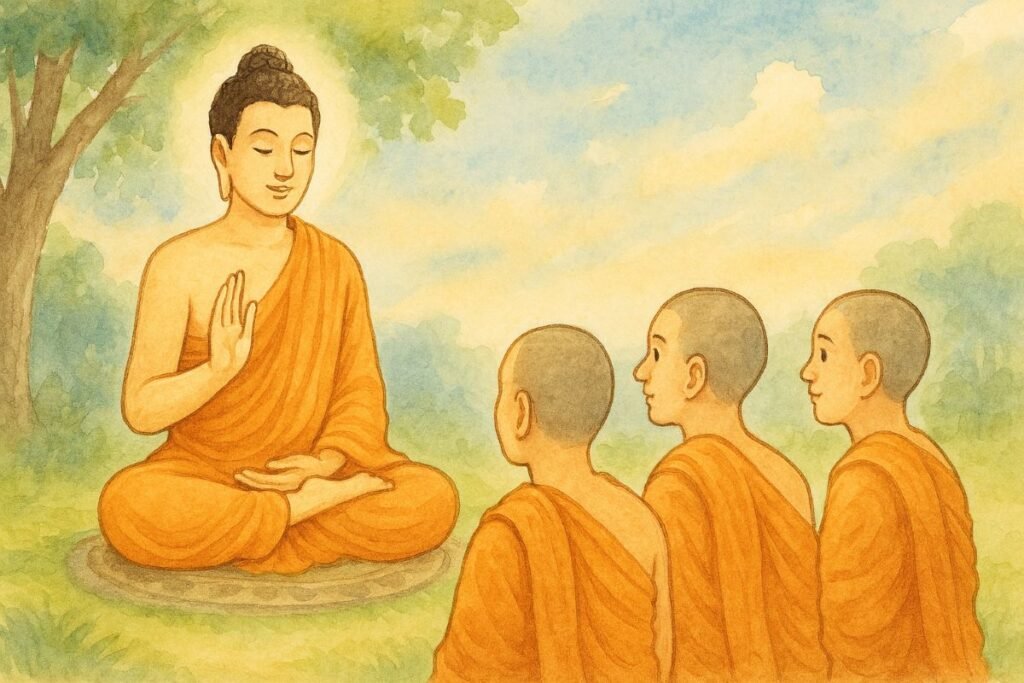
The Buddha’s life is significant because Buddhism presents awakening as something a human being can realise.
The Ariyapariyesanā Sutta (MN 26) describes the Buddha’s search for liberation, his study under teachers, his experimentation with severe ascetic practices, and his eventual rejection of those practices as ineffective.
After awakening, he spent decades teaching others.
His life therefore represents both personal liberation and the practical transmission of a path.
Part 2: The Path and Its Practices (Questions 11-30)
11. What is the Noble Eightfold Path?

The Noble Eightfold Path is the practical framework for ending suffering, outlined by the Buddha as the Fourth Noble Truth in the Dhammacakkappavattana Sutta (SN 56.11). It comprises eight interconnected factors: Right View, Right Intention, Right Speech, Right Action, Right Livelihood, Right Effort, Right Mindfulness, and Right Concentration. These factors are not sequential steps but interdependent elements to be developed together.
The path is often categorized into three core trainings: Ethical Conduct (Sīla), which encompasses Right Speech, Right Action, and Right Livelihood; Concentration (Samādhi), which includes Right Effort, Right Mindfulness, and Right Concentration; and Wisdom (Paññā), which comprises Right View and Right Intention. This structure shows how ethics, meditation, and wisdom support and reinforce one another.
Walking the Noble Eightfold Path is the practical embodiment of the Dharma. It transforms a philosophical understanding of suffering into a lived reality. By cultivating each factor, we gradually align our actions, speech, livelihood, and mind with the truth of reality, leading to the cessation of suffering and the attainment of true freedom.
12. What is the role of ethics (Sīla) in the path?
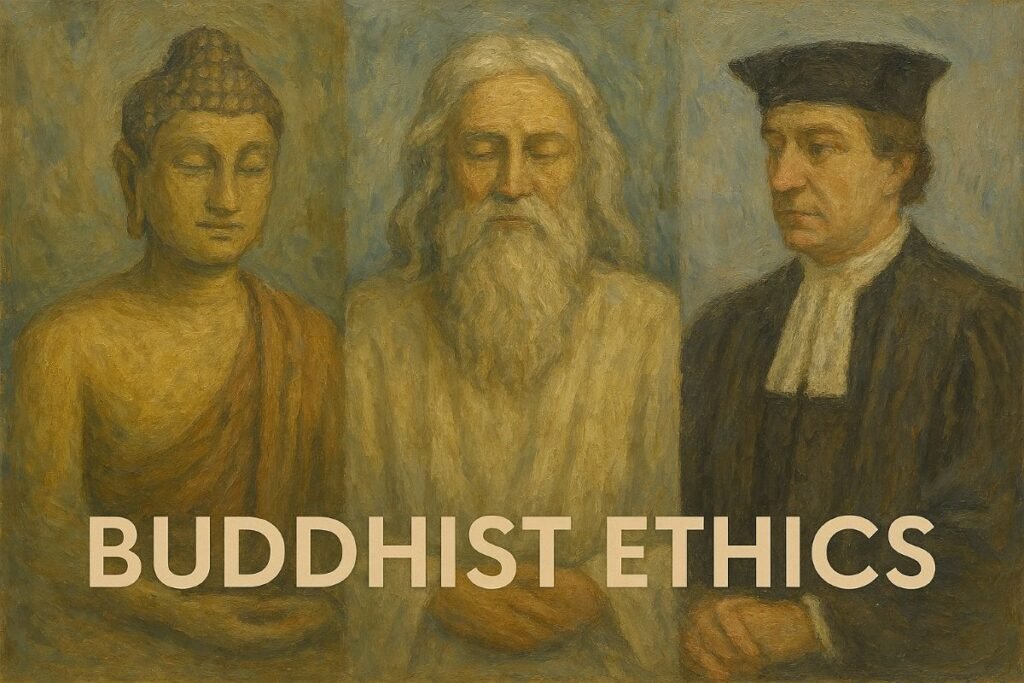
Ethics, or Sīla, forms the foundation of the entire Buddhist path. It is the first of the three trainings and provides the stability necessary for deeper meditation and wisdom. Without a foundation of ethical conduct, the mind remains agitated by guilt, remorse, and the consequences of unwholesome actions, making concentration and clear insight impossible. The Samaññaphala Sutta (DN 2) describes the gradual training, which begins with the establishment of ethical purity.
Sīla is not about obeying external commandments but about cultivating inner harmony and non-harming (Ahimsa). By refraining from actions rooted in greed, hatred, and delusion, we create a life of integrity and safety for ourselves and others. This moral clarity simplifies the mind and frees up the energy previously wasted in conflict, confusion, and rationalization.
The practice of ethics is also a profound form of mindfulness. Observing the precepts requires us to be mindful of our speech, actions, and livelihood. In this way, Sīla is not merely a set of restrictions but an active cultivation of wholesome states of mind, creating the ideal conditions for the mind to settle into concentration and open to wisdom.
13. What are the Five Precepts?
The Five Precepts (Pañca Sīla) are the foundational ethical guidelines for lay Buddhists. They are voluntary training principles, not commandments, and are recited as a commitment to wholesome living. The precepts are: to refrain from taking life, from taking what is not given, from sexual misconduct, from false speech, and from intoxicants that cloud the mind. They are detailed in the Sigalovada Sutta (DN 31).
Each precept protects both oneself and others. Refraining from killing cultivates compassion; refraining from stealing builds trust; refraining from sexual misconduct fosters respectful relationships; refraining from false speech establishes a foundation of truth; and refraining from intoxicants preserves mindfulness and clarity of mind.
The precepts are a practical expression of the principle of non-harming (Ahimsa). They are not seen as a burden but as a gift of safety (abhaya dāna) to all beings. By observing them, a practitioner creates a space of safety and trust in their own life, which is the essential basis for deepening meditation practice and spiritual growth.
14. How does karma function in the Buddhist framework?

Karma (Pali: Kamma) means “intentional action.” It is the natural law of cause and effect whereby wholesome intentions lead to pleasant results and unwholesome intentions lead to unpleasant results. The Buddha emphasized that it is the intention (cetanā) behind an action that determines its karmic fruit, as stated in the Nibbedhika Sutta (AN 6.63).
Karma is not fatalism or predestination. It is a dynamic process that emphasizes our power to shape our future through our choices in the present moment. While we experience the results of past actions, we are always free to choose how we respond in the present, creating new karma and modifying the conditions for past karma to ripen.
Understanding karma encourages personal responsibility and ethical living. Knowing that our actions have consequences, not as a system of divine punishment but as a natural law, motivates us to act with greater care, kindness, and wisdom. It provides a powerful incentive to cultivate wholesome qualities and abandon unwholesome ones.
15. What is the purpose of meditation?
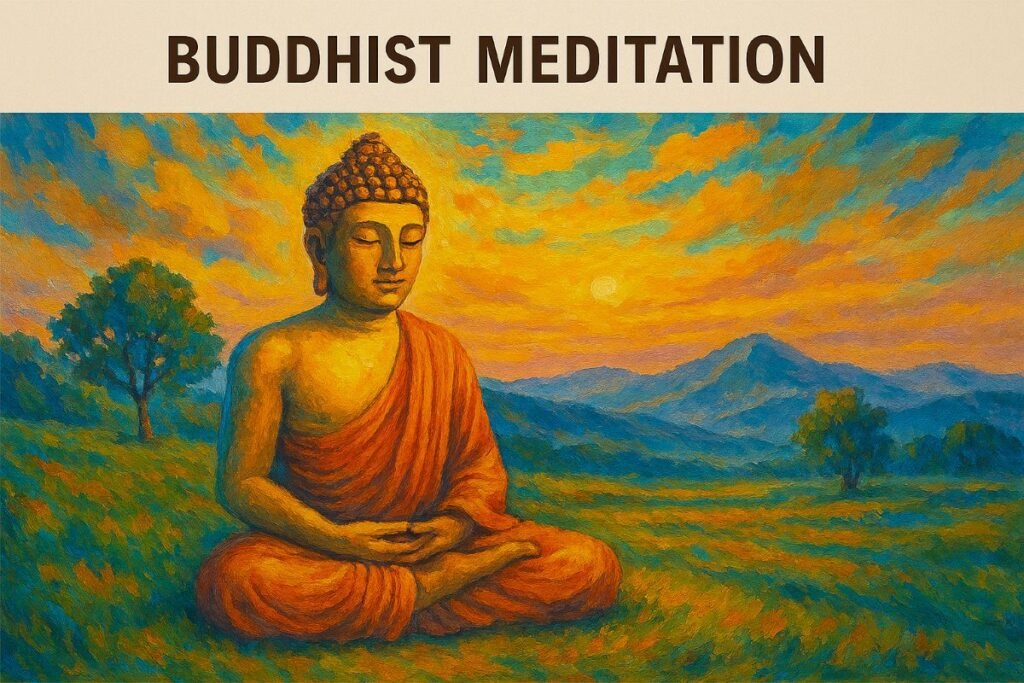
The purpose of meditation is to train and transform the mind. It serves two primary functions: the development of calm, stability, and concentration (Samatha), and the development of insight into the true nature of reality (Vipassanā). The Satipaṭṭhāna Sutta (MN 10) outlines the direct path for this purification and insight.
Calming meditation works to pacify the mind, reducing the agitation caused by craving and aversion. It allows us to experience a deep sense of peace and collectedness. Insight meditation uses this stable mind to investigate phenomena directly, seeing their characteristics of impermanence, suffering, and non-self.
Ultimately, the purpose of all Buddhist meditation is to uproot the defilements of greed, hatred, and delusion. By developing both calm and insight, the meditator creates the conditions for liberating wisdom to arise, leading to the end of suffering. It is the core practice that transforms intellectual understanding into direct, liberating knowledge.
16. What are the main types of Buddhist meditation?
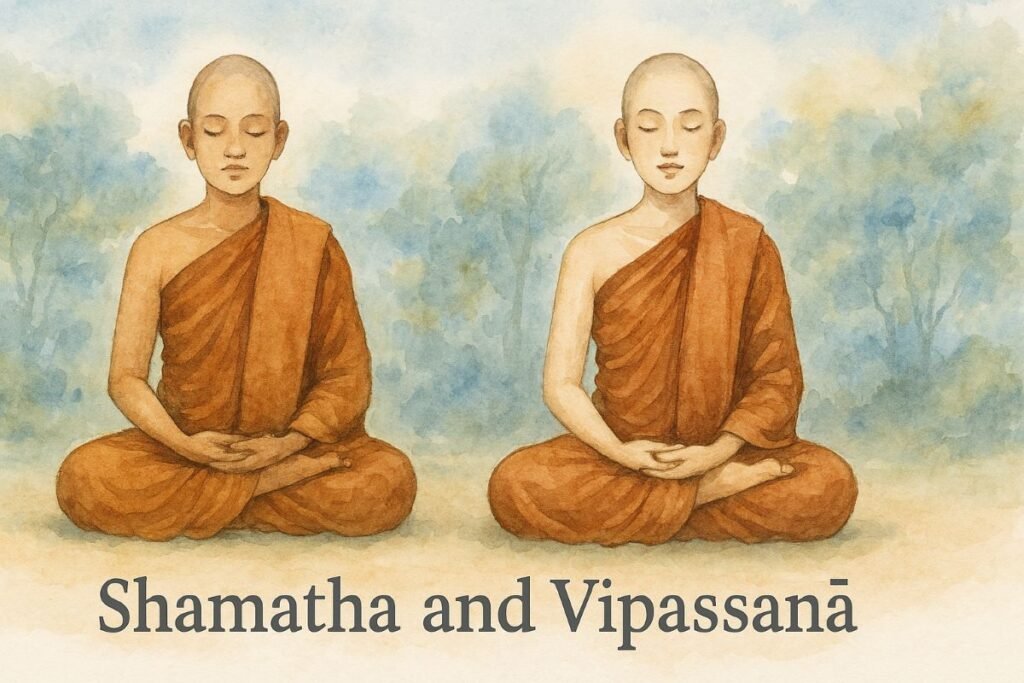
The two main categories of Buddhist meditation are Shamatha (calm-abiding) and Vipassanā (clear-seeing or insight). Shamatha practices focus on developing a stable, concentrated mind, often using a single object like the breath (Ānāpānasati) or a visual object (kasiṇa) to achieve deep states of absorption called jhānas. These states provide a mind of unparalleled clarity and stillness.
Vipassanā meditation, by contrast, is the cultivation of moment-to-moment mindfulness and clear comprehension. It involves observing the arising and passing of all phenomena: bodily sensations, feelings, thoughts, and mental states, without attachment or aversion. This direct observation reveals the three marks of existence: impermanence, suffering, and non-self.
These two practices are not mutually exclusive. A balanced practice often begins with developing calm and concentration to stabilize the mind, which then serves as a powerful platform for insight. Together, they form a complete meditative path, as the Ānāpānasati Sutta (MN 118) demonstrates, where mindfulness of the breath leads to the fulfillment of both serenity and insight.
17. What is mindfulness (Sati)?
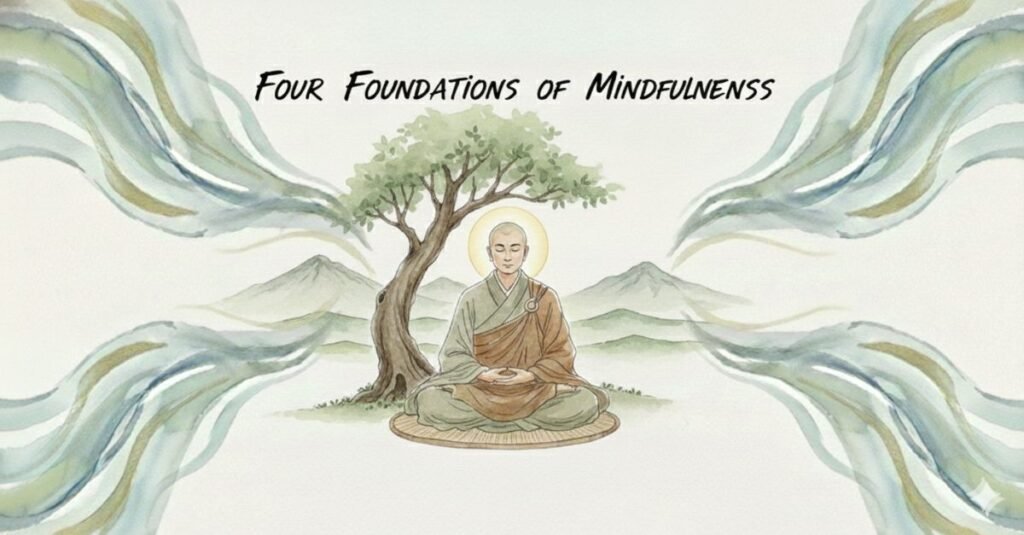
Mindfulness, or Sati, is a lucid, non-judgmental awareness of present-moment experience. It is the quality of mind that remembers to stay attentive to what is happening now without being swept away by reactions. The Satipaṭṭhāna Sutta (MN 10) defines it as the direct path to purification, describing the four foundations of mindfulness: body, feelings, mind, and mental phenomena.
Mindfulness involves both the active attention to an object and a specific quality of that attention: it is bare, receptive, and without distortion. When we are mindful, we see things as they are, not as we wish them to be. This clarity cuts through the automatic habits of craving and aversion that lead to suffering.
In practice, mindfulness transforms ordinary experience. A mindful mind is no longer a victim of its own conditioned reactions. It can hold both pleasant and unpleasant experiences with equanimity, seeing their transient nature. This capacity for clear, non-reactive observation is the foundation for developing wisdom.
18. How does concentration (Samādhi) support the path?
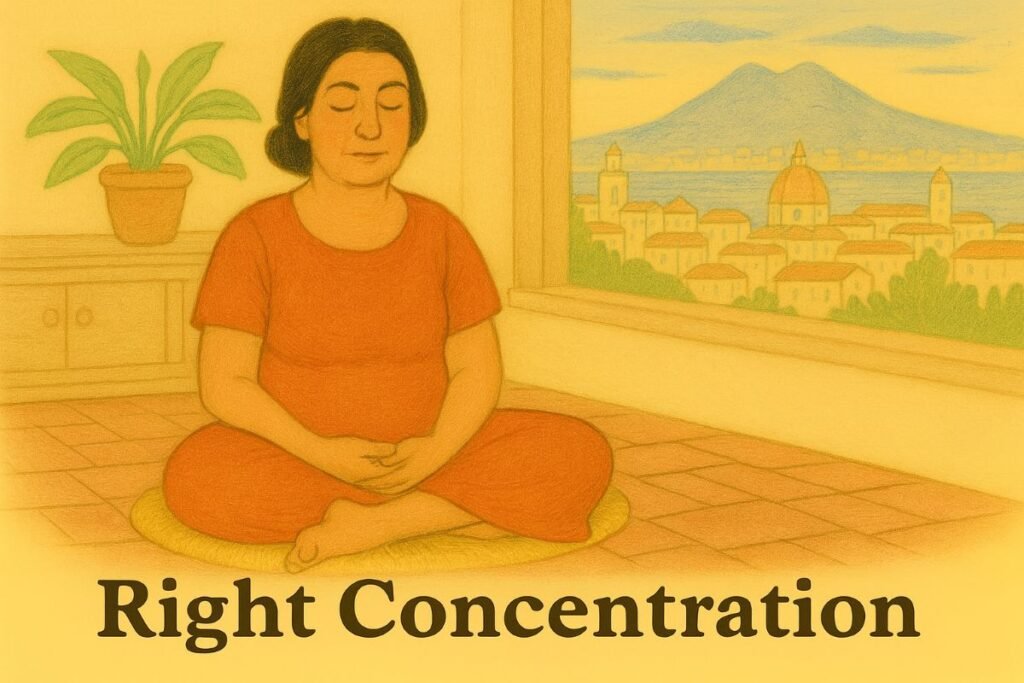
Concentration, or Samādhi, is the collected, unified state of mind that arises when it is fixed on a single object. It is the second of the three trainings and is developed through sustained meditation practice. Samādhi provides the mental stability and power necessary for deep insight to penetrate the nature of reality, as emphasized in the Mahā-Assapura Sutta (MN 39) and the Samaññaphala Sutta (DN 2).
A concentrated mind is like a magnifying glass that focuses the sun’s rays. An ordinary, scattered mind is weak and easily swayed by distractions. A concentrated mind, however, gains tremendous power and clarity. It can sustain attention on subtle objects of investigation for extended periods, allowing insight to develop.
While concentration alone is not sufficient for liberation (as even non-Buddhist meditators can attain deep absorption), it is an indispensable tool. Without a base of concentration, the mind is too turbulent to see the subtle workings of impermanence and dependent origination. The calm and collected mind is the ideal instrument for generating liberating wisdom.
19. What is the role of wisdom (Paññā)?
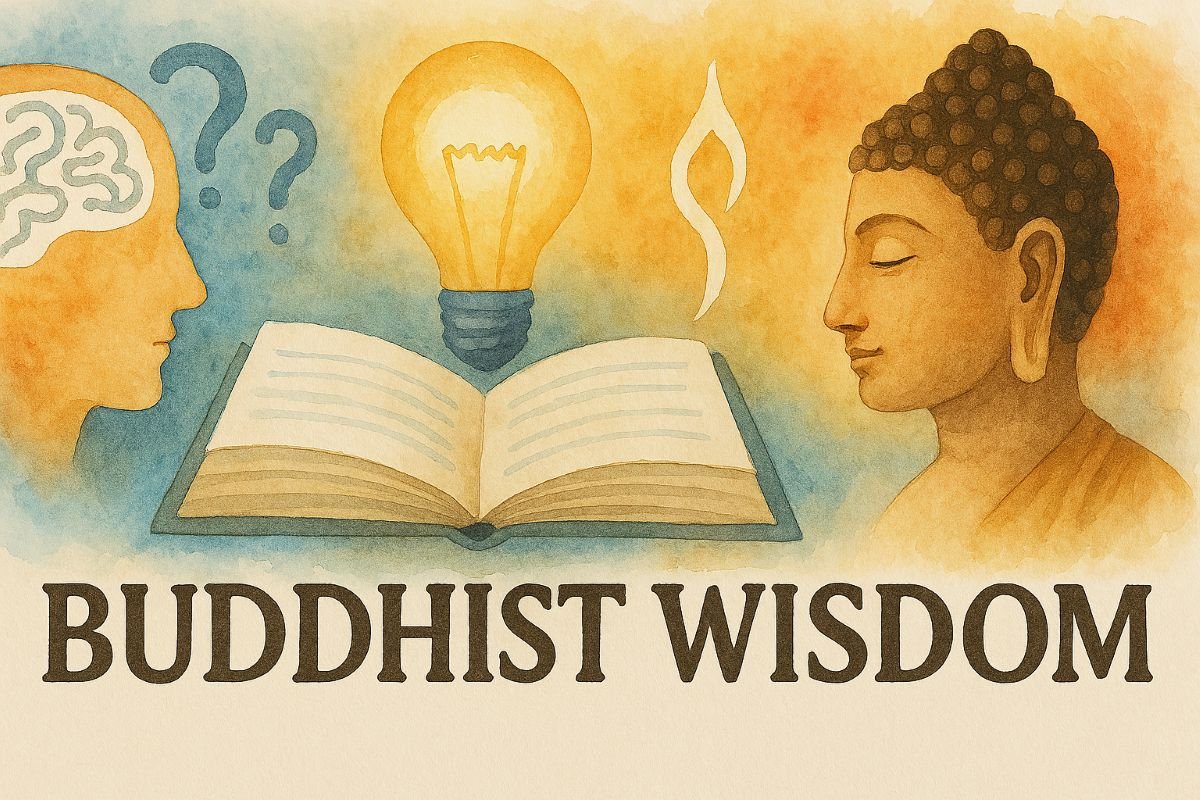
Wisdom, or Paññā, is the liberating insight that penetrates the true nature of reality. It is the third of the three trainings and the ultimate goal of the path. Wisdom is not mere intellectual knowledge but a direct, experiential realization of the Three Marks of Existence: impermanence (anicca), suffering (dukkha), and non-self (anattā). The Sampasādanīya Sutta (DN 28) describes wisdom as the supreme quality leading to awakening.
Wisdom arises from the integrated practice of ethics and meditation. Ethical conduct clears the mind of remorse, meditation stabilizes it, and this purified, stable mind can then directly see the nature of all conditioned phenomena. This direct seeing erodes and eventually uproots the underlying ignorance (avijjā) that is the root cause of all suffering.
Wisdom is what finally breaks the chains of samsara. It is the eye that sees the Four Noble Truths for oneself. With wisdom, there is no more doubt, no more clinging to a self, no more craving for existence. It is the culmination of the path, leading to the irreversible liberation of the mind.
20. How do ethics, meditation, and wisdom work together?
Ethics, meditation, and wisdom are the three interdependent trainings (ti-sikkhā) that form the structure of the Buddhist path. They are not sequential steps but mutually supporting factors. Ethics provides the foundation, as a life of integrity and non-harming creates the conditions for a calm and clear mind, as explained in the Sīla Sutta (AN 3.85).
Meditation, built on the foundation of ethics, develops the concentration and mindfulness necessary for wisdom. A mind free from the agitation of guilt and unwholesome habits can settle into deep states of calm and become a powerful instrument for investigation. This mental cultivation directly leads to the arising of insight.
Wisdom, in turn, reinforces both ethics and meditation. With a direct understanding of the nature of suffering and non-self, ethical conduct becomes spontaneous and effortless, no longer a matter of willpower. Wisdom also deepens meditation, as the meditator knows what to look for and understands the purpose of the practice. This virtuous cycle propels the practitioner toward full liberation.
21. What is Right View?

Right View (Sammā Diṭṭhi) is the first factor of the Noble Eightfold Path and the forerunner of all other factors. It is the understanding that aligns our perspective with reality. At a basic level, it involves understanding karma, rebirth, and the Four Noble Truths. At a deeper, supramundane level, it is the direct realization of these truths, the wisdom that sees the absence of a permanent self, as elaborated in the Sammādiṭṭhi Sutta (MN 9).
Right View acts as the compass for the entire path. Without a correct understanding of the problem (suffering) and its solution (the path), our efforts, however well-intentioned, may be misdirected. It provides the context for ethical conduct, the motivation for meditation, and the framework within which wisdom develops.
Cultivating Right View involves study, reflection, and critical inquiry. We must question our assumptions, listen to the teachings, and reflect on them until they become a felt understanding. Ultimately, through practice, conceptual Right View matures into the non-conceptual wisdom of a stream-enterer, who has seen the truth directly and can never again be fooled by the illusion of a permanent self.
22. What is Right Intention?

Right Intention (Sammā Saṅkappa) is the second factor of the Noble Eightfold Path, often called “right thought.” It is the mental factor that directs our mind toward wholesome goals. Right Intention is threefold: the intention of renunciation (opposite of greed), the intention of good will (opposite of ill will), and the intention of harmlessness (opposite of cruelty), as described in the Mahācattārīsaka Sutta (MN 117).
This factor serves as the link between Right View and ethical conduct. With a correct understanding of reality, our intentions naturally begin to align with that understanding. We renounce the pursuit of worldly pleasures that lead to suffering, we cultivate friendliness toward all beings, and we consciously refrain from causing harm.
Right Intention is cultivated through mindfulness and reflection. When we notice intentions of greed, ill will, or harm arising, we acknowledge them without judgment and deliberately cultivate their wholesome opposites. Over time, this practice reconditions the mind, so that wholesome intentions become spontaneous and effortless, forming the basis for Right Speech, Right Action, and Right Livelihood.
23. What is Right Speech?

Right Speech (Sammā Vācā) is the third factor of the Noble Eightfold Path, focused on the ethical use of communication. It has four components: abstaining from lying, from divisive speech, from harsh speech, and from idle chatter. The Abhaya Rājakumāra Sutta (MN 58) details the Buddha’s own standard: he only speaks what is true, beneficial, and timely.
Right Speech is a powerful practice because our words have a profound impact on ourselves and others. Lying creates internal dissonance and erodes trust. Divisive speech breaks relationships. Harsh words wound. Idle chatter scatters the mind and wastes energy. By cultivating truthful, harmonious, gentle, and meaningful speech, we create harmony and support our own spiritual development.
Practicing Right Speech requires mindfulness. Before speaking, we can ask ourselves: Is it true? Is it kind? Is it necessary? Is it the right time? This reflection slows down the automatic reaction to speak impulsively. By bringing awareness to our speech, we transform a primary source of conflict into a powerful tool for creating connection, peace, and clarity.
24. What is Right Action?

Right Action (Sammā Kammanta) is the fourth factor of the Noble Eightfold Path, focusing on ethical conduct in our physical actions. It is based on the principle of non-harming (Ahimsa) and involves abstaining from three specific actions: killing living beings, stealing (taking what is not given), and sexual misconduct. These are the first three of the Five Precepts applied as the foundation of one’s actions.
Right Action goes beyond mere abstinence. It is an active commitment to acting in ways that are beneficial, compassionate, and respectful. This means not only refraining from taking life but actively protecting life; not only refraining from stealing but cultivating generosity; not only refraining from sexual misconduct but fostering respectful and trustworthy relationships.
Cultivating Right Action requires awareness of the motivation behind our actions. By reflecting on our actions before, during, and after, we learn to see whether they are rooted in greed, hatred, or delusion. As mindfulness grows, we naturally incline toward actions that are pure, harmless, and conducive to the well-being of all.
25. What is Right Livelihood?

Right Livelihood (Sammā Ājīva) is the fifth factor of the Noble Eightfold Path, concerning how we earn a living. It means refraining from engaging in trades or professions that directly or indirectly cause harm to other beings. The Vanijja Sutta (AN 5.177) explicitly lists five specific trades to be avoided: dealing in weapons, dealing in living beings (including slavery and breeding animals for slaughter), dealing in meat, dealing in intoxicants, and dealing in poisons.
Right Livelihood extends beyond this list to any occupation that involves deceit, exploitation, or harm. It encourages us to seek work that is ethical, honest, and ideally contributes positively to society. The principle is to ensure that our primary means of survival does not force us to compromise the other factors of the path, particularly Right Speech and Right Action.
For lay practitioners, finding Right Livelihood can be a challenging but essential part of practice. It requires reflection on our work’s impact and a commitment to aligning our professional life with our spiritual values. When our livelihood is in harmony with the Dharma, our work becomes an extension of our practice rather than a distraction from it.
26. What is Right Effort?
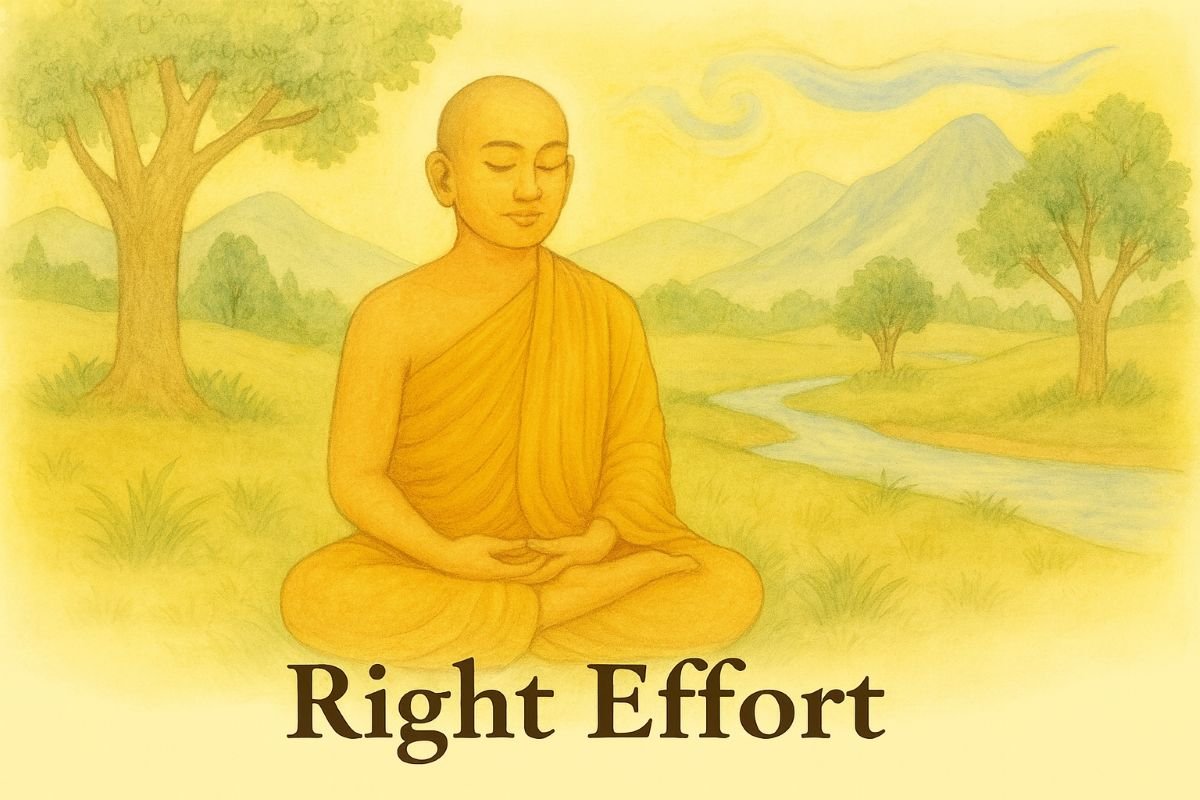
Right Effort (Sammā Vāyāma) is the sixth factor of the Noble Eightfold Path, providing the energetic engine for the entire path. It is defined as the fourfold effort to: prevent unarisen unwholesome states from arising, abandon unwholesome states that have arisen, arouse wholesome states that have not yet arisen, and maintain and perfect wholesome states that have arisen. This framework is detailed in the Saṅkhitta Dhamma Sutta (SN 49.1).
Right Effort is not about straining or striving in a tense way but about applying consistent, balanced energy to cultivate the mind. It is the skillful means of watering wholesome seeds and starving unwholesome ones. This requires mindfulness to recognize the mental states that are present and the discernment to know what to encourage and what to discourage.
This factor is crucial because the path requires sustained motivation. Without Right Effort, we may fall into laziness or be swept away by old habits. With it, we gradually transform our mental landscape, replacing patterns of greed, hatred, and delusion with the wholesome qualities of generosity, loving-kindness, and wisdom.
27. What is Right Mindfulness?

Right Mindfulness (Sammā Sati) is the seventh factor of the Noble Eightfold Path. It is the quality of mind that remembers to attend to present-moment experience with clarity, non-attachment, and acceptance. The practice is systematically laid out in the Satipaṭṭhāna Sutta (MN 10), which describes the four foundations: mindfulness of the body, feelings, mind, and mental phenomena.
Right Mindfulness is the active cultivation of awareness. It involves training ourselves to observe the workings of our body and mind without getting lost in our reactions. By anchoring our attention in the present moment, we cut through the mental habits of dwelling on the past or projecting into the future, which are primary sources of suffering.
As the path unfolds, Right Mindfulness becomes a continuous, effortless awareness. It is the gatekeeper that allows us to see the arising and passing of phenomena, leading directly to insight. It is the factor that integrates all other aspects of the path, bringing the clarity of wisdom to every moment of experience.
28. What is Right Concentration?
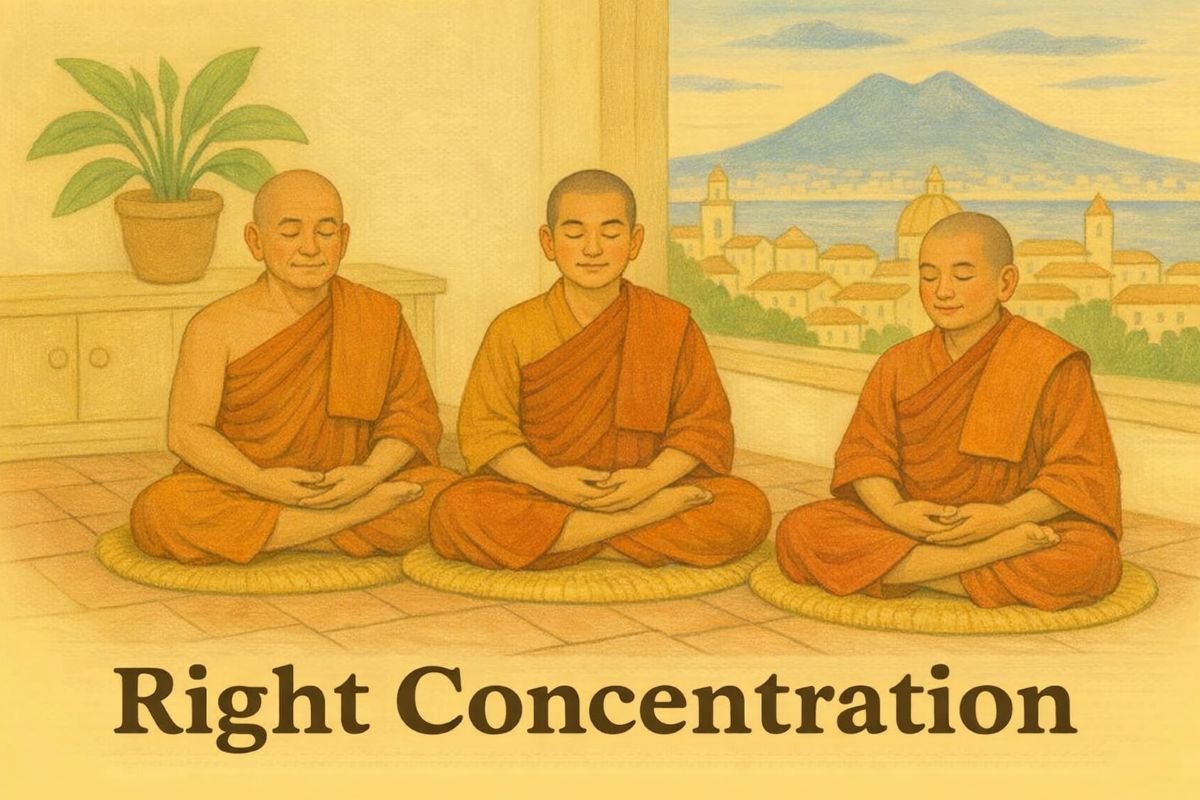
Right Concentration (Sammā Samādhi) is the eighth factor of the Noble Eightfold Path, representing the culmination of the mind’s training in collectedness and stillness. The Buddha defined it as the four jhānas (absorptions), states of deep mental unification that arise when the mind is fixed on a single object, free from the five hindrances. This is detailed in the Samaññaphala Sutta (DN 2).
In the first jhāna, the mind is secluded from sensual pleasures and unwholesome states, filled with joy and happiness born of seclusion. As concentration deepens, the factors of the mind refine: joy subsides in the second jhāna, leaving happiness and unification; equanimity and mindfulness replace happiness in the third; and in the fourth, the mind is purified, still, and perfectly balanced.
Right Concentration provides a state of unparalleled clarity and power, which becomes the basis for liberating wisdom. A mind that has achieved such deep unification is like a perfectly still lake, it can reflect reality with complete accuracy, allowing the practitioner to penetrate the deepest truths of existence and attain the final goal.
29. How do the three trainings (Sīla, Samādhi, Paññā) interconnect?
The three trainings of ethical conduct (Sīla), concentration (Samādhi), and wisdom (Paññā) form a self-reinforcing cycle. Sīla provides the foundation, as a life lived with integrity and non-harming produces a mind free from the remorse and agitation that obstruct concentration. The Cūḷavedalla Sutta (MN 44) explains how these qualities support one another.
With a clear conscience and stable, ethical habits, the mind can more easily settle into Samādhi. Concentration practices further calm and unify the mind, suppressing the five hindrances (sensual desire, ill will, sloth, restlessness, and doubt) that cloud insight. This purified mind is then capable of developing Paññā, the direct seeing of reality.
The arising of wisdom, in turn, perfects Sīla and Samādhi. Wisdom uproots the ignorance and self-view that are the source of unethical behavior, so ethical conduct becomes spontaneous and effortless. It also deepens concentration, as the practitioner now understands the nature of the meditative states and uses them with discernment. This cycle continues until full liberation is achieved.
30. What is the role of the teacher (Kalyāṇamitta) in practice?

A spiritual friend or teacher (Kalyāṇamitta) is considered crucial for progress on the path. The Buddha declared that admirable friendship, admirable companionship, admirable camaraderie is the whole of the holy life, as recorded in the Upaddha Sutta (SN 45.2). A good teacher provides guidance, corrects misunderstandings, offers encouragement, and embodies the teachings through their own example.
A teacher serves as a mirror, helping us see our blind spots and unconscious habits that we might overlook on our own. They can point us toward the right practices for our particular temperament, warn us of potential pitfalls, and inspire us with their wisdom and compassion. The Dhammapada (verse 76) says that a wise teacher who sees our faults and reproves us should be cherished as a revealer of hidden treasure.
However, the ultimate responsibility for awakening rests with the individual. A teacher is a guide, not a savior. The role is to point the way, but we must walk the path ourselves. A genuine teacher encourages our independence and self-reliance, eventually guiding us to trust our own direct experience and become our own inner guide.
Part 3: The Nature of Reality and Self (Questions 31-50)
31. What is impermanence (Anicca)?

Impermanence (Anicca) is the fundamental truth that all conditioned phenomena, everything that arises from causes and conditions—are in a constant state of flux. Nothing remains the same for two consecutive moments. From the atoms in our bodies to the thoughts in our minds, all things arise, persist for a while, and then cease. The Aniccalakkhaṇa Sutta (SN 22.12) establishes this as the first of the three marks of existence.
This truth is not merely philosophical but directly observable. Our bodies change, our feelings change, our relationships change, our thoughts change. Even the solid earth and the vast mountains are impermanent on a cosmic scale. To ignore this is to live in denial, setting ourselves up for disappointment and suffering when change inevitably comes.
The contemplation of impermanence is a powerful tool for liberation. By seeing the transient nature of all pleasant experiences, we learn not to cling to them. By seeing the transient nature of all unpleasant experiences, we learn not to despair. This understanding loosens the grip of craving and opens the door to the unconditioned, which is the only thing not subject to change.
32. What is non-self (Anattā)?

Non-self (Anattā) is the teaching that there is no permanent, unchanging, independent self or soul (ātman) to be found in any of the five aggregates (form, feeling, perception, mental formations, consciousness). What we conventionally call the “self” is merely a convenient designation for a constantly changing collection of these conditioned processes. The Anattalakkhaṇa Sutta (SN 22.59) is the Buddha’s seminal discourse on this topic.
Anattā is often the most misunderstood and challenging of the Buddha’s teachings. It does not deny the existence of a conventional, functioning person. Rather, it denies the existence of a core essence that is permanent, independent, and the ultimate owner of experience. The sense of “I,” “me,” and “mine” is a construct born of ignorance, a misperception that lies at the root of suffering.
Realizing Anattā is liberating because it dismantles the foundation of all clinging. If there is no “self” to defend, no “self” to promote, and no “self” to lose, then the fuel for greed, hatred, and fear is extinguished. This realization is not a loss but a profound freedom from the burden of ego, allowing life to flow with ease and compassion.
33. How do the Five Aggregates (Khandhas) constitute the self?

The Five Aggregates (Khandhas) are the five components that make up the totality of an individual’s experience. They are: form (the physical body and material world), feeling (pleasant, unpleasant, or neutral sensations), perception (the faculty that recognizes and labels experiences), mental formations (volitions, intentions, emotions, and habits), and consciousness (the basic awareness that cognizes an object). The Khandha Sutta (SN 22.48) defines them.
What we normally call the “self” is simply a dynamic, interactive process of these five aggregates. There is no permanent owner or controller behind them; there is just the process itself. Clinging occurs when we mistakenly identify any one of these aggregates, or their combination, as “me” or “mine.” This clinging is the direct cause of suffering.
The path to liberation involves developing insight into the true nature of the aggregates. Through mindfulness, we learn to see them as they are: impermanent, conditioned, and not-self. By breaking the habit of identifying with them, we stop constructing the ego and the suffering it entails. Seeing the aggregates clearly is seeing through the illusion of self.
34. What is Dependent Origination (Paṭicca Samuppāda)?

Dependent Origination is the principle that all phenomena arise in dependence on causes and conditions. The Buddha famously stated, “When this exists, that comes to be. With the arising of this, that arises. When this does not exist, that does not come to be. With the cessation of this, that ceases.” This principle is applied to the twelve links that describe the cycle of birth and death, from ignorance to aging and death, as outlined in the Mahānidāna Sutta (DN 15).
This teaching reveals the causal structure of suffering. It shows that ignorance of the Four Noble Truths conditions mental formations, which condition consciousness, and so on, culminating in birth, aging, and death. It is not a linear, one-time process but a dynamic cycle operating moment-to-moment, demonstrating how we continually create our own suffering through conditioned patterns.
Understanding Dependent Origination is key to liberation because it shows exactly where the chain can be broken. By uprooting ignorance and the craving it produces, we interrupt the cycle. This is not a theoretical understanding but a direct insight into the interconnected nature of reality, leading to the cessation of the entire mass of suffering.
35. What is emptiness (Sunyata)?
Emptiness (Suññatā in Pali, Śūnyatā in Sanskrit) is a profound teaching found in both the Pali Canon and Mahāyāna traditions, though it is developed differently in each. In the Pali Canon, emptiness is often presented as the emptiness of self, as in the Cūḷasuññata Sutta (MN 121), where the Buddha describes the progressive emptying of the mind of all notions of self and anything pertaining to a self. This is a direct extension of the anattā teaching.
In Mahāyāna, the concept of emptiness is extended to mean that all phenomena are empty of inherent, independent existence. This Nāgārjunan view holds that nothing exists in and of itself; everything exists in relation to causes, conditions, and conceptual imputation. A flower, for example, is empty of “flower-ness”; it is entirely dependent on sun, rain, earth, and our own perception to be experienced as a flower.
While these two formulations have different emphases, they are not contradictory. Both point to the ultimate truth that our ordinary perception of solid, independent entities, including the self, is mistaken. Realizing emptiness, in either sense, is a liberating insight that shatters conceptual clinging and opens the door to the unconditioned.
36. What is the relationship between emptiness and dependent origination?
Emptiness and dependent origination are two sides of the same coin. Dependent origination describes the arising of phenomena in dependence on causes and conditions. Emptiness describes the nature of those phenomena as lacking any inherent, independent existence. One is the process, the other is the character of all that arises through that process. The Kaccānagotta Sutta (SN 12.15) presents the middle way between existence and non-existence, which is this very principle.
If a phenomenon were not dependently originated, it would be self-existent, permanent, and independent. Such a thing, the Buddha taught, could never be found. Conversely, the very fact that things arise dependently, depending on causes, conditions, and our conceptual imputation, proves that they are empty of any such independent essence. To see a tree, for instance, is to see a web of causes: a seed, soil, water, sun, and the mind that labels it “tree.” There is no “tree” apart from these.
Understanding this relationship is the key to the middle way. It avoids the extreme of eternalism (believing in permanent, independent entities) and the extreme of nihilism (believing that nothing exists at all). Things do exist conventionally, as dependently arisen appearances, but they do not exist as the solid, independent entities our ignorance believes them to be. This insight is the heart of Buddhist wisdom.
37. What is the nature of consciousness?
In Buddhism, consciousness (viññāṇa) is not a permanent soul or self. It is one of the five aggregates, a conditioned, momentary event that arises in dependence on a sense organ and its corresponding object. The Mahātaṇhāsankhaya Sutta (MN 38) explains that consciousness is named according to its origin: eye-consciousness, ear-consciousness, and so on.
Consciousness is a process, not a thing. It is a series of moments of knowing, each one arising and ceasing, conditioned by the preceding moment. It is like a flame: it appears continuous but is actually a series of discrete moments, each one dependent on the previous moment and the fuel that sustains it. There is no “owner” of consciousness; there is just the process of cognizing.
This understanding is crucial for deconstructing the illusion of self. The sense of an enduring “I” that is having experiences is a construct built on the rapid succession of these moments of consciousness. By seeing consciousness as impersonal and conditioned, we loosen our identification with it, moving toward the insight that there is no permanent, independent knower behind the act of knowing.
38. What is the difference between conventional and ultimate truth?
Conventional truth (sammuti sacca) refers to the everyday, practical realities that we all agree upon, such as tables, chairs, and persons. These are useful and necessary for functioning in the world. Ultimate truth (paramattha sacca) refers to the fundamental, irreducible realities that exist from their own side, analyzed without conceptual overlay. In the Abhidhamma tradition, these are the four ultimate realities: mind (citta), mental factors (cetasika), matter (rūpa), and Nibbāna. The Kaccānagotta Sutta (SN 12.15) implies this distinction.
The two truths are not contradictory. The Buddha used conventional language to describe ultimate realities. For example, he spoke of “the person” conventionally, but on the ultimate level, he described only the five aggregates. Understanding this distinction prevents us from either reifying conventional realities as absolute or dismissing them as meaningless.
The path to liberation requires a skillful navigation of these two truths. We use the conventional self as a tool to practice ethical conduct and develop the path. But we simultaneously cultivate wisdom that sees through the conventional self to the ultimate realities of impermanent, conditioned phenomena. Full awakening involves a perfect integration of both, where one can function in the conventional world without any confusion or clinging.
39. How does Buddhism view the mind-body relationship?
In Buddhism, the mind (nāma) and body (rūpa) are seen as two distinct yet interdependent categories of phenomena. They are often referred to together as nāma-rūpa, which is the fourth link in the chain of Dependent Origination. They are co-dependent: without the body, there can be no physical basis for consciousness; without consciousness and other mental factors, the body is an inert corpse. The Mahānidāna Sutta (DN 15) illustrates this interdependence.
This view avoids both materialist reductionism (the mind is merely a byproduct of the brain) and idealist reductionism (the world is merely a projection of the mind). The mind and body are separate but intertwined processes that condition one another. Mental states affect the body (e.g., stress causing illness), and bodily states affect the mind (e.g., illness causing depression).
For the practitioner, this understanding emphasizes the importance of caring for both. The body is the vehicle for practice; it should be treated with respect but without attachment. Mental cultivation is the primary focus, but it is done in dependence on a healthy, balanced body. The Middle Way between sensual indulgence and asceticism is a direct application of this balanced view of nāma-rūpa.
40. What is the role of intention (Cetanā)?
Intention (cetanā) is the most important mental factor in determining the karmic quality of an action. The Buddha stated unequivocally, “It is intention that I call karma; having intended, one acts by body, speech, and mind” (Nibbedhika Sutta, AN 6.63). This means that the ethical quality of an action—whether it is wholesome or unwholesome—is determined by the intention behind it.
Intention is not just a preliminary thought but the volitional impulse that drives an action to completion. It can be wholesome (rooted in non-attachment, benevolence, and understanding) or unwholesome (rooted in greed, hatred, and delusion). The same physical action (e.g., giving money) can be karmically neutral, highly meritorious, or even harmful depending on the intention behind it.
Cultivating mindfulness of intention is a powerful practice. By observing the intentions that arise before an action, we gain the ability to choose which seeds to water. We learn to recognize and abandon unwholesome intentions at their root, before they manifest in unskillful speech or action. This is the essence of Right Effort and a key to transforming our karma.
41. How does one experience the present moment fully?
Experiencing the present moment fully is the practice of mindfulness (sati). It involves training the mind to rest on what is happening now, the breath, a bodily sensation, a sound, a thought, without judging it, without wanting it to be different, and without getting lost in stories about it. The Satipaṭṭhāna Sutta (MN 10) is the classic guide for this training.
To be fully present, we must let go of the tendency to dwell on the past or project into the future. This is not about erasing memory or planning but about not being lost in them. We acknowledge past and future when they arise as present-moment thoughts, and then we return our attention to the immediate, direct experience of the body and mind.
Full presence is a state of non-dual awareness where the separation between observer and observed dissolves. There is just the knowing of experience as it is. This state is naturally peaceful, clear, and free from the suffering created by craving and aversion. It is the gateway to insight, as only in the stillness of the present moment can the true nature of reality be directly perceived.
42. What is the difference between thinking and awareness?
Thinking is a mental activity, the production of concepts, images, and narratives. It is one function of the mind. Awareness is the fundamental, receptive quality of mind that knows the thinking, as well as all other experiences. Awareness is the background; thinking is one of the foreground objects. The distinction is crucial in meditation practice, as explained in the Bāhiya Sutta (Ud 1.10), which advises to see only what is seen, hear only what is heard.
We often mistake thinking for awareness. We say, “I am thinking,” but more accurately, “There is thinking occurring in awareness.” We are not our thoughts; we are that which knows them. When we identify with our thoughts, we become caught in their content, suffering from anxiety, anger, or desire as if they were absolute realities.
Meditation trains us to rest as awareness itself. We learn to observe thoughts as they arise and pass, without being swept away by them. This shift from being in the thought to being aware of the thought brings immense freedom. We realize that thoughts are just mental events, empty and transient, and that our true nature is the vast, open awareness in which they appear and dissolve.
43. How does Buddhism explain memory and personal continuity?
If there is no permanent self, how can there be memory and personal continuity? Buddhism explains this through the principle of conditionality. Each moment of consciousness conditions the next moment in a causal continuum. Memory is the arising of a present-moment mental state that has been conditioned by a past experience. There is no “self” that remembers; there is simply a present mental formation that bears the imprint of the past, as described in the Pubbakamma Sutta (SN 35.146).
This is like a flame that passes from one candle to another. The second flame is not identical to the first, yet it is not entirely different; it is causally connected. Similarly, the person you are now is not the same as the person you were as a child, but you are not unrelated either. There is a continuum of conditioned, changing phenomena, but no permanent entity that travels through time.
This model explains both continuity and change. It allows for moral responsibility (the present continuum is shaped by past actions) and for the possibility of radical transformation (the continuum can be redirected through present choices). Personal continuity is a functional reality, but the illusion is that it is grounded in a permanent self.
44. What is the nature of a thought?
A thought, in Buddhism, is a mental formation (saṅkhāra), one of the five aggregates. It is a conditioned phenomenon that arises, persists momentarily, and then ceases. It is not a “thing” but an event. A thought arises due to a cause, a preceding mental state, a sense impression, a memory, and is accompanied by various mental factors, such as feeling tone and intention. The Dhammapada (verse 1) famously states that all experience is preceded by mind.
Thoughts are not inherently problematic. They become a source of suffering when we cling to them, mistake them for reality, or allow them to proliferate unchecked. A thought about a past insult is just a thought; it only causes suffering when we believe it, identify with it, and spin a whole story around it. The practice of mindfulness reveals thoughts as transparent, fleeting, and not-self.
The ultimate nature of a thought, from the perspective of insight, is emptiness. It has no inherent existence. When we look for a thought, we find no location, no substance, no color, no shape. Yet it has a functional power. Understanding this paradox, that thoughts are both potent and empty, frees us from being enslaved by them, allowing us to use thoughts skillfully without being identified with them.
45. What is the difference between wholesome and unwholesome mental states?
Wholesome mental states (kusala) are those rooted in non-attachment (alobha), benevolence (adosa), and wisdom (amoha). They lead to happiness, peace, and liberation. Examples include generosity, loving-kindness, compassion, equanimity, mindfulness, and wisdom. Unwholesome mental states (akusala) are those rooted in greed (lobha), hatred (dosa), and delusion (moha). They lead to suffering and bondage. Examples include craving, anger, envy, sloth, and restlessness. The Saṅgīti Sutta (DN 33) catalogs these.
This distinction is not a matter of moral judgment but of cause and effect. Unwholesome states are called “unwholesome” because they produce painful results (vipāka) for oneself and others. Wholesome states are “wholesome” because they produce pleasant results and are conducive to awakening. A mind overwhelmed by greed, hatred, or delusion is a mind in distress; a mind infused with generosity, kindness, and clarity is a mind at peace.
The practice of mindfulness is to discern these states as they arise. When we recognize an unwholesome state, we do not suppress or condemn it; we acknowledge it and gently let it go, cultivating its wholesome opposite. This is the essence of Right Effort. Over time, wholesome states become the dominant pattern of the mind, leading naturally to deeper states of peace and clarity.
46. How does one work with difficult mental states like anger?

The Buddhist approach to anger is not to suppress it nor to act it out. When anger arises, the first step is to recognize it with mindfulness, acknowledging it as an unwholesome mental state without judging ourselves for having it. We can observe its physical sensations (heat, tightness, agitation) and its mental components (a story about being wronged). The Kodhana Sutta (AN 7.64) discusses the dangers of anger.
The second step is to apply an antidote. For anger, the primary antidote is loving-kindness (mettā). We can deliberately cultivate goodwill toward ourselves and toward the person we are angry with. Reflecting on the universal wish to be happy can soften the hardened heart. We can also reflect on the consequences of anger—how it harms us first and foremost—as a way to weaken its power.
Ultimately, working with anger requires wisdom. When we see clearly that the “self” being defended is an illusion, and that the “enemy” is also a product of conditioned causes, the ground for anger dissolves. This deep insight is the ultimate antidote. Until then, patience (khanti) and the skillful use of mindfulness and loving-kindness are our most effective tools for transforming this powerful poison.
47. What is the role of patience (Khanti)?

Patience (khanti) is one of the six perfections (pāramitās) in Mahāyāna Buddhism and a highly praised virtue in all traditions. It is the ability to endure difficulty, whether physical pain, emotional hardship, or the unpleasant behavior of others, without losing our composure or giving in to anger. The Khantivādī Jātaka (Jataka 313) tells the famous story of the Buddha’s past life as a sage who patiently endured dismemberment.
Patience is not passivity or weakness. It is a powerful, active quality of mind rooted in wisdom and compassion. It is the capacity to bear the unbearable, to remain steady in the face of provocation, and to respond skillfully rather than react habitually. Patience protects us from the destructive consequences of anger and provides the space for wise responses to emerge.
Developing patience is essential on the spiritual path because difficulties are inevitable. Without patience, we will be constantly thrown off course by the inevitable pains and frustrations of life. With patience, we can use obstacles as opportunities for practice, transforming adversity into fuel for wisdom and compassion. It is the armor that protects the practitioner on the journey to liberation.
48. What is the role of loving-kindness (Mettā)?

Loving-kindness (mettā) is the sincere wish for the well-being and happiness of all beings, without discrimination or expectation of return. It is the first of the four immeasurables (brahmavihāras) and a direct antidote to anger, fear, and ill-will. The Mettā Sutta (Khp 9) beautifully describes the scope and nature of this boundless quality.
Mettā is cultivated through a specific meditation practice. One begins by generating feelings of goodwill toward oneself, then extending them to a respected teacher, a close friend, a neutral person, a difficult person, and finally to all beings without distinction. This systematic practice trains the heart to respond to all beings with kindness, regardless of their relationship to us.
The development of mettā has profound benefits. It purifies the mind, making it calm, joyful, and receptive to insight. It improves our relationships and social interactions. And it creates a powerful protective energy, as the Mettā Sutta states: “For one who is skilled in his own good, who has realized the state of peace, let him be able, upright, and straight… He should not do the slightest thing that the wise would condemn.”
49. What is the role of compassion (Karuna)?
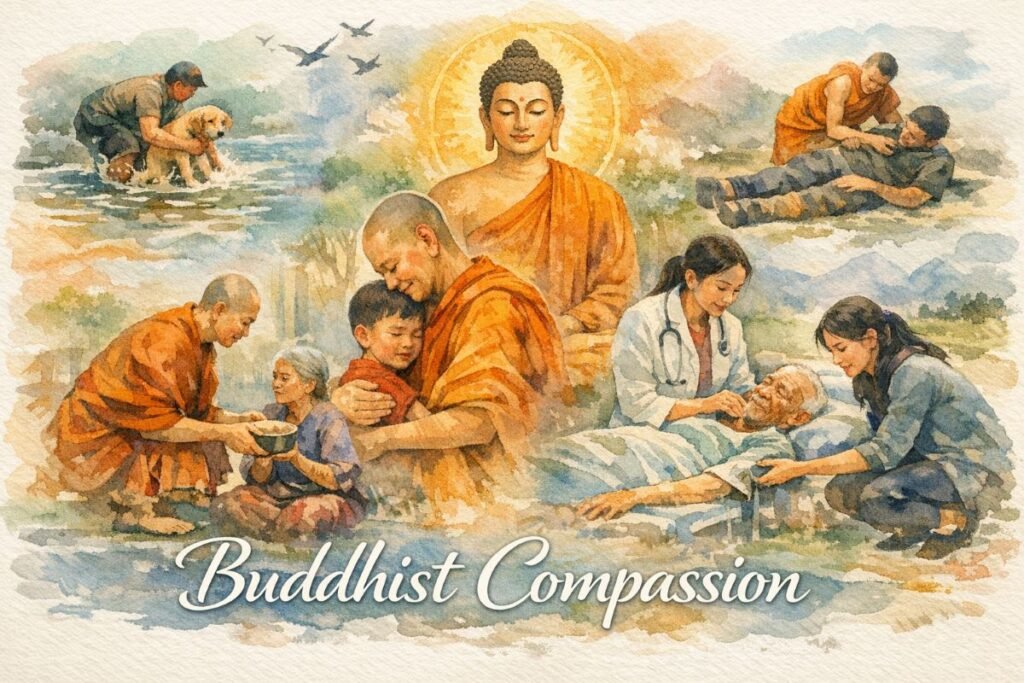
Compassion (karuṇā) is the second of the four immeasurables. It is the heartfelt response to the suffering of others: the wish for them to be free from suffering. While loving-kindness is the wish for happiness, compassion is the active concern that arises when we see pain. The Karaniya Mettā Sutta is actually a teaching on both, as they are inseparable.
Compassion is not pity, which can carry a sense of superiority. True compassion is born from a deep recognition of our shared vulnerability and the universal nature of suffering. It is the natural response of a heart that has opened to the truth of dukkha. It sees one’s own suffering and another’s as fundamentally the same.
Cultivating compassion is central to the Mahāyāna path, embodied in the Bodhisattva ideal. It is the motivation to attain enlightenment not for oneself alone, but for the benefit of all beings. This great compassion (mahākaruṇā) is the driving force behind the altruistic activities of the Bodhisattva. Even on the Theravāda path, compassion is essential as a support for ethical conduct and as a factor of the immeasurable states that lead to liberation.
50. What is the role of equanimity (Upekkhā)?

Equanimity (upekkhā) is the fourth of the four immeasurables. It is a state of balanced, impartial mind that remains steady amidst the eight worldly winds: gain and loss, fame and disrepute, praise and blame, pleasure and pain. Equanimity is not indifference or coldness but the wisdom-based balance that allows love and compassion to flow without being distorted by attachment or bias. The Upekkhā Sutta (SN 24.8) explores this quality.
Equanimity arises from wisdom, the clear recognition of the law of karma and the nature of conditioned phenomena. With equanimity, we can act compassionately without becoming overwhelmed by the suffering we see. We can rejoice in others’ success without envy. We can remain steady when faced with praise or blame, knowing that these are just conditions that come and go.
The four immeasurables are often practiced together. Loving-kindness, compassion, and sympathetic joy (muditā) are the active, engaged expressions of the heart. Equanimity is the stable ground that prevents these qualities from burning out into attachment, burnout, or despair. Together, they form a complete, balanced, and boundless heart-mind that is the foundation for deep wisdom and genuine liberation.
Part 4: The Path of the Bodhisattva and Mahāyāna (Questions 51-70)
Note: This section shifts focus to the Mahāyāna Buddhist tradition, which emerged several centuries after the Buddha’s passing and developed distinctive teachings and practices. While grounded in the foundational principles of the Four Noble Truths and the Eightfold Path, Mahāyāna places a greater emphasis on the Bodhisattva ideal and the direct realization of emptiness.
51. What is the Bodhisattva ideal?
The Bodhisattva ideal is the central tenet of Mahāyāna Buddhism. A Bodhisattva is one who, motivated by great compassion (mahākaruṇā), vows to attain full Buddhahood for the sake of liberating all sentient beings from suffering. This is a radical altruism that prioritizes the welfare of others, even over one’s own final liberation. The Bodhicaryāvatāra (The Way of the Bodhisattva) by Śāntideva is a classic text on this path.
This ideal is rooted in the understanding that ultimate liberation is not a solitary achievement. Because all beings are interconnected through dependent origination, one cannot be fully liberated while others remain in suffering. The Bodhisattva, therefore, postpones their final entry into Nirvana to work tirelessly for the benefit of all.
The Bodhisattva path is characterized by the cultivation of the six perfections (pāramitās) and the Bodhicitta, the awakened mind that is the union of compassion and the wisdom realizing emptiness. This ideal transforms the pursuit of enlightenment into a compassionate mission, infusing all practices with the motivation to benefit others.
52. What is Bodhicitta?
Bodhicitta is the mind of awakening, the spontaneous, compassionate motivation to attain Buddhahood for the benefit of all beings. It is the heart of the Mahāyāna path and the essential prerequisite for becoming a Bodhisattva. It has two aspects: the compassionate wish to liberate others and the wisdom that sees the ultimate nature of reality. The Bodhicittavivaraṇa by Nāgārjuna explores this concept.
Bodhicitta is not just an intellectual aspiration but a profound shift in one’s entire orientation. It is often described as a seed that, when planted in the heart, grows into the full tree of enlightenment. It is cultivated through practices such as the four immeasurables (loving-kindness, compassion, sympathetic joy, and equanimity) and the special practice of tonglen (giving and taking).
Developing and sustaining Bodhicitta is considered the most powerful practice in Mahāyāna. It is said that once Bodhicitta arises, even ordinary actions become the cause of enlightenment. It is the antidote to self-clinging and the fuel that propels the Bodhisattva through the vast expanse of the path, never wavering in their commitment to the welfare of all.
53. What are the Six Perfections (Pāramitās)?
The Six Perfections (Pāramitās) are the practices that a Bodhisattva cultivates on the path to Buddhahood. They are: 1) Generosity (Dāna), 2) Ethical Conduct (Sīla), 3) Patience (Kṣānti), 4) Joyful Effort (Vīrya), 5) Meditative Concentration (Dhyāna), and 6) Wisdom (Prajñā). They are called “perfections” because they are practiced with the wisdom of emptiness, transcending attachment to the self, the object, and the act itself. The Daśabhūmika Sūtra describes the perfection of these practices.
Each perfection supports and refines the others. Generosity is not merely giving but giving without attachment. Ethical conduct is not mere rule-following but spontaneously acting for the welfare of others. Patience endures hardship for their sake. Joyful effort perseveres tirelessly. Concentration provides the mental stability to sustain this activity. Wisdom, the most important, sees the empty nature of all phenomena, preventing the Bodhisattva from being caught in the illusion of a self who is helping others.
Cultivating the pāramitās transforms the mind from a self-centered one into one that is boundless and enlightened. They are not practices to be completed one after the other but are cultivated together, each one deepening the others. They represent the full embodiment of the Bodhisattva path, a complete training in compassion and wisdom.
54. What is the difference between a Bodhisattva and an Arhat?
The primary difference lies in their motivation and the scope of their goal. An Arhat (in the Theravāda tradition) is one who has attained liberation by eradicating all defilements, achieving Nirvana, and will not be reborn. Their motivation is to end their own suffering. A Bodhisattva (in the Mahāyāna tradition) vows to attain full Buddhahood, not for themselves alone, but for the benefit of all sentient beings. They consciously choose to remain in the cycle of rebirth (samsara) to help others. The Vimalakīrti Nirdeśa Sūtra contrasts these paths.
This difference in motivation leads to a difference in the qualities cultivated. While the Arhat perfects the three trainings (ethics, concentration, wisdom) for personal liberation, the Bodhisattva additionally cultivates the six perfections and places supreme emphasis on compassion. The Mahāyāna tradition often characterizes the Arhat’s awakening as a partial one, while the Bodhisattva’s goal of full Buddhahood is seen as the highest and most complete.
It is important to note that these are two ideals within the broader Buddhist tradition. Many Mahāyāna practitioners still respect the Arhat ideal, and many Theravāda practitioners value compassion. The difference is not a conflict but a reflection of the diverse ways the Buddha’s teachings can be practiced, depending on one’s spiritual inclination.
55. What is the Trikāya (Three Bodies) doctrine?
The Trikāya doctrine is a Mahāyāna explanation of the nature of a Buddha. It states that a Buddha has three “bodies” or dimensions. The Dharmakāya (Truth Body) is the ultimate, unconditioned nature of Buddhahood: the formless, unmanifest, and absolute reality of enlightenment itself, shared by all Buddhas. The Sambhogakāya (Enjoyment Body) is the blissful, celestial form that appears to advanced Bodhisattvas in pure lands to teach them. The Nirmāṇakāya (Emanation Body) is the physical, historical form, like Shakyamuni Buddha, that appears in the world to guide ordinary beings. The Mahāyānasaṃgraha and Saṃdhinirmocana Sūtra elaborate on this.
The Dharmakāya represents the ultimate truth that the Buddha realized, emptiness, the unconditioned. The Sambhogakāya represents the compassionate activity of the Buddha that manifests in forms accessible to highly realized beings. The Nirmāṇakāya is the manifestation that ordinary beings can directly interact with.
This doctrine helps reconcile the paradox of the Buddha being both an unconditioned, transcendent reality and a historical person. It also provides a framework for understanding the many Buddhas in Mahāyāna cosmology and the nature of their activity. For practitioners, it points to the potential within all beings, as the Dharmakāya is seen as the ultimate nature of one’s own mind.
56. What is the concept of Buddha-nature (Tathāgatagarbha)?
Buddha-nature (Tathāgatagarbha) is the teaching that all sentient beings possess the inherent potential to become Buddhas. It is the luminous, pure, and unchanging essence of mind that is temporarily obscured by adventitious defilements like greed and hatred. The Mahāyāna Mahāparinirvāṇa Sūtra is a key text for this teaching.
This concept is a powerful affirmation of the innate potential for awakening in every being. It is not a permanent self (ātman) but rather a way of describing the ultimate nature of mind as pure and undefiled. Just as a gold nugget covered in mud is still gold, so the mind, even when obscured, is fundamentally pure and capable of awakening.
The Buddha-nature teaching serves as an antidote to discouragement and a motivation for practice. If we are fundamentally pure, then liberation is not about gaining something new but about uncovering what is already there. This view is foundational to East Asian Buddhist traditions like Chan and Zen, which emphasize the direct realization of one’s own inherent nature.
57. What are Pure Land practices?
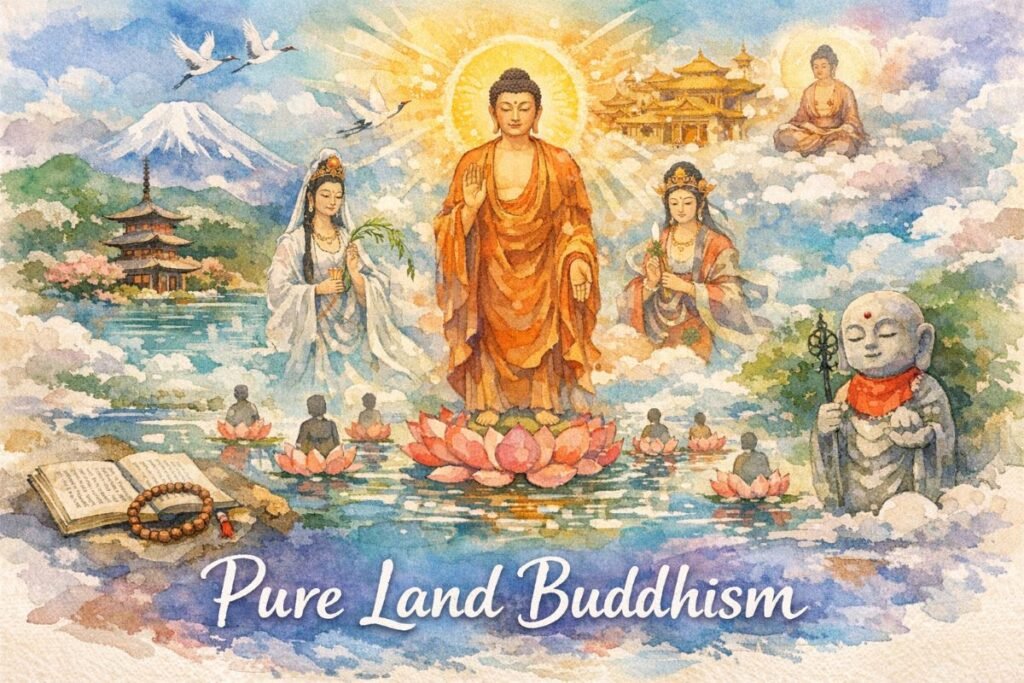
Pure Land Buddhism is a Mahāyāna tradition focused on the practice of mindfulness of the Buddha Amitābha (Amitāyus). The central practice is the recitation of his name (nembutsu in Japanese, niànfó in Chinese), with the aspiration to be reborn in his Pure Land, Sukhāvatī (the Land of Ultimate Bliss). This land is a realm created by Amitābha’s vows, ideal for practicing the Dharma without the distractions and sufferings of our world. The Sukhāvatīvyūha Sūtras are the primary texts.
Pure Land practice is often considered an “easy path” (saha-gata) because it relies on the power of Amitābha’s vows rather than solely on one’s own effort. By sincerely reciting the name and cultivating faith, aspiration, and practice, one can gain rebirth in the Pure Land, from which enlightenment is assured. This path is particularly appealing to laypeople who find the full monastic path challenging.
Despite its apparent simplicity, Pure Land practice is profound. It is a form of meditation that unifies the mind, cultivates devotion, and keeps one’s intention focused on awakening. The recitation itself, done with single-minded concentration, can lead to deep states of samādhi and direct realization of one’s own Buddha-nature, which is none other than Amitābha.
58. What is Zen (Chan) and its approach?
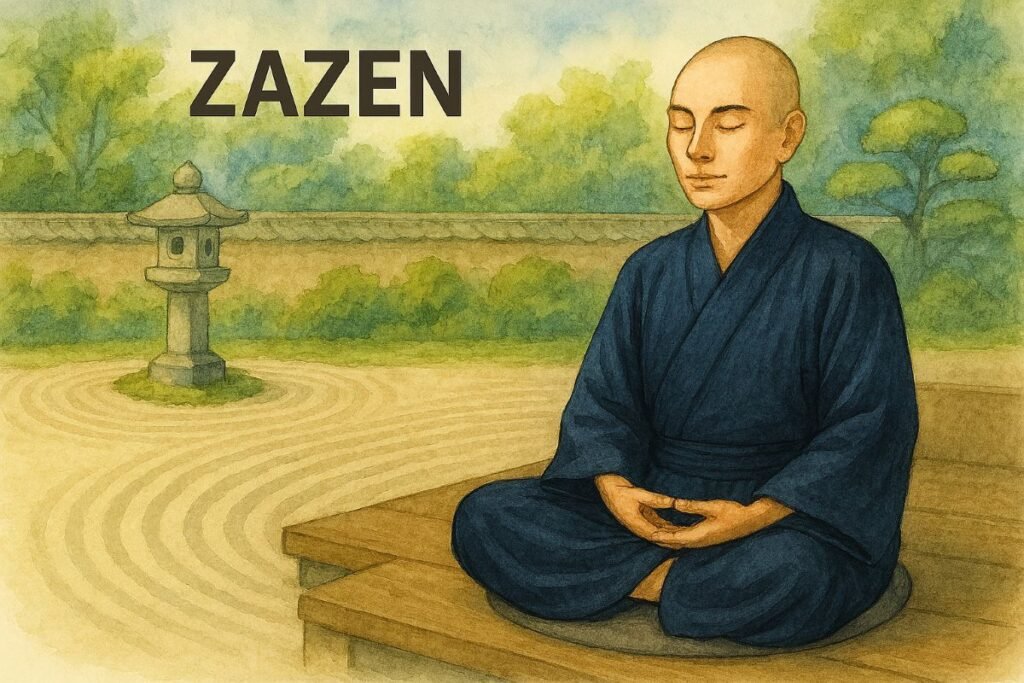
Zen (Chan in Chinese) is a Mahāyāna tradition that emphasizes direct, intuitive insight into one’s own Buddha-nature over scriptural study and intellectual understanding. According to later Chan tradition, it traces its origins to the “flower sermon” where the Buddha held up a flower and Mahākāśyapa alone understood, symbolizing a transmission “outside the scriptures.” This is a foundational legend for the school. The Platform Sūtra of the Sixth Patriarch Huineng is a key text.
The core practice in Zen is zazen (seated meditation), which is seen not merely as a means to an end but as the very expression of enlightenment. Rather than striving for a goal, the practitioner simply sits, letting go of thoughts and mental constructs, allowing the mind to settle into its natural, awakened state. Koans (paradoxical riddles like “What is the sound of one hand clapping?”) are used in some schools as a tool to shatter conceptual thinking and trigger a direct insight (kenshō).
Zen is often called the “sudden school” because it posits that enlightenment can occur in a flash of direct realization. However, this insight is then deepened and integrated through ongoing practice and everyday activity. The emphasis is on the practical, embodied experience of awakening in all activities: eating, walking, working, not just in formal meditation.
59. What is Vajrayāna (Tibetan Buddhism)?
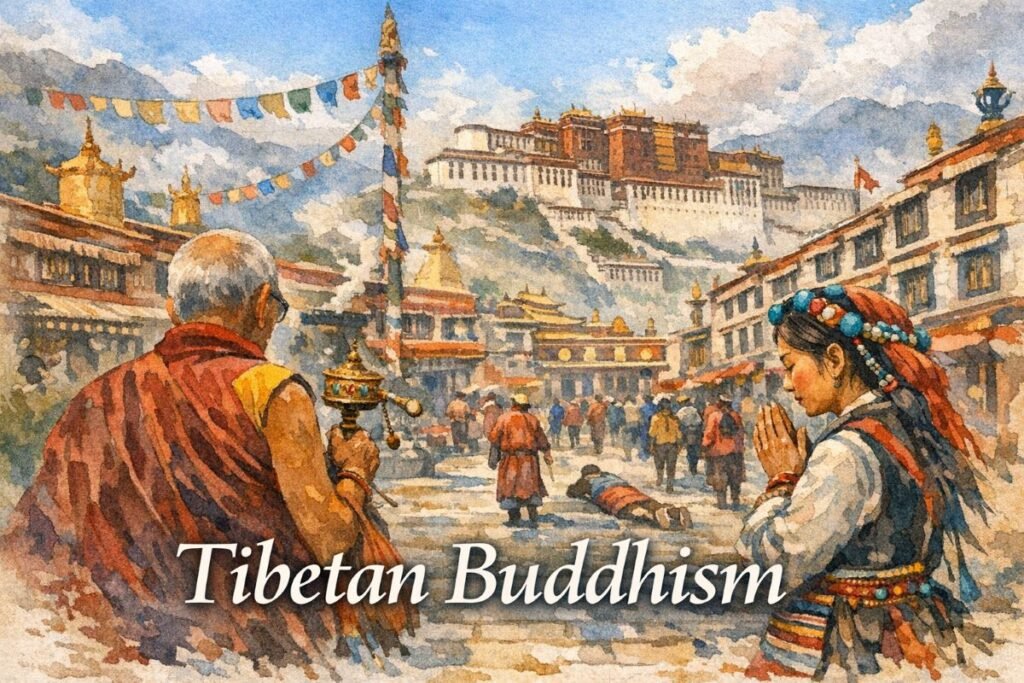
Vajrayāna, or the “Diamond Vehicle,” is a form of Mahāyāna Buddhism that developed in India and flourished in Tibet. It is considered a faster, more powerful path because it utilizes a vast array of skillful means (upāya), including mantra recitation, visualization of deities, complex rituals, and direct teachings from a guru. Its goal is to transform the practitioner’s ordinary, impure perception into the pure perception of a Buddha, thereby achieving enlightenment in one lifetime. The Guhyasamāja Tantra is a key early text.
Central to Vajrayāna is the concept of deity yoga, visualizing oneself as a fully enlightened Buddha (like Avalokiteśvara or Tārā) to dissolve the ordinary sense of self and directly embody enlightened qualities. The role of the guru is paramount, as they are seen as the living embodiment of the Buddha and the one who transmits the authentic lineage. The path involves ngöndro (preliminary practices), sādhana (daily practice), and higher tantras.
Vajrayāna’s methods are powerful but require a strong foundation in the foundational Mahāyāna principles of renunciation, Bodhicitta, and the wisdom of emptiness. Its practices are meant to be conducted in secret, with the proper commitments (samaya), to maintain their efficacy and protect practitioners from misusing the powerful energies they unleash.
60. What is the role of the guru in Vajrayāna?
In Vajrayāna Buddhism, the guru (or lama in Tibetan) is an indispensable guide and a living source of blessings. The guru is seen not just as a teacher but as the embodiment of the Buddha, the Dharma, and the Sangha. The practitioner’s relationship with the guru is founded on complete trust and devotion, as the guru is the conduit through which the lineage’s blessings and realizations are transmitted. The Hevajra Tantra and many guru-yoga practices emphasize this.
The reason for the guru’s centrality is that Vajrayāna’s advanced practices (like deity yoga) require direct transmission and precise guidance to avoid pitfalls. The guru serves as a mirror, pointing out the practitioner’s blind spots and directly introducing them to the nature of mind. Through devotion to the guru, the practitioner’s own ego-clinging is gradually overcome, and the blessings of the lineage are received.
This relationship can be easily misunderstood. The guru is not to be blindly followed; the tradition emphasizes the need for careful examination of a potential teacher over many years. A genuine guru embodies the qualities they teach and guides students toward their own inner wisdom, not toward dependency. The ultimate purpose is for the student’s mind to become inseparable from the guru’s enlightened mind.
61. What are the Four Noble Truths in Mahāyāna?
In Mahāyāna, the Four Noble Truths are accepted as foundational, but they are often interpreted with a greater emphasis on the Bodhisattva path. The first truth (suffering) is understood not only as one’s own suffering but as the immeasurable suffering of all sentient beings. The second truth (cause) is seen as the self-grasping ignorance that underlies the selfish actions that harm others. The Bodhicaryāvatāra gives this expanded perspective.
The third truth (cessation) is the realization of emptiness, which is the full awakening of a Buddha, attained for the sake of all. The fourth truth (the path) is the Noble Eightfold Path, which in Mahāyāna is often presented as the Six Perfections. Each factor of the path is practiced with the motivation of Bodhicitta and the wisdom of emptiness.
Thus, while the content of the Four Noble Truths remains the same, their scope expands in Mahāyāna. They become the framework not just for personal liberation but for the vast project of liberating all beings. The emphasis shifts from the individual’s escape from samsara to the transformation of samsara into a pure land through compassionate activity.
62. What is the Bodhisattva’s approach to suffering?
The Bodhisattva does not flee from suffering but embraces it as a tool for awakening. Because of their great compassion, they willingly enter the realms of suffering to help beings. They see suffering not as an enemy to be avoided but as a powerful motivation to practice and as a means to develop empathy, patience, and the understanding of the nature of dukkha. The Bodhicaryāvatāra (Chapter 8) discusses how to transform adversity into the path.
For the Bodhisattva, suffering is the raw material for compassion. Without the existence of suffering, there would be no need for compassion. Therefore, they view suffering as a teacher and an ally. They understand that their own suffering connects them to all beings and fuels their determination to achieve liberation for everyone.
The Bodhisattva does not seek out suffering masochistically but does not run from it either. With the wisdom of emptiness, they are able to engage with suffering without being overcome by it. They are like a parent who willingly endures hardship to care for a sick child, seeing their own well-being as inseparable from the child’s.
63. What is the concept of skillful means (Upāya)?
Skillful means (upāya) is the Mahāyāna concept that the Buddha and enlightened beings teach the Dharma in a way that is perfectly suited to the capacities, needs, and circumstances of the audience. A single, absolute truth is not proclaimed; instead, the teaching is adapted to lead beings gradually toward awakening. The Lotus Sūtra is the great classic on this concept, using the parable of the burning house to illustrate it.
This concept implies that the Dharma is not a rigid set of doctrines but a flexible set of tools. What is skillful for one person at one time may not be for another. The Buddha’s various teachings, some seemingly contradictory, are understood as different skillful means tailored to different mentalities. This allows for a great diversity of practices within the tradition.
For the practitioner, understanding upāya means respecting different paths and not clinging to one’s own view as the only truth. It also means applying the teachings to one’s own life with flexibility and creativity. The highest skillful means is the direct, spontaneous activity of an enlightened being, who perfectly knows what is needed and responds without conceptual calculation.
64. How does Mahāyāna view the historical Buddha?
Mahāyāna Buddhism views the historical Buddha, Shakyamuni, as one manifestation of Buddhahood, specifically, the Nirmāṇakāya or Emanation Body. He is seen as the compassionate appearance of the ultimate truth (Dharmakāya) in a form accessible to ordinary beings in this world. His life and teachings are considered skillful means, a perfect display of enlightenment tailored to our capacity. The Lalitavistara Sūtra, a Mahāyāna text, presents his life in a highly symbolic and divine manner.
This view allows for the existence of many other Buddhas, both in the past and in other world-systems, such as Amitābha and Bhaiṣajyaguru (the Medicine Buddha). Shakyamuni is deeply respected, but he is not the only Buddha. His teachings are seen as the entry point to the vast Mahāyāna teachings, which he also revealed in various forms to different audiences.
The Mahāyāna perspective does not diminish the historical Buddha; it elevates his teaching to a cosmic scale. He is seen not just as a wise man who discovered a truth but as a cosmic being whose compassionate activity has been manifesting throughout time and space to guide all beings toward enlightenment.
65. What is the significance of emptiness in Mahāyāna?
Emptiness (śūnyatā) is the central philosophical insight of Mahāyāna Buddhism. Building on the early teachings of non-self (anattā), Mahāyāna extends emptiness to all phenomena. Nāgārjuna, the founder of the Madhyamaka (Middle Way) school, demonstrated that all phenomena, including the Buddha, Nirvana, and the path itself, are empty of inherent existence. His Mūlamadhyamakakārikā (Fundamental Verses on the Middle Way) is the foundational text.
Understanding emptiness is the wisdom (prajñā) that perfects all other practices. A Bodhisattva practices generosity with the understanding that the giver, the gift, and the receiver are all empty of inherent existence, thus transcending attachment. This understanding prevents the Bodhisattva from falling into the extremes of eternalism or nihilism and allows them to work tirelessly for beings without being wearied by the apparent solidity of samsara.
Emptiness is not a mere philosophical position but a direct realization to be achieved through meditation and analysis. Its realization is synonymous with enlightenment. It is the ultimate truth (paramārtha-satya) that, when realized, shatters all clinging and leads to the perfect freedom and compassion of a Buddha.
66. What is the concept of “non-abiding Nirvana”?
Non-abiding Nirvana (apratiṣṭhita nirvāṇa) is a Mahāyāna concept that describes the state of a Buddha. Unlike the Arhat, who is said to “abide” in Nirvana after death, a Buddha does not remain fixed in the peace of Nirvana nor get lost in the turmoil of samsara. Because of their wisdom, they are fully liberated; because of their compassion, they are ceaselessly active for the benefit of beings. The Vimalakīrti Nirdeśa Sūtra is a key source for this idea.
This state is the perfect integration of the two truths. A Buddha knows the ultimate truth of emptiness, so they are not attached to any conditioned phenomenon. Yet they also know the conventional truth and see the suffering of beings, so they spontaneously manifest compassionate activity in countless forms. They are not “in” either samsara or Nirvana; they transcend both.
This is the ideal that the Bodhisattva aspires to. It represents the final transcendence of all dualities—between self and other, peace and activity, samsara and Nirvana. It is the state of perfect freedom, where wisdom and compassion are one, and the enlightened being is free to act in any way that benefits others, without any trace of self-interest.
67. What is the role of women in Buddhism?
The role of the women in Buddhism has been a complex and evolving subject. Historically, the Buddha established an order of nuns (bhikkhunī sangha), as recorded in the Gotamī Sutta (AN 8.51), granting women the opportunity to pursue full liberation. The Therīgāthā (Verses of the Elder Nuns) contains the powerful, inspiring verses of early enlightened women. The Buddha affirmed that women are equally capable of attaining all stages of awakening, up to Arhatship.
However, in many traditional Buddhist cultures, women have faced subordinate roles and institutional restrictions, such as the garudhammas (eight heavy rules) that placed the nuns’ order under the authority of the monks. In Mahāyāna, the concept of Buddha-nature is held to be universal, transcending gender. Some Mahāyāna sutras, like the Vimalakīrti Nirdeśa, famously challenge gender discrimination, with a goddess out-debating Śāriputra on the nature of gender.
In modern times, there is a strong movement to revive the bhikkhunī ordination lineage in Theravāda countries and to elevate the status of women in all Buddhist traditions. Contemporary teachers like Pema Chödrön have become global leaders, highlighting that the wisdom and compassion of the Dharma are accessible to all, regardless of gender.
68. What is the place of lay practitioners in Mahāyāna?
Mahāyāna Buddhism, particularly in its East Asian forms (Chan, Pure Land), historically placed a much stronger emphasis on the role of lay practitioners than the early monastic-centered traditions. The Vimalakīrti Nirdeśa Sūtra is a key text that features a layman, Vimalakīrti, who is portrayed as surpassing even the great disciples in wisdom and realization, demonstrating that enlightenment is not exclusive to monastics.
The Bodhisattva path is open to all, monastic and lay, male and female. The six perfections can be practiced in any context. A layperson can cultivate generosity, ethical conduct, patience, and wisdom within family life, work, and social engagement. The emphasis shifts from renunciation of the world to transformation within the world.
This inclusivity has allowed Mahāyāna to flourish in diverse cultural contexts. While monastic institutions remain important as centers of learning and practice, the tradition recognizes that lay practitioners are not second-class citizens but are equally capable of profound realization and are vital to the propagation and embodiment of the Dharma in society.
69. What is the role of art and ritual in Mahāyāna?
In Mahāyāna, art and ritual are viewed as powerful skillful means (upāya) for expressing and cultivating the Dharma. The creation of intricate maṇḍalas, the chanting of sutras, the making of offerings, and the performance of elaborate rituals are not seen as mere cultural additions but as profound practices that engage the mind, purify perception, and create the conditions for awakening. The Sukhāvatīvyūha Sūtras describe the splendor of the Pure Land, inspiring aspiration and devotion.
Buddhist art: statues, paintings, architecture, serves as a support for meditation and a reminder of enlightened qualities. A statue of a Buddha or Bodhisattva is not an idol but a focal point for mindfulness, a representation of the potential within oneself. Rituals like offering incense, prostrations, and circumambulations are forms of embodied practice that cultivate humility, devotion, and a sense of connection to the lineage.
These forms can be profoundly effective for many practitioners. They engage the whole person: body, speech, and mind in practice. In the Vajrayāna tradition, these external forms become even more central, as the practitioner learns to see all phenomena as the pure mandala of a Buddha, using art and ritual to transform ordinary perception into enlightened vision.
70. How does Mahāyāna view the concept of time?
Mahāyāna Buddhism often presents a radical view of time, challenging our conventional linear understanding. The concept of a “moment” (kṣaṇa) is understood to be extraordinarily short, and a Buddha’s activity is said to span countless eons (kalpas) of compassionate work. Yet, from the ultimate perspective, time itself is understood to be empty of inherent existence, a conventional construct. The Avataṃsaka Sūtra is famous for its vision of the interpenetration of all times and spaces.
The doctrine of the three times (past, present, future) is understood conventionally. Ultimately, enlightened beings are said to see all three times simultaneously, as the Avataṃsaka describes: “One moment contains all moments.” This is not a mystical speculation but a description of the nature of a mind that has realized emptiness, free from the conceptual constraints of before and after.
This understanding has practical implications. It encourages patience on the Bodhisattva path (willing to work for eons) and also a sense of urgency (realizing the preciousness of this present moment). It allows the practitioner to see that liberation is not a future event but a reality to be realized in the immediacy of the present, free from the illusion of linear time.
Part 5: Applying Buddhism in the Modern World (Questions 71-90)
71. How can mindfulness be integrated into a busy daily life?

Integrating mindfulness into a busy daily life begins with bringing full attention to ordinary activities. Instead of rushing through tasks, one can practice mindful eating, mindful walking, or even mindful dishwashing. The Satipaṭṭhāna Sutta (MN 10) provides the framework: to be aware of the body in the body, feelings in feelings, etc., regardless of what one is doing.
Setting aside time for formal meditation, even just 10-20 minutes a day, is crucial for building the capacity for mindfulness. This formal practice strengthens the “muscle” of attention, making it easier to stay mindful during the chaos of the day. Using ordinary triggers, like a phone ringing or a red light, as reminders to return to the breath can weave mindfulness into the fabric of daily life.
Technology can also be a support, not a hindrance. Using apps for guided meditation or setting mindful reminders can be helpful. Ultimately, the goal is to transform one’s entire life into a practice, so that mindfulness is not something one “does” for a few minutes a day, but the fundamental way one relates to every experience.
72. How can the Five Precepts be applied in a modern context?
The Five Precepts can be applied in a modern context by understanding their spirit rather than just their letter. Refraining from killing extends to supporting a compassionate diet, avoiding the use of harmful pesticides, and cultivating a general attitude of non-violence. Refraining from stealing includes not engaging in software piracy, tax evasion, or exploiting labor.
Refraining from sexual misconduct in a modern context means not only avoiding adultery but also fostering relationships based on mutual respect, consent, and honesty, and avoiding sexual exploitation or harassment. Refraining from false speech applies to social media: avoiding spreading rumors, using deceptive marketing, or engaging in “fake news.” It means being truthful in all communications.
Refraining from intoxicants includes being mindful of one’s relationship with alcohol, drugs, and even digital distractions that “intoxicate” the mind, clouding judgment and leading to heedlessness. The precepts, in this way, are not archaic rules but a dynamic, contemporary guide to living a life of integrity, safety, and mindfulness in the 21st century.
73. What does Buddhism say about social justice and activism?
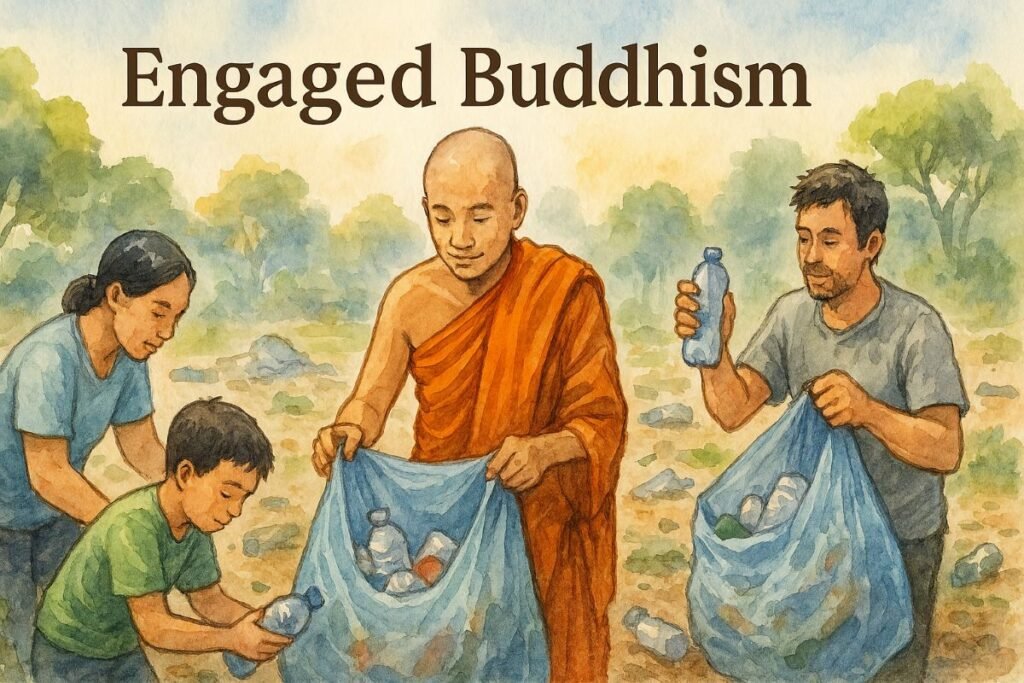
Buddhism, with its foundational principles of compassion (karuṇā) and non-harming (ahiṃsā), has a strong basis for engaging in social justice. The Bodhisattva ideal is inherently activist, it is a commitment to work for the welfare of all beings. The Buddha’s own teachings often addressed social issues, criticizing the caste system and advocating for the fair treatment of all, including women, servants, and outcasts. The Sigalovada Sutta (DN 31) outlines reciprocal duties in social relationships.
Activism in the Buddhist context is not driven by anger, hatred, or a desire for power, but by compassion and a clear understanding of the causes of suffering (greed, hatred, ignorance). It is a manifestation of the first precept, protecting life, on a social scale. Engaged Buddhists like Thich Nhat Hanh and the 14th Dalai Lama have exemplified this, advocating for peace, environmental protection, and human rights without resorting to violence or hatred.
However, Buddhism also cautions against activism that arises from attachment to views or from anger. The Kakacūpama Sutta (MN 21) teaches the importance of maintaining a mind of goodwill even when facing harsh criticism. Right activism, therefore, is motivated by compassion, informed by wisdom, and conducted with a mind of equanimity and non-hatred, even as it confronts injustice.
74. How does Buddhism address environmental concerns?
Buddhism provides a profound philosophical and ethical basis for environmentalism. The principle of dependent origination reveals the deep interconnection between all life forms and the environment. The teaching of non-harming (ahiṃsā) extends to the natural world, which is a system of sentient and non-sentient beings. The Vanaropa Sutta (SN 1.47) speaks of the merit of planting groves and building bridges, showing an early appreciation for environmental action.
The Buddha’s emphasis on moderation and contentment directly counters the consumerism and overconsumption that drive environmental destruction. The precept against killing and the ideal of compassion for all beings create an ethical imperative to protect ecosystems and species. The monastic lifestyle, with its emphasis on simplicity and minimal impact, serves as a model for sustainable living.
Engaged Buddhists today are at the forefront of environmental activism, seeing the protection of the planet as an extension of their spiritual practice. They recognize that climate change, deforestation, and species extinction are manifestations of the collective greed, hatred, and delusion that the path seeks to uproot. Caring for the Earth is not separate from caring for all sentient beings.
75. How can Buddhism help with stress and anxiety?

Buddhism offers a powerful toolkit for managing stress and anxiety, primarily through mindfulness and insight. When we are anxious, we are often caught in thoughts about the future, projecting worst-case scenarios. Mindfulness practice trains us to recognize these thoughts as just thoughts, not reality, and to return our attention to the present moment, which is often safe and manageable. The Bāhiya Sutta (Ud 1.10) offers the instruction: “In the seen, just the seen…”
Furthermore, the teachings on impermanence remind us that anxious feelings, like all phenomena, arise and pass away. We do not have to be controlled by them. Learning to observe physical sensations of anxiety (racing heart, tight chest) with equanimity, rather than reacting with fear, breaks the feedback loop that amplifies anxiety into panic.
Ultimately, the deep cause of anxiety is clinging: to control, to outcomes, to a fixed idea of how things “should” be. The path of practice gradually releases this clinging, fostering a deep sense of trust and equanimity that remains stable even in the face of uncertainty. This is not the elimination of fear but the end of being enslaved by it.
76. How to practice Buddhism with a family and career?
Practicing Buddhism with a family and career is not a hindrance but an opportunity. The Sigalovada Sutta (DN 31) is specifically addressed to laypeople, outlining how to fulfill duties toward parents, spouse, children, teachers, and employees with mindfulness and compassion. Family life becomes the primary field for practicing patience, generosity, kind speech, and selfless service.
A career can be approached as an opportunity to practice Right Livelihood and to cultivate the six perfections. One can practice generosity by mentoring colleagues, patience by enduring workplace stress, and ethical conduct by maintaining integrity. Parenting is a profound training in loving-kindness, compassion, and letting go of control. The householder’s life, with its joys and sorrows, provides endless material for cultivating the path.
The key is to integrate practice into daily life rather than seeing it as separate. Brief moments of mindfulness throughout the day, ethical reflection, and maintaining a weekly practice of meditation or Dharma study can keep one grounded. The support of a local Sangha and the aspiration to make one’s family a “mini-Sangha” are invaluable for sustaining practice amidst the demands of modern life.
77. What is the Buddhist perspective on wealth and poverty?
Buddhism does not view wealth as inherently bad. The Buddha taught laypeople how to manage their finances skillfully, advising that wealth should be enjoyed, shared with others, and used for good purposes. The Dīghajāṇu Sutta (AN 8.54) gives advice on achieving both material and spiritual well-being, emphasizing the importance of diligent work, protecting one’s earnings, and living in balance.
However, the danger of wealth lies in attachment. Wealth can become a source of greed, anxiety, and divisiveness. The Buddha famously said that the greatest wealth is the wealth of faith, virtue, generosity, and wisdom. Poverty, while not a virtue in itself, can be a condition that leads to suffering and unwholesome acts. The Cakkavatti Sutta (DN 26) describes how poverty leads to crime and social breakdown.
The Middle Way in this context is to neither condemn nor crave wealth. A lay practitioner can acquire and use wealth for the welfare of self and others, practicing generosity as a means of loosening attachment. The ultimate perspective is to see all material possessions as transient and not a true source of security, which is found only in the qualities of a well-trained mind.
78. How does one balance worldly responsibilities with spiritual aspirations?
Balancing worldly responsibilities with spiritual aspirations is a classic challenge for lay practitioners. The Buddha’s advice is to not neglect either, but to see them as integrated. The Saṅghāṭi Sutta (AN 4.61) describes a layperson who enjoys wealth and uses it for the benefit of family and monastics, and who also cultivates faith, virtue, generosity, and wisdom. One does not preclude the other.
The key is to bring the qualities developed on the path: mindfulness, patience, compassion, wisdom, into the performance of worldly duties. In this way, responsibilities become the practice rather than an obstacle. Renunciation, in the lay context, is not about giving up one’s job or family but about renouncing the attachment and selfishness that can arise within them.
A sustainable practice involves setting aside dedicated time for formal practice (like morning meditation) while treating the rest of the day as informal practice. It also involves periodically stepping back to reflect on priorities, ensuring that worldly pursuits are not eclipsing the deeper aspiration for liberation. With skillful means, the two paths can support rather than hinder each other.
79. What is the role of technology in Buddhist practice?

Technology can be both a powerful tool and a significant distraction for Buddhist practice. It can be a tool by providing access to the Dharma through online teachings, meditation apps, and digital libraries of sutras. It allows for global Sangha connections, virtual retreats, and the ability to study with teachers from anywhere in the world. This accessibility is unprecedented in Buddhist history.
However, technology is also a primary source of distraction, promoting the very habits that the path seeks to overcome: sensory craving, constant stimulation, and a scattered mind. Social media can be a breeding ground for the unwholesome states of envy, anger, and divisive speech. The constant notifications and infinite scroll are designed to hijack attention, the very faculty we are trying to cultivate.
The skillful approach is to use technology with mindfulness and intention. This might mean setting boundaries (e.g., no phones during meals, digital sabbaths), using apps as a support for practice rather than a replacement for it, and being mindful of the intentions and mental states that arise when using technology. Ultimately, we must use the tool without letting it use us.
80. How can Buddhism contribute to mental health?
Buddhism offers profound insights and practices that align closely with, and can complement, modern mental health care. Mindfulness-Based Stress Reduction (MBSR) and Mindfulness-Based Cognitive Therapy (MBCT) are evidence-based programs derived directly from Buddhist mindfulness practices, and may be effective for stress, anxiety, and depression. The focus on present-moment awareness, non-judgment, and letting go of harmful thought patterns directly addresses the core of many mental health challenges.
Beyond mindfulness, Buddhist teachings on the nature of the self (anattā) offer a direct counter to the ego-centricity and self-criticism that often underlie mental suffering. The practice of loving-kindness (mettā) is a powerful antidote to self-hatred and depression. The framework of the Four Noble Truths normalizes suffering as a human condition, reducing the shame and isolation that can accompany mental health struggles.
It is important to note that Buddhism is a spiritual path, not a replacement for clinical treatment. However, as an adjunct to therapy or as a preventative practice, it can be immensely powerful. It provides a holistic framework for understanding the mind, cultivating well-being, and building the inner resilience that is the foundation of true mental health.
81. What does Buddhism say about relationships?
Buddhism offers a rich framework for healthy relationships, based on mutual respect, responsibility, and compassion. The Sigalovada Sutta (DN 31) is the key text, outlining the reciprocal duties between parents and children, teachers and students, spouses, friends, and employers and employees. A healthy relationship is one where both parties fulfill their duties with care and goodwill.
The teaching on non-attachment is crucial for relationships. Unhealthy relationships are often characterized by clinging, the view that the other person exists to fulfill our needs. True love, in the Buddhist sense, is wanting the other to be happy and free, even if that means letting go of our own expectations. This is the love of loving-kindness (mettā) and compassion (karuṇā), free from possessiveness.
Conflict in relationships is an opportunity for practice. The teachings on Right Speech (truthful, kind, beneficial, timely) provide a framework for communication. Patience (khanti) and forgiveness allow relationships to weather storms. Ultimately, all relationships, like all conditioned things, are impermanent. Recognizing this allows us to cherish them while they last and let go with grace when they end.
82. How to handle grief and loss from a Buddhist perspective?
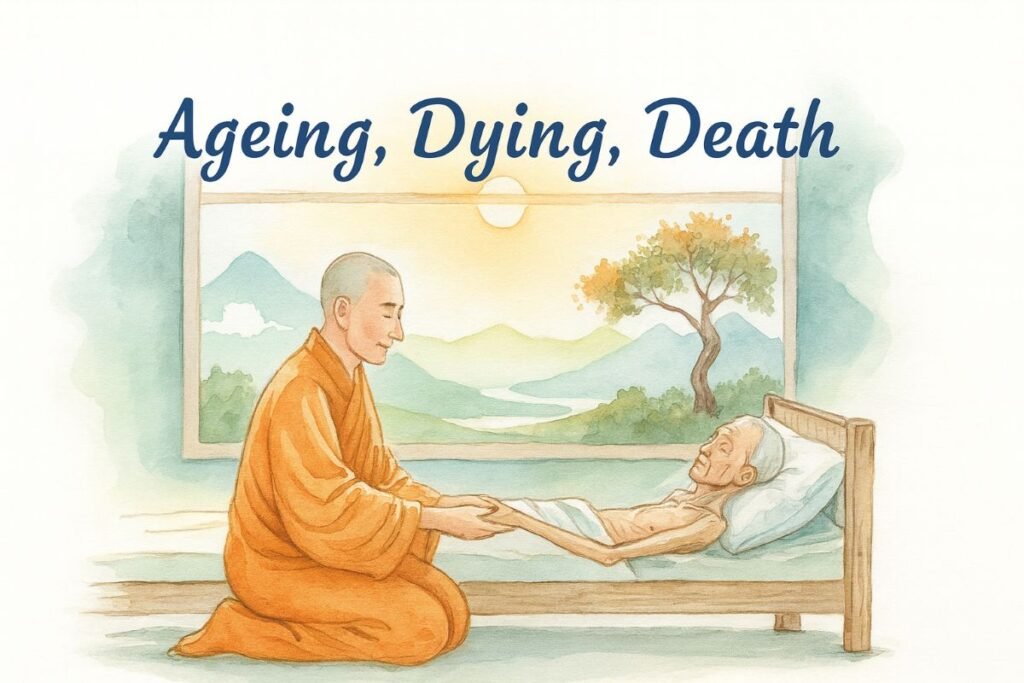
From a Buddhist perspective, grief and loss are a direct confrontation with the First Noble Truth: there is suffering. The pain of loss is a natural human response. Buddhism does not ask us to suppress or deny grief. Instead, it provides tools to work with it skillfully. Mindfulness allows us to be present with the raw sensations of grief without being overwhelmed by the stories and regrets that can compound the pain.
The teachings on impermanence (anicca) provide the ultimate context: loss is not an aberration but the very nature of conditioned existence. All that we hold dear, our loved ones, our youth, our health, is subject to change and passing. Contemplating this before loss occurs can prepare the heart. Contemplating it during loss can provide a framework for acceptance, not as resignation, but as a wise acknowledgment of reality.
The practice of loving-kindness (mettā) and compassion (karuṇā) can be directed toward oneself in grief, offering the same kindness we would offer a dear friend. The practice of transferring merit and the belief in rebirth can provide comfort, as we can dedicate our good deeds to the departed and reflect that the relationship is not entirely severed but transformed. Grief, when met with mindfulness and compassion, can become a profound teacher of the heart.
83. What is the Buddhist view on abortion?
Buddhism does not have a single, monolithic view on abortion, as it is a complex issue with ethical, karmic, and practical dimensions. The first precept (refraining from taking life) is foundational. From this perspective, abortion is generally viewed as an act of taking a life. The Vinaya (monastic code) explicitly states that a monk or nun should not encourage abortion. Therefore, many traditional Buddhist teachers advise against it.
However, the principle of compassion (karuṇā) is equally foundational. This means that the context, intention, and consequences are crucial. Many Buddhist thinkers and practitioners consider the well-being of the mother, her physical and mental health, the viability of the pregnancy, the circumstances of conception, as significant factors in making such a difficult decision. There is no concept of eternal sin; rather, the focus is on the quality of intention and the potential for future healing and wholesome action.
Thus, while respecting the first precept, many in modern Buddhism adopt a nuanced position: they do not advocate abortion but support compassionate counseling for those considering it, emphasizing that it is a grave decision to be made with as much mindfulness and wisdom as possible. Post-abortion, the focus is on healing, forgiveness, and generating positive karma to offset the negative, not on judgment.
84. How does Buddhism view suicide?
Buddhism views suicide as an unskillful and tragic act, fundamentally rooted in suffering, aversion, and delusion. Taking one’s own life violates the first precept of not killing, and the intention behind it, typically despair or aversion to pain, is an unwholesome mental state. However, the tradition recognizes that the circumstances can be complex. The Channa Sutta (SN 35.87) recounts the story of the monk Channa, who was terminally ill and in great pain. After being counseled by Sāriputta and Mahācunda, he used a knife. When this was reported to the Buddha, he clarified that Channa was blameless because, at the moment of his death, his mind was free from clinging, he had attained the final liberation of an Arahant.
This nuanced case shows that the ethical evaluation depends critically on the state of mind. For an unenlightened person, suicide is generally considered an act of aversion, which does not end suffering but merely cuts short this life and may lead to an even more difficult rebirth. The Buddhist view is that the precious human rebirth, with its unique opportunity for Dharma practice, should be protected and used for spiritual progress.
Therefore, the Buddhist response to suicidal thoughts is one of great compassion and support. It encourages reaching out for help, understanding that the mind is clouded and that the perceived hopelessness is not reality. The path offers tools to work with even the most intense suffering, and the Sangha provides a community of support. The emphasis is on preserving life and finding a way to practice within even the most difficult circumstances.
85. How to deal with conflict and disagreement in a Buddhist way?
Dealing with conflict in a Buddhist way begins with self-awareness. When conflict arises, the first step is to notice our own emotional reactions: anger, defensiveness, fear and to take a pause. The Kakacūpama Sutta (MN 21) famously teaches that even if bandits were to saw us apart limb by limb, we should not let our mind be angered, and we should maintain a mind of goodwill. This is an extreme example, illustrating that our internal state is our primary responsibility.
The next step is to practice Right Speech. This means speaking only what is true, beneficial, and timely. Before speaking, we can ask: Is it true? Is it kind? Is it necessary? Is this the right time? Often, silence or a simple request to revisit the conversation later is the most skillful response. We seek to understand the other person’s perspective, recognizing that their behavior, like ours, arises from conditions (ignorance, fear, past hurts).
Finally, we approach conflict with the intention to resolve it in a way that minimizes harm. This may involve apologizing for our part, forgiving the other, and finding a middle way that respects both parties’ needs. The ultimate goal is not to “win” the argument but to preserve the relationship and to use the conflict as an opportunity for personal growth and deeper understanding.
86. How can one cultivate generosity (Dāna) in a modern context?
Generosity (dāna) can be cultivated in myriad ways in modern life, extending far beyond giving money to monks. It begins with the intention to give freely, without expecting anything in return. This can be practiced by offering one’s time (volunteering), one’s skills (teaching, mentoring, offering professional expertise for free), or one’s attention (listening deeply to someone who needs to be heard). The Dāna Sutta (AN 7.49) describes the factors that make a gift powerful: giving with faith, respect, timeliness, an open heart, and without harming oneself or others.
Financial generosity can be practiced by supporting causes aligned with Buddhist values: environmental protection, social justice, healthcare, and of course, the preservation and dissemination of the Dharma. Even small, regular acts of giving: buying a meal for someone in need, donating to a local food bank, cultivate the habit of letting go of attachment to possessions.
The ultimate generosity is the giving of the Dharma (Dhammadāna), sharing the teachings in a way that is helpful and appropriate. This does not mean preaching but living as an example, sharing a helpful perspective with a friend, or supporting others in their own practice. Generosity is the first perfection because it directly counteracts greed and opens the heart, creating the foundation for all other wholesome qualities.
87. What is the significance of pilgrimage in Buddhism?
Pilgrimage (pāyāta) is a practice that has been important in Buddhism since the time of the Buddha. He recommended four places of pilgrimage for his followers: Lumbini (his birthplace), Bodh Gaya (the place of his enlightenment), Sarnath (the site of his first sermon), and Kusinara (the place of his passing). The Mahāparinibbāna Sutta (DN 16) records this teaching, stating that a faithful person who dies on such a pilgrimage will be reborn in a heavenly realm.
The purpose of pilgrimage is not to gain merit alone, but to connect with the living reality of the Buddha’s life and teachings. Visiting these sacred sites can inspire faith, deepen reflection on the Buddha’s example, and create a powerful sense of connection to the long lineage of practitioners. It is an opportunity to practice mindfulness, generosity, and devotion in a supportive environment.
In the modern context, pilgrimage can also be a journey to the “inner” sacred sites, the Buddha’s teachings enshrined in our own minds. Traveling to these historical sites can be a profound experience, but the ultimate pilgrimage is the inward journey from ignorance to wisdom, from suffering to liberation. All outer pilgrimage is a support for this inner journey.
88. How does Buddhism view other religions?
Buddhism generally adopts an attitude of respect and non-conflict toward other religions. The Buddha taught that there are many spiritual paths, and he advised his followers not to criticize the teachings of others out of disrespect. The Canki Sutta (MN 95) outlines a framework for evaluating teachings based on their efficacy in leading to wholesome qualities, peace, and liberation, rather than simply rejecting them for being “other.”
The view is that other religions can contain truth and lead to ethical living and positive rebirth. However, from a Buddhist perspective, they do not offer the complete path to liberation because they do not teach the full Four Noble Truths and the direct realization of non-self and emptiness. This is not a position of superiority but of different goals: a path to a heavenly realm is not the same as a path to Nirvana.
In practice, this has led to a long history of peaceful coexistence and syncretism in many Buddhist cultures. The Dalai Lama famously advocates for “secular ethics” and interfaith dialogue, recognizing that while different religions may have different views on ultimate reality, they share common values of compassion, love, and forgiveness that are essential for a peaceful world.
89. What is the future of Buddhism in the modern world?
The future of Buddhism in the modern world is likely to be characterized by continued globalization, adaptation, and diversification. As Buddhism spreads in the West, it is increasingly being integrated with modern psychology, science, and secular culture. Movements like “Engaged Buddhism” are emphasizing the application of Buddhist principles to social, political, and environmental issues. The tradition is also being challenged and reshaped by issues of gender equality, social justice, and modern ethics.
The digital age is making the Dharma more accessible than ever, with teachings, translations, and communities available online. This also presents challenges, such as the dilution of lineage and the risk of “spiritual consumerism.” There will be a continued need for authentic, well-trained teachers and the preservation of the core teachings amidst adaptation.
The future will also see the continued growth of Western Buddhism, with new forms of practice that blend traditional forms with modern culture. At the same time, Buddhism in its traditional Asian homelands is evolving, facing challenges like modernity and materialism. The resilience of the Dharma lies in its universality and its core truth: it is a path to end suffering, which is a universal human need.
90. How to begin a Buddhist practice?
To begin a Buddhist practice, one starts with the fundamentals: learn about the Buddha, the Dharma, and the Sangha. Read the foundational teachings, the Four Noble Truths and the Noble Eightfold Path. Find a local or online Sangha or a teacher (kalyāṇamitta) to connect with. The support of a community is invaluable for beginning and sustaining practice. The Upaddha Sutta (SN 45.2) emphasizes the importance of admirable friendship.
Begin a simple, regular meditation practice. Start with just 10-15 minutes a day of mindfulness of the breath (ānāpānasati). Sit comfortably, bring your attention to the sensation of the breath, and when the mind wanders, gently bring it back. This builds the foundational skill of mindfulness. Also, begin to observe the Five Precepts as a personal training in ethical conduct.
Integrate the teachings into daily life. Practice generosity in small ways, cultivate patience when difficulties arise, and try to speak with truth and kindness. The path is a gradual one; there is no need to do everything at once. Consistency is more important than intensity. The journey begins with a single step, and the direction, toward less suffering and more freedom, is what matters most.
Part 6: Deepening Practice and Advanced Topics (Questions 91-108)
91. What are the stages of enlightenment?
The Theravāda tradition outlines four progressive stages of enlightenment. The first is Stream-entry (Sotāpanna), where the practitioner has eradicated the first three fetters: self-view, doubt, and clinging to rites and rituals. They have seen the Dharma clearly and will be fully enlightened within seven lifetimes. The second is Once-returner (Sakadāgāmī), who has weakened the fetters of sensual desire and ill-will, and will return to the human realm only once more. The Sotāpatti Saṃyutta (SN 55) details the qualities of a stream-enterer.
The third stage is Non-returner (Anāgāmī), who has eradicated the five lower fetters (self-view, doubt, clinging to rites, sensual desire, and ill-will). They will not be reborn in the human realm but will attain final Nirvana in a pure abode. The final stage is Arhat (Arahant), who has eradicated all ten fetters, including the subtle ones of desire for form, desire for formless, conceit, restlessness, and ignorance. They are fully liberated, with no further rebirth.
These stages are progressive realizations of the truth. Each stage represents a deeper level of insight into the nature of reality and a corresponding weakening and final eradication of the mental defilements. They are not merely theoretical but are attainable through sustained practice, as countless practitioners throughout history have demonstrated.
92. What are the ten fetters (Samyojana)?
The ten fetters (samyojana) are the mental chains that bind beings to the cycle of rebirth (samsara). They are: (1) self-identity view (sakkāya-diṭṭhi), (2) doubt (vicikicchā), (3) clinging to rites and rituals (sīlabbata-parāmāsa), (4) sensual desire (kāma-rāga), (5) ill-will (vyāpāda), (6) desire for form (rūpa-rāga), (7) desire for formless (arūpa-rāga), (8) conceit (māna), (9) restlessness (uddhacca), and (10) ignorance (avijjā). The Samyojana Sutta (AN 10.13) lists them.
The first five are the “lower fetters,” which bind one to the sensuous realms. Their eradication defines the stages of non-returner. The last five are the “higher fetters,” which bind one to the form and formless realms and must be eradicated to become an Arhat. These fetters are not external chains but internal defilements, patterns of clinging and ignorance that reside within the mind.
The path of practice is the progressive cutting of these fetters. Each stage of enlightenment corresponds to the eradication of specific fetters. Understanding the fetters helps a practitioner identify the precise mental knots that need to be untied on the journey to liberation. They are a detailed map of the mind’s bondage.
93. What are the four foundations of mindfulness?
The four foundations of mindfulness (satipaṭṭhāna) are the complete framework for the development of mindfulness, as outlined in the Satipaṭṭhāna Sutta (MN 10). They are: mindfulness of the body (kāyānupassanā), mindfulness of feelings (vedanānupassanā), mindfulness of mind (cittānupassanā), and mindfulness of mental phenomena (dhammānupassanā).
Mindfulness of the body includes awareness of the breath, postures, bodily activities, and the anatomical parts. It grounds awareness in the physical. Mindfulness of feelings involves discerning the tone of each experience as pleasant, unpleasant, or neutral. Mindfulness of mind means being aware of the general state of consciousness, whether it is with greed, without greed, contracted, scattered, etc. Mindfulness of mental phenomena involves observing the presence or absence of the five hindrances, the aggregates, the sense-spheres, and the factors of awakening.
This teaching provides a comprehensive method for developing insight into the nature of reality. By systematically observing these four domains, a practitioner sees directly the three marks of existence (impermanence, suffering, non-self) in all experiences. The sutta declares that this is the “direct path” to the realization of Nirvana.
94. What are the five hindrances (Nīvaraṇa)?

The five hindrances (nīvaraṇa) are the primary mental obstacles to concentration and wisdom. They are: (1) sensual desire (kāmacchanda), (2) ill-will (vyāpāda), (3) sloth and torpor (thīna-middha), (4) restlessness and worry (uddhacca-kukkucca), and (5) doubt (vicikicchā). The Saṅgārava Sutta (SN 46.55) describes them as impediments that block the mind from seeing reality clearly.
When these hindrances are present, the mind cannot settle into concentration or develop clear insight. Sensual desire pulls the mind outward toward sense pleasures. Ill-will creates aversion and anger. Sloth and torpor lead to mental dullness. Restlessness and worry cause agitation. Doubt creates uncertainty and indecision.
The practice of mindfulness involves recognizing these hindrances as they arise. By acknowledging them without judgment, we take away their power. The Buddha taught specific antidotes for each: focusing on the unattractive for sensual desire, cultivating loving-kindness for ill-will, rousing energy for sloth, calming the mind for restlessness, and investigating conditions for doubt. Overcoming the hindrances is essential for deepening meditation.
95. What are the seven factors of awakening (Bojjhaṅga)?

The seven factors of awakening (bojjhaṅga) are the wholesome mental qualities that lead to enlightenment. They are: (1) mindfulness (sati), (2) investigation of phenomena (dhammavicaya), (3) energy (viriya), (4) rapture (pīti), (5) tranquility (passaddhi), (6) concentration (samādhi), and (7) equanimity (upekkhā). The Bojjhaṅga Sutta (SN 46.1) states that these seven, when developed and cultivated, lead to the destruction of the defilements.
These factors are not linear but are cultivated in a balanced way. Mindfulness is the foundation, always present. When the mind is sluggish, factors like investigation, energy, and rapture should be emphasized. When the mind is agitated, factors like tranquility, concentration, and equanimity should be emphasized. They work together, supporting each other like different spices in a meal, to bring the mind to the state of awakening.
Cultivating the factors of awakening is the direct path to enlightenment. They are the mind’s natural qualities when it is free from the five hindrances. By understanding how to arouse, balance, and develop these factors, a practitioner can systematically guide the mind from its ordinary, defiled state to the state of full awakening.
96. What are the jhānas (states of absorption)?
The jhānas (Sanskrit: dhyāna) are deep states of mental absorption achieved through the practice of concentration (samādhi). The Buddha described four jhānas in the Samaññaphala Sutta (DN 2). In the first jhāna, the mind is secluded from sensual pleasures and unwholesome states, and is filled with rapture (pīti) and happiness (sukha) born of seclusion. In the second, rapture and happiness are born of concentration, and the mind becomes unified.
In the third jhāna, rapture fades, leaving only happiness and equanimity, with full mindfulness. In the fourth jhāna, happiness also fades, and the mind is established in pure equanimity and mindfulness, neither pleasure nor pain. These states are characterized by profound mental unification, clarity, and peace.
The jhānas are powerful tools for developing the mind, providing a level of concentration that is unshakeable. They are not the goal of the path, but they provide an ideal foundation for insight meditation. With the mind stabilized in jhāna, the practitioner can turn this powerful, clear awareness to the investigation of reality, leading to deep and rapid realization of the three marks of existence.
97. What is the difference between samatha and vipassanā?
Samatha (calm-abiding) and Vipassanā (clear-seeing) are the two primary branches of Buddhist meditation. Samatha aims to develop deep concentration, stillness, and tranquility, culminating in the jhānas. Its focus is on a single object, such as the breath, to unify the mind and suppress the five hindrances. Vipassanā, in contrast, aims to develop insight into the true nature of reality: impermanence, suffering, and non-self.
While samatha stabilizes the mind, vipassanā uses that stabilized mind to investigate phenomena directly. The object of vipassanā is not a single point but the ever-changing flow of experience itself—sensations, feelings, thoughts, and mental states. The goal is to see the three marks of existence directly, leading to the uprooting of defilements and the realization of Nirvana.
Though presented as distinct, they are often practiced in tandem. A balanced practice develops samatha to create a calm, focused foundation, and then applies vipassanā to that foundation. Some meditation systems, like the Burmese Mahasi method, emphasize vipassanā from the start, while others, like the Thai Forest tradition, often emphasize samatha as a preliminary. The Ānāpānasati Sutta (MN 118) shows how mindfulness of the breath can fulfill both purposes.
98. How does one progress from conceptual understanding to direct insight?
Progressing from conceptual understanding to direct insight is the core challenge of the spiritual path. Conceptual understanding (pariyatti) is acquired through study and reflection. It is like having a map. Direct insight (paṭivedha) is the actual, non-conceptual seeing of the truth for oneself, like walking the terrain. The bridge between them is practice (paṭipatti), specifically mindfulness and meditation.
Through sustained meditation, we learn to move from thinking about impermanence to directly observing it in the rising and falling of every sensation, thought, and feeling. Instead of believing in non-self, we begin to see that there is no owner or controller behind the flow of experience. The concepts become verified through direct, personal experience.
This shift is not an intellectual achievement but a transformation in the mode of knowing. It is like seeing an optical illusion for the first time, the moment the pattern shifts, the old way of seeing collapses, and a new, more accurate perception is established. This “seeing for oneself” is what the Buddha emphasized. It is irreversible, and it is the beginning of true wisdom and liberation.
99. What is the experience of stream-entry?
Stream-entry (sotāpatti) is the first stage of enlightenment, a pivotal turning point on the path. It is a direct, non-conceptual seeing of the Dharma, a “glimpse” of Nirvana, that irrevocably transforms the practitioner. The fetters of self-identity view, doubt, and clinging to rites and rituals are completely eradicated. A stream-enterer has “entered the stream” of the Noble Eightfold Path that flows inexorably toward liberation. The Sotāpatti Saṃyutta (SN 55) describes the qualities and results.
The experience is often described as a profound opening, a shift in identity. The illusion of a permanent, separate self is shattered at a deep level. Doubt about the Buddha, Dharma, and Sangha vanishes because the truth has been directly tasted. There is an unshakeable confidence in the path. The practitioner knows, without a doubt, that liberation is real and attainable.
A stream-enterer will be fully enlightened within a maximum of seven more lifetimes and will never be reborn in any of the lower realms. This stage marks the transition from a “worldling” (puthujjana) to a “noble one” (ariya). It is a moment of irreversible progress, a taste of the deathless that changes the entire trajectory of one’s existence.
100. What is the ultimate nature of liberation (Nibbāna)?
The ultimate nature of Nibbāna is the unconditioned, that which is not born, does not become, is not made, and is not conditioned. It is the complete cessation of all suffering and the end of the cycle of rebirth. It is the extinguishing of the fires of greed, hatred, and delusion. The Udāna (8.1-8.4) contains the Buddha’s famous verses on Nibbāna: “There is, monks, an unborn, unbecome, unmade, unconditioned. If there were not, there would be no escape from the born, become, made, conditioned.”
Nibbāna is not a state of non-existence, but it is beyond all conceptual description. It is not a place, a thing, or a state of consciousness. It is the ultimate reality, the final freedom. It is described as supreme peace, the highest happiness, and the deathless. It can only be pointed to; it must be experienced directly.
Realizing Nibbāna is the ultimate purpose of the Buddhist path. It is the complete end of dukkha and the final resolution of the existential quest. It is the liberation that the Buddha discovered and taught, a freedom so profound that all worldly pleasures and powers pale in comparison. It is the realization of the unconditioned, the timeless, the infinite peace.
101. What is the meaning of the term “Buddha”?
The term “Buddha” is not a name but a title, meaning “the Awakened One.” It refers to a being who has, through their own efforts, realized the truth of reality, the Four Noble Truths, dependent origination, and the nature of mind, and has become fully liberated from all defilements and suffering. A Buddha is one who has developed all the perfections and awakened to the ultimate truth, as described throughout the Sutta Piṭaka.
There are two main types of Buddhas. A Sammāsambuddha (Fully Enlightened Buddha) is one who discovers the Dharma on their own, without a teacher, in an age where it has been lost, and then teaches it to others, establishing a dispensation (sāsana). Shakyamuni is such a Buddha. A Paccekabuddha (Silent Buddha) also discovers the Dharma on their own but does not teach it. An Arahant is one who attains liberation by hearing the teachings of a Sammāsambuddha.
The qualities of a Buddha are countless, often summarized in the Nine Recollections: the Buddha is accomplished, fully enlightened, perfect in knowledge and conduct, sublime, knower of worlds, incomparable leader of persons to be tamed, teacher of gods and humans, the Awakened One, and the Blessed One. For practitioners, the Buddha is the ultimate example of the potential for awakening inherent in all beings.
102. What is the meaning of “Dharma” (Dhamma)?
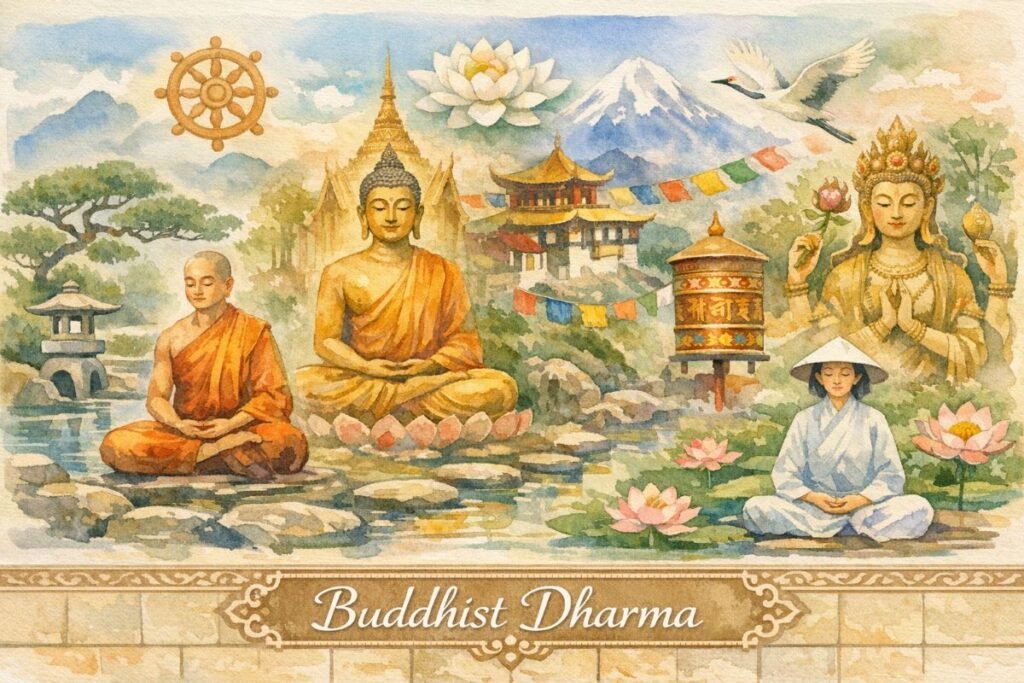
The word “Dharma” (Pali: Dhamma) has multiple interconnected meanings. Most fundamentally, it refers to the teachings of the Buddha—the Four Noble Truths, the Noble Eightfold Path, and the entire corpus of his instruction. This is the Dharma as the path to liberation. The Dhammacakkappavattana Sutta (SN 56.11) is the turning of the wheel of Dharma.
Secondly, Dharma refers to the truth or the natural law that the teachings point to. It is the ultimate reality, the way things are. In this sense, the Buddha did not “invent” the Dharma; he discovered it and taught it. This truth is universal and timeless.
Finally, in the context of the Abhidhamma and analysis of experience, dhammas refer to the fundamental, irreducible constituents of reality, the momentary mental and material phenomena that make up our experience. Understanding the Dharma in all these senses, as the path, the truth, and the constituents of reality, is the goal of study and practice.
103. What is the meaning of “Sangha”?
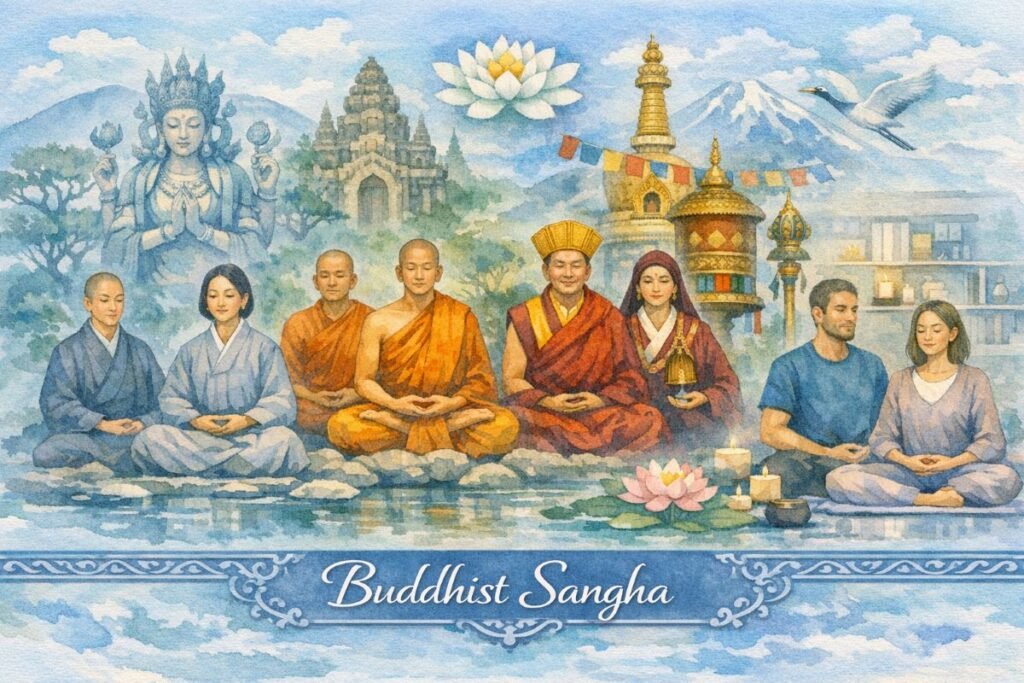
The term “Sangha” has two primary meanings in Buddhism. The conventional Sangha (sammuti sangha) refers to the ordained community of Buddhist monks (bhikkhus) and nuns (bhikkhunis). This is the community that preserves the Vinaya (monastic discipline) and has historically been the primary custodian of the teachings. The Sangha Sutta (AN 5.78) describes the qualities of the monastic community.
The noble Sangha (ariya sangha) is the community of all practitioners, monastic or lay, who have attained any of the four stages of enlightenment (stream-enterer, once-returner, non-returner, arhat). This is the true spiritual community, united by realization rather than by robes. It is this Sangha that is the third of the Three Jewels.
In a broader sense, the Sangha can also refer to the community of all practitioners, lay and monastic, who support each other in the practice of the Dharma. This is the living community that provides the context and support for individual practice. The Sangha is a refuge because it is the community that embodies, practices, and preserves the Dharma.
104. What are the three marks of existence?

The three marks of existence (ti-lakkhaṇa) are the fundamental characteristics of all conditioned phenomena. They are: Impermanence (anicca), the truth that all conditioned things arise, change, and cease; Suffering (dukkha), the truth that because conditioned things are impermanent, they cannot provide lasting satisfaction and are ultimately unsatisfactory; and Non-self (anattā), the truth that there is no permanent, unchanging, independent self or essence in any phenomenon, including our own being. The Anattalakkhaṇa Sutta (SN 22.59) expounds on these.
These three marks are not philosophical propositions to be believed but realities to be directly perceived through mindfulness and insight. When a practitioner sees impermanence directly, they understand why clinging leads to suffering. When they see the unsatisfactoriness of all conditioned states, their attachment to them loosens. When they see non-self, the illusion of a separate self that clings is shattered.
The direct realization of the three marks is the essence of liberating wisdom (paññā). It is this seeing that erodes and finally uproots the defilements. The path culminates in the complete understanding of these three characteristics, leading to the unconditioned, which is free from all three marks.
105. What is the Middle Way?
The Middle Way (majjhimā paṭipadā) is a central principle in Buddhism, referring to two things. First, it is the path of practice that avoids the extremes of sensual indulgence and self-mortification. The Buddha, after his own failed experiment with extreme asceticism, discovered this balanced path, which he articulated as the Noble Eightfold Path. This is the Middle Way in the Dhammacakkappavattana Sutta (SN 56.11).
Second, the Middle Way is a philosophical view that avoids the extremes of eternalism (the belief in a permanent, unchanging self) and annihilationism (the belief that death is the end of existence). The Kaccānagotta Sutta (SN 12.15) teaches that the Tathāgata teaches the Dharma by the middle way: dependent origination. Things exist conventionally but are empty of inherent existence.
Thus, the Middle Way applies to both practice and philosophy. In practice, it is a path of balance, effort without strain, and mindfulness without tension. In view, it is a rejection of absolute existence and absolute non-existence, understanding instead the dynamic, conditioned, and empty nature of all phenomena.
106. What is the role of doubt in Buddhism?
Doubt (vicikicchā) is identified as one of the five hindrances and one of the ten fetters. As a hindrance, it is a state of indecision, skepticism, and uncertainty that paralyzes the mind and prevents it from settling into concentration and committing to the path. It is a doubt that questions the Buddha, the Dharma, the Sangha, and the practice itself. In this form, it is an obstacle to be overcome.
However, Buddhism also encourages a healthy, investigative form of doubt. The Buddha famously instructed the Kālāmas not to accept teachings based on tradition, hearsay, or authority, but to test them for themselves. In the Kālāma Sutta (AN 3.65), he advocates for a free inquiry based on personal experience: “When you know for yourselves… these qualities are wholesome, these qualities are blameless… then you should enter and remain in them.”
The difference lies in the quality of the doubt. A paralyzing doubt is one that refuses to commit, always looking for certainty outside of experience. A healthy, investigative doubt is a skeptical, open-minded inquiry that leads to investigation, practice, and finally to the personal certainty of direct insight. The latter is a vital tool for progress; the former is a fetter to be cut.
107. What is the ultimate teaching beyond all words?
The ultimate teaching beyond all words is the direct realization of reality itself. The Buddha often remained silent when asked metaphysical questions, as in the Aggi-Vacchagotta Sutta (MN 72), because the truth transcends all conceptual frameworks. All teachings: the sutras, the meditation instructions, the philosophy, are skillful means (upāya) pointing toward this direct, non-conceptual knowing.
This ultimate teaching is not a secret doctrine but the lived experience of enlightenment. It is the direct seeing of the deathless, the realization of emptiness, the end of suffering. It cannot be captured in words because words are concepts, and this reality is beyond concepts. It is like tasting sugar: no description can replace the direct experience.
For the practitioner, this means that all study and practice are ultimately in service of this direct realization. The teachings are the finger pointing at the moon; we must not mistake the finger for the moon. The ultimate teaching is to let go of all clinging, even to the teachings themselves, and to rest in the natural, unconditioned freedom that is one’s own true nature.
108. How does one live after enlightenment?
How does one live after enlightenment? The awakened one, the Buddha or an Arhat, lives with perfect wisdom and compassion. The fires of greed, hatred, and delusion are extinguished, yet they continue to function in the world, teaching, helping, and exemplifying the path. Their actions are spontaneous, effortless, and perfectly suited to the needs of the moment, free from any trace of self-interest. The Arahant Sutta (AN 4.87) describes the state of one whose mind is liberated.
They experience pleasure and pain but are not bound by them. They engage with the world but are not attached to it. Their compassion is boundless, their wisdom is perfect, and their peace is unshakeable. They are like the lotus that grows from the mud but remains unstained. They live in the world but are not of it.
For the rest of us, this is the aspiration and the model. The awakened life is not a withdrawal from life but its fullest, most compassionate, and most liberated expression. The Buddha’s forty-five years of teaching after his enlightenment is the ultimate example: a life of ceaseless, selfless activity for the benefit of all beings, grounded in the unshakeable peace of the unconditioned.
Glossary of Key Terms
| English Term | Pali/Sanskrit Equivalent | Explanation |
|---|---|---|
| Suffering | Dukkha (Pali) | The unsatisfactory nature of conditioned existence; includes pain, stress, and the fundamental dissatisfaction of samsara. |
| Craving | Tanha (Pali) | Thirst or desire that leads to attachment and is the primary cause of suffering. |
| Nirvana | Nibbāna (Pali) | The unconditioned, ultimate liberation from suffering, the final goal of the Buddhist path. |
| Ethical Conduct | Sīla (Pali) | Moral discipline; includes the precepts and wholesome behavior that forms the foundation of the path. |
| Mindfulness | Sati (Pali) | Present-moment, non-judgmental awareness of body, feelings, mind, and mental phenomena. |
| Concentration | Samādhi (Pali) | Mental focus, collectedness, and stability, often developed through meditation. |
| Wisdom | Paññā (Pali) | Deep, direct understanding of reality, especially the three marks of existence: impermanence, suffering, and non-self. |
| Compassion | Karuṇā (Pali) | The wish to alleviate the suffering of others; a foundational virtue in all Buddhist traditions. |
| Generosity | Dāna (Pali) | Giving freely without attachment or expectation; the first perfection (pāramitā). |
| Non-self | Anattā (Pali) | The absence of a permanent, unchanging self or soul in any conditioned phenomenon. |
| Impermanence | Anicca (Pali) | The transient, ever-changing nature of all conditioned phenomena. |
| Emptiness | Suññatā (Pali), Śūnyatā (Skt) | The lack of inherent, independent existence in all phenomena; the ultimate nature of reality in Mahāyāna. |
| Bodhisattva | Bodhisattva (Skt) | One who vows to attain enlightenment for the benefit of all beings; the ideal of Mahāyāna Buddhism. |
| Precepts | Pañca Sīla (Pali) | Five basic ethical guidelines for lay practitioners: no killing, stealing, sexual misconduct, false speech, or intoxicants. |
| Dependent Origination | Paṭicca Samuppāda (Pali) | The principle that all phenomena arise and cease in dependence on causes and conditions. |
| Loving-kindness | Mettā (Pali) | Unconditional goodwill, friendliness, and the wish for happiness for all beings. |
| Equanimity | Upekkhā (Pali) | A balanced, impartial mind that remains steady amidst the eight worldly winds. |
| Samsara | Samsāra (Pali/Skt) | The cycle of birth, death, and rebirth driven by ignorance and craving. |
| Arhat | Arahant (Pali) | A fully enlightened being who has eradicated all defilements and will not be reborn. |
| Bodhicitta | Bodhicitta (Skt) | The awakened mind—the spontaneous, compassionate motivation to attain Buddhahood for the benefit of all beings. |
| Jhāna | Jhāna (Pali), Dhyāna (Skt) | Deep states of mental absorption achieved through concentration meditation. |
| Perfection | Pāramitā (Pali/Skt) | A noble quality cultivated on the path to enlightenment; there are six in Mahāyāna (generosity, ethics, patience, effort, concentration, wisdom). |
Conclusion
These 108 questions form a beginner framework for exploring the profound depths of Buddhist teachings, philosophy, and practice. They are designed to guide inquiry from the most basic diagnosis of suffering through the systematic path of ethical conduct, meditation, and wisdom, culminating in the advanced insights of Mahāyāna and the direct realization of liberation. The journey through these questions is not merely an intellectual exercise but an invitation to personal reflection and, ultimately, to the direct experience that the teachings point toward.
The path of Buddhism is a living tradition, passed down through generations of practitioners who have walked the path and realized its fruits. May this collection serve as a reliable guide, a source of inspiration, and a support for deepening your own practice. May it help clarify the teachings, inspire confidence in the path, and support the ultimate aspiration shared by all who encounter the Dharma: the end of suffering and the awakening of the heart and mind for the benefit of all beings.
For further study and to access the original discourses, explore the Sutta Central archive for a vast collection of Buddhist texts and translations.