Key Takeaways
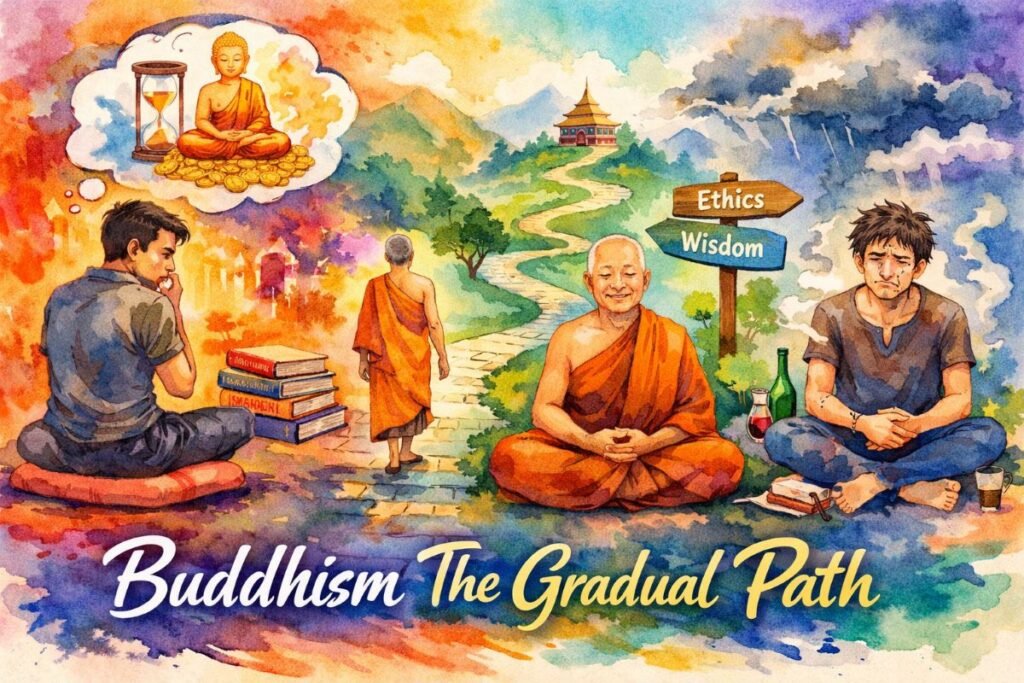
- The Buddhist path consists of three intertwined trainings: ethical conduct (Sila), mental discipline (Samadhi), and wisdom (Panna). Ignoring any one of these creates an imbalance that hinders true progress.
- Spiritual growth occurs gradually, like the ocean floor sloping gently toward the depths. Expecting sudden transformation often leads to unnecessary disappointment and self-criticism.
- The Middle Way (Majjhima Patipada) steers clear of both harsh self-discipline and careless self-indulgence. Finding this balance requires honest, ongoing reflection.
- Practicing in isolation without the support of a spiritual community (Sangha) or a wise teacher can easily lead to misunderstandings and hidden blind spots.
- Understanding a teaching intellectually is not the same as embodying it through direct experience. The ultimate goal is to transform simple knowledge into living wisdom that manifests in daily life.
- Buddhism encourages facing life’s difficulties directly, not using meditation as a way to escape from responsibilities, relationships, or emotional pain.
- The path applies to every aspect of daily existence: washing dishes, responding to an email, or sitting in traffic, not solely to formal sitting meditation.
1. Introduction to the Beginner’s Path
Setting out on a Buddhist path marks a meaningful move toward understanding the mind and discovering lasting peace. For a mature audience seeking practical wisdom, Buddhism offers a framework that is both ancient and strikingly relevant to modern life. The teachings address timeless human experiences: change, dissatisfaction, the search for genuine well-being, and provide tools to work with these realities directly.
Yet because the tradition spans more than two and a half thousand years and many diverse cultures, beginners often encounter hurdles. These are not signs of failure but natural parts of learning any new and profound discipline. By identifying common patterns of misunderstanding early, you can develop a balanced, effective, and deeply rewarding practice.
This article explores mistakes often made by those new to the path. We will examine them through the lens of the three major living traditions:
- The School of the Elders (Theravada) : The only surviving early Buddhist school, preserving the earliest recorded teachings in the Pali language. It is widely practiced today in Sri Lanka, Thailand, Myanmar, Laos, and Cambodia.
- The Great Vehicle (Mahayana) : A broad tradition that includes Zen, Pure Land, and Tibetan Buddhism, emphasizing compassion and the ideal of the bodhisattva—one who vows to attain Buddhahood for the benefit of all beings, seeking awakening that is inseparable from the liberation of all.
- The Diamond Vehicle (Vajrayana) : A branch of Mahayana practiced primarily in Tibet, Bhutan, Mongolia, Nepal, and Himalayan regions. It is known for its rich symbolic methods, visualization practices, and the central importance of the teacher-student relationship.
While these schools express the teachings through different cultural forms and practices, they share a core foundation: helping individuals move from confusion to clarity, from clinging to letting go, from suffering to genuine well-being. This article draws primarily on the Early Buddhist Texts (the Pali suttas) because they form the shared historical foundation for all schools. The practical hurdles discussed, however, apply equally across all traditions.
2. The Mistake of “Meditation Only”
One of the most common misunderstandings in modern Western practice is the belief that Buddhism is essentially identical to meditation. While meditation is a powerful and transformative tool, it represents only one part of a larger, integrated system.
2.1 The Threefold Training (Tisso Sikkha) [Sanskrit: Trishiksha]
In all major Buddhist traditions, the path is organized around three essential areas of training:
- Ethical Conduct (Sila) [Sanskrit: Śīla]: Living in a way that avoids harm to oneself and others. This includes the Five Precepts: refraining from taking life, taking what is not freely given, sexual misconduct, false speech, and using intoxicants that lead to carelessness. Ethical conduct is not a list of arbitrary rules but a practical framework for living that reduces inner conflict and external harm.
- Mental Discipline (Samadhi): The cultivation of a focused, calm, and unified mind. This includes formal meditation practices, such as mindfulness of breathing, and the development of deeper states of collectedness. The Ānāpānasati Sutta (MN 118) provides detailed instructions on training the mind through awareness of the breath, moving gradually from simple observation to refined states of tranquility.
- Wisdom (Panna) [Sanskrit: Prajñā]: Deep understanding of the true nature of reality; impermanence (anicca), unsatisfactoriness (dukkha), and not-self (anatta). This wisdom is not mere intellectual knowledge but direct, lived insight born from patient cultivation.
These three factors work together as a complete path. The Saṅgītisutta (DN 33) lists the threefold training as a fundamental grouping, emphasizing that genuine progress requires attention to all three equally.
2.2 Why Balance Matters
If a beginner focuses exclusively on meditation (Samadhi) while neglecting ethical conduct (Sila), the mind remains agitated by the consequences of unskillful actions. Consider this example:
Example: Sarah’s Unbalanced Practice
Sarah, a marketing manager in her forties, discovered Buddhist meditation through an app and became enthusiastic about sitting for forty minutes each morning. She felt calm during practice and believed she was making genuine progress. At work, however, she continued to exaggerate her team’s achievements to impress clients and occasionally took credit for colleagues’ ideas. She told herself “this is just how business works” and kept her meditation practice completely separate from her professional behavior.
Over time, Sarah noticed her meditation sessions growing increasingly restless. Guilt and anxiety surfaced as soon as she sat down, making it impossible to find the calm she once experienced. She became frustrated and nearly abandoned her practice entirely.
The Skillful Response: Sarah shared her difficulty with a more experienced practitioner, who gently pointed out that her ethical lapses were creating inner conflict. No amount of sitting could resolve a mind that knew, in its own quiet moments, that harm was being caused. Sarah began practicing Right Speech (Sammā Vācā), making a conscious effort to speak truthfully and take full responsibility for her work. She privately acknowledged her behavior to the colleague she had undermined and committed to changing her approach. As she cleaned up her conduct, her meditation gradually became peaceful again. The guilt faded, and sitting became a source of genuine rest.
The Cunda Kammaraputta Sutta (AN 10.176) describes in detail how the Buddha distinguished genuine purification from mere ritual. The Buddha explained that ethical conduct across body, speech, and mind constitutes the actual path to purity, not external observances.
Practical Application: Before each meditation session, take a few moments to reflect on your recent actions. Ask yourself: “Have I spoken truthfully today? Have I acted with kindness in my dealings? Is there any area of my life where I am causing harm to myself or another?” If you notice an unskillful behavior, make a clear resolution to address it directly. This simple practice integrates ethical conduct into your formal sitting and keeps your practice grounded in real life.
3. Expecting Immediate Transformation
We live in a world of instant results: fast food, same-day delivery, streaming entertainment on demand. The mind, however, does not change overnight. A common and understandable mistake is becoming discouraged when “enlightenment” or even a consistent sense of calm fails to arrive within the first few weeks or months.
3.1 The Concept of Gradual Training (Anupubba-sikkha)
The Buddha frequently compared the path to the ocean, which slopes gradually rather than dropping off abruptly. The Ud 5:5 Uposatha (Uposatha Sutta) records him saying:
“Just as the ocean has a gradual shelf, a gradual slope, a gradual inclination, with a sudden drop-off only after a long stretch, in the same way this Doctrine and Discipline (dhamma-vinaya) has a gradual training, a gradual performance, a gradual progression, with a penetration to gnosis only after a long stretch.”
This gradual training (Anupubba-sikkha) means we slowly replace old, unhelpful habits with new, beneficial ones. It is a process of cultivation, like tending a garden—seeds are planted, watered, and cared for over many seasons before they bear fruit. The same teaching also appears in the Uposatha Sutta (Ud 5.5).
In numerous discourses, the Buddha would begin his teaching with a graduated talk. For example, in the Sāmaññaphala Sutta (DN 2) and the Cūḷahatthipadopama Sutta (MN 27), he would start with:
- Talk on generosity (dana)
- Talk on ethical conduct (sila)
- Talk on the heavens—the wholesome results of skillful actions
- Talk on the dangers and defilement of sensual desires
- Talk on the benefits of renunciation
Only when a listener’s mind became receptive would the Buddha introduce the Four Noble Truths and the Noble Eightfold Path. This gradual method respected the natural pace of human learning and transformation.
3.2 The Trap of Goal-Orientation
Many beginners bring a “corporate mindset” to Buddhism, setting measurable targets and feeling like failures when they are not met on schedule. “If I meditate for two hours every day, I should be deeply transformed within a year.” This attitude actually creates a new form of craving, craving for results,which is precisely what the path aims to release.
The Vitakkasaṇṭhāna Sutta (MN 20) offers a more nuanced view. It acknowledges that the mind will generate unskillful thoughts, sensual, angry, or harmful, and provides five practical strategies for working with them. Notice that the sutta does not promise these thoughts will disappear forever. It offers methods for relating to them wisely, one moment at a time, without demanding immediate perfection.
Example: David’s Frustration
David, a retired accountant in his sixties, began practicing mindfulness meditation after reading several popular books. He sat diligently for thirty minutes each morning, expecting to feel noticeably calmer and more focused within a few weeks. Instead, he found his mind wandering constantly to worries about his adult children and regrets about past business decisions. After two months, he concluded “meditation doesn’t work for me” and nearly stopped altogether.
The Skillful Response: David joined a weekly meditation group where the teacher explained that a wandering mind is not a failure, it is simply what minds do. The teacher also introduced the group to the Five Hindrances (pañca nīvaraṇāni): sensual desire, ill will, sloth and torpor, restlessness and worry, and doubt. David immediately recognized his own experience, restlessness and worry about his children, doubt about whether the practice worked at all. Learning that these states are universal and expected, not personal failings, brought enormous relief. He continued his practice with patience, observing the hindrances come and go like weather patterns.
The perception of impermanence, when cultivated gradually, eventually eliminates clinging. The Ānanda Sutta (AN 10.60) lists the perception of impermanence among the ten perceptions that lead to the deathless. Small, consistent efforts yield great results.
Practical Application: View your practice as a long-term lifestyle change, similar to physical fitness. No one expects to run a marathon after two weeks of jogging. Instead of waiting for a massive breakthrough, celebrate small shifts: noticing a moment of anger before you speak, remembering to take three mindful breaths during a stressful phone call, or feeling genuine gratitude for a simple meal. These seemingly minor moments are the very building blocks of genuine transformation.
4. Misunderstanding the Middle Way (Majjhima Patipada)
The Buddha’s very first teaching after his awakening was about the Middle Way, the path between two extremes. Yet this teaching is frequently misunderstood, with beginners often tilting toward one extreme or the other.
4.1 The Two Extremes to Avoid
The Dhammacakkappavattana Sutta (SN 56.11) states:
“There are these two extremes that a seeker should not follow. Which two? The pursuit of sensual happiness in sensual pleasures, which is low, vulgar, worldly, and leads to harm. And the pursuit of self-mortification, which is painful, ignoble, and leads to harm. Avoiding both extremes, the Tathagata has awakened to the Middle Way.”
The Extreme of Rigidity: Some beginners become overly strict, following rules so rigidly that they become judgmental of themselves and others. They may force themselves to sit in painful positions for hours, believing that suffering is inherently noble. They may refuse to enjoy any form of pleasure, equating all enjoyment with attachment. This approach often leads to burnout, resentment, and a subtle form of spiritual pride that actually distances them from genuine peace.
The Extreme of Laxity: The other extreme involves using “mindfulness” as an excuse to do whatever one wants, claiming “everything is empty” or “it’s all just an experience.” This approach leads to a lack of discipline, a disregard for ethical conduct, and a refusal to acknowledge the very real consequences of harmful actions. It prevents any real progress because it avoids the genuine work of transformation altogether.
Example: Margaret’s Rigidity
Margaret, a dedicated practitioner in her fifties, adopted a strict personal regimen: vegetarian diet, no entertainment, no speaking after 8 PM, and four hours of daily sitting meditation. She felt superior to her friends who still enjoyed music or ate meat. She regularly criticized her husband for not being “serious enough” about practice. Her meditation sessions became tense and effortful, leaving her exhausted rather than peaceful.
The Skillful Response: A teacher pointed out that Margaret had adopted the extreme of self-mortification in a new form, not through physical pain, but through rigid control and spiritual superiority. The teacher suggested she intentionally allow small pleasures: listening to music, eating a meal without analyzing it, laughing at a movie. She was also encouraged to reduce her sitting to one hour daily and spend the freed time doing simple acts of kindness without any “spiritual” label. Gradually, her practice softened. She found that genuine peace arises not from controlling everything, but from a balanced, flexible relationship with life.
Example: Mark’s Laxity
Mark, a software developer in his thirties, used the phrase “it’s all just an experience” to justify behaviors he knew were harmful: drinking heavily on weekends, snapping at colleagues, avoiding responsibilities at home. He attended meditation classes irregularly and felt they gave him permission to do as he pleased.
The Skillful Response: A friend gently asked Mark: “If it’s all just an experience, why does your drinking lead to regret? Why does snapping at colleagues create more stress for you later?” Mark had to confront that he was using Buddhist language to avoid accountability. He began to practice mindfulness of the consequences of his actions, paying attention to how his behavior affected his own mind and the people around him. This honest reflection gradually led him to take the precepts seriously, not as restrictions but as practical guidelines for living with less conflict.
Practical Application: Check your “spiritual temperature” regularly. If you are feeling tense, harsh, or superior to others, you may be leaning toward the extreme of rigidity. If you are feeling lazy, indifferent to the harm you cause, or using spiritual language to excuse unskillful behavior, you may be leaning toward laxity. The Middle Way is a dynamic balance, like tuning a stringed instrument, not too tight, not too loose. And like a musical instrument, it requires frequent tuning and attentive listening.
5. Practicing in Isolation
In the modern world, many people try to learn Buddhism entirely from books, websites, or apps. While these resources are excellent and valuable, practicing in total isolation is a common and significant pitfall.
5.1 The Importance of Community (Sangha)
The community of practitioners (Sangha) is one of the “Three Jewels” or “Three Refuges” in Buddhism, alongside the Buddha and the Teaching (Dhamma). Taking refuge means turning to these three as the guiding principles of one’s life. The Sangha provides several essential supports that cannot be replicated by solitary study:
- Correction: Others can see our blind spots and “spiritual ego” more clearly than we can see them ourselves. What feels like sincere practice to us may appear quite different to an outside observer.
- Support: Knowing that others face similar struggles—restlessness, doubt, boredom, self-judgment – makes the path less lonely and more sustainable.
- Inspiration: Seeing the steady progress of more experienced students gives us confidence that the path actually works, even when our own progress feels invisible.
- Safe Container: A well-functioning spiritual community provides gentle accountability and a space to ask difficult questions without embarrassment.
5.2 The Role of the Teacher
In the Diamond Vehicle (Vajrayana), the relationship with a teacher (guru or lama) is considered absolutely central. The teacher is seen as a living guide who can tailor instructions to the student’s specific temperament and situation. Even in other schools, having a mentor or a more experienced friend (kalyāṇamitta—beautiful or virtuous friend) can prevent you from getting stuck in an echo chamber of your own making.
Example: Elena’s Isolation
Elena, a retired librarian, read dozens of Buddhist books over five years. She could explain the Four Noble Truths and the Noble Eightfold Path clearly and could quote suttas from memory. Yet she found herself irritable with her neighbors, impatient with her grandchildren, and secretly felt that she was somehow “more advanced” than people who did not study as much. She had never spoken to another Buddhist practitioner in person.
The Skillful Response: Elena finally joined a small weekly sitting group at a local community center. To her surprise, she found that others practiced differently – some chanted, some did walking meditation, some focused on compassion practices. She initially felt critical of these approaches. But over time, as she sat with the same people week after week, she developed genuine friendships. She heard others admit to the same irritability, impatience, and pride she felt. This human connection softened her sharp edges. She began to see that practice was not about accumulating knowledge but about becoming a kinder, more flexible person in real relationships.
Practical Application: Look for a local meditation group, a Buddhist center, or a reputable online community with live sessions and opportunities for discussion. You do not need to join a monastery or commit to daily group practice. But having regular contact with other practitioners, even once a month, is vital for staying grounded, humble, and on track. If no local group exists, many centers now offer online sitting groups and study circles.
6. Confusing Intellectual Knowledge with Realization
Because many beginners are well-educated and accustomed to learning through reading and analysis, they often mistake understanding a concept for truly realizing it. This is a subtle but significant error.
6.1 The Three Levels of Wisdom
Buddhist commentarial tradition, particularly the Visuddhimagga (Path of Purification) by Buddhaghosa, distinguishes three progressively deeper types of wisdom. These categories also appear in the Paṭisambhidāmagga (Treatise on Discriminations):
- Wisdom from Listening or Reading (Suta-mayā paññā): You understand the words and the logic. You could explain the concept to someone else. This is a valuable first step, but it remains at the surface level.
- Wisdom from Reflection (Cintā-mayā paññā): You have thought deeply about the teaching, tested it against your own experience, and found it makes sense to you. You can apply it in some situations.
- Wisdom from Development (Bhāvanā-mayā paññā): The truth has become part of your character through direct, repeated experience. It is no longer something you think about; it is how you actually perceive and respond to life.
You might be able to explain impermanence (anicca) perfectly, using correct terminology and citing relevant suttas. But if you still become devastated when your phone breaks or angry when a plan changes, you have not yet reached the third level of wisdom. The understanding remains conceptual rather than embodied.
Example: Robert’s Conceptual Trap
Robert, a university professor, loved the intellectual challenge of Buddhism. He wrote detailed notes on the three characteristics of existence and could lecture on dependent origination for an hour without hesitation. He felt he “understood” Buddhism very well. Yet his family noticed that he was no different than before; still easily angered when interrupted, still impatient with slow drivers, still attached to his routines and opinions.
The Skillful Response: A friend challenged Robert: “You say you understand not-self (anatta). But when someone criticizes your work, why do you feel personally attacked? Who is being attacked?” This question disturbed Robert because he realized he had no good answer. He shifted his practice from reading to observing— noticing, moment by moment, how the sense of “me” arose in daily situations. He spent a month simply paying attention to the feeling of “I like this” and “I don’t like this” as they occurred. Gradually, he began to see that what he had understood intellectually was very different from what he actually lived. This honest recognition was the beginning of genuine wisdom.
Practical Application: When you learn a new concept, do not immediately move on to the next book or article. Spend a week or a month looking for that concept in your actual daily life. If you are studying impermanence, notice how the weather changes, how your hunger comes and goes, how your moods shift from morning to evening, how a conversation with a friend can transform in an instant. Let the teaching become a lens for seeing, not just a fact to memorize.
7. Chasing Extraordinary Experiences
A very common beginner mistake is the belief that enlightenment means having dramatic visions, seeing lights, experiencing blissful altered states, or becoming a special, elevated being. This misunderstanding leads many to dismiss the subtle, ordinary transformations that are actually the heart of the path.
7.1 The Trap of Seeking “Peak Experiences”
Meditation can produce unusual phenomena: flashes of light, feelings of rapture, vivid memories, sensations of floating or expanding. These are sometimes called “meditative experiences” (ñāṇa or nimitta in the commentarial tradition). The problem is not that they occur; they can arise naturally as the mind settles, but that beginners become attached to them. They may start measuring their practice by whether these experiences appear, and feel like failures when they do not.
Worse, some practitioners chase these experiences, subtly craving them, which is the opposite of the letting-go that the path requires. The Mahānidāna Sutta (DN 15) explains that craving (taṇhā) is the very engine of suffering. Turning meditation into a search for special states simply moves craving from food and entertainment to spiritual experiences.
7.2 What Genuine Progress Actually Looks Like
The Buddha was famously practical about this. When asked what the benefits of meditation were, he did not describe visions or bliss. Instead, in the Sāmaññaphala Sutta (DN 2), he listed observable, ordinary qualities: letting go of greed and ill will, feeling content and joyful, sleeping well, being mindful and alert, not harming any being. These are not dramatic. They are quiet changes in how one lives day to day.
Example: Thomas’s Disappointment
Thomas, a construction foreman in his forties, attended a ten-day meditation retreat. During the retreat, he had several powerful experiences: his body felt like it dissolved, he saw a brilliant white light, and he felt overwhelming joy. He returned home convinced he had made huge progress. But within a week, he was again irritable with his crew, impatient with his children, and attached to his routines. He became depressed, thinking he had “lost” his progress.
The Skillful Response: A teacher explained that the experiences on retreat were like looking out an airplane window at the clouds; impressive, but not the destination. The real fruit of practice is what happens when the plane lands: how you treat the baggage handler, how you speak to your spouse, how you handle a traffic jam. The teacher encouraged Thomas to stop chasing the light and instead pay attention to small, everyday changes: did he notice his anger arising more quickly? Could he pause before speaking harshly? Could he enjoy a quiet moment without reaching for his phone? Over time, Thomas found that these ordinary shifts were more valuable than any dramatic vision.
Practical Application: Completely let go of any expectation of special experiences. If they arise, treat them as you would any other phenomenon; notice them, let them go, and return to the breath or the body. The real measure of practice is not what happens on the cushion but how you respond when someone cuts you off in traffic or when a loved one is suffering. If you are becoming kinder, more patient, more honest, you are progressing, regardless of whether you ever see a single light.
8. Attachment to Buddhist Identity
Another subtle trap is taking on “Buddhist” as a new identity to protect, defend, or feel superior about. This turns the path into another form of ego-clinging, which is precisely what the teachings aim to release.
8.1 The “I Am a Buddhist” Trap
When someone first discovers Buddhism, it is natural to feel enthusiasm and to want to identify with this new framework. However, if that identity becomes fixed and exclusive, it can create division, pride, and defensiveness. A person might start looking down on “non-Buddhists,” arguing about doctrine, or feeling anxious when their Buddhist beliefs are challenged. This is not liberation, it is just a new cage.
The Cūḷasaccaka Sutta (MN 35) records a debate between the Buddha and a wandering teacher named Saccaka. Saccaka was proud of his philosophical views and defended them aggressively. The Buddha calmly dismantled Saccaka’s positions without ever becoming attached to being “the winner.” This shows that holding views lightly, even Buddhist views, is essential.
8.2 Right View as a Tool, Not a Possession
Right View (Sammā Diṭṭhi) is the first factor of the Noble Eightfold Path. But the Buddha described it as a raft used to cross a river. In the Alagaddūpama Sutta (MN 22), he said that a man who has crossed a river using a raft does not carry it on his head once he reaches the far shore. The raft is a tool, not a possession. Holding onto views—even correct ones—becomes a burden if they turn into identity and pride.
Example: Linda’s Spiritual Superiority
Linda, a new practitioner in her thirties, became passionate about Buddhism. She read widely, chanted daily, and wore a mala bead bracelet everywhere. She started correcting her friends when they used phrases like “my soul” or “I believe in fate.” She argued with her Christian mother about the afterlife. At her meditation group, she felt superior to those who sat “incorrectly” or who arrived late. She thought of herself as “a real Buddhist” in contrast to casual practitioners.
The Skillful Response: Linda’s teacher asked her a simple question: “Before you found Buddhism, were you happier or more at ease than you are now?” Linda had to admit she was more tense and judgmental now. The teacher explained that she had taken on the label of Buddhist as a new identity to defend, replacing her old identity with a “spiritual” one, but the clinging was the same. Linda began practicing letting go of the label itself. She stopped correcting others and started listening instead. She removed her mala bracelet for a month and simply sat without any “Buddhist” props. Gradually, she found a lightness she had been missing. She could now appreciate her mother’s faith without feeling threatened.
Practical Application: Notice how you feel when someone criticizes Buddhism or when you encounter a different spiritual path. Do you feel defensive, angry, or superior? That defensiveness is a sign that you have turned the teachings into an identity. Practice holding your views lightly. Remind yourself: “These are tools for reducing suffering, not flags to wave.” If your practice makes you more humble, kind, and open, it is working. If it makes you feel special or separate, pause and investigate.
9. Using Buddhism as an Escape
Sometimes, people turn to Buddhism to “check out” of a difficult life; to numb themselves, avoid emotional pain, or sidestep challenging responsibilities. This phenomenon is sometimes called “spiritual bypassing.”
9.1 Facing, Not Fleeing
Buddhism is about facing reality directly, not escaping from it. The very first of the Four Noble Truths is the acknowledgment of unsatisfactoriness or suffering (dukkha) in life. We cannot genuinely practice if we refuse to look at what is actually happening, including our own pain, our difficult relationships, and our challenging emotions.
If we use meditation to numb ourselves to our problems or to avoid dealing with difficult situations, we are not practicing correctly. We are simply using a spiritual tool for the opposite of its intended purpose. Genuine mindfulness means being present with what is, including what is unpleasant. It means sitting with the ache of grief, the discomfort of conflict, the uncertainty of not knowing what to do, without reaching for a quick escape.
9.2 Awakening in the Midst of Life
Like other Buddhist traditions, Mahayana teaches that Nirvana (the end of suffering) is realized within lived experience rather than in a distant heaven. The goal is to become more present and effective in the world, not less. This is not a uniquely Mahayana insight; Theravada also emphasizes that the path is walked right here, in this very body and mind.
Example: Patricia’s Escape
Patricia, a nurse in her fifties, was exhausted by the demands of her job and her strained relationship with her teenage daughter. She discovered Buddhist meditation and began sitting for long periods. She felt peaceful on the cushion and started to view her daily responsibilities as interruptions to her “real practice.” She sat more and more, withdrew from family interactions, and became less engaged at work.
The Skillful Response: A senior practitioner asked Patricia: “Are you using meditation to avoid your daughter?” The question stung because it was true. Patricia realized she had turned the cushion into a hiding place. She committed to a different practice: meditating for just twenty minutes daily, then spending the time she had previously used for longer sitting in honest conversation with her daughter and in fully present care for her patients. The practice shifted from escape to engagement. She found that the true peace she had been seeking arose not in withdrawal but in showing up fully for her actual life.
Practical Application: If you find yourself using “detachment” as an excuse to be cold or indifferent to your family, friends, or responsibilities, pause. True Buddhist detachment (alobha—non-greed or non-attachment) is actually a form of non-clinging that allows for deeper, more selfless love and more effective engagement. It is not about caring less. It is about caring without grasping. Ask yourself honestly: Is my practice helping me show up more fully for my life, or is it helping me hide?
10. Glossary of Key Terms
| English Term | Pali/Sanskrit Term | Explanation |
|---|---|---|
| Community | Sangha (Pali/Sanskrit) | The community of those practicing the Buddhist path. In a broad sense, this includes all practitioners—monastics and laypeople, beginners and advanced. The Sangha is one of the Three Jewels in which Buddhists take refuge. |
| Ethical Conduct | Sila (Pali) / Śīla (Sanskrit) | Living in a way that promotes harmony and avoids harm. Includes the Five Precepts: refraining from killing, stealing, sexual misconduct, false speech, and intoxicants that lead to carelessness. Ethical conduct provides the foundation for mental calm and wisdom. |
| Five Hindrances | Pañca Nīvaraṇāni (Pali) | Five mental states that obstruct concentration and wisdom: sensual desire, ill will, sloth and torpor, restlessness and worry, and doubt. Recognizing these as normal and temporary is an important skill. |
| Gradual Training | Anupubba-sikkha (Pali) | The principle that spiritual development unfolds step by step, like the ocean sloping gradually toward the depths. Patience and steady effort are emphasized over seeking immediate results. |
| Impermanence | Anicca (Pali) / Anitya (Sanskrit) | The fundamental fact that all conditioned things are in a constant state of change. Nothing that arises remains unchanged. Recognizing impermanence directly is a key aspect of wisdom. |
| Mental Discipline | Samadhi (Pali/Sanskrit) | The cultivation of a focused, calm, and unified mind. Includes formal meditation practices such as mindfulness of breathing. Mental discipline provides the stability needed for deep wisdom to arise. |
| Middle Way | Majjhima Patipada (Pali) / Madhyamā-pratipad (Sanskrit) | The path of moderation between the extremes of sensual indulgence and harsh self-mortification. Also refers more broadly to avoiding all extreme views and finding a balanced, practical approach to practice and daily life. |
| Non-Attachment | Alobha (Pali/Sanskrit) | The absence of greed or clinging. Not to be confused with cold indifference. Genuine non-attachment allows for caring deeply without demanding that things be a certain way. |
| Spiritual Friend | Kalyāṇamitta (Pali) / Kalyāṇamitra (Sanskrit) | A virtuous friend or wise companion on the path. Someone who offers guidance, honest feedback, and encouragement. The Buddha said that having good friends is the whole of the spiritual life. |
| Teaching / Truth | Dhamma (Pali) / Dharma (Sanskrit) | The truth of how things are, as well as the path taught by the Buddha. Dhamma includes the natural laws that govern existence and the specific instructions for awakening. It is one of the Three Jewels. |
| Threefold Training | Tisso Sikkha (Pali) / Trishiksha (Sanskrit) | The three integrated divisions of the path: ethical conduct (sila), mental discipline (samadhi), and wisdom (panna). All three are necessary for genuine progress. |
| Unsatisfactoriness | Dukkha (Pali) / Duḥkha (Sanskrit) | The inherent stress, discomfort, or “off-centeredness” of conditioned existence, especially when we cling to things that are impermanent. Includes obvious suffering (pain, loss, illness) and also the subtle dissatisfaction of even pleasant experiences, because they do not last. |
| Wisdom | Panna (Pali) / Prajñā (Sanskrit) | Deep, direct understanding of the true nature of reality—impermanence, unsatisfactoriness, and not-self. Wisdom is not mere intellectual knowledge but lived insight that transforms how one perceives and responds to life. |
11. Related Resources and References
Books:
- What the Buddha Taught by Walpola Rahula—A classic and accessible introduction to the core teachings of the Buddha, based directly on the early suttas.
- Everyday Zen by Charlotte Joko Beck—A modern, down-to-earth guide to integrating Zen practice with the challenges and joys of ordinary daily life.
- Mindfulness in Plain English by Bhante Henepola Gunaratana—A clear, practical, and encouraging guide to meditation practice, written for complete beginners.
- The Heart of the Buddha’s Teaching by Thich Nhat Hanh—A comprehensive overview of Buddhist core teachings from the perspective of the Great Vehicle (Mahayana), written with warmth and clarity.
Podcasts:
- Insight Hour with Joseph Goldstein —A deep, systematic exploration of Buddhist teachings and meditation practices from a Theravada perspective.
- The Dharmapunx NYC podcast —An accessible and honest integration of Buddhist psychology with the realities of modern life, including addiction, relationships, and mental health.
- Buddhist Wisdom, Modern Life —A shorter-format podcast offering guided meditations, sutta study, and practical teachings for daily application.
- Deconstructing Yourself —A podcast exploring the intersections of Buddhist practice, neuroscience, and psychology.
Websites:
- Access to Insight—A vast, free, and well-organized library of Theravada sutta translations and commentary. An excellent resource for studying the early teachings directly.
- SuttaCentral—A scholarly resource offering multiple translations of the early Buddhist texts, including the Pali Canon and parallel versions in other ancient languages. The sutta links in this article all point to SuttaCentral or Access to Insight.
- Tricycle: The Buddhist Review—A respected magazine offering articles, teachings, and resources covering all major Buddhist traditions, with a strong beginner’s section.
Community Resources:
- Local Insight Meditation centers (often affiliated with the Insight Meditation Society or Spirit Rock) offer beginner-friendly classes and sitting groups.
- Zen centers and temples in the Soto or Rinzai traditions offer introductory programs for those interested in the Great Vehicle (Mahayana) perspective.
- FPMT (Foundation for the Preservation of the Mahayana Tradition) centers worldwide offer structured courses in Tibetan Buddhism for beginners.
Related Articles on BuddhistLearning.org:
- The Path of the Three Trainings: Integrating Sila, Samadhi, and Panna
- Finding Your Spiritual Community: A Guide to Choosing a Buddhist Group
- Mindfulness in Daily Life: Beyond the Meditation Cushion
May your practice unfold with patience, balance, and genuine well-being.