Key Takeaways
- Buddhism does not teach that thinking itself is the problem – the issue is how we relate to our thoughts
- Overthinking is understood in Buddhist psychology as mental proliferation (papañca), where the mind spins stories, judgments, and identities around simple experiences
- The three poisons – greed (lobha), aversion (dosa), and delusion (moha)—are the driving forces behind repetitive, obsessive thinking
- Thoughts are not the same as reality; they are mental events that arise due to conditions and pass away
- Mindfulness (sati) offers a way to observe thoughts without being caught up in them
- Wise attention (yoniso manasikāra) is the practice of directing the mind toward what is wholesome and beneficial
- Freedom from overthinking comes not from stopping thoughts but from letting go of clinging to them
A Note on Terminology
Overthinking is a modern psychological term, not a technical category in the early Buddhist discourses. This article uses it as a broad modern description of repetitive, distressing or unproductive thinking. The closest Buddhist concepts include papañca (mental proliferation), unwholesome thought, inappropriate attention (ayoniso manasikāra), craving, clinging and conceit, but none of these is simply synonymous with modern “overthinking.” The connections made in this article are therefore interpretive rather than claims that the Buddha taught a modern theory of overthinking.
1. Introduction: When Thinking Becomes Suffering
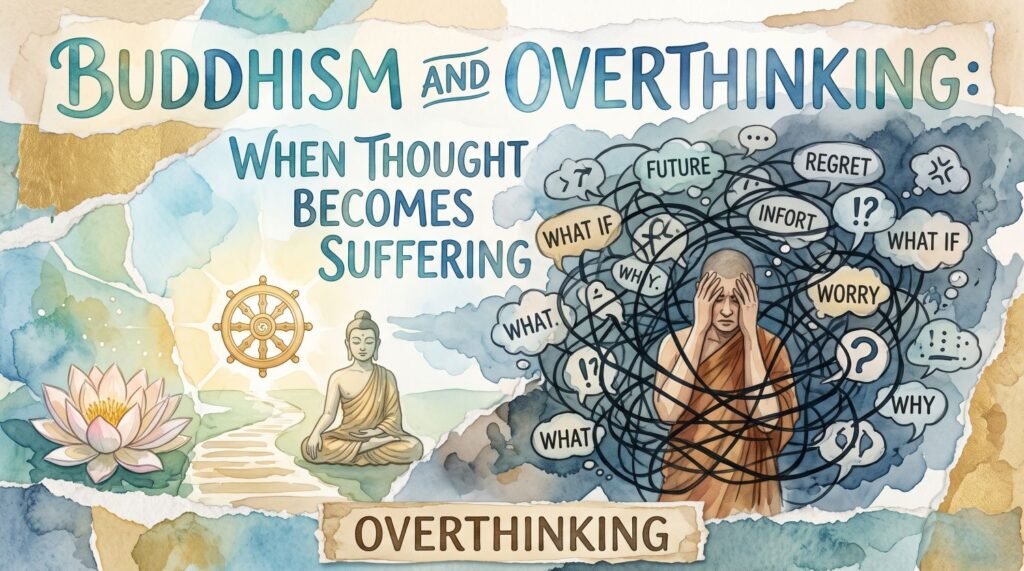
Most people know what it feels like to be trapped in a cycle of repetitive thinking. The mind replays a conversation from yesterday, imagining what could have been said differently. It projects into the future, worrying about outcomes that may never come to pass. It circles around the same question, the same regret, the same fear, without ever arriving at resolution. This is the modern experience of overthinking — and for many, it has become a constant background hum of mental activity that drains energy, disturbs sleep, and undermines peace of mind.
In Buddhist teachings, this phenomenon is not new. The Buddha described the tendency of the mind to spin out elaborate narratives around simple experiences more than 2,500 years ago. The Pali term for this is papañca, often translated as “conceptual proliferation” or “mental proliferation”. It refers to the mind’s habit of taking a simple perception — a sight, a sound, a feeling — and building layer upon layer of interpretation, judgment, story, and identity around it. The Madhupiṇḍika Sutta (MN 18) provides the canonical foundation for this understanding, describing how perception leads to thinking, and thinking leads to proliferation.
It is important to state clearly: Buddhism does not teach that thinking is bad. The Buddha himself engaged in extensive reflection and analysis. The problem is not thought itself but the clinging to thought — the way the mind grasps at certain thoughts, pushes others away, and treats the whole internal narrative as if it were solid, permanent, and true.
This article explores what Buddhism has to say about overthinking. It draws primarily on early Buddhist teachings as preserved in the Pali Canon, which form the foundation for Theravāda practice. The article also acknowledges that Mahāyāna traditions developed additional analyses of conceptual proliferation, emptiness and mind. The aim is not to eliminate thinking but to develop a wiser, more skilful relationship with the thinking mind — one that allows thoughts to arise and pass away without becoming a source of distress.
2. The Buddhist Schools and Their Approach to Thought
Before exploring the teachings themselves, it is helpful to understand the Buddhist traditions that inform this discussion.
Theravāda Buddhism — the “Way of the Elders” — is the surviving Buddhist school among the ancient Nikāya traditions and is historically associated with Sri Lanka and much of mainland Southeast Asia. Theravāda gives a central place to the Pāli Tipiṭaka, including the Nikāya collections of discourses, together with its later commentarial and scholastic traditions. Theravāda texts contain important teachings on papañca and yoniso manasikāra, both of which are useful for understanding how attention and conceptual proliferation can contribute to suffering. The tradition emphasises insight into the three marks of existence (anicca, dukkha, anattā) as the heart of liberation.
Mahāyāna Buddhism — the “Great Vehicle” — is the other major branch, prevalent in East Asia (China, Japan, Korea, Vietnam) and the Himalayas (Tibet, Nepal, Bhutan). Mahāyāna shares the foundational teachings of the early discourses but expands upon them with additional scriptures and philosophical frameworks. Different Mahāyāna traditions approach the problem of conceptual proliferation in various ways. Madhyamaka traditions emphasise the emptiness (śūnyatā) of all mental constructs. Yogācāra traditions analyse the workings of consciousness in detail. Zen/Chan traditions often use direct methods to cut through conceptual thinking. Across these diverse Mahāyāna traditions, the fundamental problem of clinging to thought is addressed through a range of skilful means.
Across many Buddhist traditions, unwholesome mental habits and attachment are understood as contributing to suffering, although traditions differ considerably in how they analyse thought, conceptuality, mind and liberation.
3. What Is Overthinking?
3.1 Thinking, Attention, and Mental Proliferation
To understand overthinking from a Buddhist perspective, we must first distinguish between different types of mental activity.
Thinking (vitakka) is a technical term whose meaning varies according to context. In meditation terminology, it is often “applied thought” or “initial application” of the mind to an object. In contexts such as the Madhupiṇḍika Sutta (MN 18), it is involved in thinking about what has been perceived. It should not be equated wholesale with the modern psychological category of “thinking.”
Attention (manasikāra) refers to attending to or directing the mind toward an object. It is the mental factor that turns the mind toward something. Wise attention (yoniso manasikāra) is attending to experience in a way that supports understanding and wholesome development. Unwise attention (ayoniso manasikāra) attends to experience in ways that feed greed, aversion, and delusion.
Mental proliferation (papañca) is something else entirely. It is the mind’s tendency to spin out endless associations, judgments, and stories around a simple perception. Where thinking is a tool, proliferation is a habit — and often an addictive one. It is the difference between using a knife to prepare a meal and using it to repeatedly cut the same piece of food into smaller and smaller pieces until nothing useful remains.
3.2 When Thought Becomes Repetitive
Overthinking is characterised by repetition. The mind returns to the same topic, the same question, the same worry, again and again. Each cycle may feel like progress — like we are getting closer to a solution — but in reality, we are often just going in circles.
This repetitive quality is one of the hallmarks of papañca. The proliferating mind does not move forward; it loops. It revisits the same mental territory, often with increasing agitation, without arriving at any new understanding.
3.3 When Thinking Stops Being Useful
Thinking becomes overthinking when it ceases to serve a useful purpose. Useful thinking leads to action, clarity, or resolution. Overthinking leads to confusion, anxiety, and paralysis.
Consider the difference between planning a presentation and worrying about it. Planning involves considering the content, structure, and delivery — and then taking action. Worrying involves imagining all the things that could go wrong, replaying past failures, and feeling increasingly anxious without actually preparing. The first is thinking; the second is overthinking.
3.4 The Difference Between Problem-Solving and Rumination
Problem-solving is directed toward a specific goal. It has a clear object and moves toward resolution. Rumination, by contrast, is circular. It revisits the same material repeatedly without making progress.
The Dvedhāvitakka Sutta (MN 19) is particularly relevant here. It distinguishes thoughts associated with sensual desire, ill will, and harmfulness from thoughts associated with renunciation, non-ill will, and harmlessness. This provides a canonical foundation for distinguishing skilful thinking from unskilful thinking.
4. The Buddhist Understanding of Thought
4.1 Thoughts Are Conditioned Mental Events
In Buddhist psychology, thoughts are not things that we own or control. They are events that arise in the mind due to conditions. Just as sounds arise and pass away in the field of hearing, thoughts arise and pass away in the field of awareness.
This understanding is liberating. If thoughts are events rather than possessions, we do not have to identify with them. We do not have to believe them or act on them. We can simply observe them as they arise and pass away.
4.2 Thought Is Not the Same as Reality
One of the most important insights in Buddhist practice is that thought is not reality. Thoughts are representations, interpretations, and constructions. They are not the things they point to. A thought about an experience is not identical with the experience itself.
The thought of a snake is not the same as an actual snake. The thought of a person being angry with us is not the same as that person actually being angry. Thoughts are mental fabrications — and fabrications can be accurate, inaccurate, or somewhere in between.
4.3 Thoughts Arise Due to Conditions
The Buddha taught that all phenomena arise due to causes and conditions and thoughts are no exception. A thought arises when certain conditions are present: sensory contact, feeling, perception, attention, and so on.
This teaching of dependent origination (paṭiccasamuppāda) is crucial for understanding overthinking. When we see that thoughts arise conditionally, we realise that they are not personal. They are not “my” thoughts in any ultimate sense. They are simply mental events that have arisen and will cease when the conditions for them change.
4.4 Thoughts Arise and Pass Away
Every thought has a beginning and an end. Even the most persistent, obsessive thought will eventually pass away — if we stop feeding it. The problem with overthinking is that we keep feeding the thoughts by paying attention to them, engaging with them, and building more thoughts on top of them.
If we can learn to observe thoughts without feeding them, they will naturally subside. This is the basic principle of mindfulness practice: watch thoughts arise, watch them pass away, and do not cling to them.
4.5 The Mind and Its Contents
Thoughts are among the changing phenomena known through experience. Buddhist practice does not require us to posit a permanent observer behind them. Instead, we learn to observe thoughts as conditioned and impermanent mental events without identifying with them as “I,” “me,” or “mine.” There is awareness of thoughts, but this awareness is not a separate, enduring self. It is simply the knowing function of consciousness, itself conditioned and changing.
5. From Thought to Suffering
5.1 How a Thought Becomes a Problem
A thought on its own is not suffering. The thought “It is raining” does not cause distress. The thought “I have work to do” does not cause distress. What causes distress is the relationship we have with the thought — the grasping, the resisting, the believing.
The process by which a thought becomes suffering can be understood through the Buddha’s teaching on the five aggregates (khandhas). Thinking involves processes distributed across several aspects of experience described by the five aggregates. The Buddha repeatedly examines whether these aggregates can rightly be regarded as “mine,” “I,” or “my self.” When we identify with a thought, we are creating a sense of self around it. When we cling to a thought, we are investing it with significance and power. And when we act on a thought out of craving or aversion, we create further suffering.
5.2 Feeling, Perception, and Thought
The process begins with contact. A sense object meets the sense faculty, and consciousness arises. Feeling (vedanā) arises — pleasant, unpleasant, or neutral. Perception (saññā) labels the experience. And then thought begins to build on this foundation.
If perception labels an experience as “dangerous”, thought may elaborate: “This is dangerous. I am in danger. What will happen to me? How can I protect myself?” The more thought elaborates, the more suffering arises.
5.3 Craving and the Continuation of Thought
Craving (taṇhā) is the fuel for overthinking. When the mind encounters a pleasant feeling, craving wants to hold onto it. When it encounters an unpleasant feeling, craving wants to push it away. And when it encounters a neutral feeling, craving wants to find something more interesting.
Craving is what keeps the thinking process going. Without craving, thoughts would arise and pass away naturally. But craving grabs hold of certain thoughts and insists on continuing them. This is why overthinking is so persistent — it is driven by the desire for things to be different from how they are.
5.4 Aversion and Repetitive Thinking
Aversion (dosa) is the other side of craving. Where craving wants to pull things closer, aversion wants to push them away. Both lead to suffering.
When we overthink about something we dislike — a person we resent, a situation we fear, a memory we find painful — we are often trying to push it away through thinking. The mind believes that if it can just “figure it out”, the unpleasantness will go away. But this kind of thinking only makes things worse.
5.5 Ignorance and Taking Thought to Be True
The root of all suffering is ignorance (avijjā) — not knowing things as they really are. In the context of overthinking, ignorance manifests as taking thoughts to be true, solid, and permanent.
When we automatically believe our thoughts, we are under the spell of ignorance. We think, “This is how it really is,” and we act accordingly. We may think, “I am a failure,” and believe it without question. We may think, “They don’t like me,” and accept it as fact. This is ignorance at work.
5.6 From “Something Happened” to “This Means Something About Me”
The process of overthinking often follows a familiar pattern. Something happens — a comment, a situation, a result — and the mind immediately adds an interpretation. The interpretation then becomes the focus of attention, and the original event fades into the background.
For example, a colleague does not say hello. The mind interprets: “They are angry with me. They don’t respect me. I must have done something wrong. What did I do? I should have been more careful.” In a few seconds, a simple non-event has become a story about personal failure and social rejection. This is the power of mental proliferation.
6. Papañca: When the Mind Proliferates
6.1 What Is Papañca?
Papañca (Sanskrit: prapañca) is one of the most important terms for understanding overthinking in Buddhism. It is often translated as “conceptual proliferation”, “mental proliferation”, or “obstruction”. The root meaning is “spreading out” or “expansion” — the mind spreading out from a simple perception into a complex web of concepts, stories, and judgments.
The Madhupiṇḍika Sutta (MN 18) describes how papañca arises. Dependent on eye and forms, consciousness arises. The meeting of the three is contact. With contact as condition, feeling arises. What one feels, one perceives. What one perceives, one thinks about. What one thinks about, one proliferates. This is the chain that leads from simple experience to mental proliferation. The sutta should not be confused with the twelvefold formula of dependent origination; MN 18 presents a different conditional analysis of how sense experience develops into conceptual proliferation.
6.2 From Simple Experience to Mental Proliferation
The process described in the Madhupiṇḍika Sutta shows how the mind moves from direct experience to conceptual elaboration. A sight, sound, or sensation arises. Feeling arises. Perception labels it. Then thinking begins. And then proliferation takes over.
The key point is that proliferation is not inevitable. The sutta describes a conditional sequence rather than a necessary one. Buddhist practice aims at understanding and ending the conditions that sustain such proliferation rather than simply trying to suppress thought.
6.3 How the Mind Builds Stories Around Experience
The mind is a master storyteller. It takes the raw data of experience and weaves it into narratives. These narratives give meaning to our lives, but they also create suffering.
When we overthink, we are often telling ourselves a story. The story may be about our past: “I made a terrible mistake, and I am a bad person.” It may be about our future: “Something terrible is going to happen, and I won’t be able to cope.” It may be about other people: “They are judging me, and they think I am inadequate.” These stories are not reality — they are constructions.
6.4 “I,” “Me,” and “Mine” in Mental Proliferation
A central feature of papañca is the construction of self. The proliferating mind takes experiences and weaves them into the story of “me”. Events are interpreted in terms of how they affect me, what they say about me, what I should do about them.
The teaching on not-self (anattā) directly addresses this tendency. The Buddha taught that there is no permanent, unchanging self to be found in any of the aggregates. When we see through the illusion of self, we stop taking things so personally. We stop overthinking about what things mean for “me”.
6.5 Why Proliferation Creates Further Suffering
Papañca creates suffering because it takes us away from reality. The more we think, the more we are lost in mental constructions. The more we are lost in mental constructions, the further we are from direct experience. And the further we are from direct experience, the more we suffer.
There is also a feedback loop: suffering creates more thinking, and more thinking creates more suffering. The mind that is agitated by overthinking is more likely to engage in further overthinking. It is a self-perpetuating cycle.
6.6 The Madhupiṇḍika Sutta and the Proliferating Mind
The Madhupiṇḍika Sutta (MN 18) is a key discourse on mental proliferation. In this sutta, the Buddha explains that papañca is rooted in perception and thought — and that it can be ended by seeing things as they really are.
The sutta is significant because it shows that proliferation is not just an individual problem — it is the basis of conflict, dispute, and suffering in the world. When we proliferate, we create divisions between self and other, and these divisions lead to conflict. Ending proliferation is therefore both a personal and a social good.
7. The Three Poisons Behind Overthinking
7.1 Greed and the Mind That Wants
Greed (lobha) is the mental factor of desire, attachment, and wanting. In the context of overthinking, greed manifests as the mind that wants things to be different. It wants the past to be different, the future to be certain, the present to be more satisfying.
When we overthink about what we want, we are feeding greed. We imagine how things could be better, how we could get more, how we could secure what we have. This kind of thinking is never satisfied — there is always more to want, more to imagine, more to worry about.
The Upādāna Sutta (SN 12.52) shows how attending to the allure of objects that can be clung to nourishes craving, which conditions clinging and subsequently the continuation of suffering. This helps illuminate how repeatedly dwelling on what we want or resist can reinforce attachment, although the sutta does not specifically present this as a theory of overthinking.
7.2 Aversion and the Mind That Resists
Aversion (dosa) is the mental factor of dislike, anger, and resistance. In overthinking, aversion manifests as the mind that rejects what is present. It resists unpleasant feelings, uncomfortable situations, and difficult people.
When we overthink about what we dislike, we are feeding aversion. We replay grievances, imagine confrontations, and dwell on injustices. This kind of thinking keeps us trapped in anger and resentment.
7.3 Delusion and the Mind That Does Not See Clearly
Delusion (moha) is the mental factor of ignorance, confusion, and not seeing reality clearly. In overthinking, delusion manifests as the mind that takes its thoughts to be true. It believes that its interpretations are accurate, its judgments are correct, and its fears are justified.
The Avijjā Sutta (AN 10.61) presents ignorance as conditioned rather than causeless, showing how inappropriate attention, lack of mindfulness, the hindrances and other conditions nourish ignorance. It also presents the reverse cultivation of appropriate attention, mindfulness and the awakening factors as conditions supporting clear knowing and liberation.
7.4 How the Three Poisons Feed One Another
The three poisons are not separate — they feed into one another. Greed and aversion are both rooted in delusion. We crave what we think will bring happiness, not seeing that happiness is impermanent. We resist what we think will bring pain, not seeing that pain is also impermanent.
In overthinking, the three poisons work together. Greed wants things to be different. Aversion rejects things as they are. Delusion believes that thinking can solve the problem. And the cycle continues.
7.5 Overthinking as a Conditioned Process
The three poisons are not inherent — they are conditioned. They arise due to causes and conditions, and they can be ended when those conditions change. This is the promise of Buddhist practice: by cultivating mindfulness and wisdom, we can uproot the poisons and end the suffering they cause.
Overthinking is not a permanent character trait. It is a conditioned habit that can be unlearned. With practice, we can relate to thoughts differently and find freedom from mental proliferation.
8. Why We Believe Our Thoughts
8.1 The Mind Creates Interpretations
The mind does not simply receive reality — it interprets it. Every perception is filtered through our conditioning, our assumptions, and our beliefs. We never experience reality directly; we experience our interpretation of it.
This is not inherently a problem. Interpretation is necessary for navigating the world. The problem arises when we confuse our interpretations with reality. When we believe our thoughts as if they were facts, we create suffering. This can be understood in Buddhist terms as the functioning of perception (saññā) and the constructions of the thinking mind.
8.2 Perception Is Not the Same as Reality
Perception (saññā) is the mental factor that labels and recognises objects. It is essential for cognitive functioning, but it is also a source of error. Perception can be mistaken, biased, or distorted.
When we see a rope and mistake it for a snake, perception has made an error. The same thing happens in overthinking: we see a situation and mistake it for something more threatening than it actually is. We perceive danger where there is none, rejection where there is none, failure where there is none.
8.3 The Story We Add to Experience
As we saw with papañca, the mind adds stories to experience. These stories are not the experience itself — they are elaborations on top of it. The experience of a colleague not saying hello is simple. The story about why they did not say hello is a construction.
The problem is that we often live in the story rather than the experience. We respond to the story as if it were true, and we suffer as a result. If we could stay with the simple experience, there would be less suffering.
8.4 “I Am Thinking” and “This Is True”
One of the most powerful habits of the mind is identification: “I am thinking” becomes “this is true.” When we identify with our thoughts, we give them authority. They become “my” thoughts, and we defend them as if they were parts of ourselves.
This identification is one of the main drivers of overthinking. We feel that our thoughts are important because they are ours. We feel that we must resolve them because they are our problems. But thoughts are not ours in any ultimate sense — they are just events arising in awareness.
8.5 Identification With Thought
The Saṃyutta Nikāya contains many discourses on the danger of identifying with the aggregates. The Buddha repeatedly teaches that identification with form, feeling, perception, formations, or consciousness leads to suffering.
When we identify with thoughts, we make them personal. We think, “I am thinking this, so it must be important.” This is the root of overthinking. If we could see thoughts as just thoughts — impersonal, conditioned, passing — we would not be so troubled by them.
8.6 Seeing Thoughts as Thoughts
The practice of mindfulness involves seeing thoughts as thoughts. This means observing the thought without getting caught up in its content. It means recognising that a thought is just a mental event, not a command, not a threat, not a truth.
When we see thoughts as thoughts, they lose their power over us. They become like clouds passing through the sky — arising, remaining for a while, and passing away. We can watch them without being disturbed.
9. Overthinking About the Past
9.1 Replaying What Happened
One of the most common forms of overthinking is replaying past events. We repeat conversations in our minds, imagining what we should have said. We revisit decisions, wondering if we made the right choice. We go over mistakes, feeling regret and shame.
This kind of thinking is driven by the desire to change the past. But the past is gone — it cannot be changed. The only thing we can change is our relationship to it.
9.2 Regret, Guilt, and Self-Judgment
Regret (kukkucca) is a mental factor that the Buddha identified as a hindrance to practice. It is the feeling that we have done something wrong and cannot undo it. When regret becomes obsessive, it turns into self-judgment and self-criticism.
The Buddha taught that remorse for past actions can be useful if it leads to a change in behaviour. But excessive remorse is a form of clinging — clinging to a past that cannot be altered.
9.3 Learning From the Past Without Living in It
The Buddhist approach to the past is to learn from it without living in it. We can reflect on past actions and see where we went wrong. We can make amends where possible and resolve to act differently in the future. But then we let it go.
The Ambalatthikā Rāhulovāda Sutta (MN 61) gives guidance on wise reflection. The Buddha teaches that one should reflect on one’s actions before, during, and after doing them — but this reflection is for learning, not for dwelling. This makes it an excellent counterexample to the idea that Buddhism simply says “don’t think about the past.” It demonstrates that reflection can be skilful when it serves ethical learning and correction.
9.4 Buddhist Reflection Versus Rumination
Buddhist reflection (yoniso manasikāra) is different from rumination. Reflection is purposeful and leads to insight. Rumination is circular and leads to suffering.
When we reflect wisely on the past, we ask questions like: “What can I learn from this?” “How can I act differently in the future?” “What conditions led to this outcome?” When we ruminate, we ask questions like: “Why did this happen to me?” “What is wrong with me?” “How can I undo this?”
9.5 Letting the Past Be a Teacher Rather Than a Prison
The past can be a teacher if we let it. It can show us what leads to suffering and what leads to happiness. It can help us make wiser choices in the present. But the past can also be a prison if we keep revisiting it with regret and self-judgment.
Freedom from overthinking about the past comes from seeing that the past is impermanent and not-self. The person who made those mistakes is not the same person who is here now. The past is like a dream — it is over, and we are free.
10. Overthinking About the Future
10.1 Anticipating What Has Not Happened
Another common form of overthinking is worrying about the future. The mind projects itself forward, imagining all the things that could go wrong. It anticipates problems, catastrophes, and failures.
This kind of thinking is driven by the desire for certainty. The mind wants to know what is going to happen so that it can prepare and protect itself. But the future is inherently uncertain — no amount of thinking can change that.
10.2 Fear and Imagined Futures
Fear (bhaya) is the emotional response to perceived danger. When the mind imagines a dangerous future, fear arises. And fear, in turn, fuels more thinking about the future. The cycle continues.
Much of our worry is about things that never happen. The mind imagines worst-case scenarios, but most of those scenarios never materialise. In this sense, worry is a waste of energy — it prepares us for things that do not occur.
10.3 Planning Versus Worrying
Planning is skilful; worrying is not. Planning involves identifying what needs to be done and taking appropriate action. Worrying involves imagining negative outcomes without taking effective action.
The difference is that planning is grounded in the present. It recognises what can be done now and does it. Worrying is grounded in the future. It imagines what might happen and gets caught up in fear.
10.4 The Desire for Certainty
The desire for certainty is a form of craving. The mind wants to know what will happen so that it can feel safe and in control. But the Buddha taught that everything is impermanent — there is no lasting security to be found in conditioned phenomena.
The teaching on impermanence (anicca) directly addresses this problem. When we deeply understand impermanence, we stop seeking certainty. We accept that things change and that we cannot control everything.
10.5 Living With Uncertainty
Learning to live with uncertainty is a key part of Buddhist practice. Instead of trying to control the future, we can develop equanimity (upekkhā). Equanimity is the ability to remain balanced in the face of uncertainty, accepting whatever comes without attachment or aversion.
Equanimity is not indifference — it is not that we do not care. It is that we care without clinging. We do our best in the present and accept the outcome with equanimity.
10.6 The Buddha’s Teaching on Impermanence
The Buddha taught that all conditioned things are impermanent. This includes our thoughts, our feelings, our bodies, and our circumstances. Nothing lasts. Nothing is stable.
When we really understand impermanence, we stop overthinking about the future. We know that whatever happens will pass. We know that we can handle what comes. We do not need to prepare for every possibility because the future is not fixed.
11. Overthinking About Ourselves
11.1 “What Do Other People Think of Me?”
A great deal of overthinking is self-referential. We worry about what others think of us. We replay social interactions, wondering if we made a good impression. We interpret neutral gestures as signs of disapproval.
This kind of thinking is driven by the desire for approval and the fear of rejection. It is rooted in the construction of self — the idea that there is a “me” that needs to be protected and validated.
11.2 Self-Criticism and Self-Image
Self-criticism is another common form of overthinking. The mind judges itself harshly, comparing itself to others and finding itself lacking. This leads to feelings of inadequacy and shame.
Buddhist practice encourages careful examination of one’s conduct and motives, but this differs from repetitive self-condemnation. The point is not to construct a negative identity around a mistake, but to understand its causes, take responsibility where appropriate, make amends, and cultivate better conduct.
11.3 Comparison and Conceit
Comparison (māna) is a mental factor that the Buddha identified as a source of suffering. It involves the tendency to compare oneself to others — as superior, inferior, or equal. All forms of comparison are rooted in conceit — the tendency to construct a self that can be compared. In early Buddhism, conceit is a deeply rooted defilement that is abandoned fully only with arahantship.
When we compare ourselves to others, we create suffering. If we think we are superior, we become proud. If we think we are inferior, we become discouraged. If we think we are equal, we become competitive. The only way to end this suffering is to see through the illusion of self.
11.4 The Construction of “Me”
The self is a construction. It is a story that the mind tells itself — a story composed of memories, beliefs, and identifications. The story is not reality; it is a mental fabrication.
When we overthink about ourselves, we are reinforcing the story. We are adding more details, more judgments, more meanings. We are making the story more solid and more real. But the story is still just a story.
11.5 Not-Self and the Thinking Mind
The teaching on not-self (anattā) is a key Buddhist perspective for understanding self-referential overthinking. When we see that there is no permanent self to be found, we stop taking things so personally. We stop worrying about what others think of us. We stop judging ourselves so harshly.
Not-self does not mean that we do not exist — it means that our existence is not fixed, permanent, or independent. We are a process, not a product. We are a flow of experiences, not a solid entity.
11.6 Freedom From Constant Self-Reference
The goal of practice is to be free from constant self-reference. This does not mean losing all sense of self — it means no longer being tied to the self as a fixed identity. It means living with ease and openness, not constantly checking how “I” am doing.
When we are free from self-reference, we can respond to life directly. We do not have to filter everything through the lens of “me” and “mine”. We can act with kindness and wisdom without worrying about how we look or what others think.
12. Mindfulness: Learning to Observe Thought
12.1 Mindfulness Is Not Merely Observing
Mindfulness (sati) is often misunderstood as the practice of stopping thoughts. This is not the case. Mindfulness is the practice of observing thoughts without getting caught up in them. It is not about stopping thinking — it is about relating to thinking differently. However, mindfulness is not merely passive observation. It involves ardency, clear comprehension, and the active cultivation of wholesome states.
The Satipaṭṭhāna Sutta (MN 10) gives detailed instructions on mindfulness of mental states, including mindfulness of the mind and its contents. The practice is to know when the mind is thinking and to know the nature of the thought. MN 10’s cittānupassanā is specifically contemplation of the state of mind — for example, whether it is with or without lust, anger, delusion, concentrated, scattered, etc.
12.2 Recognising “Thinking”
The first step in working with overthinking is simply to recognise it. We need to notice when we are caught up in thinking and acknowledge it. This is not about judging ourselves — it is about becoming aware.
When we recognise “thinking” as thinking, we are already stepping back from it. We are no longer lost in the content of the thought; we are observing it from a distance. This is the beginning of freedom.
12.3 Watching Thought Arise and Pass Away
With mindfulness, we can watch thoughts as they arise and pass away. We can see that thoughts are impermanent. They come and they go. They are not solid or lasting.
This practice has a powerful effect on overthinking. When we see that thoughts pass away, we are less likely to cling to them. We know that they will not last, so we do not need to engage with them all the time.
12.4 Returning to Present Experience
When we notice that we are caught up in thinking, we can gently return our attention to present experience. This does not mean suppressing thoughts — it means letting them be and coming back to what is happening now.
Returning attention to present experience can help interrupt habitual rumination and provide an opportunity to observe the conditions giving rise to thought. In Buddhist practice, however, mindfulness is not merely present – moment awareness; it is developed together with clear comprehension, ethical discipline, concentration and discernment.
12.5 The Body as an Anchor
Attending to bodily sensations can provide a concrete object of mindfulness when the mind is absorbed in memories or imagined futures. By bringing our attention to the body, we ground ourselves in the present moment. We feel the breath, the sensations, the physical sensations of being alive.
The body is a useful anchor because it is always present. When the mind is caught up in overthinking, we can bring our attention to the body and find relief.
12.6 Thoughts Without Following Them
A key skill in mindfulness is learning to let thoughts be without following them. We can notice a thought and let it go. We do not have to pursue it, analyse it, or respond to it.
The Vitakkasaṇṭhāna Sutta (MN 20) gives instructions for working with unskillful thoughts. The Buddha teaches various methods for dealing with them, including shifting attention to a skillful theme, considering the drawbacks of the thoughts, not attending to them, relaxing thought-fabrication, and finally forcefully restraining the mind if necessary. This is particularly important because it shows that early Buddhist practice is more sophisticated than simply “observing thoughts without interfering.” Sometimes one observes. Sometimes one redirects. Sometimes one investigates. Sometimes one deliberately abandons an unskillful thought.
13. Right View and the End of Mental Confusion
13.1 Not Every Thought Deserves an Answer
A liberating insight is that not every thought deserves an answer. The mind asks endless questions — but we do not have to answer them all. We can let questions go unanswered.
The Cūḷamālukya Sutta (MN 63) gives an example of this. The Buddha refuses to answer certain speculative questions, saying that they do not lead to liberation. The same applies to many of the questions that arise in overthinking — they do not lead anywhere useful.
13.2 Seeing Causes and Conditions
Right view (sammā diṭṭhi) is the first factor of the Noble Eightfold Path. It is the understanding that things arise due to causes and conditions and that our actions have consequences.
When we see causes and conditions, we stop taking things personally. We see that our thoughts, feelings, and experiences are not just “happening to me” — they are arising due to conditions. This understanding frees us from victimhood and self-blame.
13.3 Seeing Impermanence
Seeing impermanence (anicca) is another aspect of right view. When we see that all things are impermanent, we stop clinging. We realise that nothing lasts, so there is no point in holding on.
Impermanence is not a negative teaching — it is a liberating one. It means that suffering does not last. It means that difficult times will pass. It means that we are not stuck.
13.4 Seeing Unsatisfactoriness
Seeing unsatisfactoriness (dukkha) is the recognition that clinging to things leads to suffering. This is not about being pessimistic — it is about being realistic. The Buddha’s teaching is that suffering is caused by clinging, and it can be ended by letting go.
When we see unsatisfactoriness, we become less attached. We recognise that the things we are clinging to will not bring lasting happiness, so we let them go.
13.5 Seeing Not-Self
Seeing not-self (anattā) is the deepest aspect of right view. It is the recognition that there is no permanent, unchanging self to be found in any of the aggregates.
This insight is particularly liberating for overthinking. When we see that there is no fixed self, we stop taking things so personally. We are not threatened by others’ opinions or judgments because there is no self to be threatened.
13.6 Asking: “Is This Thought Leading to Suffering or Its Cessation?”
A practical application of right view is to ask, “Is this thought leading to suffering or its cessation?” This question helps us discern whether a thought is skilful or unskilful.
If a thought leads to more suffering, it is unskilful. We can let it go. If a thought leads to the cessation of suffering, it is skilful. We can follow it. This is a simple but powerful way to guide the mind.
14. Buddhist Practices for Working With Overthinking
14.1 Mindfulness of Breathing
Mindfulness of breathing (ānāpānasati) is a major meditation practice in the early Buddhist tradition and can be used to develop calm, concentration, mindfulness and insight. By paying attention to the breath, we anchor ourselves in the present moment and give the mind something simple to focus on.
The Ānāpānasati Sutta (MN 118) gives detailed instructions for this practice. The Buddha teaches that mindfulness of breathing leads to the establishment of mindfulness and eventually to liberation, connecting it with the four establishments of mindfulness, the seven awakening factors, clear knowing and release.
14.2 Mindfulness of the Body
Mindfulness of the body involves paying attention to physical sensations and postures. This practice grounds us in the body and helps us see that the mind is not the only thing happening.
The body is a useful anchor because it is always present. When the mind is caught up in overthinking, we can bring our attention to the body and find relief.
14.3 Mindfulness of Feelings
Mindfulness of feelings (vedanā) involves noticing pleasant, unpleasant, and neutral feelings as they arise. This practice helps us see that our thoughts are often driven by underlying feelings.
When we notice an unpleasant feeling, we can recognise it without reacting. We can see that the feeling is not permanent and that we do not have to act on it.
14.4 Mindfulness of Mind
Mindfulness of mind (cittānupassanā) is the practice of observing the state of the mind. We notice whether the mind is greedy, angry, or deluded. We notice whether it is calm, concentrated, or distracted.
This practice is particularly relevant to overthinking. By observing the mind, we become aware of when it is caught up in mental proliferation and can take steps to let go.
14.5 Walking Meditation
Walking meditation is a form of practice that uses movement to cultivate mindfulness. By paying attention to the sensations of walking, we ground ourselves in the present moment and give the mind a break from thinking.
Walking meditation is particularly useful for people who find it difficult to sit still. It allows us to practice mindfulness in motion.
14.6 Loving-Kindness
Loving-kindness (mettā) is the practice of cultivating goodwill toward oneself and others. This practice counteracts the aversion and self-judgment that fuel overthinking.
When we practice loving-kindness, we learn to be kind to ourselves. We stop judging ourselves for our thoughts and start accepting ourselves as we are.
14.7 Wise Attention
Wise attention (yoniso manasikāra) is the practice of attending to experience in a way that supports understanding and wholesome development. It is the opposite of unwise attention (ayoniso manasikāra), which attends to experience in ways that feed greed, aversion, and delusion.
Wise attention is not about suppressing thoughts — it is about choosing where to direct our attention. We can deliberately reflect on the Buddha’s teachings and see how they apply to our lives.
14.8 Letting Go Rather Than Fighting the Mind
A key principle in Buddhist practice is letting go rather than fighting. The mind cannot be forced into stillness — it must be led gently. By letting go of the struggle, we allow the mind to settle naturally.
Fighting the mind only creates more tension and more thinking. Letting go creates ease and peace. When we let go of the need to control our thoughts, we find freedom.
15. Five Practical Ways to Meet an Overthinking Mind
15.1 Recognise the Thought
The first step in working with overthinking is to recognise the thought. We notice that we are thinking and we acknowledge it. This is not about judging — it is about being aware.
Recognition breaks the spell of identification. When we recognise a thought, we are no longer lost in it. We are observing it from a distance.
15.2 Notice the Feeling Behind It
Thoughts often have feelings behind them. By noticing the feeling, we can see what is driving the thought. Is it fear? Anger? Desire? Sadness?
When we notice the feeling, we can relate to it without getting caught up in it. We can acknowledge the feeling and let it be.
15.3 See the Story the Mind Is Creating
Overthinking often involves a story. The mind is creating a narrative about what happened, what it means, and what will happen next. By seeing the story, we can recognise it as a construction.
The story is not reality — it is just a story. When we see it as a story, we can step back from it. We do not have to believe it or act on it.
15.4 Stop Feeding the Proliferation
Proliferation continues because we feed it. We give it attention and energy. To stop the proliferation, we need to stop feeding it.
Stopping feeding does not mean suppressing thoughts — it means not engaging with them. We can let thoughts be without following them. We can let them pass without giving them our energy.
15.5 Return to Direct Experience
The final step is to return to direct experience. Instead of being caught up in thinking, we come back to what is happening right now. We feel the breath, the body, the sensations.
Direct experience is the antidote to overthinking. When we are fully present, we are not caught up in mental proliferation. We are simply here, experiencing life as it is.
16. What Buddhism Does Not Mean by “Letting Go”
16.1 Letting Go Is Not Suppression
One common misunderstanding is that letting go means suppressing thoughts. This is not the case. Suppression is the opposite of letting go — it involves pushing thoughts away, which creates more tension.
True letting go means allowing thoughts to be without clinging to them. We do not push them away — we just let them go.
16.2 Letting Go Is Not Indifference
Another misunderstanding is that letting go means indifference. This is not the case. Indifference involves not caring. Letting go involves caring without clinging.
We can still care deeply about things without being attached to them. We can act with compassion and wisdom without being caught up in craving.
16.3 Letting Go Is Not Avoiding Difficult Problems
Letting go is not about avoiding difficult problems. It is about relating to them differently. We can address problems without being caught up in overthinking about them.
When we let go, we can act effectively. We are not paralysed by fear or overwhelmed by worry. We can see clearly what needs to be done and do it.
16.4 Letting Go Is Not Pretending Everything Is Fine
Letting go is not about pretending that everything is fine. It is about accepting things as they are, even when they are not fine.
Acceptance does not mean approval — it means acknowledging reality. When we accept things as they are, we can respond wisely. When we pretend things are fine, we are not facing reality.
16.5 Letting Go Means Not Clinging
At its core, letting go means not clinging. It means not holding on to things, thoughts, or identities. It means being willing to let things be as they are.
Clinging is a crucial condition in the continuation of suffering. Letting go is the path to freedom. When we stop clinging, we are free.
17. When Thinking Is Actually Useful
17.1 Wise Attention Is Part of Buddhist Practice
Buddhist practice does not involve stopping all thinking. Wise attention (yoniso manasikāra) is an essential part of the path. We need to think about the teachings, apply them to our lives, and understand their meaning.
The Buddha encouraged thinking that is helpful and leads to liberation. He said that wise attention is one of the conditions for the arising of right view.
17.2 Learning From Experience
Thinking helps us learn from experience. By reflecting on our actions and their consequences, we can make wiser choices in the future. This is a valuable and necessary form of thinking.
Learning from experience is different from dwelling on the past. It involves drawing lessons and moving on — not getting stuck in regret.
17.3 Ethical Deliberation
Thinking is also necessary for ethical deliberation. We need to consider what is the right thing to do in a given situation. This involves weighing options, considering consequences, and making choices.
Ethical deliberation is a form of wise attention. It is not overthinking — it is thoughtful decision-making.
17.4 Contemplating Impermanence
Contemplation of impermanence involves thinking about the nature of reality. We reflect on the fact that all things change. This type of thinking leads to insight and liberation.
Contemplation is different from worry. Worry is caught up in fear; contemplation is grounded in wisdom.
17.5 Examining Causes and Conditions
The Buddha encouraged examining causes and conditions (hetu paccaya). By understanding how things arise and cease, we can free ourselves from suffering. This type of thinking is a key part of the path.
Examining causes and conditions is a form of investigation. It is not mental proliferation — it is the development of wisdom.
17.6 Wisdom Requires Investigation
Wisdom (paññā) requires investigation. We need to examine our experience, question our assumptions, and see things as they really are. This involves thinking — but it is a thinking that is clear and directed toward liberation.
Investigation is not the same as rumination. Investigation is purposeful and leads to understanding. Rumination is circular and leads to suffering.
18. From Overthinking to Wisdom
18.1 Moving From “Why Is This Happening to Me?” to “What Conditions Are Present?”
A shift in perspective can transform overthinking into wisdom. Instead of asking “Why is this happening to me?” we can ask “What conditions are present?” This moves us from victimhood to understanding.
When we ask about conditions, we are investigating reality. We are seeing things as they are, not as we imagine them to be.
18.2 Moving From “What If?” to “What Is Happening Now?”
Another helpful shift is moving from “What if?” to “What is happening now?” The first question is about an imagined future. The second is about the present reality.
When we are caught up in “What if?” we are not in the present. By coming back to the present, we find peace and clarity.
18.3 Moving From “How Can I Control Everything?” to “What Can I Wisely Do?”
The desire to control everything is the source of much overthinking. Instead of trying to control everything, we can ask “What can I wisely do?” This focuses on what is possible and practical.
We cannot determine every outcome, but we can cultivate greater care over our intentions, choices and actions. This fits the teaching on kamma much better than the language of “control.”
18.4 Moving From Self-Concern to Understanding
Much overthinking is self-concerned: “What does this mean about me? What will happen to me? What should I do?” This self-concern is a source of suffering.
By moving from self-concern to understanding, we open ourselves to a larger perspective. We see that we are part of a larger whole and that our concerns are not the centre of the universe.
19. A Buddhist-Inspired Way of Responding to an Overthinking Mind
19.1 Stop
The first step is to stop. When we notice that we are caught up in overthinking, we pause. We stop feeding the cycle by not engaging further.
Stopping is not about suppressing — it is about taking a break. It is giving ourselves a moment to breathe and reconnect with the present.
19.2 Notice
The second step is to notice. We notice what is happening in the mind. What thoughts are present? What feelings are driving them? What is the story?
Noticing is the practice of mindfulness. By noticing, we become aware of what is going on without being caught up in it.
19.3 Investigate
The third step is to investigate. We investigate the thoughts and feelings with curiosity and openness. What conditions gave rise to this thought? What feeling accompanies it? Does following it lead toward greater greed, aversion and delusion, or toward clarity, non-clinging and harmlessness?
Investigation is the practice of wisdom. By investigating, we see through the illusions that fuel overthinking.
19.4 Understand
The fourth step is to understand. Based on our investigation, we gain understanding. We see the causes and conditions. We see the impermanence. We see the not-self.
Understanding is the fruit of wisdom. When we understand, we are free from the grip of overthinking.
19.5 Let Go
The fifth step is to let go. Having seen the thought clearly, we let it go. We do not need to hold onto it anymore. We release it.
Letting go is the practice of non-clinging. When we let go, we find peace.
19.6 Return
The final step is to return. We return to the present moment, to direct experience. We come back to the breath, the body, the here and now.
Returning is the practice of presence. When we return, we are free.
20. Overthinking, Uncertainty, and the Need for Control
20.1 Why the Mind Wants Certainty
The mind wants certainty because uncertainty is uncomfortable. When we do not know what is going to happen, we feel anxious. The mind tries to think its way to certainty.
But certainty is impossible. The world is uncertain. Our lives are uncertain. Conditioned phenomena are subject to change; the Buddha repeatedly directs practitioners to contemplate their impermanence rather than seeking lasting security in them.
20.2 Impermanence Means We Cannot Secure Everything
The Buddha’s teaching on impermanence means that we cannot secure anything. Everything changes. Everything passes. This is not a cause for despair — it is a cause for liberation.
When we accept impermanence, we stop trying to secure things. We let go of the need for certainty and find peace in the present.
20.3 The Problem With Trying to Control the Future
Trying to control the future is a form of clinging. We want the future to be a certain way, and we will do anything to make it so. But the future is not under our control.
Trying to control the future creates anxiety. The more we try to control, the more anxious we become. By letting go of the need to control, we find peace.
20.4 Equanimity and Uncertainty
Equanimity (upekkhā) is the ability to remain balanced in the face of uncertainty. It is not that we do not care — it is that we care without clinging.
Equanimity is developed through practice. By cultivating mindfulness and wisdom, we learn to accept uncertainty. We learn to be at peace with not knowing.
20.5 Learning to Live Without Having Every Answer
We do not need to have every answer. We do not need to know everything. We can live with questions and uncertainties.
This is not a failure — it is a liberation. When we stop needing answers, we find peace. We realise that the questions themselves are not as important as we thought.
21. The Deeper Buddhist Goal: Freedom From Clinging
21.1 The Problem Is Not Thought Alone
The problem is not thought alone. It is the clinging to thought. Thought on its own is not suffering — clinging to thought is suffering.
When we stop clinging, we are free. We can think without suffering. We can have thoughts without being caught up in them.
21.2 The Problem Is Clinging to Thought
Clinging (upādāna) is the act of holding on. When we cling to thoughts, we give them power over us. We invest them with significance and meaning.
Clinging is a crucial condition in the continuation of suffering. When we let go of clinging, we let go of suffering.
21.3 From Thought to Craving
Thoughts can lead to craving. We think about something we want, and craving arises. We think about something we do not want, and craving to avoid it arises.
The Second Noble Truth identifies craving (taṇhā) as a central condition in the arising of dukkha.
21.4 From Craving to Suffering
Craving leads to suffering. When we crave, we are not at peace. We are restless, anxious, and dissatisfied. We want things to be different.
The First Noble Truth concerns dukkha and its various manifestations: birth, aging, illness, death, sorrow, association with what is disliked, separation from what is liked, not getting what one wants, and, in summary, the five aggregates subject to clinging.
21.5 From Non-Clinging to Freedom
Non-clinging leads to freedom. When we stop clinging, we are at peace. We are not caught up in wanting or resisting. We are free.
Freedom is the third of the Four Noble Truths. It is the cessation of suffering. When we let go, we are free.
21.6 Nibbāna and the Ending of Mental Proliferation
Nibbāna (Sanskrit: nirvāṇa) is the ultimate goal of Buddhist practice. It is the cessation of craving and the liberation from the conditions that sustain suffering. In the early Buddhist teachings, it is described in terms such as the ending of greed, hatred and delusion, dispassion, cessation and liberation. The ending of mental proliferation is therefore better understood as part of the liberative transformation of the mind rather than as a definition of Nibbāna itself.
22. Bringing the Teaching Into Everyday Life
22.1 Overthinking at Work
At work, overthinking can manifest as perfectionism, worry about performance, or anxiety about colleagues. By practising mindfulness, we can stay present and focused. We can recognise when we are caught up in overthinking and let it go.
We can also use wise reflection to consider our work in a larger context. We can see that work is not the centre of existence and that our worth is not defined by our job.
22.2 Overthinking in Relationships
In relationships, overthinking can manifest as jealousy, worry about rejection, or replaying conversations. By practising loving-kindness, we can soften these tendencies. We can accept ourselves and others as we are.
We can also practice wise reflection in relationships. We can consider what is helpful and kind, and we can let go of what is not.
22.3 Overthinking Decisions
When making decisions, we may overthink and become paralysed. By practising mindfulness, we can see what is needed without getting caught up in worry. We can make decisions based on wisdom rather than fear.
Wise reflection is helpful here. We can consider our options, assess the consequences, and make a choice. Then we can let go of the decision and move on.
22.4 Overthinking Mistakes
When we make mistakes, we may overthink and feel shame. By practising loving-kindness, we can be kind to ourselves. We can accept our mistakes and learn from them.
The Ambalatthikā Rāhulovāda Sutta (MN 61) gives guidance on reflecting on mistakes. We can learn from them without dwelling on them.
22.5 Overthinking About Money and Security
Money and security are common triggers for overthinking. By practising mindfulness, we can see our relationship with money more clearly. We can let go of fear and cultivate contentment.
Contentment (santuṭṭhi) is one of the Buddhist virtues. It does not mean not wanting anything — it means being at peace with what we have.
22.6 Overthinking About Death and Loss
Death and loss are difficult topics that often trigger overthinking. By practising contemplation, we can come to terms with impermanence. We can accept that all things pass and find peace in the present.
The Maraṇasati Sutta (AN 6.19) presents mindfulness of death as a practice of great fruit and benefit, intended to awaken urgency and support progress toward the Deathless.
22.7 Overthinking Spiritual Practice
Even spiritual practice can become a source of overthinking. We may worry about whether we are doing it right, whether we are making progress, or whether we are “good enough”. This is another form of clinging.
By letting go of expectations, we can practice with ease. We can trust the process and let it unfold naturally.
23. A Daily Practice for an Overthinking Mind
23.1 Morning: Establishing Mindfulness
In the morning, take a few moments to establish mindfulness. Sit quietly and notice the breath. Set an intention for the day: “May I be mindful. May I be kind. May I be at peace.”
Morning mindfulness sets the tone for the day. It helps us stay present and not get caught up in overthinking.
23.2 During the Day: Recognising Proliferation
During the day, notice when the mind begins to proliferate. Recognise when you are caught up in thinking. Pause and take a breath. Remind yourself that thoughts are just thoughts.
This practice is simple but powerful. It interrupts the cycle of overthinking and brings us back to the present.
23.3 When the Mind Becomes Caught: Return to the Body
When the mind becomes caught in overthinking, return to the body. Feel the breath, the sensations, the physical presence. Ground yourself in the present moment.
Attending to bodily sensations can provide a concrete object of mindfulness when the mind is absorbed in memories or imagined futures.
23.4 Evening: Wise Reflection
At the end of the day, take time for wise reflection. Reflect on what happened, what you learned, and what you might do differently. Let go of any regrets or worries.
Wise reflection is not rumination — it is purposeful and leads to understanding. By reflecting wisely, we integrate our experience and grow in wisdom.
23.5 Gradually Developing Non-Clinging
Over time, the practice of mindfulness and wise reflection leads to non-clinging. We become less attached to thoughts, less caught up in mental proliferation, more at peace with things as they are.
Non-clinging is not something we achieve — it is something we gradually develop. It grows with practice, patience, and persistence.
24. What Changes When We Stop Believing Every Thought?
24.1 Greater Mental Space
When we stop believing every thought, we have more mental space. There is more room in the mind, less clutter, less noise. We can think more clearly and act more effectively.
Mental space is a gift of practice. It allows us to respond to life with wisdom and compassion.
24.2 Less Reactivity
When we stop believing every thought, we are less reactive. We do not immediately act on every impulse. We have space to consider what is helpful and what is not.
Less reactivity leads to more peace. We are not jerked around by every thought or feeling. We are steady and balanced.
24.3 Greater Patience
When we stop believing every thought, we are more patient. We do not need to have everything resolved immediately. We can wait and let things unfold.
Patience is a virtue in Buddhism. It allows us to endure difficulties without being overwhelmed by them.
24.4 More Compassion
When we stop believing every thought, we are more compassionate. We see that others are also caught up in mental proliferation. We can be kind to them — and to ourselves.
Compassion (karuṇā) is one of the brahmavihāras, the divine abodes. It is the wish for others to be free from suffering.
24.5 Clearer Decisions
When we stop believing every thought, we make clearer decisions. We are not swayed by every fear or desire. We can see what is needed and act accordingly.
Clear decisions come from a clear mind. When the mind is not clouded by overthinking, it can see clearly.
24.6 Greater Equanimity
When we stop believing every thought, we have greater equanimity. We are not disturbed by ups and downs. We can be at peace with things as they are.
Equanimity (upekkhā) is the ability to remain balanced in all circumstances. It is a fruit of practice.
24.7 A Different Relationship With the Self
When we stop believing every thought, we have a different relationship with the self. We are not defined by our thoughts. We see the self as a construction, not a solid entity.
This different relationship brings freedom. We are no longer caught up in self-concern. We can live with ease and openness.
25. Conclusion: Thought Need Not Become Suffering
This article has explored what Buddhism teaches about overthinking and how we can find freedom from mental proliferation. The teaching is clear: thinking itself is not the problem. The problem is clinging to thought — believing our thoughts, following them, and building stories around them. When we let go of clinging, we let go of suffering.
The Buddha’s teachings on papañca (mental proliferation), yoniso manasikāra (wise attention), and anattā (not-self) provide a powerful framework for understanding overthinking and working with it. The practices of mindfulness, loving-kindness, and wise reflection help us relate to thoughts differently — to see them as mental events that arise and pass away, not as solid truths that demand our attention.
The journey from overthinking to freedom is not about stopping thoughts — it is about changing our relationship to them. It is about learning to recognise thoughts as thoughts, to see the stories the mind creates, and to let go of clinging. It is about developing mindfulness, wisdom, and equanimity.
When we stop believing every thought, we find greater mental space, less reactivity, more patience, more compassion, clearer decisions, and greater equanimity. We find a different relationship with the self — one that is not caught up in constant self-reference. We find freedom from mental proliferation and the suffering it causes.
Thoughts arise. Thoughts pass away. We do not have to follow every thought. We do not have to believe every thought. We can know thought without clinging to thought. From mental proliferation to freedom — this is the path that Buddhism offers.
Glossary
Anattā — Not-self; the teaching that there is no permanent, unchanging self to be found in any of the aggregates. This is one of the three marks of existence.
Anicca — Impermanence; the teaching that all conditioned things arise and pass away. This is one of the three marks of existence.
Ānāpānasati — Mindfulness of breathing; a meditative practice that involves paying attention to the breath.
Avijjā — Ignorance; not knowing things as they really are. Ignorance is a root condition for suffering.
Bhaya — Fear; the emotional response to perceived danger.
Cittānupassanā — Mindfulness of mind; the practice of observing the state of the mind.
Dosa — Aversion; one of the three poisons. It manifests as dislike, anger, and resistance.
Dukkha — A broad term encompassing suffering, stress, unsatisfactoriness and the inability of conditioned things to provide lasting security or satisfaction. The First Noble Truth concerns dukkha and its various manifestations.
Hetu paccaya — Causes and conditions; the principle that all things arise due to causes and conditions.
Karuṇā — Compassion; the wish for others to be free from suffering.
Kukkucca — Regret; remorse for past actions.
Kusala vitakka — Skilful thinking; thinking that leads to liberation.
Lobha — Greed; one of the three poisons. It manifests as desire, attachment, and wanting.
Mahāyāna — The “Great Vehicle”; one of the two major branches of Buddhism, prevalent in East Asia and the Himalayas.
Māna — Conceit, including the tendency to compare oneself as superior, inferior or equal. It is a deeply rooted defilement that is abandoned fully only with arahantship.
Manasikāra — Attention; attending to or directing the mind toward an object.
Maraṇasati — Mindfulness of death; a contemplative practice that reflects on the certainty of death.
Mettā — Loving-kindness; the practice of cultivating goodwill toward oneself and others.
Moha — Delusion; one of the three poisons. It manifests as ignorance, confusion, and not seeing clearly.
Nibbāna — Nirvāṇa; the ultimate goal of Buddhist practice; the cessation of craving and the liberation from the conditions that sustain suffering.
Papañca — A canonical term commonly translated as mental or conceptual proliferation. MN 18 describes how thinking becomes the basis for further proliferation and proliferation-based perceptions and notions. The term should not be treated as an exact synonym for the modern psychological concept of overthinking.
Paṭiccasamuppāda — Dependent origination; the teaching that all phenomena arise due to causes and conditions.
Saññā — Perception; the mental factor that labels and recognises objects.
Sati — Mindfulness, recollection or keeping something in mind; a quality cultivated in Buddhist practice that supports sustained attention and clear recognition of experience.
Satipaṭṭhāna — Foundations of mindfulness; the practice of establishing mindfulness in the body, feelings, mind, and phenomena.
Santuṭṭhi — Contentment; being at peace with what one has.
Taṇhā — Craving; a central condition in the arising of dukkha; the second of the Four Noble Truths.
Theravāda — The “Way of the Elders”; the only surviving Buddhist school among the ancient Nikāya traditions, historically associated with Sri Lanka and much of mainland Southeast Asia.
Upādāna — Clinging; grasping; holding on to objects, thoughts or identities. In early Buddhist teaching it also has a more specific doctrinal role in dependent origination and is classified into four forms of clinging.
Upekkhā — Equanimity; the ability to remain balanced in all circumstances.
Vedanā — Feeling; pleasant, unpleasant, or neutral sensations that arise with contact.
Vitakka — Thinking or applied thought, depending on context; a technical term whose meaning varies across Buddhist contexts. In meditation literature it can refer to the application of the mind to an object.
Yoniso manasikāra — Wise or appropriate attention; attending to experience in a way that supports understanding and wholesome development.
Resources
Suttas (Primary Texts)
- Madhupiṇḍika Sutta (MN 18) — The Honeyball Discourse; on the nature of mental proliferation and its cessation.
- Dvedhāvitakka Sutta (MN 19) — Two Kinds of Thought; distinguishes skilful from unskilful thought.
- Vitakkasaṇṭhāna Sutta (MN 20) — The Relaxation of Thoughts; methods for working with unskillful thoughts.
- Satipaṭṭhāna Sutta (MN 10) — The Foundations of Mindfulness; detailed instructions on the practice of mindfulness.
- Ānāpānasati Sutta (MN 118) — Mindfulness of Breathing; instructions on using the breath as an object of meditation.
- Ambalatthikā Rāhulovāda Sutta (MN 61) — Advice to Rāhula at Ambalatthikā; guidance on wise reflection and ethical conduct.
- Avijjā Sutta (AN 10.61) — Ignorance; on the conditions that nourish ignorance and clear knowing.
- Upādāna Sutta (SN 12.52) — Clinging; on how attending to the allure of objects nourishes craving and clinging.
- Maraṇasati Sutta (AN 6.19) — Mindfulness of Death; on the benefits of contemplating death.
Books
- The Mind Illuminated by Culadasa (John Yates) — A comprehensive guide to meditation, including working with discursive thoughts.
- Seeing That Frees by Rob Burbea — An exploration of insight meditation and the relinquishment of reification.
- The Heart of Buddhist Meditation by Nyanaponika Thera — A classic introduction to Satipaṭṭhāna practice.
- Mindfulness in Plain English by Bhante Gunaratana — A clear and accessible guide to mindfulness meditation.
- What the Buddha Taught by Walpola Rahula — A concise introduction to Buddhist doctrine.
Podcasts
- The Buddhist Society Podcast — Talks and discussions on Buddhist practice and teachings.
- Deconstructing Yourself — A podcast exploring meditation, neuroscience, and personal transformation.
- Insight Hour with Joseph Goldstein — Talks on insight meditation and Buddhist psychology.
Websites
- Sutta Central — An extensive online repository of early Buddhist texts in multiple languages.
- Access to Insight — A collection of translations from the Pali Canon.
- Buddhist Learning — A resource for Buddhist teachings and practice in modern life.