Key Takeaways
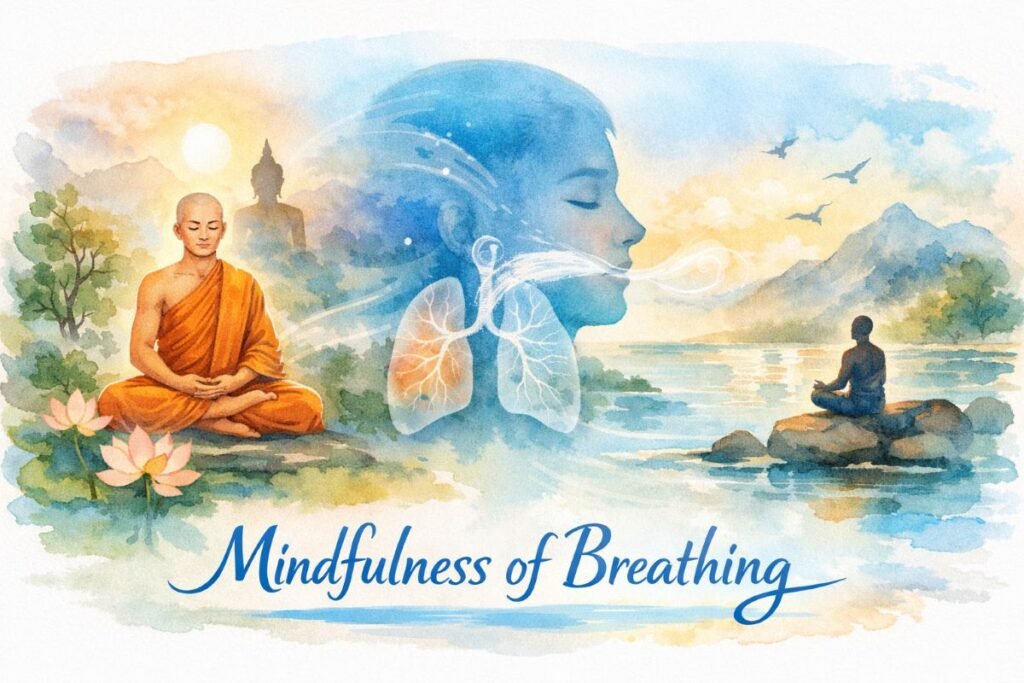
- Mindfulness of Breathing [Ānāpānasati] is a foundational Buddhist practice that uses the natural breath as an anchor for developing both calm and deep insight.
- The practice is not about controlling the breath but about observing it clearly as it is, which helps settle the mind and reduce stress.
- It is a complete system of mental training that leads from basic relaxation to the profound understanding of how the mind and body function.
- Modern research suggests that conscious breathing reduces anxiety, improves focus, and builds emotional resilience, providing evidence consistent with traditional claims about attention and emotional regulation.
- The breath is always available, making this a portable tool that can be applied in meetings, during difficult conversations, or in moments of solitude, without any external equipment.
1. Introduction to Mindfulness of Breathing
Mindfulness of Breathing [Ānāpānasati] is perhaps the most widely practiced form of meditation in the Buddhist tradition. At its core, it is the simple yet profound act of attending to the inhalation and exhalation of the breath. While it may appear basic, this practice serves as a bridge between the body and the mind, offering a way to navigate the complexities of modern life with greater ease and clarity.
In our contemporary world, the mind is often fragmented by constant digital interruptions, work pressures, and social obligations. We frequently find ourselves living in the “future” through worry or in the “past” through regret. Mindfulness of Breathing brings the practitioner back to the present moment. Because the breath is always happening “now,” it serves as a reliable anchor. By training the mind to return to the breath, we develop the capacity to remain steady amidst the shifting circumstances of life.
The breath is unique among the body’s processes. It operates automatically, yet we can also consciously influence it. This makes it a perfect meeting point between the voluntary and involuntary aspects of our being. When we sit in meditation and simply watch the breath, we are engaging with the nervous system in a way that few other activities allow. The practice is not about forcing the breath into a certain pattern but about allowing it to settle naturally. This gentle observation rebalances the mind and opens a door to deeper self-knowledge.
The Buddha himself placed great emphasis on this practice. In the Ānāpānasati Sutta (MN 118), he declared that when mindfulness of breathing is developed and cultivated, it brings the four foundations of mindfulness to perfection, which in turn bring the seven factors of awakening to perfection, leading to true knowledge and liberation. This highlights the centrality of the breath as a vehicle for the entire spiritual path.
For the modern seeker who may not identify as Buddhist, these traditional claims translate into something immediate: a calmer mind, a healthier body, and a greater capacity to meet life’s challenges without being overwhelmed. This article will explore the origins, methods, and practical benefits of this ancient practice, weaving together the traditional Buddhist framework and contemporary scientific understanding.
2. The Buddhist Schools and Origins
Mindfulness of Breathing is a universal practice found across almost all Buddhist traditions. Although the core instruction remains the same, pay attention to the breath, each school has developed its own emphasis and supporting techniques.
2.1 Historical Context
According to the early discourses, the Buddha recollected a childhood experience of meditative absorption, entered the jhānas, and realised awakening. Later Theravāda tradition strongly associates this meditative training with mindfulness of breathing, and it is often presented as the method he used to calm the mind before liberating insight arose.
The primary textual source for the practice is the Ānāpānasati Sutta, found in the Middle Length Discourses (Majjhima Nikāya) of the Pāli Canon. This sutta lays out the sixteen steps. Another key discourse is the Satipaṭṭhāna Sutta (MN 10), which uses the breath as the first method for establishing mindfulness of the body. These suttas form the scriptural backbone that all later traditions draw upon.
2.2 Theravāda (The School of the Elders)
This school, prevalent in Sri Lanka, Thailand, Myanmar, and other parts of Southeast Asia, holds the Pāli Canon as the authoritative record of the Buddha’s teachings. In Theravāda, mindfulness of breathing is practiced to develop both “tranquility” [samatha] and “insight” [vipassanā]. The sixteen steps are seen as a complete path that moves seamlessly from calming the body to seeing the impermanent nature of all experience.
The fifth-century meditation manual, the Visuddhimagga (Path of Purification) by Buddhaghosa, provides detailed instructions on how to develop the sign of concentration [nimitta] using the breath. The practitioner is advised to focus on the touch of the breath at the nostrils or upper lip. With sustained attention, a mental image or bright light may arise, which becomes the object of deep concentration leading to the jhānas, states of deep meditative absorption.
The Thai Forest Tradition, a modern renewal movement within Theravāda, places special emphasis on mindfulness of breathing. Masters such as Ajahn Mun Bhūridatta and his student Ajahn Chah taught that the breath is sufficient to take one all the way to awakening. Their teachings are direct and practical, often eschewing complex theoretical frameworks.
2.3 Zen (Chan)
In the Japanese Zen and Chinese Chan traditions, breath awareness is a foundational element of “seated meditation” [zazen]. The instruction is often extremely simple: sit still and breathe. There is no elaborate sixteen-step sequence, though the essence of the steps is contained in the experience of just sitting.
Zen teachers frequently use the method of counting the breath [susokkan] as a preliminary practice to settle the scattered mind. The meditator counts each exhalation from one to ten, then starts again. If the mind wanders, the count is lost, and the meditator returns to one. This technique cultivates a concentrated, bright attention. Once the mind is stable, the counting is dropped and the practitioner simply breathes with full awareness.
The breath in Zen is often brought down to the lower abdomen. This anchors awareness in the body’s centre of gravity and helps the practitioner feel grounded. The emphasis is on the physical, embodied aspect of breathing, which counters the tendency to get lost in abstract thought.
2.4 Tibetan Buddhism (Vajrayāna)
Tibetan Buddhism employs a vast array of meditation methods, including visualization, mantra recitation, and complex rituals. Within this rich tapestry, mindfulness of breathing is used primarily as a foundational practice to settle the mind [shinay, Skt: śamatha] before undertaking advanced tantric techniques.
In the Tibetan tradition, simple breath awareness is often taught alongside the nine-round breathing purification, a preparatory exercise that involves breathing in through one nostril at a time while visualizing the expulsion of mental poisons such as anger, attachment, and ignorance. This technique is not traditional Ānāpānasati as found in the early suttas, but it shares the principle of using the breath to calm and purify the mind.
The Mahāmudrā and Dzogchen traditions, the highest teachings of Tibetan Buddhism, sometimes speak of “vajra breathing” or simply resting in the natural breath without alteration. In these contexts, the breath becomes a support for recognizing the nature of mind itself. Even the most advanced practitioners return to the simple awareness of breathing as a way to stabilise their recognition of the mind’s innate clarity.
3. The Traditional Framework: The Sixteen Steps
The traditional teaching on mindfulness of breathing is organized into sixteen steps, divided into four sets of four. These steps are not mechanical stages to be forced. They are natural unfoldings that occur as the mind settles and sharpens. Each step is practised in conjunction with the breath: the practitioner knows clearly what is happening during the in-breath and during the out-breath.
3.1 The First Tetrad: Mindfulness of the Body
This first set of four steps establishes the foundation. Without a calm and settled body, deeper mental work is difficult. The tetrad is described in the sutta as “contemplating the body in the body.” It teaches the meditator to experience the breath as a physical phenomenon, not an idea.
- Step 1 — Discerning a long breath: The meditator knows when the breath is long. There is no attempt to make it long; it is simply recognised. A long breath might occur naturally when the body is relaxed. The key term is “discerning” [pajānāti], which means to know clearly and directly.
- Step 2 — Discerning a short breath: When the breath becomes short or shallow, the meditator knows this too. The mind remains equanimous, neither preferring the long breath nor pushing away the short one. This trains the quality of non-preference, which is essential for deeper stages.
- Step 3 — Experiencing the whole body: The word “body” [kāya] here can be understood in two ways. Some teachers interpret it as the whole physical body, feeling the breath’s influence throughout the torso and limbs. Others, following a more literal reading of the Pāli, take it to mean the “whole body of the breath”, the entire length and texture of each inhalation and exhalation. Both interpretations are traditional, and both encourage a spacious, non-localised awareness.
- Step 4 — Calming the bodily formation: The “bodily formation” [kāyasaṅkhāra] is the breath itself. As awareness deepens, the breathing becomes finer, more subtle, and more tranquil. The body relaxes deeply. This calming [passambhayaṃ] is a natural result of sustained, kind attention, not a forced breath control exercise.
In daily life, the first tetrad is a powerful tool for stress relief. When anxiety causes the breath to become rapid and shallow, sitting for a few minutes and simply knowing that the breath is short, feeling the whole body of the breath, can help the nervous system downregulate. You can then consciously invite a longer, calmer breath without strain.
3.2 The Second Tetrad: Mindfulness of Feelings
As the body settles, the mental quality of “feeling” [vedanā] becomes prominent. Vedanā refers not to emotions in the Western sense, but to the bare tone of experience: pleasant, unpleasant, or neutral. This tetrad teaches how to be with pleasant feelings without clinging and with unpleasant feelings without aversion.
- Step 5 — Experiencing rapture: Rapture [pīti] is an energetic joy that can manifest as tingling sensations, waves of bliss, or a feeling of lightness. It arises naturally when the mind begins to unify. The instruction is to know this rapture clearly, not to grasp at it.
- Step 6 — Experiencing pleasure: Pleasure [sukha] is a quieter, more settled happiness. It is the feeling of contentment that follows rapture, like the feeling of rest after satisfying work. The meditator breathes in and out experiencing this pleasure.
- Step 7 — Experiencing the mental formation: The “mental formation” [cittasaṅkhāra] refers, in the early texts, specifically to perception [saññā] and feeling [vedanā] (see MN 44). The meditator observes how these subtle perceptions and feelings arise and colour the experience of the breath.
- Step 8 — Calming the mental formation: Just as the breath was calmed in the first tetrad, now the mental activity that shapes feelings is tranquillised. The mind becomes deeply peaceful. The joy remains, but it is held with a spacious, non-grasping awareness.
This tetrad addresses a universal human challenge: our addiction to pleasant experiences and our aversion to unpleasant ones. By learning to experience pleasure without clinging, we gain a profound freedom. In everyday life, this means enjoying a good meal, a kind word, or a sunset without desperately trying to hold onto them, and thus without the suffering that accompanies loss.
3.3 The Third Tetrad: Mindfulness of the Mind
Now the focus shifts from feeling to the “mind” [citta] itself, the overall state of consciousness. This tetrad is like polishing a mirror so that it reflects clearly. The breath remains the anchor, but the primary object becomes the quality of mind.
- Step 9 — Experiencing the mind: The meditator knows whether the mind is with craving or without craving, with anger or without anger, confused or clear. This is raw self-awareness without judgment. The attitude is one of honest recognition.
- Step 10 — Gladdening the mind: If the mind is dull, contracted, or discouraged, the meditator can actively gladden it. The sutta uses the term “abhippamodayaṃ,” meaning to cheer up or inspire. This might involve bringing to mind a moment of past generosity, reflecting on the Buddha’s qualities, or simply allowing a gentle smile. The mind is brightened.
- Step 11 — Concentrating the mind: Once the mind is bright and pliable, it can be made concentrated [samādahaṃ]. The meditator steadies the mind on the breath, allowing it to become unified and undistracted. This is the heart of concentration practice.
- Step 12 — Releasing the mind: The meditator breathes in and out experiencing the liberation of the mind [vimocayaṃ]. The mind is set free from whatever had been constricting it. This release may manifest as a temporary letting go of hindrances or as a deeper unfettering, depending on the stage of practice.
In daily life, this tetrad offers a practical method for emotional regulation. When you feel down, you can gladden the mind with a positive memory. When scattered, you can concentrate the mind by focusing on three breaths. When stuck in a loop of worry, you can release the mind by mindfully bringing it back to the body.
3.4 The Fourth Tetrad: Mindfulness of Mental Qualities
The final tetrad moves into the domain of deep insight, leading toward liberation. Here the meditator contemplates the nature of reality itself.
- Step 13 — Contemplating impermanence: The meditator observes that the breath, feelings, and states of mind are all constantly arising and passing away. This direct seeing of impermanence [aniccānupassī] is the gateway to wisdom. Nothing lasts for even a moment.
- Step 14 — Contemplating fading away: As impermanence is seen deeply, the mind’s obsessive clinging to experiences begins to fade [virāgānupassī]. The strong colours of craving lose their intensity. The mind becomes dispassionate, not in a cold sense, but in the sense of no longer being burned by desire.
- Step 15 — Contemplating cessation: The meditator contemplates the cessation of conditioned phenomena as they cease [nirodhānupassī]. This is a direct observation of the ending of the processes that create suffering, a taste of stillness that can radically reorient one’s relationship to life.
- Step 16 — Contemplating relinquishment: The final step is letting go [paṭinissaggānupassī]. The meditator releases all grasping, all identification, all burdens. This is not giving up in a passive sense, but actively laying down what was never truly ours to carry.
These steps may seem abstract, but they have immediate relevance. In a moment of frustration, seeing that the feeling is impermanent and already fading can prevent a harsh word. Understanding that a painful thought will cease can give the courage to endure it without reacting.
3.5 The Relationship to the Four Establishments of Mindfulness
The Ānāpānasati Sutta states that mindfulness of breathing, when developed, brings the four establishments of mindfulness to completion. This is a crucial link that shows the practice is not just about relaxation but is a complete path. The four tetrads correspond to the four establishments:
- First tetrad (body) corresponds to contemplation of the body [kāyānupassanā].
- Second tetrad (feelings) corresponds to contemplation of feelings [vedanānupassanā].
- Third tetrad (mind) corresponds to contemplation of mind [cittānupassanā].
- Fourth tetrad (mental qualities) corresponds to contemplation of mental objects or dhammas [dhammānupassanā].
Thus, a single session of Ānāpānasati can encompass the whole spectrum of mindfulness practice. It is a self-contained vehicle for insight.
3.6 The Path of Concentration and the Awakening Factors
The Ānāpānasati Sutta places mindfulness of breathing within a larger map: from mindfulness of breathing, the four foundations of mindfulness are fulfilled; from the four foundations, the seven factors of awakening are fulfilled; and from the seven factors, true knowledge and liberation arise.
The seven factors of awakening [satta bojjhaṅgā] are mindfulness, investigation of dhammas, energy, rapture, tranquillity, concentration, and equanimity. During practice, mindfulness of the breath naturally triggers investigation into the nature of experience. This investigation arouses energy, which in time gives rise to rapture. As rapture matures, tranquillity emerges, leading to deep concentration and finally to equanimity. The meditator thus cultivates the very qualities that the Buddha taught lead to awakening.
This framework shows that Ānāpānasati is not merely a preliminary exercise. It is a complete training that, when pursued with dedication, unfolds the entire path.
4. Why the Breath? A Unique Object of Meditation
A natural question arises: of all possible meditation objects, why the breath? The Buddha’s choice is not arbitrary. The breath possesses a set of qualities that make it uniquely suited for developing both calm and insight.
First, the breath is always present. Unlike a visualized image or a recited phrase, the breath is already there, from the moment of birth to the moment of death. It requires no special preparation. Second, the breath is intimately bodily. It grounds awareness in physical sensation, pulling the mind out of abstract rumination and into the living reality of the present moment. Third, the breath is conditioned, constantly changing, and impersonal. Watching the breath, one cannot help but see impermanence [anicca]: each inhalation is slightly different from the last, each exhalation comes to an end. One also sees that the breath is not self; it arises due to causes and conditions, not because an “I” wills it. In this way, the breath becomes a doorway into the three characteristics of all existence: impermanence, suffering or unsatisfactoriness [dukkha], and not-self [anattā].
Finally, the breath is subtle enough to hold the mind’s interest without being overwhelmingly stimulating. It is a “middle way” object: neither so coarse that it excites the mind, nor so abstract that the mind slips into drowsiness. For all these reasons, the breath is the meditation object recommended most frequently by the Buddha.
5. The Noble Eightfold Path Context
Mindfulness of Breathing is not a standalone technique. In the Buddha’s teaching, it belongs within the Noble Eightfold Path, the comprehensive training that leads to the end of suffering. Specifically, it is a practice that fulfills the path factors of Right Mindfulness [sammā sati] and Right Concentration [sammā samādhi]. But these higher factors of the path rest upon a foundation of ethical conduct [sīla].
The path factors are traditionally presented in three groups: wisdom, ethical conduct, and mental discipline. Ethical conduct includes Right Speech, Right Action, and Right Livelihood. When a person’s daily life is characterized by honesty, non-harming, and integrity, the mind is less agitated by guilt, remorse, or conflict. This clear conscience makes it far easier to settle into deep meditation. The Buddha repeatedly emphasized that without a foundation of virtue, concentration struggles to take root.
Therefore, mindfulness of breathing is most effective when supported by a sincere effort to live ethically. This does not require perfection; it simply means that the practitioner seeks to avoid causing harm, to speak truthfully, and to be mindful of the consequences of their actions. With this foundation, the breath becomes a refuge where the mind can truly rest.
6. The Science of Breath and Mind
The ancient teachings on mindfulness of breathing have in recent decades been illuminated by neuroscience, physiology, and psychology. This research does not replace the traditional framework, but it provides a complementary perspective that can help a modern audience appreciate the practice.
6.1 The Autonomic Nervous System and the Vagus Nerve
The breath sits at the intersection of the autonomic nervous system’s two branches: the sympathetic (fight-or-flight) and the parasympathetic (rest-and-digest). When we are stressed, breathing becomes rapid, shallow, and irregular, driven by the sympathetic system. When we consciously slow and deepen the breath, we stimulate the vagus nerve, a major parasympathetic pathway that runs from the brainstem to the heart and other organs.
Increased vagal tone is associated with lower heart rate, reduced blood pressure, and a calmer emotional state. Heart rate variability (HRV), the variation in time between heartbeats, is a marker of vagal tone and overall resilience. Studies show that regular mindfulness of breathing practice is associated with increased HRV, indicating a healthier, more flexible nervous system.
6.2 Brain Structure and Function
Neuroimaging research, pioneered by scientists such as Richard Davidson, Sara Lazar, and Britta Hölzel, has documented structural and functional changes in the brains of long-term meditators. Key findings include:
- Increased grey matter density in the prefrontal cortex, the area associated with attention, decision-making, and emotional regulation.
- Reduced volume and reactivity of the amygdala, the brain’s fear centre. This correlates with lower anxiety and stress reactivity.
- Thickening of the insula, a region involved in interoceptive awareness, the perception of internal bodily states. This aligns with the traditional emphasis on feeling the breath in the whole body.
6.3 The Default Mode Network
The default mode network (DMN) is a set of brain regions active when the mind is at rest and not focused on an external task. It is associated with mind-wandering, self-referential thought, and excessive rumination. Mindfulness of breathing has been shown to reduce activity in the DMN, quieting the inner chatter that often fuels unhappiness. This is the neuroscientific parallel to the Buddha’s teaching that the untrained mind is like a wild elephant that must be tethered to the post of mindfulness.
6.4 Epigenetics and Cellular Health
Some studies suggest that meditation may influence telomerase activity, an enzyme that protects the ends of chromosomes, though the evidence remains preliminary. Researchers such as Elizabeth Blackburn have explored connections between mindfulness practices and cellular aging, but the field is still developing. These findings, if confirmed, would add a further dimension to the health benefits of mindful breathing.
The Girimananda Sutta (AN 10.60) records the Buddha teaching a sick monk to meditate on various themes, including mindfulness of breathing, to help one relate wisely to illness and support recovery. This ancient advice finds an echo in modern psychoneuroimmunology, which studies the mind-body connection in health.
6.5 Practical Implications of the Research
Understanding the science can be empowering for a practitioner. When you know that each conscious breath may calm the vagus nerve, strengthen prefrontal networks, and quiet the default mode network, it can reinforce motivation to practice. The research is not necessary for the practice to work, it did so for millennia without MRI machines, but it can serve as a bridge for those who might otherwise dismiss meditation as mere superstition.
7. The Five Hindrances and Their Antidotes
A traditional framework highly relevant to the practice of mindfulness of breathing is the teaching on the five hindrances [pañca nīvaraṇā]. These are mental factors that obstruct concentration and insight. Recognising them and knowing how to work with them is an essential skill for any meditator.
7.1 Sensual Desire [kāmacchanda]
This is the mind’s tendency to reach out for pleasant sights, sounds, smells, tastes, touch, and thoughts. During meditation, sensual desire may manifest as fantasies about food, relationships, or achievements. The breath can seem boring in comparison. The Buddha’s principal antidote is contemplating the unattractive aspects of the body [asubha] to cool the fever of craving. Other approaches include bringing the mind back to the breath repeatedly and noting how the desire arises and passes.
7.2 Ill Will [vyāpāda]
This is anger, irritation, or resentment toward a person, situation, or even oneself. During meditation, ill will might show up as replaying an argument or feeling annoyed at a sound. The antidote is to cultivate loving-kindness [mettā] by silently wishing well for oneself and others, then returning to the breath.
7.3 Sloth and Torpor [thīna-middha]
This is a dull, heavy state of mind and body. The meditator may feel sleepy, foggy, or lacking energy. This is common, especially when the body is tired. The Pacalā Sutta (AN 7.58) records practical advice the Buddha gave to Ven. Mahāmoggallāna for overcoming sleepiness: pulling the earlobes, rubbing the limbs, visualizing bright light, or even rising to practice walking meditation. Adjusting posture and ensuring the room is cool and well‑ventilated can also help.
7.4 Restlessness and Worry [uddhacca-kukkucca]
This is an agitated mind that flits from thought to thought and may be accompanied by regret or anxiety. The breath can seem too slow, too quiet. The antidote is to bring attention deep into the body, grounding awareness in the physical sensations of breathing, and to gently label the restlessness as “restlessness” without feeding it.
7.5 Doubt [vicikicchā]
This is scepticism about the practice, the teacher, or one’s own ability. The mind asks, “Is this working? Am I doing it right?” Doubt can be paralysing. The antidote is to gather information from reliable sources, reflect on the proven benefits, and simply continue practicing with trust in the process. The Buddha encouraged doubters to test the teachings for themselves, like a goldsmith testing gold. With patient persistence, doubt can be overcome.
8. Practical Application in Daily Life
You do not need to be on a meditation cushion to practice mindfulness of breathing. Its beauty lies in its portability. The breath is always with you, available as an anchor in any situation.
8.1 Managing Stress and Anxiety
When the stress response is triggered, our breathing becomes shallow and rapid. By consciously bringing mindfulness to the breath, we signal to the nervous system that we are safe. This calming of the bodily formation acts as a natural brake on the fight-or-flight response. In a difficult meeting or a tense conversation, simply feeling three cycles of breath can provide the gap needed to respond with wisdom rather than reacting with anger. Over time, this becomes an automatic resource: the body learns to settle itself quickly.
8.2 Improving Concentration
In an era of continuous partial attention, the breath serves as a gymnasium for the mind. Every time the mind wanders to a notification or a worry, and we gently bring it back to the breath, we are strengthening our concentration [samādhi]. This improved focus carries over into work, study, and even relationships, allowing us to be fully present. Many people report that after even a few weeks of regular short practice, they can read a page without their mind drifting, or listen without planning what to say next.
8.3 Cultivating Emotional Resilience
By observing feelings and mind states, we develop equanimity [upekkhā]. We learn that emotions like sadness or frustration are like weather patterns passing through the sky of the mind. They are impermanent [anicca]. Understanding this prevents us from being overwhelmed. Instead of thinking “I am angry,” we can see “anger is present.” This shift in perspective can prevent a small irritation from escalating into a destructive conflict.
8.4 Navigating Physical Pain
The breath can be a refuge when the body is in pain. The Girimananda Sutta records how the Buddha advised a sick monk to contemplate the breath to maintain clarity and steadiness even during illness, supporting recovery or helping one relate wisely to the illness. When we experience pain, the natural reaction is to tense up and resist, which often amplifies the suffering. Mindful breathing creates a space around the pain. The sensation may still be present, but the added layers of fear and aversion soften.
8.5 Enhancing Sleep
Many people struggle with racing thoughts at bedtime. A simple practice of lying in bed and counting the breath: one on the in-breath, two on the out-breath, up to ten and then starting again, can quiet the mental chatter. The body relaxes, the heart rate slows, and sleep arrives without a battle.
8.6 Communication and Relationships
Before a difficult conversation, taking a few conscious breaths can set a different tone. During the conversation, noticing when the breath becomes tight can alert you to rising anger or defensiveness. This awareness opens the possibility of pausing, breathing, and then speaking from a place of greater clarity rather than reaction.
9. How to Practice: A Detailed Guide
To begin a formal practice, find a quiet space where you can sit comfortably. Start with short sessions, five or ten minutes, and gradually extend the time. Quality of attention matters more than duration.
9.1 Preparing the Environment
Choose a space that is relatively free from disturbances. It need not be perfectly silent; sounds are part of experience and can become objects of mindfulness themselves. A cushion or chair that supports an upright posture is helpful. The room should be at a comfortable temperature.
9.2 Establishing the Posture
- Sit with your back straight but not rigid. Imagine the vertebrae stacked lightly, one on top of the other. This openness in the chest allows the breath to flow naturally.
- If sitting on a chair, place both feet flat on the ground. If on a cushion, cross your legs comfortably. The hands can rest in the lap, right hand on top of the left, palms up, or simply on the knees.
- The eyes may be closed or slightly open with a soft, unfocused gaze directed downward.
9.3 Setting the Intention
At the start of each session, silently articulate your intention [cetanā]. This could be: “May this practice bring calm and clarity for my own benefit and for the benefit of all beings.” Setting an intention frames the practice as meaningful rather than mechanical. Remember, too, that living ethically: speaking truthfully, acting kindly, creates the inner conditions that allow the mind to settle.
9.4 Locating the Breath
Bring attention to the place where the breath’s sensation is most distinct. For many, this is the rim of the nostrils where the air enters and leaves. For others, it is the movement of the abdomen. Choose one spot and stay with it for the whole session. Consistency builds concentration.
9.5 The Basic Technique
- Simply know the in-breath as an in-breath and the out-breath as an out-breath.
- If the mind wanders, gently note “thinking” and return to the breath. Do not scold yourself; each return is a victory.
- As you settle in, see if you can feel the entire length of each breath from its beginning to its end.
9.6 Working with the Steps
Once the mind has gained some stability, you can experiment with the sixteen steps. You might spend a week focusing only on the first tetrad. When you feel ready, allow the pleasant feelings of the second tetrad to arise. Do not force it; the steps unfold naturally when the conditions are right.
9.7 Closing the Session
When the session ends, sit quietly for a minute. Notice how the body feels and the quality of the mind. Then, slowly open the eyes and move back into your day, carrying some of that calm with you.
9.8 Walking Meditation
Mindfulness of breathing is not limited to sitting. In traditional Theravāda walking meditation, one observes the physical sensations of walking itself, the lifting, moving, and placing of each foot. Some modern teachers also synchronise the breath with walking steps, using the breath as a rhythm for movement. Both approaches integrate mindfulness into daily motion and can be a refreshing alternative when sitting is difficult.
10. Common Challenges and Misconceptions
10.1 “I Can’t Stop My Thoughts”
The goal is not to stop thoughts but to change your relationship with them. Thoughts are like clouds passing through the sky. The breath is the stable sky itself. Even experienced meditators have thoughts. The practice is to return to the breath again and again without self-judgment.
10.2 “I Feel Sleepy”
Drowsiness is a common visitor. It often signals that the body is finally relaxing. If it persists, recall the Pacalā Sutta’s advice: open the eyes, rub the limbs, visualize light, or stand up to practice walking meditation. The Buddha encouraged meditators to find a balanced posture—neither too tight nor too loose.
10.3 “It’s Boring”
Boredom is a lack of interest [chanda]. If the practice feels dull, investigate more closely. Notice the subtle texture of the breath. The air at the beginning of the in-breath is cool; at the end of the out-breath it is warm. A whole world lives inside a single breath.
10.4 Physical Discomfort
Pain in the knees, back, or shoulders can arise. Some discomfort is part of sitting still. However, sharp pain should be addressed by adjusting the posture. Use discomfort as an object of mindfulness: what is the actual sensation versus the story about it?
10.5 Doubting the Practice
When doubt arises, reflect on the credible sources that endorse this practice: the Buddha, generations of practitioners, and modern research. Acknowledge the doubt without feeding it. Like all mental phenomena, doubt is impermanent and will pass.
11. Conclusion
Mindfulness of Breathing is far more than a relaxation technique; it is a profound system of mental cultivation [bhāvanā] that has guided countless practitioners to peace and liberation over two and a half millennia. By using the simple, ever-present rhythm of the breath, we can navigate the complexities of modern life with groundedness and clarity.
The ancient framework of the sixteen steps provides a comprehensive roadmap, from physical relaxation to the deepest insights into impermanence, fading, cessation, and relinquishment. Supported by ethical living and understood within the Noble Eightfold Path, the practice unfolds naturally. Modern research suggests that conscious breathing is associated with measurable changes in brain structure and function, reduced stress reactivity, and improved emotional regulation. The breath requires no special equipment, no specific belief, and no prior expertise, only the willingness to pause, breathe, and notice.
Each breath is an invitation to begin again. In the space of one conscious inhalation, the past falls away. In one conscious exhalation, the future can wait. This is the gift of Ānāpānasati: the art and science of coming home to the present moment, breath by breath.
Glossary of Terms
- Ānāpānasati: Mindfulness of breathing; the practice of maintaining awareness on the inhalation and exhalation.
- Anicca: Impermanence; the Buddhist teaching that all conditioned things are in constant flux.
- Bhāvanā: Mental cultivation or development; often translated as meditation.
- Cetanā: Volition or intention; the mental factor that directs the mind toward a chosen purpose.
- Citta: Mind, heart, or state of consciousness.
- Kāyasaṅkhāra: Bodily formation; often refers to the breath itself as a conditioned bodily process.
- Nimitta: A sign or mental image that arises during concentration, often used as a meditation object in Theravāda.
- Pajānāti: To discern, know, or understand clearly.
- Passambhayaṃ: Calming, quieting, or stilling.
- Paṭinissagga: Relinquishment; the letting go of attachment and identification.
- Pīti: Rapture, joy, or physical pleasure arising from concentration.
- Samādhi: Concentration, oneness of mind, or mental collectedness.
- Samatha: Tranquility or calm; a state of mind characterized by stillness.
- Sutta: A discourse or sermon attributed to the Buddha.
- Taṇhā: Craving, thirst, or desire; in this context, the strong expectation that things should be a certain way.
- Upekkhā: Equanimity; mental balance and staying even-minded in the face of change.
- Vedanā: Feeling; the tone of experience, pleasant, unpleasant, or neutral.
- Vipassanā: Insight; clear seeing into the true nature of reality.
Resources for Further Learning
Books
- Mindfulness with Breathing: A Beginner’s Guide by Buddhadāsa Bhikkhu. A detailed manual on the sixteen steps from a renowned Thai forest master.
- Breath by Breath: The Liberating Practice of Insight Meditation by Larry Rosenberg. A modern, accessible look at the Ānāpānasati Sutta.
- The Experience of Insight by Joseph Goldstein. A classic text that places breathing practice within the broader context of Buddhist meditation.
- Full Catastrophe Living by Jon Kabat-Zinn. Applies mindfulness of breathing in a clinical setting with practical guidance for health and well-being.
- The Heart of the Buddha’s Teaching by Thich Nhat Hanh. A clear introduction to core Buddhist concepts including mindful breathing.
Podcasts and Audio
- Dharmaseed.org – A vast archive of free talks on mindfulness of breathing by teachers such as Christina Feldman and Gil Fronsdal.
- The Insight Hour with Joseph Goldstein – Deep dives into the mechanics of mindfulness and the breath, grounded in the early Buddhist texts.
- Audio Dharma – Short, practical guided meditations on breathing, suitable for daily life.
Related Suttas
- Ānāpānasati Sutta (MN 118) – The primary discourse on the sixteen steps.
- Satipaṭṭhāna Sutta (MN 10) – The foundational text on the four establishments of mindfulness.
- Girimananda Sutta (AN 10.60) – Discusses mindfulness of breathing as a practice to relate wisely to illness.
- Pacalā Sutta (AN 7.58) – Practical advice for overcoming sleepiness in meditation.