Key Takeaways
- The Buddha teaches two fundamental patterns of communication, ignoble expression and noble expression, which directly shape our character, relationships, and inner peace
- Ignoble speech includes four types, false speech, divisive speech, harsh speech, and idle chatter, each arising from unwholesome states of mind
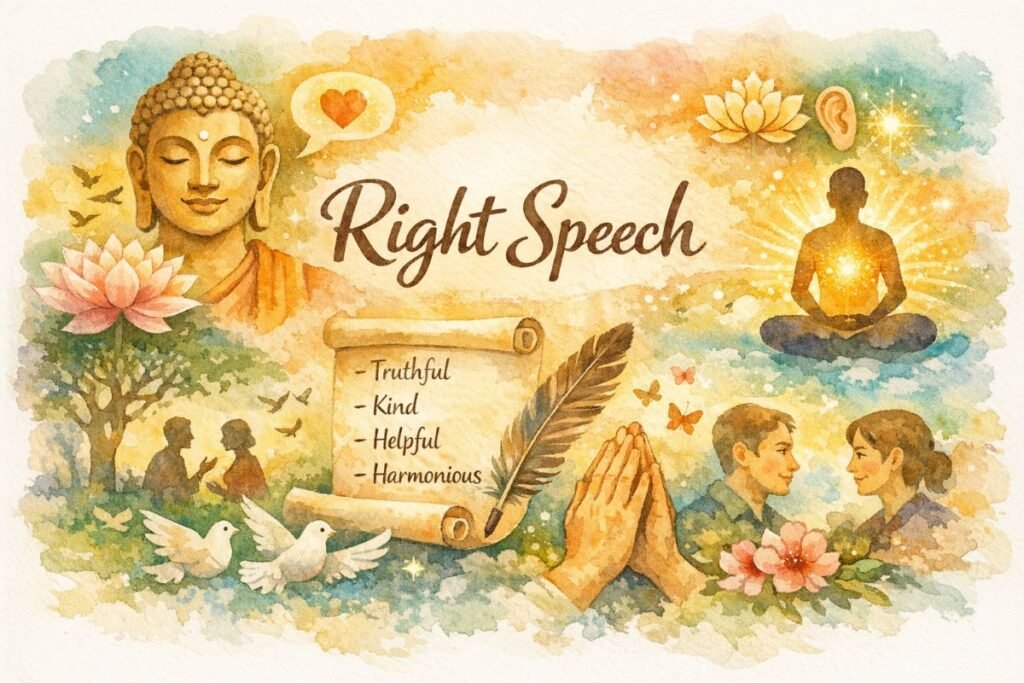
- Noble speech is the intentional practice of truthfulness, harmony promotion, kindness, and meaningful communication
- A core teaching from the Anguttara Nikaya focuses on accurately reporting direct experience, what is truly seen, heard, sensed, and known
- Right Speech is the third factor of the Noble Eightfold Path and provides essential support for mental clarity, ethical living, and meditation practice
- Practicing noble expression requires mindfulness, restraint, patience, and wisdom applied consistently in daily life situations
- Speech is not merely about the words we choose, it reflects our underlying intention, level of awareness, and degree of inner alignment with wholesome qualities
1. Introduction to the Expressions of Speech
Speech is one of the most immediate and powerful ways we affect the world around us. With just a few carefully chosen words, we can calm a tense and anxious situation or inflame it beyond recognition. We can build lasting trust and deepen connection or break it apart in an instant. In Buddhist teaching, speech is never treated as something casual or inconsequential. It is understood and respected as a potent form of action, an expression of mind that carries real consequences for ourselves and others.
The Buddha placed tremendous importance on what is traditionally called Right Speech, or right communication, which in the Pali language is known as Sammā Vācā. This teaching is not a minor suggestion or an optional extra. It stands as the third factor of the Noble Eightfold Path, the comprehensive and practical framework for ending suffering and dissatisfaction in human experience. Right Speech sits between Right Intention and Right Action, showing that our words form a bridge between our inner thoughts and our outer behavior. They reveal the quality of our mind and shape the world we inhabit.
Within this broader framework of ethical communication, the Buddha described two broad and contrasting categories of expression. The first is ignoble expression, or unskillful communication, which leads to harm, confusion, and increased suffering. The second is noble expression, or skillful communication, which leads to benefit, clarity, and genuine peace. These categories are not theoretical abstractions. They are practical guidelines that help us understand how our words either contribute to or undermine our own well-being and the well-being of those around us.
These profound teachings appear in the early discourses of the Pali Canon, particularly in the collection known as the Aṅguttara Nikāya, the Numerical Discourses of the Buddha. Specific instructions on noble and ignoble expressions are found in suttas such as Anguttara Nikaya 4.250 (AN 4.250), Anguttara Nikaya 8.67 (AN 8.67), and Anguttara Nikaya 8.68 (AN 8.68). These discourses offer clear and direct guidance on how to distinguish between speech that leads away from peace and speech that leads toward it.
It is essential to understand that these teachings are not rules imposed from some external authority or commandments handed down by a demanding figure. Instead, they function as training principles, as opportunities for self-observation and gradual refinement. They are offered as tools to help us see clearly how speech affects the mind, influences our relationships with others, and either supports or obstructs our path toward greater clarity, ease, and inner peace. The invitation is to experiment with these principles in our own lives and notice the results for ourselves.
This article explores the teachings on noble and ignoble expression with both depth and practicality. It aims to show how these ancient guidelines remain remarkably relevant and applicable in the complexities of modern daily life. Whether we are navigating workplace dynamics, family conversations, or online interactions, the principles of Right Speech offer a reliable compass for communicating with integrity and care.
2. The Framework of Noble and Ignoble Expression
The Buddha did not leave the teaching on speech vague or open to broad interpretation. He provided a clear and structured framework that anyone can understand and apply. This framework begins with identifying the types of speech that cause harm and then presents their wholesome counterparts. Understanding both sides of this equation is necessary for developing skill in communication.
2.1 The Four Ignoble Expressions
The Buddha identified four primary types of harmful and unskillful speech. These are not simply mistakes or accidental slips of the tongue. They are intentional actions rooted in underlying mental states such as greed, aversion, and delusion. Recognizing these patterns is the first step toward transforming them.
1. False Speech
In Pali, this is called musāvāda. False speech refers to the intentional telling of lies, the deliberate misrepresentation of facts or experience. It includes not only outright falsehoods but also exaggerations, minimizations, half-truths, and deceptive omissions. The core element is the intention to deceive another person or create a false impression. False speech arises from states of mind such as fear, greed for gain or approval, or the wish to harm someone’s reputation. It fractures trust and creates a foundation of unreliability in relationships.
2. Divisive Speech
In Pali, this is called pisuṇā vācā. Divisive speech is communication that aims to create separation, conflict, or animosity between people. It includes gossip, backbiting, tale-bearing, and any speech that turns one person against another. Often, this type of speech involves repeating negative things one person has said about another, or even fabricating such statements altogether. The intention behind divisive speech is often rooted in jealousy, resentment, or a misguided desire to feel important by being the one who knows and shares sensitive information. The result is the breakdown of harmony in families, workplaces, and communities.
3. Harsh Speech
In Pali, this is called pharusā vācā. Harsh speech encompasses any communication that is aggressive, cruel, insulting, or abusive. It includes yelling, swearing at someone, using belittling language, or speaking with a tone of contempt and anger. Harsh speech can be directed at people, animals, or even objects in a moment of frustration. The root of harsh speech is almost always aversion, anger, or impatience. It wounds the recipient and simultaneously agitates and harms the mind of the speaker. Words spoken in anger can leave lasting scars on relationships and create an atmosphere of fear and hostility.
4. Idle Chatter
In Pali, this is called samphappalāpa. Idle chatter refers to speech that is meaningless, purposeless, or untimely. It is talk that has no real benefit, no educational value, and no connection to what is wholesome or important. This includes excessive gossip about celebrities or acquaintances, rambling conversations that go nowhere, and filling silence with noise simply to avoid being quiet. While idle chatter may seem harmless compared to lying or shouting, the Buddha identified it as a significant drain on mental energy and a form of distraction that keeps the mind restless and unfocused. It wastes time that could be used for reflection, learning, or genuine connection.
These four forms of speech are considered ignoble because they arise from and reinforce unwholesome states of mind. They create turbulence in the heart and disturbance in the community. The Buddha encouraged his followers to recognize these patterns clearly and to make a sincere effort to abandon them.
2.2 The Four Noble Expressions
The noble expressions are not a completely different set of actions. Rather, they represent the intentional and mindful restraint from the four harmful types, coupled with a positive commitment to their opposites. This is not merely passive avoidance but an active cultivation of awareness, kindness, and care in all our communications.
1. Speaking Truthfully
This is the direct counterpart to false speech. Speaking truthfully means making a consistent and sincere effort to align our words with what is actually true. It involves verifying facts before speaking, being honest about our own limitations and mistakes, and avoiding the temptation to exaggerate or deceive for personal advantage. Truthfulness builds a foundation of trust and reliability. When others know we speak the truth, they feel safe and respected in our presence. Furthermore, speaking truthfully simplifies our own life. We do not need to remember complicated webs of lies or half-truths, and our mind remains clearer and more peaceful.
2. Promoting Harmony
This is the wholesome counterpart to divisive speech. Promoting harmony means using our speech to heal divisions, reconcile conflicts, and strengthen bonds of friendship and community. It involves speaking well of others in their absence, highlighting shared values and common ground, and gently encouraging direct communication between people who have misunderstandings. When we hear negative speech about someone, we can choose not to pass it on. We might even offer a balanced perspective or simply change the subject. The intention is to be a source of unity rather than a cause of division. This type of speech creates an environment of safety and mutual respect.
3. Speaking Kindly
This is the beneficial counterpart to harsh speech. Speaking kindly means choosing words and a tone of voice that are gentle, courteous, and considerate. It involves expressing even difficult truths with compassion and care for the listener’s feelings. Speaking kindly does not mean being weak or avoiding necessary confrontation. It means communicating with a genuine wish for the other person’s well-being, even when addressing problems or setting boundaries. The Buddha often praised speech that is gentle, pleasing to the ear, affectionate, and going to the heart. Such speech soothes the listener and protects the speaker’s own mind from the burning quality of anger.
4. Speaking Meaningfully
This is the constructive counterpart to idle chatter. Speaking meaningfully means ensuring that our communication has a worthwhile purpose. It involves speaking about topics that are beneficial, timely, and connected to what is true and good. Meaningful speech includes discussions about learning, personal growth, ethical living, kindness, and practical matters that support well-being. It also includes comfortable silence shared with others, recognizing that not every moment needs to be filled with words. The Buddha encouraged speech that is measured, thoughtful, and related to the goal of reducing suffering. By limiting idle chatter, we conserve mental energy and create space for deeper reflection and more genuine connection.
This framework of four noble and four ignoble expressions provides a clear and practical map for navigating the complex terrain of human communication. It is a training that requires patience, mindfulness, and a gentle but persistent commitment to improvement.
3. The Framework of Reporting Experience Honestly (The Teaching of AN 4.250)
The fourfold framework of ignoble and noble speech is essential. However, the primary discourse on this topic, Anguttara Nikaya 4.250 (AN 4.250), contains a specific and profound instruction that is the very heart of the teaching. It explains that noble and ignoble expressions are distinguished not just by broad categories like lying or kindness, but by the precise way we report our own direct experience.
In this teaching, the Buddha explains that speech becomes ignoble when we misrepresent what we have personally experienced through our senses and mind. He identified four primary channels of experience and pointed out how we can be dishonest about each one.
The channels of experience are described as follows:
- Seen: In Pali, diṭṭha. This refers to visual experience, what is perceived through the faculty of sight. It includes everything we see with our eyes, from a clear sky to a facial expression to a written word.
- Heard: In Pali, suta. This refers to auditory experience, what is perceived through the faculty of hearing. It includes spoken words, music, sounds of nature, and all forms of noise.
- Sensed: In Pali, muta. This is a broader category that refers to bodily and sensory experience beyond seeing and hearing. It encompasses what we smell through the nose, taste with the tongue, and feel through the body in terms of touch, temperature, pressure, and physical sensation.
- Known: In Pali, viññāta. This refers to mental experience, what is cognized or understood by the mind itself. It includes thoughts, ideas, emotions, memories, plans, and the direct knowing of mental states such as calmness or agitation.
According to this profound teaching, noble expression means aligning our speech accurately and honestly with what we have actually experienced through these four channels. Ignoble expression occurs when we claim to have seen something we did not see, or claim we did not see something we actually did see. The same principle applies equally to what is heard, sensed, and known.
For example, saying “I saw him take the item” when we only heard a rumor that he might have taken it is a form of ignoble speech. It involves misrepresenting a heard experience as a seen experience. Similarly, claiming “I know she is angry with me” when we have only sensed a certain tension in the room and have not actually confirmed her mental state is also a misrepresentation of the known category. We are presenting an assumption or an inference as a direct mental cognition.
This teaching points to a level of integrity and precision in communication that is both challenging and liberating. It invites us to be meticulous about distinguishing between what we have directly perceived and what we are inferring, assuming, or repeating from others. It asks us to own our experience accurately. Instead of saying “This food is terrible,” which is a statement presented as an objective fact about the food, we might say, “I do not enjoy the taste of this food,” which is an accurate report of our own sensed experience.
This precision reduces conflict significantly. Many arguments escalate because people state their interpretations and assumptions as if they were absolute, observed facts. By learning to speak more precisely about our own experience, we reduce the likelihood of misunderstanding and create more space for genuine dialogue. This teaching underscores that Right Speech is not only a matter of ethics but also a practice in clear seeing and mindfulness.
4. Buddhist Context and Traditions
The teachings on noble and ignoble expression are most explicitly preserved and detailed in the Pali Canon, which forms the scriptural foundation of the Theravāda tradition. Theravāda, meaning “Teaching of the Elders,” is the oldest surviving school of Buddhism and is practiced primarily in Sri Lanka, Thailand, Myanmar, Laos, and Cambodia. In this tradition, Right Speech is a core component of sīla, often translated as virtue or ethical conduct. Sīla is the indispensable foundation upon which the practices of concentration and wisdom are built.
However, the importance of mindful and ethical speech is by no means limited to the Theravāda tradition. It is a universal Buddhist value that is central across all major schools.
In the Mahāyāna tradition, which developed later and is prominent in countries such as China, Japan, Korea, and Vietnam, the principles of Right Speech are integrated with the great emphasis on compassion and the bodhisattva path. The bodhisattva is one who dedicates their life to the liberation of all beings. For a bodhisattva, speech is seen as a primary tool of skillful means, or upāya. The intention is to use words in whatever way will most effectively reduce suffering and guide others toward wisdom. This might sometimes involve gentle encouragement, at other times a firm and direct challenge, but the underlying motivation is always compassionate. The Mahāyāna sutras contain numerous teachings on the importance of gentle speech, avoiding harsh words, and using language to inspire faith and practice.
In the Vajrayāna tradition, associated particularly with Tibetan Buddhism and related lineages, speech is understood with an even more profound depth. Vajrayāna, the “Diamond Vehicle,” employs a wide range of skillful methods to transform ordinary experience into the path of awakening. Within this context, speech is recognized not only as a form of communication but also as a vehicle of energy and transformation. The practice of mantra recitation is a central feature of Vajrayāna and is understood as one way of applying the principles of Right Speech at a very subtle level, using sound and intention to cultivate specific qualities of mind. While these methods are distinctive to the Vajrayāna tradition, they rest on the same foundational understanding of speech as a potent form of kamma.
Across all these diverse traditions, a common understanding prevails. Speech is not a neutral act. It is a form of kamma, meaning intentional action that produces corresponding results. The Pali term kamma is far more nuanced than the common English word “karma” often suggests. It specifically refers to volitional action. When we speak with a particular intention, that intention shapes our mind in the present and creates the conditions for future experiences. Wholesome intentions rooted in generosity, loving-kindness, and wisdom lead toward well-being. Unwholesome intentions rooted in greed, hatred, and delusion lead toward suffering. Therefore, training in speech is training in mind, and training in mind is training in shaping the trajectory of our lives.
A Note on Language
This article primarily uses Pali terms for the core teachings, as Pali is the language of the earliest recorded Buddhist texts and provides a common foundation for understanding. However, it is important to acknowledge that Sanskrit terms are central to the Mahāyāna and Vajrayāna traditions. Where a Sanskrit term differs significantly or is the more commonly used form in those contexts, it is provided in parentheses alongside the Pali. Throughout the article, once a term is introduced and explained, the English translation is used for ease of reading and understanding.
5. Why Speech Matters So Much
In the busy flow of daily life, it is easy to underestimate the power and significance of our words. We might think that only dramatic actions have real consequences. The Buddhist teachings, however, place speech on the same level of importance as physical action and mental intention. Understanding why speech holds such a central place in the path to peace reveals the profound wisdom of this emphasis.
5.1 Speech Shapes the Mind
The relationship between speech and mind is reciprocal. The state of our mind conditions the words we speak. An angry mind produces harsh words. A greedy mind produces deceptive words. A confused mind produces rambling, meaningless words. But this process also works in the opposite direction. The words we choose to speak condition and shape the state of our mind in return.
When we intentionally tell a lie, the mind must engage in a complex and stressful activity. It must hold the truth in one place while constructing and presenting a falsehood. It must monitor the listener’s reaction for signs of suspicion. It must remember the lie to maintain consistency in the future. This internal tension creates restlessness, anxiety, and a sense of separation from others. The mind becomes clouded and disturbed. As the Dhammapada (Dhp 100) succinctly states, “Better than a thousand useless words is one single word that brings peace.”
In contrast, when we make a firm commitment to speak truthfully and kindly, the mind experiences a corresponding sense of ease and clarity. There is no need for complex mental gymnastics to maintain a facade. There is no fear of being exposed. The mind can rest in a state of greater simplicity and openness. This clarity directly supports the development of concentration and insight in meditation. The Magga-vibhanga Sutta (SN 45.8) clearly establishes Right Speech as a necessary supporting condition for the deeper stages of mental development, showing how it is part of the integrated path of virtue, concentration, and wisdom.
5.2 Speech Shapes Relationships
Human beings are fundamentally social creatures. Our sense of self, our happiness, and our security are deeply intertwined with the quality of our relationships with others. And what is the primary medium through which we build, maintain, or damage those relationships? It is speech.
Trust, the essential foundation of any healthy relationship, is built slowly over time through consistent, honest, and reliable communication. When our words match our actions and when we speak with genuine care for the other person’s well-being, trust naturally develops. People feel safe to be open and vulnerable with us. Connections deepen and become more nourishing.
Conversely, trust can be shattered in a matter of seconds through a single act of false speech or a devastatingly harsh word. Divisive speech, even if it seems entertaining or harmless as gossip, slowly poisons the atmosphere of a family or workplace. It creates factions, suspicion, and a sense of unease. People become guarded and afraid to speak openly for fear of being the next topic of gossip. Over time, communities built on ignoble speech become fragmented and stressful.
The cumulative effect of individual speech patterns extends beyond personal relationships to shape the character of entire communities and societies. A society in which the majority of people value and strive for truthful, harmonious, kind, and meaningful communication will naturally tend toward stability, cooperation, and mutual respect. Information can be trusted. Debates can be conducted with civility. Collective problems can be addressed with a shared understanding of the facts.
On the other hand, a society saturated with falsehoods, divisive rhetoric, harsh insults, and endless streams of trivial or misleading content becomes unstable and deeply stressful for its members. Trust in institutions, in the media, and even in one’s neighbors erodes. Anxiety and polarization increase. The Buddha’s teachings on speech are not just personal ethics, they are also a prescription for a more peaceful and functional society. Each individual who commits to Right Speech contributes a small but significant measure of sanity and kindness to the collective environment.
5.4 Speech Supports Meditation
For those who engage in meditation or contemplative practices, the importance of Right Speech becomes even more apparent. Meditation is the practice of calming the mind and seeing clearly into the nature of experience. It is exceedingly difficult to settle the mind if it has recently been agitated by unskillful speech.
Imagine trying to meditate after telling a significant lie. The mind is likely to be filled with anxiety, regret, and a restless narrative about the lie and its potential consequences. Imagine meditating after a heated argument filled with harsh words. The body may still be tense, and the mind will likely be replaying the argument, generating more anger and justification. These mental states are direct obstacles to tranquility and insight.
Ethical speech acts as a powerful support for meditation. When we know we have spoken truthfully and kindly throughout the day, the mind settles more easily. There is less regret to process, fewer conflicts to resolve internally. The mind feels lighter and more inclined toward peace. In this way, Right Speech is not separate from the practice of meditation, it is an integral part of preparing the ground for it.
6. Understanding Each Type in Detail with Practical Examples
To move from theoretical understanding to practical application, it is helpful to examine each type of ignoble and noble speech in greater depth, illustrated with concrete examples from modern life. These examples are designed to show not only the problem but also a skillful and compassionate response.
6.1 False Speech [musāvāda] and Truthfulness
False speech is the intentional presentation of what is not true. It is a deliberate act of deception. The underlying motivations can vary. Sometimes it is driven by fear, the fear of getting in trouble or being judged. Sometimes it is driven by greed, the desire to gain something we believe we cannot get honestly. Sometimes it is driven by simple convenience, lying because it seems easier than telling a difficult truth.
Practical Example: The Workplace Exaggeration
Consider a man named James. He works as a marketing associate and is hoping for a promotion. During a team meeting, his manager asks about the results of a recent campaign. James feels the pressure to appear more successful than he actually was. Instead of stating the modest but accurate figures, he inflates the engagement numbers by a significant margin. He says, “The campaign drove a forty percent increase in user engagement,” when the real number was closer to fifteen percent. He also implies that he was solely responsible for the strategy, even though a colleague contributed key ideas.
This is a clear instance of false speech. James has intentionally misrepresented the facts. In the short term, he receives approving nods from his manager and feels a brief flash of validation. However, over the following days and weeks, a subtle but persistent anxiety begins to take root. He worries that someone will check the data and discover the discrepancy. He avoids talking to the colleague whose contribution he downplayed. He feels a tightness in his chest whenever the campaign is mentioned. He has created a small but significant fracture in his own integrity. His mind is no longer at ease.
Skillful and Noble Response
After a few weeks of this internal discomfort, James reflects on his actions. He recognizes that the temporary praise was not worth the lasting unease. He decides to practice the noble expression of truthfulness. He schedules a brief meeting with his manager and says something like the following:
“I wanted to clarify something about the campaign numbers I mentioned a few weeks ago. In my eagerness to present the work positively, I wasn’t as precise as I should have been. The actual engagement increase was closer to fifteen percent, not forty. I also want to acknowledge that Priya contributed significantly to the early strategy phase. I apologize for not being fully accurate. I will ensure my reporting is precise moving forward.”
The moment James speaks these words, he notices a physical sense of relief wash over him. The weight of the deception is lifted. His manager, while perhaps slightly surprised, respects the honesty and the willingness to correct the record. More importantly, James experiences an internal shift. He feels a sense of alignment and integrity returning. He has chosen the path of noble expression, and his mind begins to settle.
Reflection on the Example
This example illustrates a key principle. Truthfulness is not just for the benefit of others, it is a profound form of self-care. It protects the mind from the turbulence created by maintaining falsehoods. The Buddha emphasized the importance of truthfulness repeatedly. In the Cunda Kammaraputta Sutta (AN 10.176), he describes a person who abandons false speech as one who “speaks the truth, adheres to the truth, is trustworthy and reliable, one who is no deceiver of the world.” This reliability is a foundation for a peaceful life.
6.2 Divisive Speech [pisuṇā vācā] and Promoting Harmony
Divisive speech is any communication intended to create a rift or break a connection between people. It is often more subtle than outright lying and can sometimes be disguised as concern or helpfulness. The classic form is gossip, repeating something negative one person said about another. The intention is often not pure. It may be to feel important, to vent frustration indirectly, or to undermine someone’s reputation.
Practical Example: The Office Rumor
Imagine a woman named Maya who works in a busy office. She is having coffee with a friend and colleague, Sarah. During their conversation, Maya mentions that she overheard another colleague, David, make a critical remark about a project Sarah was leading. The actual remark was fairly mild and was expressed as constructive feedback. But as Maya retells it, she adds a bit of extra spin, emphasizing David’s tone and implying a greater level of disrespect.
Maya says to Sarah, “I heard David saying your project plan was a complete mess. He sounded really annoyed, like he thinks you don’t know what you’re doing.”
Maya might tell herself she is just sharing information or looking out for her friend. But the effect of her words is immediate. Sarah’s face falls. She feels hurt and angry toward David. The next time Sarah and David are in a meeting together, there is a palpable tension. Collaboration becomes strained. The harmony of the small team is disrupted, all because of a few unskillful words spoken over coffee. This is the insidious power of divisive speech.
Skillful and Noble Response
Later that day, Maya feels a pang of regret. She sees the tension between Sarah and David and realizes her words were the cause. She decides to practice the noble expression of promoting harmony. She goes to find Sarah and says something like:
“Sarah, I want to apologize for how I relayed what I heard David say earlier. I think I added my own interpretation and made it sound worse than it was. I was not being mindful. The actual comment was more like feedback on the timeline, not an attack on your work. I feel I created unnecessary friction, and I am sorry. If there’s any real issue, I am sure you and David can talk it through directly.”
Maya then chooses not to get involved further. She does not go to David to repeat what she told Sarah. She simply stops being a conduit for potential conflict. In doing so, she takes a step toward restoring the harmony she disrupted. Her apology and clarification act as a healing balm on the small wound her words had created.
Reflection on the Example
This scenario shows how easily divisive speech can arise, even without strong malicious intent. It often stems from a lack of mindfulness and a tendency to dramatize or embellish stories. The noble alternative requires us to be careful with the words of others. We can ask ourselves, “Does repeating this promote unity or division?” If the answer is division, the most skillful act is often to remain silent or to gently encourage direct communication.
6.3 Harsh Speech [pharusā vācā] and Speaking Kindly
Harsh speech is perhaps the most immediately painful form of unskillful communication. It includes insults, yelling, sarcastic put-downs, and speaking with a tone of contempt or anger. It is a direct expression of an agitated and aversive state of mind. While the target of harsh speech clearly suffers, the speaker also inflicts harm upon their own mind.
Practical Example: The Traffic Outburst
Consider a man named David. He is driving home after a long and stressful day at work. He is tired and has a mild headache. Another driver cuts him off abruptly, forcing him to brake hard. A surge of anger flashes through David’s body. Without thinking, he leans on his horn and shouts a stream of insults inside his car, calling the other driver a reckless idiot and worse. His heart pounds, his jaw is tight, and his hands grip the steering wheel with white knuckles.
The other driver cannot even hear him. But the harm has been done, and it has been done entirely to David himself. The outburst of harsh speech has amplified his anger and flooded his body with stress hormones. For the next twenty minutes of his drive, he remains agitated and on edge. He arrives home still carrying the residue of this anger. He is short-tempered with his partner and unable to relax. A single moment of unskillful speech has poisoned his own evening.
Skillful and Noble Response
David has been learning about mindfulness and the teaching on harsh speech. The next time a similar situation occurs, a driver cuts him off, and he feels the familiar flash of anger, he remembers his previous experience. He takes a conscious, deep breath. He deliberately relaxes his grip on the steering wheel. Instead of shouting insults, he says to himself in a calm and kind inner voice, “That person may be in a hurry or distracted. May they be safe. May I be patient.”
The anger is still there as a sensation in his body, but he does not feed it with harsh words. By refraining from the verbal expression of anger, he allows the feeling to subside on its own, which it does within a minute or two. He arrives home in a far calmer state of mind. He is able to greet his partner with genuine warmth. He has protected both his own evening and the peace of his home by practicing the noble expression of speaking kindly, first to himself and then by extension to others.
Reflection on the Example
This example highlights a critical point. The first and most immediate beneficiary of speaking kindly is the speaker. Harsh speech reinforces and prolongs our own anger. Kind speech, even when directed only internally, begins the process of soothing and releasing that anger. The Buddha used the powerful simile of the saw in the Kakacupama Sutta (MN 21), stating that even if bandits were to carve one limb from limb with a two-handled saw, one who gave rise to a mind of hate on that account would not be following his teaching. This extreme image underscores the commitment to non-hate and kindness, even under the most severe provocation.
6.4 Idle Chatter [samphappalāpa] and Speaking Meaningfully
Idle chatter is often dismissed as the least harmful of the four ignoble expressions, but its cumulative effect can be significant. It is a form of mental junk food. It fills the mind with noise and distraction, leaving little room for reflection, genuine connection, or simply being at ease with silence.
While the Buddha’s original context was oral communication, the principle of avoiding meaningless, agitating, and purposeless talk offers a valuable lens for reflecting on our modern digital habits.
Practical Example: The Endless Scroll
Consider a young woman named Lena. After dinner each evening, she opens her social media apps and begins to scroll. She spends two hours reading a constant stream of content, much of it gossip about celebrities she has never met, trivial arguments between strangers, sensationalized news headlines designed to provoke outrage, and a flood of photos showing curated, unrealistic glimpses of other people’s lives.
She might comment on a few posts with brief, meaningless phrases. She might share a piece of gossip she just read. At the end of the two hours, she puts her phone down and notices a distinct feeling. She feels oddly drained, restless, and vaguely dissatisfied. Her mind is buzzing with dozens of fragmented, useless thoughts. She has not rested, nor has she learned anything of value. She has simply filled her evening with a modern form of idle chatter. This constant mental noise makes it difficult for her to focus when she tries to read a book or even to fall asleep peacefully.
Skillful and Noble Response
Lena becomes aware of this pattern and its effect on her well-being. She decides to make a conscious change. She sets a clear intention to practice the noble expression of speaking and engaging meaningfully. She limits her time on social media to twenty minutes. She unfollows accounts that primarily generate gossip or outrage. Instead, she seeks out content related to her hobbies, such as gardening and cooking, or she listens to a talk on a topic she finds genuinely interesting and nourishing.
She also notices a habit of engaging in trivial, complaining talk with a certain friend. The next time they speak, instead of joining in a litany of complaints about work and the weather, Lena gently steers the conversation toward something more constructive. She asks, “What’s something you have been learning lately?” or “Have you been working on any creative projects?” The conversation deepens, and both women leave it feeling slightly more connected and energized. By choosing meaningful communication, Lena reclaims her time and protects the clarity of her mind.
Reflection on the Example
The challenge of idle chatter has been amplified exponentially in the digital age. The Buddha’s advice to speak only what is timely, true, and beneficial is a powerful antidote to the constant noise. It is an invitation to become more intentional about what we consume and what we contribute. It is also an invitation to become more comfortable with silence, recognizing that silence itself can be a form of noble and meaningful communication, a space for the mind to rest and simply be.
7. The Qualities of Skillful Speech According to the Buddha
In the Abhaya Sutta (MN 58), the Buddha provides one of the most refined and practical frameworks for evaluating whether speech should be spoken. This teaching was given to Prince Abhaya and serves as a timeless guide for mindful communication. The Buddha outlined five key factors to consider before speaking. He explained that he would utter speech only if it met specific criteria.
1. Is it factual and true?
The first and most basic criterion is truthfulness. The information we are about to convey should be accurate and correspond to reality as we have observed it. This requires us to check our facts and be honest about what we know and do not know. It relates directly to the teaching on reporting experience honestly, distinguishing between what is seen, heard, sensed, and known.
2. Is it beneficial?
This criterion moves beyond mere factual accuracy. Something may be true, but is it helpful or beneficial to say it? Does it contribute to the well-being, understanding, or skillful development of the listener? Or does it simply cause unnecessary pain, confusion, or discouragement? The Buddha taught that even if something is true, if it is not beneficial, it should not be spoken. This requires wisdom and compassion to discern what will truly be helpful in a given situation.
3. Is it spoken with a mind of goodwill?
The underlying intention is crucial. Speech can be factually true and even potentially beneficial, but if it is delivered with a mind of ill-will, contempt, or a desire to wound, it becomes unskillful. The same words spoken with genuine care and kindness have a very different effect on both the speaker and the listener. The Buddha encouraged speaking with a mind imbued with loving-kindness.
4. Is it timely?
Timing is a critical component of skillful speech. A truth that is spoken at the wrong moment can be as harmful as a lie. For example, offering constructive feedback to a colleague who is already overwhelmed and on the verge of tears may not be the right time. The message might be true and beneficial, but the listener is not in a receptive state. Choosing the right moment requires empathy and situational awareness.
5. Is it spoken gently?
The tone and manner of delivery matter greatly. Harsh words, even if they contain a truthful message, are often rejected and cause defensiveness. The Buddha praised speech that is gentle, pleasing, and going to the heart. This does not mean being weak or avoiding necessary but difficult conversations. It means communicating difficult truths with a tone of care and respect for the dignity of the listener.
This five-point checklist provides a powerful tool for pausing before speaking. If a potential statement fails even one of these criteria, the most skillful and noble expression might simply be a wise and compassionate silence.
A Note on Navigating Tensions: Truthfulness and Harmony
Sometimes, the principles of Right Speech can appear to be in tension. A reader might ask, “What if speaking the complete truth would cause unnecessary division or harm? Is it skillful to remain silent, or is that a form of deception?” The Buddha’s framework in MN 58 provides guidance. If a statement is true but not beneficial, or if it is not the right time, the noble choice is to refrain from speaking. This is not false speech, it is the exercise of discretion rooted in compassion. The intention is not to deceive but to avoid causing needless pain. Over time, one can develop the wisdom to discern when speaking a difficult truth is an act of necessary kindness and when silence is the more compassionate response. The key is to check one’s own mind: is the motivation to protect someone’s feelings, or is it to avoid personal discomfort? Honest self-reflection is the guide.
8. Practical Daily Applications
Transforming the ancient wisdom of Right Speech into a living practice requires concrete and manageable steps. These are not grand gestures but small, consistent acts of mindfulness woven into the fabric of daily life.
8.1 The Pause Practice
This is perhaps the single most powerful tool for improving speech. It is the practice of inserting a brief moment of awareness between an impulse to speak and the act of speaking itself.
How to practice:
Before you open your mouth to speak, especially in a situation that has some emotional charge, take one conscious breath. In that brief pause of two or three seconds, you can ask yourself a few simple questions:
- Is what I am about to say true?
- Is it helpful or beneficial?
- Is this the right time to say it?
This pause creates a small gap of freedom. It interrupts the automatic, habitual pattern of reactive speech. In that gap, you have the opportunity to choose a more skillful response. It might lead you to rephrase something, or it might lead you to choose noble silence.
8.2 The Experience Check
This practice directly applies the teaching from Anguttara Nikaya 4.250 (AN 4.250) on reporting experience accurately.
How to practice:
When you find yourself about to state something as a fact, pause and check the source of your knowledge.
Ask yourself:
- Did I actually see this with my own eyes (diṭṭha)?
- Did I hear it directly with my own ears (suta)?
- Did I sense it through smell, taste, or touch (muta)?
- Am I knowing this as a direct mental cognition or is it an assumption, an inference, or something I heard from someone else (viññāta)?
This check helps you be more precise. Instead of saying, “John is angry,” you might say, “John’s voice was raised and his face looked tense,” which is a more accurate report of what was seen and heard. This precision reduces misunderstanding and conflict.
8.3 The Kindness Adjustment
This practice focuses on the tone and phrasing of our speech, aiming to replace harshness with clarity and care.
How to practice:
When you need to express a difficult feeling or address a problem, consciously choose words that are firm yet kind. Avoid accusatory “you” statements, which often trigger defensiveness. Instead, use “I” statements that express your own experience.
Instead of saying:
“You never listen to me.” (Accusatory, harsh)
Try saying:
“I feel unheard right now, and it would help me if we could talk this through.” (Honest, expresses personal experience, invites collaboration)
Instead of saying:
“That’s a stupid idea.” (Insulting, harsh)
Try saying:
“I see a few potential challenges with that approach. Could we look at another option?” (Direct, but respectful and constructive)
This small adjustment in language makes a significant difference in how the message is received and helps maintain connection even during difficult conversations.
8.4 The Silence Practice
Sometimes, the most noble and skillful expression is no expression at all. Learning to be comfortable with silence is an essential part of training in Right Speech.
How to practice:
Recognize situations where your speech is likely to be unskillful. This might be when you are very angry, when you are tempted to join in gossip, or when you feel pressured to fill an awkward silence with idle chatter. In these moments, make a conscious choice to remain silent.
This is not a passive or sulking silence. It is an active and mindful choice. You can use the moment of silence to connect with your breath or to generate a thought of goodwill for the people around you. The Buddha praised this as “noble silence,” a sign of inner composure and wisdom. It protects you from speaking harm and creates a space of calm for others.
9. Expanded Real-Life Scenarios
Applying the teachings on speech to common but challenging situations helps to solidify our understanding and build confidence in using these tools.
9.1 Navigating Workplace Conflict
The Situation:
Anna is a project manager. She hears from a third party that a colleague on another team, Ben, has been criticizing the timeline of her project, calling it “unrealistic and poorly planned.” Anna feels a flush of anger and defensiveness. Her immediate impulse is to find her own team members and vent about Ben’s comment, perhaps adding a few criticisms of Ben’s own projects in return. She also considers firing off a curt, defensive email.
Ignoble Response:
Anna gives in to her initial impulse. She goes to lunch with two members of her own team and says, “Can you believe Ben? He called our project timeline unrealistic and poorly planned. As if his last project wasn’t a complete disaster.” The team members nod in agreement, and the conversation turns into a session of complaining about the other department. The email is not sent, but the verbal gossip has created a new layer of us-versus-them tension. Anna feels a temporary sense of righteous validation, but later, she notices a lingering feeling of unease and division. She has engaged in divisive and harsh speech.
Noble and Skillful Response:
Anna feels the initial flash of anger but remembers her practice. She takes a few deep breaths and does not act on her first impulse. She reflects on the criteria for skillful speech from the Abhaya Sutta (MN 58). She realizes that venting to her team would not be beneficial or harmonious.
She decides on a different course of action. The next day, after she has fully calmed down, she approaches Ben directly. She does not mention the third party. Instead, she speaks from her own intention to promote harmony and clarity.
She says, “Hi Ben, do you have a few minutes? I wanted to check in about the timeline for the Omega Project. I’ve been reviewing it myself and wanted to see if you had any concerns from your team’s perspective about the feasibility. I’m open to feedback.”
Ben is slightly surprised but appreciates the direct, non-confrontational approach. He shares some legitimate concerns about a few dependencies that might be tight. Anna listens without becoming defensive. Together, they identify one area where a minor adjustment could be made to reduce risk. The conversation ends with both of them feeling respected and with a clearer, more collaborative plan. Anna chose the noble expressions of truthfulness (addressing the issue directly), harmony (speaking to Ben, not about him), and kindness (a calm and respectful tone).
Outcome:
The noble response transformed a potential conflict into an opportunity for better collaboration and mutual understanding. It preserved the working relationship and reduced future stress.
9.2 Addressing Family Tension
The Situation:
Michael is a father of a teenage son, Leo. Leo comes home an hour past his curfew without having called or texted. Michael has been sitting by the phone, cycling through worry and then building anger. The moment Leo walks through the door, Michael feels a surge of adrenaline.
Ignoble Response:
Michael immediately yells, “Where have you been? You are an hour late! You are so irresponsible and disrespectful! You are grounded for a month!” This is a classic example of harsh speech fueled by fear and anger. Leo, already on the defensive, yells back, “I was just with my friends, calm down! You never trust me!” The situation escalates into a shouting match. Both father and son go to bed angry and hurt. The underlying issue, the need for clear communication about curfew, is buried under the harsh words.
Noble and Skillful Response:
Michael sees Leo walk in and feels the familiar wave of anger and worry. But this time, he consciously takes three deep breaths before speaking. He even takes a sip of water to create an additional pause. He speaks in a firm but calm and low voice.
“Leo, I’m glad you’re home safe. I was very worried. It is now one hour past our agreed-upon curfew, and I didn’t hear from you. That was frightening for me. Let’s talk about this in the morning when we’ve both had a chance to rest. I love you. Goodnight.”
This response is truthful (it is an hour past curfew), it is beneficial (it defuses the immediate crisis), it is spoken with goodwill (the expression of love and care), and it is timely (recognizing that a tired and angry moment is not the right time for a productive discussion). Michael practices noble speech, and he also models it for his son.
The next morning, after breakfast, they have a calm conversation. Michael explains his fear and why the agreed-upon time matters. Leo apologizes for not calling and explains he lost track of time. They agree on a plan for better communication in the future. The relationship is not damaged, it is potentially strengthened.
Outcome:
The noble response de-escalated a volatile situation and preserved the loving connection. It created the necessary space for a constructive conversation later.
9.3 Engaging with Social Media
The Situation:
Priya is scrolling through a social media feed and sees a post from an old acquaintance. The post contains a sensational and unverified claim about a public figure. The claim is inflammatory, and the comments section below the post is filling up with angry, divisive, and harsh language.
Ignoble Response:
Priya feels a rush of indignation. Without pausing to verify the claim, she shares the post on her own timeline with a comment like, “Can you believe this? Unbelievable!” She is spreading information that may be false (idle chatter or false speech) and is certainly divisive and agitating. She also types a few sarcastic and harsh replies to people in the comments section who disagree with her. She spends the next hour in a state of agitation, refreshing the page to see new replies.
Noble and Skillful Response:
Priya sees the post and feels the initial emotional reaction. But she remembers her commitment to noble expression online. She pauses. She recognizes that she does not know if the claim is true. She considers the five factors of skillful speech. The information is unverified (not necessarily true), sharing it will only spread agitation (not beneficial), and engaging in the comments section is likely to lead to harsh speech.
She makes a conscious choice. She does not share the post. She does not comment. She may even choose to unfollow or mute the acquaintance to reduce her exposure to such content. She closes the app and turns her attention to something more meaningful, like reading a book or having a conversation with her partner. She has chosen noble silence over contributing to digital noise and conflict.
Outcome:
By choosing not to engage, Priya protects her own peace of mind. She prevents herself from becoming a conduit for misinformation and acrimony. She uses her time and attention in a way that is more aligned with her values and well-being.
10. Common Challenges and Skillful Responses
The path of Right Speech is a lifelong practice. It is natural to encounter obstacles and difficulties. Recognizing these common challenges and having a plan to work with them can prevent discouragement.
10.1 The Challenge of Habitual Speech
Many of our speech patterns are deeply ingrained habits formed over years or even decades. Sarcasm, complaining, gossiping, and exaggerating can become so automatic that we do not even notice them. We speak on autopilot.
Skillful Response:
The solution is not to try and fix everything at once, which is impossible. The key is to develop gentle and persistent awareness. Begin by simply noticing the habit after it has happened, without self-judgment. “Ah, I just engaged in some gossip. I noticed my mind felt a little excited while doing it.” This simple act of noticing, done repeatedly over time, begins to weaken the habit. Gradually, the gap between the impulse and the action becomes more apparent, and we can begin to apply the pause practice more effectively. This is a gradual training, and patience is essential.
10.2 The Challenge of Emotional Reactivity
The most difficult moments for Right Speech are those when we are flooded with strong emotions like anger, fear, or hurt. In these moments, the part of the brain responsible for impulse control can be overwhelmed. The pause practice can feel impossible.
Skillful Response:
The first step is recognizing the signs of strong emotion in the body, a racing heart, tight jaw, heat in the face. This recognition itself is a moment of mindfulness. If possible, physically remove yourself from the situation. Go for a walk, step into another room, get a glass of water. The act of moving the body can help to discharge some of the intense energy. Focus on taking slow, deep breaths, paying attention to the sensation of the breath entering and leaving the body. This is not the time for a rational conversation. The goal is simply to ride out the wave of emotion without speaking or acting in a way you will later regret. The conversation can happen later, once calm has been restored.
10.3 The Challenge of Social Pressure
Social situations can exert a strong pull toward unskillful speech. When a group of friends or colleagues is engaged in lively gossip or complaining, it can feel awkward or even alienating to refuse to participate. There can be a subtle (or not so subtle) pressure to join in.
Skillful Response:
You are not required to deliver a sermon on Right Speech or to condemn the conversation. There are gentle and skillful ways to navigate this.
- The Gentle Redirect: You can acknowledge what was said and then subtly change the subject. “Oh, that’s interesting. By the way, did anyone see that new documentary…?”
- The Non-Participation: You can simply listen without adding fuel to the fire. You do not have to nod enthusiastically or offer your own piece of gossip. Your silence is a form of non-cooperation with the unskillful speech.
- Offering a Balanced Perspective: If appropriate and if you can do so kindly, you might offer a more neutral or compassionate view. “It sounds like she might be going through a difficult time,” can sometimes deflate the energy of a gossip session.
These are ways of maintaining your own integrity without creating unnecessary conflict or self-righteousness.
11. Integration with the Broader Noble Eightfold Path
Right Speech does not exist in isolation. It is an integral component of the Noble Eightfold Path, the Buddha’s comprehensive roadmap to liberation from suffering. Its position on the path reveals its crucial supporting role.
The path is traditionally grouped into three divisions of training: wisdom, ethical conduct, and mental discipline. Right Speech falls within the division of ethical conduct, or sīla, along with Right Action and Right Livelihood. This is the foundation.
- Support from Right Intention: Before speaking, there is intention. Right Intention is the resolve to cultivate non-ill will, non-harming, and renunciation. When our underlying intention is one of kindness and harmlessness, Right Speech flows from it more naturally.
- Supporting Right Action: Speech is a form of action. Refraining from harmful speech aligns with the broader principle of non-harming through bodily deeds as well.
- Supporting Right Livelihood: Right Livelihood means earning a living in a way that does not cause harm. This includes avoiding professions that rely on deception or divisive speech, such as trading in weapons, living beings, meat, intoxicants, or poisons.
- Supported by Right Effort: Right Effort is the energy to cultivate wholesome states and abandon unwholesome ones. We apply effort to be mindful of our speech, to restrain harmful impulses, and to actively speak in ways that are true, harmonious, kind, and meaningful.
- Supported by Right Mindfulness: Right Mindfulness is the faculty of being aware of what is happening in the present moment. We need mindfulness to notice the impulse to speak, to check the facts of our experience (as in AN 4.250), and to be aware of the tone of our voice.
- Supporting Right Concentration: As discussed, ethical speech creates a peaceful mind, free from regret and agitation. This calm and stable mind is precisely the foundation required for developing deep concentration in meditation.
The Magga-vibhanga Sutta (SN 45.8) provides the canonical definition of each factor of the path, showing how they are interconnected. Practicing Right Speech is therefore not a standalone endeavor. It is a way of practicing the entire Noble Eightfold Path through the specific doorway of our daily communication.
12. Long-Term Benefits of Cultivating Noble Expression
The commitment to training in noble speech is not about being perfect. It is about making a sincere and consistent effort. Over time, this effort yields profound and tangible benefits that permeate every aspect of life.
- Greater Inner Peace: As the gap between our inner truth and our outer expression narrows, the mind experiences a deep and lasting sense of ease. The internal conflict and anxiety that arise from deception, harshness, and gossip begin to subside. The mind feels cleaner and lighter.
- Stronger and More Authentic Relationships: Trust is the bedrock of all healthy relationships, and it is built brick by brick through consistent, truthful, and kind speech. When people know they can rely on our words and that we will speak with care, even about difficult matters, our connections deepen and become more resilient and nourishing.
- Enhanced Clarity of Mind: The practice of checking our speech against the criteria of truth, benefit, and timeliness sharpens our overall discernment. We become more precise in our thinking and more aware of our own assumptions and biases. The fog of idle chatter lifts, and the mind becomes clearer and more focused.
- Reduced Conflict and Stress: By choosing words that promote harmony and kindness, we actively de-escalate tension in our homes, workplaces, and communities. We become a source of calm rather than a cause of turmoil. The sheer amount of external stress caused by arguments and misunderstandings diminishes.
- A Supportive Foundation for Meditation: This is one of the most direct spiritual benefits. A mind that is not agitated by regret over recent lies or harsh words settles down into meditation with far greater ease. The silence we cultivate in our speech becomes an inner silence that supports deep states of concentration and insight. Ethical speech is the guardian of the mind’s peace.
These benefits are not a reward for good behavior. They are the natural and direct results of aligning our speech with what is true, wholesome, and compassionate. They develop gradually, often almost imperceptibly at first, but over months and years of practice, the transformation in our character and in the quality of our life becomes unmistakable.
13. A Summary of the Practice
The path of noble expression can be distilled into a few simple, practical guidelines that can be held in the heart and returned to again and again.
- Pause. Before speaking, take a breath. Create a space of choice between the impulse and the word.
- Speak truthfully. Align your words with what is real and accurate. Be honest about what you see, hear, sense, and know.
- Speak kindly. Choose a gentle tone and words that convey respect and care, even when the message is difficult.
- Speak helpfully. Aim your speech toward what is beneficial, what will support well-being and understanding, not what will cause harm or agitation.
- Speak at the right time. Be sensitive to the context and the receptivity of the listener. A truth spoken at the wrong time can be a weapon.
- Speak meaningfully. Value the gift of speech. Use it to connect, to learn, to comfort, and to express what is true and good.
- Rest in noble silence. When in doubt, or when words are not needed, or when you know you cannot speak skillfully, choose silence. It is a powerful and protective practice.
14. Conclusion: Speech as a Path of Practice
The teaching on noble and ignoble expression is a profound and practical gift from the Buddhist tradition. It is an invitation to examine one of the most common yet consequential activities of our daily lives. It is not a set of rigid commandments designed to restrict our freedom but a set of training wheels to help us find a more stable, peaceful, and authentic way of moving through the world.
This teaching invites us to look deeply, not just at the words that come out of our mouths, but at the intentions that precede them and the effects that follow them. It asks us to consider how our speech reflects our understanding of reality. Do we speak as if our thoughts and assumptions are solid, objective facts? Or can we learn to speak with a lighter touch, owning our experience and making space for other perspectives?
By practicing noble speech, we begin a process of profound alignment. We align our outer expression with our inner awareness. We align our words with our values. This alignment is itself a source of immense peace and clarity. When what we say matches what we know and what we intend, there is no inner conflict, no need for pretense, and no fear of being found out.
This is not a practice that is ever truly finished. There will be days when we are mindful and days when we stumble back into old habits. The path is not one of perfection but one of sincere and continuous effort. Each moment of mindfulness, each pause, each kind word chosen instead of a harsh one, is a small step on the path. And over time, these small steps accumulate.
Gradually, and often without our even noticing it, speech ceases to be just a tool for getting what we want or reacting to the world. It becomes a practice in itself, a living expression of the wisdom and compassion we are cultivating. It becomes a path of peace, walked one word, one silence, at a time.
Glossary of Key Terms
| English Term | Pali/Sanskrit Term | Explanation |
|---|---|---|
| Action | Kamma (Pali) / Karma (Sanskrit) | Intentional action, whether physical, verbal, or mental, that produces corresponding results. Speech is a potent form of kamma. |
| Divisive Speech | Pisuṇā Vācā | Speech intended to create discord, animosity, or separation between people. Includes gossip, backbiting, and tale-bearing. |
| Harsh Speech | Pharusā Vācā | Speech that is aggressive, insulting, abusive, or cruel. It arises from anger and aversion and wounds both speaker and listener. |
| Heard | Suta | Auditory experience, what is perceived through the ear. One of the four bases for accurate reporting of experience. |
| Idle Chatter | Samphappalāpa | Speech that is meaningless, purposeless, untimely, or lacking in benefit. It agitates and distracts the mind. |
| Known | Viññāta | Mental experience, including thoughts, ideas, emotions, and direct cognitions. One of the four bases for accurate reporting. |
| Noble Eightfold Path | Ariya Aṭṭhaṅgika Magga | The Buddha’s practical path to liberation, consisting of eight factors: Right View, Right Intention, Right Speech, Right Action, Right Livelihood, Right Effort, Right Mindfulness, and Right Concentration. |
| Noble Expression | Ariya Vohāra | Skillful and wholesome communication that is truthful, promotes harmony, is kind, and is meaningful. The opposite of ignoble expression. |
| Right Speech | Sammā Vācā | The third factor of the Noble Eightfold Path. Defined as abstaining from false, divisive, harsh, and idle speech, and cultivating their wholesome opposites. |
| Seen | Diṭṭha | Visual experience, what is perceived through the eye. One of the four bases for accurate reporting. |
| Sensed | Muta | Bodily and sensory experience beyond seeing and hearing. Includes smell, taste, and touch sensations. One of the four bases for accurate reporting. |
| Virtue / Ethical Conduct | Sīla | The foundation of Buddhist practice, encompassing wholesome actions of body, speech, and livelihood. Right Speech is a core component of sīla. |
Further Resources
Sutta References (Available on SuttaCentral)
The following suttas provide the scriptural foundation for the teachings discussed in this article and are excellent resources for further personal study.
- Anguttara Nikaya 4.250 (AN 4.250) – The direct teaching on noble and ignoble expressions and reporting experience.
- Anguttara Nikaya 8.67 (AN 8.67) – On ignoble expressions.
- Anguttara Nikaya 8.68 (AN 8.68) – Further elaboration on noble expressions.
- Cunda Kammaraputta Sutta (AN 10.176) – A comprehensive teaching on purification by bodily, verbal, and mental conduct, including Right Speech.
- Abhaya Sutta (MN 58) – The Buddha’s detailed criteria for evaluating whether to speak: true, beneficial, timely, gentle, and with goodwill.
- Sammādiṭṭhi Sutta (MN 9) – A foundational discourse on Right View, explaining the roots of wholesome and unwholesome action.
- Magga-vibhanga Sutta (SN 45.8) – The definitive analysis of each factor of the Noble Eightfold Path.
- Sigalovada Sutta (DN 31) – The Buddha’s advice to a layperson on ethics and relationships, including guidelines for speech.
- Dhammapada Verses on Speech (Dhp 100–102) – Poetic verses highlighting the power and importance of well-spoken words.
- Kakacupama Sutta (MN 21) – The Simile of the Saw, a powerful teaching on patience and maintaining a mind free from hate even under extreme provocation.
Recommended Books
These translations and anthologies are from well-regarded scholarly sources and provide reliable access to the Buddha’s teachings.
- The Middle Length Discourses of the Buddha: A Translation of the Majjhima Nikaya, translated by Bhikkhu Ñāṇamoli and Bhikkhu Bodhi.
- The Numerical Discourses of the Buddha: A Translation of the Aṅguttara Nikāya, translated by Bhikkhu Bodhi.
- The Connected Discourses of the Buddha: A Translation of the Saṃyutta Nikāya, translated by Bhikkhu Bodhi.
Online Resources
- SuttaCentral: An invaluable online repository of early Buddhist texts in multiple languages, including Pali and English translations. The primary source for the sutta links in this article.
- Access to Insight: A comprehensive website providing a large library of translations and essays on Theravada Buddhism.
Audio and Video Resources
- Many reputable Buddhist centers and monasteries offer freely available audio talks on the topic of Right Speech and mindful communication. Searching for “Dharma talk on Right Speech” or “Buddhist teaching on Wise Speech” will yield many options from respected teachers in various traditions. These talks can provide further inspiration and practical advice for integrating these teachings into daily life.