Key Takeaways
- The Two Truths doctrine is one of the most influential frameworks in later Buddhist philosophy, distinguishing two complementary ways of speaking about reality: conventional truth and ultimate truth. Its explicit terminology and systematic formulation developed after the Buddha’s lifetime, primarily within the Abhidharma schools and later Mahāyāna philosophy.
- The doctrine prevents two extreme errors: reification (clinging to phenomena as ultimately real) and nihilism (denying conventional causality, ethics, and meaningful action). However, how ultimate truth is understood differs significantly between Buddhist schools.
- The early suttas contain teachings — especially dependent origination, not-self, and conditionality — that later Buddhist philosophers drew upon when developing systematic accounts of conventional and ultimate truth. The connection is historical and interpretive, not a matter of the Buddha himself teaching the later technical doctrine.
- The explicit Two Truths framework first emerged in the Abhidharma traditions (both Theravāda and Sarvāstivāda) as a means of categorizing the Buddha’s teachings. Nāgārjuna’s Madhyamaka philosophy later critiqued the Abhidharma assertion that irreducible phenomena (dhammas) possess intrinsic nature (sabhāva).
- Theravāda Abhidhamma and Madhyamaka offer competing ontological claims: Theravāda identifies ultimate realities as dhammas with intrinsic characteristics, while Madhyamaka argues that all phenomena, including dhammas, are empty of inherent existence (svabhāva). Both systems employ a two-truth framework, but their conclusions diverge fundamentally.
- The Two Truths are not mere philosophy; they are a practice framework, integrating ethics, concentration, and wisdom. However, the practical application of the doctrine varies according to the interpretive tradition.
Historical Note
The Buddha’s early discourses do not present the Two Truths doctrine in the technical form later associated with saṃvṛti-satya and paramārtha-satya. The doctrine developed through later Buddhist philosophical reflection. Early teachings on dependent origination, not-self, conditionality, and the skillful use of teachings became important resources for subsequent Buddhist thinkers, including Nāgārjuna. The relationship between early Buddhism and later Two Truths philosophy is therefore one of historical development and interpretation rather than simple identity. This article traces that development while clearly distinguishing between what the early texts teach and what later philosophers built upon them.
Overview
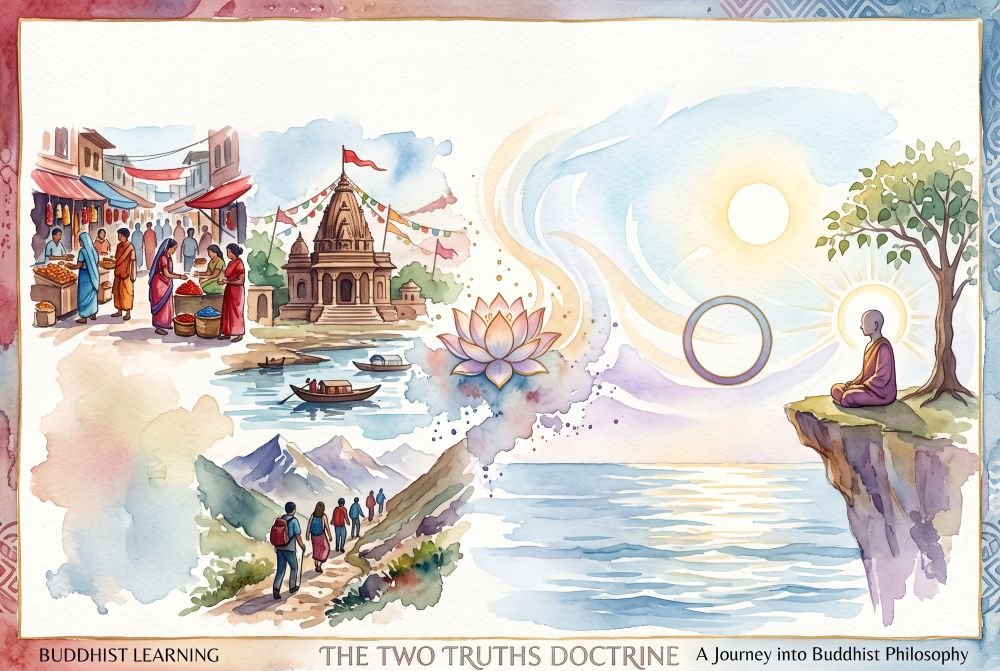
The Two Truths doctrine is a foundational framework in Buddhist thought that distinguishes two complementary ways of speaking about reality: conventional truth (saṃvṛti-satya in Sanskrit; sammuti-sacca in Pali) and ultimate truth (paramārtha-satya in Sanskrit; paramattha-sacca in Pali). This distinction is central to classical discussions of emptiness and dependent origination, particularly within the Mahāyāna Madhyamaka tradition. Properly understood, the Two Truths prevent two opposite errors — nihilism (denying conventional reality) and reification (treating emptiness or phenomena as absolute) — and show how ethical action, meditation, and philosophical analysis fit together in the path to liberation.
The Two Truths should not be understood as two separate worlds or two independent realities. In Madhyamaka, conventional and ultimate truth concern the same dependently arisen phenomena, understood differently. Other Buddhist traditions formulate the relationship differently. This article distinguishes between these traditions throughout.
1. What the Two Truths Are: Definitions and Historical Context
Conventional truth (saṃvṛti-satya / sammuti-sacca): In Madhyamaka, conventional truth concerns the conventional world of persons, objects, language, relationships, and causal functioning. Different Buddhist traditions, however, explain the nature and status of conventional truth differently. Conventional truth is the domain of language, ethics, and pragmatic action. When someone says “this is a table” or “I am a teacher,” that person speaks conventionally. This level is not false in a simplistic sense; it is functionally valid and necessary for communication, moral responsibility, and spiritual practice itself. The Buddha himself used conventional language to teach the path, refer to himself, and address his disciples by name.
However, Buddhist philosophers do not uniformly define conventional truth as merely “everyday reality.” Different schools developed sophisticated theories of convention, designation, valid cognition, and the relationship between language and reality. In some interpretations, conventional truth is merely a pedagogical convenience; in others, it has a pragmatic reality sufficient to ground ethics and practice.
Ultimate truth (paramārtha-satya / paramattha-sacca): The meaning of “ultimate truth” varies among Buddhist traditions. In Madhyamaka, ultimate truth is the emptiness of phenomena of inherent or intrinsic existence. It is not a separate metaphysical realm or substance. In Theravāda Abhidhamma and commentarial thought, the conventional/ultimate distinction is framed differently, particularly through the distinction between conventional designation (paññatti) and ultimate phenomena (paramattha dhammas).
Why the distinction matters: Without a two-truth framework, two errors arise. If conventional appearances are treated as ultimately real, one falls into reification — believing in fixed essences and selves. If ultimate analysis is treated as denying conventional reality, one falls into nihilism — denying causality, ethics, and the meaningfulness of action. The Two Truths doctrine preserves both the validity of everyday functioning and the corrective insight of analysis, though the nature of that corrective insight varies by tradition.
As the Buddha taught in the Kaccānagotta Sutta (SN 12.15), he taught a middle way that avoids the extremes of “everything exists” and “everything does not exist,” precisely by understanding dependent origination. Later philosophers, particularly Nāgārjuna, interpreted this middle way through the lens of the Two Truths.
2. Early Buddhist Roots: What the Suttas Actually Teach
The early discourses do not present the later Two Truths doctrine in its technical form. However, they contain teachings that later Buddhist philosophers — both Abhidharma commentators and Mahāyāna thinkers — drew upon when developing their theories of conventional and ultimate truth. These teachings include dependent origination, not-self, conventional designation, and the appropriate use of the Dhamma.
Dependent Origination (paṭicca-samuppāda)
The Buddha repeatedly taught that phenomena arise dependently on causes and conditions. This teaching undermines the idea of an independent, permanent self or essence. The canonical exposition of dependent origination in the Mahānidāna Sutta (DN 15) is a thoroughgoing analysis of how consciousness, name-and-form, contact, feeling, craving, and the rest of the twelve links operate in a dynamic, conditional stream, with no agent or self standing outside the process.
DN 15 provides an important early Buddhist account of conditionality. Later Buddhist philosophers, particularly Nāgārjuna, could relate this account to the doctrine of emptiness. However, the sutta itself does not state that phenomena are empty of inherent existence. It describes the conditional arising of suffering and the conditions for its cessation. The Mahānidāna Sutta also contains the reciprocal conditioning of consciousness and name-and-form, showing that these factors co-arise in dependence on one another.
Another accessible dependent-origination passage is the Vibhaṅga Sutta (SN 12.2), which lays out the twelve-link formula and its implications in a concise, systematic manner. This sutta demonstrates that ignorance conditions formations, formations condition consciousness, and so forth, culminating in the entire mass of suffering. The impersonal, conditional nature of this sequence is central to early Buddhist analysis. Later Madhyamaka philosophers drew upon this conditionality to support their arguments for emptiness, but SN 12.2 itself does not use the term “emptiness” in the technical Madhyamaka sense.
Not-Self (anattā)
The Buddha’s teaching that the five aggregates (form, feeling, perception, mental formations, consciousness) are not-self was a direct challenge to reified selfhood. The classic discourse is the Anattalakkhaṇa Sutta (SN 22.59), where the Buddha took each aggregate and asked: “Is this mine? Is this I? Is this my self?”— to which the monks responded, “No, venerable sir.” The sutta teaches that the aggregates are impermanent, subject to suffering and change, and therefore unsuitable for identification as self.
SN 22.59 provides an early canonical analysis of the aggregates that later Buddhist thinkers could relate to questions of conventional personhood and ultimate analysis. The sutta does not, however, employ the later technical vocabulary of conventional and ultimate truth. It does not say “here is the conventional truth” and “here is the ultimate truth.” It simply instructs that the aggregates are not-self. The sutta does not present a theory of conventional personhood; rather, it examines the aggregates in order to undermine identification with them. Later Buddhist traditions interpreted such teachings within broader theories of conventional and ultimate truth.
The Snake Simile and the Raft Parable
In the Alagaddūpama Sutta (MN 22), the Buddha famously compared the Dhamma to a raft used to cross a river — once crossed, one does not carry the raft on one’s head. This simile teaches that even the Dhamma is a tool to be used skillfully and then relinquished. The sutta warns against misapprehending the Dhamma, comparing it to grasping a snake by the wrong end.
The raft simile illustrates a related principle: teachings are means for overcoming suffering and should not themselves become objects of attachment. Later Buddhist philosophers could draw on such passages when reflecting on the status of concepts and teachings. The sutta does not, however, present the Two Truths doctrine. It teaches non-attachment to views and teachings, which later interpreters linked to the conventional nature of all conceptual frameworks.
Summary of the Sutta Material
The early suttas provide the raw materials for later philosophical developments. They teach:
- That phenomena arise conditionally.
- That no permanent self exists in the aggregates.
- That even the Dhamma is a tool to be used and relinquished.
- That the Buddha taught a middle way between extremes.
These teachings became important resources for Buddhist philosophers developing theories of conventional and ultimate truth. However, the explicit Two Truths terminology and its systematic elaboration belong to later historical periods. The connection between the early suttas and the later doctrine is historical and interpretive, not a matter of the Buddha himself teaching the later framework.
3. The Abhidharma Gap: Where the Two Truths Were First Formalized
The development of the Two Truths doctrine was not a simple transition from an early Buddhist “Two Truths doctrine” to Mahāyāna. Early Buddhist teachings were interpreted and systematized in different ways over several centuries. Abhidharma traditions developed increasingly sophisticated analyses of phenomena, while Mahāyāna philosophers developed new accounts of emptiness, conventionality, and ultimate truth. Nāgārjuna’s Madhyamaka represents one particularly influential development within this wider history.
The explicit Two Truths formulation did not begin with Nāgārjuna. It was developed by the early Abhidharma schools (both Theravāda and Sarvāstivāda) to categorize the Buddha’s teachings and resolve apparent contradictions between different discourses. This historical step is essential for understanding both the development of the doctrine and Nāgārjuna’s later critique.
The Abhidharma Project
The Abhidharma traditions emerged in the centuries following the Buddha’s death. Monastic scholars sought to systematize the vast body of discourses, creating detailed taxonomies of mental and physical phenomena. A central concern was to distinguish between the way things appear in everyday language and the way they exist when analyzed into their ultimate constituents.
In the Sarvāstivāda Abhidharma, the distinction between conventional and ultimate truth was explicitly formulated to classify the Buddha’s teachings. Certain discourses were considered conventional (saṃvṛti)—they used everyday language, names, and concepts to communicate with ordinary people. Other discourses were considered ultimate (paramārtha) — they described phenomena in terms of their irreducible constituents. The Sarvāstivāda tradition held that these ultimate constituents (dharmas) exist across all three times (past, present, future), hence the name “Sarvāstivāda” (the “all-exists” school).
In the Theravāda Abhidhamma, a similar distinction was developed. The commentaries distinguish between conventional concepts (paññatti) and ultimate realities (paramattha dhammas). Ultimate realities are the final, irreducible constituents of experience: consciousness, mental factors, material form, and Nibbāna. These dhammas possess their own intrinsic characteristics (sabhāva) and arise and cease in infinitesimal moments according to causal conditions.
The Significance of the Abhidharma Gap
The Abhidharma formalization of the Two Truths is historically crucial because it provided the target for Nāgārjuna’s later critique. Nāgārjuna did not create the Two Truths framework out of thin air; he inherited it from the Abhidharma traditions. However, he radically reinterpreted it.
For the Abhidharma schools, ultimate truth meant the irreducible dhammas that are the building blocks of reality. These dhammas are real in a way that conventional concepts (like “person” or “table”) are not. Nāgārjuna accepted the distinction between conventional and ultimate discourse but rejected the Abhidharma claim that dhammas possess intrinsic nature. He argued that even dhammas are dependently arisen and therefore empty of inherent existence. His Madhyamaka philosophy was thus a direct philosophical attack on the Abhidharma assertion of sabhāva.
Skipping this Abhidharma stage creates a misleading historical narrative: it makes it appear as though Nāgārjuna’s philosophy emerged directly from the early suttas. In fact, Nāgārjuna was engaging with centuries of Abhidharma scholarship, critiquing its ontological commitments while using its conceptual tools. The Two Truths framework that he employed was already well-established in the Abhidharma traditions; his innovation was to use it to argue for universal emptiness.
4. Nāgārjuna and Madhyamaka: The Revolutionary Reformulation
Within Madhyamaka, Nāgārjuna (c. 2nd–3rd century CE) systematized arguments that all phenomena lack inherent existence. He used reductio ad absurdum arguments to show that any claim of intrinsic nature leads to contradictions. Crucially, Nāgārjuna insisted that emptiness itself is not an absolute entity; it is a negation of inherent existence and must not be reified. This insistence is often expressed through the Two Truths framework: conventional truths are affirmed for practical purposes, while ultimate truth is the analytic insight that dissolves reification.
Nāgārjuna’s Critique of Abhidharma
Nāgārjuna’s project was fundamentally critical. He took the Abhidharma assertion that dhammas possess intrinsic nature (svabhāva in Sanskrit, corresponding to the Pali sabhāva) and argued that such a notion is incoherent. Anything that arises dependently cannot possess independent, self-contained existence. Since all phenomena are dependently arisen —as the early suttas teach — they cannot possess intrinsic nature.
The Two Truths doctrine was central to this critique. Nāgārjuna argued that the Abhidharma schools had confused conventional and ultimate truth. They had taken conventionally designated phenomena (like dhammas) and treated them as ultimately real. By distinguishing between the conventional level (where we can speak of dhammas functioning) and the ultimate level (where they are seen to be empty of inherent existence), Nāgārjuna preserved the validity of Abhidharma analysis while denying its ontological conclusions.
The Two Truths in the Mūlamadhyamakakārikā
Nāgārjuna’s Mūlamadhyamakakārikā (MMK) is the central Madhyamaka text. It uses dialectical refutation to show that any claim to intrinsic nature leads to contradiction. Two verses are particularly important for understanding his use of the Two Truths.
In MMK 24.8, Nāgārjuna states that the Buddha’s teaching is based on the Two Truths:
“The Buddha’s teaching of the Dharma is based on two truths: conventional truth and ultimate truth. Those who do not understand the distinction between these two truths do not understand the Buddha’s profound teaching.”
This verse presents Nāgārjuna’s interpretation of the Buddha’s method. For Nāgārjuna, the Buddha taught using conventional language to guide beings toward ultimate insight. The Two Truths are not two separate realities but two pedagogical and analytical frameworks.
In MMK 24.18, Nāgārjuna famously links dependent origination, emptiness, and the middle way:
“Whatever is dependently co-arisen, that is explained to be emptiness. That, being a dependent designation, is itself the middle way.”
This verse states that emptiness is not a separate reality but the very nature of dependently arisen phenomena. Since phenomena arise dependently, they are empty of inherent existence. This emptiness is not a negation of existence but a description of how things exist: they exist dependently, not autonomously. The middle way is precisely this understanding — avoiding both the extreme of eternalism (treating phenomena as ultimately real) and the extreme of nihilism (denying conventional functioning).
Emptiness Is Not Nihilism
A common misunderstanding is to equate emptiness with nothingness. Nāgārjuna rejected this interpretation. Emptiness denies intrinsic essence, not the existence of phenomena. Things still arise, interact, and have effects. The Two Truths doctrine preserves this: conventional truth affirms causal functioning; ultimate truth denies independent essence.
Nāgārjuna also cautioned against reifying emptiness itself. In MMK 13.8, he asked that if something is non-empty, then how could it become empty? Emptiness is the absence of inherent existence, not a positive metaphysical substrate. The expression “emptiness of emptiness” became a useful later formulation of this point; the underlying argument is found in Nāgārjuna’s critique of treating emptiness as an independently existing entity.
The Two Truths as a Methodological Tool
The Two Truths doctrine in Nāgārjuna’s hands became a methodological tool: use conventional discourse to teach and practice, and use ultimate analysis to dismantle reified views. This is not a claim that the historical Buddha explicitly taught this framework. Rather, it is Nāgārjuna’s interpretation of how the Buddha’s teachings should be understood.
For Nāgārjuna, without relying on conventional truth, one cannot realize ultimate truth. The path itself operates at the conventional level: one takes precepts, practices meditation, studies teachings, and engages in ethical action. These activities are conventionally valid. Ultimate realization is not a rejection of these activities but a transformation in how they are understood.
5. What Ultimate Truth Means in Madhyamaka
Ultimate truth is an analysis, not a hidden reality: A common misunderstanding is to treat ultimate truth as a separate metaphysical realm or as a positive “thing” behind appearances. Classical Madhyamaka rejects this: ultimate truth is the absence of inherent existence revealed by analysis. It is not a hidden substance. Nāgārjuna explicitly stated that if one takes emptiness as a view, one is incurable. Thus, ultimate truth is a method of seeing, not an object of grasping.
Emptiness is not nihilism: Another common misunderstanding is to equate emptiness with nothingness. Emptiness denies intrinsic essence, not the existence of phenomena. Things still arise, interact, and have effects. The Two Truths doctrine preserves this: conventional truth affirms causal functioning; ultimate truth denies independent essence.
Emptiness is not a new absolute: Nāgārjuna and his followers cautioned against reifying emptiness itself. If emptiness were treated as an ultimate “thing,” one would have replaced one reified view with another. The Two Truths doctrine prevents this by keeping emptiness as an analytic tool rather than a metaphysical entity. As Nāgārjuna stated in MMK 13.8: “The Victorious Ones have said that emptiness is the relinquishing of all views. Those who hold emptiness as a view are said to be incurable.”
6. How the Two Truths Work in Practice: Ethics, Meditation, and Wisdom
Ethics at the Conventional Level
Ethical conduct functions within conventional human life, but Madhyamaka does not therefore regard ethics as dispensable or meaningless. Conventional causal and ethical functioning is precisely what makes practice possible. The suttas repeatedly emphasized ethical conduct as foundational for practice; see, for example, the Sāmaññaphala Sutta (DN 2), which outlines the gradual training beginning with virtue.
The Two Truths doctrine preserves the meaningfulness of ethical action. In both Theravāda and Madhyamaka, ethical conduct creates the conditions for insight and reduces harm. The difference lies in the ultimate status of the agent and the action, but both traditions affirm the conventional necessity of ethical conduct.
Meditation and the Progressive Realization of Ultimate Truth
Meditative practices are methods for directly investigating experience and realizing the ultimate truth. In early Buddhism, insight (vipassanā) into the three marks — impermanence (anicca), suffering (dukkha), and not-self (anattā)—leads to dispassion and liberation. Early Buddhist insight practice emphasizes these three marks directly in experience.
A later Two Truths framework can provide one way of relating these dimensions of Buddhist practice, particularly in Mahāyāna contexts. The Satipaṭṭhāna Sutta (MN 10) teaches mindfulness of the body, feelings, mind, and phenomena as a direct path, and these contemplations operate on both conventional and ultimate levels.
Wisdom as the Integration of the Two Truths
Wisdom (paññā or prajñā) in Buddhism is the capacity to see both levels: to act skillfully in the conventional world while understanding the ultimate emptiness (or the conditioned nature) of phenomena. This integrated wisdom avoids both nihilism and reification. A wise person does not abandon ethics upon realizing emptiness; rather, they engage in ethics more fully because they see the conditional, interdependent nature of suffering and its causes.
7. Technical Debates and Nuances in Classical Exegesis
The Two Truths doctrine has been the subject of intense philosophical debate. Below are some of the major technical issues and how different traditions approach them.
Madhyamaka Negative Formulation
Some interpreters emphasize that ultimate truth is a negation — showing what phenomena are not (i.e., not inherently existent). This is the classic Madhyamaka stance: emptiness is a corrective negation, a prasajyapratiṣedha (non-implicative negation) in Prāsaṅgika-Madhyamaka. It does not affirm any positive quality.
Positive Formulations in Some Mahāyāna Traditions
Other traditions (and some Mahāyāna texts, particularly in the Yogācāra and Tathāgatagarbha streams) present ultimate truth in more positive terms — e.g., as luminous mind, Buddha-nature, or non-dual awareness. These readings aim to preserve the soteriological power of ultimate realization but risk reifying the ultimate if not carefully framed. These formulations are not identical across traditions, and they should not automatically be equated with the Madhyamaka understanding of ultimate truth. The Laṅkāvatāra Sūtra and the Ratnagotravibhāga are key texts in this positive framing.
The Status of Conventional Truth: Merely Provisional or Pragmatically Real?
Some debates center on whether conventional truth is merely a pedagogical convenience or whether it has a kind of pragmatic reality. Most traditions hold that conventional truth is real enough to ground ethics and practice, even if it is not ultimately self-existent. In Prāsaṅgika-Madhyamaka, conventional truth is said to be valid “by the consensus of the world” (lokasaṃvṛti) — it is not established by ultimate analysis but is still functionally effective.
Language and Ineffability
If ultimate truth is beyond conceptualization, how can it be taught? Buddhist traditions answer with skillful means: teachers use conventional language, metaphors, and practices to point toward the non-conceptual realization. The Two Truths doctrine legitimizes this pedagogical strategy: conventional language is used to guide students to ultimate insight. The Mahāyāna Diamond Sūtra develops related themes concerning non-attachment to dharmas and non-dharmas.
8. The Philosophical Bridge: Dependent Origination and Emptiness
A Madhyamaka interpretation can summarize the relationship between dependent origination and emptiness as follows:
- Phenomena arise dependently on causes, conditions, parts, and conceptual designation.
- If something arises dependently, it cannot possess an independent, permanent essence.
- Therefore, phenomena are empty of inherent existence (ultimate truth).
- Yet, because they arise dependently, they function causally and conventionally (conventional truth).
This chain of reasoning is not explicitly found in the early suttas. However, later Madhyamaka philosophers developed a philosophical connection between the early teachings on conditionality and the doctrine of emptiness. The suttas — see the Mahānidāna Sutta (DN 15) and the Vibhaṅga Sutta (SN 12.2)—provide important early Buddhist bases for later reflection on conditionality, non-self, and emptiness. The Mahānidāna Sutta is particularly detailed, showing how consciousness depends on name-and-form and vice versa, creating a dynamic, self-sustaining cycle with no fixed self at its core.
9. Comparison of Buddhist Traditions
The following table summarizes the different approaches to the Two Truths across Buddhist traditions:
| Tradition | Conventional | Ultimate | Relationship |
|---|---|---|---|
| Early Nikāyas | Ordinary language and practical life | No formal Two Truths system | Dependent origination, anattā, impermanence, and liberation |
| Theravāda Abhidhamma/commentaries | Paññatti / conventional designation | Paramattha-dhammas | Analytical distinction between conventional designation and ultimate phenomena |
| Madhyamaka | Saṃvṛti-satya | Paramārtha-satya as emptiness | Both concern dependently arisen phenomena; neither is a separate world |
| Yogācāra | Conventional cognition/designation | Transformation of cognition / ultimate nature, depending on interpretation | Three-natures (trisvabhāva) framework |
| Tibetan traditions | Conventional truth | Ultimate truth/emptiness | Detailed school-specific interpretations |
10. Practical Examples to Illustrate the Two Truths
Example 1: The Person and the Aggregates
- Conventional: “John” is a person with a name, social role, and responsibilities.
- Theravāda analysis: “John” is a designation applied to a changing stream of aggregates (form, feeling, perception, formations, consciousness). The aggregates themselves are ultimate realities with intrinsic characteristics.
- Madhyamaka analysis: “John” is a dependently designated concept. Even the aggregates are empty of inherent existence; there is no “John-essence” or “aggregate-essence” that exists independently.
The Anattalakkhaṇa Sutta (SN 22.59) provides the early canonical analysis that later traditions interpreted in these different ways.
Example 2: The Chariot (A Classic Milindapañha Analogy)
- Conventional: “This is a chariot” — a useful designation for a functional vehicle.
- Theravāda analysis: The chariot is a dependent assemblage of parts (axle, wheels, chassis, reins), causes (craftsmanship), and designation (we call it a chariot). There is no chariot-essence that exists independently of these parts. However, the parts themselves are ultimately real dhammas.
- Madhyamaka analysis: The chariot is empty of inherent existence. It is merely a dependently designated concept. Even the parts are empty of inherent existence, as they too arise dependently.
The chariot analogy appears in the Milindapañha, a later Buddhist text, rather than in the early Nikāyas. It shows how conventional designations are pragmatically useful while ultimate analysis dissolves reified essences.
Example 3: Anger
- Conventional: “I am angry” — a valid experience with physiological and psychological components.
- Theravāda analysis: Anger arises dependently on a trigger, a perception of offense, a bodily sensation, and a mental reaction. The mental factors constituting anger have specific characteristics. They are conditioned, impermanent, and not-self.
- Madhyamaka analysis: Anger is a dependently designated concept. There is no “anger-essence” that exists autonomously. When analyzed, it is seen as a conditioned process, not a solid entity.
11. Addressing Common Misunderstandings in Depth
Misunderstanding 1: Emptiness Means Nothing Exists
Clarification: Emptiness denies inherent existence, not existence simpliciter. Phenomena still arise, interact, and have effects. The Two Truths doctrine preserves conventional causality and moral responsibility. If emptiness meant nothing existed, the Buddha would not have taught the Four Noble Truths or the Noble Eightfold Path as effective means to end suffering.
Misunderstanding 2: Ultimate Truth Is a Hidden Reality Behind Appearances
Clarification: In Madhyamaka, ultimate truth is an analytic conclusion about the mode of existence of phenomena; it is not a hidden metaphysical substrate. Nāgārjuna’s insistence that emptiness is not a thing prevents this reification. In Theravāda, ultimate realities are the dhammas themselves, not hidden behind appearances but accessible through analysis.
Misunderstanding 3: Two Truths Means Two Separate Worlds
Clarification: The Two Truths are two ways of speaking about the same phenomena: one pragmatic, one analytic. They are not ontologically separate realms. The same cup of tea is conventionally “a cup of tea” and ultimately (in Madhyamaka) “a dependently arisen collection of elements, sensations, and conceptual designations” or (in Theravāda) “a collection of material and mental dhammas.”
Misunderstanding 4: Realizing Emptiness Makes Ethics Irrelevant
Clarification: On the contrary, in Mahāyāna thought, insight into emptiness is closely connected with compassion because it undermines rigid distinctions and attachment to an independently existing self and others. Mahāyāna traditions connect insight into emptiness with compassion by arguing that clinging to an independently existing self and independently existing others is undermined by insight into dependent designation and emptiness. The Bodhisattvacharyāvatāra (by Śāntideva), particularly Chapter 9 on wisdom, argues that compassion is the natural consequence of understanding emptiness. In Theravāda, realizing not-self leads to dispassion and non-harm, deepening ethical commitment.
12. Two Truths and Practice: A Step-by-Step Guide for Contemplatives
The following sequence is a practical synthesis rather than a canonical Buddhist formulation of a “Two Truths meditation.” Different Buddhist traditions structure the path differently.
1. Ethical Foundation (sīla) — operate at the conventional level.
Begin with ethical training: generosity, restraint, and right speech. Ethical conduct stabilizes the mind and creates the conditions for insight. The suttas repeatedly emphasize ethics as foundational.
2. Cultivate Concentration (samādhi) — stabilize attention.
Use concentration practices, such as mindfulness of breathing (ānāpānasati), to calm the mind. Concentration is a conventional skill that supports insight. The Ānāpānasati Sutta (MN 118) is the primary canonical guide.
3. Investigate Experience (vipassanā) — analyze the aggregates.
Apply analytical attention to the five aggregates and to dependent origination. Use the Anattalakkhaṇa Sutta (SN 22.59) as a canonical guide for investigating not-self.
4. See Dependent Origination — trace causes and conditions.
Study and meditate on dependent origination using the Mahānidāna Sutta (DN 15) and the Vibhaṅga Sutta (SN 12.2) to see how phenomena arise dependently. Map a specific experience — say, a painful feeling — back to its conditions: contact, sense-base, consciousness, and ultimately ignorance and craving.
5. Realize the Ultimate (according to one’s tradition) — avoid reification.
For Theravāda practitioners, this means seeing the conditioned, impermanent, not-self nature of the dhammas. For Madhyamaka practitioners, it means realizing the emptiness of inherent existence in all phenomena. Conceptual analysis and direct non-conceptual realization are treated differently in different traditions. In either case, the insight should not be reified into a fixed view.
6. Integrate Wisdom and Compassion — act in the world.
Let the insight inform compassionate action. The Two Truths doctrine ensures that ethical engagement remains meaningful.
13. Two Truths in Different Buddhist Traditions: Comparative Nuance
Theravāda Perspective
The explicit technical Two Truths framework is not central in the Nikāyas. Later Theravāda commentarial and Abhidhamma traditions distinguish conventional designation (paññatti) and ultimate phenomena (paramattha-dhamma). The Theravāda understanding of “ultimate” should not be equated with Madhyamaka emptiness. In Theravāda, the ultimate phenomena are not generally declared empty of intrinsic existence in the Madhyamaka sense. The Theravāda tradition’s two-truth formulation is an important system in its own right, with its own conceptual history and philosophical function.
The foundational suttas for this approach — the Anattalakkhaṇa Sutta (SN 22.59), the Mahānidāna Sutta (DN 15), and the Vibhaṅga Sutta (SN 12.2) — remain central, but they are interpreted within the Theravāda commentarial framework rather than the Madhyamaka framework.
Mahāyāna and Madhyamaka
Mahāyāna traditions, especially Madhyamaka, articulate the Two Truths doctrine explicitly and develop sophisticated arguments about emptiness and the status of conventional truth. Nāgārjuna’s Mūlamadhyamakakārikā is the central text here. A central Madhyamaka claim is that ultimate truth is realized through insight into emptiness, which is the absence of inherent existence in all phenomena. Nāgārjuna linked emptiness to dependent origination and insisted emptiness is not a reified absolute.
Yogācāra
Some Mahāyāna schools, like Yogācāra, emphasize the role of mind and consciousness in the analysis of experience. Yogācāra interpreters sometimes frame ultimate truth in terms of transformed cognition (parāvṛtti) or luminous awareness (prabhāsvara-citta). These readings can be complementary but also lead to debates about whether ultimate truth is purely negative or has a positive aspect. Yogācāra itself contains diverse interpretations, and it should not be reduced to the claim that “everything is merely mind.” The Saṃdhinirmocana Sūtra is a key Yogācāra text that presents the Two Truths in terms of the three natures (trisvabhāva).
Vajrayāna / Tibetan Buddhism
In Tibetan Buddhism, the Two Truths are extensively commented upon, particularly in the Gelug, Nyingma, Kagyu, and Sakya schools. In the dominant Gelug presentation, the Prāsaṅgika-Madhyamaka interpretation, championed by Candrakīrti and later Tsongkhapa, emphasizes that conventional truth is established by valid conventional cognition (lokasaṃvṛti), while ultimate truth is the mere negation of inherent existence. In the Nyingma school, the Two Truths are often integrated with the Dzogchen view of primordial purity (ka dag) and spontaneous presence (lhun grub). The Prāsaṅgika/Svātantrika distinction became particularly influential in later Tibetan doxography.
14. Language, Pedagogy, and Skillful Means
Because ultimate truth is often described as beyond conceptualization, Buddhist teachers rely on skillful means (upāya)— conventional teachings, metaphors, and practices — to guide students. The Two Truths doctrine legitimizes this pedagogical strategy: conventional language is used to point toward non-conceptual realization.
The Lotus Sūtra is a classic example of upāya, where the Buddha tells parables to guide beings of different capacities. The Mahāyāna Diamond Sūtra develops related themes concerning non-attachment to dharmas and non-dharmas, repeatedly using negations (“no self, no person, no sentient being, no life span”) to deconstruct reification while still affirming the practice of giving and ethical conduct.
A practical note for teachers and students: Use conventional descriptions and practices as tools, not as ends in themselves. The Kesamutti Sutta (AN 3.65) is useful for discussing the Buddha’s approach to evaluating teachings and, especially, the ethical consequences of greed, hatred, and delusion.
15. Advanced Philosophical Issues: A Closer Look
The Problem of Self-Reference
If ultimate truth is ineffable, can it be taught? The Two Truths doctrine allows for a pragmatic answer: conventional language can point to ultimate insight without fully capturing it. Nāgārjuna’s dialectic often uses conventional assertions only to show their limits and to guide the student beyond them.
The “Emptiness of Emptiness”
Nāgārjuna’s claim that emptiness itself is empty prevents reification. This is sometimes called the “emptiness of emptiness.” It means that the insight into emptiness should not become another fixed view. In MMK 22.11, he stated that the Tathāgata is not found in emptiness, nor is emptiness found in the Tathāgata; this reciprocal negation prevents any absolute position.
Two Truths and Epistemology
Different traditions debate whether ultimate truth is accessible through reason, meditation, or both. Madhyamaka emphasizes dialectical refutation and meditative insight; other schools emphasize direct yogic realization. Different Madhyamaka thinkers debate how reasoning, conceptual understanding, and non-conceptual realization relate to ultimate truth.
Svātantrika vs. Prāsaṅgika Distinction
In later Indian and Tibetan Madhyamaka, a key sub-division arose. Later Tibetan doxography commonly distinguished Svātantrika and Prāsaṅgika Madhyamaka. The Svātantrika tradition uses autonomous inferences (svatantra-anumāna) to establish emptiness conventionally, while Prāsaṅgika uses only reductio ad absurdum (prāsaṅga) to refute others’ positions without asserting any own thesis. This debate centers on how to handle conventional truth while maintaining the ineffability of ultimate truth.
16. Contemporary Applications: Ethics, Science, and Social Engagement
A Contemporary Application: Ethics and Social Identity
The Two Truths framework can support engaged ethics. Recognizing conventional designation can reduce rigid identity-based hostility and increase compassion, while conventional norms remain necessary for social functioning. In contemporary discussions, some practitioners apply emptiness to deconstruct fixed identities (race, gender, nationality) and open space for flexible, compassionate responses, while conventional truth acknowledges the real suffering caused by social structures. This is a contemporary application rather than a direct teaching of the early Buddhist texts or Nāgārjuna.
Dialogue with Science
The Two Truths framework can provide a philosophical lens for discussing scientific models without requiring scientific entities to be treated as metaphysically independent substances. Conventional descriptions (models, theories) are pragmatically useful, while ultimate analysis questions whether theoretical entities have independent existence. This is analogous to philosophical debates about scientific realism and instrumentalism.
Psychology and Therapy
Contemporary mindfulness and cognitive therapies sometimes draw on Buddhist insights about non-self and dependent arising. These parallels should not be taken to mean that these therapies are applications of the Buddhist Two Truths doctrine; they are overlapping but distinct frameworks.
17. Reading Recommendations and Canonical Anchors
Below are the primary sutta references linked directly to their full texts on SuttaCentral, alongside recommended secondary readings.
Canonical Suttas (Linked In-Text)
- Mahānidāna Sutta (DN 15) — Great Discourse on Origination
- Vibhaṅga Sutta (SN 12.2) — Analysis of Dependent Origination
- Anattalakkhaṇa Sutta (SN 22.59) — Not-self Characteristic
- Alagaddūpama Sutta (MN 22) — The Snake Simile
- Kaccānagotta Sutta (SN 12.15) — The Middle Way
- Ānāpānasati Sutta (MN 118) — Mindfulness of Breathing
- Satipaṭṭhāna Sutta (MN 10) — Foundations of Mindfulness
- Sāmaññaphala Sutta (DN 2) — The Fruits of Recluseship
- Kesamutti Sutta (AN 3.65) — The Kālāma Sutta
- Cūḷakammavibhaṅga Sutta (MN 135) — The Shorter Exposition of Action
- Ādittapariyāya Sutta (SN 35.28) — The Fire Sermon
Secondary Readings
- Jay L. Garfield, The Fundamental Wisdom of the Middle Way: Nāgārjuna’s Mūlamadhyamakakārikā (translation and commentary).
- Jan Westerhoff, Nāgārjuna’s Madhyamaka: A Philosophical Introduction.
- Mark Siderits, Buddhism as Philosophy: An Introduction.
- Paul Williams, Mahayana Buddhism: The Doctrinal Foundations.
- Peter Harvey, An Introduction to Buddhism: Teachings, History and Practices.
- Rupert Gethin, The Foundations of Buddhism.
These are secondary sources, not Buddhist canonical authorities.
18. Common Questions Answered with Nuance
Q: If everything is empty (or conditioned and not-self), why bother with ethics or practice?
A: Because emptiness and conditionality do not negate causal efficacy. Conventional causes and effects remain operative. Ethical practice creates the conditions for insight and reduces harm. As Nāgārjuna stated in MMK 24.10, without relying on conventional truth, one cannot realize ultimate truth. In the Theravāda tradition, the conditioned nature of phenomena makes ethical action meaningful and effective.
Q: Is ultimate truth the same as Nirvāṇa?
A: Ultimate truth is an analysis of how phenomena exist; Nirvāṇa is the cessation of suffering and the fruit of realizing that analysis. The relationship varies by tradition. Madhyamaka does not treat Nirvāṇa as an independently existing substance. Nāgārjuna’s treatment of saṃsāra and Nirvāṇa challenges the assumption that they are two independently existing realities, but different Madhyamaka traditions explain the relationship in somewhat different ways.
Q: Can ultimate truth be expressed in words?
A: Words can point to ultimate truth but cannot fully capture it. This is why Buddhist teachers use skillful means — stories, similes, and practices — to guide students toward direct realization.
Q: How does the Two Truths doctrine relate to the Four Noble Truths?
A: The Four Noble Truths operate as a framework for conventional Buddhist practice and liberation. In Madhyamaka, however, the truths themselves are also empty of inherent existence; their emptiness does not undermine their conventional validity or soteriological function. As Nāgārjuna argued in MMK 24, the Four Noble Truths are dependently designated yet still valid as a path. The earlier example of the chariot or the person already illustrates this principle more directly.
Q: Is conventional truth “false” in some sense?
A: No, conventional truth is not “false” in a naive sense. It is valid for its domain— practical interaction, ethics, and even the path itself. It is “conventional” in the sense that it is dependent on conceptual designation, not because it is a lie.
19. Practical Exercises for Integrating the Two Truths
Exercise 1: Reflective Reading of the Anattalakkhaṇa Sutta
Read the Anattalakkhaṇa Sutta (SN 22.59) slowly. After each paragraph, pause and ask: “What is this teaching about the aggregates? How might a later philosopher interpret this as conventional or ultimate?” Notice how the sutta uses conventional language (“monks,” “form,” “feeling”) to deconstruct the self.
Exercise 2: Dependent Origination Mapping
Take a simple experience (e.g., feeling anger or joy) and map its dependent conditions: triggers, perceptions, bodily sensations, thoughts, and actions. Notice how the experience arises dependently and lacks a fixed essence. Use the Vibhaṅga Sutta (SN 12.2) as a guide. Write down the twelve links as they appear in that experience.
Exercise 3: Meditative Inquiry into the Aggregates
In sitting practice, observe the arising and passing of sensations and thoughts. Investigate whether any of these phenomena have an independent, unchanging core. Use the framework of the five aggregates: is this feeling permanent? Is this perception self? Use the analysis to investigate whether any apparently solid or independent entity can be located apart from its conditions, parts, and conceptual designation.
Exercise 4: Ethical Reflection on a Social Role
Consider a social role that one inhabits (e.g., parent, colleague, teacher). Reflect on how this role is a conventional designation dependent on relationships and conditions. Use this reflection to cultivate flexibility and compassion in that role. Ask: “What would acting from this role look like if it were seen as dependently designated rather than as a fixed identity?”
Exercise 5: The Chariot Analysis
Take a complex object (a car, a computer, a relationship) and break it down into its parts, causes, and conditions. Then ask: “Where is the essence of this object? Is it in the parts? In the whole? In the design?” Notice how the object is merely a convenient designation for a collection of conditions.
20. Warnings and Ethical Considerations for Teachers and Students
Avoid Dogmatism
The Two Truths doctrine is a philosophical tool, not a dogma. Teachers should avoid presenting emptiness as a metaphysical absolute or as a license for moral indifference. The Alagaddūpama Sutta (MN 22) warned against grasping the Dhamma wrongly, like catching a snake by the tail.
Contextualize Teachings
When teaching emptiness, always situate it within ethical practice and meditative training. The suttas emphasized the integration of ethics, concentration, and wisdom. Teaching emptiness without ethics can lead to moral confusion or spiritual bypassing.
Respect Different Traditions
Theravāda and Madhyamaka offer different, competing accounts of ultimate truth. Presenting Madhyamaka as the definitive “Buddhist” ultimate truth marginalizes the orthodox Theravāda position. Teachers should clearly demarcate the historical and philosophical boundaries between traditions.
The Danger of Spiritual Bypassing
Emptiness should not be used to suppress emotions, avoid responsibility, or bypass relational difficulties. True insight into emptiness (or not-self) manifests as greater sensitivity, not less. The conventional world remains, but it is seen through the lens of wisdom.
21. Summary and Concluding Reflections
The Two Truths doctrine is a sophisticated and historically layered framework that preserves the reality of everyday life while pointing to a deeper analysis that dissolves reified views. Properly understood, the Two Truths doctrine:
- Prevents nihilism and reification by maintaining both functional conventionality and ultimate analysis (whether that analysis reveals conditioned dhammas or emptiness).
- Grounds ethical practice and meditative inquiry by showing that the path operates at the conventional level even as it leads to ultimate realization.
- Connects sutta-level teachings (dependent origination, anattā) with later philosophical analysis, though the connection is historical and interpretive rather than direct.
- Provides a pedagogical strategy for teaching ineffable insight through conventional language and skillful means, respecting the capacities of different students.
The historical development of the doctrine must be respected: from the early suttas’ teachings on conditionality and not-self, through the Abhidharma formalization of conventional and ultimate categories, to Nāgārjuna’s critical reformulation in the Madhyamaka tradition. The Theravāda and Madhyamaka interpretations are competing systems, not complementary versions of a single doctrine.
For further study, read the canonical suttas linked above on SuttaCentral and pair them with Nāgārjuna’s Mūlamadhyamakakārikā and contemporary scholarly commentaries. The Two Truths are not a mere intellectual puzzle; they are an invitation to see the world as it is — interdependent, fluid, and open to liberation, whether that liberation is understood as the cessation of suffering through insight into the conditioned dhammas or through the realization of universal emptiness. Understanding the Two Truths allows one to work skillfully with concepts, transforming perception from clinging to freedom, and from delusion to compassion.