KeyTakeaways
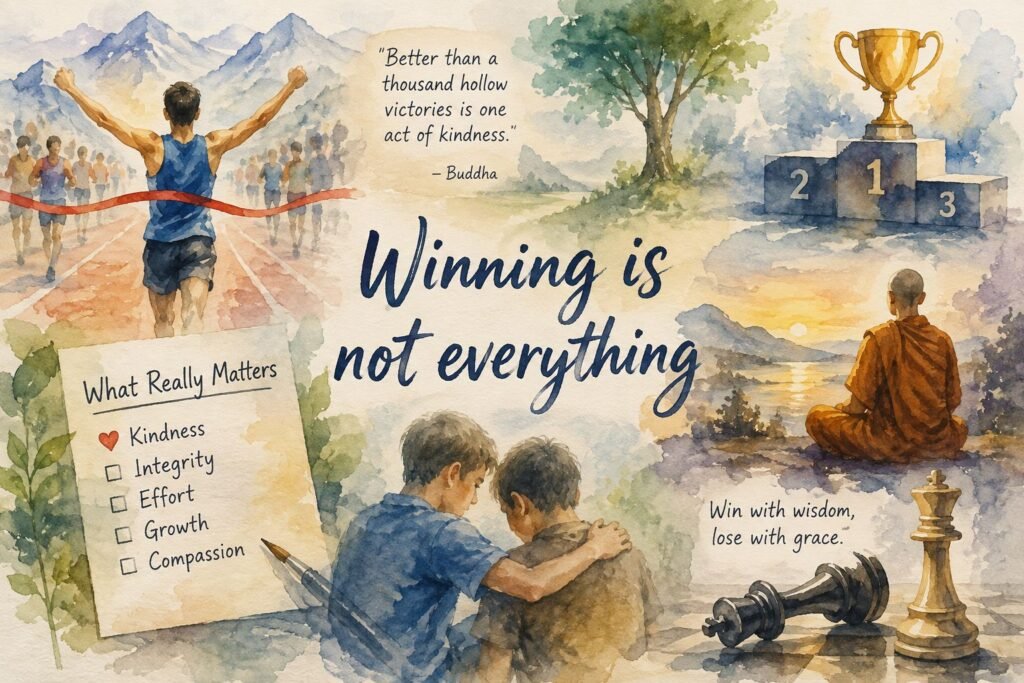
- “Winning is the only thing” fails on its own terms once winning means defeating others to secure status, possessions, or a sense of superiority, something none of the three major Buddhist traditions treat as a final good.
- Victory can produce hostility and defeat can produce genuine pain. Peace, in the Dhammapada’s account, comes from setting down the attachment to both outcomes, not from simply learning to lose gracefully.
- Hatred is never resolved by more of the same force that produced it. This is stated almost at the opening of the Dhammapada and echoed, centuries later and in a different language, by Śāntideva’s warning that a single flash of anger can undo eons of accumulated merit.
- Mahāyāna philosophy goes further than restraint. Śāntideva argues that an opponent who provokes anger is, strictly speaking, necessary for the practice of patience, which makes the rival closer to a teacher than an obstacle.
- Vajrayāna does not ask a practitioner to suppress the competitive drive. It treats pride and jealousy as raw energy to be transformed into specific forms of wisdom, rather than emotions to be pushed down.
- Losing hurts, and none of the three traditions pretends otherwise. What gets distinguished is the pain itself from the additional suffering the mind piles on top of it.
- The deepest Buddhist victory, across all three traditions, is conquest of the mind’s own greed, hatred, delusion, pride, and envy, not conquest of another person.
Introducotion
“Winning isn’t everything, it’s the only thing.” “Winning beats losing every time.” “Show me a good loser, and I’ll show you a loser.”
These three slogans, staples of twentieth century competitive culture, encode a theory of human worth. Victory is treated as close to the highest good available to a person. Defeat is treated as a condition to be avoided at nearly any cost. Grace in losing is treated as evidence of not having wanted to win badly enough.
Buddhism asks a different question, and it asks it consistently across very different periods and schools. Not “did I win,” but what was happening in the mind while trying to win, and what happened in the mind when the result arrived. The Pāli Dhammapada asks it. Śāntideva asks it from within Indian Mahāyāna philosophy several centuries later. The tantric masters of Vajrayāna ask a sharper version of it still, treating the very impulse to dominate a rival as raw material for transformation rather than something to be merely restrained. Three traditions, three methods, and a shared diagnosis.
What “Winning” Actually Means
The word winning does not carry one meaning. A student mastering a difficult subject, a surgeon completing an operation well, and a business destroying a rival through deception are all sometimes described as winning, yet they have almost nothing in common ethically.
Buddhism does not condemn a successful outcome simply because it is successful. What gets examined is the condition behind the outcome, specifically whether the drive to win is entangled with what the Theravāda Abhidhamma calls the three unwholesome roots (akusala-mūla), greed (lobha), hatred or aversion (dosa), and delusion (moha). Vajrayāna literature usually works with a related list of five poisons, adding pride (māna) and jealousy or envy (īrṣyā) to the same three, a difference in taxonomy that becomes useful later in this piece, once the discussion turns to how each tradition proposes to work with them.
“I want to perform well” is not necessarily greed. “I must defeat this person because I cannot bear their success” is something else. “I want to develop my ability” is not necessarily attachment. “If I lose, I am worthless” is attachment.
Intention and the Weight Behind an Action
Buddhist ethics across every school is concerned with intention (cetanā) before it is concerned with the scoreboard. Two people can perform the same external action for entirely different reasons, and those reasons carry different karmic weight.
Picture two athletes training with equal intensity. One trains because the discipline itself is satisfying, because there is real joy in testing one’s own limits. The other trains because losing feels unbearable, because a rival’s success has become a personal threat. Externally the two look identical. A stopwatch cannot tell them apart. Internally they are cultivating opposite things. The first is building diligence and a kind of quiet confidence. The second is rehearsing craving and aversion on a daily schedule, and calling it training.
This does not collapse the difference between winning and losing into nothing. Winning a court case and losing one have very different practical consequences. Buddhism does not deny conventional reality. It insists that conventional consequence and spiritual consequence are two different measurements, and a single event can score very differently on each.
How Victory Feeds the Poisons of Mind
Winning can generate the thought “I want more,” so that one victory becomes insufficient and the next one becomes necessary. This is the basic structure of craving (taṇhā, or tṛṣṇā in Sanskrit sources). The winner becomes dependent on continued winning, and victory stops being an outcome and starts being an identity that must be defended.
Winning can also generate hostility, particularly toward whoever stood in the way of it. And it can generate a third poison, delusion, specifically the belief that success establishes a fixed, superior self, just as losing can generate the opposite belief that defeat establishes a fixed, inferior self.
The Vajrayāna five poison scheme adds the two poisons winning culture arguably produces most reliably. Pride (māna) is close to the definition of what a winner is culturally permitted, even expected, to feel. Jealousy or envy (īrṣyā) is close to the definition of what a loser is expected to feel toward whoever beat them. Later sections of this piece look at how the tantric tradition proposes to handle these two specifically, since restraint alone tends not to work well against either.
What the Dhammapada Says About Victory and Defeat
The clearest statement on this subject in the Pāli canon is Dhammapada verse 201, from the Sukhavagga, the chapter on happiness. The verse states that victory produces hostility, that the one who is defeated lives with genuine pain, and that the person who has found peace is the one who has set down both victory and defeat rather than continuing to chase one while fearing the other (Dhammapada 201).
Notice what the verse does not say. It does not say winning is good and losing is bad. It does not say the reverse either. It identifies suffering on both sides of the duality. This is a sharper claim than ordinary sportsmanship. A person can win a contest, spend the evening replaying the victory, feel superior, and quietly fear that someone will eventually surpass them. Another person can lose the same contest, acknowledge the disappointment honestly, and return to ordinary life without resentment. Conventionally the first person won. Measured against verse 201, the second person may have had the spiritually more fruitful evening.
Hatred Bred by Victory, and Its Antidote in Two Traditions
If verse 201 diagnoses the problem, one of the very first verses in the entire Dhammapada supplies the antidote. Two verses into the opening chapter, the Buddha states that hatred is never settled by more hatred, only by its absence, and calls this a law with no exceptions (Dhammapada 5). Applied to competition specifically, this means a further string of victories will not resolve hostility a person has already accumulated, because hostility is not a debt that winning repays.
Roughly a millennium later, working in Sanskrit at Nālandā monastery, the Mahāyāna philosopher Śāntideva opened the patience chapter of his Bodhicaryāvatāra with a related but sharper warning, that a single flash of anger can destroy the good karma built up through generosity and religious offerings across a thousand ages, and that nothing resembles anger as a source of harm to its own possessor, just as nothing resembles patience as a protection against it (Bodhicaryāvatāra 6.1 to 6.2). The two texts arrive at the same conclusion from very different starting points. Anger produced through winning or losing is not neutralised by anything except its absence.
Conquering Oneself, in Two Traditions
The Dhammapada returns to the theme of victory once more, in the Sahassavagga, the chapter on “the thousands.” Verse 103 states that conquering a thousand men a thousand times over in battle is a lesser achievement than conquering oneself, and the verses that follow add that self-conquest cannot be undone by any external force, not even a god (Dhammapada 103). This reframes the entire vocabulary of winning. The ordinary competitor asks who they defeated. The verse asks what was overcome inside the practitioner, whether it was anger, greed, jealousy, or conceit.
Śāntideva pushes this same idea one step further, into something genuinely more radical. Rather than treating an opponent as a distraction from the real work of self-conquest, he argues that an opponent who provokes anger is actually indispensable to the practice of patience, and that patience is indispensable to the entire bodhisattva path. Since patience cannot be cultivated without something to be patient with, the person causing harm becomes, functionally, as necessary to spiritual progress as a teacher, which is precisely why Śāntideva’s commentators describe the chapter’s logic as concluding that enemies deserve something closer to gratitude than resentment. Where the Dhammapada says the target of conquest is internal, Śāntideva adds that the rival supplying the provocation has, without asking for the job, become part of the curriculum.
The Second Noble Truth and the Craving to Win
The Buddha’s first sermon at Sarnath sets out the four noble truths, and the second identifies craving as the origin of suffering, specifically the kind of craving that is bound up with relishing and grasping at one pleasurable thing after another (Saṃyutta Nikāya 56.11).
Applied to competition, this is close to a diagnosis of the entire winning culture examined at the start of this piece. Losing hurts, as an ordinary fact of conditioned existence. But the mind often adds a second layer on top of the hurt, a craving that insists on winning next time at any cost, and that craving is what tends to produce anger, envy, dishonesty, and exhaustion. The problem is no longer the contest. The problem is what the mind has attached to the contest.
Losing and the Second Arrow
The Buddha addressed the raw experience of pain directly in a short discourse to the monks at Sāvatthī, using an image that has since become one of the most widely cited teachings in contemporary mindfulness practice. He described an untrained person struck by misfortune as being hit by two darts in quick succession, the first being the unavoidable pain of the event itself, the second being the mental proliferation, the worry, self-blame, and story-making, that the untrained mind adds on top of it. A trained disciple, he said, still feels the first dart. What is absent is the second (Saṃyutta Nikāya 36.6).
This distinction matters enormously for how a Buddhist practitioner should think about losing. There is a real difference between “I lost, and that hurts” and “I lost, therefore I am worthless.” The first is an experience, honestly felt. The second is the second arrow, and it is optional.
Equanimity and the Eight Worldly Concerns
Buddhist practice names eight conditions that repeatedly pull the mind off balance, the eight worldly concerns (aṭṭha lokadhammā), gain and loss, status and disgrace, praise and blame, pleasure and pain. The Buddha taught the monks at Sāvatthī that both the ordinary person and the awakened disciple encounter all eight. The difference is not exposure to them. It is whether the mind understands each one as impermanent and unreliable, or grasps at the favourable four while recoiling from the unfavourable four as though either could be made permanent through effort (Aṅguttara Nikāya 8.6).
Winning is usually a bundle of the favourable half of that list, gain, status, praise, and pleasure arriving together, which is exactly why it is so seductive and so unstable. Equanimity (upekkhā) is the quality that meets all eight without being thrown by any of them. It does not mean indifference to outcomes. It means refusing to let a changing condition dictate the state of the mind.
Right Effort Across the Traditions
None of this amounts to an argument for passivity in any of the three traditions. Theravāda places Right Effort (sammā vāyāma) among the eight factors of the path, considered further in this site’s article on the Four Right Exertions, which asks a practitioner to prevent unwholesome states from arising, abandon those already present, cultivate wholesome states not yet present, and maintain those already established.
Mahāyāna organises the same energy as one of the six perfections (pāramitā) a bodhisattva cultivates on the path to Buddhahood, diligence or effort (vīrya pāramitā), which sits alongside generosity, ethical discipline, patience, meditative concentration, and wisdom. What both frameworks share, despite the different architecture, is the same absence noted earlier in this piece. Neither asks the practitioner to defeat a rival. Both direct sustained, disciplined energy inward, at ignorance and the defilements of one’s own mind, rather than outward at another person’s failure.
Not-Self, Emptiness, and the Trap of Identity
“I am a winner” sounds like a healthy statement, but it constructs a self that then has to be defended. When the same person eventually loses, and everyone eventually loses at something, the identity is threatened, and shame or anxiety can follow. The same is true in reverse for “I am a loser.”
This is close to the heart of the Buddha’s second sermon, delivered to the five ascetics shortly after his awakening, in which he examined each of the five aggregates that make up a person, form, feeling, perception, mental formations, and consciousness, and showed that none of them can be commanded into permanence and none can safely anchor an identity, since none of them remain the same from one moment to the next (Saṃyutta Nikāya 22.59) this is ithe concept of non-self.
Mahāyāna philosophy carries this further into the doctrine of emptiness. The Diamond Sūtra teaches that a bodhisattva who gives should give without dwelling in a fixed notion of giver, gift, or recipient, sometimes called the purity of the three spheres, not because the act of giving is unreal, but because treating giver, gift, and recipient as solid, independent things turns a simple act of generosity into a transaction that feeds the self (Vajracchedikā Prajñāpāramitā Sūtra). Applied to competition by the same logic, a contest can be entered fully, with real effort, without the mind needing to solidify a victor, a contest, and a defeated party into fixed, self-defining categories. The action happens. The self-story about it is optional.
Impermanence and the Instability of Victory
Even a genuinely well-earned victory sits inside impermanence (anicca). Every championship ends, every record eventually falls, every market leader eventually meets new competition. Building happiness on top of something this unstable is, structurally, a poor foundation.
The Buddha’s own final words to his students, spoken at Kusinārā just before his death, distil this teaching into a single instruction, that all conditioned things are of a nature to decay and that the proper response is to keep practising with diligence rather than to mourn what cannot be kept (Dīgha Nikāya 16). If this is true of conditioned existence as a whole, it is certainly true of a trophy, a promotion, or an election result. This is not an argument against enjoying success. It is an argument against clinging to it.
Being a Good Loser as a Strength, Not a Failure
The slogan “show me a good loser and I’ll show you a loser” treats grace in defeat as evidence of insufficient desire to win. Every tradition covered so far reverses this evaluation.
A person who loses, feels the disappointment honestly, learns what there is to learn, and does not collapse into self-contempt or reach for resentment, is demonstrating equanimity under real pressure. That is not weakness. It is one of the more demanding applications of patience available in ordinary life, precisely because the pain of losing is real, as the two arrows teaching acknowledges directly, and is not being denied, only not being allowed to calcify into an identity or a grudge.
From Obstacle to Teacher, the Bodhisattva’s Rival
Theravāda’s antidote to competitive envy is sympathetic joy (muditā), the capacity to rejoice in another person’s good fortune, one of the four sublime states of mind alongside loving-kindness, compassion, and equanimity. It is close to the psychological opposite of “if you win, I lose,” and it does not require abandoning one’s own goals, only refusing to convert someone else’s success into a private injury.
Śāntideva’s argument, discussed earlier in the context of self-conquest, extends this considerably. If an opponent’s provocation is genuinely necessary for the practice of patience, then the opponent has done the practitioner a service, whether or not that was the opponent’s intention. A rival seen only as an obstacle is easy to resent. A rival recognised, in Śāntideva’s more demanding formulation, as functionally equivalent to a teacher, becomes very difficult to hate, and considerably harder to reduce to a simple enemy.
Vajrayāna, Transforming Rather Than Suppressing
Where Theravāda emphasises restraint and gradual purification, and Mahāyāna reframes the rival philosophically, Vajrayāna takes a third approach entirely, treating the raw energy behind competitiveness as workable material rather than as something to be pushed down. In the tantric system of the five buddha families, each of the five poisons named earlier in this piece is understood as an unrefined form of a specific wisdom, rather than as a problem to be eliminated.
Pride, in this system, is associated with the buddha Ratnasambhava and the jewel family, and is said to transform into the wisdom of equality, the direct recognition that oneself and one’s rival share the same basic nature, which is precisely the recognition that ordinary pride obscures. Jealousy and competitiveness are associated with the buddha Amoghasiddhi and the karma family, and are said to transform into all-accomplishing wisdom, an energy for effective action that no longer needs someone else’s failure as its fuel (Study Buddhism, Five Buddha Families). The method here is not to feel less competitive. It is to recognise the same energy that drives the competitive impulse as a distorted form of something that, correctly seen, has nothing to do with defeating anyone.
Right Speech, Right Livelihood, and the Ethics of Competition
A “win at all costs” mentality tends to erode ethical conduct on the way to the result. In speech, it shows up as mockery, trash talk, and deliberate humiliation of an opponent, which sits uneasily against the standard of speech that is truthful, beneficial, and well timed (Right Speech). In business, the same mentality can make exploitative labour, deception, or environmental harm feel negotiable if they help secure the win, which is precisely what Right Livelihood is meant to guard against.
The relevant Buddhist question in both settings, across every tradition discussed here, is not only whether the result was achieved, but how it was achieved and what suffering was produced along the way. A victory purchased through cruelty or dishonesty is not made clean by the fact that it succeeded.
Can a Buddhist Compete? Preference versus Attachment
A Buddhist can want to win. Wanting to perform well is not, by itself, evidence of greed or hatred. The distinction that matters is between preference and attachment (upādāna). “I hope I win” is a preference. “I cannot be at peace if I lose” is attachment. “I will give this everything I have” is preference. “I will do anything to win” is attachment.
The Middle Way here sits between two extremes, indifference on one side and obsession on the other. Train, prepare, compete where competition is appropriate, and give the effort everything it deserves, without handing over one’s peace of mind to the result.
A Practical Test Before Competing
Before entering a competitive situation, it is worth asking a few direct questions. Why do I want to win. Am I motivated by wholesome aspiration, or by fear, pride, and envy. What am I willing to do in order to win. Can I compete without hating the other person. Can I notice craving and aversion as they arise, without being carried by them. Can I accept either outcome. Can I learn from defeat, and receive victory without becoming intoxicated by it. The more honestly those questions can be answered, the more competition becomes a field for practice rather than a departure from it.
Conclusion
Ultimately, across the teachings of the Dhammapada, Śāntideva, and the tantric masters, the core message remains the same: spiritual progress is not defined by worldly success or failure. While we may conventionally prefer to achieve our goals, wisdom, ethical conduct, and a mind free from clinging matter far more than any single outcome. True inner strength is found in the ability to experience loss without resentment, hatred, or self-contempt—a profound display of perfected patience rather than weakness. The ultimate victory is never about defeating others, but about ensuring hatred does not defeat us. True peace arrives only when winning is no longer a prerequisite for freedom.
Readers who want to explore the wider map of the path this piece draws on—including the eightfold path, the six perfections, and the five buddha families—can start from this site’s index and recommended reading order.