Part I: Historical Genesis and Scholarly Lineage: The Unbroken Transmission
1.1 Etymological and Doctrinal Self-Identification: The Claim of Primacy
The term Theravāda is a compound of two Pali words: Thera, meaning “Elder,” referring to the senior, experienced monks who preserved the early teachings, and Vāda, meaning “doctrine,” “theory,” or “school.” Thus, it translates definitively as “The Doctrine of the Elders.” This name is not merely descriptive but constitutes a direct claim of historical and doctrinal primacy, asserting an unbroken lineage back to the Buddha’s immediate disciples. Furthermore, within its own classical literature, the tradition often identifies itself as Vibhajjavāda, the “Analysts” or “Those who make distinctions.” This refers to its particular methodological approach to doctrinal inquiry, especially regarding the nature of existence and the person. The Vibhajjavādins analytically distinguished between what exists in an ultimate sense (paramattha) and what exists only by conventional designation (paññatti), and rejected the eternalist positions of schools like the Sarvāstivādins (who held “all exists”) without falling into nihilism. This analytical spirit infuses the entire Abhidhamma project. Theravāda’s identity is thus built upon three interdependent pillars that have sustained it for over two millennia: the scrupulous preservation of the Buddhavacana (the Buddha’s authentic Word) in the Pali linguistic medium, the strict adherence to the monastic discipline (Vinaya) as codified by the Mahāvihāra lineage of Sri Lanka, and the comprehensive, systematized path of practice laid out in commentarial masterworks like the Visuddhimagga.
1.2 Origins: From First Council to Sectarian Formation in Early Buddhism
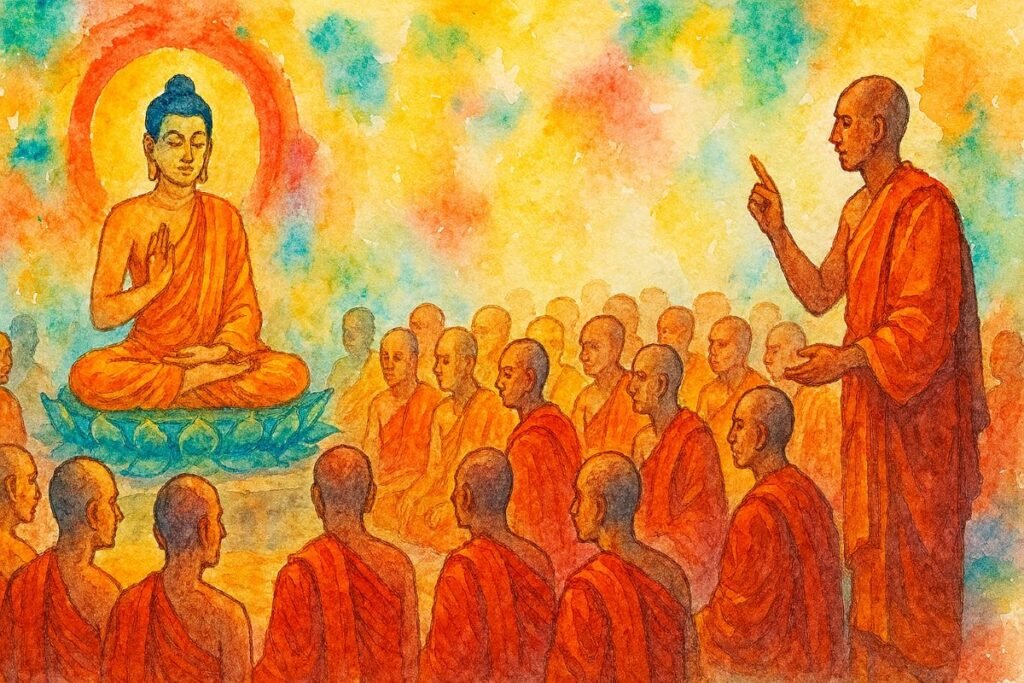
Theravāda traces its conventional, mytho-historical lineage to the First Buddhist Council (Saṅgīti), said to have been held at Rājagaha three months after the Buddha’s final passing (Parinibbāna), traditionally dated to 483 BCE. According to the chronicles, the aim was to collectively recite and thereby preserve the teachings. The venerable Ānanda, the Buddha’s personal attendant, recited the Discourses (Sutta), while Upāli recited the Monastic Discipline (Vinaya). While this council represents an idealized, unifying origin point for all Buddhist schools, Theravāda historiography specifically places itself within the Sthavira (Sanskrit for “Elder”) faction that emerged from the Second Council at Vesālī, held approximately a century later (c. 383 BCE). This council was convened to adjudicate disputes over ten points of monastic discipline, particularly concerning handling money and storing food. The Sthaviras were the conservatives who opposed perceived relaxations of the Vinaya rules advocated by the majority group, the Mahāsāṃghikas (“Great Assembly”). The Sthavira faction is thus seen as the forebear of Theravāda.
The decisive moment for the crystallization of a distinct Theravāda orthodoxy is recorded as the Third Council at Pāṭaliputta (modern Patna) around 250 BCE, under the patronage of the great Emperor Ashoka. According to the Theravāda chronicles, the elder Moggaliputta Tissa presided, compiled the Kathāvatthu (“Points of Controversy”) to refute heretical views proliferating within the Sangha, and purified the monastic order. It was immediately following this council that Ashoka’s son (or younger brother in some sources), the monk Mahinda, was dispatched to Sri Lanka. This missionary act is the foundational narrative of Theravāda as a distinct, institutionalized entity with a defined geographical and political center beyond the Indian mainland.
1.3 Consolidation in Sri Lanka: The Mahāvihāra Orthodoxy and Textual Preservation
Mahinda’s mission to King Devanampiya Tissa of Sri Lanka (r. 247-207 BCE) successfully established the Buddha’s dispensation (Sāsana) on the island. The Mahāvihāra (Great Monastery) in the capital, Anuradhapura, became the epicenter and bastion of what would become definitive Theravāda orthodoxy. For centuries, its great rival was the Abhayagiri Vihāra, a monastery that was more receptive to non-Theravādin ideas and texts, including Mahayana sutras and Vajrayana practices. The intellectual history of early Sri Lankan Buddhism is, in part, a history of the Mahāvihāra’s struggle to maintain its textual and disciplinary purity against the more cosmopolitan and syncretic Abhayagiri.
A monumentally significant event in global religious history occurred during the reign of King Vaṭṭagāmaṇī Abhaya (29-17 BCE). Fearing the irrevocable loss of the solely orally transmitted canon due to a devastating famine, internal warfare, and the fragile nature of human memory, the Sangha convened at the Aluvihare rock temple complex. There, over a period of time, learned reciter-monks (bhāṇakas) committed the entire Tipiṭaka, along with the Sinhalese-language commentaries (Aṭṭhakathā), to writing on processed palm leaves (ola). This act transformed the tradition from an oral to a literary culture, creating a fixed, immutable textual standard against which all subsequent doctrine and practice could be authoritatively measured. It fundamentally solidified the Mahāvihāra’s interpretative authority.
Subsequent centuries witnessed cycles of South Indian Chola invasion, political fragmentation, monastic decline, and spirited revival. A paradigmatic figure of renewal was King Parakramabahu I (1153-1186 CE) of Polonnaruwa, who famously “unified” the Sangha by purging it of corrupt and lax monks, and by formally abolishing the Abhayagiri and Jetavana monastic lineages, bringing all monastics under the strict Mahāvihāra Vinaya and doctrinal guidance. This great reform established the classical, streamlined Theravāda model: monastic, textual, and royal, that would later be exported to mainland Southeast Asia.
1.4 Expansion to Mainland Southeast Asia: The “Sinhalese Reformation” Model
The spread of Theravāda across Burma, Thailand, Cambodia, and Laos was not a rapid evangelistic conversion but a slow, centuries-long process of elite monastic networking, translation projects, and, most crucially, royal patronage. A recurring pattern, termed by scholars the “Sinhalese Reformation,” involved Southeast Asian rulers, seeking religious legitimacy and a cohesive state ideology—importing senior, learned monks from Sri Lanka to re-ordain local monastic communities. This established a “pure” lineage (siṃhala-saṅgha) and created a direct link to the Mahāvihāra orthodoxy.
- Burma/Myanmar: Theravāda coexisted for centuries with other Buddhist schools (e.g., Sarvāstivāda) and Brahmanical traditions. Its establishment as a dominant state religion is credited to King Anawrahta (1044-1077) of the rising Pagan Empire. After conquering the Mon kingdom of Thaton in lower Burma, he brought its Pali scriptures and learned monks to his capital. Subsequently, he invited Sinhalese monks to reform the Burmese Sangha along Mahāvihāra lines. The colossal temple-building project at Pagan (9th-13th centuries) physically anchored Theravāda in Burmese civilization, architecture, and national identity. Later, in the 15th century, a series of missions to Sri Lanka re-established the Sinhalese ordination line, creating the Mahāsvara lineage that dominates to this day.
- Thailand/Siam: The Mon civilization of Dvaravati (6th-11th centuries CE) was likely Theravādin. However, the direct ancestry of the modern Thai tradition originates with the Sukhothai Kingdom (1238-1438). King Ram Khamhaeng, drawing on the prestige of Sinhalese Buddhism, invited monks from Sri Lanka to establish a new, purified ordination line. This lineage was later radically reformed in the 19th century by King Mongkut (Rama IV), who, before his ascension, spent 27 years as a disciplined monk. He founded the strict, text-focused, and reformist Thammayut Nikaya (“Order Adhering to the Dhamma”), which exists alongside the larger, more traditional Mahanikaya.
- Cambodia and Laos: The mighty Khmer Empire (9th-15th centuries), centered at Angkor, was officially Hindu (Shaivite and Vaishnavite) and Mahayana Buddhist, as evidenced by its monumental architecture. The gradual infiltration of Theravāda from neighboring Thailand and Sri Lanka, beginning around the 13th century, coincided with the empire’s political and economic decline. Its egalitarian, village-based monasticism, accessible to all men for temporary ordination, proved more socially adaptable than the court-centered Brahmanism. By the 14th-15th centuries, it had become the dominant religion of the populace. In Laos, Theravāda was established similarly from Cambodian and Thai sources, becoming integral to Lao ethnic and royal identity under the Lan Xang kingdom (14th-18th centuries).
Part II: The Pali Canon: An Analytical Framework of the Tipiṭaka
2.1 The Tipiṭaka: A Closed Canon of Supreme Authority
The Pali Tipiṭaka is a “closed” canon, meaning its contents were formally fixed by the 5th century CE with the completion of the commentarial work of Buddhaghosa. No subsequent texts can be added to this corpus as canonical Buddhavacana. This stands in stark contrast to the “open” and expansive canons of Mahayana traditions. Its authority within conservative/tradition bound Theravāda is absolute and non-negotiable. The three “baskets” or collections (piṭaka) are not arbitrary categories but represent a graduated curriculum for the aspiring monastic: the Vinaya for cultivating communal harmony and personal discipline; the Sutta for gaining a profound understanding of the Dhamma; and the Abhidhamma for developing the penetrative wisdom that dismantles clinging.
2.2 Detailed Analysis of the Vinaya Piṭaka: The Constitution of the Sangha
The Vinaya is the comprehensive rulebook and constitutional law of the monastic community (Sangha). Its precise preservation is considered the very lifeblood of the tradition, as a valid, uninterrupted Sangha is deemed necessary for valid ordination and the continuation of the Buddha’s dispensation (sāsana). It is comprised of three major sections:
- Suttavibhaṅga: This is the core commentary on the Pāṭimokkha, the code of 227 rules for monks (with a parallel Bhikkhunīvibhaṅga containing 311 rules for nuns). Each rule is presented through a meticulous format: a) the origin story (vatthu) detailing the specific incident and person that prompted the Buddha to lay down the rule; b) the rule’s definitive wording (pāḷi); c) a list of exceptions and minor clauses; and d) a word-commentary (padabhājaniya). Rules are categorized by severity from the gravest Pārājika (“defeat,” entailing permanent expulsion from the Sangha) down to minor Pācittiya offences requiring only confession.
- Khandhaka: Comprising 22 chapters, these texts detail the procedures and protocols (kamma) for collective Sangha life. The Mahāvagga includes the grand narrative of the founding of the Sāsana: the Buddha’s awakening, his first sermon to the five ascetics, the formation of the Sangha, and detailed rules for ordination (upasampadā), the annual rains retreat (vassa), medicine, and robe-making. The Cullavagga covers disciplinary procedures like dealing with schisms, specific training rules, the conduct and establishment of the nuns’ order, and accounts of the first two councils.
- Parivāra: A later, post-canonical analytical manual, essentially a “digest” or catechism of the Vinaya. It employs lists, summaries, and question-and-answer formats, likely used for instruction and examination of monks.
2.3 The Sutta Piṭaka: The Discursive and Dialogical Teachings
This “Basket of Discourses” contains the doctrinal, ethical, and psychological teachings delivered by the Buddha and his chief enlightened disciples to a diverse array of people: monks, nuns, kings, brahmins, householders, and deities. It is divided into five collections (Nikāyas), each with a distinct character and pedagogical purpose.
Table 1: The Five Nikāyas of the Sutta Piṭaka
| Nikāya | Pali Meaning | Scope & Character | Representative & Key Suttas | Primary Doctrinal Emphasis |
|---|---|---|---|---|
| Dīgha Nikāya | “Long Collection” | 34 lengthy discourses aimed at a broad audience, including brahmins, kings, and ascetics. Often polemical, cosmological, and dealing with social ethics. | Brahmajāla Sutta: Classifies 62 speculative wrong views. Mahāparinibbāna Sutta: The Buddha’s final days, last instructions, and passing. Saṃgīti & Dasuttara Suttas: Catechistic summaries of teachings. Mahāsatipaṭṭhāna Sutta: The great discourse on the four foundations of mindfulness. | Social ethics, critique of rival philosophies (brahmanical & śramaṇa), ideal kingship, monastic community, detailed meditation instructions, cosmology. |
| Majjhima Nikāya | “Middle-Length Collection” | 152 medium-length discourses, considered the pedagogical core for monastics. Balanced, methodical, and comprehensive exposition. | Mūlapariyāya Sutta: On the “root of all things” and perception. Satipaṭṭhāna Sutta: The foundational discourse on mindfulness. Ānāpānasati Sutta: Mindfulness of breathing. Kaccānagotta Sutta: On right view and the Middle Way between existence and non-existence. | The gradual training, detailed meditation guides, analysis of not-self, dependent origination, the Middle Way, practical path-factors. |
| Saṃyutta Nikāya | “Connected Collection” | 2,889 shorter suttas grouped into 56 thematically connected chapters (saṃyutta). Provides in-depth, focused study of specific doctrines. | Nidāna Saṃyutta: On the 12 links of Dependent Origination. Khandha Saṃyutta: On the Five Aggregates of clinging. Saḷāyatana Saṃyutta: On the Six Sense Bases. Māra Saṃyutta: On the tempter’s assaults. | Deep, systematic exploration of specific doctrinal threads, showing their interconnections and practical application. Highly analytical. |
| Aṅguttara Nikāya | “Numerical Collection” | 9,557 suttas arranged in ascending numerical order (ones, twos, threes, up to elevens). A versatile pedagogical toolkit. | Ekaka Nipāta: Single themes like mindfulness as the one path. Duka Nipāta: Pairs like calm & insight, blame & praise. Tika Nipāta: Triads like the three feelings, three roots of the unwholesome. | Memorizable lists, ethical training, practical psychology, qualities to be developed or abandoned by monastics and laity. Facilitates teaching. |
| Khuddaka Nikāya | “Minor Collection” | A diverse anthology of 15-19 books (varies by recension) of varied genre. Contains some of the earliest and latest material in the canon. | Dhammapada: 423 seminal ethical verses. Sutta Nipāta: Ancient, poetic discourses. Theragāthā/Therīgāthā: Poems of enlightened monks/nuns. Jātaka: 547 past-life tales of the Buddha. Milindapañha: Dialogue between King Milinda & monk Nāgasena (post-canonical but included). | Inspiration, devotional poetry, narrative ethics, advanced philosophical dialogue, canonical “story-telling.” |
2.4 The Abhidhamma Piṭaka: The Systematic, Phenomenological Philosophy
The seven books of the Abhidhamma represent a profound intellectual shift from narrative and dialogic teaching to a purely descriptive, taxonomic, and phenomenological analysis of consciousness and reality. It operates on two distinct levels: the conventional (sammuti) reality of persons, beings, and things, and the ultimate (paramattha) reality of momentary, impersonal, conditioned phenomena called dhammas.
- Dhammasaṅgaṇī (“Enumeration of Phenomena”): The foundational matrix of the entire Abhidhamma system. It catalogs and defines all ultimate realities: 89 (or 121) types of consciousness (citta), 52 mental factors (cetasika), 28 types of materiality (rūpa), and the unconditioned Nibbāna. It lists their concomitants and ethical quality (wholesome, unwholesome, or indeterminate).
- Vibhaṅga (“The Book of Analysis”): Takes 18 key topics from the Suttas (e.g., the five aggregates, the sense bases, the Four Noble Truths, the faculties, dependent origination) and analyzes each using multiple, rigorous methodologies: via Sutta-style exposition, via Abhidhamma-style definition, and via catechistic questioning.
- Dhātukathā (“Discussion of Elements”): A concise, densely packed treatise that mathematically correlates the frameworks of the aggregates (khandha), sense bases (āyatana), and elements (dhātu) into a single, unified matrix, showing their interrelationships.
- Puggalapaññatti (“Designation of Persons”): The only Abhidhamma text that deals explicitly with conventional reality. It classifies human types (e.g., the hateful person, the faithful person) for pedagogical and ethical purposes, bridging the gap between ultimate analysis and everyday experience.
- Kathāvatthu (“Points of Controversy”): A historical-philosophical record of debates, traditionally attributed to Moggaliputta Tissa at the Third Council. It defends Theravāda orthodoxy against 217 points of doctrine held by other early Buddhist schools (e.g., the existence of a “person” (puggala) as a real entity, the nature of an Arahant, the omniscience of the Buddha).
- Yamaka (“The Pairs”): An advanced exercise in logic, definition, and the precise understanding of terminology. It tests comprehension by posing questions in paired, converse forms (e.g., “Are all wholesome roots wholesome? Yes. Are all roots wholesome? No.”) to eliminate ambiguity.
- Paṭṭhāna (“The Book of Conditional Relations”): The monumental, culminating work of the Abhidhamma, renowned as the most complex. It details the 24 modes of conditionality (paccaya)—such as root condition, object condition, predominance condition, proximity condition—through which all dhammas interact in the dynamic process of dependent arising. It demonstrates the profound complexity, order, and non-randomness of the causal universe.
2.5 The Commentarial (Aṭṭhakathā) and Sub-Commentarial (Ṭīkā) Apparatus
The Tipiṭaka is never read in isolation within Theravāda; it is inseparable from its massive, sophisticated exegetical tradition. The original commentaries were said to have been brought to Sri Lanka by Mahinda in the Sinhalese language. In the 5th century CE, the great Indian-born scholar Buddhaghosa undertook the monumental task of translating, editing, and re-composing these Sinhalese commentaries into elegant Pali. His Visuddhimagga (“The Path of Purification“) is the supreme synthesis, a step-by-step manual from virtue through concentration to insight, seamlessly integrating Sutta, Vinaya, and Abhidhamma into a single, coherent path. Other major figures in the commentarial lineage include Dhammapāla (6th century, author of sub-commentaries and commentaries on the Khuddaka Nikāya texts) and Sāriputta (12th century, author of the sub-commentary Sāratthadīpanī). This multi-layered exegetical apparatus provides the definitive, orthodox interpretation of the canon, shaping all subsequent Theravāda thought.
Part III: The Foundational Doctrine: The Anatomy of the Four Noble Truths
3.1 The Framework of Diagnosis and Cure: The Buddha as Physician
The Four Noble Truths (Cattāri Ariyasaccāni) are not metaphysical propositions to be believed on faith, but four objective realities (sacca) to be fully understood (pariññā) by the “noble ones” (ariya). They form the immutable structural framework of all Theravāda teaching, perfectly embodying the Buddha’s role as a spiritual physician: diagnosing the chronic illness (dukkha), identifying its cause (samudaya), declaring with certainty that a cure is possible (nirodha), and prescribing the detailed treatment (magga).
3.2 First Noble Truth: The Truth of Suffering (Dukkha Ariyasacca)
Dukkha is a profound, multifaceted term that encompasses far more than simple physical pain. Its full understanding is synonymous with enlightenment itself. It operates on three ascending levels of subtlety:
- Dukkha as Ordinary, Manifest Suffering (Dukkha-dukkha): This is the obvious, visceral experience of physical and mental pain—the suffering of birth, aging, sickness, death, of being associated with the unpleasant, separated from the pleasant, and not getting what one wants.
- Dukkha due to Change and Impermanence (Vipariṇāma-dukkha): This is the suffering inherent in the instability of all pleasant feelings and agreeable conditions. Even moments of happiness contain the seed of dukkha because they are impermanent; their inevitable passing leads to loss, disappointment, and the underlying anxiety that they will end.
- Dukkha as Conditioned States (Saṅkhāra-dukkha): The most subtle and pervasive level. The five aggregates subject to clinging (upādānakkhandha)—material form, feeling, perception, mental formations, and consciousness—are themselves dukkha. Because they are impermanent, conditioned, and empty of a self, they are inherently unsatisfactory, oppressive, and unfit to be identified as “mine,” “myself,” or “what I am.”
3.3 Second Noble Truth: The Truth of the Origin of Suffering (Samudaya Ariyasacca)
The cause of dukkha is identified with pinpoint precision: it is craving (taṇhā), which arises dependent on feeling (vedanā) and is rooted in the fundamental ignorance (avijjā) of the true nature of reality. Craving is threefold, manifesting as:
- Craving for Sensual Pleasures (Kāma-taṇhā): Desire for pleasurable objects of the six senses (sights, sounds, smells, tastes, touches, mental phenomena).
- Craving for Existence and Becoming (Bhava-taṇhā): Desire for continued becoming, for eternal life, for a fixed and enduring identity or self, for fame, achievement, or a particular state of existence.
- Craving for Non-Existence and Annihilation (Vibhava-taṇhā): Desire for annihilation, for the self to be utterly destroyed at death, for oblivion, or for the destruction of what is unpleasant.
This craving is the fuel that perpetuates the cyclical, conditioned process of dependent origination (paṭiccasamuppāda), leading to renewed existence, birth, and thus, more dukkha.
3.4 Third Noble Truth: The Truth of the Cessation of Suffering (Nirodha Ariyasacca)
This is Nibbāna (Sanskrit: Nirvāṇa). It is the unconditioned (asaṅkhata) element, defined as the extinguishing (nibbāna literally means “to blow out”) of the fires of greed (lobha), hatred (dosa), and delusion (moha). It is not the annihilation of a self (as there is no self to annihilate), but the cessation of a process—the end of craving and ignorance. It is described positively as the supreme security from bondage, liberation, peace, the deathless, and the ultimate refuge. Critically, it is directly experienceable in this very life (diṭṭheva dhamme), as the “extinguishment of the defilements” (kilesa-parinibbāna), and it is also the final state after the death of an Arahant (khandha-parinibbāna or parinibbāna), where the aggregates cease without remainder.
3.5 Fourth Noble Truth: The Truth of the Path (Magga Ariyasacca)
The practical, actionable path leading to the cessation of dukkha is the Noble Eightfold Path (Ariyo Aṭṭhaṅgiko Maggo). It is explicitly called the “Middle Way” (Majjhimā Paṭipadā) because it avoids the two extremes of sensual indulgence (which is low, vulgar, and unbeneficial) and self-mortification (which is painful, unworthy, and unbeneficial). It is a comprehensive training program encompassing ethical, mental, and intellectual development.
Part IV: The Path to Liberation: The Graduated Training of the Noble Eightfold Path

The Eightfold Path is a unified, mutually supportive program of training. Its eight factors are to be developed simultaneously, yet there is a natural progression and interdependence: Wisdom (paññā) provides the direction, Ethical Conduct (sīla) purifies the base of action, and Mental Discipline (samādhi) concentrates and empowers the mind for insight.
Table 2: The Noble Eightfold Path – The Threefold Training (Sīla, Samādhi, Paññā)
| Path Factor | Pali | Training Group | Detailed Explanation & Practical Application |
|---|---|---|---|
| 1. Right View | Sammā-diṭṭhi | Wisdom (Paññā) | The correct understanding of reality. This has two levels: 1) Anubodhi: Intellectual, learning-based understanding acquired through study and reflection. 2) Pativedha: Direct penetration and experiential understanding through insight meditation. It primarily means understanding the Four Noble Truths, but also includes understanding karma (the law of moral cause and effect) and dependent origination (the law of causal conditionality). It is the forerunner and guide for all other path factors, like a lamp in darkness. |
| 2. Right Intention | Sammā-saṅkappa | Wisdom (Paññā) | The commitment, resolve, or trajectory of the mind oriented toward liberation. It is threefold: 1) Intention of renunciation (nekkhamma-saṅkappa), countering sensual desire. 2) Intention of goodwill and non-ill-will (abyāpāda-saṅkappa), countering hatred. 3) Intention of harmlessness (avihiṃsā-saṅkappa), countering cruelty. It turns understanding into purposeful motivation. |
| 3. Right Speech | Sammā-vācā | Ethical Conduct (Sīla) | Abstaining from four types of harmful verbal action: 1) False speech (musāvāda)—lying and deceit. 2) Divisive speech (pisunāvācā)—slander and gossip that creates discord. 3) Harsh speech (pharusāvācā)—abusive, angry, or hurtful words. 4) Idle chatter (samphappalāpa)—frivolous, pointless talk that wastes time and stirs up the mind. One cultivates truthful, harmonious, gentle, and meaningful speech. |
| 4. Right Action | Sammā-kammanta | Ethical Conduct (Sīla) | Abstaining from three types of harmful bodily action: 1) Taking life (pāṇātipātā)—killing or harming living beings. 2) Taking what is not given (adinnādānā)—stealing, fraud, cheating. 3) Sexual misconduct (kāmesu micchācārā)—adultery, exploitation, or harmful sexual behavior. One cultivates respect for life, property, and personal relationships. |
| 5. Right Livelihood | Sammā-ājīva | Ethical Conduct (Sīla) | Abandoning trades and professions that cause direct, obvious harm to others: trading in weapons, in living beings (slave trade, prostitution), in meat production and butchery, in intoxicants (alcohol, drugs), and in poisons. One earns a living in a way that is honest, legal, peaceful, and blameless, without exploiting or harming others. |
| 6. Right Effort | Sammā-vāyāma | Mental Discipline (Samādhi) | The energetic cultivation of the mind, the “battle” against unwholesome states. It is fourfold: 1) The effort to prevent unwholesome states (e.g., greed, anger) from arising. 2) The effort to abandon unwholesome states that have already arisen. 3) The effort to arouse wholesome states (e.g., generosity, kindness) not yet arisen. 4) The effort to maintain, increase, and perfect wholesome states already arisen. It is the application of will and energy to the path. |
| 7. Right Mindfulness | Sammā-sati | Mental Discipline (Samādhi) | The clear, steady, non-judgmental, present-moment awareness of phenomena as they are. It is developed via the systematic framework of the Four Foundations of Mindfulness (Satipaṭṭhāna): 1) Contemplation of the body (kāyānupassanā)—mindfulness of breathing, postures, activities, bodily parts, elements, and decay. 2) Contemplation of feelings (vedanānupassanā)—recognizing feelings as pleasant, unpleasant, or neutral. 3) Contemplation of mind (cittānupassanā)—knowing mind states as lustful, hateful, deluded, concentrated, etc. 4) Contemplation of mental objects (dhammānupassanā)—applying mindfulness to the hindrances, aggregates, sense bases, factors of enlightenment, and Noble Truths. This is the heart of Theravāda meditative practice. |
| 8. Right Concentration | Sammā-samādhi | Mental Discipline (Samādhi) | The development of a unified, undistracted, collected, and powerfully focused mind (cittass’ekaggatā). Traditionally, this is achieved through mastering the four meditative absorptions (jhānas), states of profound stillness, bliss, and equanimity born of seclusion from sensual desire and unwholesome states. The jhānas provide the supernormal clarity and stability of mind necessary for the deep penetration of insight (vipassanā). |
Part V: Philosophical Psychology: The Abhidhamma’s Microscopic Analysis
5.1 The Theory of Ultimate Realities (Paramattha Dhammā): Deconstructing Experience
The Abhidhamma’s analytical method relentlessly deconstructs all conventional experience (persons, tables, selves) into a dynamic stream of ultimate, ineffable, momentary realities called dhammas. These are not substances but evanescent events in a causal continuum. There are four exclusive categories:
- Consciousness (Citta): The bare awareness or cognition of an object. It is classified into 89 (or 121) types based on: a) its nature (wholesome, unwholesome, resultant, or functional), b) its plane of existence (sensuous sphere, fine-material sphere, immaterial sphere, or supra-mundane), and c) its associated mental factors. A single moment of consciousness (cittakkhaṇa) is unimaginably brief.
- Mental Factors (Cetasika): The 52 qualities that invariably arise together with consciousness, “coloring” the citta and giving each moment its specific character. They include universal factors present in every mind-moment (e.g., contact, feeling, perception, volition, one-pointedness), occasional factors (e.g., applied thought, sustained thought, decision), and beautiful or unwholesome factors (e.g., greed, hatred, wisdom, compassion).
- Materiality (Rūpa): 28 types of material phenomena, all derived from the four primary elements (mahābhūta): earth element (solidity/extension), water element (cohesion/fluidity), fire element (temperature/maturation), air element (movement/distension). Derived materiality includes the five physical sense organs and their five external objects, as well as subtler forms like nutritive essence and life faculty. Rūpa arises and ceases much slower than the rapid flow of mind.
- Nibbāna: The unconditioned (asaṅkhata) element, distinct from all conditioned dhammas. It is not a dhamma in the conditioned sense, but the cessation (nirodha) of the conditioned dhammas of greed, hatred, and delusion. It is known by the mind through a supra-mundane citta.
5.2 The Three Universal Characteristics (Tilakkhaṇa): The Marks of All Conditioned Existence
All conditioned dhammas (cittas, cetasikas, and rūpas) are stamped with three inescapable characteristics, the direct realization of which constitutes liberating insight:
- Impermanence (Anicca): All conditioned things are in constant, instantaneous flux. They are not stable entities but processes. Existence is a rapid, serial arising (uppāda), a brief moment of standing (ṭhiti), and an inevitable passing away (bhaṅga). Nothing remains the same for two consecutive moments.
- Suffering (Dukkha): Because they are impermanent, subject to change, and not subject to one’s will, conditioned dhammas are incapable of providing lasting satisfaction, security, or happiness. They are inherently oppressive, unsatisfactory, and a basis for suffering when clung to.
- Non-Self (Anattā): There is no permanent, unchanging, independent “self,” soul, essence, or controller within or behind these impersonal, conditioned, and dependently-originated processes. The notion of “I,” “me,” or “mine” is a delusion superimposed upon this stream. The “person” is a convenient label for a dynamic, causally connected assemblage of dhammas.
5.3 Dependent Origination (Paṭiccasamuppāda): The Detailed Causal Map of Samsāra
This is the Buddha’s detailed causal formula explaining precisely how ignorance leads to suffering and how wisdom leads to its cessation. The classic twelve-link formula illustrates the process across three lifetimes, showing the conditioning relationship (idappaccayatā) between factors:
- Past Life: Ignorance (avijjā) of the Four Noble Truths and Volitional Formations (saṅkhārā) or karmic activities condition…
- Present Life: …Consciousness (viññāṇa) at conception, which co-arises with Mind-Body (nāma-rūpa), which develop the Six Sense Bases (saḷāyatana). Sense-base contact with objects (phassa) leads to Feeling (vedanā), which, if not mindfully observed, leads to Craving (taṇhā), which intensifies into Clinging (upādāna), which fuels the process of Becoming (bhava) or karmic accumulation, which conditions…
- Future Life: …Birth (jāti) into a new existence, and thus Aging & Death (jarā-maraṇa) and all the attendant suffering.
Understanding this chain intellectually is the task of Right View. Breaking it at the critical link between feeling and craving through mindful observation (yoniso manasikāra) is the work of meditation and the key to liberation.
Part VI: The Stages of the Path and the Ideal of the Arahant
6.1 The Threefold Training (Ti-sikkhā) in Practice: A Sequential Mastery
The path is cultivated through the sequential yet interwoven development of three trainings:
- Moral Discipline (Sīla): The indispensable foundation. For laity, this is the Five or Eight Precepts; for monastics, the full Pāṭimokkha. Sīla purifies bodily and verbal actions, creating external and internal stability, non-remorse, and the blamelessness that allows the mind to become calm and receptive for meditation.
- Concentration (Samādhi): Cultivated through Samatha (tranquility) meditation, using one of forty traditional objects (e.g., the breath (ānāpānasati), loving-kindness (mettā), a colored disk (kasina)). Mastery leads through access concentration (upacāra-samādhi) to the eight jhānas, states of profound mental unification, purification, and mastery, free from the five hindrances (sensual desire, ill-will, sloth, restlessness, doubt).
- Wisdom (Paññā): Cultivated through Vipassanā (insight) meditation. Using the concentrated, powerful, and malleable mind developed in samādhi, one systematically investigates the mind-body process to directly discern (pativedha) the three characteristics in one’s own experience. This proceeds through a classical sequence of “stages of insight” (vipassanā-ñāṇa), culminating in the breakthrough to the supra-mundane path (magga).
6.2 The Four Stages of Enlightenment: The Eradication of Fetters
A practitioner who directly penetrates the Four Noble Truths with supra-mundane wisdom attains one of four irreversible stages of “Noble Person” (ariya-puggala). Each stage permanently eradicates specific “fetters” (saṃyojana), mental bonds that tie beings to the cycle of suffering.
Table 3: The Four Stages to Arahantship: Eradication of the Ten Fetters
| Stage | Pali Term | Fetters Eradicated | Description, Attributes & Spiritual Destiny |
|---|---|---|---|
| 1. Stream-Enterer | Sotāpanna | 1. Identity View (sakkāya-diṭṭhi) 2. Doubt (vicikicchā) 3. Clinging to Rites & Rituals (sīlabbata-parāmāsa) | Has “entered the stream” that flows inevitably to Nibbāna. Possesses unshakable confidence in the Buddha, Dhamma, and Sangha. Will never be reborn in a lower, woeful realm (hell, animal, hungry ghost). Is bound for full enlightenment and will attain it within a maximum of seven more lifetimes in the human or heavenly realms. |
| 2. Once-returner | Sakadāgāmi | Greatly weakens: 4. Sensual Desire (kāma-rāga) 5. Ill-will (byāpāda) | Has significantly attenuated craving for sensual pleasures and anger/aversion. “Returns” to the sense-desire realm (kāma-loka) only once more. After that one final human rebirth, will attain final liberation. |
| 3. Non-returner | Anāgāmi | Fully eradicates: 4. Sensual Desire (kāma-rāga) 5. Ill-will (byāpāda) | Has completely destroyed all craving for sensual pleasures and any trace of ill-will. Will not return to the human world or any sense-desire realm. At death, is spontaneously reborn in a high Brahmā world called a “Pure Abode” (suddhāvāsa), and attains final Nibbāna there, without ever descending. |
| 4. The Worthy One | Arahant | Eradicates the five higher fetters: 6. Desire for Fine-Material Existence (rūpa-rāga) 7. Desire for Immaterial Existence (arūpa-rāga) 8. Conceit (māna) 9. Restlessness (uddhacca) 10. Ignorance (avijjā) | Has “laid down the burden,” completed the spiritual task, and destroyed all mental defilements. Lives out the remainder of their life in a state of perfect wisdom, boundless compassion, and sublime equanimity. At the dissolution of the body, attains Parinibbāna—the final cessation of the aggregates, with no future rebirth of any kind. This is the culmination of the Holy Life. |
6.3 The Arahant: The Ideal Realized and Embodied
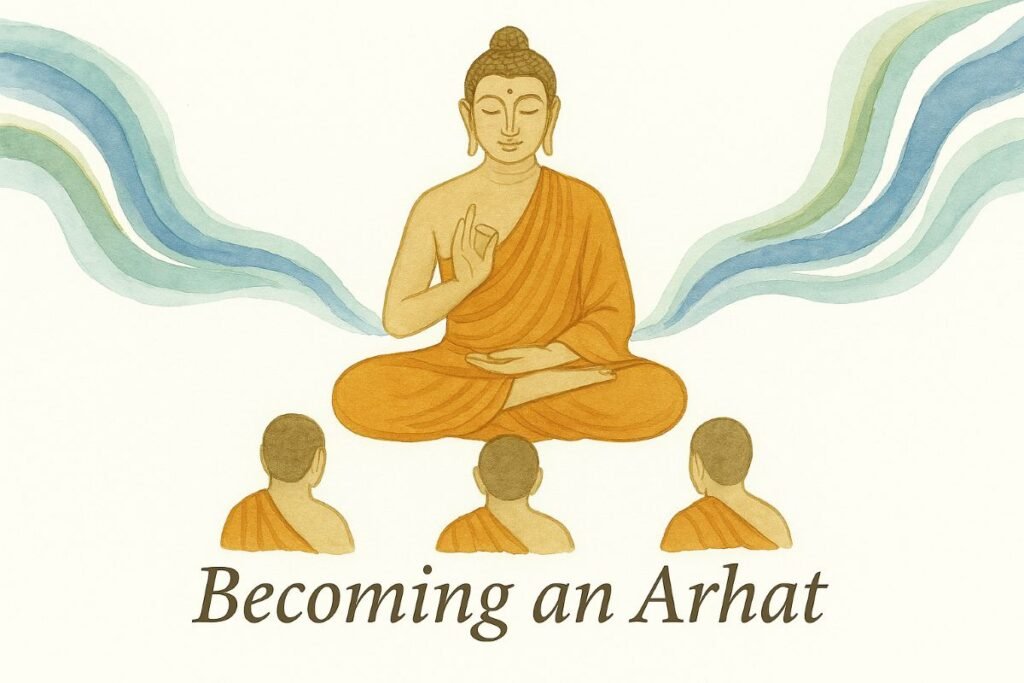
The Arahant stands as the pinnacle of Theravāda sainthood and the living proof of the Dhamma’s efficacy. They have fully comprehended the Four Noble Truths and eradicated all ten fetters. Their defining attributes include:
- Unassailable Freedom from Defilements: The roots of greed, hatred, and delusion are utterly destroyed. They may still experience sensory input and pleasant/unpleasant feelings, but no craving, aversion, or delusion arises in response. Their actions are spontaneously pure.
- Perfect, Effortless Ethicality: Their bodily, verbal, and mental actions are in perfect, spontaneous accord with the Dhamma. They are incapable of intentionally breaking the core moral precepts. Their virtue is innate and natural.
- Unshakable Peace and Equanimity: Their mind is characterized by supreme equanimity (upekkhā), utterly unaffected by the “eight worldly winds” (loka-dhamma): gain and loss, fame and disgrace, praise and blame, pleasure and pain.
- Living for the Benefit of Others: While completely free from any obligation or clinging, the Arahant almost invariably teaches and guides others out of boundless compassion (karuṇā) and loving-kindness (mettā). The Buddha himself is described as the first and foremost Arahant.
- Parinibbāna: The Final Cessation: At the dissolution of the bodily aggregate, the Arahant’s stream of conditioned dhammas ceases forever. This is not annihilation (as there has never been a self to annihilate) but the final stopping of a conditioned process. It is the ultimate security, the “cooling” of all suffering, the culmination and fulfillment of the Holy Life.
Part VII: The Monastic Community (Sangha) and Laity: A Symbiotic Ecosystem
7.1 The Bhikkhu Sangha: Structure, Ordination, and Daily Life
Ordination (upasampadā) is a formal, communal legal act performed by a chapter (sīma) of at least five fully ordained monks. A candidate (sāmaṇera, novice) must be free of specific obstacles (e.g., certain diseases, debt, obligations to parents or the state), possess an alms bowl and a set of robes, and undergo a rigorous examination. The ceremony involves a formal motion (ñatti) and proclamation (kammavācā) that transforms his status.
- Life in Dependence (Nissaya): Monks live in deliberate dependence on the lay community for the four requisites: almsfood (piṇḍapāta), robes (cīvara), shelter (senāsana), and medicine (gilāna-paccaya). This reciprocal relationship—material support for spiritual guidance and merit—is the fundamental economic and social contract of traditional Theravāda society.
- The Rhythms of Monastic Routine: Daily life is structured by the Pāṭimokkha recitation every fortnight, the strict observance of the three-month rains retreat (vassa), and the cycles of study, meditation, and communal duties. A typical day involves an early morning alms round, a single main meal eaten before noon, periods of study or meditation, evening chanting or Dhamma teaching to laity, and meditation late into the night.
- The Vinaya as a Training (Sikkhā): The 227 rules are not arbitrary prohibitions but a holistic training system designed by the Buddha to create a life of utmost simplicity, contentment, and mindfulness. They minimize social entanglements, reduce choices, and eliminate causes for conflict and regret, thereby creating an optimal environment for mental cultivation and liberation.
7.2 The Bhikkhunī Sangha: A Historical Lineage and a Modern Debate
The order of nuns was founded by the Buddha five years after the monks’ order, following the persistent requests of his foster mother, Mahāpajāpatī Gotamī. The Pali Canon contains a full Bhikkhunīvibhaṅga with 311 rules. This dual-Sangha thrived in India and Sri Lanka. However, the higher ordination lineage for nuns died out in the 11th century CE. Theravāda ordination rules require the presence of a dual-Sangha (a quorum of monks and nuns) for the full ordination of women. This has made the revival of the lineage from other living Buddhist traditions (notably the Chinese Dharmaguptaka lineage) a point of intense doctrinal, legal, and social debate. Some monastic communities and Buddhist nations, particularly in Sri Lanka and the global West, have accepted these “revived” ordinations. Others, citing strict Vinaya interpretation, reject their validity, creating a significant division in contemporary Theravāda.
7.3 Lay Practice: The Upāsaka/Upāsikā and the Economy of Merit
The lay follower formally “goes for refuge” to the Triple Gem: Buddha, Dhamma, Sangha, and observes the Five Precepts (pañcasīla) as the foundation of ethical life. On Uposatha days (the new moon, full moon, and two quarter moons), devout laypeople may observe the Eight Precepts (adding abstention from eating after noon, entertainments, adornments, and luxurious beds), often spending the day at a monastery in meditation and Dhamma study.
- The Centrality of Giving (Dāna): The primary religious act for the laity is generosity, particularly to the Sangha. This generates merit (puñña), a positive, psycho-ethical force believed to yield happiness in this life, a favorable rebirth, and the supportive conditions necessary for practicing the path in future lives. Large-scale donations fund the construction of monasteries (vihāra), libraries, hospitals, roads, and wells—all seen as supreme merit-making.
- Ritual, Devotion, and Protective Chanting: While doctrine is non-theistic and emphasizes self-effort, popular practice includes devotional acts (pūjā) toward Buddha images, relic veneration, recitation of protective suttas (paritta) like the Maṅgala or Ratana Sutta, and pilgrimages to sacred sites such as the Bodhi tree in Bodh Gaya, the Temple of the Tooth (Daladā Māligāva) in Kandy, or the Shwedagon Pagoda in Yangon.
Part VIII: Modern Developments and Global Transmission
8.1 The Modern Vipassanā (Insight Meditation) Movement: Democratizing Meditation
Beginning in late 19th-century Burma as a reactive movement to British colonial rule, perceived monastic scholasticism, and the threat of Christian missions, this movement boldly re-emphasized meditation practice for both monastics and the laity.
- Ledi Sayadaw (1846-1923): A pivotal scholar-meditator who wrote accessible vernacular meditation manuals and taught rigorous insight practice to thousands of laypeople, arguing that in the current age, meditation was not just for monastics but essential for all serious Buddhists to preserve the Sāsana.
- Mahasi Sayadaw (1904-1982): Systematized the “Mahasi method” or “Noting Technique.” Meditators focus primarily on the abdominal rise and fall as an anchor, while meticulously applying a silent mental “note” (noting is the mental label) to all other physical and mental phenomena as they arise (e.g., “thinking,” “hearing,” “pain,” “restlessness”). This method, emphasizing momentary concentration, became the template for countless government-sponsored and lay-run meditation centers (sāsana yeiktha) across Burma and later the world.
- S.N. Goenka (1924-2013): A Burmese-Indian lay teacher who established a global network of non-sectarian, donation-based Vipassanā retreat centers. His rigorous ten-day silent courses, teaching a systematic body-scanning awareness to develop equanimity towards sensations, have introduced a form of Theravāda-derived practice to hundreds of thousands worldwide, completely divorced from cultural and religious trappings.
8.2 The Thai Forest Tradition: The Ascetic Revival
A parallel 20th-century revival movement, primarily in Thailand and Laos, that stressed strict asceticism, meditative mastery in wilderness settings, and the direct, non-scholastic experience of the Dhamma.
- Ajahn Mun Bhuridatta (1870-1949): The founding patriarch. He wandered the forests of Northeast Thailand and Laos, striving for and, according to his disciples, attaining the level of Arahantship. He emphasized strict adherence to the Vinaya, the practice of the thirteen dhutanga (austere ascetic practices like living in the open, eating only from the alms bowl), and the cultivation of the jhānas as a basis for transcendent insight.
- Ajahn Chah (1918-1992): Perhaps the most influential disciple of the tradition for the West. He established Wat Pah Pong and its many branch monasteries. His simple, direct, and often humorous teachings on “letting go,” observing the natural mind, and the futility of clinging attracted many Western disciples. This led directly to the establishment of monasteries like Amaravati and Chithurst in the UK, Abhayagiri in the USA, and Bodhinyana in Australia, which have been crucial for transmitting not just meditation, but the full monastic form of Theravāda to the West.
8.3 Engaged Buddhism and Social Ethics: Expanding the Sphere of Dhamma
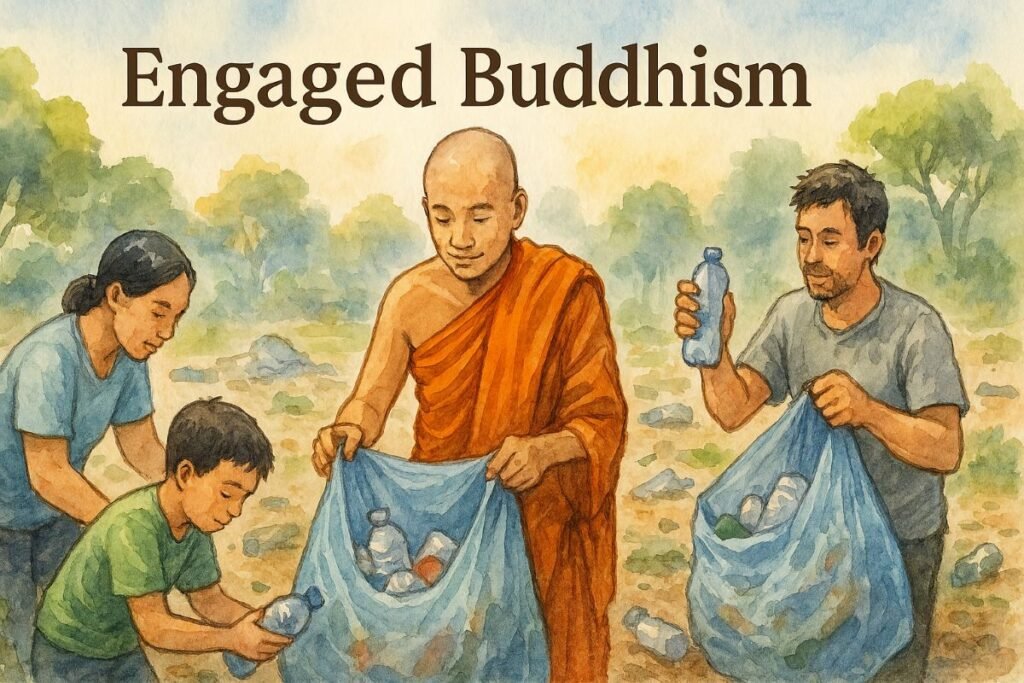
While Theravāda has traditionally focused on individual liberation through renunciation, modern thinkers and activists have drawn out its profound social and ethical implications.
- Buddhadasa Bhikkhu (1906-1993): Thailand’s most influential modernist monk. He reinterpreted core concepts like Nibbāna as a state of mind (“voidness of self”) attainable here and now, and critiqued consumerism, social injustice, and environmental destruction from a Buddhist perspective, advocating for a “Dharmic Socialism.”
- A.T. Ariyaratne (b. 1931): Founder of Sri Lanka’s Sarvodaya Shramadana Movement, applying Buddhist principles of self-reliance (swashakthi), communal sharing (sambhavā), and compassionate work to large-scale rural development, peace-building, and post-tsunami reconstruction.
- Environmental Ethics and Ecology: The principles of interdependence (paṭiccasamuppāda), compassion for all living beings, and the virtue of non-harming (ahiṃsā) have been mobilized to promote ecological conservation. Monastic-led projects for forest ordination (phā pa), tree-planting, watershed protection, and opposing destructive logging are active across Thailand, Sri Lanka, and Cambodia.
8.4 Theravāda in the West: Challenges, Adaptations, and Hybridization
The transmission to the West since the mid-20th century involves two often parallel streams: ethnic temples serving immigrant communities from Sri Lanka, Burma, Thailand, Laos, and Cambodia; and meditation centers/monasteries serving primarily convert, Western-born populations.
- Key Challenges and Tensions:
- Sustaining Monasticism: Supporting full-time, celibate monastics in societies without a cultural tradition of daily alms-giving is a fundamental challenge. Western monasteries have adapted with board memberships, support committees, and work projects, often navigating a tension between traditional dependence and modern financial sustainability.
- Teacher Authority, Transparency, and Scandals: The deeply revered status of monks and the guru-disciple model has sometimes clashed with Western norms of accountability, transparency, and egalitarianism, leading to painful crises over teacher misconduct, abuse of power, and financial mismanagement.
- Secularization and the Mindfulness Movement: The explosive popularity of secular mindfulness, while dramatically increasing awareness of meditation, often completely strips the practices of their ethical (sīla) and liberative (paññā) context. This leads to debates about appropriation, dilution, and the potential for “McMindfulness” that serves capitalist or therapeutic ends rather than liberation.
- Gender Equality and the Bhikkhunī Question: The issue of full female ordination is particularly acute in Western convert communities, where expectations for gender equality are high. Many leading Western Theravāda centers have been at the forefront of supporting and conducting bhikkhunī ordinations, placing them at odds with more conservative monastic hierarchies in Asia.
Part IX: Supplementary Reference Materials
9.1 Glossary of Key Pali Terms
Table 4: Expanded Glossary of Essential Theravāda Terminology
| Pali Term | Definition & Explanation |
|---|---|
| Abhidhamma | The “higher” or “special” teaching; the third basket of the Tipiṭaka, consisting of a rigorous philosophical and psychological analysis of reality into ultimate mental and physical phenomena (dhammas). |
| Anicca | Impermanence; the inconstant, unstable, ephemeral nature of all conditioned phenomena. The first of the Three Marks of Existence. |
| Arahant | A “Worthy One”; a person who has attained Nibbāna by eradicating all ten mental fetters, thus ending the cycle of rebirth. The ideal of the Theravāda path. |
| Bhāvanā | Mental development or cultivation; meditation. Literally “causing to become.” Often divided into Samatha-bhāvanā (tranquility) and Vipassanā-bhāvanā (insight). |
| Bhikkhu / Bhikkhunī | A fully ordained Buddhist monk / nun. One who lives on alms and follows the complete Vinaya discipline. |
| Bodhisatta (Skt: Bodhisattva) | In Theravāda, this refers specifically to the being who would become Gotama Buddha during his long path of cultivation over many lifetimes, as narrated in the Jātaka tales. It is not the universal ideal for all practitioners (which is the Arahant). |
| Brahmavihāra | The “four divine abidings” or sublime states: loving-kindness (mettā), compassion (karuṇā), empathetic joy (muditā), and equanimity (upekkhā). Both meditation subjects and ethical attitudes. |
| Dhamma (Dhamma) | 1) The teachings of the Buddha. 2) The ultimate truth or law of reality. 3) A phenomenon, a mental or physical event, an ultimate constituent of experience (as in Abhidhamma). |
| Dukkha | Suffering, stress, unsatisfactoriness; the inherent inability of conditioned existence to provide lasting happiness. The first Noble Truth. |
| Jhāna | Meditative absorption; a state of deep mental unification characterized by a specific set of factors (e.g., applied thought, sustained thought, rapture, bliss, one-pointedness). There are eight jhānas, four of the material sphere and four of the immaterial sphere. |
| Kamma (Skt: Karma) | Intentional action of body, speech, or mind. The universal law of moral cause and effect: wholesome actions lead to pleasant results, unwholesome actions to painful results. |
| Khandha | Aggregate; the five heaps that constitute a sentient being’s experience: form (rūpa), feeling (vedanā), perception (saññā), mental formations (saṅkhāra), and consciousness (viññāṇa). |
| Mettā | Loving-kindness; the sincere wish for the happiness and welfare of others. Cultivated as a meditation practice (mettā-bhāvanā) to overcome ill-will and develop boundless goodwill. |
| Nibbāna (Skt: Nirvāṇa) | The unconditioned; the extinguishing of the fires of greed, hatred, and delusion; the cessation of suffering; the final goal of the Buddhist path. |
| Pāli | The canonical language of Theravāda Buddhism, a Middle Indo-Aryan dialect closely related to the Magadhi language of the Buddha’s time. |
| Paññā | Wisdom; the penetrative understanding of the true nature of phenomena (as impermanent, unsatisfactory, and non-self). The third division of the Noble Eightfold Path and the Threefold Training. |
| Saṃsāra | The beginningless cycle of birth, death, and rebirth, characterized by dukkha. Driven by ignorance and craving. |
| Sangha | 1) In a narrow sense: the community of Buddhist monastics (bhikkhu/bhikkhunī saṅgha). 2) In a broad, noble sense: the community of all those who have attained at least the first stage of enlightenment (Stream-enterer and above). One of the Three Jewels. |
| Sati | Mindfulness; awareness, attention, recollection, the ability to keep an object in mind. The seventh factor of the Noble Eightfold Path. |
| Sīla | Moral virtue, ethical conduct. The training in bodily and verbal purity, based on the precepts. The first division of the Threefold Training. |
| Taṇhā | Craving, thirst; the root cause of suffering. The second Noble Truth. Manifests as craving for sensual pleasures, for existence, and for non-existence. |
| Tipiṭaka (Skt: Tripiṭaka) | The “Three Baskets”: the complete Pali Canon, comprising the Vinaya Piṭaka, Sutta Piṭaka, and Abhidhamma Piṭaka. |
9.2 Annotated List of Study Resources
- Primary Text Repositories (Digital):
- SuttaCentral: (https://suttacentral.net/) The indispensable, modern scholarly tool. Offers original Pali texts and side-by-side translations in many languages, linked to parallels in other Buddhist canons (Chinese, Sanskrit, Tibetan). Essential for comparative study.
- Access to Insight: (https://www.accesstoinsight.org/) The classic, extensive collection of Theravāda texts in English translation, with a strong focus on the Pali Canon and teachings from the Thai Forest Tradition. User-friendly and vast.
- Tipiṭaka.io: (https://tipitaka.io/) A clean, searchable interface for the Pali Tipiṭaka in Roman script, with some English translations and Pali dictionary tools.
- Introductory Books (Balanced & Foundational):
- What the Buddha Taught by Walpola Rahula. A concise, clear, and profoundly influential introduction to core teachings from a Theravāda perspective. Remains a classic starting point.
- The Buddha and His Teachings by Nārada Thera. A more traditional, comprehensive, and devotional overview of doctrine, history, and practice.
- An Introduction to Buddhism by Peter Harvey. A superb academic survey that expertly places Theravāda within the broader historical and doctrinal context of the Buddhist world.
- In-Depth Academic & Historical Studies:
- Theravāda Buddhism: A Social History from Ancient Benares to Modern Colombo by Richard Gombrich. A brilliant and readable analysis of the tradition’s social and historical dimensions, from its Indian origins to modern Sri Lanka.
- Buddhist Thought: A Complete Introduction to the Indian Tradition by Paul Williams (with Anthony Tribe and Alexander Wynne). Excellent for understanding Theravāda Abhidhamma and soteriology in relation to other Indian Buddhist schools.
- Practice Manuals and Guidance:
- The Heart of Buddhist Meditation by Nyanaponika Thera. The seminal work that introduced the Satipaṭṭhāna Sutta and mindfulness practice to the Western world. Profound and clear.
- Mindfulness in Plain English by Bhante Henepola Gunaratana. A very accessible, practical, and no-nonsense guide to Vipassanā meditation.
- Satipaṭṭhāna: The Direct Path to Realization by Bhikkhu Anālayo. A modern classic. A detailed, comparative, and practical verse-by-verse study of the foundational discourse on mindfulness by a renowned scholar-monk.
Conclusion: The Enduring Path of Analysis and Realization
Theravāda Buddhism presents a comprehensive, logically structured, and psychologically profound path from the bondage of conditioned existence (saṃsāra) to the unconditioned freedom of Nibbāna. Its unique strength lies in its remarkable textual preservation, its unparalleled systematic analysis of mind and reality through the Abhidhamma, and its clear, graduated path of ethical training, meditative concentration, and liberating wisdom. While firmly rooted in the ancient monastic traditions and cultures of Sri Lanka and Southeast Asia, it has demonstrated a significant capacity for adaptation and innovation in the modern global era, primarily through the vehicle of insight meditation. It remains a vital, living tradition that offers a rigorous, non-theistic, and empirically-oriented discipline for the radical transformation of human consciousness. It holds the figure of the Arahant—the one who has fully understood the Four Noble Truths and walked the Noble Eightfold Path to its very end—not as a distant myth, but as its ultimate, realistic, and attainable goal for humanity.