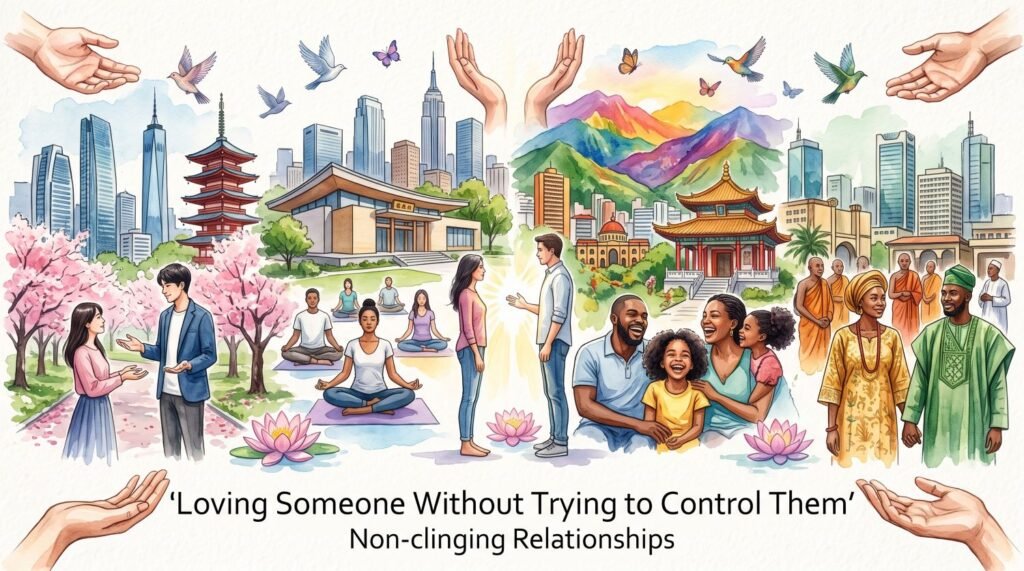
Key Takeaways
- True love in Buddhism is the selfless wish for another person’s happiness, while control is a symptom of attachment (upādāna) that seeks to satisfy our own need for security and certainty.
- The impulse to manage others arises from craving (taṇhā) and ignorance (avijjā), not from genuine care. The three poisons of greed (lobha), aversion (dosa), and delusion (moha) fuel controlling behavior.
- Recognizing that every individual is the owner of their own intentional actions (kamma) allows us to step back and offer support rather than interference.
- Developing a balanced mind (upekkhā) enables us to stay present and loving even when a partner or friend makes choices we find difficult.
- By noticing the physical and mental urge to control, we can pause and transform that energy into curiosity and understanding.
- The Buddhist path is ultimately for liberation from suffering (nibbāna). Improved relationships are a natural by-product of this inner work, not the final goal.
1. Introduction
The desire to control those we love is one of the most common yet destructive habits in human relationships. It often disguises itself as caring or protection. We tell ourselves that we are only trying to help a partner be more organized, a child be more successful, or a friend be more responsible. However, beneath these justifications usually lies a layer of personal anxiety. We try to control others because we are afraid of what will happen to us if they change, fail, or leave.
In the modern world, where we are encouraged to curate every aspect of our lives, this habit has become even more pronounced. We treat our relationships like projects to be managed rather than living, breathing connections to be nurtured. Social media constantly presents us with images of perfect partnerships, creating unrealistic expectations about how our loved ones should behave and how our relationships should look. This external pressure feeds the illusion that we can and should engineer our relationships to meet certain standards.
Buddhism offers a radical alternative. It points to a way of loving that is expansive, courageous, and rooted in the recognition of the other person’s inherent freedom. This approach is not about becoming indifferent or distant. It is about transforming the very quality of our love from grasping to releasing, from demanding to offering, from fear to trust.
The journey from controlling love to freeing love is not easy. It requires patience, self-honesty, and a willingness to sit with discomfort. Yet the rewards are profound. When we release our grip on others, we often find that our relationships become more genuine, more resilient, and more joyful. We discover that freedom and closeness are not opposites but partners in a healthy, loving connection. More importantly, we move closer to the Buddhist goal of liberation itself, for every act of letting go is a small step toward the ultimate release from all clinging.
2. The Buddhist Schools and Their Perspectives
To understand the depth of these teachings, it helps to see how different Buddhist traditions approach the concept of love and freedom. This article focuses on two of Buddhism’s major branches, Theravāda and Mahāyāna, while acknowledging that Vajrayāna Buddhism also offers rich teachings on this topic. Each tradition emphasizes different aspects of the path, yet all converge on the fundamental insight that clinging causes suffering.
Theravāda Perspective
Theravāda, often called the School of the Elders, focuses heavily on the psychological mechanics of the mind. This tradition emphasizes personal insight and the direct observation of mental states. It teaches us to look at the Three Marks of Existence: impermanence (anicca), unsatisfactoriness (dukkha), and non-self (anattā). By understanding that neither we nor our partners are permanent, unchanging entities, we begin to see that control is a logical impossibility.
The Theravāda tradition provides practical tools of mindfulness (sati) to catch the controlling mind in action. Sati literally means recollection or remembering. It is the quality of mind that bears the teachings in mind, that remembers to be aware. In practice, this includes present-moment awareness, but its root meaning is broader. It is the ability to remember what we know to be true even in the heat of strong emotion.
Through meditation and careful attention to our own thoughts and emotions, we can learn to recognize the moment when the urge to control arises. We can observe it without acting on it, creating space for wiser responses. This tradition emphasizes that liberation comes through understanding the true nature of reality, including the reality of our relationships.
Theravāda also stresses the importance of renunciation, not as a rejection of life but as a letting go of the mental habits that cause suffering. In the context of relationships, this means renouncing the fantasy that we can make others into what we want them to be. It means accepting the inherent unpredictability of all connections and finding peace within that uncertainty.
Mahāyāna Perspective
Mahāyāna, the Great Vehicle tradition, emphasizes the Bodhisattva ideal, a person dedicated to the liberation of all beings. In this school, love is seen through the lens of emptiness (śūnyatā in Sanskrit). This does not mean that relationships are empty of meaning. It means that they are empty of a fixed, independent essence. Because everything is interconnected and constantly changing, trying to grasp or control a person is like trying to catch the wind in a net.
It is important to distinguish this fully developed Mahāyāna philosophical understanding of emptiness from the earlier Pali Canon usage of suññatā, which refers more specifically to the emptiness of self and what belongs to self as a meditative perception. The Madhyamaka school, founded by Nāgārjuna, later elaborated the doctrine of universal emptiness of inherent existence.
The Mahāyāna perspective encourages us to love with open hands, appreciating the flow of the relationship without trying to stop it. It teaches the practice of skillful means (upāya), the idea that our actions should be guided by wisdom and compassion rather than rigid rules. In relationships, this means responding to each situation with fresh eyes rather than applying fixed formulas about how partners should behave.
In Tibetan Mahāyāna lojong or mind-training teachings, traceable through Atiśa and the Kadampa tradition, practitioners contemplate that all beings have been our mothers, fathers, partners, and children in past lives. This contemplation creates a profound sense of connection and responsibility. It is important to note that this specific teaching belongs to the Tibetan lojong tradition rather than being a universal Mahāyāna doctrine.
Both schools teach that the goal of a relationship is not to find a missing piece of ourselves, but to support one another in the journey toward greater wisdom and peace. Whether we emphasize personal insight or universal compassion, the destination is the same: a heart free from the compulsion to control.
3. Understanding the Psychology of Control
Control is a defense mechanism. To stop doing it, we must look directly at the mental states that trigger it. Understanding why we grasp is the first step toward releasing our grip.
The Fear of Impermanence (Anicca)
Everything changes. This is the most basic law of nature, yet it is the one we resist most fiercely. In a relationship, we fear that the other person’s feelings will change, their health will decline, or their interests will diverge from ours. We fear that the person we love today will become someone different tomorrow. Control is our attempt to build a dam against the river of change. We think, if I can keep them acting exactly this way, I will be safe.
Buddhism teaches that peace comes not from stopping the river but from learning how to swim in it. Change is not the enemy of love. It is the medium through which love expresses itself. When we accept that everything is in flux, including our relationships, we can relax our grip. We can appreciate each moment as it arises without needing to freeze it in place.
This is not to say that we should be passive or indifferent. We can still express preferences, set boundaries, and work toward shared goals. The difference is that we hold these things lightly, knowing that they too are subject to change. We do not stake our fundamental well-being on things going exactly as we planned.
The Burden of Attachment (Upādāna)
In common English, attachment sounds like a good thing. It implies connection, closeness, and care. But in Buddhist terminology, attachment (upādāna) literally means fuel or clinging. It is the quality of mind that leans on something else for support. If I am attached to you, I am using you to prop up my own sense of self. Consequently, I must control you to ensure my support system does not collapse.
The Buddha identified four types of clinging in the early teachings: clinging to sensual pleasures, clinging to views, clinging to rules and rituals, and clinging to the doctrine of self. In relationships, we often see all four at work. We cling to the pleasure of our partner’s attention. We cling to our views about how they should behave. We cling to our rules about what makes a good relationship. And we cling to the identity of being someone who is loved and needed.
True love, by contrast, is self-sustaining. It comes from a place of internal fullness rather than external lack. When we feel complete within ourselves, we do not need to use others as emotional crutches. We can love them for who they are, not for what they do for us. This does not mean we do not need anyone. Humans are social beings who thrive in connection. But it means our fundamental sense of security comes from within, not from another person’s compliance with our wishes.
Craving (Taṇhā) and the Three Poisons
The Buddha taught in the Dhammacakkappavattana Sutta (SN 56.11) that the root of all suffering is craving (taṇhā). This is not the same as wholesome desire (chanda), which is the aspiration for good things like liberation and well-being. Craving is the thirst that can never be fully quenched because it is based on a misunderstanding of reality.
The three poisons are greed (lobha), aversion (dosa), and delusion (moha). In relationships, greed manifests as the desire to possess another person, to have them all to ourselves, to extract maximum pleasure and security from them. Aversion manifests as the anger and frustration we feel when they do not comply with our wishes. Delusion is the fundamental misunderstanding that we can find lasting happiness through controlling another person.
The Buddha’s teaching on dependent origination shows how this works. Ignorance (avijjā) about the true nature of reality leads to formations, which lead to consciousness, and eventually to craving and clinging. In the context of relationships, we do not see clearly that people are impermanent, that we cannot own them, and that our attempts to control them cause suffering for everyone involved. Out of this ignorance, we act in ways that create more suffering.
The Conceit of Self (Asmimāna)
We often suffer from the conceit of self (asmimāna), the subtle and pervasive belief in a permanent, separate I who is the manager of our lives and the lives of those around us. This manager feels a heavy responsibility to make sure everyone behaves correctly. We spend enormous mental energy planning, strategizing, and worrying about how to get others to do what we think they should do.
It is not that there is no self at all in the conventional sense. The Buddha did not teach annihilation. In the Anattalakkhaṇa Sutta (SN 22.59), he taught that what we call self is a collection of five aggregates: form, feeling, perception, mental formations, and consciousness. These aggregates are impermanent, unsatisfactory, and not-self. There is no permanent, unchanging entity behind them. When we realize this, we can finally resign from the job of overseeing everyone else’s life.
This realization can be both terrifying and liberating. It is terrifying because it means we cannot guarantee that our loved ones will be safe, happy, or successful. It is liberating because it releases us from an impossible task. We can focus on what we can actually control: our own thoughts, words, and actions.
4. The Four Immeasurables as Antidotes to Control
The Four Immeasurables (brahmavihāra) are not just nice ideas. They are specific mental trainings designed to wash away the toxins of control and resentment. These four qualities, when cultivated systematically, transform how we relate to others. They are called immeasurable because they can be extended to all beings without limit. These qualities are found in the early Buddhist teachings and are emphasized in both Theravāda and Mahāyāna traditions.
Loving-Kindness (Mettā)
Loving-kindness is the antidote to irritation and the need to fix others. It is a soft, inclusive friendliness that wishes well for all beings. When you feel the urge to control, you can silently practice wishing the person well. May you be happy as you are, not as I want you to be. This shifts the focus from your demands to their well-being. It is a recognition that their happiness is the goal, not their compliance.
Loving-kindness practice often begins with oneself. This is not selfishness but wisdom. If we cannot wish ourselves well, we will always be looking to others to fill our emptiness. By cultivating genuine warmth toward ourselves, we become less needy in our relationships. We can give from a place of abundance rather than grasping from a place of scarcity.
The Karaniya Metta Sutta (Sn 1.8) is one of the most beloved texts on loving-kindness. It describes a love that is as boundless as a mother’s protection of her only child. The image is one of fierce, unconditional devotion. But the Buddha extends this image to include all beings, not just our own children. The challenge is to love without possession, to care deeply without smothering, to protect without controlling. This sutta is a verse chant used in Theravāda communities for blessing and protection. It is distinct from AN 4.125, which is a separate discourse explaining the benefits of developing loving-kindness.
Compassion (Karuṇā)
Compassion is the ability to stay present with pain, both yours and theirs. Often, we control others because we cannot stand to see them suffer, or we cannot stand the anxiety their suffering causes us. We rush in to fix things, to offer advice, to arrange solutions. This is not compassion but discomfort with our own helplessness.
True compassion allows us to sit with others in their struggle without jumping in to take the steering wheel. It is the strength to let them have their own experience, even when that experience is difficult. Compassion recognizes that suffering is a natural part of life and that growth often comes through facing challenges directly. It offers presence rather than solutions.
This does not mean we never help. When someone genuinely needs assistance, compassion responds. But it responds from a place of clarity rather than anxiety. It asks what would truly help here rather than what would make me feel better about this situation. The difference is subtle but significant.
Sympathetic Joy (Muditā)
Sympathetic Joy is the direct opposite of the zero-sum game often played in controlling relationships. In a controlling dynamic, if the other person finds joy outside of the relationship, the controller feels threatened. They worry that the partner’s independent happiness will lead to distance or abandonment. Sympathetic joy trains the mind to feel expanded by the other person’s independent happiness.
If they find a new hobby, a new friend, or a new passion, their joy becomes your joy. This is the practice of celebrating others’ good fortune without comparing it to your own. It is the antidote to jealousy, envy, and the competitive streak that so often poisons relationships. When we cultivate sympathetic joy, we become allies in each other’s flourishing rather than competitors for limited resources of happiness.
This practice requires a shift in perception. Instead of seeing another’s success as a threat, we see it as an addition to the total happiness in the world. The universe is not a fixed pie. There is no limit to the joy that is available. By rejoicing in others’ joy, we actually increase our own. We become part of a circle of abundance rather than a spiral of scarcity.
Equanimity (Upekkhā)
Equanimity is often called the great protector of love. It is the quality of being even-minded, of remaining balanced in the face of both success and failure, praise and blame. It allows us to love someone intensely while simultaneously accepting that we have no ultimate power over their choices.
Equanimity does not mean indifference. It does not mean we stop caring or stop acting. It means we act with wisdom rather than compulsion. We do what seems right in the moment, and then we release our attachment to how it turns out. This is the balance point between engagement and surrender, between effort and acceptance.
The Buddha described equanimity as one of the factors of awakening. It is not a cold detachment but a warm, stable presence that can hold both joy and sorrow without being overwhelmed. In relationships, equanimity allows us to stay connected even when we disagree, to love even when we are disappointed, and to trust even when we cannot control.
5. The Four Noble Truths and the Root of Control
The Four Noble Truths, first taught in the Dhammacakkappavattana Sutta (SN 56.11), are the Buddha’s foundational teaching on suffering and its end. Understanding them is essential for anyone who wants to uproot the habit of control.
The first noble truth is that suffering (dukkha) exists. Dukkha is not just dramatic pain. It is the subtle unsatisfactoriness that pervades our experience. In relationships, dukkha appears as the anxiety of not knowing if our partner still loves us, the frustration of unmet expectations, the grief of change and loss, and the exhaustion of trying to manage another person’s life. Even in good relationships, there is a background hum of uncertainty and vulnerability.
The second noble truth is that suffering has a cause. The cause is craving (taṇhā) and clinging (upādāna). We crave security, pleasure, and control. We cling to people, to images, to outcomes. In relationships, we suffer because we want the other person to be different from who they are, or we want the relationship to be permanent and predictable. We want to freeze the flow of life into a shape that pleases us.
The third noble truth is that suffering can cease. When we let go of craving and clinging, suffering ends. This does not mean we stop loving. It means we stop demanding that love conform to our specifications. We can enjoy the relationship without needing it to be a certain way. We can appreciate the other person without needing to own them.
The fourth noble truth is the path to the end of suffering. This is the Noble Eightfold Path, which includes right understanding, right intention, right speech, right action, right livelihood, right effort, right mindfulness, and right concentration. In the context of relationships, right speech means speaking truthfully and kindly. Right action means acting with integrity and non-harm. Right mindfulness means being aware of our own mental states without acting on them impulsively.
When we understand the Four Noble Truths, we see that control is not a solution to our suffering. It is a symptom of it. The more we try to control, the more we suffer. The more we let go, the more peace we find. This is the paradoxical wisdom of the Buddhist path.
6. Practical Methods for Letting Go in Daily Life
How do we actually stop controlling in the heat of the moment? It requires a combination of self-inquiry, behavioral change, and consistent practice. The following methods can be applied immediately and developed over time. Some of these methods are drawn directly from canonical teachings. Others are contemporary applications that translate ancient wisdom into modern language.
Identifying the Control Itch
Control usually starts as a physical sensation. It might be a tightening in the stomach, a constriction in the chest, a sharp tone in the voice, or a repetitive loop of thoughts about what the other person should be doing. Mindfulness (sati) allows us to catch this itch before we act on it. When you feel it, take three breaths. Pause and ask yourself what you are afraid will happen if you stay silent right now. Usually, the answer reveals a fear of losing connection, a fear of being judged, or a fear of chaos.
This practice is a contemporary application of sati. The canonical teaching emphasizes remembering the Dhamma, but applying that recollection to present-moment bodily and mental sensations is a natural extension. By naming the fear, we diminish its power. We can then choose a response rather than reacting habitually. This pause, this moment of awareness, is the beginning of freedom.
The Law of Kamma as a Boundary
A central Buddhist teaching is that all beings are the owners of their intentional actions (kamma). The Buddha stated in the Kammassakatā Sutta (AN 5.57) that beings are heirs to their kamma, born of their kamma, and related to their kamma. Kamma is not just action. It is intentional action (cetanā). It is the quality of mind that motivates what we do, say, and think.
When we try to control someone, we are essentially trying to take ownership of their kamma. This is not only impossible but also disrespectful. It robs the other person of the opportunity to learn from the natural consequences of their actions. By stepping back, you are showing the highest form of respect. You are acknowledging that they are capable of navigating their own life path.
This does not mean you never offer advice or express concern. It means you do so without attachment to the outcome. You offer your perspective as a gift, not as a demand. You recognize that their kamma is their own, just as your kamma is yours. This understanding creates healthy boundaries without resentment.
Radical Acceptance of the Present Moment
Control is always focused on the future, on what might happen or what should happen. Love is always focused on the present. By practicing the acceptance of the person exactly as they are in this moment, flaws, mistakes, and all, you dissolve the energy of control. This does not mean you do not have boundaries. It means your boundaries are about your own actions, not about forcing them to change.
Radical acceptance is not resignation. It is not saying that anything goes or that you must endure harmful behavior. It is saying that you see clearly what is in front of you without the distorting lens of your preferences. From this clear seeing, you can respond wisely rather than react blindly.
Right Speech and Controlling Language
The Buddha’s teaching on right speech (sammā-vācā), part of the Noble Eightfold Path, is directly relevant to controlling relationships. Right speech means avoiding lying, divisive speech, harsh speech, and idle chatter. In relationships, controlling speech often takes the form of you should statements, unsolicited advice, and subtle manipulation.
Controlling speech often sounds like ‘You should…’ – a demand in advice clothing. A less controlling alternative is not to perform your feelings, but to make a brief, kind invitation that leaves real freedom. Right speech in the Buddha’s sense means true, timely, gentle, beneficial, and spoken with goodwill – and sometimes the most skillful speech is to say less and let the other person have space. If you do speak, name what you value, make a specific and doable request, and genuinely allow a no. That is the difference between asking for connection and demanding reassurance.”
Right speech also means knowing when to stay silent. Often, the most loving thing we can do is listen without offering solutions. The Buddha emphasized the importance of speaking at the right time, in the right way, and with the right intention. When our intention is to control, our speech will reflect that. When our intention is to understand and support, our speech becomes a gift rather than a weapon.
7. Navigating Modern Relationship Challenges
Modern life presents unique challenges to the practice of non-controlling love. Technology, cultural expectations, and the pace of change all create new opportunities for grasping. Understanding these challenges helps us apply Buddhist principles in contemporary contexts.
Digital Control and Privacy
In the age of smartphones, control often manifests as checking a partner’s location or social media activity. This is a modern form of grasping (upādāna). From a Buddhist perspective, this behavior stems from a lack of internal refuge. If we have a strong sense of inner stability, a sense of peace that does not depend on external validation, we do not feel the need to monitor others.
Trust is not the absence of risk. It is the willingness to live with the reality of impermanence without needing to spy on it. Trust says, I cannot control you, and I choose to love you anyway. This is a courageous stance, but it is also the only stance that allows for genuine connection. Surveillance creates distance, not closeness. It feeds suspicion and breeds resentment. Letting go of digital control is an act of faith in the relationship and in yourself.
The Fixer Trap
Many people who consider themselves helpers are actually subtle controllers. They offer unsolicited advice and feel resentful when it is not taken. They see themselves as benevolent guides, but their help comes with strings attached. Buddhism suggests that we should offer help like a lamp, simply shining light on a path, rather than like a tractor, trying to pull the person along.
When we are empty of our own agendas, we can truly hear what the other person needs, which is often just our presence, not our directions. This requires the humility to recognize that we may not know what is best for someone else. Their path may look different from what we would choose, and that is their right.
Balancing Connection and Autonomy
Modern relationships often struggle with the tension between intimacy and independence. Some people fear that giving too much space will lead to distance, while others fear that too much closeness will lead to suffocation. Buddhism offers a middle way. We can be deeply connected without merging, and we can respect autonomy without withdrawing.
The key is to see the relationship not as two separate entities but as an interdependent system. Each person influences the other, yet each retains their own kamma, their own path, their own destiny. We can walk together without walking in lockstep. We can share our lives without owning each other.
8. The Wisdom of Non-Attachment
Non-attachment is often misunderstood as indifference or not caring. In reality, non-attachment is what makes deep caring possible. When you are attached, you are looking at the other person through the lens of your own needs. When you are non-attached, you see them as they truly are.
The Parable of the Raft
The Buddha used the image of a raft to explain his teachings in the Alagaddūpama Sutta (MN 22). The teachings are a raft to get across the river of suffering, but once you reach the other side, you do not carry the raft on your back. Similarly, the rules or expectations we have in relationships are meant to be helpful tools, not heavy burdens we force ourselves and others to carry forever.
If a rule is no longer serving the happiness of both people, equanimity allows us to let it go. This requires ongoing discernment. What worked in one phase of the relationship may not work in another. What served us when we first met may become a prison as we grow and change. Non-attachment gives us the flexibility to adapt, to release outdated patterns, and to discover new ways of being together.
Loving the Flow, Not the Form
We often fall in love with a form, a specific version of a person. But people are a flow, a changing process of thoughts, feelings, and physical states. If we love the flow, we are not surprised when the person changes. We expect it. This perspective is beautifully detailed in the Karaniya Metta Sutta (Sn 1.8), which describes a love that is as boundless as a mother’s protection of her only child, yet free from the toxicity of possessiveness.
Loving the flow means appreciating what is here now, without clinging to it or demanding that it last forever. It means finding joy in the unfolding rather than in a fixed image. This is the deepest form of love, because it is love of reality rather than love of fantasy.
9. Cultivating Inner Stability
The ultimate cure for the need to control others is to find security within ourselves. The Buddha’s final words in the Mahāparinibbāna Sutta (DN 16) encourage his followers to be islands unto themselves, to take refuge in themselves and the Dhamma rather than in external supports. This teaching is often summarized as be an island unto yourself, though the full passage includes the instruction to take the Dhamma as one’s island as well.
Developing Self-Sufficiency
When we develop our own meditation practice, our own interests, and our own sense of ethics, we become less sticky. We do not need to cling to others for our basic sense of safety. This internal strength allows us to be a cool forest for others, a place where they can come to rest without being pressured or managed.
Self-sufficiency does not mean isolation. It means that our happiness does not depend entirely on another person’s behavior. We can enjoy their company, appreciate their love, and still maintain a sense of inner stability regardless of what they do. This paradoxically makes us better partners, because we are not desperately grasping for reassurance.
The Role of Ethics (Sīla)
Living ethically, avoiding lying, stealing, and harming, creates a mind that is free from remorse. A mind free from remorse is naturally more stable and less prone to the anxieties that drive control. When we act with integrity, we trust ourselves more, and that self-trust naturally extends to others.
Ethics in relationships means being honest about our needs and boundaries. It means not manipulating or deceiving to get our way. It means taking responsibility for our own happiness rather than blaming others for our dissatisfaction. When we live this way, we have nothing to hide and nothing to defend. We can relax into the relationship without the constant vigilance that control requires.
The Support of Community
While the work of letting go is ultimately individual, we do not have to do it alone. Spiritual community (saṅgha) offers support, encouragement, and accountability. Being around others who are practicing non-controlling love helps us stay on track. It reminds us that we are not alone in our struggles and that transformation is possible.
10. Abuse Is Not Love: When to Leave and How Buddhism Supports You
Recognizing the Difference Between Control and Abuse
The previous sections explored how the desire to control others can arise from attachment, fear, and the wish for things to be different from how they are. But there is a crucial distinction between the ordinary human tendency to want things our way and a sustained pattern of behaviour that harms, intimidates, or controls another person.
Abuse can include:
- Physical violence or threats of violence.
- Emotional or psychological abuse, including constant criticism, humiliation, isolation from friends and family, manipulation, or gaslighting.
- Sexual coercion or any non-consensual sexual act.
- Financial abuse or control, such as preventing someone from working or accessing money.
- Stalking, surveillance, or monitoring that creates fear or restricts freedom.
Abuse is not simply a relationship disagreement to be resolved by better communication. It can involve an ongoing pattern of harm, intimidation, and control. The person being abused is not responsible for the abuser’s behaviour. Patience, forgiveness, compassion, or Buddhist practice do not require anyone to remain in a situation that is dangerous.
Beginning Anew and other practices of reconciliation should never be used to pressure someone into confronting an abusive person, forgiving them, reconciling with them, or remaining in contact with them.
The Buddhist Case Against Enduring Abuse
Buddhism is sometimes portrayed as teaching endless endurance or passive acceptance of whatever happens. That is too simplistic. Buddhist ethics places strong emphasis on non-harming, compassion, wisdom, and the consequences of intentional action.
These principles do not require a person to submit to abuse.
The First Precept and Non-Harming
The first Buddhist precept is to refrain from taking life. The Dhammapada expresses the broader principle behind this precept by observing that all beings fear violence and death, and that one should put oneself in the place of another rather than causing harm. The emphasis is on recognising the seriousness of violence and refraining from participating in it.
A contemporary application of this principle is that protecting oneself from serious harm can be consistent with Buddhist non-harming. This should be distinguished from claiming that the early texts explicitly teach modern domestic-violence safety practices. Those practices arise from contemporary knowledge about abuse, coercive control, and personal safety.
Non-harming does not require tolerating violence. Creating distance from someone who is harming you may be a necessary expression of care for life and safety.
Kamma and Responsibility
Buddhist teachings place responsibility for intentional action on the person who performs it. An abuser is responsible for their own choices, intentions, and actions. The person being abused does not acquire responsibility for another person’s harmful conduct merely because they remain in the relationship.
Leaving an abusive relationship can therefore be understood as an act motivated by safety, non-harming, and wise discernment rather than hatred or revenge. The ethical quality of any action depends on its intentions and circumstances, so Buddhism does not provide a simple rule that every act of leaving is automatically wholesome. The important distinction is between leaving in order to protect life and well-being and acting from a desire to retaliate or cause unnecessary harm.
The Mangala Sutta (Sn 2.4) includes avoiding harmful or unwise associations among its blessings, while the Sigalovada Sutta (DN 31) discusses relationships with trustworthy and untrustworthy people. These teachings support the importance of wise discernment in relationships, although neither Sutta is specifically a teaching about domestic abuse.
Equanimity Is Not Indifference to Harm
Equanimity (upekkhā) does not mean indifference to suffering or the absence of ethical concern. In Buddhist practice, equanimity is associated with a balanced mind that is not overwhelmed by attachment, aversion, or partiality.
In the context of abuse, equanimity should not be interpreted as a command to remain passive while someone is being harmed. A balanced mind can include recognising danger clearly, establishing firm boundaries, seeking help, and leaving when necessary.
This is a contemporary application of Buddhist principles rather than a claim that the early Buddhist texts contain a modern doctrine of domestic-violence safety.
Compassion Does Not Require Staying
Loving-kindness (mettā) and compassion (karuṇā) are not the same as allowing another person unlimited access to you.
The Karaṇīya Mettā Sutta (Sn 1.8) presents loving-kindness as a boundless attitude extending toward all beings. Its famous comparison is to the love a mother has for her only child. This provides a powerful image of non-hatred and goodwill, but it does not require continued contact with someone who is dangerous.
You can wish that an abusive person abandons harmful behaviour while maintaining firm boundaries. You can have compassion without reconciliation. You can refuse contact without hatred. You can forgive someone, if forgiveness becomes meaningful to you, without trusting them again or allowing them access to your life.
In a contemporary adaptation of Buddhist practice, self-directed kindness may also mean recognising that your own safety and well-being matter. Seeking help, leaving an abusive situation, and rebuilding your life need not be understood as selfishness.
Seeking Help and Safety
If you are experiencing abuse, Buddhist practice should complement appropriate practical support, not replace it. Leaving an abusive relationship can sometimes increase danger, particularly when an abusive person fears losing control. Professional safety planning can therefore be important.
Safety Planning
A safety plan is a practical strategy developed around your particular circumstances. Depending on the situation, it may include:
- Identifying a trusted person you can contact or stay with.
- Keeping essential identification, medication, money, keys, and other necessities accessible.
- Keeping important documents or copies somewhere safe.
- Considering how and when to leave if leaving becomes necessary.
- Seeking advice from a domestic and family violence service before confronting the abusive person or announcing plans to leave.
- Considering digital safety if your phone, computer, accounts, or location are being monitored.
The safest approach will depend on the circumstances. A domestic and family violence professional can help develop a plan appropriate to the level of risk.
Professional Support
Trained professionals can help with the practical, legal, and safety issues involved in abuse and separation. Domestic and family violence services can also help when a person is not yet ready to leave.
In Australia, 1800RESPECT provides support for people experiencing domestic, family, and sexual violence. If you are in immediate danger, contact emergency services.
If you are elsewhere, use the relevant domestic-violence or safeguarding service in your country. Service numbers and availability can change, so verify current contact details before relying on them.
This information is general and is not a substitute for professional legal, medical, or safety advice.
The Role of Buddhist Community
A Buddhist community (saṅgha) can provide friendship, practical support, and spiritual companionship. However, not every Buddhist community or teacher is equipped to respond appropriately to abuse.
A person experiencing abuse should be cautious of advice that encourages them to endure violence, remain in danger, suppress their feelings, or reconcile with someone who continues to harm them.
A trustworthy spiritual friend should support your safety and wise discernment rather than pressure you to remain in a harmful situation. Where necessary, seek help from professionals with expertise in domestic and family violence, even when Buddhist community support is also available.
You Are Not Failing at Love
Leaving an abusive relationship is not a failure of love. It can be an act of wisdom, courage, and non-harming.
The Buddhist path begins with understanding suffering, investigating its causes, recognising the possibility of its cessation, and cultivating a path leading toward that cessation. One contemporary way of applying this framework to abuse is to recognise the suffering caused by the abusive situation, understand the conditions that sustain it, seek safety and freedom from those conditions, and cultivate a life grounded in wisdom, ethical conduct, and compassion.
You are not required to hate the person who harmed you. You are not required to forgive them before you protect yourself. You are not required to reconcile with them. You can wish that they stop causing harm while maintaining firm boundaries.
You are not abandoning compassion by leaving abuse.
You are refusing to participate in a cycle of harm.
11. Conclusion
Loving someone without trying to control them is a lifelong practice of courage. It requires us to stand at the edge of the unknown and trust that even if things change, even if we get hurt, and even if the relationship ends, we will be okay. This is the fearless love that the Buddhist path aims to cultivate.
By letting go of the reins, we actually become more connected to those we love. We move from a relationship based on power over to one based on mutual respect. We discover that the more freedom we give, the more love we receive in return. As we walk this path, we realize that the only person we truly have the power to transform is ourselves. That transformation is the greatest gift we can give to the world.
The journey is not always comfortable. There will be moments when we want to grab back the reins, to insist on our way, to protect ourselves from uncertainty. But each time we choose to release, we grow a little more. Each time we choose trust over control, we water the seeds of genuine love. Over time, these small choices accumulate, and we find ourselves living in a different way. We find that we are more peaceful, more open, and more capable of the deep connection we have always wanted.
Ultimately, the Buddhist path is not just about better relationships. It is about liberation from all suffering. The practice of non-controlling love is a training ground for the ultimate letting go that is nibbāna, the complete release from craving and clinging. When we learn to release our grip on the people we love, we are practicing for the final release that frees us from the cycle of birth and death. Better relationships are a beautiful by-product. Liberation is the goal.
For those wishing to deepen their understanding of how attachment leads to grief, the Piyajātika Sutta (MN 87) provides a sobering look at the risks of clinging. The Sigalovada Sutta (DN 31) offers practical social ethics for maintaining harmony without coercion. To understand the benefits of a mind trained in love, one might reflect on the Metta Sutta, and for a reminder of the inevitability of death and the possibility of non-grieving, the Salla Sutta (Sn 3.8) is an essential resource. Finally, the Dhammapada verses 209-211 are often misread as “don’t love.” In Pali, they warn about piya – affection rooted in clinging and possession – not mettā, boundless goodwill. The point is not to hold nothing dear as indifference, but to love without making the other person your possession, so that separation does not become a fetter.
Glossary of Terms
- Anattā (Pali): Non-self. The doctrine that there is no permanent, unchanging self or soul at the core of our experience. One of the Three Marks of Existence.
- Anicca (Pali): Impermanence. The law of nature stating that all conditioned things are in a constant state of change. One of the Three Marks of Existence.
- Asmimāna (Pali): The conceit of self, the subtle and pervasive belief in a permanent I or me. A form of clinging that perpetuates suffering.
- Avijjā (Pali): Ignorance. The fundamental misunderstanding of the true nature of reality, which is the root cause of suffering in the cycle of dependent origination.
- Brahmavihāra (Pali): The Four Immeasurables or divine abodes. Loving-kindness, compassion, sympathetic joy, and equanimity. These are mental states to be cultivated without limit.
- Cetanā (Pali): Intention or volition. The mental factor that motivates action and is central to the concept of kamma.
- Chanda (Pali): Wholesome desire or aspiration. Distinguished from taṇhā, which is the craving that causes suffering.
- Dosa (Pali): Aversion, hatred, or ill-will. One of the three poisons.
- Dukkha (Pali): Suffering, unsatisfactoriness, or stress. The first noble truth. It includes both obvious pain and the subtle unease that pervades ordinary experience.
- Kamma (Pali): Intentional action. The law of moral causation. Beings are the owners of their kamma, heirs to their kamma.
- Karuṇā (Pali): Compassion. The heartfelt wish for others to be free from pain and the causes of pain. One of the Four Immeasurables.
- Lobha (Pali): Greed, attachment, or craving. One of the three poisons.
- Mettā (Pali): Loving-kindness. A selfless, universal friendliness and the wish for all beings to be happy. One of the Four Immeasurables.
- Moha (Pali): Delusion or ignorance. One of the three poisons. Synonymous with avijjā in some contexts.
- Muditā (Pali): Sympathetic joy. The practice of rejoicing in the good fortune and happiness of others. One of the Four Immeasurables.
- Nibbāna (Pali): Liberation, the complete cessation of suffering. The ultimate goal of the Buddhist path. It is the letting go of all craving and clinging.
- Sati (Pali): Mindfulness. Literally recollection or remembering. The practice of bearing the teachings in mind and maintaining awareness of the present moment.
- Sīla (Pali): Ethics or moral conduct. The training in avoiding harmful actions and cultivating wholesome ones. One of the three trainings on the Noble Eightfold Path.
- Sammā-vācā (Pali): Right speech. Avoiding lying, divisive speech, harsh speech, and idle chatter. One of the factors of the Noble Eightfold Path.
- Saṅgha (Pali): The community of practitioners. One of the Three Refuges.
- Suññatā (Pali): Emptiness. In the Pali Canon, this refers to the emptiness of self and what belongs to self. In Mahāyāna, the related Sanskrit term śūnyatā refers to the universal emptiness of inherent existence.
- Taṇhā (Pali): Craving or thirst. The fundamental cause of suffering. It is the desire for sensual pleasures, existence, and non-existence.
- Theravāda (Pali): The School of the Elders. One of the major branches of Buddhism, dominant in Southeast Asia.
- Upādāna (Pali): Clinging or attachment. Literally fuel. The mental habit of grasping at people, things, or views as a source of security.
- Upekkhā (Pali): Equanimity. A balanced mental state that remains calm in the face of both success and failure, praise and blame. One of the Four Immeasurables.
- Mahāyāna (Sanskrit): The Great Vehicle. One of the major branches of Buddhism, dominant in East Asia and Tibet.
Recommended Resources
- Books: Boundless Heart by Christina Feldman offers a beautiful exploration of the Four Immeasurables. Against the Stream by Noah Levine discusses the rebellious nature of practicing love in a culture of control. The Art of Disappearing by Ajahn Brahm explores the wisdom of letting go in daily life.
- Podcasts: The Insight Hour with Joseph Goldstein provides deep psychological insights into the nature of attachment and freedom. Dharma Talks by Thanissaro Bhikkhu offer careful canonical explanations of the teachings cited in this article.