Key Takeaways
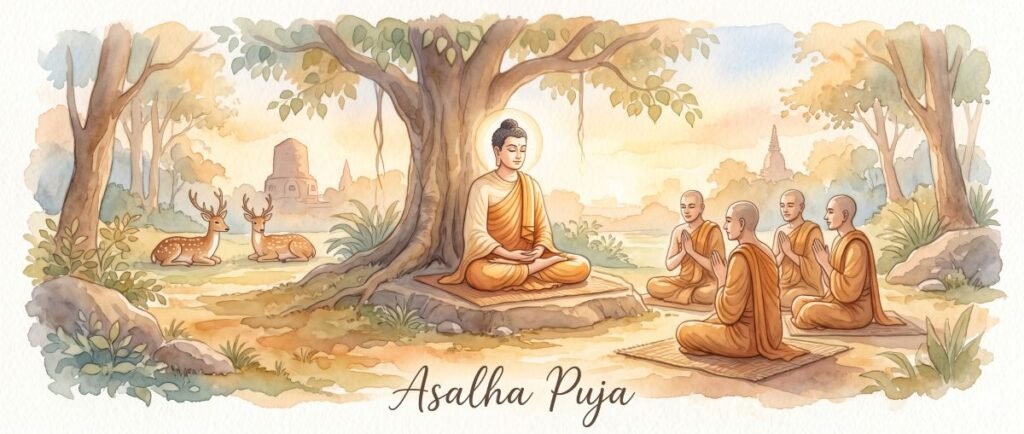
- Asalha Puja honours the day the Buddha delivered his first teaching, “Setting in Motion the Wheel of Dhamma,” in the Deer Park at Sarnath.
- It falls on the full moon of the lunar month of Āsāḷha (usually July), immediately preceding the three‑month rains retreat (Vassa), and is a major observance across all Buddhist traditions, especially in Theravāda countries.
- The sermon introduced the Middle Way, the Four Noble Truths, and the Noble Eightfold Path — the foundation of all Buddhist practice and thought.
- The event also marks the birth of the Sangha, the community of noble disciples, when the ascetic Koṇḍañña became the first stream‑enterer after hearing the discourse.
- Today the day is an opportunity for deepening ethical living, meditation, and wisdom, and for reflecting on how these timeless teachings can relieve suffering in modern life.
1. Introduction
Every year, millions of Buddhists around the world pause to remember a single afternoon in a quiet deer sanctuary over 2,500 years ago. A former prince turned wandering teacher had just walked a long road from the place of his awakening to find his five former companions. He sat down in the shade of a tree, and when he spoke, the words that came to be known as the “Turning of the Wheel of Dhamma” began to reshape human understanding of suffering, freedom, and the possibility of genuine happiness.
Asalha Puja (Pāli: Āsāḷhā Pūjā; sometimes written Asanha Bucha or Asala Poya) is the annual commemoration of that first discourse. The name itself is deceptively simple: Āsāḷha is the lunar month corresponding roughly to June–July, and pūjā means honour, veneration, or offering. But what the day celebrates is anything but ordinary. It honours the moment when the Buddha first made clear exactly what he had discovered under the Bodhi tree and how any human being, through their own effort, could discover it too.
Immediately after Asalha Puja comes the start of Vassa, the three‑month rains retreat, a time when monastics settle in one place, intensify meditation, and the lay community has a special opportunity to support them. In many Western countries, Buddhist centres may observe the occasion on the nearest weekend to allow wider participation. This article explores the origins, scriptural roots, spiritual meaning, regional expressions, and modern relevance of Asalha Puja. No special knowledge is assumed. Every key term is explained as it arises, and the teachings are presented in plain English with a practical eye toward daily life. Whether you are a newcomer to Buddhism or a long‑time practitioner, you will find here a thorough, balanced, and accessible guide to one of the tradition’s most significant days.
2. Origins and Historical Development
2.1 Scriptural Foundations
The story of Asalha Puja rests on a single ancient discourse preserved in the Pāli Canon, the earliest complete surviving collection of the Buddha’s teachings according to Theravāda tradition. That discourse is the Dhammacakkappavattana Sutta — “The Discourse on Setting in Motion the Wheel of Dhamma” — found in the Saṃyutta Nikāya (SN 56.11). It is one of the most studied and recited texts in the Buddhist world.
In a little over a dozen paragraphs, the sutta encapsulates the core of the Buddha’s teaching. It opens with the Buddha addressing the group of five ascetics (Pāli: pañcavaggiya) and telling them that two extremes should be avoided by one who has gone forth into the homeless life: devotion to sensual pleasures, which is low and unworthy, and devotion to self‑mortification, which is painful and unbeneficial. Instead, the Buddha says, he has awakened to a Middle Way that gives rise to vision and knowledge and leads to peace, direct knowledge, enlightenment, and Nibbāna — the extinguishing of the fires of greed, hatred, and delusion.
That Middle Way is precisely the Noble Eightfold Path (ariya aṭṭhaṅgika magga): right view, right intention, right speech, right action, right livelihood, right effort, right mindfulness, and right concentration.
The sutta then unfolds the Four Noble Truths (cattāri ariyasaccāni) — the truth of suffering (dukkha), its origin, its cessation, and the path leading to cessation. What makes the discourse truly historic is the claim that the Buddha not only declared these truths but declared that he had fully understood them in three distinct phases and twelve aspects, and that only when this knowledge and vision was perfectly complete did he know he had attained unexcelled perfect awakening. As the sutta reports, while the teaching was being delivered, the ascetic Koṇḍañña gained the “Dhamma‑eye” — the direct insight that “whatever is subject to arising is all subject to cessation.” At that moment the Sangha, the community of noble disciples, was born.
A second sutta, the Anattalakkhaṇa Sutta (SN 22.59), often linked in memory to this same period, was given five days later and completed the liberation of all five ascetics. But the holiday itself focuses squarely on the first turning.
2.2 The Core Story
To fully appreciate Asalha Puja, it helps to re‑live the human story behind the sutta. After his enlightenment at Bodh Gaya, the Buddha spent several weeks absorbing the implications of his discovery. A famous passage describes his initial hesitation: the truth he had found was deep, subtle, and hard to see, and he doubted whether a world addicted to craving would understand it. According to traditional accounts, the deity Brahmā Sahampati then entreated him to teach for the sake of those with “little dust in their eyes.” Surveying the world with his awakened vision, the Buddha saw beings of different capacities, just as in a pond there are lotuses that grow under water, at water level, and above water. He agreed to teach.
His first thought was to approach his two former meditation teachers, Āḷāra Kālāma and Uddaka Rāmaputta, but they had already died. So he turned his steps toward the five ascetics who had served him during his years of extreme self‑mortification. Their names were Aññā Koṇḍañña, Vappa, Bhaddiya, Mahānāma, and Assaji. They were now staying at the Deer Park in Isipatana, near present‑day Varanasi (formerly Bārāṇasī). When they saw him coming, they initially resolved not to honour him because they believed he had given up the holy life and returned to comfort. But as the Buddha drew closer, his serene radiance was so compelling that they spontaneously prepared a seat and water for his feet. Still, they addressed him by name as “friend,” a sign of lingering scepticism. The Buddha immediately corrected them, telling them that he had become a fully awakened Tathāgata and had found the deathless. He urged them to listen.
What followed, according to the texts, was the Dhammacakkappavattana Sutta. The sutta notes that while the teaching was being explained, “the dust‑free, stainless Dhamma‑eye arose in the Venerable Koṇḍañña,” and the earth‑dwelling deities let out a cry of joy that reverberated upward through the celestial realms until it reached the Brahma world, signalling that a cosmic door had opened. Koṇḍañña asked for ordination, and the Buddha admitted him with the simple words, “Come, bhikkhu, well proclaimed is the Dhamma; live the holy life for the complete ending of suffering.” Thus, on that full‑moon day of Āsāḷha, not only was the Dhamma set rolling, but the Saṅgha — the community of those who have directly touched the truth — came into existence.
Over the following days, the Buddha guided the remaining four ascetics with further instruction until they too opened the Dhamma‑eye. All five later attained full liberation after hearing the Anattalakkhaṇa Sutta, completing the first arahant Sangha.
2.3 Growth into a Calendar Festival
In the earliest days of the monastic order, the full‑moon day of Āsāḷha was not yet a public “holiday” in the modern sense. But it had immense liturgical weight. The Buddha and his monks had already adopted the custom of gathering on full‑moon and new‑moon days to recite the monastic code (pātimokkha) and to teach lay followers. The full moon of Āsāḷha acquired an additional significance because it marked the beginning of the three‑month rains retreat (Vassa), a period when monastics stay in one place, intensify their meditation, and refrain from travel to avoid harming insects and crops.
Over the centuries, as the Buddhist calendar took shape, the commemoration of the first sermon naturally aligned with the full‑moon day that already opened the retreat. The observance grew from a simple monastic ritual into a communal celebration that included lay people in large numbers. Royal patronage in ancient India and Sri Lanka supported the construction of shrines and stūpas at Sarnath, and the day became an occasion for special offerings, public Dhamma talks, and illuminated processions.
By the time Buddhism spread to Southeast Asia, the holiday was firmly established. Today, Asalha Puja is a public holiday in Thailand, a national religious day in Myanmar, and a full‑moon poya observance in Sri Lanka. In each culture it has developed local colours, but the spiritual heart remains the same: remembering the moment the Buddha’s compassion found its first verbal expression and a path out of suffering was clearly mapped for the world.
3. Spiritual Meaning and Central Teachings
3.1 The Main Dhamma Message
The Dhamma message of Asalha Puja can be summed up in three movements that the Buddha wove together in his first sermon: the Middle Way, the Four Noble Truths, and the Noble Eightfold Path. Each of these deserves careful unpacking because they are not merely ancient doctrines; they form a practical toolkit for understanding and transforming the human experience.
The Middle Way (majjhimā paṭipadā)
The Buddha began by rejecting two common human strategies for dealing with the discomfort of existence. One is the relentless chase after pleasant feelings — through food, entertainment, status, and sensory indulgence. The other is the harsh denial of the body and the self through extreme asceticism, which he himself had tried to the point of near‑death without reaching peace. The Middle Way is not a compromise or a bland average; it is a radical reframing that asks us to stop fixating on pleasure and pain and instead attend to the quality of our mind and actions. In daily life, this shows up as mindful consumption, balanced work and rest, and a careful look at whether our habits genuinely lead to long‑term well‑being or only short‑term gratification.
The Four Noble Truths (cattāri ariyasaccāni)
These are often compared to a physician’s diagnosis:
- The truth of suffering (dukkha): birth, ageing, illness, death, union with what is displeasing, separation from what is pleasing, and not getting what one wants are all forms of dukkha. In short, the five aggregates of clinging are dukkha.
- The truth of the origin of suffering (dukkha‑samudaya): it is craving (taṇhā) that leads to renewed existence, accompanied by delight and lust, seeking pleasure now here, now there — craving for sensual pleasure, craving for existence, and craving for non‑existence.
- The truth of the cessation of suffering (dukkha‑nirodha): the remainderless fading and cessation of that very craving, letting go of it, not clinging to it.
- The truth of the path leading to cessation (dukkha‑nirodha‑gāminī paṭipadā): the Noble Eightfold Path.
Importantly, the Buddha did not simply list these four points. He applied a three‑phase, twelve‑aspect analysis. For each truth he acknowledged (1) that the truth exists, (2) that it must be fully understood (or abandoned, or realised, or developed), and (3) that it has been fully understood. This structure shows that the teachings are not meant for intellectual filing but for active, personal investigation. Until you have directly seen the truth of suffering in your own body and mind, understood its cause in your own cravings, glimpsed its cessation, and cultivated the path factors, the process is incomplete.
The Noble Eightfold Path (ariya aṭṭhaṅgika magga)
The path is divided into three trainings:
- Wisdom (paññā): right view (understanding the four truths) and right intention (thoughts of renunciation, goodwill, and harmlessness).
- Ethical conduct (sīla): right speech, right action, and right livelihood.
- Mental discipline (samādhi): right effort, right mindfulness, and right concentration.
Every factor supports the others. For example, without a baseline of ethical behaviour the mind is too agitated to settle into mindful concentration, and without concentration wisdom remains shallow. The path is not a ladder to be climbed once; it is a circle of deepening practice.
The sermon’s climax — the attainment of the Dhamma‑eye by Koṇḍañña — shows that the listener’s direct experience of the teaching is what matters. The holiday thus invites every practitioner not merely to hear or recite the words but to let them become a lens through which daily experience is examined.
3.2 Symbolism and Its Practical Lesson
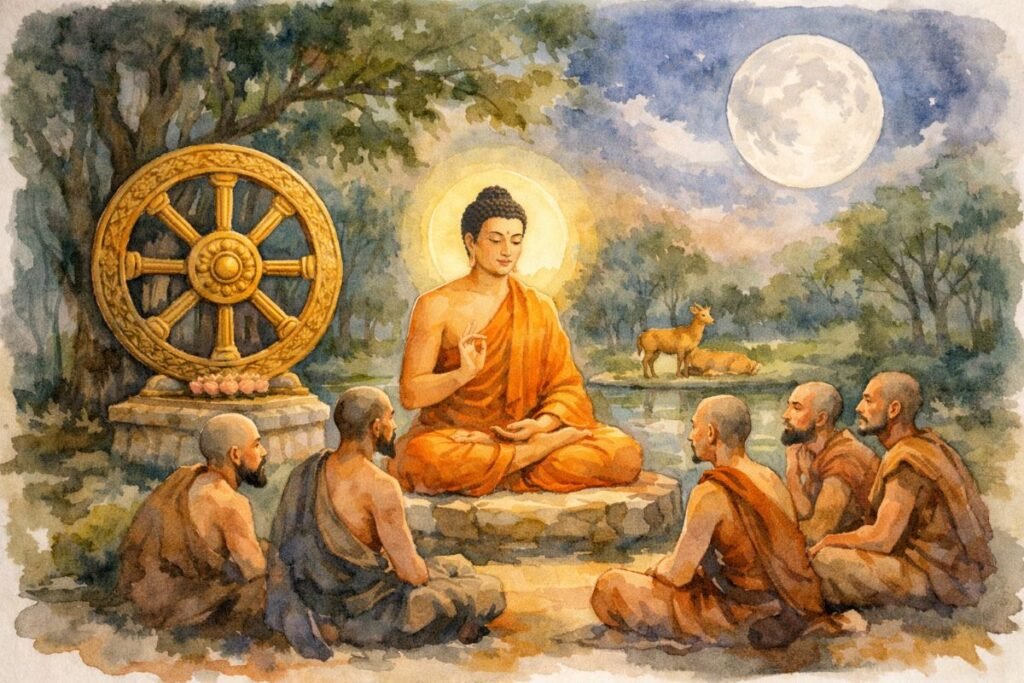
Asalha Puja overflows with symbols that can speak directly to a modern practitioner.
- The Wheel (Dhamma‑cakka): The setting‑in‑motion of the wheel represents a dynamic, living teaching that moves through time and cultures. A wheel needs a central hub (wisdom), strong spokes (the path factors), and a rim (ethical discipline) to keep rolling. When we feel stuck in life, we can ask which part of our inner wheel is wobbly — perhaps our speech is harsh, or our effort is misdirected.
- The Deer Park: The Buddha chose a protected animal sanctuary, a place of safety and natural quiet. It reminds us that the deepest insights often emerge when we step away from the noise of daily demands and create a refuge — whether a physical corner of the home, a daily meditation routine, or a commitment to a calmer state of mind.
- The Full Moon: The full moon illuminates the darkness without discrimination. In many Buddhist cultures the moon symbolises the cool, peaceful nature of a mind that has let go of the heat of defilements. Practically, full‑moon days become natural anchor points for re‑evaluating one’s inner weather, a built‑in monthly check‑in that modern life has largely forgotten.
- The Five Ascetics: Initially sceptical and stubborn, they represent the ordinary mind that resists change even when a solution is standing right in front of it. Their eventual opening shows that with patience and honest listening, even deeply conditioned habits of doubt can soften.
Taken together, these symbols suggest that awakening is possible in ordinary surroundings — a dusty deer park, a rented apartment, a crowded office — when the conditions of listening, reflection, and balanced effort are present.
3.3 Frameworks for Understanding
Scholars and meditation teachers often map the First Sermon onto several overlapping frameworks that can help us organise our practice.
The Threefold Training (tisso sikkhā): Sīla (ethics), samādhi (concentration), and paññā (wisdom) are all present in the Eightfold Path. A simple householder’s practice could allocate attention to each: for example, observing the five precepts (sīla), sitting quietly for ten minutes a day to gather the mind (samādhi), and studying a sutta or reflecting on impermanence (paññā). Asalha Puja is an ideal day to reset all three.
The Gradual Path: The Buddha’s teaching often follows a step‑by‑step talk (ānupubbikathā): giving (dāna), virtue (sīla), the heavens, the danger of sensual pleasures, and the blessing of renunciation, before launching into the Four Noble Truths. This sequence shows that deep insight is supported by a foundation of generosity and moral clarity. On the holiday, many lay people begin the day with almsgiving and taking precepts, which naturally prepares the heart to receive the deeper Dhamma.
Dependent Origination (paṭicca‑samuppāda) in Seed Form: Although the First Sermon does not spell out the twelve‑link chain, the principle is there: suffering has a cause (craving), and when that cause ceases, suffering ceases. The law of conditionality — “when this exists, that comes to be” — is the silent engine behind the Four Truths. In modern life, this framework helps us avoid simplistic, single‑cause blame. If we are habitually irritable, for example, we can trace the chain: irritable feeling (vedanā) arises because of contact with an unpleasant object, which arose because of previous choices, and so on. Unwinding the chain becomes a practical art.
Stream‑Entry (sotāpatti): Koṇḍañña became a sotāpanna, a “stream‑enterer,” one who has entered the current that inevitably leads to full liberation within seven lifetimes at most. Stream‑entry eradicates three fetters: self‑view, doubt about the path, and attachment to rites and rituals. The holiday reminds us that spiritual progress is real, measurable in terms of what one has permanently let go of, and is accessible to lay men and women who practise diligently.
4. How the Holiday Is Observed
4.1 Temple and Monastic Practices
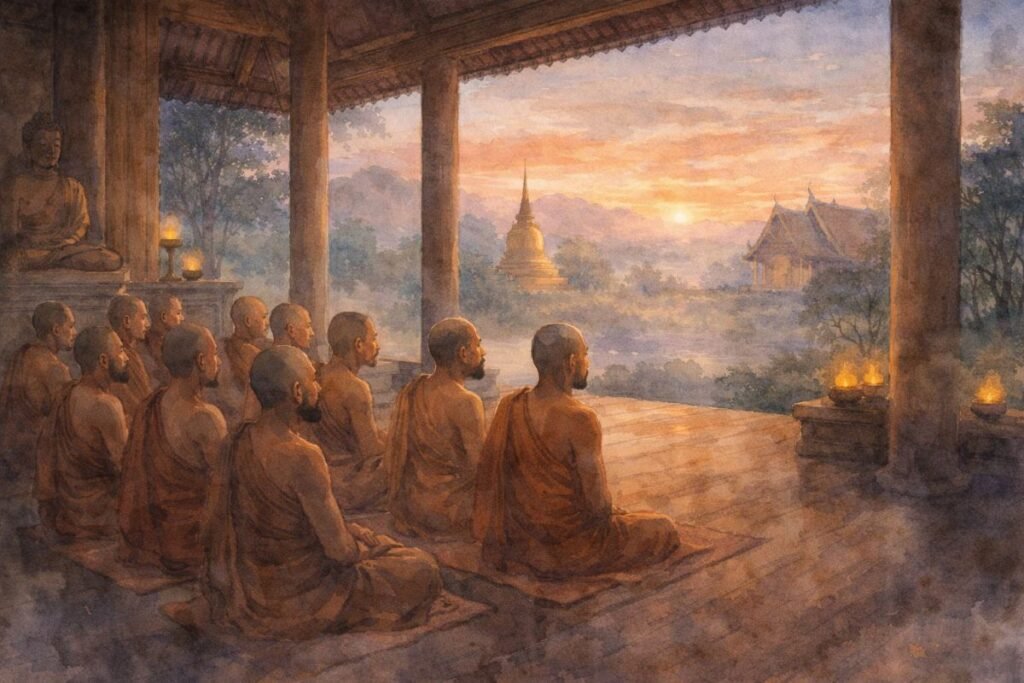
In a traditional Theravāda monastery, Asalha Puja begins before dawn. Monks gather to chant the Dhammacakkappavattana Sutta in Pāli, often in a slow, rhythmic recitation that fills the hall with a sense of gravity and peace. In many temples the entire sutta is recited multiple times, sometimes interspersed with vernacular explanations so that lay attendees can follow the meaning.
A central act is the offering of requisites to the Sangha — robes, alms‑food, medicines, and other allowable items — particularly because the day often coincides with the eve of the three‑month rains retreat. In the Vinaya, the monastic discipline, the Buddha permitted lay supporters to offer “Vassa‑candles” and robes to sustain the monks during the months of seclusion. Many monasteries take this occasion to formally mark the start of the retreat with a ceremony where each monk declares his intention to reside at that monastery for the coming three months.
Throughout the day, senior monks deliver Dhamma talks that unpack the First Sermon, often linking it to a particular contemporary issue such as anxiety, relationship conflict, or environmental distress. It is common to hear a long, unhurried teaching that might span two or three hours, punctuated by periods of silent meditation.
4.2 Lay Observances
For lay followers (upāsakā and upāsikā), Asalha Puja is a day for gathering merit, deepening understanding, and refreshing a commitment to the path. Typical lay activities include:
- Taking the Three Refuges and Precepts: Early in the morning, lay people go to a temple to formally request the refuge formula (Buddha, Dhamma, and Sangha) and to undertake the five training precepts — refraining from killing, stealing, sexual misconduct, false speech, and intoxicants. Some may observe the eight precepts for the day, which adds additional restraints such as abstaining from food after midday and from entertainment, making the day resemble a short‑term monastic retreat.
- Listening to Dhamma Talks: In many temples, benches and mats fill with families who sit for hours under flapping fans, wholly absorbed in the words of a trusted elder monk. The talk is often seen as the heart of the celebration because hearing the true Dhamma with a receptive mind is itself considered a highly meritorious act that can give rise to wholesome insights.
- Circumambulation and Candle Processions: Perhaps the most visually striking practice is the evening candle‑light procession (often called wian tian in Thai). Lay devotees walk clockwise three times around the main temple hall or stūpa, holding lighted candles, incense sticks, and flowers. The three circuits honour the Triple Gem, and the act of walking together symbolises the turning of the Dhamma‑wheel. In the soft darkness, the moving line of flickering flames becomes a tangible metaphor for the light of wisdom dispelling ignorance.
- Meditation and Study: For those inclined, the holiday provides an uninterrupted stretch of time to sit in meditation, often guided by a monk, or to read the Dhammacakkappavattana Sutta slowly with a commentary. In many village temples, lay people camp overnight on the temple grounds and practise until dawn.
4.3 Community and Family Customs
Asalha Puja spills from the temple into the home and street. In Thailand, families rise early to prepare sweet rice, curries, and fruit to present to monks on their alms‑round. Children are taught to bow properly and to pour water as a symbolic sharing of merit with departed relatives. Afterwards, relatives often share a meal together, taking care to speak kindly and avoid arguments, consciously creating an atmosphere of sīla for the day.
In Sri Lanka, Asala Poya frequently becomes the occasion for large‑scale processions. The month of Esala is also historically associated with the famous Esala Perahera in Kandy, which honours the Sacred Tooth Relic and coincides with the same lunar season, blending Buddhist pageantry with national cultural expression. Streets fill with drummers, dancers, and elaborately decorated elephants.
In Myanmar, the full‑moon day of Waso (the Burmese equivalent of Āsāḷha) sees families visiting pagodas to offer robes and provisions to the Sangha for the coming rains. The day is also popular for ordination ceremonies, when young men temporarily enter the monkhood — a practice closely tied to the idea that entering the Sangha even for a short time brings great benefit to oneself and one’s parents.
4.4 Liturgical Timing and the Lunar Calendar
Asalha Puja always falls on the full‑moon day of the eighth lunar month in the traditional Indian Buddhist calendar, known as Āsāḷha. Because the Buddhist lunar year varies against the solar Gregorian calendar, the date shifts between late June and late July. Many diaspora communities consult their home‑country religious calendars or a global Buddhist calendar to determine the precise date.
The use of a lunar calendar connects the holiday to natural cycles. The full moon has long been associated in Buddhism with meditation and heightened clarity, and the entry into the rainy season physically draws the community together. In the modern world, where digital notifications have replaced seasonal rhythms, consciously observing a lunar‑based occasion can restore a sense of connection to nature’s pace.
5. Regional Expressions Across Buddhist Schools
5.1 Theravāda Traditions
Asalha Puja is most elaborately observed in the Theravāda countries of South and Southeast Asia, where it is sometimes regarded as second in importance only to Vesak.
- Thailand (Asanha Bucha, อาสาฬหบูชา): The day is a national holiday. Banks, schools, and government offices close, and alcohol sales are banned by law for 24 hours. In the morning, thousands of monks walk through cities and villages to receive alms. The candle‑light procession in the evening is a universal practice, with iconic venues such as Wat Phra That Doi Suthep in Chiang Mai drawing enormous crowds. Many Thais use the long weekend to visit their home provinces and make merit with family.
- Sri Lanka (Asala Poya): Every full‑moon day is a poya, a day of religious observance, but Asala holds special weight because it commemorates the First Sermon. The month also hosts the grand Esala Perahera in Kandy, a historic festival honouring the Sacred Tooth Relic, adding a vibrant cultural layer. Temples are filled to capacity, and many devotees spend the entire day in meditation, study, and offering dāna.
- Myanmar (Waso Full Moon): In Myanmar the full moon of Waso marks the start of Buddhist Lent (Wa). It is Dhamma Day, when the Buddha preached the First Sermon, but also a day of intense community support for monasteries. Huge groups of donors pool resources to offer robes and provisions. In some villages, people construct temporary pavilions along the road to serve free food and drinks to anyone passing by, a tangible expression of dāna.
- Laos and Cambodia: In Laos (Boun Asahna Boucha) and Cambodia (Bon Asanha Bucha), the pattern is similar — morning alms‑giving, temple chanting, candle processions. In rural areas, the holiday blends with folk traditions of making merit for ancestors and invoking protection for the coming rains.
5.2 Mahāyāna Traditions
In the Mahāyāna traditions of East Asia and Vietnam, the First Sermon is acknowledged, but it is not typically fixed to a single annual festival with the same widespread cultural fanfare seen in Theravāda regions. Instead, the turning of the Dharma wheel is a motif found in art, scripture, and occasional “Dharma Day” or “Sermon Day” observances, often scheduled according to local temple calendars.
In Mahāyāna thought, the Buddha’s teaching career is often described as three turnings of the Dharma wheel, with the Deer Park sermon constituting the first turning. This perspective does not diminish the first sermon but places it within a broader framework that includes later expositions on emptiness and Buddha‑nature. In China and Taiwan, some monasteries might hold a special service on a date near the eighth lunar month, reciting the Sūtra of the Turning of the Dharma Wheel or passages from the Saṃyuktāgama (the Chinese parallel to the Saṃyutta Nikāya). In Vietnamese Buddhism, the day is sometimes called Lễ Phật Đản Sơ (First Sermon Day) and may be marked with community meals and teachings, though it does not enjoy the same public holiday status as in Thailand or Sri Lanka.
Japanese Buddhism developed its own liturgical calendar, where memorial services for the Buddha’s major life events are often spread across different dates. The first discourse is recalled during various seasonal retreats and on the eighth day of the twelfth lunar month in some lineages, but a single nationwide Asalha‑equivalent holiday never took root.
Nevertheless, the content of the First Sermon — the Four Noble Truths and the Eightfold Path — remains absolutely central to all Mahāyāna schools. Bodhisattva practitioners are urged to master these foundational truths before venturing into the deeper expositions of emptiness and Buddha‑nature.
5.3 Vajrayāna Traditions
In the Tibetan Buddhist tradition, the day of the Buddha’s first teaching is observed with great devotion as Chökhor Düchen (chos ’khor dus chen), the “Festival of the Turning of the Wheel of Dharma.” It usually falls on the fourth day of the sixth Tibetan lunar month, which often aligns closely with the Theravāda Asalha date, though it can differ by several weeks.
Chökhor Düchen is traditionally regarded as one of the four major Tibetan Buddhist festivals, along with Losar (New Year), Saga Dawa (Vesak), and Lhabab Düchen (the Buddha’s descent from heaven). Tibetan Buddhists believe that any meritorious action performed on this day is multiplied many times over. Common practices include:
- Going on pilgrimage to holy sites such as Sarnath, Bodh Gaya, or local monasteries.
- Circumambulating stūpas and temples while reciting mantras.
- Making extensive offerings of water bowls, incense, and butter lamps.
- Listening to teachings on the Four Noble Truths from a qualified lama.
- Re‑committing to the bodhisattva vow and to daily meditation practice.
In the Himalayan regions of India, Nepal, and Bhutan, whole communities come together for prayers and festive meals. Monks and nuns dedicate extra sessions to study and debate, often focusing on the Dhammacakkappavattana Sūtra and its commentaries as preserved in the Tibetan Kangyur. The Vajrayāna emphasis on the relationship between teacher and student also means many disciples use Chökhor Düchen to recall their own first encounter with the Dharma and to express gratitude to their teachers.
5.4 The Holiday in Global and Western Contexts
As Buddhism has established roots in Europe, Australia, and the Americas, Asalha Puja has evolved in multicultural and often inter‑sectarian ways. In a typical Western Buddhist centre, the day might be advertised as “Dhamma Day” or “Dharma Day” and observed on a weekend close to the full moon to accommodate work schedules.
The format is often a day‑long retreat that blends elements from different traditions — a Pāli sutta study in the morning, a shared vegetarian meal, a joint session of sitting and walking meditation, and an evening candle‑lit ceremony. Teachers from Theravāda, Mahāyāna, and Vajrayāna backgrounds may each offer a reflection on the First Sermon, highlighting its unifying force.
For immigrant communities, the temple remains the hub of cultural and spiritual continuity. Thai, Sri Lankan, Burmese, Lao, and Cambodian temples in countries such as the United States, Canada, the United Kingdom, and Australia organise full‑scale celebrations that mirror those back home, often raising funds for monastery expansion or charitable projects. These events are a powerful way for second‑generation children to connect with their heritage and for interested non‑Buddhist neighbours to experience the tradition’s hospitality.
Online, many organisations now livestream Dhamma talks and guided meditations for a global audience. In this way, Asalha Puja continues to “turn the wheel” across time zones, making the timeless message accessible to anyone with an internet connection and a sincere heart.
6. Relevance for Modern Life and Daily Application
6.1 Cultivating the Holiday’s Quality at Home
Not everyone lives near a Buddhist temple, and many who do may still wish to deepen the day through personal practice. The spirit of Asalha Puja can be fully honoured inside one’s own home.
- Create a small shrine or focal point: A clean surface with a candle, a flower, and perhaps a printed or digital copy of the Dhammacakkappavattana Sutta turns an ordinary corner into a space of contemplation. The act of setting it up with care is already a training in mindfulness and respect.
- Read and reflect on the sutta slowly: Spend 30 minutes with the actual text. As you read, pause after each truth and ask, “Where do I experience this in my own life today?” Make notes. The goal is not intellectual analysis but honest inner dialogue.
- Undertake the five or eight precepts for the day: Even if you have never taken precepts formally, you can simply resolve at dawn, “Today I will not kill any living being, I will not take what is not given, I will speak truthfully and kindly, I will avoid sexual harm, and I will keep my mind clear by avoiding intoxicants.” The effort to uphold these resolutions for a single day can reveal how much of our ordinary distress comes from small, habitual transgressions.
- Practice generosity (dāna) intentionally: Make a donation to a charitable cause, offer a meal to a neighbour, or give your full, undivided attention to a family member who needs to talk. Generosity counteracts the tightening of selfish craving that the Buddha identified as the root of suffering.
- Meditate on the Four Noble Truths: Try a simple meditation: sit quietly and scan your body and mind for any present sense of unsatisfactoriness — a physical ache, a restless thought, a background mood of anxiety. Name it silently: “This is dukkha.” Then notice if there is a subtle urge to push it away or to reach for something more pleasant. That is taṇhā, craving. For a few moments simply allow the craving to be there without acting on it. Notice what it feels like when the pressure of that craving relaxes even a little. That is a taste of cessation. Set the intention to continue practising the Eightfold Path, one factor at a time, in the hours ahead.
6.2 Navigating Challenges with the Holiday’s Wisdom
The First Sermon is not a museum piece; it is a diagnostic tool that can be applied directly to contemporary struggles.
- When stress feels overwhelming: The First Noble Truth helps us understand stress as one expression of dukkha rather than an isolated personal failure. It says that pain and unsatisfactoriness are part of the human condition. The Second Noble Truth then asks, “What am I clinging to right now? Am I craving a different outcome, or a version of myself that never makes mistakes?” Identifying the specific craving strips it of its diffuse power. The path factors — right view, right intention, right effort — then become concrete steps: reframe the situation with realistic expectations, let go of the mental story, and channel effort into something wholesome rather than spinning in worry.
- In conflict with others: Right speech, right action, and right intention provide an immediate checklist. Before speaking, ask: Is it true? Is it kind? Is it necessary? Is it the right time? When the mind is caught in anger, the Middle Way suggests neither lashing out nor suppressing, but mindfully observing the anger without feeding it. The Buddha’s serene confrontation with the sceptical ascetics models how to meet resistance with gentle, unshakeable presence.
- Facing major life decisions: The principle of conditionality reminds us that every action has consequences, and that wholesome actions tend to produce wholesome results. When choosing between paths, we can use the Eightfold Path factors as filters. Does this option align with right livelihood (no harm to others)? With right effort (will it drain or nourish my long‑term well‑being)? The Middle Way also cautions against extremes — a career change, for example, does not require either reckless jumping or paralysed over‑analysis; gradual, informed steps honour the balance.
- Dealing with addiction or harmful habits: Craving (taṇhā) is the engine of addiction. The Four Noble Truths frame recovery beautifully: acknowledge the suffering the habit causes (truth of dukkha), understand that the root is not the substance or behaviour itself but the underlying craving and the pleasant feeling it temporarily provides (truth of origin), recognise that cessation is possible — many have recovered (truth of cessation), and follow a structured path of treatment, mutual support, mindfulness, and ethical living (truth of the path). The Eightfold Path, in fact, aligns closely with evidence‑based recovery programmes that emphasise honesty, community, self‑awareness, and purposeful living.
6.3 Social and Environmental Dimensions
The Buddha’s teaching does not stop at the tip of one’s nose. The path factors of right action and right livelihood naturally extend into social and ecological ethics.
- Right consumption: The truth of suffering can be applied to our consumption patterns. The craving for ever‑cheaper goods drives industries that exploit workers and strip ecosystems. A practitioner might observe Asalha Puja by reviewing their household’s consumption and making one concrete change: buying fair‑trade products, reducing single‑use plastics, or supporting a local farm. Such actions externalise the letting‑go of craving in a tangible way.
- Compassionate service: The holiday’s emphasis on dāna inspires community service. In several Western cities, Buddhist groups organise “Dhamma Day” park clean‑ups, food‑bank volunteering, or clothing drives. Such acts express the truth that the path is not only about quieting one’s own mind but about reducing suffering wherever it is encountered.
- Structural application of the Four Truths: Social workers, psychologists, and activists have begun to use the Four Noble Truths as a framework for understanding systemic suffering. In a community health context, for instance, dukkha might be the high rates of chronic disease; the origin might be the craving for profit that leads to fast‑food advertising and food deserts; cessation could be the vision of a healthy, well‑nourished neighbourhood; and the path could involve education, policy change, and community gardening. While such applications are secular, they draw directly on the diagnostic logic first articulated at the Deer Park.
- The Rains Retreat as ecological metaphor: Vassa, which begins the day after Asalha Puja, originally aimed to protect tiny creatures and growing crops. Today, it can serve as a reminder that spiritual development and ecological awareness are not separate. Deliberately slowing down, staying put, and living simply for a season cuts carbon footprints and cultivates a sense of enoughness. An urban practitioner might designate a “mini‑Vassa” of a week or a month to consume less, travel less, and observe the mind’s reaction to reduced stimulation.
7. Common Misunderstandings and Clarifications
Even with its deep roots, Asalha Puja is sometimes misunderstood, both by outsiders and by Buddhists themselves. The following clarifications aim to prevent the holiday from being reduced to mere ritual or dismissed as irrelevant.
- “It’s only a Theravāda thing.” Although Theravāda cultures give it the most public prominence, the event it celebrates — the first turning of the Dharma wheel — is foundational to every Buddhist school. Tibetan, Chinese, and Western Buddhists also honour the First Sermon, even if the date and name differ. The day belongs to the whole Buddhist family.
- “The First Sermon was just a lecture.” In the popular imagination, a sermon is a one‑way speech. But the Dhammacakkappavattana Sutta describes a dynamic, living exchange that produced a direct spiritual awakening in at least one listener. The holiday encourages us to approach the Dhamma not as a body of information to be consumed, but as a catalyst for inner transformation.
- “Only monks can really practise it.” Koṇḍañña was an ascetic, but he was not yet a bhikkhu when the Dhamma‑eye arose; he became one moments later. Throughout the suttas, lay men and women also attain stream‑entry. The Eightfold Path is not graded by robes; it is graded by sincerity and effort. Asalha Puja reminds us that the Dhamma is for everyone.
- “The Middle Way means moderation in everything.” The Middle Way is specifically a path between sensual indulgence and self‑mortification, and it leads to a very specific destination: the cessation of suffering. It is not a lazy endorsement of “everything in moderation.” Some things — harm, cruelty, dishonesty — are to be abandoned entirely, not moderated.
- “Merit‑making alone is enough.” Many traditional observances involve giving dāna and performing rituals to accumulate merit. These are wholesome, but the Buddha consistently taught that the highest form of merit comes from practising in accordance with the Dhamma, even for a moment. The holiday is an invitation to go beyond surface‑level religious observance and to directly investigate the four truths within one’s own experience.
- “It’s irrelevant to modern life.” The holiday’s core teachings address suffering and its end — a project that is hardly outdated. The frameworks of craving, ethical conduct, mindfulness, and wisdom are, if anything, more urgently needed in an age of digital distraction, ecological strain, and mental health crises. When understood deeply, Asalha Puja is profoundly practical.
8. Conclusion
Asalha Puja takes us back to a single afternoon when a teacher and five students sat together under the trees and opened a door that can never be shut. The wheel that began to turn that day has rolled through centuries, cultures, and languages, and it continues to move wherever a human being honestly asks, “Why is there suffering, and can it end?”
The day is not a memorial for a distant historical figure but an active, living event. Every recitation of the Dhammacakkappavattana Sutta, every candle flame lifted in the dark, every moment of bare attention to an aching heart repeats the ancient pattern: suffering is recognised, its root is seen, release is glimpsed, and a path is walked.
For the modern practitioner, the holiday offers a template for a sane and compassionate life. The Middle Way counsels balance and mindful investigation. The Four Noble Truths provide a clear, non‑judgemental framework for working with whatever difficulty arises. The Eightfold Path lays out a complete training that does not require retreating from the world but asks us to engage with it more wisely.
As the full moon of Āsāḷha approaches, consider what it would mean to set aside even a few hours to re‑read the First Sermon, to sit in silence, to give without expecting return, and to reflect on the causes of suffering and freedom in your own life. In doing so, you become part of the turning — not as a passive observer but as a living point on the great wheel of Dhamma, lighting the way forward.
Glossary
Āsāḷha (Asalha)
The eighth lunar month of the traditional Indian Buddhist calendar, roughly coinciding with June–July. The full moon of this month marks Asalha Puja.
Aññā Koṇḍañña
The first disciple to attain stream‑entry after hearing the Buddha’s first sermon. He later became an arahant.
Dāna
Generosity or giving, the first of the bases of meritorious action. It includes material offerings and the giving of time, attention, and care.
Dhamma (Sanskrit: Dharma)
The Buddha’s teachings; the truth about the nature of reality; the law of conditionality; the path to liberation.
Dhamma‑cakka (Dharmacakra)
The “Wheel of Dhamma,” a symbol of the Buddha’s teaching, especially its first proclamation.
Dhamma‑eye (Dhammacakkhu)
The direct insight that “whatever is subject to arising is all subject to cessation,” synonymous with stream‑entry.
Dukkha
Suffering, unsatisfactoriness, stress. The first of the Four Noble Truths, covering everything from gross pain to subtle existential disquiet.
Eightfold Path (ariya aṭṭhaṅgika magga)
The path of practice leading to the cessation of suffering: right view, right intention, right speech, right action, right livelihood, right effort, right mindfulness, and right concentration.
Four Noble Truths (cattāri ariyasaccāni)
The core framework of the Buddha’s teaching: the truth of suffering, its origin (craving), its cessation, and the path leading to its cessation.
Middle Way (majjhimā paṭipadā)
The path between indulgence in sensual pleasures and self‑mortification, exemplified by the Noble Eightfold Path.
Nibbāna (Sanskrit: Nirvāṇa)
The extinguishing of greed, hatred, and delusion; the ultimate goal of Buddhist practice.
Pūjā
Honour, veneration, or devotional offering. The word for a religious ceremony or festival.
Sangha (Saṅgha)
The community of the Buddha’s disciples. In its highest sense, the noble Sangha of those who have attained direct insight; conventionally, the monastic order.
Sotāpanna (Stream‑enterer)
One who has entered the stream to Nibbāna, having abandoned self‑view, doubt, and attachment to rites and rituals.
Taṇhā
Craving or thirst, the root cause of suffering described in the Second Noble Truth.
Vassa
The three‑month rains retreat observed by monastics, beginning the day after Asalha Puja.
Further Resources
- What the Buddha Taught by Walpola Rahula – A clear, concise, and widely recommended introduction to the Four Noble Truths and Eightfold Path.
- In the Buddha’s Words by Bhikkhu Bodhi – An anthology of suttas from the Pāli Canon with helpful introductions and notes.
- The Life of the Buddha by Bhikkhu Ñāṇamoli – A narrative biography drawn directly from the Pāli texts.
- The Middle Length Discourses of the Buddha (Majjhima Nikāya), translated by Bhikkhu Ñāṇamoli and Bhikkhu Bodhi – Contains several suttas that expand on the First Sermon.
- Online: SuttaCentral offers free, searchable translations of the Dhammacakkappavattana Sutta in multiple languages.
- Podcasts: Dhamma Talks from the Thai Forest Tradition (various teachers) and The Insight Hour with Joseph Goldstein frequently explore the Four Noble Truths and Eightfold Path in depth.