
Key Takeaways
- Distraction is not simply a modern problem caused by technology, it is rooted in a deep human tendency to move away from discomfort
- Buddhist teachings describe the mind as naturally restless, and this restlessness is one of several patterns that pull attention away from the present
- Understanding the Buddhist analysis of dissatisfaction [dukkha] helps explain why the mind so readily reaches for something else
- The practice of mindfulness [sati] offers a way to observe distraction without being carried away by it
- Different Buddhist traditions approach distraction in different ways, though many share an emphasis on training attention
- Practical techniques from Buddhist practice can help modern people work with distraction in daily life
- Working with distraction is not about eliminating it, it is about changing our relationship to it
1. Introduction
Distraction has become a defining feature of modern life. Many people find themselves reaching for their phones dozens of times each day, losing hours to scrolling through social media, or struggling to complete simple tasks without their attention wandering elsewhere. While technology has certainly made distraction more accessible, the underlying tendency to move away from the present moment is far older than any smartphone or social media platform.
Buddhist teachings have addressed this human tendency for over two thousand years. Long before the invention of notifications and endless news feeds, Buddhist practitioners recognized that the mind has a natural inclination to wander, to seek stimulation, and to move away from uncomfortable experiences. This tendency was understood not as a personal failing but as a fundamental characteristic of how the untrained mind operates.
Understanding the Buddhist perspective on distraction offers more than historical curiosity. It provides a framework for understanding why we become distracted and what we can do about it. Rather than simply trying to force ourselves to concentrate through willpower alone, Buddhist teachings suggest that lasting change comes from understanding the deeper patterns that drive our attention away from the present moment.
This article explores the Buddhist roots of distraction, examining how teachings on the nature of mind, dissatisfaction/suffering, and mindfulness apply to the challenges of modern life. Whether you are new to Buddhism or have been practicing for years, understanding these principles can change your relationship with distraction and help you develop a more focused, steady approach to daily living.
2. Understanding the Nature of Distraction
What Is Distraction?
Distraction can be understood simply as the movement of attention away from what we intend to focus on toward something else. This movement can happen in obvious ways, such as when we pick up our phone while working on an important project, or in subtle ways, such as when our minds drift into daydreaming during a conversation.
From a Buddhist perspective, distraction is not merely a problem of attention. It is connected to deeper patterns of restlessness, craving, and avoidance that shape how the mind relates to experience. Not every moment of wandering attention is driven by these forces, and it would be a mistake to treat all distraction as a symptom of craving. Sometimes attention simply moves because the mind is tired, because a noise draws it, or because the task at hand genuinely does not require steady focus. Still, when distraction becomes compulsive and hard to redirect, it is often entangled with the deeper patterns that Buddhist teachings describe.
The experience of distraction is universal. Every person who has tried to meditate has experienced the mind wandering away from the breath or the object of focus. Every student who has tried to study has felt the pull of more interesting activities. Every worker who has tried to complete a task has felt the urge to check email or social media or to engage in a different activity. These experiences point to something fundamental about how the human mind operates.
The Wandering Mind

Buddhist literature and teaching traditions have used images such as a wild elephant or a monkey swinging through trees to describe the untrained mind, constantly moving from one branch to another without rest. These images capture the restless quality of attention that most people experience. The mind moves from thought to thought, from sensation to sensation, rarely resting in one place for long. Understanding Buddhist psychology means studying how these mental habits form, how they reinforce themselves, and how they can gradually be reshaped.
This wandering quality is not inherently problematic. The mind’s ability to shift attention allows us to respond to changing circumstances, to notice important details, and to adapt to new situations. The problem arises when this movement becomes compulsive, when we lose the ability to choose where our attention goes and find ourselves pulled away from what matters most.
The Buddhist understanding of the mind emphasizes that this wandering tendency is not random. It follows patterns that can be observed and understood. When we pay attention to when and why our minds wander, we begin to see that distraction often serves a purpose, even if that purpose is not always helpful. We might distract ourselves to avoid uncomfortable feelings, to escape from boredom, or to seek stimulation when we feel understimulated. Recognizing these patterns is the beginning of working with them.
Distraction as Avoidance
One insight from Buddhist psychology is that distraction often functions as a form of avoidance. When we encounter something unpleasant, whether an external situation or an internal experience, the mind naturally seeks to move away from it. This movement away can take many forms, including physical action, mental activity, or emotional numbing.
Consider a common example. A person sits down to work on a challenging task. As soon as the difficulty becomes apparent, they feel a sense of discomfort, perhaps anxiety about failing or frustration at the complexity. Without conscious awareness, they reach for their phone, open a new browser tab, or begin thinking about something else entirely. The distraction provides temporary relief from the discomfort, but it also prevents them from working through the challenge and completing the task.
This pattern repeats throughout daily life. We distract ourselves from boredom, from sadness, from anger, from fear, and from almost any experience that feels unpleasant. The distraction provides short-term relief, but it also reinforces the habit of avoidance. Over time, we may become less able to tolerate discomfort and more dependent on distraction to manage our emotional states. Noticing this pattern without harsh self-judgment is itself a form of practice.
3. The Buddhist Concept of Dissatisfaction
Defining Dissatisfaction
The Buddhist term for dissatisfaction points to a broader analysis than a passing mood of discontent. It covers the suffering and unsatisfactoriness bound up with conditioned existence and with clinging, including the way even pleasant experiences cannot be held. It is often translated as suffering, unsatisfactoriness, or stress, but none of these words captures it fully. The concept is wider than a feeling. It describes a structural feature of experience, the way things arise, change, and pass, and the way the mind’s grasping after them produces unease.
This is where the Four Noble Truths begin, not with a denial of unease but with an honest look at it. The first truth is not a statement about the world being bad. It is a statement about the pervasiveness of unsatisfactoriness in conditioned experience, and the way that clinging to what changes produces suffering.
Dissatisfaction applies to positive experiences as well as negative ones because they cannot last. The pleasure of eating a delicious meal ends when the meal is finished. The joy of a happy relationship is mixed with the fear of losing it. The satisfaction of achieving a goal is soon replaced by the need to achieve something else. This impermanent quality of all experience creates a subtle but persistent sense of unease that the mind often tries to outrun.
From a Buddhist perspective, this dissatisfaction is not a flaw in the world or a punishment for wrongdoing. It is a characteristic of conditioned existence, of things that arise and pass away. Understanding this helps explain why people so often seek distraction. If experiences cannot fully satisfy, then perhaps the next experience will. This hope drives the endless search for stimulation, achievement, and pleasure that characterizes so much of human activity.
The Gap Between Experience and Expectation
Buddhist teachings often describe dissatisfaction as arising from the gap between what we want and what we have, or between how things are and how we think they should be. The mind creates expectations, desires, and preferences, and then measures actual experience against these mental constructions. When reality does not match our expectations, unease arises.
This dynamic is clearly visible in the experience of distraction. When we sit down to work, we might expect the task to be engaging, rewarding, or at least not unpleasant. When we encounter difficulty or boredom instead, discomfort arises. The mind then seeks to close the gap by finding something more pleasant, which is where distraction comes in.
The problem is that distracting ourselves from dissatisfaction does not actually resolve it. It simply temporarily obscures the underlying experience. The dissatisfaction remains, waiting to resurface when the distraction ends. This is why people can spend hours scrolling through social media and still feel unsatisfied, restless, and vaguely uncomfortable when they finally put the phone down.
Craving and Its Role in Distraction

The Buddhist concept of craving [taṇhā] refers to a thirst or compulsive wanting that keeps the mind reaching for more. It is a form of desire that cannot be fully quenched by the object it seeks, because the seeking itself tends to renew. Craving is closely related to aversion, the pushing away of what is unwanted, though the two are not identical. Craving pulls toward, aversion pushes away, and together they keep the mind in constant motion. The line between ordinary ambition and compulsive craving is thinner than most people assume, and noticing when healthy aspiration becomes craving is often the first honest step in understanding what is actually driving our behaviour.
Craving fuels distraction in a direct way. When we crave pleasant experiences, we are easily pulled away from tasks that do not provide immediate gratification. When we are averse to unpleasant experiences, we quickly turn away from challenges, discomfort, and difficulty. The stronger the craving and the aversion, the more powerful the pull of distraction.
Buddhist teachings describe several broad categories of craving. There is craving connected to sensory pleasures, such as the desire for delicious food, beautiful sights, or pleasant sounds. There is craving connected to existence, the desire to be something or someone, which manifests as ambition and the pursuit of identity. There is craving connected to non-existence, a longing tied to the wish for annihilation or for the ending of experience, which at its subtlest is a wish to be free of what is difficult to bear. These categories overlap and are not meant as a tidy psychological checklist. They are ways of describing the different directions in which desire moves.
All of these forms of craving contribute to distraction in different ways. Craving for sensory pleasure pulls us toward entertaining content and away from boring tasks. Craving for existence drives us to seek validation and achievement, which can draw us away from present-moment awareness. Aversion and the wish to escape difficulty lead us to retreat into fantasy, entertainment, or other forms of numbing.
4. The Restless Mind
Mental Agitation
Buddhist psychology identifies restlessness as one of the five hindrances [nīvaraṇāni] that obstruct clear awareness and mental stability. Restlessness is the tendency of the mind to be agitated, unsettled, and unable to remain still. It is closely related to distraction and is often experienced as a feeling of inner turbulence or the inability to relax. Knowing how to recognise and work with these obstacles is a core skill, and the five hindrances are usually where that skill begins to develop.
Restlessness can manifest physically as fidgeting, pacing, or an inability to sit still. It can manifest mentally as racing thoughts, jumping from one topic to another, or the constant urge to be doing something. It can manifest emotionally as anxiety, worry, or a general sense of unease.
From a Buddhist perspective, restlessness is not simply a personality trait or a symptom of modern life. It is a pattern of the untrained mind, a habit of agitation that has been reinforced over many repetitions. Understanding restlessness as a hindrance, as something that obstructs clarity and peace, helps us appreciate why addressing it matters for spiritual practice and for daily well-being.
The Five Hindrances
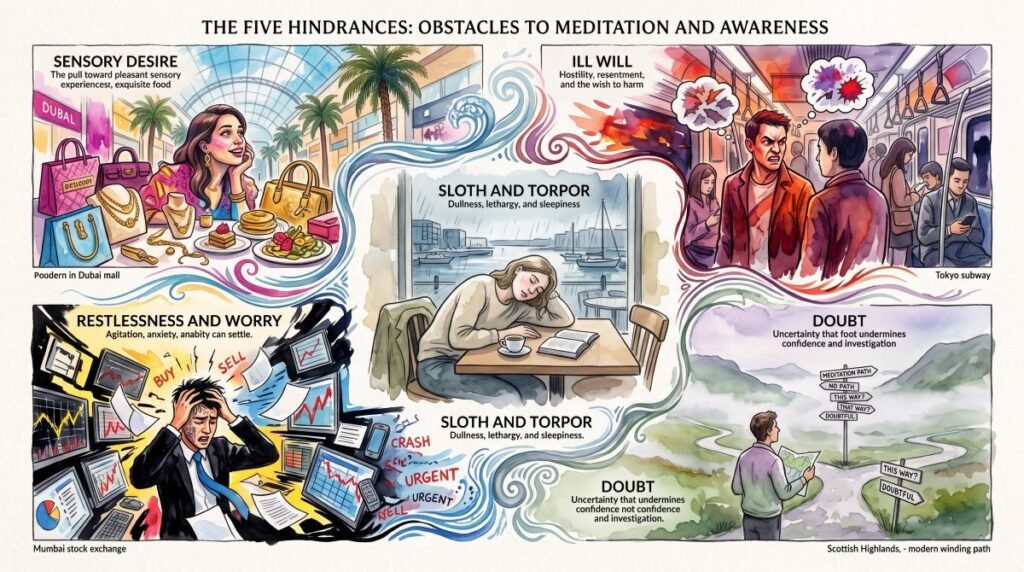
The five hindrances are mental states that obstruct meditation and clear awareness. They include:
- Sensory desire, the pull toward pleasant sensory experiences
- Ill will, hostility or resentment, the wish to harm or see another suffer
- Sloth and torpor, the tendency toward dullness, lethargy, and sleepiness
- Restlessness and worry, the tendency toward agitation, anxiety, and inability to settle
- Doubt, uncertainty that undermines confidence and investigation in the practice
Distraction is related to several of these hindrances. Sensory desire pulls the mind toward pleasurable distractions. Ill will pushes the mind away from unpleasant experiences. Restlessness makes it difficult for the mind to remain focused on anything for long. Understanding these patterns helps us see that distraction is not always a single problem but often a symptom of multiple underlying tendencies.
The hindrances are not considered permanent faults or character flaws. They are described as temporary visitors that arise and pass away. With practice and understanding, their power to disrupt attention and clarity diminishes. The goal is not to eliminate them through force but to recognize them clearly, understand their causes, and learn to let them go.
The Role of Boredom

Boredom is a common trigger for distraction. When we find ourselves in situations that lack stimulation, the mind begins to seek something more interesting. This seeking can be so automatic that we are barely aware of it. We might find ourselves reaching for our phone, starting a conversation, or drifting into daydreaming without any conscious decision to do so.
Buddhist teachings offer a different perspective on boredom. Rather than seeing it as a problem to be solved through stimulation, they suggest that boredom can be an opportunity for practice. When we are bored, we have a chance to observe the mind’s reaction without immediately acting on it. We can notice the discomfort, the urge to seek stimulation, and the stories the mind tells about how unbearable the situation is.
This practice of observing boredom without acting on it can be challenging. The mind will protest, insisting that something must be done to alleviate the discomfort. But if we can sit with boredom, if we can allow it to be present without trying to fix it, we may discover that it is not as unbearable as it seemed. We may find that beneath the boredom is a quality of stillness that was there all along, obscured by the mind’s restless activity.
5. Mindfulness and the Present Moment

Understanding Mindfulness
Mindfulness is the quality of remembering to keep a chosen object or experience in mind, together with a clear awareness of what is actually happening. It involves paying attention to what is present now, whether that is a physical sensation, an emotion, a thought, or an external event. Contemporary descriptions often add that this awareness is non-judgmental, and while that captures something useful about the attitude, the classical emphasis falls on remembering and clear knowing rather than on the absence of judgement as such. Traditionally this attention is mapped across the body, feelings, mind states, and the patterns of experience themselves, a structure known as the Four Foundations of Mindfulness.
The word mindfulness is often translated as awareness or remembering. This second translation points to an important aspect of the practice: the quality of remembering to be present. In the midst of distraction, mindfulness is what brings us back. It is the capacity to notice that the mind has wandered and to gently return attention to what is happening now.
Mindfulness is not a technique that can be mastered once and then forgotten. It is a capacity that must be cultivated continuously. Every time we notice that the mind has wandered and bring it back, we strengthen the quality of mindfulness. Every time we choose to be present rather than moving away into distraction, we reinforce the habit of awareness.
The Practice of Returning
The practice of mindfulness is often described as the practice of returning. The mind wanders, and we return it to the present moment. This wandering and returning is not a failure. It is the practice itself. Each return is an opportunity to strengthen awareness and weaken the habit of distraction.
When we first begin practicing mindfulness, the mind may wander frequently. We may find ourselves lost in thought, caught up in stories, or distracted by external events. The instruction is not to prevent this wandering but to notice it and return. Over time, with patience and persistence, the wandering may become less frequent and the periods of presence may become longer.
This practice can be applied to any activity. When eating, we can return attention to the taste, texture, and sensation of the food. When walking, we can return attention to the feeling of the feet on the ground. When listening to another person, we can return attention to their words and their presence. In every moment, there is an opportunity to practice returning. Washing dishes, folding laundry, or waiting in line all become training grounds when mindfulness in ordinary activities is taken seriously.
Mindfulness in Daily Life
While formal meditation practice is important, mindfulness can also be developed and observed in daily life. Can we remain present while working, while driving, while interacting with others? Can we notice the urge to be distracted and choose not to act on it? Can we bring awareness to mundane activities that we usually do on autopilot?
Integrating mindfulness into daily life does not require special conditions or extra time. It requires only the intention to be present and the willingness to return attention again and again. Simple activities like washing dishes, brushing teeth, or waiting in line become opportunities for practice.
The benefits of this practice extend beyond meditation. People who cultivate mindfulness often report improved concentration, greater emotional balance, and a deeper sense of steadiness. They describe themselves as less reactive and more able to appreciate the simple pleasures of daily life. These reported benefits arise not from escaping distraction but from learning to work with it skillfully. The overlap between contemplative practice and psychological well-being is now widely explored, and the ways Buddhism supports mental health are worth understanding in their own right.
6. The Role of Concentration

Developing Focus
Concentration [samādhi] is the ability to keep attention steady on a single object or experience. It is the opposite of distraction, the capacity to remain focused without being pulled away. Like mindfulness, concentration can be cultivated through practice. Within the wider path it is treated as one of the central factors of training, and Right Concentration is often described as the gathering of the mind that makes insight possible.
Buddhist teachings often describe concentration as a foundation for deeper understanding. When the mind is scattered and distracted, it is difficult to see clearly. When the mind is concentrated and still, insight becomes possible. This is why so much emphasis is placed on developing concentration in Buddhist practice.
Concentration is not achieved through force or willpower alone. While effort is necessary, the development of concentration is more like training a muscle than forcing a result. With consistent practice, the mind gradually becomes more stable and focused. The habit of distraction weakens, and the ability to remain present strengthens.
Meditation as Training
Meditation is the primary training ground for concentration and mindfulness. In meditation, we set aside time to practice being present with a chosen object. This object might be the breath, a sound, a visual image, or a feeling of loving-kindness [mettā]. The specific object matters less than the practice of returning to it again and again. Anyone unsure where to begin can start simply with a Buddhist meditation techique, returning to the breath until the basic rhythm becomes familiar.
When we sit down to meditate, we quickly discover how distracted the mind is. Thoughts arise, emotions surface, and external sounds draw our attention. The practice is not to stop these distractions but to notice them without getting caught up in them. We acknowledge what is happening and gently return to the object of focus.
Over time, this practice changes our relationship with distraction. We begin to see thoughts as just thoughts, not as commands that must be obeyed. We begin to see the urge to check our phone as just an urge, not as something that must be acted upon. This ability to observe without immediately reacting is an important aspect of meditation practice.
The Balance of Effort and Relaxation
Developing concentration requires a balance between effort and relaxation. Too much effort leads to tension, strain, and frustration. Too little effort leads to sleepiness, dullness, and wandering. The skillful practitioner learns to find the middle way, applying just enough effort to stay present while remaining relaxed and at ease. Many of the difficulties that arise in practice come from tipping too far in one direction, which is why it helps to recognise common meditation mistakes early rather than struggling through them alone.
This balance is not achieved once and then maintained automatically. It requires ongoing attention and adjustment. On some days, the mind may be agitated and need more relaxation. On other days, the mind may be dull and need more energy. Learning to read the mind’s condition and respond appropriately is part of the art of meditation.
This principle applies beyond formal meditation. In daily life, we can bring the same balance of effort and relaxation to our activities. When working on a task, we can notice when we are straining and relax. When feeling sluggish, we can notice and apply more energy. This kind of adjustment can help maintain focus without becoming tense or exhausted. Patience matters here, because the rewards of practice tend to arrive slowly, and staying with meditation long enough for change to take root is itself part of the training.
7. Distraction and the Major Buddhist Schools
Theravada Perspectives
The Theravada tradition, which draws from the earliest Buddhist teachings, emphasizes the importance of mindfulness and concentration as factors of awakening. Distraction is understood as a hindrance that obstructs the path to liberation. The practice of insight meditation [vipassanā] involves observing the arising and passing of experiences, including the experience of distraction, without attachment or aversion. This emphasis on direct observation and gradual training has shaped Theravada Buddhism from its earliest days.
Theravada teachings often use the image of a gatekeeper to describe mindfulness. Just as a gatekeeper watches who enters and leaves a city, mindfulness watches what arises in the mind. When distraction approaches, mindfulness notices it. When distraction passes, mindfulness notices that too. Through this practice, the meditator develops equanimity, the ability to remain balanced and peaceful regardless of what arises.
The Theravada approach to distraction emphasizes understanding its impermanent nature. Distraction is not a permanent state but a temporary event that arises and passes away. By observing distraction without getting caught up in it, the meditator gradually weakens its power. What once seemed like a solid, overwhelming force is seen as a passing cloud, empty of any lasting substance.
Mahayana Perspectives
The Mahayana tradition, which developed over several centuries and spread throughout East Asia and Tibet, offers additional perspectives on distraction. Mahayana teachings emphasize the emptiness [śūnyatā] of all phenomena, the absence of any inherent, independent existence in things and in mental events, distraction included. This does not mean distraction is unreal or that it should be welcomed. It means distraction lacks the fixed, solid nature it appears to have, and so it can be met with less clinging and less resistance.
In some approaches within Mahayana, particularly those associated with Zen, practitioners are encouraged to let thoughts and sensations arise and pass without clinging to them or suppressing them. This is not the same as welcoming distraction. The instruction is to stop adding to experience, not to cultivate it. The practitioner, in some approaches, allows the mind’s activity to settle on its own rather than fighting it or feeding it. This attitude is closely tied to the way Zen practice treats sitting, working, and everyday activity as inseparable.
Within some Pure Land traditions, devotional focus on a Buddha or a recited phrase serves as one method among several for steadying the mind, and practitioners in those traditions describe it as a support against scattered attention. This is one approach among many in Mahayana, not a general summary of Mahayana practice as a whole.
Shared Themes
Despite differences in emphasis and method, many Buddhist traditions share an emphasis on training attention and on loosening the grip of distracting mental states, even where the terminology, methods, and stated goals differ. The precise role of mindfulness and concentration varies across traditions, and their relationship to awakening is described in different ways. It would be inaccurate to claim complete doctrinal uniformity.
What can be said is that a great many Buddhist teachings treat the untrained mind as prone to scattering, and treat the cultivation of steady attention as valuable. They also share the view that the goal is not simply to eliminate distraction but to develop a wiser relationship with it. Distraction will arise. Thoughts will come and go. The question is not whether we can stop this from happening but whether we can relate to it with awareness, equanimity, and compassion. The wider aim is liberation from suffering and the awakening that ends it, with a mind less driven by compulsive distraction as a practical consequence of that training.
8. Practical Applications for Modern Life

Working with Technology
Technology has become a primary source of distraction in modern life. Notifications, alerts, and the endless availability of entertainment create constant opportunities for attention to be pulled away. Applying Buddhist principles to technology use can help us develop a wiser relationship with our devices. The difficulties are not entirely new in kind, only in intensity, and these contemplations on delusion in the digital age offer a useful way to think about the pull of screens.
One practical approach is to bring mindfulness to technology use. Before picking up the phone, we can pause and notice what we are feeling. Are we bored? Anxious? Lonely? Seeking stimulation? Simply noticing these underlying states can sometimes be enough to reduce the compulsion to reach for the device.
Another approach is to set boundaries around technology use. This might mean designating certain times or places as device-free, such as during meals or in the bedroom. It might mean turning off notifications or using apps that track and limit screen time. The specific boundaries matter less than the intention to be more intentional about technology use.
When we do use technology, we can practice doing so mindfully. Instead of scrolling mindlessly, we can choose what we want to look at and then return to the present moment when we are done. Instead of responding immediately to every message, we can pause, take a breath, and respond with awareness. These small practices can gradually change our relationship with technology over time.
Relationships and Communication
Distraction affects not only our individual lives but also our relationships. When we are distracted during conversations, we fail to listen fully and respond authentically. The other person may feel unheard, unimportant, or frustrated. Over time, distraction can erode the quality of our relationships.
Bringing mindfulness to communication can transform our connections with others. When listening, we can practice giving full attention to the speaker. This means putting down the phone, making eye contact, and resisting the urge to formulate a response while the other person is still talking. We can listen not just to the words but to the tone, the emotion, and the underlying message.
When speaking, we can practice being present with our words. Instead of speaking on autopilot or rehearsing what we will say next, we can notice what we are feeling and choose our words with awareness. We can pause before responding, taking a breath to create space between stimulus and reaction. These practices can support more attentive communication and may strengthen relationships over time. Qualities such as patience, honesty, and restraint are cultivated deliberately on the Buddhist path, and the framework of the Six Perfections places them within a wider structure of training.
Work and Productivity
Distraction is a significant challenge in the workplace. Workers are interrupted, or interrupt themselves, many times per hour, and it can take significant time to regain focus after each interruption. This constant fragmentation of attention reduces productivity, increases stress, and diminishes the quality of work.
Buddhist principles can help address workplace distraction. One approach is to cultivate single-tasking rather than multi-tasking. When working on a task, give it full attention. Close unnecessary tabs, silence notifications, and resist the urge to switch to something else. When the mind wanders, gently bring it back to the task at hand.
Another approach is to take regular breaks for mindfulness practice. Even a few minutes of focused breathing or body awareness can refresh the mind and support concentration. Some workplaces offer meditation rooms or mindfulness programs, but even without formal support, individuals can find moments for practice throughout the day.
It is also important to recognize that some distraction arises from deeper sources, such as dissatisfaction with work, difficult relationships, or unresolved stress. Addressing these underlying issues, perhaps through counseling or changes in work situation, may be more effective than simply trying to force concentration.
Emotional Regulation
Many distractions serve an emotional purpose. We distract ourselves to avoid uncomfortable feelings such as anxiety, sadness, anger, or boredom. While this strategy provides short-term relief, it prevents us from processing emotions and developing healthy coping skills. A steadier relationship with difficult feelings can be developed, and the practices that build emotional resilience are largely the same ones that reduce the pull of distraction.
Buddhist practices offer alternative ways of working with difficult emotions. Instead of distracting ourselves, we can learn to be present with our feelings without being overwhelmed by them. This involves noticing the emotion, feeling it in the body, and observing it with curiosity and compassion.
When we bring mindful awareness to emotions, we often discover that they are not as solid or permanent as they seemed. Emotions arise, peak, and pass away. They are like weather patterns moving through the sky. By observing them without reacting, we can develop greater emotional balance and resilience.
This does not mean suppressing emotions or pretending they do not exist. It means developing a wiser relationship with them. We can acknowledge our feelings without being controlled by them. We can feel sadness without drowning in it. We can experience anger without lashing out. This capacity for emotional regulation is a practical benefit that practitioners often report, and it is closely connected to the training in attention described throughout this article.
9. Common Misunderstandings
Distraction Is Not the Enemy
One common misunderstanding is that Buddhist practice is about eliminating distraction entirely. This view sets up distraction as an enemy to be defeated, which creates a combative relationship with our own minds. In reality, the goal is not to eliminate distraction but to relate to it wisely.
Distraction is a natural function of the mind. Human attention naturally responds to changes, novelty, threats, rewards, and internal thoughts. These functions are not inherently problematic. They become problematic when they are compulsive, when we cannot choose where to place our attention.
The Buddhist approach is to develop awareness of distraction without being controlled by it. When distraction arises, we notice it. We do not need to push it away or berate ourselves for being distracted. We simply recognize what is happening and gently return to the present moment. This gentle, non-judgmental approach is often more effective than forceful suppression.
Presence Is Not Passivity
Another misunderstanding is that being present means being passive or indifferent. Some people imagine that mindfulness requires withdrawing from life, becoming detached from goals and relationships. This is not the Buddhist understanding of presence.
Presence does not mean giving up on goals or aspirations. It means pursuing them with awareness rather than on autopilot. It does not mean becoming indifferent to others. It means being fully available for connection and relationship. Presence is not the absence of activity but the quality of awareness that we bring to activity.
In fact, being more present often makes us more effective in the world. When we are fully engaged in what we are doing, we tend to make better decisions, respond more skillfully to challenges, and experience greater satisfaction in our activities. Presence is not a retreat from life but a way of engaging more fully with it.
The Goal Is Not Perfection
A third misunderstanding is that Buddhist practice aims for perfect concentration or permanent freedom from distraction. This sets an impossible standard that leads to frustration and self-criticism. Even experienced meditators experience distraction. The mind’s tendency to wander does not disappear completely.
The practice is not measured by perfect concentration or permanent freedom from distraction. We practice returning attention again and again, and over time, the habit of distraction weakens. We become more aware, more balanced, and more at peace. But we are still human. We still experience the full range of mental states, including distraction. A related pattern is the mind’s habit of circling the same concerns without resolution, and the Buddhist approach to overthinking addresses much the same territory from a slightly different angle.
What changes is our relationship with distraction. Instead of being disturbed by it, we can meet it with equanimity. Instead of being controlled by it, we can choose how to respond. This shift in relationship is the fruit of practice, not the elimination of all distraction.
10. Conclusion
The need to escape, to move away from discomfort and toward stimulation, is a long-standing human tendency. Buddhism has recognized and addressed this tendency for over two millennia, offering insights and practices that remain relevant today. Understanding distraction as connected to dissatisfaction, craving, and restlessness helps us see it not as a personal failing but as a pattern of the untrained mind that can be gradually transformed.
The path forward involves cultivating mindfulness and concentration, learning to be present with our experience rather than constantly moving away from it. This cultivation happens through formal meditation practice and through the countless small moments of daily life where we can choose to return to the present moment.
Different Buddhist traditions offer different perspectives and methods for working with distraction, but many share a concern with training attention and loosening the grip of compulsive mental habits. Whether through observing the impermanence of distraction, meeting it with non-clinging in the light of emptiness, or steadying the mind through devotional focus, the wider aim remains liberation from suffering and the awakening that ends it. Freedom from compulsive distraction can be one practical consequence of that training.
For modern people, these teachings offer practical guidance for navigating a world full of distractions. By bringing awareness to our relationship with technology, our communication with others, our work, and our emotions, we can begin to change distraction from a constant struggle into an opportunity for growth. The practice is not always easy, but it is always available. In every moment, there is the possibility of returning, of being present, of choosing awareness over escape.
Recommended Readings & Resources
Books
- The Heart of Buddhist Meditation by Nyanaponika Thera, a classic guide to mindfulness and concentration practice
- Mindfulness in Plain English by Bhante Henepola Gunaratana, an accessible introduction to insight meditation
- The Wise Heart by Jack Kornfield, a broad exploration of Buddhist psychology and its practical applications
- Wherever You Go, There You Are by Jon Kabat-Zinn, a practical guide to mindfulness in daily life
- The Attention Revolution by Alan Wallace, a detailed exploration of the stages of meditative concentration
Podcasts
- The Secular Buddhist Podcast, exploring Buddhist practice without dogma
- Insight Hour with Joseph Goldstein, teachings on mindfulness and insight from a leading teacher
- Ten Percent Happier with Dan Harris, practical mindfulness advice for modern life
- The Zen Studies Podcast, exploring Zen practice and its relevance to contemporary life
Further Study
- Recommended reading for students of the Dharma
- Understanding the mind’s patterns
- Working with the five hindrances
- The Six Perfections
- Mindfulness in ordinary activities
- The Four Foundations of Mindfulness
Glossary
- Awakening [bodhi]: The realization of truth, the goal of Buddhist practice
- Concentration [samādhi]: The ability to focus attention steadily on an object
- Craving [taṇhā]: Compulsive thirst or wanting that keeps the mind reaching for more
- Dissatisfaction [dukkha]: The suffering and unsatisfactoriness bound up with conditioned existence and clinging
- Emptiness [śūnyatā]: The absence of inherent, independent existence in all phenomena
- Hindrances [nīvaraṇāni]: Mental states that obstruct meditation and clear awareness
- Insight meditation [vipassanā]: A practice of observing experience to develop wisdom
- Loving-kindness [mettā]: The quality of goodwill and benevolence toward all beings
- Mindfulness [sati]: Remembering to keep a chosen object or experience in mind with clear awareness
- Restlessness [uddhacca]: Mental agitation and inability to remain still