Key Takeaways
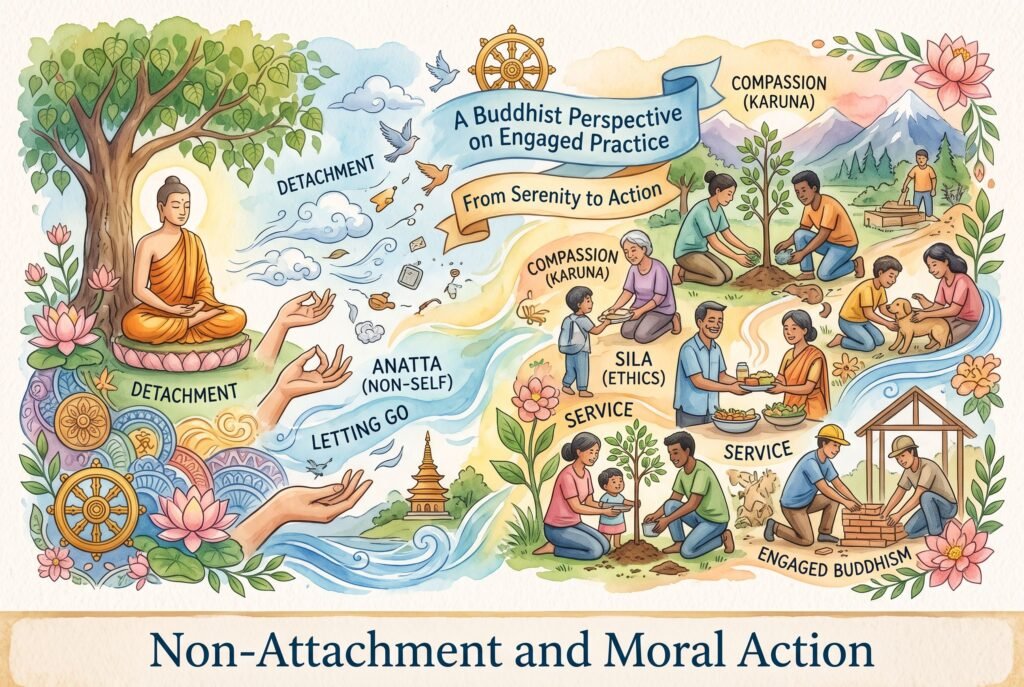
- Non-Attachment Is Not Apathy: Non-attachment, more precisely understood as non-clinging (anupādāna) and freedom from craving (taṇhā), is not cold indifference. It is the relinquishment of grasping and possessiveness regarding outcomes.
- The Problem with Unwholesome Motives: Anger (kodha), hatred (dosa), and ill-will are unwholesome roots (akusala-mūla) that cloud judgment and perpetuate suffering. While they may generate energy, they are corrupt fuels for action.
- Compassion Over Reactivity: Buddhism replaces reactive anger with mettā (loving-kindness), karuṇā (compassion), and wholesome intention, grounded in upāyakosalla (skillful means).
- The Two Arrows Principle: The first arrow is painful experience; the second arrow is the mental suffering we add through reaction. Dropping the second arrow does not mean submitting to the first, it means responding without being blinded by reactivity.
- Emptiness and Not-Self as Foundations for Action: Recognizing suññatā and anattā removes ego-driven self-interest that breeds despair, savior complexes, and burnout, enabling sustained, non-violent engagement.
- Self-Preservation as Ethical Foundation: Non-attachment does not mean self-neglect or reckless disregard for life. The body is the indispensable basis for practice, and non-harming (ahiṃsā) applies equally to self and others.
1. Introduction: The Tension Between Non-Attachment and Moral Action
A central paradox often emerges for practitioners engaging deeply with Buddhist philosophy: If the core diagnosis of human suffering is clinging, attachment, and ego-identification, does radical non-attachment disable our capacity to fight injustice, protect others, and correct systemic wrongs?
It is a persistent misunderstanding that the Buddhist ideal is a state of stoic indifference, an impassive withdrawal from the messy, volatile affairs of human society into an insular sanctuary. When we encounter teachings on letting go, the “Two Arrows” (found in the Sallatha Sutta, SN 36.6), anattā (not-self), paṭicca-samuppāda (dependent origination), and suññatā (emptiness), the mind can easily interpret these concepts as a mandate to disengage.
Furthermore, real-world experience demonstrates that negative emotions- righteous rage, visceral disgust at cruelty, explosive anger at institutional corruption — are powerful catalysts for historical transformation. The fury against oppression has fueled revolutions, dismantled tyrannies, and forced moral reckonings. If Buddhism demands the eradication of these emotional states, does it strip humanity of the very fuel required to confront evil?
Buddhism directly confronts this dilemma. It argues that while unwholesome emotions like anger provide potent energy, they act as corrupted fuel — clouding judgment, inflicting secondary psychological damage on the actor, and perpetuating cycles of violence. The Buddhist path does not replace intense action with passive detachment; it replaces toxic, reactive fuel (akusala) with sustained, unshakeable intent rooted in wisdom, loving-kindness, and compassion.
The central thesis of this article is that Buddhist non-attachment is not indifference to suffering. It is freedom from the craving, grasping, and aversion that distort one’s response to suffering. Buddhist ethics therefore does not require a choice between compassionate action and inner equanimity. The challenge is to act vigorously to reduce suffering without allowing hatred, conceit, craving, or fixation on outcomes to govern the action.
2. Clarifying Terminology: Detachment vs. Non-Clinging
To understand how Buddhism reconciles moral action with spiritual liberation, we must clarify translation issues that can obscure the original teachings.
| PĀLI TERM | MISTRANSLATION | ACCURATE MEANING |
|---|---|---|
| Upekkhā | Indifference / Apathy | Equanimity / Clear-Seeing Balance |
| Upādāna | Attachment (Static) | Grasping / Fueling / Clinging |
| Taṇhā | Desire (All forms) | Thirst / Craving for Sensual Pleasure, Existence, or Non-Existence |
| Chanda | Craving / Intention | Desire-to-Act / Zeal / Interest (Ethically Variable) |
2.1 The Near Enemy of Equanimity
The Pāli term upekkhā is often translated as “detachment” or “indifference.” In later Buddhist commentarial tradition, passive indifference is described as the “near enemy” of equanimity — an unwholesome state that resembles the wholesome one but is subtly different.
- Near Enemy — Ignorant Indifference: A state that resembles equanimity but lacks clear comprehension and genuine concern. It can manifest as emotional disengagement or worldly unconcern rather than balanced understanding. While aversion can motivate indifference, the near enemy of equanimity is more precisely identified in the commentarial tradition as ignorant indifference (aññāṇ’upekkhā) rather than dosa itself.
- True Equanimity (Upekkhā): The mental stability that remains unshaken by the “Eight Worldly Winds” (gain and loss, pleasure and pain, praise and blame, fame and disrepute). Equanimity does not mean refraining from action; it means acting without being thrown off balance by the outcome.
The distinction between equanimity and cold indifference is useful and defensible within Buddhist ethics, though the “near enemy” framework is a later commentarial development (found in the Visuddhimagga and related texts) rather than an explicit early canonical teaching.
2.2 Taṇhā vs. Wholesome Desire-to-Act
Buddhism distinguishes between two types of motivation:
- Taṇhā (Thirst/Craving): The standard threefold formulation in the early texts is:
- Kāma-taṇhā — craving for sensual pleasures
- Bhava-taṇhā — craving for existence/becoming
- Vibhava-taṇhā — craving for non-existence
Taṇhā is not necessarily “ego-driven” in the modern psychological sense. It is the fundamental thirst that perpetuates the cycle of birth and death (saṃsāra). The Buddhist framework is more precisely concerned with taṇhā leading to upādāna (grasping), which in turn leads to becoming and suffering, rather than operating through a modern Western conception of “ego.”
- Wholesome Desire-to-Act (Kusala Chanda): Chanda itself is ethically variable in Buddhist Abhidhamma — it can be wholesome or unwholesome depending on the mental factors with which it is associated. In the Abhidhamma lists of mental factors (cetasika), chanda is classified as an ethically variable factor (aññasamānā), meaning its moral quality depends entirely on the other mental factors accompanying it. When associated with wholesome mental factors, chanda can function as wholesome desire-to-act. In an engaged ethical context, this may be directed by wisdom, non-ill-will, compassion, and harmlessness.
When the Buddha set out to teach the Dhamma, or when an individual works to build a hospital, protect an ecosystem, or end exploitation, the motivating force can be chanda rooted in wisdom and compassion. Such intention acts vigorously without clinging to personal ownership of the results. It is important to note that cetanā (volition/intention) is the more important canonical term for intention in the ethics and kamma discussion, while chanda refers more specifically to the desire or interest to act.
3. The Mechanics of the Two Arrows: Action Without Escalation
The Sallatha Sutta (SN 36.6) outlines the teaching of the Two Arrows, providing a framework for how a wise individual engages with suffering.
3.1 The First Arrow: Painful Experience
The First Arrow represents the actual painful feeling — whether physical pain, unpleasant sensory experience, or the mental pain of encountering difficulty. When you witness an act of cruelty, institutional corruption, or personal misfortune, the First Arrow has struck. It is a real, conditioned phenomenon.
3.2 The Second Arrow: Proliferated Mental Reaction
The Second Arrow is the additional mental suffering produced by the untrained mind’s reaction: sorrow, grief, lamentation, distress, resistance, and in some circumstances, anger or rumination. The untrained mind, when touched by pain, shoots itself with a second arrow of mental anguish.
The Buddha observed:
“When touched with a feeling of pain, the uninstructed run-of-the-mill person sorrows, grieves, and laments, beats his breast, becomes distraught. So he feels two pains, physical and mental. Just as if they were to shoot a man with an arrow, and right after that, were to shoot him with another arrow, so that he would feel the pain of two arrows.” — SN 36.6
Crucially, dropping the Second Arrow does not mean ignoring the First Arrow. If an activist, doctor, or community leader is struck by the First Arrow (a crisis), firing a Second Arrow into their own mind (rage, panic) does not extract the first arrow. It doubles the suffering. By eliminating the Second Arrow, the mind maintains clarity to address the First Arrow effectively.
Note on Application: The Sallatha Sutta does not define the first arrow specifically as “social injustice” nor the second arrow specifically as papañca (conceptual proliferation). The text’s immediate analysis concerns painful feeling and the untrained person’s reaction to it. The application of this teaching to social and political action is a valid contemporary extension, but it should be recognized as such. Papañca is a more specific concept in early Buddhist thought, particularly in the Madhupiṇḍika Sutta (MN 18), where it is associated with conceptual proliferation rooted in perception, conceit, and craving.
4. The Fuel Problem: Why Anger Is a Faulty Engine
A central challenge remains: Does anger not get things done?
It cannot be denied that anger acts as a high-octane accelerant. It overrides hesitation, numbs fear, and mobilizes human energy at incredible speed. However, Buddhist psychological analysis (Abhidhamma) exposes the structural flaws of relying on unwholesome root states (akusala-mūla).
4.1 The Cost of Aversion (Dosa)
In Buddhist psychology, anger (kodha), ill-will (byāpāda), and disgust (paṭigha) belong to the root of Aversion (dosa). The Abhidhamma classifies dosa as one of the three unwholesome roots, alongside greed (lobha) and delusion (moha).
From a Buddhist psychological perspective, aversion narrows the mind’s responsiveness and encourages distorted or one-sided engagement with its object. When an individual operates out of rage:
- Loss of Skillful Means: The rage-driven mind demands immediate, blunt release rather than calculated, long-term strategic execution. It prefers the emotional payoff of punishing the offender over the complex work of fixing underlying systems.
- Karmic Consequences: In Buddhist ethics, intentional action (cetanā) rooted in hatred is unwholesome kamma. Such action also tends, within the present life, to reinforce hostile mental habits. Buddhist doctrine distinguishes these immediate psychological effects from kamma-vipāka, the karmic results that may follow from intentional action in this life or future lives. The causal mechanics of kamma and vipāka are complex and debated across Buddhist traditions; canonical texts present kamma as morally significant but later scholastic treatments vary on how immediate or deterministic vipāka is. It is important to emphasize that the doctrine of kamma does not justify systemic oppression or fatalism about suffering—kamma is about intentional action shaping the future, not a deterministic justification for ignoring present systemic injustice.
- Unsustainability: In practical terms, sustained anger can become exhausting and difficult to maintain without reinforcing further distress. Once the initial surge subsides, the individual often crashes into fatigue, cynicism, and despair.
4.2 The Venomous Root with the Honey Tip
The Buddha acknowledged the seductive quality of moral outrage. In the Chetvā Sutta (SN 1.71), a devatā asks:
“Having slain what does one sleep soundly? Having slain what does one not sorrow? What is the one thing, O Gotama, whose killing you approve?”
The Buddha replied:
“Having slain anger, one sleeps soundly; having slain anger, one does not sorrow. The killing of anger, O devatā, with its poisoned root and honeyed tip, the noble ones praise the killing of that.” — SN 1.71
The “honeyed tip” can be understood, in contemporary terms, as the immediate sense of power, certainty, or justification that anger can provide. The “poisonous root” is the long-term corrosion of the mind that harbors it, along with the predictable cycle of retaliation it provokes in others.
The Buddha’s teaching here is fundamentally ethical and soteriological: dosa is an unwholesome mental root and should be abandoned. This does not require the empirical claim that anger never produces useful social results. Rather, it asserts that anger is an unwholesome basis for action from the perspective of Buddhist ethics and the path to liberation.
4.3 The Antidote: Mettā (Loving-Kindness) and the Brahmavihāras
In Buddhist psychology, mettā (loving-kindness) is the specific, direct antidote to dosa (aversion/anger). While karuṇā (compassion) is the response to suffering, mettā is the unconditional wish for the well-being and happiness of all beings, including oneself, friends, neutral persons, and even enemies.
The four Brahmavihāras (divine abodes) provide the proactive emotional engine for the engaged practitioner:
- Mettā — Loving-kindness: The wish for all beings to be happy and well
- Karunā — Compassion: The wish for all beings to be free from suffering
- Muditā — Sympathetic joy: Rejoicing in the happiness and success of others
- Upekkhā — Equanimity: Maintaining balanced composure amid the eight worldly winds
When discussing the removal of anger from activism, it is insufficient to simply say “don’t be angry.” The Buddhist path provides a positive replacement: the cultivation of mettā as the foundational attitude that underlies all ethical action. An activist grounded in mettā can oppose harmful policies and systems without dehumanizing those who perpetuate them, can maintain firm boundaries without hatred, and can sustain engagement over the long term without burnout.
5. Right Intention: The Ethical Engine of Action
The Buddha’s most direct bridge between inner motivation and ethical action is Right Intention (sammā-saṅkappa). In the Mahācattārīsaka Sutta (MN 117), Right Intention is defined as:
- Intention of renunciation (nekkhammasaṅkappa) — letting go of craving and attachment
- Intention of non-ill-will (abyāpādasaṅkappa) — goodwill and loving-kindness
- Intention of harmlessness (avihiṃsāsaṅkappa) — non-harming and compassion
This framework is almost tailor-made for the engaged practitioner. Buddhism does not merely ask whether an action produces a desirable result. It asks what mental intention gives rise to the action. The Buddha identifies non-ill-will and harmlessness as forms of Right Intention. Thus the Buddhist alternative to anger-driven activism is not passivity but action grounded in non-ill-will and harmlessness.
5.1 Right Intention and Activism
Applied to social action, Right Intention means:
- Renunciation: Letting go of craving for personal recognition, power, or outcome-fixation. The activist’s motivation is not “I must succeed” but “this suffering should be alleviated.”
- Non-ill-will: Opposing harmful policies and systems without hatred toward those who perpetuate them. This is the cultivation of mettā even toward adversaries.
- Harmlessness: Ensuring that one’s methods do not cause unnecessary suffering. This requires ongoing reflection on whether one’s actions are truly reducing harm or merely expressing outrage.
The Vepacitti Sutta (SN 11.4) illustrates this principle: Sakka says that one who does not respond to an angry person with anger wins a difficult battle, benefiting both oneself and the other. This is not presented as cowardice but as strength governed by Dhamma.
6. Right Effort: Sustained Action Without Hatred
Sustained action can be anchored in Right Effort (sammā-vāyāma). In the Vibhaṅga Sutta (SN 45.8), the four Right Efforts are:
- Preventing unwholesome states that have not yet arisen
- Abandoning unwholesome states that have already arisen
- Cultivating wholesome states that have not yet arisen
- Maintaining and developing wholesome states that have already arisen
This provides an authentically Buddhist account of energetic action without hatred. The practitioner is called to actively cultivate wholesome states (compassion, loving-kindness, wisdom) and actively abandon unwholesome states (anger, hatred, ill-will). This is not passive but vigorously engaged.
7. The Five Precepts and Right Action
The most obvious ethical foundation for engaged practice is the Five Precepts (pañca-sīla), particularly the first:
- Pāṇātipātā veramaṇī — abstaining from taking life
And the broader category of Right Action (sammā-kammanta) in the Noble Eightfold Path, which includes abstaining from killing, stealing, and sexual misconduct.
These provide a clear ethical hierarchy for the engaged practitioner:
Four Noble Truths → Noble Eightfold Path → Right Intention → Right Speech/Action → Non-hatred/Harmlessness → Engaged Action
The precepts are not merely negative prohibitions but positive commitments to non-harming that inform how one engages with social issues. An activist who takes the first precept seriously is committed to opposing violence while not resorting to violence themselves.
8. Dependent Origination, Emptiness, and Not-Self: Deep Foundations for Action
Rather than enforcing passivity, the core Buddhist insights, paṭicca-samuppāda (Dependent Origination), suññatā (Emptiness), and anattā (Not-Self), provide frameworks for effective, sustained action. This section moves across several Buddhist traditions, and their philosophical vocabularies and doctrinal formulations should not be treated as interchangeable.
8.1 Dependent Origination: A Contemporary Application to Social Conditions (Pāli Canon)
Paṭicca-samuppāda describes the conditional arising of phenomena and, most centrally in the early teachings, the conditions through which suffering arises and ceases. Applied more broadly, this principle can encourage us to examine the conditions that sustain harmful behaviour and social suffering rather than reducing complex problems to isolated individuals.
When applied to social, political, or interpersonal problems, this insight shifts the focus from personal hatred to structural intervention:
- The Ignorant View: Sees bad actors as inherently evil, self-caused entities. The solution is punishment, destruction, and moral condemnation.
- The Dependently Arisen View: Sees harmful behavior as the downstream consequence of ignorance (avijjā), trauma, institutional incentives, structural conditioning, and historical patterns.
By seeing that bad behavior is dependently arisen, you do not excuse it — you learn how to dismantle it. The Mahāhatthipadopama Sutta (MN 28) provides an important canonical foundation for understanding conditioned phenomena and the relationship between dependent arising and the Dhamma. Applying this framework to social systems is a contemporary extension; the sutta itself analyses the five aggregates as dependently arisen.
8.2 Emptiness (Suññatā): The Fluidity of Reality
8.2.1 Early Buddhist Understanding (Pāli Canon)
The early Buddhist understanding of suññatā — as found in the Suñña Sutta (SN 35.85) — explains that the world is empty of self and what belongs to self. The Buddha states:
“Ānanda, they say that ‘the world is empty.’ What does the saying ‘the world is empty’ refer to? It is empty of self or what belongs to self.” — SN 35.85
The eye, forms, consciousness, contact, feelings, and so on are empty in this sense. This is a teaching about non-self and the absence of any permanent, independent essence in phenomena.
8.2.2 Mahāyāna Madhyamaka Development
In the Mahāyāna tradition, Nāgārjuna developed this understanding further in the Mūlamadhyamakakārikā (Fundamental Verses on the Middle Way). In MMK 24.20, Nāgārjuna argues that if phenomena were intrinsically non-empty — that is, if they lacked the dependent arising and cessation characteristic of conditioned phenomena — the Four Noble Truths and the path to liberation would become unintelligible. Emptiness, in this Mahāyāna framework, is understood as the very condition that makes change and liberation possible.
Important Note: The Madhyamaka understanding of śūnyatā develops the earlier Buddhist analysis of conditionality and non-self in a distinctive Mahāyāna philosophical direction. It should not be assumed to be identical in formulation or scope to the Pāli Canon’s treatment of suññatā. Nāgārjuna’s argument is about the ontological status of all phenomena, not specifically about social injustice. The application of this reasoning to social suffering is a contemporary extension.
8.3 Not-Self (Anattā): A Buddhist Perspective on Egoic Identification (Pāli Canon)
The greatest trap for the well-intentioned reformer is egoic identification. When action is tied to identity — “I am the defender of the weak,” “My movement must prevail,” “I cannot rest while this exists”— the action is vulnerable to three debilitating failures:
- Despair: When victory is delayed, the ego interprets it as a personal failure.
- Dogmatism: The identity of the activist can become dependent on the existence of the enemy.
- Savior Complex: The focus shifts subtly from actual relief of suffering to the inflation of the activist’s self-image.
The teaching on anattā deconstructs the “I.” In contemporary terms, this can be understood as dissolving the “savior complex.” Action shifts from being an expression of “me and my campaign” to a natural, unegoic response to present-moment suffering.
Note: This application of anattā to the “savior complex” is a modern application of the doctrine rather than a canonical definition. It is best understood as: “A Buddhist perspective on egoic identification and burnout can be found in the teaching of anattā…”—making clear that this is an application of Buddhist doctrine rather than something the Buddha explicitly taught using this psychological terminology.
9. The Bodhisattva Ideal: A Mahāyāna Framework for Engaged Action
While the Pāli Canon provides the foundational ethical framework of Right Intention and Right Effort, the Mahāyāna tradition developed the Bodhisattva ideal as a powerful motivational framework for social action.
A Bodhisattva is one who, motivated by great compassion (mahākaruṇā), takes the vow to postpone their own final liberation until all beings are freed from suffering. This is not a passive waiting but an active commitment to work tirelessly for the welfare of all beings, in this life and beyond.
Key elements of the Bodhisattva path relevant to engaged practice include:
- The Bodhisattva Vow: A formal commitment to work for the liberation of all beings, which provides a framework for sustained, selfless action.
- The Six Perfections (Pāramitā): Generosity, ethical conduct, patience, energy, meditation, and wisdom — which provide a comprehensive training for effective action.
- Skillful Means (Upāyakosalla): The ability to adapt one’s methods to the specific needs of beings and situations, which is essential for effective activism.
Upāyakosalla (“skill in means”) occurs in early Buddhist sources (including AN 6.79 and other passages) and was subsequently developed into a major doctrine of skillful means in Mahāyāna Buddhism. This is not simply a Mahāyāna import but a concept with roots in early Buddhism that was greatly expanded in the Mahāyāna tradition.
10. Historical Realization: Engaged Buddhism in Practice
The practical application of these insights is demonstrated across centuries of Buddhist history, though not without deep tension, historical paradoxes, and ongoing debate. Buddhist traditions have differed considerably in how they understand the relationship between contemplative practice, political authority, social reform, and resistance to injustice. Some Buddhist traditions and historical actors have supported violent or state coercive measures (e.g., certain medieval polities and monastic institutions that aligned with royal power). Buddhist ethical ideals have often been invoked in support of non-violence, but Buddhist institutions and states have not consistently behaved according to those ideals. The framework presented here is therefore a Buddhist ethical interpretation of engaged action, not a claim that all Buddhist schools have historically endorsed modern activism in the same form.
| ARCHETYPE | HISTORICAL EXPRESSION | CORE METHODOLOGY |
|---|---|---|
| Emperor Ashoka | Edicts of Maurya Empire (3rd Century BCE) | Non-harming and welfare expressed through imperial policy, institutional welfare, restraint in punishment |
| Thich Nhat Hanh | Order of Interbeing (Vietnam / Global) | Non-violent civic service, peace-making, non-partisan relief |
| Maha Ghosananda | Dhammayietra (Cambodia) | Walking through active warzones to re-arm society with peace |
10.1 Ashoka: Welfare and Restraint
Emperor Ashoka’s edicts (see the Major Rock Edicts) clearly express concern for humane treatment, welfare, restraint, and non-killing, including medical treatment for humans and animals. His reign exemplifies the application of Buddhist ethical principles to governance, calling for restraint in punishment and administration, along with extensive welfare measures. The relationship between Ashoka’s policies and canonical Buddhism is, however, a subject of scholarly debate; his edicts represent a particular interpretation of Dhamma rather than a straightforward application of monastic Buddhist doctrine.
10.2 Thich Nhat Hanh and Engaged Buddhism
During the Vietnam War, Zen Master Thich Nhat Hanh coined the term “Engaged Buddhism” to address a critical question: How do you act to protect lives and rebuild shattered communities without adopting the hatred of the warring factions?
He established the School of Youth for Social Service, training thousands of volunteers to rebuild bombed villages, establish medical clinics, and assist refugees under active fire. They sought to provide relief and reconstruction without taking up arms or reducing either side to an enemy deserving hatred. (See Thich Nhat Hanh, Vietnam: Lotus in a Sea of Fire, and other primary sources on the Order of Interbeing.)
Thich Nhat Hanh is widely credited with developing and popularizing the modern concept of Engaged Buddhism. This represents a modern Buddhist movement and interpretation drawing on Buddhist ethical and contemplative traditions, rather than an ancient or universally accepted formulation.
10.3 The Self-Immolation Controversy
The Vietnam War produced one of the most controversial phenomena in modern religious history: the self-immolations of Buddhist monastics, most famously Thích Quảng Đức in 1963 in protest against religious persecution.
When Thich Nhat Hanh explained these acts to Western leaders (including Martin Luther King Jr.), he sought to contextualize them not as acts of despair, suicide, or hatred, but as extreme, non-violent political alarms designed to shock the world’s conscience. Thích Quảng Đức’s classification as “not suicide” reflects Thích Nhất Hạnh’s Buddhist interpretation rather than an objective doctrinal fact; academic discussion recognizes precisely this interpretive dispute.
Yet this creates a profound doctrinal paradox:
- Early Buddhist Monastic Law (Vinaya Pitaka): Pārājika 3 concerns intentionally causing the death of a human being, including inciting another person to die. The origin story of this rule explicitly deals with monks becoming disgusted with their bodies and taking their own lives or arranging for others to kill them. The technical rule is fundamentally about intentional killing and incitement to death. The Vinaya rules on suicide and causing death are complex and context-sensitive; canonical narratives about monks and suicide are not straightforward endorsements.
- The First Sermon: The Buddha explicitly rejected extreme self-mortification (attakilamathānuyoga) as unwholesome.
Neither the First Sermon nor Pārājika 3 provides a simple one-to-one answer to the modern phenomenon of political self-immolation. The canonical Vinaya strongly condemns intentional killing and incitement to death, while later Buddhist traditions have developed more complex interpretations of exceptional cases.
Understanding Engaged Buddhism requires recognizing this history without mistaking extreme wartime anomalies for normative Buddhist doctrine.
10.4 Maha Ghosananda: The “Gandhi of Cambodia”
Following the devastation wrought by the Khmer Rouge — which decimated the Cambodian Buddhist monastic community — Venerable Maha Ghosananda returned to Cambodia.
Rather than calling for vengeance or retribution, he organized the Dhammayietra — annual peace marches. The first major walk occurred in 1992, and the marches subsequently went through dangerous areas. Later marches genuinely encountered active conflict; in 1994, walkers were caught in crossfire and people were killed.
His rallying chant, derived from the Dhammapada, was simple. His approach emphasized compassion, reconciliation, and non-retaliation rather than revenge, even toward those associated with the violence. He is often described as the “Gandhi of Cambodia,” though this should be treated as a descriptive journalistic label rather than a doctrinal equivalence.
His commitment to non-retaliation and reconciliation enabled him to engage communities on opposing sides of the conflict and contributed to broader efforts toward peace and reconciliation.
11. Doctrinal Clarification: Self-Preservation and Non-Harm
To ensure that non-attachment is never conflated with self-neglect, reckless endangerment, or suicidal martyrdom, Buddhist doctrine establishes clear boundaries around self-care and the preservation of life.
11.1 Self-Preservation as Ethical Foundation
- The Rarity and Value of Human Birth: The Chiggaḷayuga Sutta (SN 56.48) gives the famous simile of the blind turtle surfacing once every hundred years to put its head through a yoke floating on the ocean, illustrating the extraordinary rarity of human birth. Throwing away the physical form through recklessness undermines the capacity to practice the Dhamma and perform kamma that benefits the world.
- The Acrobat Simile: In the Sedaka Sutta (SN 47.19), the Buddha uses the simile of two acrobats to illustrate the mutual relationship between self-protection and protecting others. The sutta states:
“Protecting oneself, one protects others; protecting others, one protects oneself.” — SN 47.19
The sutta explains the two directions through mindfulness on one side and patience, harmlessness, loving-kindness, and sympathy on the other. The sutta provides a useful Buddhist foundation for understanding why responsible self-protection can support one’s ability to protect others. In contemporary terms, this can be applied to sustainable service and avoidance of burnout.
11.2 The Complexity of Self-Harm in Buddhist Literature
Buddhist ethics strongly discourages intentional harm and places particular emphasis on preserving life and avoiding actions rooted in aversion, delusion, or craving. The First Precept specifically concerns abstaining from taking life, while Buddhist teachings more broadly encourage care, restraint, and non-harming.
Important Nuance: Early Buddhist literature has a complex treatment of suicide, including cases involving terminal illness and highly realized practitioners. The canonical material cannot responsibly be reduced to “Buddhism says suicide is always forbidden.”
Buddhist texts strongly discourage intentional destruction of life and explicitly prohibit monks from killing or inciting the death of human beings. Buddhist discussions of suicide are nevertheless more complex than a simple categorical prohibition, particularly in narratives involving advanced practitioners. The cases of Venerable Channa (in SN 35.87 and MN 144) and Venerable Godhika (in SN 4.23) are particularly relevant; both involve highly realized practitioners and have been subject to extensive scholarly interpretation, demonstrating that the canonical material does not present a simple, uniform position on suicide.
12. Comparative Framework: Reactive Action vs. Wise Buddhist Action
| Dimension | Reactive Action (Anger/Disgust-Driven) | Wise Buddhist Action (Compassion/Wisdom-Driven) |
|---|---|---|
| Primary Root | Dosa (Aversion), Kodha (Rage) | Mettā (Loving-kindness), Karunā (Compassion), Paññā (Wisdom) |
| Cognitive State | Tunnel vision, high emotional volatility | Broad awareness, strategic adaptability |
| View of Adversary | Essentializes the opponent and reduces them to a fixed identity | Recognizes harmful conduct while understanding persons and circumstances as conditioned and changeable |
| Relationship to Outcome | High anxiety, rigid outcome-fixation | Diligent effort without clinging to results |
| Self-Preservation | Vulnerable to burnout and recklessness | Grounded in self-care as prerequisite for service |
| Long-Term Sustainability | Rapid exhaustion, cynicism, burnout | Potentially sustainable when supported by wisdom, ethical discipline, mindfulness, and appropriate boundaries |
| Systemic Impact | Perpetuates tribal friction and retaliation | Seeks cessation of harm, prevents further hostility |
| Speech and Action | May involve harsh or harmful speech/action | Guided by Right Speech and Right Action |
13. Non-Attachment in Collective Movements
The principles outlined above apply not only to individual practitioners but also to collective movements. When groups organize for social change, the dynamics of egoic identification can be amplified, leading to:
- Charismatic Leadership Dangers: Movements can become dependent on individual leaders, creating vulnerability when leaders burn out, become corrupted, or are attacked. The principle of anattā suggests rotating leadership, decentralizing authority, and building institutional structures that outlast any individual.
- Accountability Without Demonization: Movements can maintain firm accountability for harmful actions without demonizing opponents. This involves clear naming of harms (see the section on Right Speech below) combined with openness to transformation and reconciliation.
- Coalition Building: Non-attachment to one’s own organizational identity allows for flexible coalition building across differences. When movement identity becomes rigid, collaboration becomes difficult.
- Sustainable Activism: Collective movements that institutionalize self-care, rest, rotation of roles, and shared leadership are more sustainable than those that demand total sacrifice from individuals.
Practical Governance Suggestions: Movements can implement rotation of leadership, clear accountability structures, de-emphasizing charismatic savior narratives, and explicit commitments to non-harm even in the face of provocation. These suggestions are reasonable practical advice, though the tether to anattā is a contemporary application rather than a direct canonical teaching.
14. The Role of Wisdom (Paññā) and Discernment in Action
Throughout this article, we have emphasized loving-kindness (mettā), compassion (karuṇā), and equanimity (upekkhā). However, wisdom (paññā) is equally essential for effective action. Wisdom in the Buddhist sense involves:
- Seeing Clearly: Understanding the actual conditions that give rise to suffering, rather than reacting to surface appearances. This is the application of dependent origination to social analysis.
- Strategic Discernment: Knowing what interventions are likely to be effective in specific contexts. This is the development of upāyakosalla (skillful means) — the ability to choose the right response for the right situation.
- Timing and Patience: Recognizing that some changes take time and that force can be counterproductive. The patience (khanti) praised in the Vepacitti Sutta (SN 11.4) is not passivity but strategic forbearance.
- Self-Knowledge: Understanding one’s own limitations, biases, and tendencies toward reactivity. This is the foundation of sustainable engagement.
Without wisdom, compassion can become sentimentality, and equanimity can become indifference. The full Buddhist path integrates all three: ethical conduct (sīla), concentration (samādhi), and wisdom (paññā).
15. Right Speech and the Ethics of Public Denunciation
The teaching on Right Speech provides guidance for how practitioners can name harms without falling into hatred or harshness. It is helpful to distinguish between:
- Right Speech (sammā-vācā), defined in the Noble Eightfold Path as abstaining from false, divisive, harsh, and idle speech (see SN 45.8)
- The five qualities of well-spoken speech (see AN 5.198), which describe speech that is:
- Timely
- Truthful
- Affectionate/gentle
- Beneficial
- Spoken with goodwill
The Abhayarājakumāra Sutta (MN 58) demonstrates that the Buddha may say something difficult or unpleasant when it is true, beneficial, and timely, motivated by compassion. This is an important qualification for activists who must sometimes speak hard truths.
Applied to activism, this suggests:
- Naming Harms: Truthful and timely naming of harmful conduct can be consistent with Right Speech, provided it is beneficial, appropriately timed, and free from ill-will.
- Avoiding Harshness: Public denunciation need not involve personal attack, mockery, or contempt. The suttas distinguish between speaking firmly and speaking harshly.
- Distinguishing Actions from Persons: Condemn harmful actions while leaving room for the possibility of transformation. The Subhāsitajaya Sutta (SN 11.5) explicitly contrasts punitive rhetoric with speech that avoids generating fights and quarrels, concluding that Sakka wins through good speech.
16. Practical Steps: Cultivating Wise, Compassionate Action
How does a practitioner transform reactive moral outrage into sustainable, wise, effective action in daily life? The following steps are grounded in the teachings explored above.
1. Pause at the Threshold of the Second Arrow
When confronted with injustice, environmental degradation, or personal harm, pay immediate attention to the bodily feeling. Identify the physical heat, tightness, or surging energy of anger. Recognize this as a reactive state. Acknowledge: “This is anger. It is an internal state of aversion. It is not the problem itself; it is my reaction to the problem.”
Practice Example: If you see a viral video of abuse: pause, notice bodily heat; breathe; then ask what structural interventions — reporting, supporting NGOs, policy advocacy — will reduce harm, rather than simply sharing the video with outrage.
2. Recognise and Settle the Energy of Aversion
Do not suppress the physical energy generated by the body. Instead, strip away the narrative of hatred and moral judgment. Allow the raw physiological arousal to settle into a stable, unshakeable core. Transition from “I hate this person/system” to “This suffering is present; let me understand its conditions.”
Practice Example: In a heated meeting, notice the impulse to attack someone you disagree with. Instead, breathe and ask: “What conditions led them to this position? What would actually reduce harm here?”
3. Map the Conditions (Paṭicca-samuppāda)
Analyze the problem through the lens of Dependent Origination. Ask:
- What economic, historical, psychological, or institutional conditions produce this behavior?
- Where can an intervention be made to disrupt these conditions?
- What action will actually alter the systemic leverage points rather than providing an emotional release?
Practice Example: When confronting a harmful policy, research its origins: Who benefits? What historical context produced it? What economic incentives sustain it? Target those conditions rather than simply denouncing the policymakers as evil.
4. Engage with Wholesome Intention and Skillful Means
Act with full force, commitment, and skill (upāyakosalla), driven by the desire to alleviate suffering (karuṇā) and the cultivation of loving-kindness (mettā). Communicate firmly without dehumanizing opponents. Demand structural change while leaving the door open for the adversary’s transformation and redemption.
Practice Example: In public advocacy, state clearly: “This policy causes measurable harm to vulnerable populations” rather than “The people who support this are monsters.” Use the qualities of well-spoken speech: truthful, beneficial, timely, gentle, and with goodwill.
5. Protect the Vessel and Release the Result
Recognize that sustainable action requires a healthy physical and psychological foundation. Establish strict boundaries against burnout, physical harm, and exhaustion (ahiṃsā toward self). Relinquish personal ownership of the final outcome, knowing that long-term systemic change depends on millions of conditions beyond one individual’s control.
Practice Example: Set boundaries around work hours, delegate responsibilities, take rest days, and maintain contemplative practice. Remind yourself: “My effort matters, but the outcome depends on many factors beyond my control. I act because action is the right thing to do, not because I must personally achieve a particular result.”
17. Objections and Frequently Asked Questions
17.1 “Doesn’t non-attachment mean passivity?”
No. The Buddhist path is not about doing nothing; it is about acting without being blinded by reactivity. The key distinction is between being unshaken by outcomes (non-attachment) and being indifferent to suffering (apathy). The Buddha was not passive — he taught tirelessly for 45 years.
17.2 “But anger motivates people to act. Isn’t some anger justified?”
Anger can certainly motivate action, and from a worldly perspective, it often does. However, the Buddhist claim is not empirical (“anger never works”) but ethical and soteriological (“anger is an unwholesome mental root that distorts perception and perpetuates suffering”). The question is: what kind of action do we want to cultivate? Action rooted in hatred, even when it produces short-term results, tends to replicate the very patterns of dehumanization we seek to overcome. The Buddhist alternative is not to eliminate energy but to transform it — from hatred to loving-kindness, from rage to compassion.
17.3 “What about defensive force or self-defense?”
This is a complex issue with no single Buddhist position. The precepts against killing are universal in intention, but Buddhist traditions have historically grappled with questions of defensive force, state violence, and just war analogues. Buddhist nationalism and state violence in contexts such as Sri Lanka and Myanmar demonstrate that Buddhist ideals have been invoked to justify violence as well as to oppose it. Some traditions (e.g., certain East Asian Buddhist polities) endorsed defensive warfare under limited conditions; others (e.g., many modern engaged Buddhist movements) advocate strict non-violence. For the purposes of this article, the central point is that even when physical force may be unavoidable, the mental state of the actor should not be rooted in hatred. The Vinaya, in its monastic context, prohibits monks from killing under any circumstances, but the application of this principle to lay statecraft is less straightforward.
17.4 “Is this article just modern Western Buddhism?”
The article draws on early Buddhist texts (Pāli Canon), Abhidhamma, Mahāyāna philosophy (particularly Nāgārjuna and the Bodhisattva ideal), and modern Engaged Buddhism, while applying these teachings to contemporary issues. This is consistent with the engaged Buddhist movement, which is a modern development but draws on traditional sources. The article has attempted to clearly label when it is moving between traditions and when it is applying ancient teachings to modern contexts.
17.5 “Does Buddhism have a tradition of social activism?”
The engaged Buddhist movement is a modern development, but it draws on deep currents within the tradition. Ashoka’s welfare state, the bodhisattva ideal of compassionate action, and various historical examples of monastic involvement in social welfare all provide precedent. However, Buddhist traditions have also been associated with state power, coercive measures, and in some cases, violence. The relationship between Buddhism and social action is complex and historically contingent.
18. Sutta References and Textual Foundations
For further study of the textual foundations of these concepts, consult the primary sources:
Pāli Canon
- SN 36.6 — Sallatha Sutta: The Arrow. The foundational text distinguishing physical pain from mental reactivity. The two-arrow formulation is explicit: the uninstructed person feels two pains, while the instructed noble disciple feels only one.
- SN 1.71 — Chetvā Sutta / Having Slain. Describes anger as having a “poisoned root and honeyed tip.” The noble ones praise the slaying of anger.
- SN 35.85 — Suñña Sutta: Empty. Explains how the world is empty of self and what belongs to self. The eye, forms, consciousness, contact, feeling, perception, intention, craving, and so on are empty in this sense.
- MN 28 — Mahāhatthipadopama Sutta: The Greater Discourse on the Simile of the Elephant’s Footprint. Connects Dependent Origination with seeing the Dhamma clearly. Sāriputta analyzes the five aggregates as dependently arisen.
- SN 11.4 — Vepacitti Sutta: Discusses the traps of responding to anger with anger, establishing that patient endurance and non-anger conquer the hardest challenges. Sakka says that one who does not respond to an angry person with anger wins a difficult battle, benefiting both oneself and the other.
- SN 11.5 — Subhāsitajaya / Victory by Good Speech: Reinforces the theme of non-violence, calmness, and the avoidance of escalating conflict. The sutta contrasts Vepacitti’s punitive approach with Sakka’s non-escalatory speech and concludes that Sakka wins through good speech.
- SN 47.19 — Sedaka Sutta: At Sedaka. Features the simile of the acrobats, illustrating that by protecting oneself (maintaining mindfulness and non-harm), one protects others; and by protecting others, one protects oneself. The sutta explicitly connects this with mindfulness, patience, harmlessness, loving-kindness, and sympathy.
- MN 117 — Mahācattārīsaka Sutta: The Great Forty. Defines Right Intention as renunciation, non-ill-will, and harmlessness, and distinguishes between the mundane and supramundane Eightfold Path.
- SN 45.8 — Vibhaṅga Sutta: Defines each factor of the Noble Eightfold Path, including Right Speech (abstaining from false, divisive, harsh, and idle speech) and Right Effort (the four efforts).
- AN 5.198 — Vācā Sutta: Lists the five qualities of well-spoken speech: timely, truthful, gentle, beneficial, and spoken with goodwill.
- MN 58 — Abhayarājakumāra Sutta: Demonstrates that the Buddha may say something difficult or unpleasant when it is true, beneficial, and timely, motivated by compassion.
- SN 56.48 — Dutiyachiggaḷayuga Sutta: The famous blind-turtle/yoke simile illustrating the rarity of human birth.
- SN 35.87 and MN 144 — The case of Venerable Channa, a gravely ill monk who takes his own life, and the Buddha’s complex response.
- SN 4.23 — The case of Venerable Godhika, who takes his own life after repeated experiences of temporary liberation.
Mahāyāna Sources
- Nāgārjuna, Mūlamadhyamakakārikā (Fundamental Verses on the Middle Way), Chapter 24, verse 20. On the relationship between emptiness and the Four Noble Truths. (Mahāyāna Madhyamaka tradition.)
Vinaya Sources
- Vinaya Pitaka, Pārājika 3: On intentional killing and incitement to death.
Historical Sources
- Ashoka’s Major Rock Edicts: For primary sources on Ashoka’s welfare measures and restraint.
- Thich Nhat Hanh: Vietnam: Lotus in a Sea of Fire and other writings on Engaged Buddhism.
19. Summary: The Mind of the Wise Practitioner
Detachment in Buddhism is not the absence of love, care, or action. It is the absence of clutter.
When you strip away the clutter of ego, self-righteousness, rage, and outcome-addiction, you are not left with a hollow void of apathy. You are left with the natural, unhindered capacity for clear seeing, loving-kindness, and compassionate action.
Anger and disgust are short-range, volatile reactions. They may break a barrier down today, but they scatter shrapnel into the ground that poisons tomorrow’s harvest. The Buddhist alternative is not to eliminate energy but to transform it— from hatred to loving-kindness, from rage to compassion, from fear to wisdom.
The Buddhist path invites us to step beyond the crude fuel of anger. By grounding ourselves in the truths of Emptiness, Dependent Origination, and Not-Self, and by cultivating Right Intention and Right Effort, we become capable of standing in the middle of worldly suffering — unshaken by the arrows, unbound by outcomes, preserving the vessel of life, and tirelessly working for transformation.
Non-hatred does not entail non-action. Sakka’s patience in the Vepacitti Sutta (SN 11.4) is not presented as cowardice; it is presented as strength governed by Dhamma. And the Subhāsitajaya Sutta (SN 11.5) explicitly contrasts punitive rhetoric with speech that avoids generating fights and quarrels.
Buddhism’s claim is fundamentally ethical and soteriological: dosa is an unwholesome mental root and should be abandoned. Anger may generate energy, but it is an unwholesome basis for action from the perspective of Buddhist ethics and the path to liberation. The challenge is to act vigorously to reduce suffering without allowing hatred, conceit, craving, or fixation on outcomes to govern the action. The path provides the tools—mettā, karuṇā, Right Intention, Right Effort—to sustain such action over the long term.
20. Recommended Reading
For further exploration of the themes in this article, the following sources are recommended:
Canonical Translations
- Bhikkhu Bodhi (trans.), The Connected Discourses of the Buddha (Saṃyutta Nikāya). Wisdom Publications, 2000.
- Bhikkhu Ñāṇamoli and Bhikkhu Bodhi (trans.), The Middle Length Discourses of the Buddha (Majjhima Nikāya). Wisdom Publications, 1995.
- I.B. Horner (trans.), The Book of the Discipline (Vinaya Pitaka). Pali Text Society, 1938-1966.
Mahāyāna Philosophy
- Jay L. Garfield, The Fundamental Wisdom of the Middle Way: Nāgārjuna’s Mūlamadhyamakakārikā. Oxford University Press, 1995. (Translation and commentary.)
Engaged Buddhism
- Thich Nhat Hanh, Vietnam: Lotus in a Sea of Fire. Hill and Wang, 1967. (Primary source on Engaged Buddhism.)
- Christopher S. Queen and Sallie B. King (eds.), Engaged Buddhism: Buddhist Liberation Movements in Asia. State University of New York Press, 1996. (Secondary scholarship.)
Historical Studies
- Romila Thapar, Aśoka and the Decline of the Mauryas (3rd ed.). Oxford University Press, 1997. (Historical analysis of Ashoka.)
- Oskar von Hinüber, A Handbook of Pāli Literature. Walter de Gruyter, 1996. (For Vinaya and canonical studies.)
This article is intended for educational purposes and represents the perspectives of the Buddhist traditions discussed. It is not a substitute for direct study of the original texts under qualified teachers.