A Practical Guide to Seeing Reality Clearly
Key Takeaways
- Emptiness (suññatā) means that all things lack any fixed, independent self or essence belonging to a self. They exist only through conditions.
- Dependent Origination (paṭicca‑samuppāda) explains how those conditions give rise to experience moment by moment.
- Not‑self (anattā) is the insight that nothing in body or mind can be owned, controlled, or taken as “me” or “mine.”
- These three teachings are not separate. They describe the same reality from different angles.
- Understanding them removes clinging, softens suffering, and opens the heart to freedom.
- These insights are not beliefs to adopt but ways of seeing that become clearer through careful observation and practice.
1. Introduction: Three Doors to the Same Truth
The Buddha taught many things, but some teachings sit at the very heart of the path. Emptiness, Dependent Origination, and Not‑self are three of these core insights. They are not abstract philosophy. They are practical tools for understanding why we suffer and how to stop suffering.
These teachings describe the same reality from different perspectives.
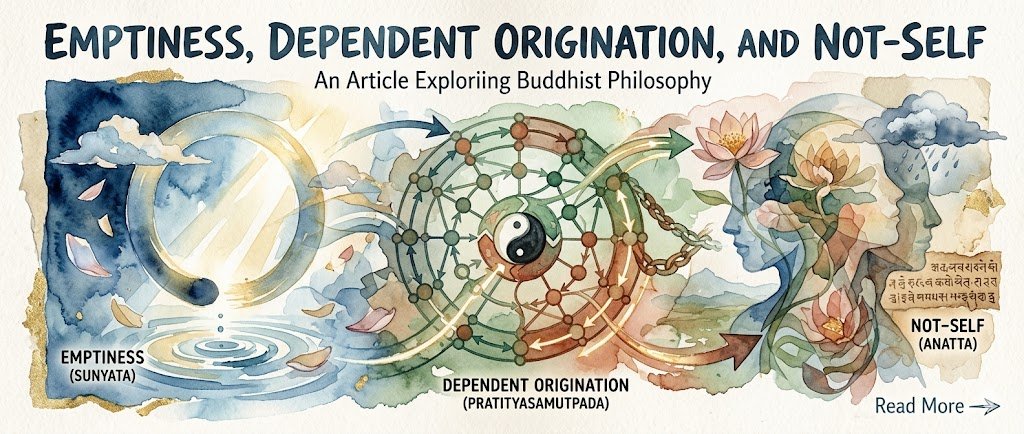
- Dependent Origination shows the process of how things arise.
- Emptiness describes the nature of those things once they arise.
- Not‑self describes the mistaken relationship we form with them.
Together, they dismantle the illusion that life is happening to a solid “me.” Instead, they reveal a fluid, interconnected process unfolding moment by moment.
This article explores these teachings in a clear, grounded way, using everyday examples and practical reflections. The goal is not to overwhelm you with theory but to help you see how these insights can transform your relationship with experience.
Note: In later Buddhist thought, especially in the Mahāyāna tradition, emptiness (śūnyatā) was developed into the philosophical position that all phenomena lack inherent existence (svabhāva). This article draws primarily from the early Pali suttas, where suññatā is specifically the absence of self and what belongs to self, revealed through seeing conditionality and impermanence. Where a later formulation helps illuminate the point, it will be clearly marked.
2. Why These Teachings Matter
Many people encounter Buddhism through meditation, mindfulness, or ethics. These are essential foundations. But the deeper purpose of the path is to understand the nature of reality so clearly that clinging naturally falls away.
Clinging is the root of suffering.
We cling to:
- our opinions
- our identities
- our emotions
- our possessions
- our relationships
- our bodies
- our stories about the past and future
- our hopes and our fears
- our beliefs about how things should be
- our sense of being a separate self
The Buddha taught that we cling because we misunderstand the nature of things. We assume they are stable, controllable, and “ours.” But when we look closely, we see that everything is changing, conditioned, and ungraspable.
Emptiness, Dependent Origination, and Not‑self reveal this truth.
They are not beliefs to adopt. They are ways of seeing.
When these insights deepen, the mind becomes lighter, more flexible, and less reactive. Suffering begins to unravel not through force but through understanding.
3. The Relationship Between the Three Teachings
Although these teachings are often presented separately, they are inseparable in practice.
3.1 Dependent Origination → Emptiness
When you see that everything arises due to conditions, you see that nothing has the permanent, independent self we habitually project. This is what the Buddha meant by saying the world is “empty of self and what belongs to self” (SN 35.85).
3.2 Emptiness → Not‑self
If all phenomena are empty of a permanent self, then the sense of “I” cannot be an exception. It, too, is dependently arisen and empty of an unchanging essence. Not‑self is the experiential recognition of this truth applied to the five aggregates.
3.3 Not‑self → Freedom
When the illusion of a solid self weakens, clinging loses its foundation. Without clinging, suffering fades. Freedom is not something we acquire; it is what remains when the unnecessary is removed.
The Buddha expressed this relationship succinctly:
“One who sees dependent origination sees the Dhamma; one who sees the Dhamma sees dependent origination.” — MN 28
These teachings are not three separate doors. They are three angles on the same open space.
4. A Practical Example: The Coffee Cup
Imagine you’re holding a warm cup of coffee.
Dependent Origination
The cup exists because of countless conditions: clay, heat, a potter, tools, transportation, your decision to buy it, the laws of physics, the entire history of the universe. Nothing about the cup is independent.
Emptiness
Because the cup depends on conditions, it has no fixed essence. It is not inherently “cup”—the label is a convention. It is empty of a permanent self and empty of belonging to anyone inherently.
Not‑self
You may think, “This is my cup.” But the cup does not obey you; it breaks when conditions change. It does not belong to a permanent “me,” because such a “me” cannot be found.
This simple example shows how the three teachings interlock. They are not mystical. They are describing the ordinary world as it actually is.
5. How to Read This Article
The article is divided into clear sections: Emptiness, Dependent Origination, Not‑self, How they fit together, Common misunderstandings, Real‑world applications, Reflections and exercises, Sutta references, and Summary.
Each section uses simple language to explain deep ideas. Read it straight through or dip into sections as needed. The point is not to accumulate knowledge but to see more clearly.
6. Emptiness (Suññatā)
Emptiness is one of the most misunderstood teachings. Many people imagine a void or cosmic nothingness. But in the early Buddhist teachings, emptiness is about seeing things clearly, without adding layers of projection, identity, or ownership.
Emptiness simply means:
Things are empty of the qualities we imagine they have.
They are empty of:
- permanence
- independent selfhood
- control
- inherent meaning
- being “mine”
They are not empty of existence. They are empty of misunderstanding.
The Buddha used the word “empty” in a practical way: a house is empty of people; a forest is empty of elephants; a phenomenon is empty of a self. Emptiness is a description, not a metaphysical claim.
When we see emptiness, we stop clinging to things as if they were solid, reliable, or “mine.” This is why emptiness is liberating, it removes the weight we place on experience.
Later, the Mahāyāna philosopher Nāgārjuna extended this insight to say that all phenomena are empty of inherent existence (svabhāva), a formulation that profoundly influenced Buddhist thought. While this article stays close to the early Pali suttas, we will occasionally note such clarifications when they help convey the practical point.
7. Emptiness as the Absence of “I” and “Mine”
The Buddha often described emptiness as the absence of “I‑making” and “mine‑making.”
When you look at your thoughts, feelings, and sensations, you may notice a subtle habit: the mind claims them.
- “My anger.”
- “My anxiety.”
- “My body.”
- “My story.”
But when you examine closely, you find that none of them obey you. They arise on their own, pass on their own, change without your permission.
“This is empty of self or of what belongs to self.” — SN 35.85
Emptiness is not a philosophical idea. It is a direct observation: nothing in experience can be owned.
8. Emptiness as Conditionality
A thing is empty of a permanent self because it depends on conditions.
A tree is empty of “treeness”, it is a temporary arrangement of soil, water, sunlight, genetics, time, and countless unseen processes.
A thought is empty of “my thought”, it arises from memory, mood, sensory input, habits, biology, language, and past experiences.
When you see conditionality clearly, emptiness becomes obvious. Nothing stands alone.
This is why the Buddha said:
“The world is empty of self and what belongs to self.” — SN 35.85
And later Nāgārjuna would summarize:
“Whatever is dependently arisen is empty.” — Mūlamadhyamakakārikā 24.18
Emptiness is not a special state. It is the natural condition of all phenomena.
9. Emptiness and the Illusion of Solidity
We tend to treat experiences as fixed objects: “This emotion is overwhelming,” “This problem is permanent.” But when we look closely, everything is in motion. Even a belief shifts over time; an intense emotion peaks and fades.
Emptiness reveals that what we take to be solid is actually fluid. What we take to be stable is actually dynamic. What we take to be “me” is actually a process. This insight softens the mind, reduces reactivity, and opens space for compassion and flexibility.
10. Emptiness and the Middle Way
Emptiness protects us from two extremes:
- Eternalism — believing in a fixed, permanent essence (leads to clinging).
- Nihilism — believing nothing exists or matters (leads to despair).
The Buddha rejected both. Emptiness is the Middle Way: things exist, but not in the way we imagine. They function, but they are not fixed. They appear, but they are not independent.
This middle understanding allows us to engage with life fully without being trapped by it.
11. Emptiness in Everyday Life
Emotions: Anger feels solid, but it has a beginning, middle, end, depends on conditions, and changes. It is empty of self; this makes it workable.
Identity: “I am a parent,” “I am a failure”: identities are roles, not essences. They shift with context and are empty.
Problems: Seem overwhelming as a solid block; break them into conditions and they become manageable.
Relationships: Are processes that depend on communication, history, and care; they are empty of fixed meaning.
The Body: Feels solid, but it is a river of processes. Empty of a permanent form, this insight brings acceptance of aging and illness.
12. Emptiness and Freedom
Clinging depends on the illusion of solidity. We cling because we believe things are stable, controllable, “mine,” and define us.
When we see emptiness, clinging loses its foundation. We stop trying to hold what cannot be held, stop resisting what cannot be controlled, stop identifying with what is not “me.” This is the beginning of freedom.
“Seeing thus, the instructed noble disciple grows disenchanted.” — SN 22.59
Disenchantment is not disappointment; it is the release of illusion and the mind becoming light.
13. Emptiness Is Not a Special State
Emptiness is a way of seeing, not a trance. You can see it while washing dishes, talking, feeling stressed, walking, breathing. Meditation simply helps you notice it more clearly. Emptiness is not hidden: it is the most obvious thing once the filters of projection are removed.
14. Emptiness and Compassion
When we see emptiness, compassion naturally arises because emptiness reveals interconnectedness. People act based on conditioning; no one is a fixed “self”; no one is beyond change.
This softens judgment and makes forgiveness easier. Emptiness is not cold: it is warm, gentle, and inclusive.
15. Emptiness and Letting Go
Letting go is not pushing things away; it is seeing that there is nothing to hold. When you see that emotions, thoughts, identities, and the self are empty, clinging naturally relaxes. Letting go becomes effortless, it happens when understanding deepens.
16. Dependent Origination (Paṭicca‑samuppāda)
Dependent Origination explains how experience arises, why suffering appears, and how freedom becomes possible. It is not a theory about the universe; it is a description of the moment‑to‑moment unfolding of experience.
At its heart:
When this is, that is.
When this ceases, that ceases.
Everything arises due to conditions. Nothing arises independently. This applies to thoughts, emotions, habits, relationships, identity, suffering, and liberation.
17. The Buddha’s Formula
The classic twelve-link formula describes how suffering arises: Ignorance → Formations → Consciousness → Name‑and‑form → Six sense bases → Contact → Feeling → Craving → Clinging → Becoming → Birth → Aging‑and‑death.
This is not a linear chain; it is a dynamic system. The formula is meant to be seen in your own experience, not merely memorized.
18. Dependent Origination as a Moment‑to‑Moment Process
In a single moment: a feeling arises → craving follows → clinging forms → becoming solidifies → a sense of “I” is born → suffering appears. This can happen dozens of times per minute. The twelve links are about how the mind creates suffering right now.
19. The Core Insight: Nothing Arises on Its Own
A thought does not appear because you choose it; a mood does not arise because you command it. Everything arises due to conditions. To see Dependent Origination is to see reality without distortion.
20. A Simple Example: Hearing a Sound
- Contact: ear + sound + attention.
- Feeling: pleasant, unpleasant, or neutral.
- Craving: wanting more, wanting it to stop.
- Clinging: a story forms (“Who made that noise?”).
- Becoming: the mind enters a role (irritated person).
- Birth: a temporary “self” is born.
- Suffering: tension appears.
This whole sequence unfolds in a fraction of a second. Dependent Origination is the architecture of experience.
21. The Three Key Links: Feeling → Craving → Clinging
Feeling is natural. Craving is the turning point. Clinging is the trap. If craving does not arise, the cycle stops. If clinging does not arise, suffering does not appear. Mindfulness of feeling is therefore a powerful gateway to freedom.
22. Dependent Origination and Emptiness
Because things arise from conditions, they are empty of a permanent self. The suttas repeatedly show that what is dependently arisen is empty of self and what belongs to self (SN 35.85). Nāgārjuna later summarized: “Whatever is dependently arisen is empty.” Emptiness is the natural conclusion of Dependent Origination.
23. Dependent Origination and Not‑self
If everything arises due to conditions, then nothing can be a permanent self. You do not create your thoughts; they arise due to conditions. This is why the Buddha said:
“This is not mine, this I am not, this is not my self.” — SN 22.59
Not‑self is a direct observation of conditionality.
24. Dependent Origination and the Illusion of Control
You cannot decide to never feel anger again or to stop thinking. These states arise from conditions. This does not mean we are powerless; it means we work with conditions rather than against them. We stop blaming ourselves and others for experiences not freely chosen.
25. Dependent Origination and Responsibility
Because everything arises from conditions, we can change the conditions. Ethics, meditation, wisdom, kindness, and letting go all change the causal landscape. Dependent Origination is not fatalism; it is empowering. Transformation is possible because nothing is fixed.
26. Dependent Origination in Daily Life
- Stress arises from pressure, expectations, habits, and past conditioning. Change the conditions, and stress changes.
- Anger arises from unmet needs, stories, memories, and bodily states. It is not “you”; it is a conditioned event.
- Anxiety arises from uncertainty, trauma, sensitivity, thought patterns. Seeing this reduces shame.
- Joy also arises from conditions; it is not a reward but a natural outcome of supportive causes.
Dependent Origination applies to everything.
27. Dependent Origination and Freedom
Freedom comes from understanding experience. When we see that feelings are conditioned, craving is optional, clinging is unnecessary, identity is constructed, and suffering is fabricated, the cycle unravels.
“With the cessation of craving comes the cessation of suffering.” — SN 12.2
28. The Cessation Sequence
When ignorance fades, wisdom arises → craving weakens → clinging dissolves → becoming stops → the “birth” of the self stops → suffering ends. This is not a mystical event; it is a natural process, like a fire going out when no more fuel is added.
29. Not‑self (Anattā)
Not‑self challenges our deepest assumption: that there is a solid “me” inside. The Buddha invites us to examine this assumption carefully.
Not‑self does not mean you don’t exist. It means the things we take to be “me” or “mine” do not hold up under investigation. Nothing in body or mind can be taken as a permanent, independent self. This insight is meant to be seen, not believed.
30. What Not‑self Does Not Mean
- Not‑self does not mean you disappear.
- It does not deny responsibility; actions still have consequences.
- It does not mean passivity; you can still act and decide.
- It does not mean nothing exists; things exist conventionally but not as independent, unchanging selves.
31. The Buddha’s Method: The Five Aggregates
The Buddha analysed experience into five aggregates:
- Form (body)
- Feeling (pleasant, unpleasant, neutral)
- Perception (recognition)
- Formations (thoughts, intentions, emotions)
- Consciousness (awareness)
He then asked:
“Is this permanent or impermanent? … Is it fit to be regarded as ‘This is mine, this I am, this is my self’?” — SN 22.59
The answer: impermanent, conditioned, not under our control, thus not self. This is a description, not a metaphysical claim. Crucially, the Buddha uses impermanence (anicca) as the basis: what is impermanent is suffering (dukkha), and what is impermanent and suffering is not fit to be regarded as self. So aniccā is the doorway to anattā.
32. Not‑self as the Absence of Ownership
We say “my body,” “my thoughts,” “my emotions.” But none of them obey us. The body ages despite our wishes; feelings arise without permission; thoughts appear on their own. Not‑self is the recognition that nothing in experience can be owned in the way we imagine.
33. Not‑self and the Illusion of the Controller
We feel a controller inside, but careful examination reveals only processes. Intentions arise, decisions form, actions occur: nowhere is a separate “self” directing it. The Buddhist tradition later captured this as:
“There is suffering, but none who suffers; there is a deed, but no doer.” — Visuddhimagga
This is a precise description of conditionality, not a paradox.
34. Not‑self and the Sense of “I Am”
Two levels of selfing:
- “I am this” (identification with specific experiences)
- “I am” (the subtle sense of being a separate entity)
Both are constructed and arise due to conditions. When identification weakens, the mind becomes lighter; when the sense of “I am” fades, the mind becomes free.
35. Not‑self and the Construction of Identity
Identity feels solid but is built from conditions: genetics, family, culture, memories, habits, trauma, and more. It is a process, not an essence. As the nun Vajirā said:
“Just as, with an assemblage of parts, the word ‘chariot’ is used, so, when the aggregates exist, there is the convention ‘a being.’”
This is not diminishing human dignity; it reveals the fluidity of experience. Identity becomes flexible rather than rigid.
36. Not‑self and Suffering
We suffer because we take personally what is not personal. “My failure,” “my success,” “my pain.” Not‑self dissolves this personalisation. When we stop taking experience personally, suffering loses its foundation.
37. Not‑self in Daily Life
- Instead of “I am angry,” see “anger is arising.”
- Instead of “I am anxious,” see “anxiety is present.”
- Instead of “my pain,” see “pain is being felt.”
- Instead of “my thoughts,” see “thinking is happening.”
This subtle shift removes the unnecessary layer of identity.
38. Not‑self and Freedom
When you see that thoughts, emotions, the body, identity, and reactions are not you, you stop fighting experience. You stop defending a self that does not exist. Clinging dissolves.
“When one sees the five aggregates as not‑self, one becomes disenchanted.” — SN 22.59
Disenchantment leads to release; release leads to peace.
39. Not‑self and Compassion
If there is no fixed self, others are not fixed either. People act from conditioning; suffering is impersonal; no one is inherently good or bad. This softens judgment and opens the heart. Not‑self is not cold; it is warm and inclusive.
40. Not‑self and Letting Go
Letting go becomes effortless when you see there is no one to hold on. Experiences come and go; nothing stays, nothing belongs to you, nothing defines you. Letting go is the natural response to understanding.
41. How the Three Teachings Fit Together
These three teachings are inseparable. Each illuminates the others. Together they form a complete picture of how experience arises and suffering ends.
42. Dependent Origination → Emptiness
If something arises due to conditions, it is not independent, not permanent, not controllable, not “mine.” This is emptiness.
43. Emptiness → Not‑self
If all phenomena are empty of a permanent self, the sense of “I” cannot be an exception. Not‑self is the experiential recognition of emptiness applied to the aggregates.
44. Not‑self → Freedom
When the sense of ownership dissolves, clinging becomes unnecessary. When clinging dissolves, suffering fades.
“In seeing not‑self, the mind becomes dispassionate.” — SN 22.59
45. The Three Teachings as a Single Insight
You can think of the three teachings as three lenses:
45.1 Dependent Origination
Shows the process of arising.
The “how” of experience.
45.2 Emptiness
Shows the nature of what arises.
The “what” of experience.
45.3 Not‑self
Shows the mistaken relationship we form with what arises.
The “who” that we imagine.
Together, they reveal:
- how experience unfolds
- why suffering appears
- how liberation becomes possible
They are not three separate truths.
They are one truth seen from three angles.
When you look through one lens, you inevitably see the others. The distinctions are pedagogical, not ontological. In direct experience, they merge into a single, liberating vision.
46. A Practical Example: Anxiety
Let’s take a common experience: anxiety.
46.1 Dependent Origination
Anxiety arises due to conditions:
- uncertainty
- past experiences
- bodily sensitivity
- thoughts
- social pressure
- habits
- caffeine or lack of sleep
It is not self‑created.
It is conditioned.
46.2 Emptiness
Because anxiety depends on conditions, it is empty of:
- permanence
- independence
- selfhood
It is a temporary process, not a solid thing.
46.3 Not‑self
Anxiety is not “you.”
It is not “yours.”
It is not happening to a self.
It is simply arising due to conditions.
When these three insights come together, anxiety becomes workable.
It loses its power.
It becomes just another conditioned event.
You can relate to it with curiosity rather than fear, with understanding rather than resistance. This does not make the anxiety disappear instantly, but it removes the additional suffering of identification and struggle.
47. A Practical Example: Praise and Blame
Consider praise and blame — two experiences that strongly affect the sense of self.
47.1 Dependent Origination
Praise and blame arise due to:
- social norms
- expectations
- cultural conditioning
- the other person’s mood
- your actions
- timing
- the entire history of the interaction
They are not personal in the way we assume.
47.2 Emptiness
Praise and blame are empty of inherent meaning.
They depend entirely on conditions.
47.3 Not‑self
Praise does not make you “good.”
Blame does not make you “bad.”
There is no fixed self to be elevated or diminished.
This insight brings emotional stability.
It frees you from being pushed around by opinions.
You can receive feedback with openness and discernment without being defined by it. The rollercoaster of approval and disapproval flattens into a gentle terrain.
48. A Practical Example: Identity
Identity feels solid, but it is built from conditions.
48.1 Dependent Origination
Your identity arises from:
- family
- culture
- language
- memories
- habits
- biology
- environment
- life experiences
48.2 Emptiness
Because identity depends on conditions, it is empty of permanence.
It changes over time, sometimes dramatically.
48.3 Not‑self
Identity is not “you.”
It is a temporary configuration of conditions.
This insight makes identity flexible rather than rigid.
It allows growth, change, and compassion — for yourself and others.
You can hold roles and characteristics lightly, using them skillfully without being trapped by them.
49. The Three Teachings in Meditation
In meditation, the three teachings appear naturally.
49.1 Dependent Origination
You see how:
- sensations lead to feelings
- feelings lead to craving
- craving leads to tension
- tension leads to suffering
49.2 Emptiness
You see that sensations, thoughts, and emotions:
- arise
- change
- pass
They have no solidity.
They are like bubbles, clouds, or ripples on a pond.
49.3 Not‑self
You see that none of these experiences belong to a “self.”
They arise on their own.
They pass on their own.
Meditation becomes a laboratory for insight.
The cushion is where you can observe the process in slow motion, under the microscope of sustained attention.
50. The Three Teachings in Daily Life
Outside meditation, the three teachings show up in ordinary moments.
50.1 When someone criticises you
- Dependent Origination: their words arise from conditions.
- Emptiness: the criticism has no inherent meaning.
- Not‑self: it does not define you.
50.2 When you feel joy
- Dependent Origination: joy arises from supportive conditions.
- Emptiness: joy is impermanent.
- Not‑self: joy is not “you,” so you don’t cling to it.
50.3 When you feel pain
- Dependent Origination: pain arises from causes.
- Emptiness: pain is a process, not a punishment.
- Not‑self: pain is not “your” pain; it is simply pain.
50.4 When you make a mistake
- Dependent Origination: the mistake arose from conditions.
- Emptiness: the mistake is not a permanent stain.
- Not‑self: the mistake does not define your worth.
These insights make life lighter, more spacious, and more workable.
Every moment becomes an opportunity for seeing clearly.
51. The Three Teachings and the End of Suffering
The Buddha taught that suffering arises from misunderstanding.
We suffer because we believe:
- things are permanent
- things are independent
- things are controllable
- things are “mine”
- there is a solid “me” at the centre
Emptiness, Dependent Origination, and Not‑self dismantle these illusions.
When the illusions fall away, clinging becomes unnecessary.
When clinging ends, suffering ends.
This is the heart of the path.
It is not about achieving a special state. It is about removing the ignorance that causes us to grasp at what cannot be held. When the grasping stops, peace is already here.
52. Common Misunderstandings
Emptiness, Dependent Origination, and Not‑self are subtle teachings. Because they challenge our usual assumptions, they are easy to misunderstand. The Buddha repeatedly warned against misinterpreting these insights in ways that lead to confusion, passivity, or despair. This section clarifies the most common misunderstandings so that your practice remains grounded, balanced, and aligned with the Middle Way.
53. Misunderstanding 1: “Emptiness means nothing exists.”
This is the most widespread misunderstanding.
Emptiness does not mean non‑existence.
Things exist conventionally.
They function.
They have effects.
They can cause suffering or bring joy.
Emptiness simply means that things do not exist in the way we imagine — as independent, permanent, self‑contained entities.
The Buddha never taught nihilism.
He taught clarity.
“This world is supported by a duality: existence and non‑existence.” — SN 12.15
Emptiness is the Middle Way between these extremes.
It affirms the conventional reality of things while denying their ultimate, independent existence. This is a subtle but crucial distinction.
54. Misunderstanding 2: “Not‑self means I don’t exist.”
Not‑self does not deny experience.
It denies the misinterpretation of experience.
You still experience:
- sensations
- thoughts
- emotions
- intentions
- choices
- relationships
The teaching simply says that none of these can be taken as a permanent “self.”
The Buddha never said, “You do not exist.”
He said, “What you take to be self is not self.”
This is a crucial distinction.
The conventional person exists and functions. What does not exist is a permanent, independent essence within or behind that person.
55. Misunderstanding 3: “If there is no self, then who acts?”
This misunderstanding arises from assuming that a controller is required for action. But the Buddha taught that actions arise from conditions, not from a separate agent.
There is:
- intention
- effort
- choice
- action
…but no independent “self” behind them.
“There is action, but no doer.” — AN 6.38
This is not paradoxical.
It is a precise description of conditionality.
The process functions without a controller.
Just as a flame burns without a “fire‑self,” the mind acts without a “mind‑self.” The actions happen; they are real. But the notion of a separate agent is an afterthought, a mental construct.
56. Misunderstanding 4: “If everything is empty, nothing matters.”
This is a misunderstanding rooted in nihilism.
The Buddha rejected this view.
Because things are empty, they are:
- workable
- changeable
- responsive
- dependent on conditions
This makes ethics meaningful.
This makes practice possible.
This makes compassion natural.
If things were fixed, nothing could change.
Emptiness is what makes transformation possible.
Far from making life meaningless, emptiness reveals the profound significance of every action, because every action shapes the conditions of the future.
57. Misunderstanding 5: “Emptiness is a special mystical state.”
Emptiness is not a trance, a vision, or a mystical experience.
It is a way of seeing.
You can see emptiness:
- while washing dishes
- while feeling stressed
- while talking to a friend
- while breathing
- while walking
Emptiness is the natural condition of all phenomena.
Meditation simply helps you notice it more clearly.
You do not need to enter an altered state to understand emptiness. You just need to look at ordinary experience with fresh eyes, noticing conditionality, impermanence, and the absence of ownership.
58. Misunderstanding 6: “Dependent Origination is about past and future lives only.”
The twelve‑link formula can be interpreted across lifetimes, but the Buddha also taught it as a moment‑to‑moment psychological process.
In a single moment:
- feeling arises
- craving follows
- clinging forms
- becoming solidifies
- a sense of “I” is born
- suffering appears
This cycle can occur dozens of times per minute.
Dependent Origination is not primarily about metaphysics.
It is about how suffering is created right now.
The most useful application of the teaching is in the present moment, where you can observe the links in action and learn to interrupt them.
59. Misunderstanding 7: “Not‑self means I should suppress my personality.”
Not‑self is not about erasing individuality.
It is about seeing that personality is conditioned and not a permanent essence.
You can still:
- have preferences
- express creativity
- form relationships
- make choices
- enjoy life
The difference is that you no longer cling to these as “me” or “mine.”
Not‑self makes personality flexible, not suppressed.
You can be fully yourself without being trapped by self‑definition.
60. Misunderstanding 8: “If there is no self, I am not responsible for my actions.”
This misunderstanding confuses not‑self with fatalism.
The Buddha taught that actions have consequences.
Karma is not about a self; it is about cause and effect.
Because everything is conditioned, your actions shape future conditions.
This is why ethics matter.
This is why practice matters.
This is why liberation is possible.
Not‑self does not remove responsibility.
It removes the burden of identity.
You are still responsible for your actions because they have real effects on the stream of conditions. But you do not need to carry the additional weight of a permanent self that is defined by those actions.
61. Misunderstanding 9: “Emptiness means detaching from life.”
Emptiness does not mean withdrawing from life.
It means engaging with life without clinging.
You can still:
- love
- work
- create
- help others
- enjoy beauty
- feel emotions
The difference is that you relate to these experiences with wisdom rather than grasping.
Emptiness makes life lighter, not smaller.
It opens the door to a fuller, more intimate engagement because you are not constantly trying to hold on.
62. Misunderstanding 10: “Not‑self is depressing.”
For many people, the idea of not‑self initially feels unsettling.
But when understood correctly, it is profoundly liberating.
Not‑self means:
- you are not trapped by your past
- you are not defined by your mistakes
- you are not limited by your conditioning
- you are not fixed
- you can change
- you can grow
- you can be free
Not‑self is not the loss of something real.
It is the release of something imagined.
The depression some people feel is actually the grief of letting go of an illusion. But beyond that grief is freedom.
63. Misunderstanding 11: “Emptiness is only for advanced practitioners.”
The Buddha taught emptiness to monks, nuns, laypeople, and even children.
It is not an advanced topic.
It is a foundational insight.
You do not need deep meditation to understand emptiness.
You need curiosity, honesty, and careful observation.
The Buddha said:
“This Dhamma is visible here and now.” — AN 3.55
Emptiness is not distant.
It is immediate.
Even a beginner can glimpse emptiness by noticing how a sound arises and passes, or how an emotion depends on conditions.
64. Misunderstanding 12: “Seeing emptiness means rejecting the world.”
Seeing emptiness does not mean rejecting the world.
It means seeing the world clearly.
You still participate in life.
You simply stop clinging to it.
This makes life more vivid, not less.
More intimate, not more distant.
More compassionate, not more detached.
Emptiness opens the heart to the world as it is, without the filters of projection and fear.
65. Misunderstanding 13: “Not‑self means I should stop using the word ‘I.’”
The Buddha used the word “I” in everyday speech.
He did not require linguistic gymnastics.
Not‑self is not about vocabulary.
It is about insight.
You can say “I am walking” without believing in a permanent self.
Language is a tool, not a trap.
Conventional language is perfectly fine as long as we do not mistake it for ultimate truth.
66. Misunderstanding 14: “If everything is empty, practice is pointless.”
This misunderstanding reverses the logic of the path.
Because everything is empty, practice is possible.
Because everything is conditioned, change is possible.
Because nothing is fixed, liberation is possible.
Emptiness is not a reason to stop practicing.
It is the reason practice works.
If things were fixed and independent, no amount of practice could change anything. Emptiness is the condition that makes the path meaningful and effective.
67. Misunderstanding 15: “Not‑self is something to believe.”
Not‑self is not a belief.
It is an observation.
You do not need to adopt a doctrine.
You simply need to look closely at experience.
When you see that:
- thoughts arise on their own
- emotions arise on their own
- sensations arise on their own
- intentions arise on their own
…the illusion of a self naturally weakens.
Not‑self is discovered, not believed.
The Buddha did not ask for faith in not‑self. He asked for investigation. “Look,” he said. “See for yourself.”
68. Real‑World Applications
The teachings of Emptiness, Dependent Origination, and Not‑self are not meant to stay on the meditation cushion. They are tools for living wisely in the world. When applied to daily life, they reduce stress, soften reactivity, deepen compassion, and bring clarity to situations that once felt overwhelming. This section explores how these insights function in ordinary human experiences — work, relationships, conflict, emotions, decision‑making, and more.
The goal is not to become detached or indifferent.
The goal is to engage with life without clinging.
69. Applying the Teachings to Stress
Stress arises when the mind believes that experience must be controlled.
But stress is a conditioned event.
69.1 Dependent Origination
Stress arises from:
- pressure
- expectations
- fear of outcomes
- habits
- past conditioning
- bodily states
- lack of rest
- overload
It is not personal.
It is not a failure.
It is a process.
69.2 Emptiness
Stress is empty of solidity.
It is not a fixed “thing.”
It changes moment by moment.
It can be broken down into smaller, manageable components.
69.3 Not‑self
Stress is not “your” stress.
It is not happening to a self.
It is simply arising due to conditions.
This perspective softens the experience.
It creates space.
It reduces shame.
It makes stress workable.
Instead of being overwhelmed, you can investigate the conditions that give rise to stress and address them one by one.
70. Applying the Teachings to Conflict
Conflict often arises from clinging to views, identities, and expectations.
70.1 Dependent Origination
Conflict arises from:
- different conditioning
- different values
- different histories
- different emotional states
- different needs
- miscommunication
No one is inherently right or wrong.
People act from causes.
70.2 Emptiness
The conflict is empty of inherent meaning.
It is not a solid, unchangeable situation.
It depends on conditions.
70.3 Not‑self
You do not need to defend a fixed identity.
You do not need to protect a “self.”
You can listen without fear.
This makes communication clearer, calmer, and more compassionate.
You can address the issues without making it personal.
71. Applying the Teachings to Relationships
Relationships flourish when we stop clinging to fixed roles and expectations.
71.1 Dependent Origination
Relationships arise from:
- shared experiences
- communication
- mutual care
- habits
- timing
- conditions
They are dynamic, not static.
71.2 Emptiness
A relationship is empty of fixed meaning.
It is not “good” or “bad” in itself.
It is a living process.
71.3 Not‑self
You do not need to be a fixed “partner,” “parent,” or “friend.”
You can respond to each moment with flexibility.
This reduces resentment and increases understanding.
You can hold the relationship lightly, appreciating it without clinging.
72. Applying the Teachings to Work
Work can be a major source of stress, identity, and pressure.
The three teachings help reframe it.
72.1 Dependent Origination
Work stress arises from conditions:
- deadlines
- expectations
- workplace culture
- personal habits
- economic pressures
It is not personal.
72.2 Emptiness
Success and failure are empty of inherent meaning.
They depend on conditions.
72.3 Not‑self
Your job does not define you.
Your role is not your identity.
Your performance is not your worth.
This perspective brings balance and clarity.
You can work diligently without being consumed by outcomes.
73. Applying the Teachings to Emotions
Emotions feel personal and overwhelming, but they are conditioned events.
73.1 Dependent Origination
Emotions arise from:
- bodily states
- memories
- thoughts
- hormones
- environment
- habits
73.2 Emptiness
Emotions are empty of permanence.
They arise, peak, and fade.
73.3 Not‑self
Emotions are not “you.”
They do not define you.
They do not belong to a self.
This makes emotions less threatening and more workable.
You can feel them fully without being swept away by them.
74. Applying the Teachings to Decision‑Making
Decision‑making becomes clearer when we see that choices arise from conditions.
74.1 Dependent Origination
Choices arise from:
- values
- information
- mood
- past experiences
- intuition
- context
74.2 Emptiness
There is no perfect decision.
Every choice is empty of inherent certainty.
74.3 Not‑self
You are not a fixed “decision‑maker.”
You are a process responding to conditions.
This reduces anxiety and perfectionism.
You can make decisions with care and then let go of the results.
75. Applying the Teachings to Aging and Illness
Aging and illness are universal experiences.
The three teachings bring wisdom and compassion to these realities.
75.1 Dependent Origination
The body changes due to conditions:
- genetics
- time
- environment
- biology
75.2 Emptiness
The body is empty of permanence.
It cannot be held or controlled.
75.3 Not‑self
The body is not “you.”
It is a process unfolding according to conditions.
This perspective brings acceptance and peace.
It does not eliminate pain, but it removes the additional suffering of resistance and identification.
76. Applying the Teachings to Success and Failure
Success and failure often shape identity.
The three teachings dissolve this rigidity.
76.1 Dependent Origination
Success and failure arise from conditions:
- effort
- timing
- support
- luck
- circumstances
76.2 Emptiness
Neither success nor failure has inherent meaning.
They are empty of fixed value.
76.3 Not‑self
Success does not make you superior.
Failure does not make you inferior.
There is no fixed self to be elevated or diminished.
This brings emotional stability and humility.
You can learn from both without being defined by either.
77. Applying the Teachings to Desire
Desire is not the enemy.
Clinging is.
77.1 Dependent Origination
Desire arises from conditions:
- biology
- culture
- habit
- mood
- environment
77.2 Emptiness
Desire is empty of permanence.
It changes constantly.
77.3 Not‑self
Desire is not “your” desire.
It is simply a conditioned event.
This makes desire less overwhelming and easier to work with.
You can notice it, understand it, and choose whether to act on it — without being driven by it.
78. Applying the Teachings to Fear
Fear often feels deeply personal.
But it is a conditioned response.
78.1 Dependent Origination
Fear arises from:
- past experiences
- perceived threats
- bodily reactions
- thoughts
- uncertainty
78.2 Emptiness
Fear is empty of solidity.
It rises and falls.
78.3 Not‑self
Fear is not “you.”
It is not a flaw.
It is a natural response.
This reduces shame and increases courage.
You can face fear with curiosity rather than being paralysed by it.
79. Applying the Teachings to Compassion
Compassion deepens when we see that all beings are conditioned.
79.1 Dependent Origination
People act from causes.
No one is inherently good or bad.
79.2 Emptiness
Others are empty of fixed identity.
They can change.
79.3 Not‑self
There is no separate self.
We are interconnected.
This makes compassion natural and effortless.
It arises from understanding rather than effort.
80. Applying the Teachings to Letting Go
Letting go is not something you force.
It is something that happens when understanding deepens.
80.1 Dependent Origination
Clinging arises from conditions.
When conditions change, clinging weakens.
80.2 Emptiness
There is nothing solid to hold.
Everything is fluid.
80.3 Not‑self
There is no one to hold on.
There is no one to defend.
Letting go becomes the natural response to wisdom.
It is like opening your hand to release a bird. The release is not an act of effort; it is the cessation of grasping.
81. Reflections and Exercises
Understanding Emptiness, Dependent Origination, and Not‑self is not an intellectual achievement. These teachings become transformative only when they are reflected upon, observed directly, and applied to lived experience. The Buddha repeatedly emphasised that insight arises from seeing, not from believing.
This section offers practical reflections and exercises designed to help you recognise these teachings in your own experience. They are simple, direct, and grounded in everyday life. You do not need special states of meditation. You only need curiosity, honesty, and a willingness to look closely.
82. Reflection: “What is the nature of this experience?”
Whenever a strong emotion, thought, or sensation arises, pause and ask:
“What is the nature of this experience?”
Look for three qualities:
- impermanence
- conditionality
- lack of ownership
You are not trying to change the experience.
You are learning to see it clearly.
This reflection reveals emptiness in real time.
It turns every experience into an opportunity for insight.
83. Exercise: Watching a Thought Arise and Pass
Sit quietly for a few minutes.
Do not try to stop thinking.
Simply observe.
Wait for a thought to appear.
Notice that you did not choose it.
Watch how it changes.
Watch how it fades.
Notice that another thought arises.
Notice that it also passes.
This simple exercise reveals:
- Dependent Origination (thoughts arise due to conditions)
- Emptiness (thoughts have no solidity)
- Not‑self (thoughts are not “you”)
You begin to see the mind as a process, not a person.
This is a direct glimpse of the three teachings in action.
84. Reflection: “Is this under my control?”
Choose any experience — a sensation, emotion, or thought — and ask:
“Is this fully under my control?”
You will discover:
- sensations arise on their own
- emotions arise on their own
- thoughts arise on their own
- moods arise on their own
This reflection reveals the absence of a controller.
It softens the illusion of self.
85. Exercise: Feeling → Craving → Clinging
Throughout the day, notice the sequence:
- Feeling (pleasant, unpleasant, neutral)
- Craving (wanting, not wanting, ignoring)
- Clinging (identifying, resisting, grasping)
For example:
- You hear a notification → pleasant → craving to check → clinging to urgency.
- You feel discomfort → unpleasant → craving to escape → clinging to avoidance.
- You feel bored → neutral → craving stimulation → clinging to distraction.
Seeing this sequence clearly is one of the most powerful insights in the path.
It reveals how suffering is constructed moment by moment.
And it shows exactly where intervention is possible — at the link between feeling and craving.
86. Reflection: “What conditions gave rise to this?”
Whenever something arises — a mood, reaction, desire, or thought — ask:
“What conditions gave rise to this?”
You may notice:
- lack of sleep
- hunger
- stress
- memories
- social cues
- environment
- habits
- hormones
This reflection reveals Dependent Origination directly.
It dissolves self‑blame and blame of others.
It opens the door to compassion.
87. Exercise: The Changing Body
Spend a few minutes observing bodily sensations.
- warmth
- pressure
- tingling
- movement
- pulsing
- tension
- relaxation
Notice how sensations shift constantly.
Notice how none of them can be held.
Notice how none of them obey you.
This reveals:
- impermanence
- emptiness
- not‑self
The body becomes less of a “thing” and more of a flowing process.
This insight eases attachment to the body and fear of its changes.
88. Reflection: “Is this me? Is this mine?”
Choose any experience and ask:
- Is this me?
- Is this mine?
- Is this what I am?
Do not answer intellectually.
Look directly.
You will find that no experience can be owned.
This is the heart of not‑self.
89. Exercise: Watching Identity Shift
Throughout the day, notice how your sense of self changes depending on context.
- At work, you feel like a professional.
- With friends, you feel like a companion.
- With family, you feel like a child or parent.
- When praised, you feel confident.
- When criticised, you feel insecure.
- When alone, you feel different again.
Identity is fluid.
It depends on conditions.
It is empty of essence.
This exercise weakens rigid self‑images.
You see identity as a costume, not a skin.
90. Reflection: “What happens when I don’t cling?”
When a pleasant or unpleasant experience arises, experiment with not clinging.
- Let the pleasant be pleasant without grasping.
- Let the unpleasant be unpleasant without resisting.
- Let the neutral be neutral without ignoring.
Notice what happens.
You may find:
- the mind relaxes
- tension decreases
- clarity increases
- suffering fades
This reflection reveals the freedom that comes from non‑clinging.
It is an experiment you can run at any time.
91. Exercise: Seeing Emptiness in Objects
Choose a simple object — a cup, a leaf, a phone — and reflect:
- What conditions created this?
- What conditions sustain it?
- What conditions will cause it to break or fade?
- Does it have an independent essence?
This exercise reveals emptiness in the ordinary world.
It makes the insight concrete and accessible.
92. Reflection: “What if this is just a process?”
Whenever you feel overwhelmed, ask:
“What if this is just a process?”
- anger is a process
- fear is a process
- desire is a process
- sadness is a process
- joy is a process
- identity is a process
Processes are workable.
Processes are not personal.
Processes are empty.
This reflection brings spaciousness and relief.
It depersonalises experience and makes it manageable.
93. Exercise: The Pause
Throughout the day, practice pausing for one breath before reacting.
In that pause, notice:
- the feeling tone
- the craving impulse
- the beginning of clinging
- the sense of “I” forming
This tiny moment reveals the mechanics of suffering.
It also reveals the possibility of freedom.
The pause is a wedge of mindfulness inserted into the automatic chain of Dependent Origination.
It creates space for wisdom to arise.
94. Reflection: “What is happening now?”
This is the simplest and most powerful reflection.
Whenever the mind becomes lost in stories, ask:
“What is happening now?”
Not yesterday.
Not tomorrow.
Not the story.
Not the interpretation.
Just this moment.
This reflection cuts through illusion and brings you back to direct experience.
It grounds you in the reality of the present, where the teachings are visible.
95. Exercise: Letting Experience Be Experience
Choose any experience — pleasant, unpleasant, or neutral — and let it be exactly as it is.
- Do not push it away.
- Do not pull it closer.
- Do not fix it.
- Do not judge it.
Just let it be.
This exercise reveals:
- impermanence
- emptiness
- not‑self
- the end of clinging
It is simple, but profound.
In the space of allowing, suffering dissolves.
96. Sutta References
The teachings are illuminated by the following key suttas. References have been verified and corrected for accuracy.
96.1 Suttas on Emptiness (Suññatā)
- MN 121 — The Lesser Discourse on Emptiness: progressive perceptions of emptiness.
- MN 122 — The Greater Discourse on Emptiness: dwelling in emptiness as peaceful abiding.
- SN 35.85 — The World is Empty: the world is empty of self and what belongs to self.
- SN 22.95 — Phena Sutta (The Lump of Foam): the aggregates are like foam, bubbles, mirages, showing their insubstantial nature.
- SN 12.15 — Kaccānagotta Sutta: the Middle Way, avoiding “existence” and “non‑existence.”
96.2 Suttas on Dependent Origination
- SN 12.1 — The basic formula of the twelve links.
- SN 12.2 — The cessation sequence.
- SN 22.95 — Phena Sutta: illustrates the empty, conditioned nature of the aggregates.
- SN 12.12 — The Two Conditions: ignorance and craving sustain the cycle.
- MN 38 — Mahātaṇhāsankhaya Sutta: corrects Sati’s wrong view on consciousness; detailed analysis of craving’s arising from feeling.
- SN 12.15 — Kaccānagotta: Dependent Origination and the Middle Way.
96.3 Suttas on Not‑self
- SN 22.59 — Anattalakkhaṇa Sutta: the first discourse on not‑self; impermanence as basis.
- SN 22.95 — Emptiness of the aggregates.
- SN 22.79 — The Lump of Foam: poetic description of aggregates as insubstantial.
- SN 35.101 — Not Yours
- MN 148 — The Six Sets of Six: absence of a controlling self in sensory experience.
96.4 Suttas Linking All Three
- MN 28 — One who sees Dependent Origination sees the Dhamma.
- SN 22.95 — Unifies conditionality, insubstantiality, and not‑self.
- SN 12.15 — The Middle Way.
- SN 12.23 — Upanisa Sutta: step‑by‑step cessation to liberation.
For the Nāgārjuna quote, “Whatever is dependently arisen is empty,” see Mūlamadhyamakakārikā 24.18. The “no doer” phrase is from the Visuddhimagga, not a sutta, but captures the spirit of conditionality.
97. Summary and Closing
The teachings of Emptiness, Dependent Origination, and Not‑self are often treated as complex philosophical ideas. But in the Buddha’s path, they are practical tools for understanding the nature of experience and the mechanics of suffering. They are not meant to be believed. They are meant to be seen.
This article has explored these teachings from multiple angles: conceptual, practical, meditative, and everyday. The goal has been to show how they interlock, how they illuminate one another, and how they can be applied directly to the challenges and joys of ordinary life.
Yet these three insights do not stand in isolation. They rest on a deeper foundation that the Buddha articulated as the three marks of existence, and they point toward a definitive goal. To complete the picture, we must briefly touch on those foundations and that goal.
98. The Foundational Triad: Anicca, Dukkha, Anattā
The Buddha summarised the nature of all conditioned phenomena with three characteristics (ti‑lakkhaṇa):
- Anicca (impermanence): Everything that arises passes away. Sensations, thoughts, moods, relationships, bodies—all are in constant flux. Impermanence is not a doctrine; it is a directly observable fact.
- Dukkha (unsatisfactoriness): Because everything is impermanent, nothing can provide lasting satisfaction. Even pleasant experiences are tinged with the unease of knowing they will end. This fundamental unreliability is the stress the Buddha spoke of.
- Anattā (not‑self): Because phenomena are impermanent and unsatisfactory, they cannot be a permanent, independent self. Nothing in body or mind can be rightly regarded as “I, me, or mine.”
These three are deeply interwoven. Impermanence is the doorway. When we see impermanence clearly, we recognise dukkha. And when we see impermanence and dukkha, the insight of not‑self naturally follows. This is precisely the logic the Buddha laid out in his second discourse, the Anattalakkhaṇa Sutta (SN 22.59).
Emptiness, Dependent Origination, and Not‑self are expressions of this same triad. Dependent Origination reveals the mechanism of impermanence and conditionality. Emptiness describes the absence of a permanent self within that flow. Not‑self is the personal, felt recognition of that emptiness.
99. The Destination: Nibbāna
The path does not end with insight alone. The Buddha’s teaching is ultimately about liberation, the cessation of suffering, which he called nibbāna.
Nibbāna is not a place or a state to be attained after death. It is the extinguishing of the fires of greed, hatred, and delusion. It is the peace that remains when clinging has fully ceased, when the mind no longer grasps at anything as “me” or “mine.”
The three teachings are the map. Nibbāna is the destination.
When the illusions of solidity, permanence, and self are completely seen through, the mind stops fabricating suffering. What remains is the unconditioned, a peace beyond description, visible here and now, in this very life.
The Buddha described it simply:
“The fading away and cessation of suffering—this is the goal.” — SN 12.2
Every reflection, every exercise, every moment of clear seeing in this article points, however distantly, toward that peace.
100. The Coherence of the Path
When we put all the pieces together, a coherent, liberating vision emerges:
- Dependent Origination shows that suffering arises from conditions, primarily from craving rooted in ignorance.
- Emptiness shows that those conditions and their results are empty of a permanent self, empty of the solidity we project upon them.
- Not‑self shows that the very sense of “I” that suffers is itself a conditioned process, not an unchanging owner.
The three marks: anicca, dukkha, anattā, are the lens through which we verify these teachings in our own experience. And nibbāna is the natural result of that verification, the unfabricated peace that dawns when the fuel of clinging has been exhausted.
There is no contradiction here, only a seamless path from ignorance to wisdom, from suffering to freedom.
101. From Understanding to Liberation
Intellectual understanding is a starting point, not the endpoint. The Buddha did not ask us to adopt a new belief system. He asked us to look, to investigate, to see for ourselves.
As we repeatedly bring attention to the conditioned, impermanent, and ownerless nature of experience, the mind gradually lets go of its habitual grasping. Insight deepens. Clinging weakens. And slowly, sometimes imperceptibly, the heart becomes lighter.
This is not a process of self‑improvement. It is a process of un‑burdening—of seeing through what was never real in the first place.
102. The Invitation to Look
The Buddha’s final instruction can be summarised simply:
Look at the body.
Look at the mind.
Look at thoughts.
Look at emotions.
Look at reactions.
Look at identity.
Look at suffering.
Look at freedom.
Everything you need to understand these teachings is already present in your own experience. The three marks are visible in every moment. The three teachings are waiting to be recognised.
When you see clearly, the path unfolds naturally.
When the path unfolds, the heart becomes light.
When the heart becomes light, the peace of nibbāna is no longer distant.
103. The Heart of Emptiness
Emptiness means all phenomena are empty of a permanent self, independent essence belonging to a self, control, and inherent meaning. They are fluid, conditioned, and ungraspable. Emptiness is clarity.
104. The Heart of Dependent Origination
Everything arises due to conditions. Nothing stands alone. This applies to suffering and liberation alike. “When this is, that is. When this ceases, that ceases.”
105. The Heart of Not‑self
Nothing in body or mind can be taken as “me” or “mine.” The aggregates are impermanent (anicca), therefore they are suffering (dukkha), therefore they are not‑self (anattā). The sense of “I” is a process, not an essence.
106. How the Three Teachings Interlock
Dependent Origination shows how; emptiness shows what; not‑self shows the error of ownership. Together they dismantle the illusions that fuel suffering. When clinging weakens, suffering fades.
107. The Practical Impact
These teachings bring less reactivity, self‑blame, judgment, fear, and rigidity, and more clarity, compassion, flexibility, peace, and freedom.
108. The Middle Way
Emptiness, Dependent Origination, and Not‑self protect us from eternalism and nihilism. They form the Middle Way of clarity and compassion.
109. The Path Forward
You don’t need to master them intellectually. Simply notice conditions, change, absence of ownership, the fading of clinging, and the easing of suffering. Insight grows naturally. The Dhamma is visible here and now. Its final fruit is nibbāna, the cessation of suffering, the highest peace.
110. Closing Reflection
The Buddha asked us to look, not to believe. Look at the body, mind, thoughts, emotions, identity, suffering, freedom. Everything needed to understand these teachings is already present in your experience. When you see clearly, the path unfolds; the heart becomes light; freedom is near.
May this understanding bring clarity, ease, and freedom to all who encounter it.