Key Takeaways
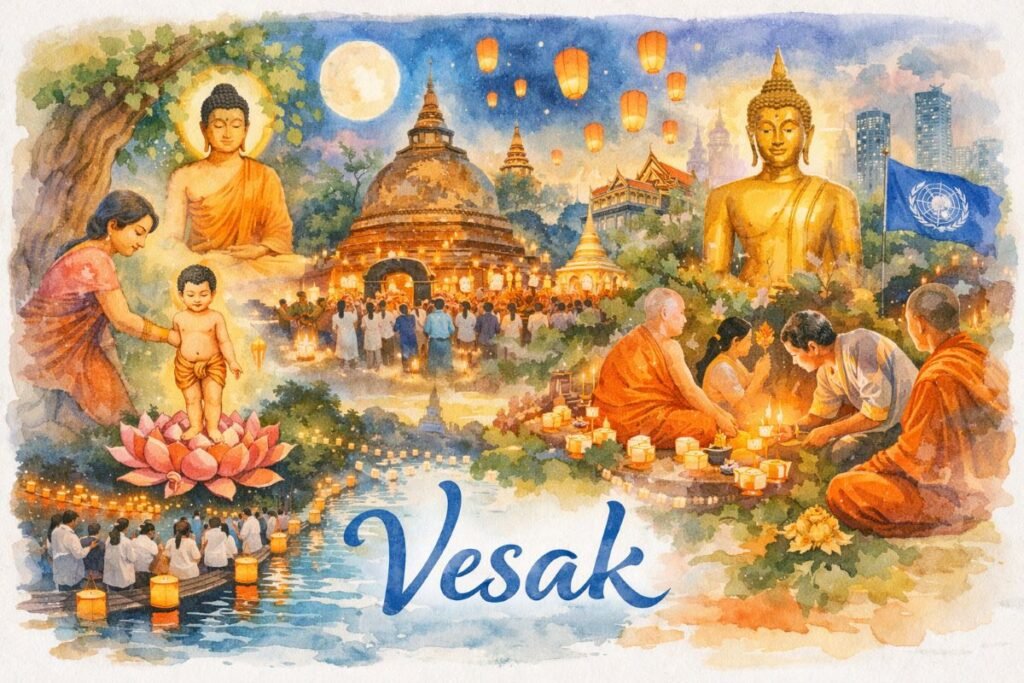
- Vesak is the most significant holy day in the Buddhist calendar, commemorating three pivotal events in the Buddha’s life: his birth, his enlightenment, and his passing into final Nibbāna.
- The festival is observed on the full moon day of the lunar month Vesākha, which usually falls in May.
- Vesak is recognised by the United Nations and celebrated by Buddhists across all major traditions, though with different customs and dates.
- The holiday is not merely a historical commemoration but an invitation to reflect on the Buddha’s teachings and apply them to daily life.
- Observances include meditation, chanting, acts of generosity, observing precepts, and participating in community ceremonies.
- The deeper purpose of Vesak is to inspire personal spiritual development and the cultivation of wisdom, compassion, and ethical conduct.
1. Introduction
Vesak is widely regarded as the most important festival in the Buddhist calendar. Known by various names: Vesākha [Pali], Vaiśākha [Sanskrit], Buddha Pūrṇimā, Buddha Jayanti, Visakha Bucha, or simply Buddha Day, it is a day of profound significance for Buddhists around the world. The holiday commemorates three extraordinary events in the life of the historical Buddha, Siddhattha Gotama (Siddhārtha Gautama): his birth, his attainment of enlightenment, and his final passing away, or parinibbāna [Pali] (parinirvāṇa [Sanskrit]). According to Buddhist tradition, all three of these milestones occurred on the full moon day of the lunar month Vesākha, though in different years. This is a later commentarial tradition rather than a claim found in the early Pāli Canon itself, but it has become the accepted understanding across most Buddhist cultures.
For Buddhists, Vesak is far more than a historical anniversary. It is a time for renewal, a moment to pause from the routines of daily life and reconnect with the core teachings of the Buddha. It is an opportunity to reflect on the nature of suffering, the path to its cessation, and the qualities of wisdom and compassion that the Buddha embodied. The festival invites both communal celebration and personal introspection, blending joyful gatherings with quiet moments of meditation and prayer.
This article explores the origins, spiritual meaning, observances, and regional expressions of Vesak across the Buddhist world. It also considers how the holiday’s teachings and practices can be applied to modern life, offering practical guidance for those who wish to honour the spirit of Vesak in their own daily routines.
2. Origins and Historical Development
2.1 Scriptural Foundations
The precise origins of Vesak as a unified festival are not entirely clear from the early Buddhist scriptures. The holiday is not explicitly mentioned in the earliest canonical sources. However, the three events it commemorates: the birth, enlightenment, and final passing of the Buddha, are well documented in the Pali Canon and other early Buddhist texts.
The birth of a Buddha is described in the Mahāpadāna Sutta (DN 14), which sets out the general pattern of a Buddha’s final birth. The enlightenment narrative is found in several discourses, including the Mahāsaccaka Sutta (MN 36) and the Ariyapariyesanā Sutta (MN 26). The Buddha’s final passing is recorded at length in the Mahāparinibbāna Sutta (DN 16).
The Mahāvaṃsa, a historical chronicle of Sri Lanka composed in the fifth century CE, makes reference to the festival. The Chinese Buddhist pilgrim Faxian, who travelled to India in the early fifth century, also recorded festivals of a similar nature. It is sometimes proposed that the celebration may have been introduced to Sri Lanka with the expansion of Buddhism to the island during the time of the Emperor Ashoka in the third century BCE, though this connection is not strongly evidenced. It is also possible that the festival has older, regional roots that have been lost to history.
The Theravāda Vesak festival in its current form took shape in Sri Lanka during the nineteenth century, a period of Buddhist revival in response to British colonial rule and Christian missionary activity. This revival helped to standardise and popularise the celebration, which then spread to other Theravāda countries.
2.2 The Core Story
The three events commemorated on Vesak are central to the Buddhist narrative.
Birth: Siddhattha Gotama was born into a royal family in the Sakya republic, in what is now Nepal. His mother, Queen Mahāmāyā, gave birth to him in Lumbinī Grove, under the canopy of sal trees. His name, Siddhattha, means “wish fulfilled”. According to later narrative tradition, the baby took seven steps and proclaimed that this was his last birth. This account appears in the Lalitavistara Sūtra and other later texts, rather than in the early discourses.
Enlightenment: At the age of thirty-five, after years of searching and ascetic practice, Siddhattha sat in meditation beneath a Bodhi tree in Bodh Gayā, India. There he attained awakening, becoming the Buddha, the “Awakened One”. Through this awakening he fully understood the Four Noble Truths and discovered the Noble Eightfold Path that leads to liberation. He had freed his mind from the bonds of greed, hatred, and delusion.
Final Passing: At the age of eighty, the Buddha passed away into parinibbāna: the final, unconditioned state beyond birth and death. This occurred in Kusinārā, India. His final words to his disciples were: “All conditioned things are subject to decay. Strive on with diligence.”
2.3 Growth into a Calendar Festival
Over the centuries, Vesak grew from a local observance into a major international festival. In 1950, the World Fellowship of Buddhists made Vesak an international holiday to be celebrated on the first full moon of May. In 1999, the United Nations General Assembly, by its resolution 54/115, recognised Vesak internationally, acknowledging the contribution that Buddhism has made to the spirituality of humanity.
Since then, the United Nations has commemorated Vesak annually at its headquarters and other offices around the world. The recognition by the UN has helped to raise awareness of the holiday and its message of peace, compassion, and universal brotherhood.
3. Spiritual Meaning and Central Teachings
3.1 The Main Dhamma Message
At its heart, Vesak is a celebration of the Dhamma, the teachings of the Buddha. The three events commemorated on this day are not simply historical milestones; they are symbolic of the path that practitioners are invited to follow.
The birth of the Buddha represents the arising of a Buddha in the world, a rare and precious occurrence. For many Buddhists, the Buddha’s birth also serves as a powerful symbol of humanity’s potential for awakening, reminding us that each person has the capacity for wisdom, compassion, and liberation. The enlightenment of the Buddha demonstrates that this potential can be realised through effort, mindfulness, and understanding. The final passing of the Buddha into parinibbāna illustrates the ultimate goal of the Buddhist path: freedom from the cycle of birth, death, and rebirth.
Vesak thus serves as an annual reminder of the path that the Buddha laid out. It is a time to renew one’s commitment to the practice of generosity, ethical conduct, and mental cultivation. As one teacher observed, “Vesak is not only a time for celebration, but also a time for reflection”. It invites people to foster peace within their families, communities, and societies through the teachings of the Buddha.
3.2 Symbolism and Its Practical Lesson
Many of the rituals and symbols associated with Vesak carry deep spiritual meaning. Some of these observances, such as the bathing of the Buddha statue, are post-canonical developments that arose in later centuries and were adopted across various Buddhist traditions.
Flowers are commonly offered at shrines and temples. They are beautiful but short-lived, wilting and fading within hours or days. This serves as a vivid reminder of anicca, the Buddhist teaching of impermanence. All things, including our own bodies and experiences, are subject to change and decay. The offering of flowers is not for the Buddha’s benefit but for the practitioner’s own reflection.
Candles and oil lamps are lit to symbolise the light of wisdom dispelling the darkness of ignorance. The act of lighting a lamp can be seen as a commitment to cultivating understanding and clarity in one’s own mind. In the Light Transference ceremony, the flame is passed from person to person, illustrating that wisdom can be shared without diminishing the source.
Incense is often burned as an offering, its fragrance spreading through the air. This symbolises the spread of good qualities: kindness, compassion, and virtue, throughout the world.
Bathing the Buddha is a ceremony in which devotees pour perfumed water over a statue of the infant Prince Siddhattha. This act symbolises the symbolic purification of one’s own unwholesome thoughts and actions, and the aspiration to cleanse the mind of defilements. This ritual, which originated in East Asian Mahāyāna traditions and was later adopted in some Theravāda contexts, is a post-canonical development.
The Bodhi tree is also a powerful symbol. The tree under which the Buddha sat is a living reminder of the possibility of awakening. Watering the Bodhi tree, as practised in some countries, symbolises nurturing the seeds of wisdom and compassion within one’s own mind.
The full moon itself carries meaning. In Buddhist tradition, the full moon is associated with completeness and clarity. Many significant events in the Buddha’s life, including his renunciation, his first sermon, and the convening of the first council, are said to have occurred on full moon days. The full moon of Vesākha thus represents a particularly auspicious moment for spiritual practice.
These symbols are not mere ritualistic gestures. They are practical tools for training the mind and cultivating wholesome qualities. Each offers a tangible way to reflect on the Buddha’s teachings and to bring them into one’s own experience.
3.3 Frameworks for Understanding
Vesak can be understood through several key Buddhist frameworks that provide structure for both the celebration and the spiritual life.
The Threefold Training (tisikkhā): The Buddha’s path is often summarised as three interconnected trainings: ethical conduct (sīla), mental development (samādhi), and wisdom (paññā). Vesak observances typically include elements of all three: observing precepts (ethical conduct), meditation and chanting (mental development), and listening to Dhamma talks (wisdom).
The Four Noble Truths: These are the foundation of the Buddha’s teaching. They describe the nature of suffering, its origin, its cessation, and the path to its cessation. Vesak is an opportunity to reflect on these truths and to consider how they apply to one’s own life.
The Noble Eightfold Path: This is the practical guide to ending suffering, comprising right view, right intention, right speech, right action, right livelihood, right effort, right mindfulness, and right concentration. The practices of Vesak, generosity, ethical restraint, meditation, and study—are all expressions of this path.
The Triple Gem (Tiratana): Buddhists take refuge in the Buddha, the Dhamma, and the Saṅgha (the community of monastics and noble disciples). Vesak is a time to reaffirm this refuge and to express gratitude for the guidance these three gems provide.
Dependent Origination (paṭiccasamuppāda): Vesak is often used as an occasion to reflect on this central teaching, which explains how suffering arises through a chain of causes and conditions, and how it can be brought to an end. This framework encourages practitioners to examine their own lives and identify the causes of their difficulties.
Merit (puñña): The concept of merit is central to traditional Vesak observance. Merit refers to the wholesome karmic results that arise from generous, ethical, and meditative actions. Making merit on Vesak, through giving, observing precepts, and meditating, is understood to bring blessings in this life and to support progress on the path. While merit-making is not the ultimate goal of Buddhism, it is an important aspect of lay practice that creates favourable conditions for spiritual development.
4. How the Holiday Is Observed
4.1 Temple and Monastic Practices
Temples and monasteries are the focal points of Vesak celebrations. In many communities, the day begins before dawn with the hoisting of the Buddhist flag. The flag, with its six vertical stripes of blue, yellow, red, white, orange, and a combination of these colours, symbolises the six colours of the aura that radiated from the Buddha.
Monks and nuns lead chanting and recitation of scriptures. The Maṅgala Sutta (Discourse on Blessings), the Ratana Sutta (Discourse on the Jewels), and the Metta Sutta (Discourse on Loving-Kindness) are among the texts commonly chanted. However, the specific texts vary from region to region; some traditions also chant the Dhammacakkappavattana Sutta, the Bojjhaṅga Suttas, or the Jayamaṅgala Gāthā. These suttas are believed to bring protection and blessings, and their recitation helps to establish a peaceful and harmonious atmosphere.
Dhamma talks are given by monastics or senior lay teachers, exploring the life of the Buddha, the significance of Vesak, and the practical application of Buddhist teachings. These talks are often followed by periods of meditation, allowing participants to deepen their understanding through direct experience.
In some traditions, the uposatha observance is held, during which laypeople take the Eight Precepts for the day. These precepts include abstaining from killing, stealing, sexual activity, false speech, intoxicants, eating after midday, entertainment and adornment, and using high or luxurious beds. Observing these precepts is a way of simplifying one’s life and focusing on spiritual practice. The Eight Precepts are not commandments but voluntary commitments undertaken for one day as a form of spiritual discipline. They help practitioners develop mindfulness, contentment, and a deeper appreciation for the simplicity of monastic life.
4.2 Lay Observances
For lay Buddhists, Vesak is a day of heightened spiritual activity. Many choose to visit the temple, make offerings, and participate in ceremonies. Others may observe the day at home, engaging in meditation, chanting, and reading of scriptures.
Generosity (dāna) is a cornerstone of Vesak observance. Buddhists bring food, flowers, incense, and other supplies to the temple as offerings to the monastics. This act of giving is not only a gesture of support for the monastic community but also a practice of letting go of attachment and cultivating a generous heart. On Vesak morning in many Sri Lankan and Southeast Asian communities, there is a tradition of preparing and offering milk-rice (kīribath in Sri Lanka), which commemorates the nourishing meal offered by the laywoman Sujātā to the ascetic Gotama just before his enlightenment.
Observing the Five Precepts is another common practice. These are the basic ethical guidelines for lay Buddhists: abstaining from taking life, taking what is not given, sexual misconduct, false speech, and intoxicants. By observing these precepts, practitioners commit to a day of harmless and mindful living.
Vegetarian meals are often consumed on Vesak, reflecting the value of non-harming and compassion for all living beings. Many temples provide free vegetarian meals to visitors, fostering a sense of community and shared practice.
Charitable deeds are also encouraged. This may include donating to those in need, volunteering at a community organisation, or simply offering kindness and assistance to others. Some Buddhists release captive animals, such as fish or birds, as an act of compassion, though this practice is increasingly viewed with caution due to ecological concerns, as it can harm local ecosystems and cause suffering to the released animals.
Making merit is a pervasive theme throughout these activities. Whether through giving, ethical conduct, or meditation, each action is understood to generate wholesome karmic results. While the ultimate goal is Nibbāna, the accumulation of merit is seen as a supportive and beneficial practice for laypeople, creating conditions for happiness and further spiritual progress.
4.3 Community and Family Customs
Vesak is also a time for community and family gatherings. In many countries, streets and homes are decorated with lights, lanterns, and flags. The lighting of lanterns symbolises the illumination of wisdom and the dispelling of darkness.
Processions are a common feature of Vesak celebrations. Devotees may walk around the temple or shrine three times, carrying flowers, incense, and candles. This act, known as circumambulation, is a gesture of respect and devotion.
In Sri Lanka, dansal (free food stalls) are set up along roadsides, offering food and drink to all passers-by, regardless of their religion or background. This practice embodies the spirit of generosity and hospitality that is central to the festival.
In Thailand, the wian tian ceremony involves a candlelight procession around the temple’s main hall. Participants walk in silence, holding candles, flowers, and incense, as a way of paying homage to the Triple Gem.
Family gatherings are also important. Families may come together to prepare vegetarian meals, visit the temple, or engage in quiet reflection. For children, Vesak can be an opportunity to learn about the life of the Buddha and the values of kindness, honesty, and generosity.
4.4 Liturgical Timing and the Lunar Calendar
Vesak is observed on the full moon day of the lunar month Vesākha, which is the fourth month of the traditional Indian lunar calendar. In the Gregorian calendar, this usually falls in May, though it can sometimes occur in April or June.
The date varies from year to year and from country to country, depending on local calendar traditions and astronomical calculations. In 2026, for example, Vesak falls on 30 April in Myanmar, 1 May in Cambodia, India, and Laos, 30 May in Sri Lanka, and 31 May in Indonesia, Malaysia, Singapore, Thailand, and Mongolia.
In East Asian Mahāyāna traditions, the Buddha’s birthday is often celebrated on the eighth day of the fourth lunar month, rather than on the full moon. This date is known as Hanamatsuri in Japan. In these traditions, the emphasis is primarily on the birth of the Buddha, though the other two events are also acknowledged.
Tibetan Buddhists follow the Phugpa calendar system, which often results in Saga Dawa falling on a different date than the Theravāda Vesak. In Japan, the Gregorian calendar date of 8 April is used, which is not tied to the lunar cycle at all.
The diversity of dates reflects the rich tapestry of Buddhist cultures and the different ways in which the lunar calendar is interpreted and applied. Despite these variations, the underlying significance of the holiday remains the same: a joyous celebration of the Buddha’s life and teachings.
5. Regional Expressions Across Buddhist Schools
Vesak is celebrated by Buddhists across all major traditions, Theravāda, Mahāyāna, and Vajrayāna, though the customs and emphases vary. It is worth noting that the unification of the three events into a single holiday is primarily a Theravāda feature; Mahāyāna traditions often observe the Buddha’s birth, enlightenment, and passing on separate dates.
5.1 Theravāda Traditions
In Theravāda countries: Sri Lanka, Thailand, Myanmar, Cambodia, Laos, and others, Vesak is observed with great devotion and is often a public holiday.
Sri Lanka: Vesak is the most significant Buddhist festival in Sri Lanka. The day is marked by religious observances at temples, including the observance of the Eight Precepts, meditation, and listening to Dhamma talks. In the evening, homes and streets are illuminated with lanterns and oil lamps. Dansal stalls offer free food and drink to all, embodying the spirit of generosity. Elaborate pandals (decorated structures) depict scenes from the life of the Buddha. The offering of milk-rice (kīribath) in the morning is a common custom.
Thailand: Known as Visakha Bucha Day, it is a national holiday. Buddhists visit temples, make offerings, and participate in the wian tian candlelight procession. Observing the Five Precepts is emphasised, and many people refrain from alcohol and meat.
Myanmar: The festival is called Kasone-la-pyae, meaning “Full Moon Day of Kasone”. It is a time for watering the Bodhi tree, a practice that symbolises nurturing the seeds of enlightenment.
Cambodia and Laos: Known as Visak Bochea in Cambodia and Vixakha Bouxa in Laos, the day is observed with temple visits, chanting, and acts of merit.
5.2 Mahāyāna Traditions
In Mahāyāna countries: China, Japan, Korea, Vietnam, and others, the focus is often on the Buddha’s birth, though the other two events are also acknowledged. The enlightenment is sometimes observed separately on a different date, and the passing is often commemorated on the fifteenth day of the second lunar month.
China and Korea: The Buddha’s birthday is celebrated on the eighth day of the fourth lunar month. Temples are decorated with lanterns and flowers, and devotees participate in bathing the Buddha ceremony. Vegetarian meals are commonly prepared.
Japan: Known as Hanamatsuri (Flower Festival), it is celebrated on 8 April in the Gregorian calendar. A unique custom is the pouring of amacha (sweet tea made from hydrangea leaves) over a statue of the infant Buddha. This is done in imitation of the heavenly beings who, according to tradition, showered the newborn prince with fragrant waters.
Vietnam: Called Phat Dan, it is celebrated on the eighth day of the fourth lunar month. The day is marked by temple visits, flower offerings, and the release of captive animals.
5.3 Vajrayāna Traditions
In Vajrayāna countries: Tibet, Mongolia, and parts of the Himalayas, Vesak is also observed, often under the name Saga Dawa. In these traditions, the three events are commemorated together, similar to the Theravāda practice, though the calendar calculation differs.
Tibet: Saga Dawa commemorates the birth, enlightenment, and parinirvāṇa of the Buddha. The entire fourth month of the Tibetan calendar is considered sacred, with the full moon day being the most important. Devotees engage in pilgrimage, circumambulation of sacred sites, and the practice of generosity. Many Tibetan Buddhists observe vegetarianism during this month as an expression of compassion.
Mongolia: Vesak is celebrated by Buddhists in Mongolia, where it is among the most important festivals. Vajrayāna practices, including tantric rituals and the recitation of mantras, are often incorporated into the celebrations.
5.4 The Holiday in Global and Western Contexts
As Buddhism has spread to the West, Vesak has taken on new forms and meanings. In many Western countries, Buddhist communities, often comprising multiple traditions, come together to celebrate Vesak as a shared event.
The United States has seen a growing recognition of Vesak. In 2021, President Joe Biden became the first US president to host a formal Vesak celebration at the White House. This event brought together representatives from Theravāda, Mahāyāna, and Vajrayāna traditions. The celebration highlighted the growing recognition of Buddhist cultural and spiritual traditions in the United States.
In Europe, Vesak is celebrated by Buddhist communities in countries such as the United Kingdom, Germany, and France. These celebrations often reflect the diversity of the Buddhist population, incorporating elements from various traditions. Interfaith events are also common, with Buddhists inviting members of other faiths to join in the celebrations.
The global spread of Vesak has also led to increased interest in the holiday among non-Buddhists. Many people are drawn to its message of peace, compassion, and mindfulness, and find value in its practices regardless of their own religious background.
6. Relevance for Modern Life and Daily Application
Vesak is not merely a historical commemoration or a cultural festival. It offers a wealth of practical wisdom that can be applied to the challenges of modern life. The teachings and practices associated with Vesak provide a framework for living with greater mindfulness, compassion, and ethical integrity.
6.1 Cultivating the Holiday’s Quality at Home
The spirit of Vesak can be cultivated in daily life, not just on the holiday itself. Here are some practical ways to bring the qualities of Vesak into your home and routine:
Mindfulness and Meditation: Set aside time each day for quiet reflection or meditation. Even five or ten minutes of mindfulness can help to calm the mind and cultivate awareness. During Vesak, many Buddhists engage in extended meditation; you can adopt a shorter version of this practice as a daily habit. A specific meditation practice associated with Vesak is Buddhānussati, the recollection of the Buddha’s qualities, reflecting on his wisdom, compassion, and purity as an inspiration for one’s own practice.
Ethical Conduct: Observe the Five Precepts as a guide for daily living. Refrain from harming living beings, stealing, sexual misconduct, false speech, and intoxicants. These precepts are not rigid rules but practical guidelines for living in harmony with others and with oneself.
Generosity: Practice generosity in small ways. This could be offering a kind word, giving a gift, donating to a charity, or volunteering your time. The act of giving helps to loosen attachment and cultivate a generous heart.
Simplification: During Vesak, many Buddhists wear simple clothing and eat humble meals. Consider adopting a simpler lifestyle, even for a day. This can help to reduce stress and create space for what truly matters.
Reflection: Take time to reflect on the Buddha’s teachings. Read a sutta, listen to a Dhamma talk, or journal about your own spiritual journey. This practice helps to integrate the teachings into your daily experience.
Recollection of the Saṅgha: Vesak is also an occasion to appreciate the role of the monastic community in preserving and transmitting the Dhamma for over 2,500 years. Reflecting on this can inspire gratitude and a sense of connection to the wider Buddhist tradition.
6.2 Navigating Challenges with the Holiday’s Wisdom
The Buddha’s teachings, which are central to Vesak, offer guidance for navigating the challenges of modern life.
Suffering and Its Causes: The First Noble Truth acknowledges that suffering (dukkha) is an inherent part of existence. This is not a pessimistic view but a realistic one. Recognising suffering allows us to address its causes rather than denying or avoiding them. In modern life, this might mean acknowledging stress, anxiety, or dissatisfaction and taking steps to understand and alleviate them.
Impermanence: The teaching of impermanence (anicca) is a reminder that all things change. This can be a source of both challenge and liberation. When we cling to things that are impermanent, we suffer. When we accept change, we find freedom. In daily life, this might mean letting go of attachments to outcomes, possessions, or even relationships that have run their course.
Compassion: The Buddha’s teachings emphasise compassion (karuṇā) for all beings. In a world marked by division and conflict, compassion is a powerful antidote. Practising compassion might mean offering a listening ear to a friend, volunteering for a cause, or simply being kind to strangers.
Mindful Consumption: The practice of vegetarianism during Vesak is a reminder to consume mindfully. In modern life, this might extend to what we eat, what we buy, and what media we consume. Mindful consumption means being aware of the impact of our choices on craving and attachment, as well as on ourselves, others, and the environment.
Community: Vesak is a communal celebration, reminding us of the importance of community. In a time of increasing isolation, building and maintaining connections with others is more important than ever. This might mean joining a meditation group, participating in community events, or simply reaching out to neighbours and friends.
Heedfulness (appamāda): The Buddha’s final injunction, “Strive on with diligence”, is a call to heedfulness. This quality of being mindful, alert, and conscientious is the foundation of all spiritual practice. In daily life, heedfulness means paying attention to our actions, words, and thoughts, and making choices that lead to well-being rather than harm.
6.3 Social and Environmental Dimensions
The spirit of Vesak extends beyond personal practice to social and environmental concerns. The Buddha’s teachings on compassion, non-harming, and interdependence have profound implications for how we relate to the world.
Social Justice: The practice of generosity and compassion during Vesak can inspire action on social issues. Buddhists are increasingly involved in efforts to address poverty, inequality, and injustice. The holiday serves as a reminder that spiritual practice and social engagement are not separate but interconnected.
Environmental Stewardship: The principle of non-harming (ahiṃsā) extends to the natural world. Vesak can be a time to reflect on our relationship with the environment and to take action to protect it. This might mean reducing waste, conserving resources, or supporting environmental causes.
Interfaith Understanding: Vesak is increasingly celebrated as an interfaith event, with people of different traditions coming together to honour the Buddha’s message of peace. This spirit of openness and dialogue is a model for building understanding across religious and cultural divides.
Global Citizenship: The United Nations’ recognition of Vesak highlights the holiday’s relevance to global issues. The Buddha’s teachings on compassion, peace, and the interconnectedness of all beings offer a vision for a more just and sustainable world.
7. Common Misunderstandings and Clarifications
As with any major religious festival, there are some common misunderstandings about Vesak that are worth clarifying.
Misunderstanding 1: Vesak is only about the Buddha’s birthday.
While Vesak is sometimes called “Buddha’s Birthday,” it actually commemorates three events: birth, enlightenment, and final passing. In some Mahāyāna traditions, the birth is emphasised, but the full significance of Vesak encompasses all three milestones.
Misunderstanding 2: The Buddha is a god.
The Buddha was a human being who attained enlightenment through his own effort. He is not a god, nor does he ask to be worshipped. The offerings made during Vesak are expressions of gratitude and respect, not acts of worship in the theistic sense.
Misunderstanding 3: Vesak is a sombre occasion.
While Vesak includes moments of quiet reflection, it is generally a joyous celebration. The birth of the Buddha, his enlightenment, and his final liberation are all occasions for rejoicing.
Misunderstanding 4: The rituals are empty gestures.
The rituals of Vesak: offering flowers, lighting lamps, bathing the Buddha, are not empty rituals. They are designed to cultivate specific mental qualities: mindfulness, generosity, compassion, and wisdom. When performed with understanding, they are powerful tools for spiritual development.
Misunderstanding 5: Vesak is only for Buddhists.
While Vesak is a Buddhist holiday, its message of peace, compassion, and mindfulness has universal appeal. People of all faiths and none can appreciate and learn from the values that Vesak embodies.
Misunderstanding 6: The “all three events on one day” tradition is found in the early scriptures.
As noted earlier, this is a later commentarial tradition rather than a claim found in the early Pāli Canon. The early discourses record the birth, enlightenment, and passing as separate historical events without linking them to the same calendar date. The unification of these events is a development of later Buddhist tradition.
Misunderstanding 7: The bathing of the Buddha is an ancient practice.
While bathing ceremonies are now widespread, they originated in East Asian Mahāyāna traditions and are not found in the early Buddhist texts. They are a later devotional practice that has been adopted in various Buddhist cultures.
8. Conclusion
Vesak is a festival of profound significance in the Buddhist world, commemorating the birth, enlightenment, and final passing of the Buddha. It is a time for reflection, renewal, and rejoicing, a moment to pause from the busyness of daily life and reconnect with the core teachings of the Dhamma.
The holiday’s observances: meditation, chanting, acts of generosity, and ethical conduct, are not mere rituals but practical tools for cultivating the qualities that lead to peace and liberation. The symbols of Vesak, from flowers to candles, offer vivid reminders of impermanence, wisdom, and compassion. The full moon reminds us of clarity and completeness, the Bodhi tree symbolises the possibility of awakening, and the tradition of merit-making encourages us to act with generosity and kindness.
Across the diverse traditions of Buddhism: Theravāda, Mahāyāna, and Vajrayāna, Vesak is celebrated with unique customs and emphases, yet the underlying spirit remains the same: a joyous homage to the Buddha and his teachings, and a renewed commitment to the path he laid out. The monastic community’s role in preserving these teachings is honoured, and the lay community’s practice of generosity supports the continuation of the Dhamma for future generations.
In a world marked by division, stress, and uncertainty, the message of Vesak is as relevant as ever. The Buddha’s teachings on mindfulness, compassion, and the interconnectedness of all beings offer a practical and hopeful vision for navigating the challenges of modern life. Whether through meditation, acts of kindness, or simply taking a moment to reflect, each of us can honour the spirit of Vesak in our own way.
As the United Nations Secretary-General António Guterres observed: “Guided by the Buddha’s example, let us summon our shared humanity and build the more peaceful and sustainable world all people need and deserve”. May the spirit of Vesak inspire us all to live with greater wisdom, compassion, and peace.
Glossary
Terms are listed alphabetically. Pali forms are given first, with Sanskrit in parentheses where relevant.
Anicca (Sanskrit: anitya): Impermanence. The Buddhist teaching that all conditioned phenomena are subject to change and decay.
Appamāda: Heedfulness, diligence, or vigilance. The quality of being mindful and conscientious, emphasised in the Buddha’s final words.
Bodhi: Awakening or enlightenment. The state of perfect understanding attained by the Buddha.
Bodhi tree: The sacred fig tree under which the Buddha attained enlightenment.
Buddha: “Awakened One.” A title given to Siddhattha Gotama, who attained enlightenment and taught the path to liberation.
Buddhānussati: Recollection of the Buddha. A meditation practice involving reflection on the nine supreme qualities of the Buddha.
Dāna: Generosity or giving. The practice of offering material goods, time, or kindness to others.
Dhamma (Sanskrit: Dharma): The teachings of the Buddha; also, the universal truth or law that the teachings reveal.
Dukkha (Sanskrit: duḥkha): Suffering, unsatisfactoriness, or stress. The First Noble Truth acknowledges that dukkha is an inherent part of conditioned existence.
Five Precepts: The basic ethical guidelines for lay Buddhists: abstaining from killing, stealing, sexual misconduct, false speech, and intoxicants.
Four Noble Truths: The foundational teaching of the Buddha: the truth of suffering, the truth of its origin, the truth of its cessation, and the truth of the path to its cessation.
Karuṇā: Compassion. The quality of wishing to relieve the suffering of others.
Mahāyāna: “Great Vehicle.” One of the major branches of Buddhism, prevalent in East Asia.
Metta (Sanskrit: maitrī): Loving-kindness. The quality of wishing for the happiness and well-being of all beings.
Nibbāna (Sanskrit: Nirvāṇa): The unconditioned state beyond birth, death, and suffering; the ultimate goal of the Buddhist path.
Noble Eightfold Path: The practical guide to ending suffering, comprising right view, right intention, right speech, right action, right livelihood, right effort, right mindfulness, and right concentration.
Pali: The language of the Theravāda Buddhist scriptures.
Parinibbāna (Sanskrit: Parinirvāṇa): The final passing away of the Buddha into Nibbāna, the state beyond rebirth.
Paṭiccasamuppāda (Sanskrit: Pratītyasamutpāda): Dependent Origination. The teaching that all phenomena arise in dependence on causes and conditions.
Puñña (Sanskrit: Puṇya): Merit. Wholesome karmic results arising from generous, ethical, and meditative actions.
Sanskrit: The classical language of ancient India, used in many Mahāyāna Buddhist texts.
Saṅgha: In its earliest doctrinal usage, the Saṅgha refers to the community of noble disciples who have attained stages of awakening. In common modern usage, it often refers to the monastic community (monks and nuns) and, more broadly, the wider Buddhist community.
Siddhattha Gotama (Sanskrit: Siddhārtha Gautama): The historical Buddha.
Sutta (Sanskrit: Sūtra): A discourse or teaching attributed to the Buddha.
Theravāda: “Teaching of the Elders.” One of the major branches of Buddhism, prevalent in South and Southeast Asia.
Triple Gem (Tiratana): The three refuges of Buddhism: the Buddha, the Dhamma, and the Saṅgha.
Uposatha: A day of observance, typically on the full moon and new moon, when lay Buddhists may observe additional precepts and engage in intensified practice.
Vajrayāna: “Diamond Vehicle.” One of the major branches of Buddhism, prevalent in Tibet and Mongolia.
Vesākha (Sanskrit: Vaiśākha): The lunar month in which Vesak is celebrated; also the name of the festival itself.
Resources for Further Exploration
- Access to Insight – A comprehensive online library of Theravāda Buddhist texts: accesstoinsight.org
- Buddhist Digital Resource Center – A vast collection of Buddhist scriptures and texts: buddhistdigitalresources.org
- Tricycle: The Buddhist Review – A magazine offering teachings, news, and perspectives on Buddhist practice: tricycle.org
- Lion’s Roar – A publication featuring Buddhist teachings and contemporary applications: lionsroar.com
- Buddhistdoor Global – News and features from the Buddhist world: buddhistdoor.net
- Dhammatalks.org – Free audio and text resources on Theravāda Buddhism: dhammatalks.org
- SuttaCentral – A comprehensive, multilingual collection of early Buddhist texts: suttacentral.net