Key Takeaways
- The Resultant Vehicle: Vajrayāna is defined as the “Resultant Vehicle” because it takes the goal — Buddhahood — as the path itself, utilising the innate Buddha Nature as the primary tool for transformation, as taught in the Guhyasamāja Tantra.
- Esoteric Methodology: It employs “skillful means” including deity yoga, mantras, mudras, and mandalas to transmute ordinary perception and negative emotions into enlightened wisdom, as elaborated in the Hevajra Tantra.
- The Guru-Disciple Bond: Success in the tantric path is predicated on the guidance of a qualified Guru and the receipt of formal empowerments to “ripen” the practitioner’s mindstream, a principle enshrined across all major schools of Tibetan Buddhism.
- Four Major Lineages: The tradition is preserved through the Nyingma, Kagyu, Sakya, and Gelug schools, each maintaining unique specialised systems like Dzogchen and Mahamudra.
- Rapid Awakening: Unlike the gradual path of the sutras, Vajrayāna is designed to achieve full enlightenment in a single human lifetime, as elaborated in the Kālacakra Tantra tradition.
- Esoteric Transmission: Vajrayāna teachings are considered restricted, requiring authorisation and suitable preliminaries before one can engage with them.
- Transformation, Not Rejection: Rather than renouncing the world, Vajrayāna teaches practitioners to recognise the world as already sacred and to use all experiences as fuel for awakening.
1. Introduction: The Nature of the Diamond Vehicle
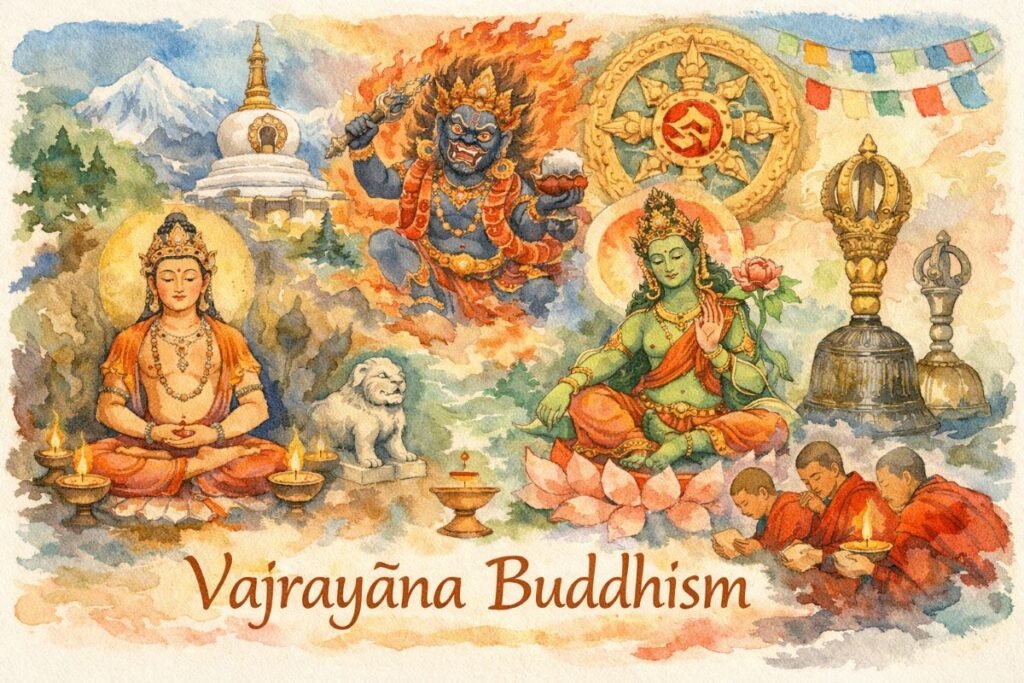
Vajrayāna Buddhism, also known as Tantric Buddhism, the Mantrayāna, or the “Diamond Way,” represents a sophisticated and dynamic phase of Buddhist development that emerged in India around the 5th to 7th centuries CE. The term Vajra signifies both a diamond’s indestructibility and a thunderbolt’s irresistible power to shatter the illusions of the ordinary mind. While it shares the Mahāyāna goal of universal liberation through compassion and wisdom, Vajrayāna introduces esoteric “inner technologies” designed to accelerate this process dramatically.
The word “Vajrayāna” combines two Sanskrit terms: vajra (diamond or thunderbolt) and yāna (vehicle or path). The diamond metaphor points to the indestructible nature of the awakened mind — once the nature of reality is directly perceived, it cannot be lost or destroyed. The thunderbolt represents the direct, penetrating quality of tantric methods that cut through delusion without hesitation. This vehicle is sometimes called the “Resultant Vehicle” because it takes the outcome of practice — Buddhahood — and uses it as the method itself, as explained in the Guhyasamāja Tantra, one of the most important scriptures of tantric Buddhism. Instead of gradually cultivating qualities that lead to enlightenment, the practitioner visualises themselves as already enlightened and acts accordingly.
Some Vajrayāna traditions — particularly those that emphasise Tathāgatagarbha and luminosity teachings — regard the tantric path as connected with the Third Turning of the Wheel of Dharma. Others classify Vajrayāna as a distinct esoteric vehicle built upon the Mahāyāna foundations, beyond the three turnings altogether. Both positions are found within the tradition. What is universally affirmed is that Vajrayāna does not replace the teachings of the First and Second Turnings but presupposes and builds upon them. It is the dominant form of Buddhism in Tibet, Bhutan, Mongolia, and parts of Japan (Shingon), viewing the mundane world as ultimately inseparable from enlightenment. Rather than renouncing the world entirely, Vajrayāna practitioners learn to recognise it as already luminous in its essential nature.
For the modern practitioner, Vajrayāna offers tools to work with the mind’s energies directly, transforming challenging emotions into sources of wisdom rather than causes of suffering. This makes it particularly relevant for those who wish to integrate spiritual practice into busy, contemporary lives. The path invites us not to escape but to engage, not to reject but to transform, not to wait but to act now for the benefit of all.
2. Historical Genesis and Development
2.1 The Indian Mahāsiddha Tradition
Vajrayāna emerged gradually within Indian Mahāyāna Buddhism, shaped decisively by the movement of the Mahāsiddhas (“Great Adepts”) — non-conformist yogis who emphasised direct engagement with the body, emotions, and the phenomenal world. Scholars generally understand this emergence as a gradual development from Mahāyāna communities, ritual traditions, and the growing body of Tantras, a genre of esoteric literature that reinterpreted early Buddhist themes into a complex system of symbols and practices. These wandering masters, often from lower social classes, intensified and systematised this development, and by the 8th century their successors had carried the teachings into Tibet, China, and Japan.
Key figures in this tradition include:
- Saraha: An arrow-maker who composed dohās (songs of realisation) that remain foundational texts in the Mahamudra lineage. His songs express the non-dual nature of mind in simple, direct language.
- Nāgārjuna: Although known for his Madhyamaka philosophy, he is also associated with tantric works and is considered central to the Guhyasamāja Tantra system.
- Virūpa: A great adept who established the Sakya lineage’s foundational Lamdré teachings, demonstrating the power of realisation over physical phenomena.
- Tilopa and Naropa: Two Indian masters who transmitted the Kagyu lineage. Tilopa received teachings directly from wisdom ḍākinīs, while Naropa, a great scholar, underwent severe trials to receive the transmission. Their lineage is preserved at the official Karmapa website.
2.2 The Two Disseminations in Tibet
The history of Vajrayāna in Tibet is divided into two major periods:
The Early Dissemination (7th–9th Century):
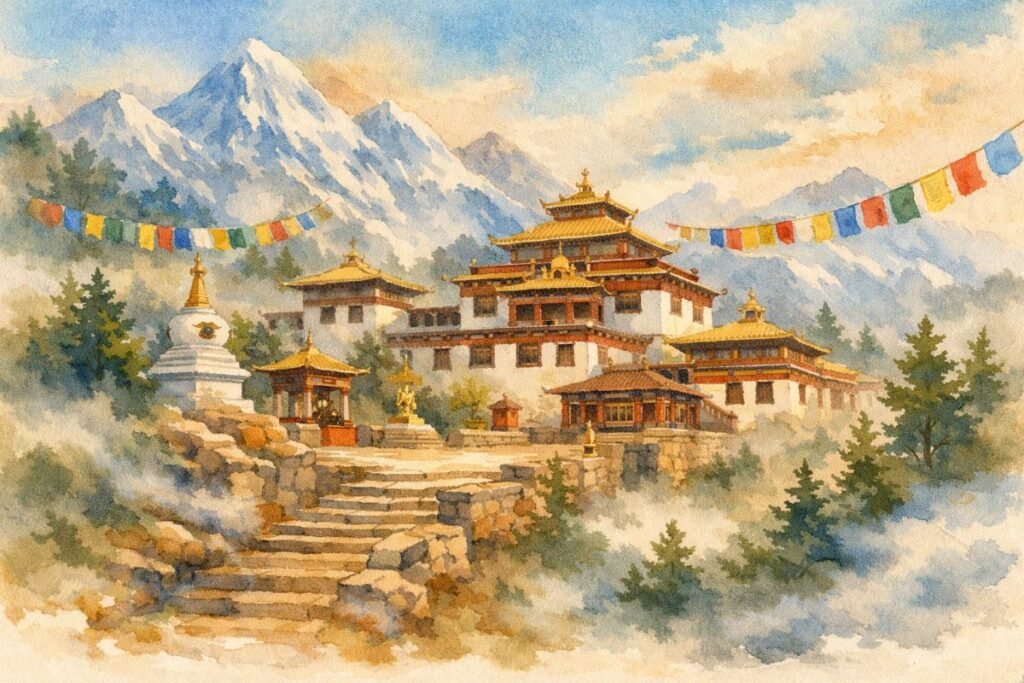
King Trisong Detsen invited the tantric master Padmasambhava (Guru Rinpoche) and the scholar Śāntarakṣita to Tibet. They founded Samye Monastery, the first Buddhist monastery in Tibet, and established the Nyingma (“Ancient”) school. During this period, many tantras were translated from Sanskrit into Tibetan, forming the basis of the Kangyur and Tengyur. Padmasambhava also concealed numerous teachings as terma (hidden treasures) to be discovered by future masters.
The Later Dissemination (10th Century Onward):
Following a period of decline, new lineages emerged from the “New Translations” of Indian texts. This era saw the arrival of the Bengali master Atiśa, whose Lamp for the Path to Enlightenment became the foundation for the Kadam school, which later evolved into the Gelug tradition. The later dissemination brought more systematic and scholastic approaches to tantric practice, with masters like Marpa the Translator bringing back texts on Mahamudra and the Six Yogas of Naropa.
2.3 The Spread to Other Regions
Beyond Tibet, Vajrayāna spread to:
- China: During the Tang dynasty, tantric teachings were transmitted by masters like Vajrabodhi and Amoghavajra, though the tradition later declined.
- Japan: Kūkai (Kōbō Daishi) brought the teachings to Japan in the 9th century, establishing the Shingon school. The Tendai school also incorporates esoteric elements.
- Mongolia and the Himalayan regions: Vajrayāna remains a vibrant tradition in these areas, with deep historical roots in Tibetan Buddhism.
3. The Buddhist Schools of Vajrayāna
Vajrayāna Buddhism belongs to the Mahāyāna branch of Buddhism, which emphasises the aspiration to achieve enlightenment for the benefit of all sentient beings. Within Mahāyāna, Vajrayāna is considered a distinct vehicle with its own texts, practices, and lineages. A comprehensive overview of how these relate is available at Encyclopedia of Buddhism’s Tibetan Buddhism entry.
3.1 Tibetan Buddhist Schools
The most well-known form of Vajrayāna is Tibetan Buddhism, which comprises four major schools:
- Nyingma: The “Ancient” school, founded in the 8th century by Padmasambhava and Śāntarakṣita. It emphasises Dzogchen (Great Perfection) and the discovery of terma (hidden treasures). The Nyingma school is known for its Nine Yānas (vehicles) classification, which places Dzogchen at the summit.
- Kagyu: The “Oral Lineage,” tracing its origins to the Indian masters Tilopa, Naropa, and the Tibetan translator Marpa. It is known for Mahamudra (Great Seal) and the Six Yogas of Naropa. The Kagyu school has many sub-lineages, including the Karma Kagyu (headed by the Karmapas) and the Drikung Kagyu.
- Sakya: Renowned for scholastic rigour and the “Path and Its Fruit” (Lamdré) system. It emerged in the 11th century under the guidance of Khön Könchok Gyalpo. The Sakya school is known for its Hevajra Tantra practices and its emphasis on the three visions: impure, experiential, and pure.
- Gelug: The newest and largest school, founded by Tsongkhapa in the 14th century. It emphasises the Graduated Path (Lamrim) and rigorous monastic discipline. The Gelug school is known for its scholarship, debate traditions, and the system of the Dalai Lamas and Panchen Lamas.
3.2 Japanese Esoteric Buddhism
Beyond Tibet, Vajrayāna traditions exist in Japan, including:
- Shingon: Founded by Kūkai (Kōbō Daishi) in the 9th century, based on the Mahāvairocana Tantra. It is one of the few remaining forms of East Asian tantric Buddhism. Shingon emphasises the Two Mandalas (Taizōkai and Kongōkai) and the practice of Sokushin Jōbutsu (attaining Buddhahood in this very body).
- Tendai: While primarily a Mahāyāna school, it incorporates esoteric elements and practices introduced from China. Tendai is known for its comprehensive system of study and practice.
3.3 Newar Buddhism
In Nepal, the Newar community preserves a unique form of Vajrayāna that predates Tibetan influence. This tradition maintains ancient Sanskrit texts and rituals not found elsewhere. Newar Buddhism is largely non-monastic, with practitioners known as Vajrācāryas performing rituals for the community. It is a living link to the Indian tantric tradition.
3.4 Common Threads
Despite their differences, all Vajrayāna schools share certain features: acceptance of the Tantras as canonical scriptures; reliance on lineage transmission and the guidance of a qualified teacher; use of esoteric methods including mantra, mudra, and visualisation; the view that enlightenment can be achieved in a single lifetime; and emphasis on the inseparable nature of emptiness and appearance. The Encyclopedia of Buddhism’s survey of Tibetan schools offers a useful comparative overview.
4. The Vajrayāna Canon: Tantras and Treatises
The Tibetan Buddhist canon is the most extensive repository of Vajrayāna literature. A detailed survey is maintained by the Buddhist Digital Resource Center (BDRC), and many texts are freely available through the 84000 Translation Project. The canon divides into two broad categories:
4.1 The Kangyur: The Translated Words
The Kangyur contains the Buddha’s own teachings, including nearly 500 Tantras. These are traditionally classified into four classes:
- Kriya Tantra (Action Tantra): Emphasises external ritual and purification. Practices include bathing, dressing in clean clothes, and creating elaborate altars. This class is considered the most accessible. The Mañjuśrīmūlakalpa is a key Kriya Tantra.
- Charya Tantra (Performance Tantra): Balances external ritual with internal meditation. The practitioner engages in both physical actions and mental visualisations. The Mahāvairocana Tantra is the primary text of this class, representing a transition point between external ritual and internal yoga.
- Yoga Tantra: Focuses primarily on internal yoga and visualisation. The practitioner identifies with the deity while maintaining some sense of separation. The Tattvasaṃgraha Tantra is a major Yoga Tantra, synthesising the teachings of many deities.
- Anuttarayoga Tantra (Highest Yoga Tantra): The most advanced practices, including the Guhyasamāja, Hevajra, and Kālacakra Tantras. These methods work directly with the subtle body, transforming desire and anger into wisdom. Anuttarayoga Tantra is further divided into Father Tantras (emphasising method), Mother Tantras (emphasising wisdom), and Non-dual Tantras (such as Kālacakra). A full classification is available at Encyclopedia of Buddhism.
4.2 The Tengyur: The Translated Treatises
The Tengyur comprises approximately 3,400 commentaries by Indian masters explaining the Tantras. These works provide philosophical frameworks, meditation instructions, and ritual details essential for proper practice. They are considered authoritative because their authors, such as Candrakīrti and Nāgārjuna, were either enlightened beings or highly accomplished scholars.
4.3 Terma: Hidden Treasures
A unique feature of the Nyingma school is the concept of terma, or hidden treasures. According to tradition, Padmasambhava concealed teachings and sacred objects throughout Tibet, to be discovered by later masters known as tertöns. These discoveries are considered fresh transmissions that address the needs of their particular era. Famous termas include the Tibetan Book of the Dead (discovered by Karma Lingpa) and the Longchen Nyingthig (discovered by Jigme Lingpa).
5. Bodhicitta: The Essential Foundation
Of all the prerequisites for Vajrayāna practice, Bodhicitta — the altruistic intention to attain enlightenment for the benefit of all sentient beings — is universally affirmed as the most essential. Traditional teachers across all schools say it plainly: without Bodhicitta, there is no Vajrayāna. A practitioner who has not genuinely generated this motivation, however skilled in visualisation or mantra, is working outside the tantric path as traditionally understood.
Bodhicitta has two dimensions in Vajrayāna:
- Relative Bodhicitta: The heartfelt aspiration and active commitment to benefit all beings, cultivated through meditation on love, compassion, and the exchanging of self and other.
- Absolute Bodhicitta: The direct recognition of the empty, luminous nature of mind — understood as the ultimate expression of compassionate wisdom. In some presentations, this merges with the realization of emptiness itself.
Bodhicitta is not merely a moral prerequisite but the motivational engine that transforms tantric method into a path of liberation rather than a path of self-enhancement. Every empowerment, every visualisation, every mantra recitation is undertaken with the aspiration: may this practice benefit all beings without exception. When this intention is present, the energy of practice expands beyond the individual; when it is absent, the very speed of the tantric path can accelerate affliction rather than wisdom.
6. Core Philosophical Doctrines
6.1 The Two Truths and Non-Duality
Vajrayāna philosophy is rooted in the Madhyamaka (Middle Way) view that all phenomena are empty of inherent existence. A central teaching is that, from the perspective of ultimate reality, samsara and nirvana are understood as inseparable in their empty nature — they share the same ultimate ground. This should not be misread as the claim that samsara simply equals nirvana, which traditional Buddhism would reject. From the ordinary perspective of deluded beings, samsara and nirvana remain completely distinct. Realising their inseparability is the fruit of advanced practice, not a beginner’s assumption. Rather than rejecting desire or anger, the practitioner learns to use these powerful energies as “fuel” for awakening, transmuting them rather than suppressing them.
The concept of “two truths” distinguishes between:
- Conventional Truth: The ordinary, relative world of everyday experience — the world of cause and effect, of pleasure and pain, of birth and death.
- Ultimate Truth: The reality of emptiness, where all conceptual categories dissolve. It is the absence of inherent existence in all phenomena.
In Vajrayāna, these truths are not seen as opposing but as complementary. Through Pure Vision (dag snang), the ordinary world is recognised as a divine display of primordial wisdom. This recognition is structured around the Four Tantric Purities, one of the classic frameworks through which Vajrayāna teachers explain the transformation of perception:
- Purity of body: One’s own body is recognised as the body of the deity — inherently pure and complete.
- Purity of environment: The external world is perceived as the pure realm (mandala) of the deity rather than an ordinary location.
- Purity of enjoyment: Sensory experiences and resources are seen as offerings and nourishment on the path, rather than sources of attachment.
- Purity of actions: All activity is understood as the activity of enlightened beings, suffused with compassionate intention.
These four purities are not wishful thinking imposed on experience but the recognition of what is already the case at the ultimate level — a recognition that gradually displaces habitual impure perception through practice. They form the philosophical basis for deity yoga and explain why Vajrayāna does not require rejection of the world as a precondition for liberation.
6.2 Buddha Nature
Central to Vajrayāna is the doctrine of Buddha Nature (tathāgatagarbha), the innate potential for enlightenment present in all beings. This teaching serves as the bridge between the sutras and tantras, representing the “Third Turning of the Wheel of Dharma.” It points out that the true nature of emptiness is “radiant clarity.” A comprehensive resource dedicated to this teaching is the Tsadra Foundation’s Buddha-Nature portal.
Buddha Nature has three key aspects:
- Emptiness: The absence of fixed, independent existence
- Luminosity: The innate capacity for awareness and knowing
- Compassion: The natural desire to benefit others once clarity is realised
Recognising Buddha Nature means understanding that enlightenment is not something to be achieved but something to be uncovered. It is already present within, obscured only by temporary defilements. This teaching is foundational to the tantric view that one can take the result as the path.
6.3 Emptiness and Appearance
In Vajrayāna, emptiness (śūnyatā) is not a blank void but a basis for the manifestation of wisdom. It is often described as inseparable from compassion. When the mind is free from conceptual grasping, it naturally manifests as compassionate activity.
Vajrayāna places particular emphasis on the inseparability of emptiness and luminous awareness, while remaining grounded in the Mahāyāna understandings of emptiness from which it develops. The deity is seen as the union of emptiness and appearance — empty of inherent existence yet appearing vividly — making it possible to work with appearances as expressions of wisdom rather than obstacles to it.
7. Foundational Practices: The Graduated Path and Preliminaries
7.1 The Graduated Path (Lamrim)
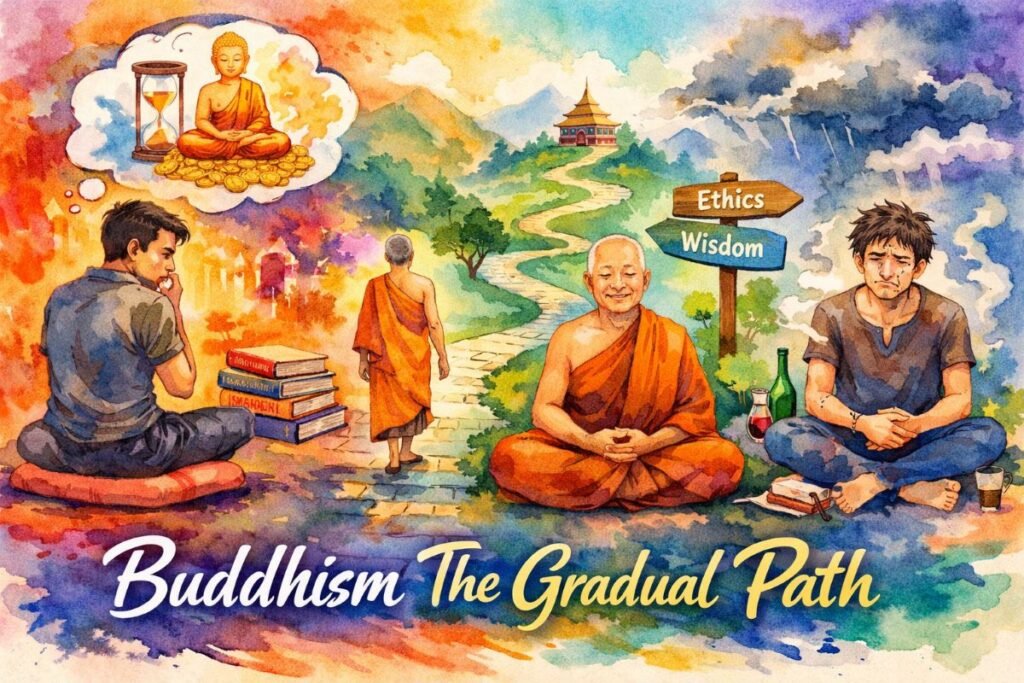
Before engaging in advanced tantric practices, students must establish a firm foundation in the Buddhist path. The Lamrim (Graduated Path) is a systematic framework derived from Atiśa’s Lamp for the Path to Enlightenment. It outlines the entire path in three scopes:
- Initial Scope: Developing reliable ethical conduct (śīla) and a genuine wish to escape from lower realms of suffering.
- Intermediate Scope: Generating the aspiration to achieve liberation from samsara for oneself. This involves studying the Four Noble Truths and the twelve links of dependent origination.
- Great Scope: Cultivating bodhicitta — the altruistic intention to attain enlightenment for the benefit of all sentient beings. This is the entry point to the Mahāyāna path.
7.2 The Preliminary Practices (Ngöndro)
In the Vajrayāna tradition, before one can engage in the advanced practices of deity yoga, one must complete the preliminary practices known as ngöndro. These are designed to purify the mindstream and prepare the practitioner for deeper work. They include:
- Taking Refuge and Generating Bodhicitta: Formal commitment to the Buddha, Dharma, and Sangha – The Three Jewels, combined with the aspiration to liberate all beings.
- Vajrasattva Meditation: Purification through recitation of the hundred-syllable mantra, cleansing negative karma and mental obscurations.
- Mandala Offering: Symbolic offering of the entire universe to accumulate merit, counteracting attachment and self-centredness.
- Guru Yoga: Merging the mind with the Guru’s wisdom, receiving blessings that empower the practitioner for the path.
These preliminaries are often counted, with practitioners completing 100,000 repetitions of each. While this may seem laborious, it is considered essential for building the foundation necessary for advanced practice.
8. Esoteric Practices: Deity Yoga, Mantra, Mudra, and Mandala
8.1 Deity Yoga
Deity Yoga is the defining practice of Vajrayāna — the feature that, as Tsongkhapa famously argued, most distinguishes tantric Buddhism from other Buddhist vehicles. The practitioner visualises themselves as a Yidam (meditational deity) embodying specific enlightened qualities. The key principle is the union of method and wisdom: the deity’s form embodies skillful means, while the recognition of the deity’s empty nature embodies wisdom. Neither is practised in isolation.
Deity Yoga proceeds through two major stages, which together constitute the structural core of highest yoga tantra:
Generation Stage (utpattikrama)
The practitioner vividly visualises the complete form of the deity — colours, hand implements, ornaments, surrounding mandala, and companion deities — in precise detail. This is not mere imagination but a disciplined cultivation of divine pride: the recognition that one’s own body, speech, and mind are inseparable from the body, speech, and mind of the Buddha. The ordinary sense of self-as-ordinary-person is displaced by the recognition of self-as-deity. The deity is not viewed as an external being to be worshipped but as the natural expression of one’s own enlightened nature, made vivid and accessible through visualisation.
Generation stage practices serve two functions simultaneously: they purify ordinary perception (substituting pure vision for habitual impure appearance) and they create the conditions for the completion stage practices to take effect. A well-established generation stage is considered a prerequisite for safe and effective completion stage work.
Completion Stage (sampannakrama)
In the completion stage, attention shifts from the visualised deity to the practitioner’s own psychophysical system. The practitioner works with the subtle body — its energy channels (nāḍī), winds (prāṇa), and drops (bindu) — to bring about a direct encounter with the nature of mind, particularly the clear light (prabhāsvara) that underlies all experience. Key completion stage practices include:
- Tummo (Inner Heat, caṇḍālī): The deliberate generation of inner heat through breath retention and visualisation, which dissolves ordinary winds into the central channel and induces states of bliss and clarity. This is considered the foundation of the other completion stage practices.
- Clear Light (prabhāsvara): The recognition and stabilisation of the luminous, empty nature of mind that becomes accessible when the winds dissolve and ordinary mental activity subsides.
- Illusory Body (māyādeha): The recognition that the subtle body arising from the winds is not a fixed, substantial entity but an appearance without inherent existence, like a dream or a reflection in a mirror.
- Dream Yoga: Training in maintaining awareness during the dream state to recognise its appearance-without-substance quality, directly applicable to the waking state and ultimately to the bardo.
The generation and completion stages should not be understood as entirely sequential; advanced practitioners move fluidly between them, and some presentations describe their inseparability as the heart of highest yoga tantra.
8.2 The Three Roots
Running throughout deity yoga and indeed all of Vajrayāna practice is the framework of the Three Roots, which are the primary sources of blessing, accomplishment, and protection for the tantric practitioner:
- The Guru (Root of Blessing): The qualified teacher who transmits the lineage, grants empowerments, and provides the pointing-out instructions that make realisation possible. The Guru is the living expression of the Buddha’s compassion within the practitioner’s own experience. Without a Guru, the tantric path cannot begin.
- The Yidam (Root of Accomplishment): The meditational deity with whom the practitioner enters into relationship through empowerment and sustained practice. The Yidam embodies the specific qualities — wisdom, compassion, power — that the practitioner aspires to realise, and serves as the primary vehicle for transformation.
- The Ḍākinī and Protector (Root of Activity): The enlightened feminine principle (Ḍākinī) and the dharma protectors who clear obstacles, intensify realisation, and protect the integrity of the practice. Ḍākinīs are understood as embodiments of wisdom energy, associated with the transmission of esoteric teachings.
The Three Roots provide the structure within which the entire system of empowerments, practices, and relationships in Vajrayāna is organised. They correspond to the Three Jewels (Buddha, Dharma, Sangha) but at the esoteric level particular to tantra.
8.3 Mantra
Mantras are sacred syllables used to protect the mind from ordinary appearances. Each mantra corresponds to a particular deity, embodying that deity’s qualities. Reciting a mantra is not simply a mental repetition but a form of sonic vibration that transforms consciousness. It purifies the mind, connects the practitioner with the deity, and generates the power of realisation.
Common mantras in Vajrayāna include:
- Oṃ Maṇi Padme Hūṃ: The mantra of Avalokiteśvara, embodying compassion. It is widely recited in Tibet and the Himalayan regions.
- Oṃ Aḥ Hūṃ: The seed syllables of the body, speech, and mind of the Buddhas.
- Vajra Guru Mantra: Associated with Padmasambhava, the founder of Tibetan Buddhism.
7.3 Mudra
Mudra refers to ritual hand gestures that signify the qualities of various Buddhas. These are used in meditation and ritual to enhance concentration and invoke the presence of awakened beings. Each mudra has a specific meaning, such as teaching, giving, or fearlessness. The most common mudras include:
- Dhyana Mudra: The gesture of meditation, with hands placed in the lap.
- Abhaya Mudra: The gesture of fearlessness, with the right hand raised.
- Bhumisparsha Mudra: The gesture of touching the earth, symbolising the Buddha’s enlightenment.
7.4 Mandala
Mandala is a cosmic diagram representing a pure Buddha-realm. Practitioners visualise themselves and the world as this pure realm, which helps transform ordinary perception. Mandalas are also created in sand or painted on cloth, serving as objects of meditation and offering. They represent the palace of the deity, with four gates, a central hub, and concentric circles symbolising the elements and the stages of the path. For an overview of mandala symbolism, see Encyclopedia of Buddhism.
8. The Guru Principle and Samaya
8.1 The Role of the Guru
Vajrayāna is an esoteric transmission; teachings must be passed directly from teacher to student. The Guru plays a central role, providing:
- Empowerment (Abhisheka): Formal authorisation to practise a particular deity — not merely a symbolic ceremony but an actual transmission of the deity’s blessings.
- Instruction: Detailed guidance on meditation and ritual, tailored to the individual student’s capacity and temperament.
- Blessing: Transmission of lineage wisdom through their presence, as the Guru is seen as embodying the Buddha’s compassion and wisdom.
- Guidance: Personal advice to address obstacles and errors, with the Guru acting as spiritual friend and mentor.
The relationship with the Guru is based on devotion, trust, and openness. The practitioner sees the Guru as embodying the Buddha’s compassion and wisdom, making it possible to receive teachings that would otherwise be inaccessible. However, the Guru is not viewed as a personal deity but as a guide who points the way to one’s own enlightened nature.
8.2 Samaya: Sacred Commitments
The practitioner takes Samaya vows to maintain the purity of the “vajra bond.” These commitments include:
- Loyalty to the Guru: Not breaking the relationship with the teacher — a commitment to respect and follow the teacher’s guidance, not blind obedience.
- Loyalty to the Deity: Maintaining the visualisation and practice without abandonment.
- Loyalty to the Dharma: Upholding the teachings and lineage, including the vows of ethical conduct and compassion.
- Loyalty to the Sangha: Supporting the community of practitioners.
Breaking these vows is considered a serious obstacle to progress. However, the tradition emphasises that if broken, they can be repaired through confession and renewed commitment.
9. Advanced Systems: Dzogchen, Mahamudra, and the Six Yogas
9.1 Dzogchen (The Great Perfection)
Dzogchen is the highest teaching in the Nyingma school, pointing directly to the innate nature of mind. It involves recognising primordial awareness without the need for gradual stages or elaborate visualisations. Instead of creating a pure realm, the practitioner discovers that the nature of the mind is already pure.
In Dzogchen, the practitioner is introduced to the nature of mind through a direct transmission from the Guru. Once recognised, the practitioner rests in this awareness, allowing all thoughts and emotions to self-liberate. The practice is divided into two primary approaches:
- Breakthrough (Trekchö): Cutting through delusion to see the naked nature of mind.
- Leap-Over (Tögal): Directly experiencing the visions of the pure realms, which spontaneously arise from the nature of mind.
9.2 Mahamudra (The Great Seal)
Mahamudra is the central practice of the Kagyu school, involving direct meditation on the nature of mind. Practitioners observe thoughts and emotions as they arise, recognising them as expressions of the mind’s luminosity. The goal is to see the mind itself, free from all conceptual constructs.
Mahamudra is traditionally taught in four stages:
- One-pointedness: Focusing the mind on a single object, such as the breath or a visual image.
- Simplicity: Resting in the nature of mind without conceptual elaboration.
- One Taste: Recognising all phenomena as equal in emptiness.
- Non-Meditation: Abiding in the natural state without any effort or fixation.
9.3 The Six Yogas of Naropa
The Six Yogas of Naropa are a set of advanced completion-stage practices central to the Kagyu school. A detailed explanation by Dr. Alexander Berzin is available at Study Buddhism. The six practices are:
- Tummo (Inner Heat): Generating inner warmth to purify the body and experience bliss.
- Clear Light: Meditating on the mind’s innate radiance.
- Illusory Body: Recognising the dream-like nature of reality.
- Dream Yoga: Training in lucidity during sleep.
- Bardo Yoga: Navigating the intermediate state between death and rebirth.
- Phowa (Conscious Ejection): Conscious ejection of consciousness at death to achieve rebirth in a pure land.
These practices are considered highly advanced and require extensive preparation and guidance from a qualified teacher.
10. Vajrayāna in Daily Life: Practical Applications for the Modern World
10.1 Transforming Everyday Experience
Vajrayāna teaches that every moment is an opportunity for practice. Instead of avoiding ordinary life, practitioners bring their awareness to present experiences. This includes:
- Mindful Eating: Offering food as nourishment for the body, visualising it as nectar. One can recite mantras before meals to bless the food.
- Mindful Walking: Seeing the path as a mandala, stepping with the intention to benefit beings.
- Mindful Breathing: Reciting mantras with each breath, purifying the mindstream — a practice that can be done while commuting or during breaks at work.
- Viewing Others as Deities: In advanced practice, one sees all beings as deities and their speech as mantra, transforming relationships and reducing judgment.
10.2 Working with Emotions
In Vajrayāna, negative emotions are seen as raw energy that can be transformed. This approach is sometimes called “the path of transformation” and is discussed in depth at Study Buddhism’s tantra pages. For example:
- Anger: Can be transmuted into mirror-like wisdom, seeing things as they are without distortion.
- Desire: Can become discriminating wisdom, seeing both good and bad clearly without attachment.
- Ignorance: Can become the wisdom of the nature of reality, recognising emptiness.
This approach is distinct from suppression. Instead of pushing emotions away, the practitioner learns to use their energy to fuel awakening.
10.3 Integrating with Modern Life
For the modern practitioner, Vajrayāna offers practical tools. Publications from Lion’s Roar and Tricycle Magazine regularly feature contemporary teachers discussing how to bring these methods into everyday contexts:
- Workplace Practice: Seeing colleagues as deities and work as a sacred activity, reducing stress and increasing mindfulness.
- Parenting: Viewing children as emanations of enlightened beings, encouraging patience and compassion.
- Relationships: Transforming attachment into compassion by recognising the Buddha nature in one’s partner.
10.4 Overcoming Obstacles
The path is not without challenges. However, the tradition provides methods for overcoming obstacles:
- Visualisation: Seeing obstacles as temporary appearances that lack inherent existence.
- Mantra Recitation: Using sound to cut through mental fixation and invoke blessings.
- Study: Learning the teachings to gain confidence and clarity.
- Community: Seeking support from fellow practitioners (Sangha).
10.5 The Four Activities
In the tantric tradition, practitioners are encouraged to perform the “four activities” (las bzhi):
- Pacifying: Calming disturbances and obstacles.
- Enriching: Cultivating positive qualities and abundance.
- Magnetising: Attracting beneficial conditions and beings.
- Subjugating: Overcoming negative forces with compassion.
These activities are not about worldly gain but about creating favourable conditions for spiritual progress.
11. Common Misconceptions and Pitfalls
11.1 It Is Not Anti-Intellectual
Vajrayāna is sometimes mistakenly seen as anti-intellectual. In reality, it requires thorough study of the foundational teachings of Buddhism, including the Abhidharma (higher knowledge), Madhyamaka philosophy, and the ethics of the Bodhisattvayāna. The Dalai Lama, a Gelug practitioner, is a renowned scholar who insists on the importance of philosophical study before engaging in tantra.
11.2 It Is Not About Instant Gratification
While Vajrayāna promises rapid results, it demands tremendous effort and discipline. The swiftness of the path is not a short-cut but a high-speed route that requires all the necessary preparations. As the saying goes, “The higher the view, the finer the conduct.”
11.3 It Is Not a Replacement for the Sutras
Vajrayāna does not supersede the sutras but complements them. The tantric practices are considered the “inner” teachings, which require the “outer” foundation of the sutras. The Encyclopedia of Buddhism’s Vajrayāna entry makes clear that without a firm grounding in the Bodhisattva precepts and the understanding of emptiness, tantric practice is ineffective and can be dangerous.
11.4 The Guru Is Not Infallible
While the Guru is respected, the tradition does not view the Guru as infallible. The practitioner is encouraged to examine the teacher thoroughly before committing. The ultimate goal is to recognise the Guru’s enlightened qualities within one’s own mind.
11.5 The Dangers of Misusing Tantra
The esoteric nature of the teachings means they can be misused if the practitioner lacks the proper motivation. The tantras themselves warn against practising them for selfish purposes, such as gaining power or material wealth. Such misuse is considered a violation of the samaya vows and leads to severe negative consequences. This is discussed in the context of tantric ethics at Encyclopedia of Buddhism.
12. Conclusion: The Swift Path in a Modern Context
Vajrayāna Buddhism offers a radical, sophisticated approach for deconstructing ordinary reality. By viewing human embodiment and emotional turbulence as a potent field of exploration rather than a prison, it provides the possibility of attaining the same Buddhahood as Shakyamuni in this very body and lifetime.
The diamond path is not for everyone; it requires intense commitment, devotion to a teacher, and the willingness to engage with profound transformations. However, for those who feel drawn to it, it offers a direct and powerful approach to awakening. It preserves the vast wealth of Indian Buddhism while continuing to adapt its “skillful means” for the benefit of all sentient beings.
In a world that often feels chaotic and overwhelming, the teachings of Vajrayāna remind us that every moment is sacred, every being is a Buddha, and every action can be a gesture of awakening. The path invites us not to escape but to engage, not to reject but to transform, not to wait but to act now for the benefit of all.
The tradition remains a living, breathing organism, passed from heart to heart, from mind to mind. In the modern context, it offers a refreshing antidote to materialism, alienation, and spiritual materialism. It shows that the ultimate truth is not far away in a distant heaven but is as close as our own breath, our own heartbeat, our own mind. By learning to see the world as a divine mandala, we can find peace and purpose even in the midst of life’s inevitable storms.
Glossary of Key Terms
Abhisheka (Empowerment): A ritual initiation granting permission to practise a specific tantric deity. It “ripens” the mindstream for deeper practice.
Anuttarayoga Tantra (Highest Yoga Tantra): The highest class of tantra, involving advanced methods like deity yoga, the subtle body, and the transformation of desire.
Bodhicitta: The altruistic intention to attain enlightenment for the sake of all sentient beings. It is the foundation of the Mahāyāna and Vajrayāna paths.
Buddha Nature (Tathāgatagarbha): The innate potential for enlightenment present in all beings, described as the union of emptiness and luminosity.
Charya Tantra (Performance Tantra): The second class of tantra, balancing external ritual with internal meditation.
Clear Light: The innate luminosity of mind, realised during deep meditation and at the time of death.
Completion Stage (sampannakrama): The second stage of deity yoga, involving working with the subtle body to realise emptiness.
Deity Yoga: The central practice of Vajrayāna, where one visualises oneself as a meditational deity to transform ordinary perception.
Dzogchen: The “Great Perfection,” the highest teaching of the Nyingma school, pointing directly to the nature of mind.
Generation Stage (utpattikrama): The first stage of deity yoga, involving vivid visualisation of the deity’s form and surroundings.
Guru: A spiritual teacher essential for tantric transmission. In Tibetan, “Lama.”
Kagyu: One of the four major schools of Tibetan Buddhism, known for Mahamudra and the Six Yogas of Naropa.
Kangyur: The “Translated Words,” containing the Buddha’s own teachings in Tibetan translation.
Kriya Tantra (Action Tantra): The first class of tantra, emphasising external rituals and purification.
Lamrim: The “Graduated Path,” a systematic framework for the entire Buddhist path, based on Atiśa’s teachings.
Mahamudra: The “Great Seal,” the Kagyu system of meditation on the nature of mind.
Mahāsiddha: “Great Adept,” an Indian yogi who achieved enlightenment through non-conventional methods.
Mandala: A sacred diagram or pure environment of a deity, used for visualisation and offering.
Mantra: Sacred syllables used for purification, invocation, and protection of the mind.
Mudra: Symbolic hand gestures used in ritual and meditation, signifying enlightened qualities.
Ngöndro: Preliminary practices that prepare the mind for tantric work, including prostrations, mandala offerings, and Vajrasattva meditation.
Nyingma: The “Ancient” school of Tibetan Buddhism, founded in the 8th century, known for Dzogchen and terma.
Pure Vision: The practice of seeing all phenomena as the pure display of enlightened wisdom.
Samaya: Sacred tantric vows and commitments between teacher and student, maintaining the integrity of the vajra bond.
Sakya: One of the four major schools of Tibetan Buddhism, known for the Lamdré (Path and Its Fruit) system.
Śūnyatā: Emptiness, the lack of inherent existence in all phenomena.
Tantra: Esoteric scriptures and practices that form the basis of Vajrayāna Buddhism.
Tengyur: The “Translated Treatises,” containing Indian commentaries on Buddhist texts.
Terma: Hidden treasures discovered by later masters, a distinctive Nyingma practice.
Tummo: Inner heat yoga, a practice for generating warmth and purifying the subtle body.
Upaya: “Skillful means,” the strategies used to bring about rapid enlightenment.
Vajra: Diamond or thunderbolt, symbolising the indestructible wisdom of enlightenment.
Vajrayāna: The “Diamond Vehicle,” the tantric branch of Buddhism.
Yidam: A meditational deity representing the practitioner’s enlightened nature.
Resources for Further Study
Recommended Books
- Introduction to Tantra: The Transformation of Desire by Thubten Yeshe — An accessible guide to the tantric approach to life.
- Vajrayana: An Introduction by Khenchen Thrangu Rinpoche — A comprehensive overview of the principles and practices.
- The Tibetan Book of Living and Dying by Sogyal Rinpoche — A modern classic on the application of Vajrayāna teachings to death and dying.
- Mahamudra: The Moonlight of Wisdom by Tashi Namgyal — A detailed commentary on the Mahamudra path.
- Dzogchen: The Heart Essence of the Great Perfection by the Dalai Lama — An explanation of the Nyingma tradition’s highest teachings.
- The Life of Milarepa — A biographical account of one of Tibet’s greatest yogis, illustrating the transformative power of the path.
- Jewel Ornament of Liberation by Gampopa — A classic text on the gradual path in the Kagyu tradition.
Online Resources
- Lotsawa House — Translations of Tibetan Buddhist texts.
- Study Buddhism (Berzin Archives) — Comprehensive scholarly articles on all aspects of Tibetan Buddhism.
- Buddhist Digital Resource Center (BDRC) — A digital library of Tibetan texts.
- Encyclopedia of Buddhism — A reliable cross-traditional Buddhist reference.
- 84000: Translating the Words of the Buddha — Free English translations of canonical Buddhist texts.
- Tsadra Foundation Buddha-Nature Portal — A multimedia resource hub for tathāgatagarbha scholarship and teachings.
Podcasts and Audio
- The Buddhist Geeks — A podcast exploring modern Buddhism, including Vajrayāna perspectives.
- The Wisdom Podcast — Featuring interviews with contemporary teachers and scholars of Tibetan Buddhism.
- The Lion’s Roar Podcast — Teachings and discussions on various aspects of Buddhist practice.
This article was created for BuddhistLearning.org. For more resources, teachings, and community support, please visit our website.