Key Takeaways
- Everything depends on food: In Buddhist teaching, “food” or nutriment [ahara] refers to anything that sustains and maintains life, whether physical or mental.
- Four distinct types: There are four kinds of nutriments: edible food, sensory contact, mental intention, and consciousness.
- Craving drives consumption: These nutriments are kept alive by craving [tanha]. Understanding this link helps us see why suffering repeats itself.
- Mindful consumption: Practicing awareness of what we “ingest” through our senses and thoughts is as important as being mindful of what we eat.
- A path to freedom: Fully comprehending each nutriment leads to profound inner release, not just better daily habits.
1. Introduction to the Four Nutriments
In the Theravada tradition, particularly within the Pali Canon, the concept of nutriment [ahara] is central to understanding how we exist and why we suffer. While teachers from other traditions, such as the Zen master Thich Nhat Hanh, have also engaged with this teaching, its structured formulation is rooted in the earliest Buddhist texts. The Buddha famously stated that “all beings subsist on nutriment” (SN 12.11). This teaching suggests that nothing, not our depression, our joy, or even our physical health, can survive without being “fed.”
Traditionally, these four nutriments are understood not only as what sustains us day to day but also as the fuel that drives the cycle of rebirth [samsara] from one life to the next. They are the conditions for the continuation of existence, and by understanding them we gain a powerful tool for cutting through suffering at its root.
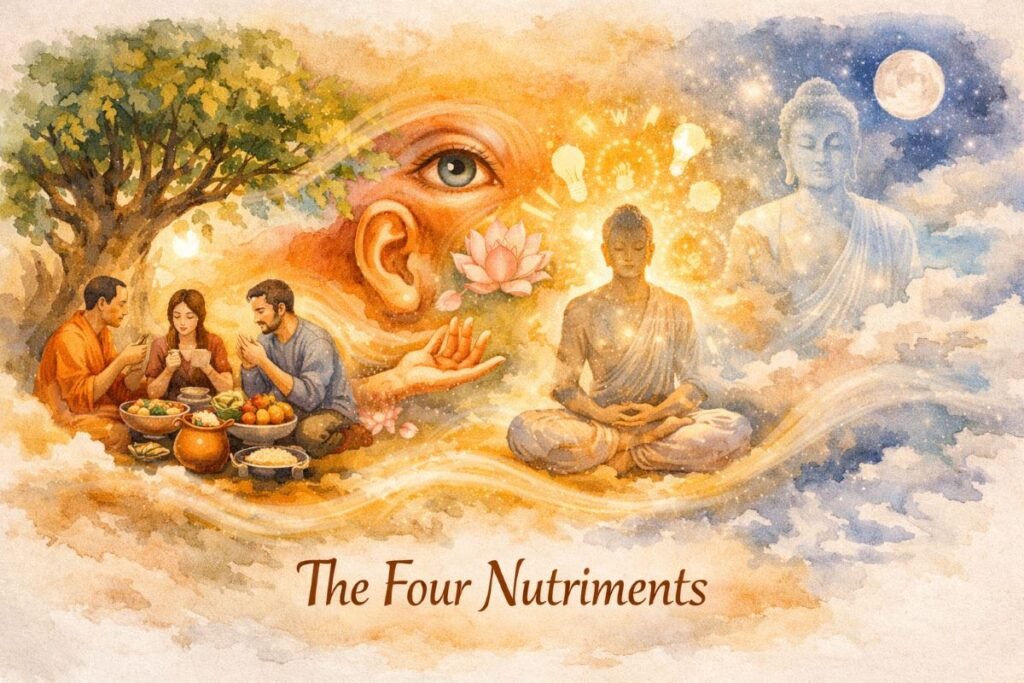
The Buddha expanded the ordinary idea of food to include the mental and sensory inputs that sustain our psychological life. He identified four kinds of nutriment that keep the whole person going:
- Edible food [kabalinkara ahara]
- Sensory contact [phassa ahara]
- Mental intention [manosancetana ahara]
- Consciousness [vinnana ahara]
In the background of this teaching lies an essential point: craving is the origin of all four nutriments. As the Sammaditthi Sutta (MN 9) states, from the arising of craving comes the arising of nutriment, and from the cessation of craving comes the cessation of nutriment. Understanding this connection gives us direct access to the Four Noble Truths in daily life.
2. Edible Food: The First Nutriment
Edible food [kabalinkara ahara] is the most obvious form of sustenance. It refers to the physical nourishment we take in through the mouth to maintain the material body. In a modern context, this includes everything from our daily meals and snacks to the drinks we consume.
The Purpose of Eating
The Buddha did not look at edible food as something to be simply enjoyed or avoided. He taught that we should see it primarily as a means to sustain life for the purpose of spiritual practice, rather than for mere indulgence, beauty, or bodybuilding. A powerful teaching tool he used is the Simile of the Son’s Flesh, found in the Puttamaṁsa Sutta (SN 12.63). In that story, a couple travelling through a desert runs out of supplies. With no hope of rescue, they eventually kill their own living child and eat the flesh only in order to survive the crossing and reach safety. The lesson is not to make us fearful of eating but to awaken a sense of necessity, gratitude, and awareness. Food is not just fuel; it involves the sacrifice of other life forms, the labor of countless beings, and the resources of the earth. By contemplating this stark and shocking image, we may understand the value of eating with moderation and deep appreciation, not greed or callousness.
How Edible Food Feeds Suffering or Well-Being
When we eat unmindfully, we often feed craving rather than the body. The three mental poisons of greed, aversion, and delusion can easily drive our relationship with food. We might eat too much because of greed for pleasant taste, restrict food harshly out of aversion to our body, or mindlessly consume junk out of delusion about what truly nourishes us. This creates physical stress, guilt, and a sense of lack. On the other hand, eating with awareness turns a daily necessity into a practice of peace. As Thich Nhat Hanh has taught, a simple carrot contains the sun, the rain, and the farmer’s care. When we see this, gratitude naturally arises and the need to overconsume lessens.
Practical Application
- Mindful eating pauses: Before a meal, take three conscious breaths. Look at the food on your plate and mentally trace back some of the elements, like soil, water, and human hands.
- Eat without screens: Turn off the television and put down your phone. Pay attention to the flavors, textures, and the body’s hunger and fullness cues. This reduces overeating and increases satisfaction.
- Moderation, not extremes: Eat to support health and energy. Neither overindulge out of craving nor restrict out of self-punishment. A gentle middle way keeps the body light and the mind clear.
- Reflect on purpose: Ask yourself before eating, “Am I consuming this to nourish my practice of kindness and awareness, or just to distract myself from a difficult emotion?”
3. Sensory Contact: The Second Nutriment
Sensory contact [phassa ahara] is the “food” we ingest through our six sense doors: seeing, hearing, smelling, tasting, touching, and the mind that perceives thoughts and ideas. Every time you scroll through social media, listen to a podcast, have a conversation, or simply sit on a park bench and feel the breeze, you are consuming sensory contact. This nutriment feeds our inner life moment by moment.
The Impact of What We Take In
Just as physical food can be fresh and nourishing or rotten and poisonous, sensory contact can be wholesome or toxic. The Buddha used the vivid image of a “skinned cow” in the Puttamaṁsa Sutta (SN 12.63) to illustrate how vulnerable we are. A cow with its skin removed is constantly attacked by insects and parasites wherever it stands. Similarly, we are endlessly “bitten” by sensory impressions that trigger pleasant or unpleasant feelings. When we are unaware, those feelings condition craving and aversion, which then drive our actions.
In modern life, the commercial and digital worlds exploit this sensitivity. News feeds are designed to provoke outrage because that keeps us engaged. Advertisements create a sense of lack so that we buy products to fill the void. Constant exposure to violent images, angry rhetoric, and unrealistic beauty standards feeds seeds of fear, dissatisfaction, and confusion deep in our minds. We can literally “starve” our peace by gorging on toxic content.
Sensory Contact and the Chain of Suffering
In the Buddhist analysis of dependent origination, sensory contact is a crucial link. When a working eye meets a visible form, eye-consciousness arises, and the meeting of the three is contact. From contact arises feeling, and from feeling arises craving. If we guard the sense doors, we can interrupt this chain. This does not mean blocking out the world, but relating to sensory experience with mindfulness and wise attention [yoniso manasikara]. Instead of being pulled along by every headline and notification, we notice, “This is just a sound, a sight, a thought,” and choose what to engage with.
Practical Application
- Conscious media diet: Treat your attention like a precious meal. Decide in advance how much news, social media, and entertainment you will consume each day. Unsubscribe from feeds that consistently trigger stress or comparison.
- Sensory rest: Schedule short periods without input. Sit in a quiet room, walk in nature without headphones, or simply drink a cup of tea without distraction. This allows the mind to digest and settle.
- Choosing nourishing inputs: Actively surround yourself with uplifting music, inspiring talks, beautiful art, and kind conversation. These sensory contacts feed joy, calm, and resilience.
- Pausing at the doors: When you notice a strong reaction to something you saw or heard, pause for three seconds. Label it gently: “This is an unpleasant sight,” or “This is a pleasant sound,” and let the reactive wave subside.
4. Mental Intention: The Third Nutriment
Mental intention [manosancetana ahara], also translated as volition or intellectual intention, is the “food” that drives our actions and shapes our future. It is not simply a passing wish but the active, goal-directed energy of the mind. The Buddha identified intention as the chief factor that constitutes kamma (action). Every thought we dwell on and every decision we make feeds a particular direction for our life, and in the larger picture, mental intention is the kamma that propels a being into a new existence.
The Power of Purpose
Our deepest intentions are like an underground river that feeds all the streams of daily activity. If our primary intention is fueled by craving for status, sensory pleasure, or self-validation, we are feeding a cycle of stress and discontent. The simile from the Puttamaṁsa Sutta (SN 12.63) for this nutriment is a pit of burning coals into which two strong men drag a struggling person. It points to how powerful, unconscious intentions can pull us relentlessly toward suffering, even when we resist. For example, a deep-seated intention to be recognized can drive a person to work excessive hours, ignore relationships, and burn out, all while feeling they have no choice.
Conversely, wholesome intentions, such as the genuine desire to be kind, to find peace, or to contribute to the well-being of others, provide the energy needed for a meaningful life. They feed the mind with purpose, which in turn sustains effort and resilience. Even when faced with difficulties, a person nourished by a compassionate intention can keep going without being destroyed by resentment or exhaustion.
The Role of Intention in Habits
Unwholesome habits survive because they are being fed by a specific intention, often hidden beneath the surface. A habit of procrastination may be fed by an underlying intention to avoid discomfort. A habit of angry outbursts may be fed by an intention to assert control when feeling helpless. Recognizing the intention behind a habit is the first step to starving it. We can then consciously redirect that mental energy toward a different, more beneficial aim.
Practical Application
- Morning intention setting: Before starting your day, take a quiet moment to set a clear, wholesome intention. It could be as simple as, “Today, I will practice patience with my family,” or “May my work be a source of benefit, not just profit.”
- Checking the “why” behind goals: When you find yourself chasing a goal, pause and ask, “What intention is feeding this? Is it to feed the ego’s need for security and recognition, or is it born from clarity and care?” No need to judge, just see clearly.
- Transforming habits by changing intention: Pick one unhelpful habit you want to shift. Ask yourself gently, “What does this habit promise me? What uncomfortable feeling am I trying to escape?” Then experiment with meeting that discomfort directly through mindfulness rather than feeding the old reaction.
- Replacing the nutriment: If envy often arises, notice that it feeds on a certain mental intention, perhaps a desire to be special. You can begin to nourish an alternative intention, such as “May I rejoice in others’ happiness” (sympathetic joy). Over time, the new intention grows stronger as you feed it.
5. Consciousness: The Fourth Nutriment
Consciousness [vinnana ahara] is the most subtle nutriment. In the early Buddhist texts, consciousness refers to the knowing of an object through a sense base; it arises dependently on contact and does not constitute a permanent, independent self. Clinging to consciousness as “me” or “mine,” however, feeds the sense of a separate self and sustains suffering. In the broader framework of dependent origination, consciousness plays a crucial role in the continuation of the rebirth process, often referred to as rebirth-linking consciousness [patisandhi-vinnana], though it is not a transmigrating soul.
The Simile of the Spears
The Buddha illustrated this nutriment with the image of a thief, a criminal, who is struck by one hundred spears three times a day- morning, noon, and evening, receiving three hundred spears in total. He survives, but lives in constant agony. This stark comparison shows how consciousness, when clung to as a solid identity, sustains a continuous state of subtle stress. The “self” we hold onto feels constantly threatened by change, aging, and loss. Even pleasant experiences are tinged with anxiety because we know they will end. Consciousness feeding on itself perpetuates this underlying unease.
How Conditioning Shapes Consciousness
Our consciousness is heavily conditioned by the people, culture, language, and habits that surround us. If we live in an environment saturated with fear and greed, those qualities become nutrients for our own mind. Similarly, when we surround ourselves with people who embody generosity and calm, our consciousness is nourished in a positive direction. This is not a “collective consciousness” in the sociological sense, but rather the simple fact that the mind takes the shape of what it repeatedly contacts and attends to.
How to Nourish Wholesome Consciousness
The health of our consciousness depends on what we habitually attend to. If we constantly dwell on worries, regrets, and self-criticism, we feed a contracted, heavy consciousness. If we cultivate mindfulness, gratitude, and loving-kindness, we feed an expansive, light awareness. Meditation practice allows us to observe the dependent arising of consciousness without identifying so strongly with its contents. We see that thoughts, moods, and even the sense of “I” are passing events, not a solid self that needs constant protection.
Practical Application
- Mindfulness of the mind: Several times a day, pause and notice the general tone of your awareness. Is it agitated and scattered, or calm and collected? Just observing without judgment begins to nourish clarity.
- Wholesome associations: Choose to spend time, whether in person or through books and teachings, with those whose consciousness you respect. Their presence feeds the best in you.
- Letting go of identity stories: Practice seeing the stories you tell about yourself (“I am a failure,” “I am superior”) as just thoughts being fed by repeated attention. Each time you let a story come and go without feeding it, you weaken its grip.
- Meditative nourishment: A daily meditation practice, even ten minutes of following the breath, feeds consciousness with stillness and presence, reducing its dependence on dramatic stimuli.
6. The Four Nutriments in Dependent Origination
The teaching on the four nutriments is not merely a set of wellness principles. It sits inside the profound framework of dependent origination [paticca-samuppada], which describes how suffering arises and ceases. The relationship can be stated simply:
- Craving conditions nutriment.
- Nutriment sustains the process of becoming [bhava] and existence.
- Sustained existence fuels further suffering and rebirth.
- When craving ceases, nutriment ceases to feed becoming, and the cycle is broken.
The Puttamaṁsa Sutta (SN 12.63) presents the four nutriments not just as things to consume wisely, but as objects of deep comprehension. The sutta’s liberative structure shows that when each nutriment is fully understood, it leads to a specific liberating insight:
- Fully comprehending edible food leads to comprehending the passion for the five strings of sensuality, resulting in the end of suffering with no further rebirth.
- Fully comprehending sensory contact leads to comprehending the three kinds of feeling (pleasant, painful, neutral), leaving nothing further to do.
- Fully comprehending mental intention leads to comprehending the three kinds of craving (for sensuality, for existence, for non-existence), bringing complete release.
- Fully comprehending consciousness leads to comprehending mentality-materiality [nama-rupa], the necessary condition for existence, and to final liberation.
This structure shows that the Buddha intended this teaching as a complete path to freedom. By looking deeply into what we feed on, we can cut craving at its root. The everyday practice of mindful consumption is thus a direct training in the causes of awakening.
7. The Four Nutriments and the Four Noble Truths
The teaching on the four nutriments is a direct, practical application of the Four Noble Truths, the core framework of Buddhism.
- The Truth of Suffering (Dukkha): We are constantly “hungry.” We depend on physical food, sensory stimulation, goals, and a sense of self to keep going. This very dependency, and the fleeting nature of all four nutriments, creates a background hum of insecurity and dissatisfaction. Every day we feed ourselves, and yet hunger returns. That recognition is the first truth.
- The Origin of Suffering (Samudaya): The cause of this ongoing hunger is craving [tanha]. We crave more pleasant tastes, exciting sights, fulfilling intentions, and a secure, permanent identity. This craving pushes us to consume the four nutriments in ignorant, clinging ways, which in turn produces more craving. The nutriments and craving feed each other in a vicious cycle.
- The Cessation of Suffering (Nirodha): If we can “starve” the unwholesome forms of these nutriments, the fire of craving goes out. The cessation of suffering does not mean we stop eating or experiencing the world. It means we stop feeding the greedy, hateful, and deluded mind. We learn to take in nutriment without clinging. There is still tasting, contacting, intending, and awareness, but no compulsive clinging. This points toward the peace realized in Nibbana, where craving and clinging have been fully abandoned.
- The Path to Cessation (Magga): The Noble Eightfold Path is the “dietary plan” for a healthy life. Right View involves understanding the four nutriments and their role in suffering. Right Intention is the direct cultivation of wholesome mental intention. Right Speech, Action, and Livelihood create healthy sensory contacts. Right Effort, Mindfulness, and Concentration help us see consciousness clearly and stop feeding it with delusion. Every step of the path is a way to feed the mind with what leads to liberation rather than bondage.
When we face a difficulty, we can ask: “Which nutriment is sustaining this? Am I feeding this depression with certain thoughts (consciousness), with isolation (sensory contact), with an unconscious desire to punish myself (mental intention), or with unhealthy food and sleep patterns (edible food)?” This inquiry opens the door to change.
8. Glossary of Terms
- Ahara [Nutriment]: Anything that sustains or supports the maintenance of life. The Buddha taught that all beings are sustained by four kinds of ahara.
- Kabalinkara Ahara [Edible Food]: Physical sustenance consumed through the mouth, such as solid food and drink. It nourishes the material body.
- Manosancetana Ahara [Mental Intention]: The volitional, purposeful energy of the mind. It is the driving force behind thoughts, speech, and actions, and shapes future kamma, including the force that leads to rebirth.
- Phassa Ahara [Sensory Contact]: The meeting of a sense organ (eye, ear, nose, tongue, body, mind), a corresponding sense object, and consciousness. This contact feeds feelings, which in turn feed craving.
- Vinnana Ahara [Consciousness]: The knowing awareness that arises dependent on a sense base and an object. It is not a permanent self but a conditioned process that plays a crucial role in dependent origination and the continuation of the rebirth process.
9. Related Resources
Books
- The Heart of the Buddha’s Teaching by Thich Nhat Hanh – A clear, accessible overview of core Buddhist concepts including the nutriments.
- The Vision of Dhamma by Nyanaponika Thera – A collection of essays that explore deep aspects of Buddhist psychology.
Suttas from the Pali Canon
- SN 12.11: Ahara Sutta – A concise statement that all beings subsist on nutriment.
- SN 12.63: Puttamaṁsa Sutta – The Discourse on the Son’s Flesh, containing vivid similes for each of the four nutriments.
- MN 9: Sammaditthi Sutta – The Discourse on Right View, explaining the nutriments’ role in dependent origination and their origin in craving.
Podcasts and Talks
- The Four Types of Food for Healthy Growth (TWOII Podcast, Episode #76)
- The Four Kinds of Nutriments (Dharma Talk by Sister Harmony)