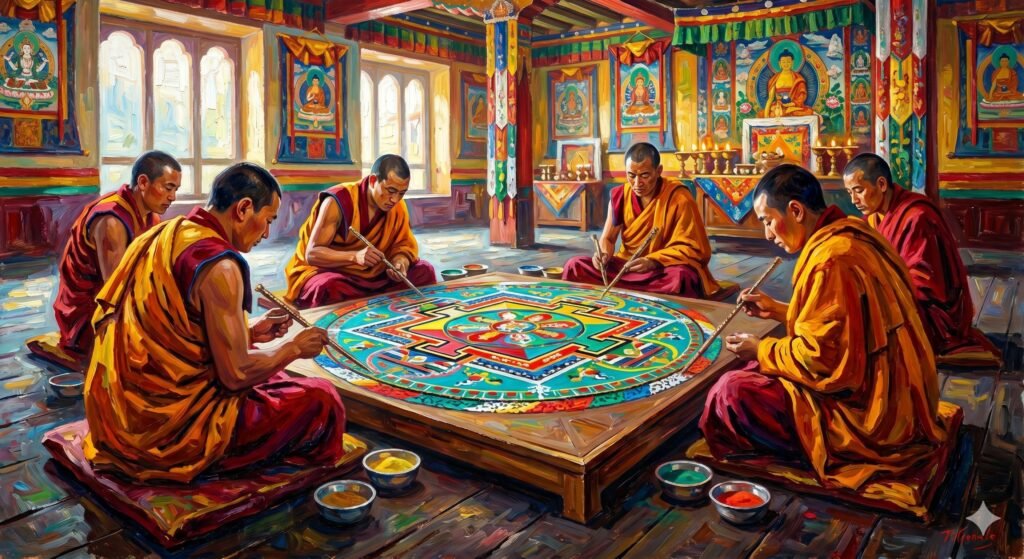
From the tantric monasteries of the Pala Dynasty to the museums of the contemporary West, the Tibetan sand mandala remains one of Buddhism’s most demanding and doctrinally complete ritual forms.
Key Takeaways
- Sacred map of enlightenment. The sand mandala is not art for art’s sake; it is a three-dimensional celestial palace rendered in two dimensions, representing the purified environment of an awakened being (sambhogakāya) and encoding the complete path to liberation.
- Impermanence as core instruction. The ritual destruction of the mandala after days or weeks of labour is a direct, visceral teaching on anitya — the first of the three marks of conditioned existence. It is not symbolic gesture but deliberate practice.
- Emptiness made visible. The sweeping of differentiated coloured sands into an undifferentiated heap illustrates śūnyatā: all apparent forms lack inherent existence (svabhāva) and arise solely through dependent origination (pratītyasamutpāda).
- A collective tantric sādhana. Construction requires years of monastic training in sacred geometry, mantra memorisation, and mastery of the chak-pur. The building itself is a form of active meditation, not a spectacle.
- Liberation through sight (mthong grol). Traditional Tibetan doctrine holds that simply gazing upon a correctly constructed mandala plants a karmic seed of liberation in the mind-stream of any witness — the primary justification for public displays.
- Dissemination, not disposal. The final release of consecrated sand into flowing water is the completion of the mandala’s purpose: the distribution of accumulated merit to all sentient beings, enacting the bodhisattva’s fundamental vow.
Introduction
At first glance, a Tibetan Buddhist sand mandala appears to be a painting of extraordinary intricacy and chromatic intensity. But to perceive it only as a visual object is to misread it entirely. The Tibetan sand mandala — rendered in the liturgical language as dkyil ‘khor, literally “centre and circumference” — is simultaneously a living philosophical treatise, an active tantric ritual, and a carefully structured public teaching on the nature of conditioned reality. Unlike a thangka or a stone carving intended to endure across generations, the sand mandala is created with the explicit and deliberate intention of being destroyed. In the most elaborate cases, uncounted hours of collaborative monastic labour are unmade in a single hour.
This tradition, transmitted without interruption for more than twelve centuries, distils some of the most demanding and technically precise doctrines of Buddhist philosophy into a single ritual sequence: the radical interdependence of all arising phenomena, the fundamental groundlessness of perceived permanence, the Vajrayāna understanding of pure perception as the basis of tantric practice, and the Mahāyāna imperative of universal compassion expressed through merit dedication.
The sand mandala is not a popular illustration of Buddhist ideas; it is an advanced practice that presupposes specific initiatory transmission, years of textual memorisation, and a complete command of tantric iconometry. Certain aspects of mandala practice are by tradition esoteric — accessible only to those who have received the appropriate empowerment (abhiṣeka) — and detailed explanations vary across lineages and initiation levels. What follows engages the tradition at the level of publicly transmitted teaching while acknowledging where deeper practice belongs to restricted transmission.
What follows is a detailed examination of the mandala tradition across its historical, doctrinal, material, technical, and ritual dimensions — with particular attention to the canonical sources and philosophical frameworks that give each stage of the practice its meaning.
1. Historical Origins and Lineage Transmission
1.1 Roots in Indian Tantric Buddhism and the Pala Dynasty
The sand mandala did not originate in Tibet. Its earliest codified forms are traceable to the tantric traditions of northeastern India during the Pala Dynasty (c. 750–1161 CE), a period that produced the great monastic universities of Nālandā, Vikramaśīlā, and Odantapurī. It was within these institutions that Indian Buddhist mahāsiddhas developed elaborate mandala rituals as a method for making the enlightened mind of a specific deity accessible within ordinary physical space — described in the tantric literature as the “summoning” or “drawing down” of a deity’s wisdom-mind (jñāna).
Among the earliest detailed canonical descriptions of powdered-colour mandala construction is the Guhyasamāja Tantra (c. 8th century CE), one of the most influential texts in the Anuttarayoga class and widely considered foundational to Tibetan Vajrayāna. The Kālacakra Tantra (c. 10th–11th century) — accompanied by its principal commentary, the Vimalaprabhā — elaborates the most architecturally complex sand mandala still in active ritual use: a three-dimensional palace housing over 700 deities, rendered across five concentric structural levels. Both texts have complex commentarial histories and have been transmitted through multiple Tibetan lineages, meaning that details of iconometric interpretation can vary between schools.
1.2 Transmission to Tibet: Padmasambhava, Śāntarakṣita, and Royal Patronage
By the late 8th century, the conditions for a formal Buddhist transmission to Tibet converged under King Trisong Detsen (r. c. 755–797 CE), who extended invitations to two Indian masters of complementary genius: Śāntarakṣita, the abbot of Nālandā and a philosopher of the Yogācāra-Mādhyamika synthesis, and Padmasambhava, a tantric adept associated with the mahāsiddha lineage. According to traditional Tibetan accounts, Padmasambhava’s specific role was to subdue indigenous forces resistant to the dharma’s establishment through the power of tantric rituals, including mandala rites of consecration. Modern historians approach these hagiographical accounts with appropriate caution; what is historically secure is the royal patronage and the institutional founding.
Traditional accounts associate the construction of Samye Monastery (Tib. bSam yas, c. 779 CE) — Tibet’s first formally constituted Buddhist monastery — with the first major sand mandala rituals performed on Tibetan soil. The monastery’s own design was conceived as a three-dimensional cosmogram based on the Abhidharma model of the universe, with a central temple representing Mount Meru surrounded by subsidiary temples representing the continents and oceans. The architectural and ritual logic of the mandala were thus embedded in Tibetan Buddhism from its institutional beginning.
1.3 Systematisation Across the Four Schools
Over the following centuries, the mandala tradition was systematised and preserved within all four major schools of Tibetan Buddhism: the Nyingma (“Ancient Ones”), Kagyu, Sakya, and Gelug. Each school maintains its own mandala liturgies and iconometric systems, and symbolic correspondences — including colour assignments, directional mappings, and deity arrangements — can differ meaningfully between traditions. All schools share the foundational understanding of the mandala as a maṇḍala-abhiṣeka: an initiatory environment that must be formally established through empowerment before it can function as a field of practice.
The Gelug school, founded by Tsongkhapa Lobzang Drakpa (1357–1419 CE), is particularly associated with the public performance of the Kālacakra sand mandala, which has been constructed in venues including Madison Square Garden (New York, 1991) and the Verizon Center (Washington DC, 1999) as part of the Kālacakra initiation ceremonies attended by large numbers of practitioners and members of the public.
2. Core Doctrines Embodied in the Sand Mandala
The sand mandala functions not as an illustration of Buddhist concepts but as a physical enactment of them. Each stage of its construction, inhabitation, and destruction is structurally isomorphic with a specific doctrinal teaching. The following six doctrines deserve sustained examination.
2.1 Impermanence (Anitya)
Impermanence is the first of the three marks of conditioned existence (trilakṣaṇa), alongside suffering (duḥkha) and non-self (anātman). While Buddhist practitioners intellectually assent to this teaching, the sand mandala forces the truth of impermanence into direct sensory confrontation. The teaching is foundational across all Buddhist traditions; within the Northern transmission on which Tibetan practice rests, the Udānavarga — the Sanskrit counterpart to the Pali Dhammapada, preserved in Tibetan translation in the Kangyur — states with equivalent directness: anityā bata saṃskārāḥ — “conditioned formations are indeed impermanent.” Je Tsongkhapa, in his Lam rim chen mo (Great Treatise on the Stages of the Path), devotes sustained attention to meditating on impermanence at both its coarse level (the death of persons and things) and its subtle level (the momentary arising and ceasing of all phenomena within each instant) — a distinction that advances well beyond the popular understanding and gives the mandala’s destruction its deeper resonance.
The deliberate destruction of a completed mandala after days of concentrated labour is not theatrical. It is a pedagogically precise intervention: it forces the practitioner — and any witness — to experience, rather than merely acknowledge, what it means for something beautiful and complex to be impermanent. The resistance most observers feel in the moment of destruction is precisely the attachment (upādāna) that Buddhist practice aims to dissolve.
After days of painstaking placement of millions of individual grains of coloured sand, a single brushstroke by the senior monk destroys the entire mandala’s formal structure. This act makes visceral what the intellect already knows: that attachment to any conditioned thing — however beautiful or meaningful — is itself a source of suffering (duḥkha). The message is not nihilistic but liberating: the willingness to release is itself a form of realisation.
2.2 Emptiness (Śūnyatā) and the Coalescence of Form and Formlessness
Emptiness, as developed in the Prajñāpāramitā literature and systematised by Nāgārjuna (c. 2nd–3rd century CE) in the Mūlamadhyamakakārikā, does not mean nothingness. It means that all phenomena lack svabhāva — inherent, independent, self-generated existence. All things arise in dependence on causes, conditions, and conceptual designation; none possess a fixed essence that exists from its own side.
The sand mandala illustrates this at two moments with particular clarity. During construction, the mandala exists only as a provisional collection of components — individual grains of coloured sand, a wooden platform, the monks’ trained intentionality, the supporting liturgical framework, and the perceiving minds of those present. Subtract any one of these conditions, and “mandala” as a concept and as an object dissolves; there is no separable, self-standing “mandala-essence” independent of its components. During destruction, when all differentiated coloured sands are swept into a single grey-brown heap, the distinct forms of palace, gate, deity, and lotus petal dissolve back into undifferentiated matter. The famous formula of the Heart Sutra (Prajñāpāramitāhṛdaya) — rūpaṃ śūnyatā, śūnyatāiva rūpam, “form is emptiness, emptiness is form” — is here given physical expression: the distinctions that characterised the mandala were real at the conventional level; their dissolution reveals the lack of inherent existence that was always their ultimate nature. Nāgārjuna’s teaching is not that all things collapse into a metaphysical undifferentiated substance, but that conventional distinctions and ultimate emptiness are two truths about the same reality, neither reducible to the other.
2.3 Dependent Origination (Pratītyasamutpāda)
The teaching of dependent origination holds that all phenomena arise in dependence on causes and conditions, and that nothing whatsoever possesses independent self-existence. The standard formulation, preserved across the Sanskrit Āgamas and Tibetan Kangyur, reads: imasmiṃ sati idaṃ hoti; imassuppādā idaṃ uppajjati; imasmiṃ asati idaṃ na hoti; imassa nirodhā idaṃ nirujjhati — “when this exists, that comes to be; with the arising of this, that arises. When this does not exist, that does not come to be; with the cessation of this, that ceases.”
The sand mandala instantiates this teaching with unusual completeness. Its arising depends on a specific convergence of causes (the tantric tradition, the monastic training, the physical materials, the dyes, the ritual implements) and conditions (the invitation to perform the rite, the availability of consecrated space, the presence of qualified practitioners, the assembly of observers). Remove any one condition, and the mandala as a sacred field does not arise. When those conditions change at the ritual’s conclusion, the mandala ceases. There is no residual “mandala-nature” that persists after the sand is swept; only the karmic imprints left in the minds of those who participated remain.
2.4 The Generation Stage (Bskyed-rim) and the Mandala as Mind
One of the most important, and frequently underexplained, functions of the sand mandala is its role as the architectural blueprint for the Generation Stage (bskyed-rim) of Anuttarayoga Tantra practice. The mandala is not merely a visual field to be contemplated from outside; it is the environment into which the practitioner mentally projects themselves during devatā-yoga (deity yoga). In this practice, the yogi dissolves their ordinary self-perception and reconstitutes their psycho-physical aggregates (skandhas), elements, and sense-consciousnesses as the palace and its inhabiting deities. The body becomes the mandala architecture; the mind becomes the deity’s wisdom-mind; speech becomes mantra. Ordinary body, speech, and mind are not suppressed but transformed into their purified expressions.
This understanding points toward a three-level reading of the mandala that Vajrayāna commentators consistently emphasise: the outer mandala is the purified environment — the celestial palace and its cosmological surround; the inner mandala is the practitioner’s own purified body and mind, their psycho-physical aggregates reconstituted as the palace and deities; and the secret mandala is enlightened awareness itself — the primordially pure nature of mind that the practice aims to recognise. The sand mandala is thus simultaneously a cosmological map, a meditational tool, and a mirror of the practitioner’s own buddha-nature. Without this three-level reading, the mandala’s ritual logic is only partially understood.
2.5 Pure Perception (Dag snang)
In Vajrayāna Buddhist philosophy, ordinary sentient beings perceive the world through the distorting lens of the three poisons — desire (rāga), aversion (dveṣa), and ignorance (moha) — and consequently experience ordinary reality as a realm of suffering and confusion (saṃsāra). Within many Vajrayāna traditions, a fully awakened being is understood to perceive the same phenomenal world as a pure land — a celestial palace inhabited by awakened beings expressing enlightened qualities. These are not two different places; they are two different modes of perception directed at the same reality.
The sand mandala is, among other things, a training tool for cultivating pure perception (dag snang). By constructing a detailed representation of a deity’s pure land and meditating within or around that representation while engaging the Generation Stage practice described above, the practitioner progressively loosens the grip of ordinary, deluded perception. Within many Vajrayāna traditions, this is understood not as fantasy but as recognition of an underlying purity obscured by delusion — though the specific philosophical framing of this recognition varies between the Yogācāra-influenced and Mādhyamika-influenced strands of Vajrayāna thought.
2.6 Merit Dedication and the Bodhisattva Vow (Bodhicittotpāda)
The creation of a sand mandala generates substantial puṇya (merit) — positive karmic energy that, in the Buddhist understanding, accrues to those who perform virtuous acts. However, in both Mahāyāna and Vajrayāna Buddhist ethics, the personal accumulation of merit is not the primary aim. A bodhisattva — one who has generated bodhicitta, the mind of awakening oriented toward the liberation of all sentient beings — dedicates all accumulated merit outward. Śāntideva’s Bodhicaryāvatāra expresses this orientation throughout its tenth chapter on merit dedication (pariṇāmanā): all virtue is redirected toward the liberation of every being in saṃsāra without exception. The release of the mandala’s sand into flowing water is the physical enactment of this dedication: the accumulated blessings (adhiṣṭhāna) and merit of weeks of concentrated tantric practice are sent outward to every sentient being who comes into contact with that water.
3. Liberation Through Sight (Mthong Grol)
A concept that is central to understanding why Tibetan monks construct sand mandalas in public — and one absent from most popular accounts — is mthong grol (pronounced tong-dröl): literally “liberation through sight.” This principle holds that simply gazing upon a correctly constructed and consecrated mandala plants a karmic seed of liberation (thar pa’i sa bon) in the mind-stream of any witness, regardless of their level of Buddhist understanding, initiatory status, or conscious engagement. The visual encounter with the mandala is understood to function as a form of auspicious connection (rten ‘brel) with the deity’s wisdom-mind.
This teaching provides the primary theological justification for public mandala displays. The mandala is not being “performed” for an audience in the theatrical sense; it is understood to be doing something to that audience at the level of karmic causation that transcends their conscious understanding of what they are seeing. A visitor to a museum who spends ten minutes watching monks work on a Kālacakra mandala has, according to this doctrine, received a genuine, if subtle, transmission. This is why the monks’ motivation and the correctness of the ritual remain essential even when the audience is largely non-Buddhist: the efficacy is understood to operate independently of the viewer’s comprehension.
Mthong grol belongs to a broader category of “liberation through the senses” teachings in Tibetan Buddhism — alongside thos grol (liberation through hearing, associated with the Bardo Tödöl or “Tibetan Book of the Dead”) and reg grol (liberation through touch) — all of which assert that the dharma can imprint itself on the mind-stream through channels other than formal intellectual study.
4. The Mandala as Cosmogram: Symbolism of the Celestial Palace
A fully realised sand mandala is a complex geometric diagram encoding an entire cosmology. Every structural element, colour, directional axis, and concentric ring carries a specific doctrinal reference within the tantric iconometric system. The details below reflect broadly transmitted teachings; readers should note that specific correspondences — especially directional mappings — vary significantly between mandalas and across lineages.
4.1 The Centre: The Deity as Enlightened Quality
The centre of the mandala is the throne-seat of the principal deity — which may be Avalokiteśvara (the bodhisattva of compassion), Mañjuśrī (wisdom), Tārā (swift liberation), or, in the most architecturally complex case, Kālacakra (the “Wheel of Time,” representing the convergence of cosmic, physical, and contemplative time). The deity does not represent an external being who must be petitioned; within the Vajrayāna view, the deity is an embodied representation of enlightened qualities that are inherent to the practitioner’s own mind-stream. The construction of the mandala from its centre outward mirrors the meditative logic of tantric practice: awakening is established as the ground, not constructed as a goal.
4.2 The Four Gates: Directional Symbolism and Its Variations
Surrounding the central throne-room is a square palace with four elaborately ornamented gates opening to the cardinal directions. In many commentarial and contemplative traditions, the four gates are associated with the four brahmavihārās — the “divine abodes” or Four Immeasurables — providing an accessible pedagogical layer for practitioners entering the mandala in visualisation:
| Direction | Immeasurable (Brahmavihāra) | Sanskrit Term |
|---|---|---|
| East | Loving-kindness | Maitrī |
| South | Compassion | Karuṇā |
| West | Sympathetic Joy | Muditā |
| North | Equanimity | Upekṣā |
This brahmavihāra mapping represents one widely used contemplative teaching layer and is appropriate for general mandala practice. It is not a universal iconometric rule across all Anuttarayoga Tantra mandalas. The Kālacakra Tantra, for instance, employs a substantially different directional architecture: East is mapped to Black/Wind, South to Red/Fire, West to Yellow/Earth, and North to White/Water. In advanced tantric systems the gates are more typically mapped to the four doors of liberation (śūnyatā, animitta, apraṇihita, anabhisaṃskāra) and to the purification of the subtle body’s channels and drops. Specific mandala systems should always be understood through their own root tantra and commentarial tradition.
4.3 The Outer Rings: Fire, Vajra, and the Eight Charnel Grounds
Outside the square palace, a series of concentric rings structure the passage from ordinary perception to awakened reality. The innermost concentric ring is typically the Vajra Circle (Dorje Ring) — a band of crossed vajras symbolising upāya (skilful means): the active, compassionate capacity to engage with suffering beings without being overwhelmed. Outside this is the Ring of Fire (Vajra Fire Wall) — a band of multi-coloured flames representing the wisdom that burns away the three poisons and protects the practitioner’s mind from distraction and ordinary conceptual proliferation.
In the most advanced tantric mandalas, the outermost ring depicts the Eight Great Charnel Grounds (aṣṭa mahāśmaśānāni) — cremation sites populated by corpses, skeletons, fierce dharma-protectors (dharmapāla), and ascetic practitioners. These charnel grounds are interpreted differently across lineages and commentarial traditions — as stages of practice, as representations of impermanence and the fragility of the physical body, and in some tantric contexts as the outer expression of inner transformations. What is consistent across traditions is their function: a direct engagement with the reality of death that Buddhist practice, across all schools, insists must be confronted rather than avoided.
4.4 Colour Symbolism: The Five Wisdoms and the Five Buddha Families
The five primary colours used in sand mandala construction correspond to the five tathāgatakulas (Buddha families), the five transcendent wisdoms (pañca jñāna), the five afflictive emotions transformed by practice, and the five elements — forming a complete transformational map of the mind. The following table reflects the standard arrangement found in the Mahāyoga and Anuttarayoga frameworks, including the Guhyagarbha Tantra and the Gelug commentarial tradition:
| Colour | Buddha Family (Tathāgata) | Transcendent Wisdom | Affliction Transformed | Element |
|---|---|---|---|---|
| White | Vairocana | Dharmadhātu Wisdom (dharmadhātu-jñāna) | Ignorance (moha) | Space |
| Yellow | Ratnasambhava | Wisdom of Equality (samatā-jñāna) | Pride (māna) | Earth |
| Red | Amitābha | Discriminating Wisdom (pratyavekṣaṇā-jñāna) | Attachment (rāga) | Fire |
| Green | Amoghasiddhi | All-Accomplishing Wisdom (kṛtyānuṣṭhāna-jñāna) | Envy (īrṣyā) | Air/Wind |
| Blue | Akṣobhya | Mirror-like Wisdom (ādarśa-jñāna) | Aversion (dveṣa) | Water |
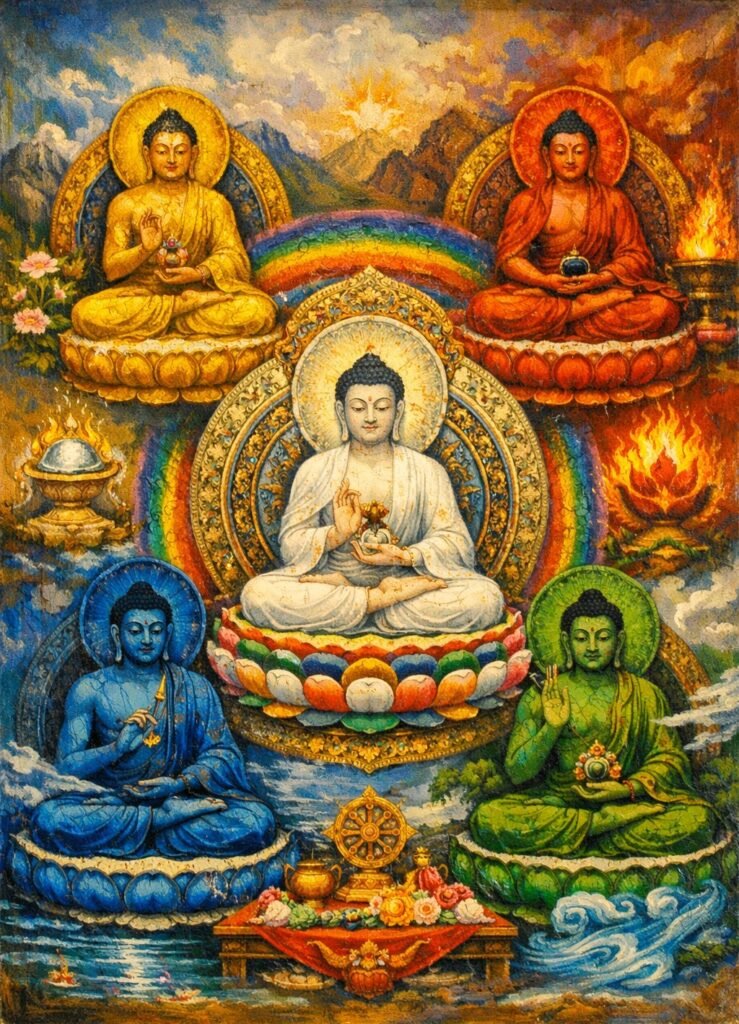
Vairocana’s association with Dharmadhātu Wisdom and Space reflects his position as the all-encompassing primordial Buddha whose awareness pervades the entire field of phenomena. Akṣobhya — “the Immovable” — is associated with Mirror-like Wisdom and Water: clear, perfectly reflective, and unperturbed, his wisdom reflects all phenomena without distortion or reaction. This transformational schema derives principally from the Vajrasekhara Tantra and the Guhyagarbha Tantra commentarial tradition, and is elaborated in Longchenpa’s Treasury of the Dharmadhātu (Chos dbyings mdzod). Every grain of sand placed in a specific zone of the mandala thus carries a specific wisdom-valence, making the act of construction a form of continuous meditational encoding.
5. Monastic Training and Lineage Transmission
The construction of a sand mandala is not a craft skill; it is a ritual competence that requires formal initiatory transmission, years of textual study, and sustained supervised practice. Untrained participation is not merely inadvisable but, within the tradition, actively counter-productive: a mandala constructed without correct empowerment and intention is understood to be an empty geometric arrangement rather than a living field of awakened energy.
5.1 Initiatory Prerequisites: Abhiṣeka and Samaya
Before a monk may participate in the construction of a specific mandala, they must have received the corresponding abhiṣeka — the tantric empowerment or “ripening initiation” for that particular deity. The four levels of empowerment in the Anuttarayoga system (vase, secret, wisdom, word) progressively authorise the practitioner to engage with increasingly subtle aspects of the deity’s mandala. The reception of abhiṣeka also entails the undertaking of specific samaya — tantric commitments whose maintenance sustains the connection between the practitioner and the deity’s wisdom-mind. The samaya include obligations of practice, conduct, and discretion: some aspects of mandala liturgy and inner practice are understood to belong to the restricted domain of these commitments and are not suitable for public exposition.
5.2 Memorisation of the Sādhana and Iconometric Systems
Senior practitioners traditionally memorise the entire mandala from its sādhana (ritual text) and its associated iconometric manual (thig rtsa or thig tshad — literally “line-measures”). This includes the spatial coordinates of each deity, their attributes, hand implements (mudrā and āyudha), mantra syllables, and the precise geometric proportions of every structural element. For the Kālacakra mandala, this encompasses the spatial and symbolic characteristics of over 700 deities. In practice, reference diagrams may also be used during training and construction, particularly for younger monks still developing full memorisation. Monastic training for this level of practice begins in the great Gelug monastic universities — Sera, Drepung, and Ganden — typically commencing in early adolescence and continuing through formal examination over a period of years.
5.3 Mastery of the Chak-pur
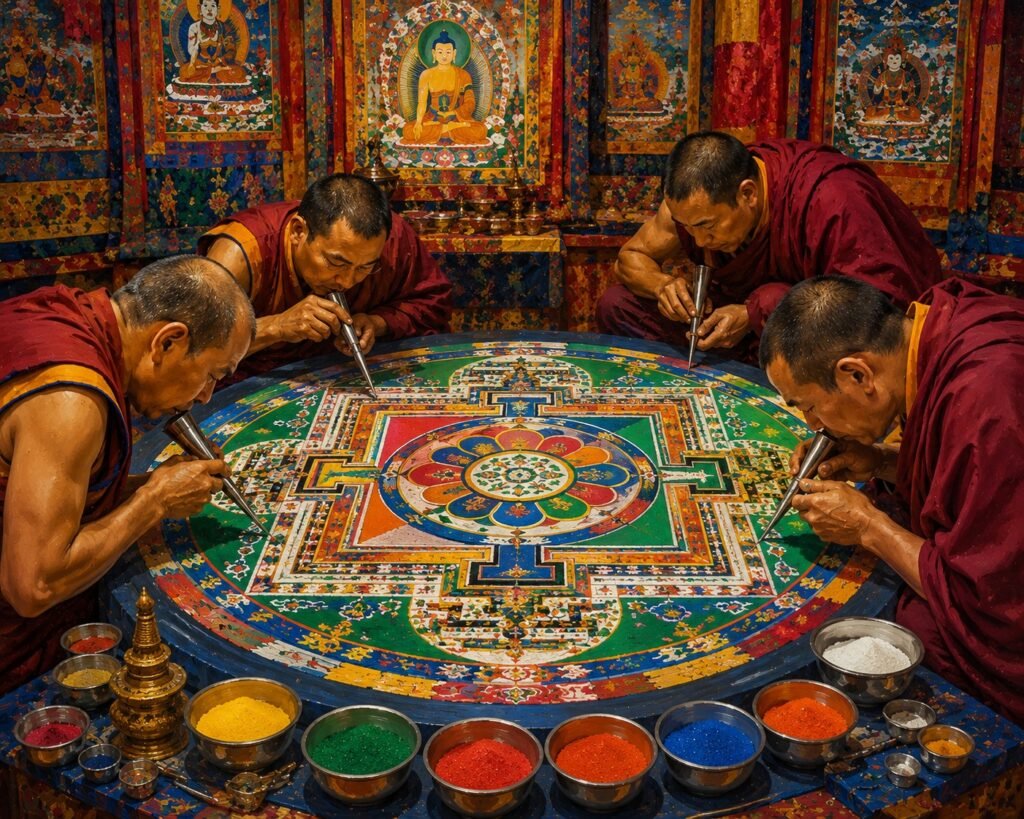
The primary construction tool is the chak-pur (Tib. lcags spyor) — a narrow copper or brass conical funnel with a serrated outer edge. The monk loads the funnel with a specific colour of sand, then scrapes a metal rod along the serrations at a controlled rate; the resulting vibration causes sand to trickle from the tip in a thin, governed stream whose width and density are modulated by angle, pressure, and rhythm. Monks practice for months or years before they are permitted to work on a consecrated mandala platform. The disciplines required include angle control (to vary line thickness), breath regulation — many monks wear surgical masks to prevent inadvertent dispersal of sand grains — and rhythm consistency. The finest-detail work is done not with the chak-pur but with a fine bamboo tube, allowing placement of very small amounts of sand with precision. The chak-pur itself is a consecrated ritual implement, blessed at the opening of each construction session; its narrow tip symbolises one-pointed concentration (samādhi), the precondition for any valid tantric act.
6. Sacred Materials and Their Symbolic Valence
6.1 The Sand: From Semi-Precious Minerals to Contemporary Practice
In the classical Tibetan monastic tradition, the “sand” of the sand mandala was not sand at all but the finely ground powder of semi-precious minerals: turquoise (g.yu), lapis lazuli (be’u), coral (byur ru), and mother-of-pearl (dung gi bye ma). Precious materials such as gold and silver dust were occasionally used in especially significant ritual contexts. The use of actual minerals was understood not as opulence but as an offering of the earth’s intrinsic beauty to the deity — transforming geological matter into devotional substance. In contemporary practice, white marble powder or gypsum is most commonly dyed with opaque mineral-based inks; the resulting coloured sand closely replicates the traditional appearance. Some monastic communities outside Tibet continue to use pulverised mineral powders for the most important ceremonial mandalas.
6.2 Traditional Pigment Sources and Material Notes
The five primary colours of the traditional Tibetan palette are derived from natural mineral and organic sources. Two historically important pigments — orpiment (natural arsenic trisulphide, the traditional source of vivid yellow) and cinnabar (mercuric sulphide, the traditional source of deep red) — are toxic compounds that have been largely replaced in contemporary practice by safer synthetic alternatives. This is worth noting both for accuracy and for any environmental context around the final water offering:
| Colour | Traditional Source | Notes |
|---|---|---|
| White | Crushed gypsum or powdered shell | Associated with lunar clarity and mirror-like purity |
| Yellow | Orpiment (ba bla, arsenic trisulphide) or yellow ochre | Orpiment is toxic; ochre or synthetic pigment now standard |
| Red | Cinnabar (mtshal, mercuric sulphide) or red ochre | Cinnabar is toxic; modern mandalas use mineral-safe alternatives |
| Blue | Indigo (rams) mixed with chalk, or ground azurite | Azurite produces a deeper blue-green; indigo a warmer blue |
| Green | Malachite (g.yu ljang khu) or mixed yellow and blue | Ground malachite produces a distinctive granular green of unusual saturation |
Where contemporary museum mandalas use marble powder dyed with non-toxic pigments, the water offering at the ritual’s conclusion presents no environmental risk. Traditional mineral-powder mandalas warrant more careful consideration of the dissolution context.
7. The Stages of Construction
A complete sand mandala requires between five and fifteen days of continuous monastic work, depending on the mandala’s scale and iconographic complexity. The largest public mandalas measure approximately 1.5 metres square and require teams of eight to ten monks working in coordinated shifts. The following stages are common to all traditions, though specific details vary by school and deity.
Stage 1: Consecration of the Site (1–2 hours)
The wooden platform on which the mandala will be constructed must be transformed into consecrated ground. Monks chant foundational Mahāyāna liturgies — including the Prajñāpāramitāhṛdaya and the Maṇḍala Offering Prayer — and scatter blessed rice and flower petals at the four cardinal points. A preliminary drawing in tsampa (roasted barley flour) is made on the platform surface to purify it and establish the energetic ground for the deity’s eventual presence. This preliminary rite is understood as an act of invitation: the deity’s wisdom-mind is invited to inhabit the space that will become its palace.
Stage 2: Drawing the Geometric Blueprint (4–12 hours)
Using chalk lines, calibrated string, and long straightedges, the monks draw the complete mandala outline — all structural walls, gates, lotus petals, and concentric rings — on the platform surface. Every measurement is derived from the iconometric system preserved in the thig rtsa. The geometric foundation is based on a system of intersecting circles and squares governed by proportional principles found in related tantric yantra traditions; a mandala’s geometric accuracy is considered ritually as well as aesthetically significant, since a faulty geometry is understood to constitute a faulty vessel for the deity’s presence.
Stage 3: Laying the Sand (Days)
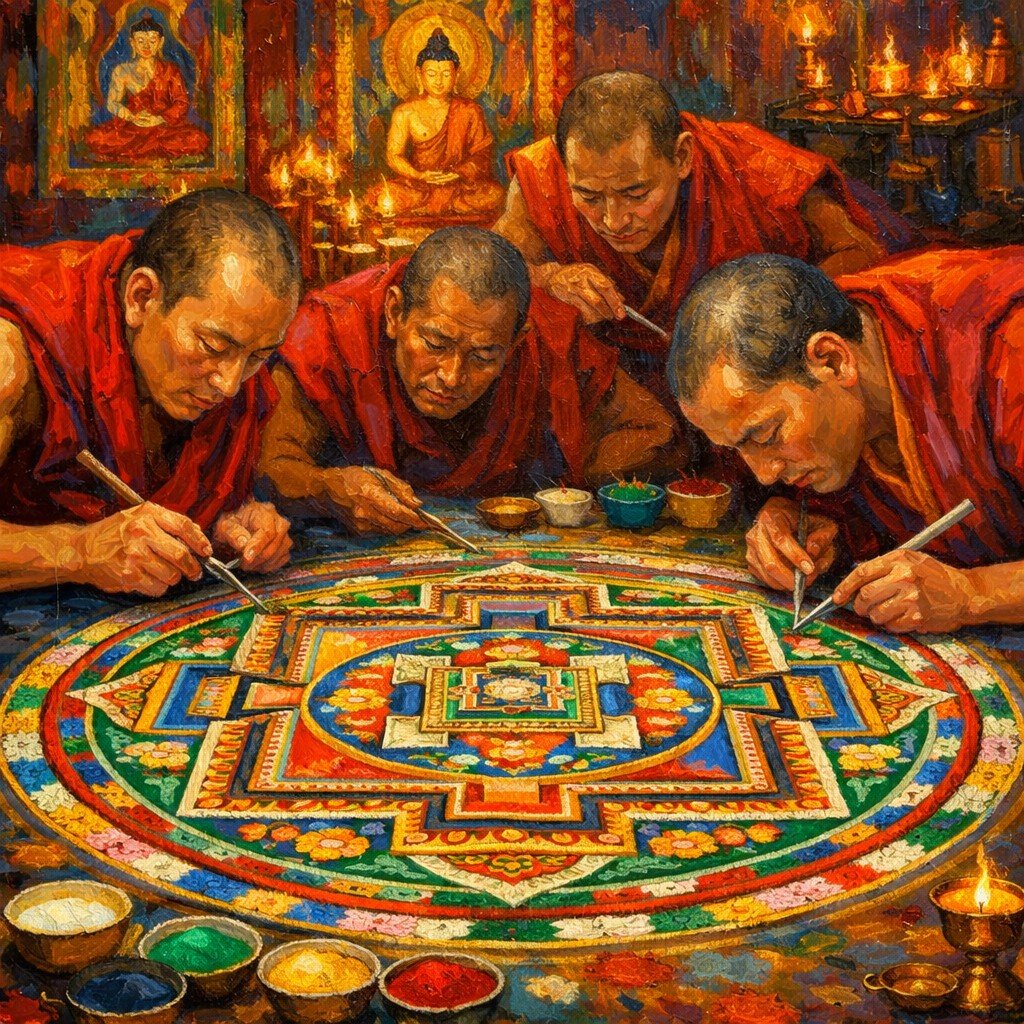
Construction begins at the exact geometric centre — the throne-seat of the principal deity — with the senior monk laying the first grains while chanting the deity’s root mantra. From the centre outward, four monks work simultaneously on the four quadrants to maintain perfect symmetry. The colour sequence follows the iconometric prescription precisely: each zone receives its designated colour, each form its designated proportions. The finest details are executed with a single bamboo tube. A monk’s breath control during fine-detail passages approaches the regulation of a meditator in deep concentration.
Stage 4: Consecration of the Completed Mandala (1 hour)
When the final grain of sand is placed, the monks move immediately into the closing consecration puja (las kyi cho ga). A small statue or torma (ritual offering-cake) representing the principal deity is placed at the mandala’s geometric centre. Butter lamps are lit, incense offered, and the full sequence of the deity’s mantra is recited. Within the tradition, it is understood that the mandala becomes fully animated through this consecration — that the deity’s wisdom-presence is genuinely established within the palace at this moment. Prior to consecration, the mandala is a precision drawing; after consecration, it functions as a living sacred field.
8. The Ritual of Dismantling and Its Philosophical Depth
8.1 The Deliberate Choice of Destruction
To an observer unfamiliar with Buddhist philosophy, the destruction of a completed sand mandala is bewildering. Within the tradition, however, the deliberate dismantling is an act of philosophical integrity. Leaving the mandala intact would constitute a lie: it would imply that conditioned forms can be preserved, that beauty can be made permanent, that the practitioner’s accumulated virtue is a possession rather than an energy to be released. The monk who sweeps the sand is not being destructive; he is being honest — and, by forcing observers to confront their own resistance to impermanence, compassionate.
8.2 The Ritual Sweep: A Reverse Sādhana
The dismantling ritual mirrors the construction in reverse order. The senior monk uses a vajra or ritual brush to draw an initial line through the outermost fire ring, then proceeds inward in a prescribed sequence — first the outer concentric rings, then the palace walls, the gates, and finally the central deity-throne. As each region is swept, its carefully laid sand merges with the expanding grey-brown heap. The moment at which the distinct primary colours — white space, yellow earth, red fire, green wind, blue water — converge into a single undifferentiated pile is, for a prepared observer, a direct demonstration of the Heart Sutra‘s central statement: rūpaṃ śūnyatā, śūnyatāiva rūpam – Form is emptiness, emptiness is form. The diversity was real at the conventional level; the lack of inherent existence was always the ultimate truth of those conventional forms. Both are true simultaneously.
8.3 The Re-absorption of the Deity’s Wisdom-Mind
In tantric theology, the sweeping of the mandala is not merely a physical action; it is the reverse movement of the ritual’s opening. The deity’s presence was never understood to reside in the sand itself — this would be a category error equivalent to confusing a finger pointing at the moon with the moon. The sand was the support (rten) for the deity’s presence, established through the monks’ combined visualisation, mantra recitation, and the power of the initiatory lineage. At dismantling, within the tradition’s understanding, the deity’s energy is re-absorbed into the heart of the vajra master through the reverse visualisation sequence of the sādhana — to be re-emitted at the next appropriate occasion. The mandala’s form is dissolved; the practice’s awakened continuity is not lost but preserved in the living lineage.
9. The Final Release: Dissemination of Accumulated Merit
9.1 The Water Offering Ceremony
The grey-brown sand mixture — containing the accumulated blessings (adhiṣṭhāna) and merit of the entire construction and consecration process — is gathered into a silk-wrapped porcelain or silver vessel. The monks, typically accompanied by lay practitioners who participated in the rituals, process in a formal line to the nearest flowing water: a river, ocean inlet, or lake. During the procession, the compassion mantra Oṃ Maṇi Padme Hūṃ is chanted continuously. When the sand is released into the water, it is not discarded; within the tradition’s understanding, every sentient being who encounters that water receives a subtle karmic imprint from the mandala’s blessing field — an extension of the mthong grol principle into the element of water.
9.2 The Completion of the Mandala’s Purpose
The sand release is not the end of the mandala’s purpose; it is its fulfilment. The mandala was not constructed to be seen and admired — or more precisely, being seen was only the first stage of its function. Its ultimate purpose was always the bodhisattva’s dedication: the complete surrender of accumulated virtue for the benefit of all beings, with no hoarding, no residue, and no regret. The Mahāyāna dedicatory verse (pariṇāmanā), recited after every virtuous act in the tradition, expresses precisely this orientation: all virtue is redirected toward the liberation of every being in saṃsāra without exception.
9.3 The Absence of Relics as Final Teaching
Unlike a consecrated Buddha statue, a thangka scroll painting, or a text, no physical trace of the sand mandala survives its dissolution. This is the tradition’s final and most complete teaching on non-attachment: even the physical support of the practice is surrendered. What persists is not an object but a transformation — the subtle shift in the minds of those who participated, the merit distributed through the water offering, and the living continuity of the lineage that will construct the next mandala when the conditions again arise.
10. Contemporary Contexts, Preservation, and Critical Perspectives
10.1 Sand Mandalas in Western Institutional Settings
Since the early 1990s, Tibetan monks — primarily from Drepung Loseling Monastery (re-established in Mundgod, Karnataka, following exile from Lhasa) and associated Vajrayāna centres — have constructed sand mandalas in museums, universities, cathedrals, and cultural centres across North America, Europe, and Australia. Notable documented instances include the Kālacakra mandala created at the American Museum of Natural History (New York, 1991) in conjunction with the Dalai Lama’s Kālacakra initiation, and the Chenrezig mandala created at Clark College (Vancouver, Washington) in 2012 and 2020. These performances serve multiple simultaneous functions: they transmit teaching to non-Buddhist audiences, they generate merit formally dedicated to world peace, and they maintain the living practice of a tradition that was systematically suppressed in Tibet following the events of 1950. The mthong grol principle provides the tradition’s own theological rationale for these public displays: the audience need not understand what they are seeing for the encounter to be karmically significant.
10.2 Therapeutic and Interfaith Applications
Sand mandalas have increasingly been used in contexts of collective suffering — for communities following natural disasters, in hospice and palliative care settings, and as gestures of reconciliation in zones of conflict. The Medicine Buddha (Sangye Menla) mandala is particularly associated with such contexts; its iconography is structured around the qualities of the enlightened healer, including the lapis lazuli body that symbolises the removal of the poison of ignorance. This expansion of the mandala’s traditional ritual context reflects both the adaptability of the Vajrayāna tradition and the consistent Mahāyāna position that the dharma’s capacity to address suffering is not sectarian in scope.
10.3 The Commodification Problem and the Question of Ritual Efficacy
The display of sand mandalas as art-world events has attracted sustained critical attention from within the Tibetan Buddhist tradition. Several prominent teachers have raised concerns that when admission fees are charged, mandalas are photographed for commercial purposes, or when the accompanying ritual is abbreviated or omitted, the mandala risks being reduced to a visual spectacle stripped of its tantric function. This concern is not merely aesthetic; it touches on a genuine theological question: does the efficacy of a tantric practice depend on its formal ritual context and the samaya commitments of its practitioners, or does it depend primarily on the purity of intention of those performing it?
The counter-position, articulated by a number of Gelug and Kagyu teachers involved in Western dharma transmission, holds that the mandala’s blessing and mthong grol function remain intact so long as the monks perform the construction and dismantling rituals correctly and with proper intention — and that if Western audiences leave with a genuine experiential encounter with impermanence, the teaching has succeeded regardless of the institutional context. This tension reflects a broader unresolved question in contemporary Buddhism about the relationship between esoteric ritual integrity and the tradition’s imperative of universal compassionate outreach.
Conclusion
The Buddhist sand mandala is, at its core, a philosophical curriculum compressed into a ritual of coloured dust. From the first consecration of the platform to the final release of sand into flowing water, every action enacts a foundational Buddhist doctrine with a directness and physical immediacy that textual study alone can replicate. The outer mandala maps the purified cosmos; the inner mandala maps the practitioner’s own transformed body and mind; the secret mandala points to the enlightened awareness that was never absent. The monks who spend hours on their knees, regulating their breath so as not to disturb a single grain, are enacting in the physical world what the sūtras and tantras assert at the level of philosophy: that all things arise in dependence, abide provisionally, and dissolve without remainder.
And the dissolution is not the end. The mthong grol teaching insists that every mind-stream touched by the sight of the mandala carries something forward. The water offering insists that every being downstream carries something forward. The lineage insists that the next mandala will be built. What the sand mandala refuses — in every one of its actions, from first grain to final river — is the pretence that anything conditioned can be held. What it offers instead is the direct experience of letting go, and the discovery that what remains, when the attachment releases, is not loss but clarity.
Further Reading and Scholarly Resources
Primary canonical sources: The Kālacakra Tantra (Tib. Dus kyi ‘khor lo) and its principal commentary the Vimalaprabhā remain the canonical foundation for the most elaborate sand mandala tradition. The Guhyasamāja Tantra and Guhyagarbha Tantra provide the philosophical and iconometric underpinnings of the five-family system. Nāgārjuna’s Mūlamadhyamakakārikā and Śāntideva’s Bodhicaryāvatāra (ch. 10 on merit dedication) are essential for the śūnyatā and bodhisattva-vow doctrines. For the impermanence teaching in the Northern transmission context, Tsongkhapa’s Lam rim chen mo (Great Treatise on the Stages of the Path) provides an authoritative Tibetan exposition of both coarse and subtle impermanence. Longchenpa’s Treasury of the Dharmadhātu (Chos dbyings mdzod) elaborates the five-wisdom schema from a Nyingma perspective.
Secondary scholarship: Barry Bryant, The Wheel of Time Sand Mandala: Visual Scripture of Tibetan Buddhism (1992) remains the most detailed English-language treatment of Kālacakra sand mandala iconometry and ritual procedure. Robert Beer, The Handbook of Tibetan Buddhist Symbols (2003) provides comprehensive reference for individual iconographic elements. For the Madhyamaka philosophical context, Guy Newland’s Introduction to Emptiness (2009) and Jeffrey Hopkins’s Meditation on Emptiness (1983) offer rigorous accounts of the philosophical framework underlying the mandala’s doctrinal logic. For the Generation Stage practice and its relationship to mandala architecture, Daniel Cozort’s Highest Yoga Tantra (1986) is a reliable scholarly guide.
Contemplative practice: For practitioners without access to formal Vajrayāna transmission, the following week-long exercise engages the mandala’s core teaching at a contemplative level: create something modest and complete — a sand drawing, a flower arrangement, a calligraphic page — with full, undivided attention to each detail of its making. When it is finished, regard it carefully for some time. Then dismantle it intentionally. Observe the emotional texture of that moment. The resistance, loss, or reluctance that arises is precisely what the sand mandala is designed to illuminate — and, gradually, to dissolve.