A – Article
| Term | Language / category | Definition |
|---|---|---|
| AbhiṣekaSkt. | Vajrayāna practice | Tantric empowerment or ‘ripening initiation’ for a specific deity, authorising the practitioner to engage with that deity’s mandala. Four levels exist in the Anuttarayoga system: vase, secret, wisdom, and word. |
| AdhiṣṭhānaSkt. | General doctrine | Blessings; the positive karmic energy and auspicious influence transmitted through a sacred object, practice, or lineage master. The term preferred in traditional sources over the New Age rendering ‘healing energy’. |
| AkṣobhyaSkt. | Five Buddhas | ‘The Immovable’; one of the five tathāgatas, associated with the colour blue, Mirror-like Wisdom (ādarśa-jñāna), the element Water, and the transformation of aversion (dveṣa). Positioned in the eastern quarter of advanced mandalas in many systems. |
| AmitābhaSkt. | Five Buddhas | ‘Boundless Light’; one of the five tathāgatas, associated with the colour red, Discriminating Wisdom (pratyavekṣaṇā-jñāna), the element Fire, and the transformation of attachment (rāga). |
| AmoghasiddhiSkt. | Five Buddhas | ‘Unfailing Accomplishment’; one of the five tathāgatas, associated with the colour green, All-Accomplishing Wisdom (kṛtyānuṣṭhāna-jñāna), the element Air/Wind, and the transformation of envy (īrṣyā). |
| Anattā / AnātmanPali / Skt. | Three marks | Non-self; the third mark of conditioned existence. The doctrine that no phenomenon — including persons — possesses a fixed, independent, unchanging self or essence. A cornerstone of all Buddhist philosophical schools. |
| Anicca / AnityaPali / Skt. | Three marks | Impermanence; the first mark of conditioned existence. All conditioned formations arise, abide for a time, and cease. The sand mandala enacts this teaching through its deliberate destruction after completion. |
| Anuttarayoga TantraSkt. | Tantra classification | ‘Unsurpassed Yoga Tantra’; the highest of the four classes of tantra in the Sarma (New Translation) schools. Encompasses the most advanced Generation and Completion Stage practices and the most architecturally complex sand mandalas, including the Kālacakra. |
| Aṣṭa mahāśmaśānāniSkt. | Mandala symbolism | The Eight Great Charnel Grounds; depicted in the outermost ring of advanced tantric mandalas, featuring cremation sites, skeletons, and fierce protectors. Interpreted variously across lineages as representing impermanence, stages of practice, and the transformation of mental states. |
B – Article
| Term | Language / category | Definition |
|---|---|---|
| Ba blaTib. | Materials | Orpiment; natural arsenic trisulphide, historically used as the source of vivid yellow pigment in traditional Tibetan sand mandalas. Toxic; largely replaced in contemporary practice by mineral-safe alternatives. |
| BodhicittaSkt. | Mahāyāna doctrine | ‘Mind of awakening’; the aspiration to attain full enlightenment for the benefit of all sentient beings. The motivational foundation of the bodhisattva path and a prerequisite orientation for Mahāyāna and Vajrayāna practice. |
| BodhicaryāvatāraSkt. | Canonical text | ‘Guide to the Bodhisattva’s Way of Life’; composed by Śāntideva (c. 8th century CE). Chapter 10 on merit dedication (pariṇāmanā) provides the canonical Mahāyāna basis for the water offering at the conclusion of the sand mandala ritual. |
| BrahmavihārāSkt. | General doctrine | ‘Divine abode’; the four immeasurable attitudes of loving-kindness (maitrī), compassion (karuṇā), sympathetic joy (muditā), and equanimity (upekṣā). In many contemplative traditions the four gates of the mandala palace are associated with these four qualities as a teaching layer. |
| Bskyed-rimTib. | Vajrayāna practice | Generation Stage; the first of two stages in Anuttarayoga Tantra practice. The practitioner dissolves ordinary self-perception and mentally reconstitutes their body, speech, and mind as the mandala palace, deities, and mantras respectively. The sand mandala serves as the architectural blueprint for this practice. |
| Byur ruTib. | Materials | Coral; one of the semi-precious materials historically ground to produce red and orange pigments in classical Tibetan sand mandalas. |
C – Article
| Term | Language / category | Definition |
|---|---|---|
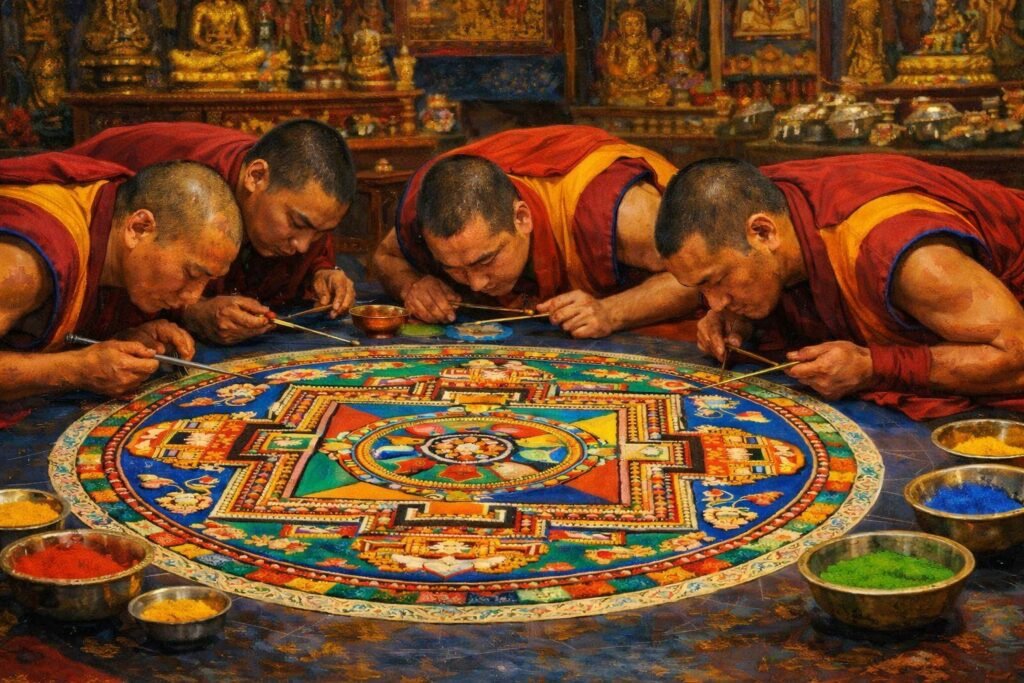
| Chak-purTib. (lcags spyor) | Ritual implement | The narrow copper or brass conical funnel used to apply coloured sand during mandala construction. A consecrated ritual implement; the monk scrapes a metal rod along its serrated edge to vibrate sand through the tip in a controlled stream. Mastery requires years of training. |
| Cho ga (las kyi cho ga)Tib. | Ritual | Consecration ritual performed upon completion of the sand mandala, animating the palace and establishing the deity’s wisdom-presence within it. The mandala is understood to become a living sacred field only after this rite. |
| Chos dbyings mdzodTib. | Canonical text | ‘Treasury of the Dharmadhātu’; composed by Longchenpa (1308–1364 CE). A foundational Nyingma text that elaborates the five-wisdom and five-Buddha-family schema from the perspective of Dzogchen and the Guhyagarbha Tantra commentarial tradition. |
D – Article
| Term | Language / category | Definition |
|---|---|---|
| Dag snangTib. | Vajrayāna doctrine | Pure perception; the Vajrayāna practice of training to perceive all phenomena as the display of enlightened qualities rather than through the distorting lens of the three poisons. The sand mandala is one of the primary supports for cultivating dag snang. |
| Dag pa’i zhing khamsTib. | Cosmology | Pure land; the purified realm of a fully awakened being, perceived through the eyes of pure perception. In tantric practice the mandala represents such a pure land, and the Generation Stage involves the practitioner identifying their environment with it. |
| Devatā-yogaSkt. | Vajrayāna practice | Deity yoga; the central practice of Vajrayāna in which the practitioner meditates by identifying with the form, qualities, and wisdom-mind of a specific deity. The sand mandala is the environmental support for this identification during Generation Stage practice. |
| Dharmadhātu-jñānaSkt. | Five wisdoms | Dharmadhātu Wisdom; the transcendent wisdom of Vairocana, the white central Buddha. Pervades the entire field of phenomena (dharmadhātu) and is associated with Space and the transformation of ignorance (moha). |
| DharmadhātuSkt. | Philosophy | ‘Realm of phenomena’; the totality of all phenomena as they are in their ultimate nature — empty of inherent existence and pervaded by awakened awareness. Vairocana’s Dharmadhātu Wisdom is the direct recognition of this nature. |
| DharmapālaSkt. | Iconography | Dharma protector; fierce guardian deity depicted in the outer rings of advanced mandalas, particularly within the charnel grounds. Protects practitioners and the integrity of the lineage transmission. |
| Dkyil ‘khorTib. | Core term | Mandala; literally ‘centre and circumference.’ The Tibetan rendering of the Sanskrit maṇḍala. Encompasses both the physical sand construction and the visualised celestial palace it represents. |
| Dorje RingTib. | Mandala structure | Vajra Circle; the concentric ring of crossed vajras that immediately surrounds the palace walls in the sand mandala. Represents upāya (skilful means) and the indestructible nature of awakened mind. |
| Dung gi bye maTib. | Materials | Mother-of-pearl powder; one of the semi-precious materials historically ground to produce white or iridescent pigment in classical Tibetan sand mandalas. |
| Duḥkha / DukkhaSkt. / Pali | Three marks | Suffering, dissatisfaction, or the pervasive unsatisfactoriness of conditioned existence; the second mark of conditioned existence. The sand mandala’s teaching on impermanence and non-attachment is oriented toward the cessation of duḥkha. |
| DveṣaSkt. | Three poisons | Aversion or hatred; one of the three root poisons of the mind. Transformed into Mirror-like Wisdom (ādarśa-jñāna) through the practices associated with Akṣobhya. |
G – Article
| Term | Language / category | Definition |
|---|---|---|
| G.yuTib. | Materials | Turquoise; one of the semi-precious minerals historically ground to produce blue-green pigment in classical Tibetan sand mandalas. Carried symbolic associations with sky and prosperity in Tibetan culture. |
| G.yu ljang khuTib. | Materials | Malachite; a green copper carbonate mineral historically used to produce green pigment in traditional Tibetan sand mandalas. Produces a distinctive granular green of unusual saturation. |
| Guhyagarbha TantraSkt. | Canonical text | A foundational Mahāyoga tantra of the Nyingma school, central to the elaboration of the five-Buddha-family and five-wisdom schema used in mandala construction and the colour symbolism system. |
| Guhyasamāja TantraSkt. | Canonical text | One of the earliest and most influential Anuttarayoga tantras (c. 8th century CE), containing detailed descriptions of mandala construction using powdered colours. Widely considered foundational to Tibetan Vajrayāna. |
H – Article
| Term | Language / category | Definition |
|---|---|---|
| Heart Sutra (Prajñāpāramitāhṛdaya)Skt. | Canonical text | A concise Prajñāpāramitā text chanted at key stages of the mandala ritual. Its central formula — rūpaṃ śūnyatā, śūnyatāiva rūpam (‘form is emptiness, emptiness is form’) — is enacted physically by the mandala’s construction and destruction. |
J – Article
| Term | Language / category | Definition |
|---|---|---|
| JñānaSkt. | Philosophy | Wisdom or gnosis; specifically the awakened wisdom-mind of a deity or buddha, understood as genuinely present in a correctly constructed and consecrated mandala. Distinguished from ordinary intellectual knowledge (vijñāna). |
K – Article
| Term | Language / category | Definition |
|---|---|---|
| Kālacakra TantraSkt. | Canonical text | ‘Wheel of Time’; a major Anuttarayoga tantra (c. 10th–11th century CE), accompanied by the commentary Vimalaprabhā. Source of the most architecturally complex sand mandala in active use, housing over 700 deities across five concentric structural levels. Directional symbolism differs markedly from simpler mandalas. |
| KaruṇāSkt. | Brahmavihārā | Compassion; the wish that all sentient beings be free from suffering. The second of the Four Immeasurables, associated in many contemplative traditions with the southern gate of the mandala palace. |
| KangyurTib. | Canon | The Tibetan Buddhist canon of translated teachings attributed to the Buddha, including both sūtra and tantra. The Northern/Tibetan equivalent of the Pali Canon; the Sanskrit Udānavarga and other foundational texts appear within it. |
| Kṛtyānuṣṭhāna-jñānaSkt. | Five wisdoms | All-Accomplishing Wisdom; the transcendent wisdom of Amoghasiddhi. The capacity to accomplish the benefit of beings spontaneously and without effort, associated with the element Air/Wind and the transformation of envy (īrṣyā). |
L – Article
| Term | Language / category | Definition |
|---|---|---|
| Lam rim chen moTib. | Canonical text | ‘Great Treatise on the Stages of the Path’; composed by Je Tsongkhapa (1357–1419 CE). Provides an authoritative Tibetan Vajrayāna exposition of impermanence at both its coarse level (death of persons and things) and its subtle level (momentary arising and ceasing of all phenomena). |
M – Article
| Term | Language / category | Definition |
|---|---|---|
| MahāsiddhaSkt. | Historical | ‘Great adept’; an Indian Buddhist tantric master of the Pala period and related eras who developed the mandala rituals that were later transmitted to Tibet. Padmasambhava is the most prominent mahāsiddha associated with the Tibetan transmission. |
| MaitrīSkt. | Brahmavihārā | Loving-kindness; the wish that all sentient beings experience happiness. The first of the Four Immeasurables, associated in many contemplative traditions with the eastern gate of the mandala palace. |
| MānaSkt. | Three poisons | Pride or arrogance; one of the five afflictions transformed through Vajrayāna practice. Transformed into the Wisdom of Equality (samatā-jñāna) through the practices associated with Ratnasambhava. |
| MaṇḍalaSkt. | Core term | Literally ‘circle’ or ‘that which possesses an essence’; in tantric Buddhism, a diagrammatic representation of a deity’s purified environment rendered as a celestial palace, used as the support for Generation Stage practice, initiation, and merit-generating ritual. |
| Maṇḍala-abhiṣekaSkt. | Vajrayāna practice | Mandala empowerment; the initiatory rite through which a deity’s mandala is formally established as a sacred field and practitioners are authorised to engage with it. Without this empowerment, the mandala functions as a geometric drawing rather than a living tantric environment. |
| MohaSkt. | Three poisons | Ignorance or delusion; the root of all afflictions and the primary obscuration preventing recognition of the mind’s true nature. Transformed into Dharmadhātu Wisdom (dharmadhātu-jñāna) through the practices associated with Vairocana. |
| Mthong grolTib. | Vajrayāna doctrine | ‘Liberation through sight’; the doctrine that simply gazing upon a correctly constructed and consecrated mandala plants a karmic seed of liberation (thar pa’i sa bon) in the mind-stream of any witness, regardless of their level of understanding or initiatory status. The primary traditional justification for public mandala displays. |
| MtshalTib. | Materials | Cinnabar; mercuric sulphide, historically the source of deep red pigment in classical Tibetan sand mandalas. Toxic; replaced in modern practice by mineral-safe alternatives. |
| MuditāSkt. | Brahmavihārā | Sympathetic joy; the capacity to rejoice in the happiness and good fortune of others without envy. The third of the Four Immeasurables, associated in many contemplative traditions with the western gate of the mandala palace. |
| MūlamadhyamakakārikāSkt. | Canonical text | ‘Fundamental Verses on the Middle Way’; the foundational philosophical text of Nāgārjuna (c. 2nd–3rd century CE), establishing the systematic analysis of śūnyatā (emptiness) that underpins the mandala’s doctrinal logic. |
| MudrāSkt. | Iconography | Ritual hand gesture; a specific position of the hands that encodes a deity’s particular quality, vow, or function. Used alongside āyudha (implements) to identify each deity within the mandala. |
N – Article
| Term | Language / category | Definition |
|---|---|---|
| NādaSkt. | Vajrayāna doctrine | Sacred sound; the understanding in Vajrayāna that all sound partakes of the nature of mantra and is a dimension of reality that can serve as offering and practice. The vibration of the chak-pur during mandala construction is understood in this light. |
P – Article
| Term | Language / category | Definition |
|---|---|---|
| PadmasambhavaSkt. | Historical | ‘Lotus-Born’ (Tib. Guru Rinpoche); Indian tantric master credited by traditional accounts with transmitting Vajrayāna Buddhism to Tibet in the late 8th century CE under royal patronage of King Trisong Detsen. Central to the founding of Samye Monastery and the Nyingma lineage. |
| Pañca jñānaSkt. | Five wisdoms | The five transcendent wisdoms; the enlightened cognitive modes associated with the five tathāgatas (Buddha families) in Vajrayāna Buddhism. Each corresponds to the transformation of one of the five root afflictions and is encoded in the colour scheme of the sand mandala. |
| PariṇāmanāSkt. | Mahāyāna doctrine | Merit dedication; the Mahāyāna practice of redirecting all accumulated virtue outward for the benefit of all sentient beings rather than retaining it for personal benefit. Enacted physically by the water offering at the conclusion of the sand mandala ritual. |
| Pratyavekṣaṇā-jñānaSkt. | Five wisdoms | Discriminating Wisdom; the transcendent wisdom of Amitābha. The capacity to perceive the particular, distinguishing qualities of all phenomena without confusion or error, associated with the element Fire and the transformation of attachment (rāga). |
| PratītyasamutpādaSkt. | Core doctrine | Dependent origination; the Buddha’s foundational teaching that all phenomena arise in dependence on causes and conditions and possess no independent self-existence. The sand mandala’s arising and dissolution are held to instantiate this teaching directly. |
| PrajñāpāramitāSkt. | Canonical text | ‘Perfection of Wisdom’; a body of Mahāyāna sūtras, including the Heart Sutra, that expound the doctrine of śūnyatā. Chanted during mandala consecration and closely linked to the philosophical logic of the mandala’s construction and destruction. |
| PuṇyaSkt. | General doctrine | Merit; positive karmic energy generated by virtuous actions. The creation of a sand mandala is considered a substantial generator of puṇya, which is then dedicated outward through the water offering per the bodhisattva vow. |
R – Article
| Term | Language / category | Definition |
|---|---|---|
| RāgaSkt. | Three poisons | Desire or attachment; one of the three root poisons. Transformed into Discriminating Wisdom (pratyavekṣaṇā-jñāna) through the practices associated with Amitābha. |
| RamsTib. | Materials | Indigo; an organic blue dye derived from the indigo plant, used traditionally — often mixed with chalk — to produce blue pigment for sand mandalas. Produces a warmer blue than mineral azurite. |
| RatnasambhavaSkt. | Five Buddhas | ‘Jewel-born’; one of the five tathāgatas, associated with the colour yellow, the Wisdom of Equality (samatā-jñāna), the element Earth, and the transformation of pride (māna). |
| Reg grolTib. | Vajrayāna doctrine | Liberation through touch; one of the Tibetan Buddhist ‘liberation through the senses’ teachings, analogous to mthong grol (sight) and thos grol (hearing). Holds that physical contact with a sacred object can plant karmic seeds of liberation. |
| RtenTib. | Ritual | Support; the physical object — statue, thangka, or sand mandala — that serves as the basis for a deity’s presence in a ritual context. The rten is distinct from the deity whose presence it supports; the mandala is the rten, not the deity itself. |
| Rten ‘brelTib. | General doctrine | Auspicious connection or interdependent arising; the understanding that encountering a sacred object, teacher, or text — including through mthong grol — creates a karmic link with the dharma that ripens toward liberation over time. |
S – Article
| Term | Language / category | Definition |
|---|---|---|
| SādhanaSkt. | Ritual | Ritual practice text describing the complete sequence of a deity’s meditation: visualisation, mantra, offerings, and dissolution. The liturgical source from which monks memorise all iconometric details of the mandala they construct. |
| SamādhiSkt. | General doctrine | Meditative concentration; one-pointed focus of the mind, symbolised by the narrow tip of the chak-pur. Considered an essential quality for valid tantric action and specifically required during fine-detail work on the mandala. |
| SamayaSkt. | Vajrayāna practice | Tantric commitments undertaken upon receiving abhiṣeka; ethical, ritual, and discretionary obligations that maintain the practitioner’s connection with the deity’s wisdom-mind. Some aspects of mandala liturgy belong to the protected domain of samaya and are not suitable for public explanation. |
| Samatā-jñānaSkt. | Five wisdoms | Wisdom of Equality; the transcendent wisdom of Ratnasambhava. Perceives all phenomena with equanimity, recognising the fundamental equality of all beings and things. Associated with the element Earth and the transformation of pride (māna). |
| SaṃsāraSkt. | General doctrine | Cyclic existence; the beginningless round of conditioned existence driven by the three poisons and characterised by the three marks (impermanence, suffering, non-self). Liberation from saṃsāra is the stated aim of Buddhist practice. |
| SambhogakāyaSkt. | Buddhist cosmology | ‘Enjoyment body’; one of the three bodies (trikāya) of a Buddha. The purified environment of an awakened being as perceived through pure perception; the ontological register in which the mandala’s celestial palace exists. |
| Samye Monastery (bSam yas)Tib. | Historical | Tibet’s first Buddhist monastery (c. 779 CE), founded under King Trisong Detsen with the assistance of Padmasambhava and Śāntarakṣita. Traditional accounts associate its founding with the first sand mandala rituals on Tibetan soil. Its architectural design was conceived as a three-dimensional mandala cosmogram. |
| SkandhaSkt. | Philosophy | Aggregate; one of the five psycho-physical components of a person (form, feeling, perception, mental formations, consciousness). In Generation Stage practice, the practitioner reconstitutes these five aggregates as the five tathāgatas and the architecture of the mandala palace. |
| SvabhāvaSkt. | Philosophy | Inherent, independent, self-generated existence; that which Nāgārjuna’s Mādhyamika analysis demonstrates to be absent in all phenomena. The central target of śūnyatā teaching; no phenomenon — including the mandala — possesses svabhāva. |
T – Article
| Term | Language / category | Definition |
|---|---|---|
| TathāgatakulaSkt. | Five Buddhas | Buddha family or ‘tathāgata family’; one of the five groupings of awakened qualities organised around the five primordial Buddhas (Vairocana, Akṣobhya, Ratnasambhava, Amitābha, Amoghasiddhi). The colour system of the sand mandala is structured around these five families. |
| TengyurTib. | Canon | The Tibetan Buddhist canon of translated commentarial and philosophical treatises, distinct from the Kangyur (canonical teachings attributed to the Buddha). Contains the works of Indian masters such as Nāgārjuna, Candrakīrti, and Śāntideva that provide the philosophical framework for mandala practice. |
| Thar pa’i sa bonTib. | Vajrayāna doctrine | Karmic seed of liberation; in the context of mthong grol, the subtle positive karmic imprint planted in the mind-stream of anyone who witnesses a correctly constructed mandala, regardless of their level of understanding. |
| Thig rtsa / Thig tshadTib. | Ritual | Iconometric manual; literally ‘line-measures.’ The traditional technical text prescribing the precise proportions, spatial coordinates, and geometric relationships for every element of a specific mandala’s construction. |
| Thos grolTib. | Vajrayāna doctrine | Liberation through hearing; the ‘liberation through the senses’ principle most famously associated with the Bardo Tödöl (Tibetan Book of the Dead). Holds that hearing specific mantras, teachings, or sacred sounds can plant karmic seeds of liberation in the mind-stream. |
| Trilakṣaṇa / TilakkhaṇaSkt. / Pali | Core doctrine | Three marks of conditioned existence: impermanence (anitya), suffering (duḥkha), and non-self (anātman). All three are embodied and enacted in the construction, inhabitation, and destruction of the sand mandala. |
| Trisong DetsenTib. | Historical | King of Tibet (r. c. 755–797 CE) who established Buddhism as Tibet’s official religion, invited Padmasambhava and Śāntarakṣita to Tibet, and patronised the construction of Samye Monastery. His reign marks the formal introduction of the sand mandala tradition to Tibet. |
| TsampaTib. | Materials | Roasted barley flour; a Tibetan staple used in the preliminary ritual drawing on the mandala platform prior to construction, serving to purify the surface and establish it as consecrated ground. |
| Tsongkhapa Lobzang DrakpaTib. | Historical | Founder of the Gelug school (1357–1419 CE), author of the Lam rim chen mo. His systematic exposition of the stages of the path, including detailed teachings on impermanence at coarse and subtle levels, is foundational to the Gelug understanding of mandala practice. |
U – Article
| Term | Language / category | Definition |
|---|---|---|
| UdānavargaSkt. | Canonical text | Sanskrit counterpart to the Pali Dhammapada, preserved in Tibetan translation in the Kangyur. The canonical source within the Northern transmission for the teaching on impermanence: anityā bata saṃskārāḥ — ‘conditioned formations are indeed impermanent.’ |
| UpādānaSkt. | General doctrine | Clinging or attachment; one of the twelve links of dependent origination and the specific mental factor that the sand mandala’s destruction is designed to directly confront and dissolve in the minds of practitioners and witnesses. |
| UpāyaSkt. | Mahāyāna doctrine | Skilful means; the compassionate capacity to engage with suffering beings in whatever way most effectively leads them toward liberation. Symbolised in the mandala by the Vajra Circle — the ring of crossed vajras surrounding the palace walls. |
| UpekṣāSkt. | Brahmavihārā | Equanimity; the capacity to remain stable and undisturbed by the fluctuations of conditioned experience. The fourth of the Four Immeasurables, associated in many contemplative traditions with the northern gate of the mandala palace. |
V – Article
| Term | Language / category | Definition |
|---|---|---|
| VairocanaSkt. | Five Buddhas | The primordial, all-encompassing Buddha of the central family, associated with the colour white, Dharmadhātu Wisdom (dharmadhātu-jñāna), the element Space, and the transformation of ignorance (moha). His wisdom pervades the entire field of phenomena. |
| VajraSkt. | Ritual implement | ‘Thunderbolt’ or ‘diamond’; a ritual sceptre symbolising the indestructible, lucid nature of awakened mind. Used by the senior monk to begin the dismantling of the mandala, drawing the initial line through the outermost fire ring. |
| Vajra Fire WallEng. | Mandala structure | The ring of multi-coloured flames at or near the outermost concentric ring of the mandala palace, representing the wisdom-fire that burns away ignorance and the three poisons. Serves as a protective barrier for the practitioner’s mind during meditation. |
| Vajrasekhara TantraSkt. | Canonical text | A major Yoga Tantra text that is one of the primary canonical sources for the five-Buddha-family and five-wisdom schema encoded in the colour symbolism of sand mandala construction. |
| VijñānaSkt. | Philosophy | Consciousness or sense-cognition; ordinary dualistic awareness, as distinct from jñāna (wisdom). In Generation Stage practice the practitioner’s vijñāna is transformed or reconstituted as the non-dual jñāna of the mandala’s deities. |
| VimalaprabhāSkt. | Canonical text | ‘Stainless Light’; the principal commentary on the Kālacakra Tantra, providing the authoritative iconometric and ritual instructions for the Kālacakra sand mandala. An essential reference for scholars of the tradition. |
| ViśuddhadṛṣṭiSkt. | Vajrayāna doctrine | Pure vision or pure perception; the Sanskrit equivalent of the Tibetan dag snang. The enlightened mode of perception that the sand mandala is designed to cultivate, in which all phenomena are recognised as the display of awakened qualities. |
Ā – Article
| Term | Language / category | Definition |
|---|---|---|
| Ādarśa-jñānaSkt. | Five wisdoms | Mirror-like Wisdom; the transcendent wisdom of Akṣobhya, the blue Buddha of the eastern family. Clear, perfectly reflective, and unperturbed, it perceives all phenomena without distortion or reaction. Associated with the element Water. |
| ĀyudhaSkt. | Iconography | Ritual hand implement or attribute held by a deity — such as a lotus, sword, or wheel — that encodes that deity’s specific enlightened quality or function. Each deity in a mandala is identified in part by its āyudha. |
Ī
| Term | Language / category | Definition |
|---|---|---|
| ĪrṣyāSkt. | Three poisons | Envy or jealousy; one of the five afflictions transformed through Vajrayāna practice. Transformed into All-Accomplishing Wisdom (kṛtyānuṣṭhāna-jñāna) through the practices associated with Amoghasiddhi. |
Ś – Article
| Term | Language / category | Definition |
|---|---|---|
| ŚāntarakṣitaSkt. | Historical | Indian Buddhist philosopher and abbot of Nālandā, invited to Tibet by King Trisong Detsen alongside Padmasambhava. His contribution to the Tibetan transmission was primarily philosophical and institutional rather than tantric. |
| ŚāntidevaSkt. | Historical | Indian Mahāyāna philosopher (c. 8th century CE), author of the Bodhicaryāvatāra. His chapter on merit dedication (pariṇāmanā) provides the canonical basis for dedicating the mandala’s accumulated merit to all sentient beings. |
| ŚūnyatāSkt. | Core doctrine | Emptiness; the absence of inherent, independent existence (svabhāva) in all phenomena. Systematised by Nāgārjuna in the Mūlamadhyamakakārikā. The sand mandala’s destruction enacts this teaching: form dissolves back into undifferentiated matter, revealing that distinctions were always conventionally real but ultimately without inherent existence |