Key Takeaways
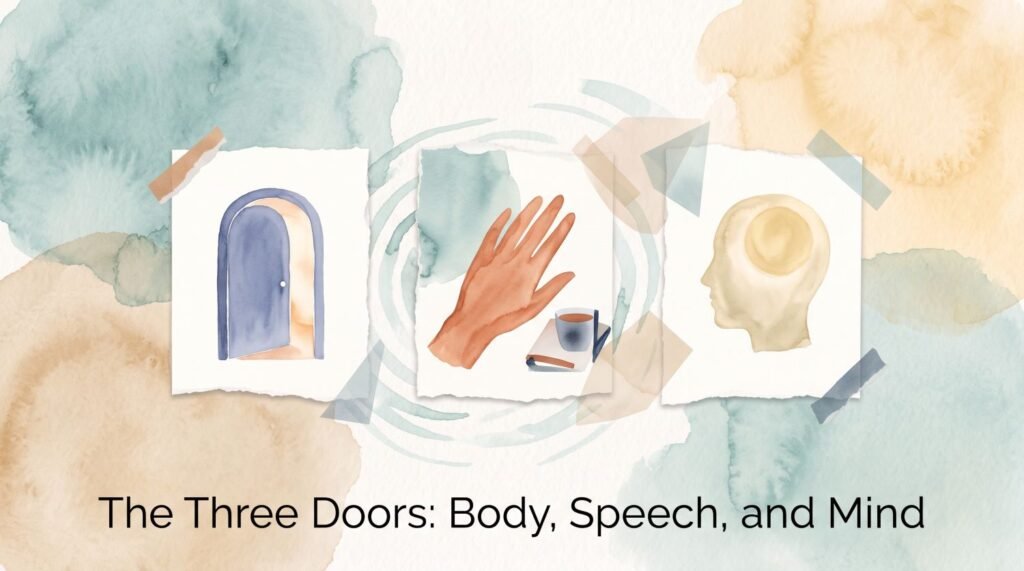
- The “three doors” is a later Buddhist pedagogical label for three channels of action: body, speech, and mind. The early Buddhist discourses more commonly speak of bodily action, verbal action, and mental action.
- Theravāda texts use the Pāli terms body [kāya], speech [vacī], and mind [mano]. Mahāyāna and Vajrayāna texts often use the Sanskrit terms body [kāya], speech [vāk], and mind [citta].
- The framework is ethical and psychological, not merely therapeutic. Its purpose is the purification of intention and the ending of clinging, not the construction of a more comfortable identity.
- The ten wholesome courses of action in the early texts provide a concrete ethical map for body, speech, and mind. The Sāleyyaka Sutta (MN 41) and the Cunda Kammaraputta Sutta (AN 10.176) are important reference points.
- The three doors are conditioned processes, not independent entities. They are embedded in the broader framework of dependent origination [paṭicca-samuppāda], which explains how actions, intentions, and results arise through complex conditions.
- Mahāyāna and Vajrayāna traditions develop the three doors in relation to emptiness [śūnyatā], Buddha-nature [tathāgatagarbha], and the three bodies of a Buddha [trikāya]. These are later doctrinal developments and should not be presented as early Buddhist teaching. Some Mahāyāna traditions emphasise Buddha-nature, while the bodhisattva path is broadly shared throughout Mahāyāna.
- The early Buddhist teaching of the luminous mind [pabhassara citta] is not the same as Mahāyāna Buddha-nature, even though later traditions may relate them.
- Practical application requires ethics, mindfulness, and wisdom together. Mindfulness without ethical restraint is not the Buddhist path.
- The goal is liberation [Nibbāna], not self-improvement, self-optimisation, or the replacement of one identity with a more pleasing identity.
1. Introduction: What Are the Three Doors?
Buddhist practice is often described as a training in three areas: ethical conduct, mental discipline, and wisdom. A related framework describes human activity as passing through three channels or doors: the body, speech, and mind. This framework is useful because it places practice where life actually happens, in what we do, what we say, and what we intend.
The phrase “three doors” needs careful handling. It is not a fixed phrase used everywhere in the earliest Buddhist discourses. The early Pāli texts usually speak of three kinds of action: bodily action [kāya-kamma], verbal action [vacī-kamma], and mental action [mano-kamma]. The “three doors” formulation is more prominent in later scholastic, Mahāyāna, and Vajrayāna contexts. This article uses the phrase as a convenient teaching label, but it does not claim that the Buddha used “three doors” as a fixed technical term in the Nikāyas.
The basic idea is simple. We act through the body. We communicate through speech. We intend, think, and choose through the mind. These three channels are not separate compartments. A mental intention shapes speech. Speech shapes relationships. Bodily action shapes the conditions of the mind. The Buddhist path works with all three because liberation is not a private mental experience that leaves conduct untouched.
The three doors are also not independent entities. They arise dependently. An intention arises based on conditions. Speech arises based on intention and circumstance. Bodily action arises based on a complex web of physical, mental, and environmental factors. Understanding this matters because it prevents the practitioner from treating the body, speech, and mind as fixed things that “I” possess. They are processes, conditioned and impermanent.
This article explains the framework from the perspective of the early Buddhist texts, with clear notes on how Theravāda, Mahāyāna, and Vajrayāna traditions differ. It separates canonical doctrine from contemporary application. It also avoids two common errors. The first error is to reduce the three doors to a general wellness programme about “mindful living.” The second is to present later Mahāyāna doctrines, such as Buddha-nature, as if they were the common teaching of all Buddhism.
2. The Doctrinal Foundations Across Traditions
Buddhism is not a single uniform system. The three doors are approached differently in different traditions. A responsible explanation must say which tradition is speaking.
2.1 The Early Buddhist and Theravāda Framework
In the early Buddhist texts preserved in Pāli, action is analysed through intention [cetanā]. The Nibbedhika Sutta (AN 6.63) explains that intention is what the texts call action. This does not mean that only mental intention matters. It means that bodily and verbal actions are ethically significant because they are shaped by intention. An accidental movement is not the same as a deliberate act. A careless word and a deliberately cruel word are not ethically identical.
The early texts set out ten courses of action, often called the ten wholesome and unwholesome courses. The Sāleyyaka Sutta (MN 41) presents this framework clearly. The three bodily courses are taking life, taking what is not given, and sexual misconduct. The four verbal courses are false speech, divisive speech, harsh speech, and idle chatter. The three mental courses are covetousness, ill will, and wrong view. Their opposites are the ten wholesome courses.
This is not a list of arbitrary rules. Each course describes a pattern of intention and action that either harms oneself and others or supports well-being and liberation. The framework is ethical because actions have consequences. It is psychological because the mind is the source of action. It is soteriological because the purification of action supports the ending of suffering.
The Theravāda tradition inherits this framework and places it within the gradual training. Ethical restraint supports concentration. Concentration supports insight. Insight uproots the defilements. The goal is the ending of suffering in this life and the end of rebirth in saṃsāra. The three doors are therefore not an end in themselves. They are the training ground for liberation.
2.2 The Mahāyāna and Vajrayāna Perspective
Mahāyāna and Vajrayāna traditions also work with body, speech, and mind, but they do so within different doctrinal frameworks. In some Mahāyāna texts, the three doors are connected with the three bodies of a Buddha [trikāya]. The ordinary body, speech, and mind are not rejected. They are purified and transformed. The three bodies are the emanation body [nirmāṇakāya], the enjoyment body [saṃbhogakāya], and the truth body [dharmakāya]. These are Mahāyāna and Vajrayāna categories. They are not part of the early Theravāda framework.
Some Mahāyāna traditions also teach Buddha-nature [tathāgatagarbha]. This doctrine holds that all sentient beings possess the potential for awakening, often described as an inherent capacity that is obscured by temporary defilements. The Sanskrit term for these temporary defilements is adventitious afflictions [āgantuka-kleśa]. This teaching is not found as such in the early Pāli Nikāyas. It is a later Mahāyāna development and should be identified as such. It is also important to note that not all Mahāyāna schools place Buddha-nature at the centre of their doctrine. Madhyamaka philosophy, for example, emphasises emptiness [śūnyatā] and the middle way rather than an inherent awakened nature. The bodhisattva path, however, is broadly shared across Mahāyāna traditions.
Vajrayāna traditions further develop the three doors in ritual and meditative practice. Speech may be engaged through mantra. The body may be engaged through posture, gesture, and ritual. The mind may be engaged through visualisation and deity yoga. These practices belong to specific tantric systems and require transmission and context. They should not be presented as generic Buddhist practice for everyone.
The important point is not that one tradition is right and another wrong. The important point is that the three doors are interpreted differently. A Theravāda practitioner may work with ethical restraint, mindfulness, and insight. A Mahāyāna practitioner may add the bodhisattva vow and the aspiration for universal awakening. A Vajrayāna practitioner may engage in tantric methods under a qualified teacher. These are not interchangeable.
2.3 What the Framework Is Not
The three doors framework is not:
- A claim that the body, speech, and mind are three separate selves.
- A licence to ignore ethics in favour of “inner experience.”
- A modern self-help model for becoming a more confident or productive person.
- A substitute for the Four Noble Truths and the Noble Eightfold Path.
- A single pan-Buddhist doctrine that all schools explain in the same way.
The framework is a practical map. It helps the practitioner notice where action is arising and where training is needed. It does not replace the deeper doctrines of not-self [anattā], impermanence [anicca], and dependent origination [paṭicca-samuppāda].
3. The Three Doors and Dependent Origination
The three doors are sometimes taught as if body, speech, and mind were separate compartments. This is a useful simplification for practice, but it is not the full picture. The early Buddhist teaching of dependent origination [paṭicca-samuppāda] explains that all phenomena arise through conditions. Nothing arises independently. The body, speech, and mind are not exceptions.
3.1 The Principle of Conditionality
Dependent origination is the principle that when this exists, that comes to be. When this does not exist, that does not come to be. With the arising of this, that arises. With the cessation of this, that ceases. This is not a linear chain of causes and effects. It is a description of how experience is structured through interdependent conditions.
The Mahātaṇhāsaṅkhaya Sutta (MN 38) explains dependent origination and rejects the idea that consciousness persists unchanged from life to life. It presents conditionality as the structure of experience, and it shows how suffering arises and ceases through a dependent process. The teaching is practical. It is not a metaphysical theory of the universe. It is a map of the mind.
3.2 The Three Doors as Conditioned Processes
Applied to the three doors, dependent origination shows that bodily action, verbal action, and mental action do not arise from a self that stands outside the process. They arise from conditions. An angry word arises from conditions such as fatigue, perceived insult, habitual reactivity, and the presence of ill will. A generous act arises from conditions such as empathy, past training in generosity, and the sight of someone in need.
This does not mean there is no responsibility. The Nibbedhika Sutta (AN 6.63) is clear that intention matters. But responsibility is not the same as a permanent self that controls everything. Responsibility means that conditions can be cultivated or abandoned. The practitioner can create conditions for wholesome action and remove conditions for unwholesome action.
Understanding dependent origination prevents two errors. The first error is to believe that “I” am the sole author of my actions, independent of conditions. The second error is to believe that actions are entirely determined and that effort is pointless. The Buddhist path avoids both. It teaches that action is conditioned, but also that conditions can be changed through training.
3.3 The Five Aggregates and the Six Sense Bases
The three doors are related to the five aggregates [khandha] and the six sense bases [saḷāyatana]. The five aggregates are form, feeling, perception, mental formations, and consciousness. The body door is most obviously expressed through the aggregate of form, though bodily action also depends on the other aggregates. The mind door is most obviously expressed through feeling, perception, mental formations, and consciousness, though it also depends on form. The speech door involves mental formations, especially intention, and depends on both body and mind.
The six sense bases are the eye, ear, nose, tongue, body, and mind. Contact at these bases gives rise to feeling, which gives rise to craving, which gives rise to clinging. This is the cycle that the three doors either reinforce or interrupt. When contact occurs, the practitioner can train awareness at the door of the mind. This interrupts the automatic movement from feeling to craving to action. The Anattalakkhaṇa Sutta (SN 22.59) teaches that the five aggregates are not-self. They are not permanent, they are not satisfactory, and they are not “mine.” This insight applies directly to the three doors. The body is not-self. Speech is not-self. The mind is not-self. They are processes, not possessions.
4. The Door of the Body [Kāya]: Ethical Action and Embodiment
The body is the most visible door. It is where action becomes public. It is also where clinging to identity is often most intense. We identify with the body, defend the body, decorate the body, fear ageing, and fear death. Buddhist practice does not require hatred of the body. It requires understanding the body as a conditioned process rather than a permanent possession.
4.1 The Body as Process, Not Possession
The early texts analyse the body through the four great elements [mahābhūta]: earth, water, fire, and air. These represent solidity, cohesion, temperature, and motion. This analysis is not a scientific theory of matter. It is a contemplative method for loosening the illusion that the body is a solid, independent self. The body is a dynamic process sustained by conditions. It is not a fixed entity that belongs to a permanent owner.
This contemplation should be balanced. The body is not evil. It is a support for practice. The Buddhist path encourages care for the body, not neglect. The body can be used for generosity, service, and meditation. The problem is not the body itself. The problem is clinging to the body as “me” or “mine.”
4.2 The Three Bodily Courses
The early texts identify three unwholesome bodily courses:
- Taking life: intentionally harming or killing a living being.
- Taking what is not given: stealing or appropriating what belongs to others.
- Sexual misconduct: harmful or exploitative sexual behaviour.
Their opposites are the three wholesome bodily courses: protecting life, practising generosity, and respecting appropriate sexual boundaries. These are not merely rules. They are training principles. Protecting life cultivates non-harm. Generosity weakens grasping. Respecting boundaries cultivates restraint and care.
In modern life, these principles apply to many situations. Protecting life includes not only avoiding killing but also avoiding reckless behaviour that endangers others. Generosity includes giving time, attention, and resources. Respecting boundaries includes honesty in relationships and not using power or dependency for sexual advantage.
4.3 Practical Application: Body in Daily Life
The body door can be trained in ordinary activities:
- Before speaking or acting, notice the physical tension that accompanies anger or fear. Relax the shoulders, unclench the jaw, and breathe. This is not a substitute for insight, but it creates space for wise action.
- Use the body to support generosity. Offer help, clean a shared space, or prepare food for someone. These are small acts, but they train the mind away from self-absorption.
- Practise mindful movement. Walking meditation, gentle yoga, or simple awareness of posture can support concentration. The goal is not to look calm. The goal is to understand the body as changing and conditioned.
- Keep the precepts. The five precepts are not a burden. They are a fence that protects the mind from regret and restlessness.
The body door is not about perfect posture or athletic health. It is about using the body as a vehicle for ethical action and awareness.
5. The Door of Speech [Vacī / Vāk]: Communication and Silence
Speech is the most socially active door. It is the bridge between the inner life and the shared world. In the early texts, speech includes spoken words, but the principle extends to written communication, digital messages, and the inner commentary that precedes speech.
5.1 The Four Verbal Courses
The early texts identify four unwholesome verbal courses:
- False speech: speaking what is untrue with the intention to deceive.
- Divisive speech: speech that creates division or turns people against one another.
- Harsh speech: speech that is abusive, cruel, or intended to wound.
- Idle chatter: speech that is frivolous, unhelpful, or driven by restlessness.
The Cunda Kammaraputta Sutta (AN 10.176) presents these four as part of the ten courses of action. The positive counterparts are often described in the early texts as truthfulness, speech that unites, gentle speech, and meaningful speech spoken at the right time. These are not just “nice” qualities. They are training principles that reduce harm and support clarity.
Right Speech in the Noble Eightfold Path is not merely silence or politeness. It is speech that is true, beneficial, and timely. The Buddha’s teaching on speech is not a demand to be agreeable at all times. Sometimes truthful speech is uncomfortable. The criterion is not whether the speech pleases others. The criterion is whether it is true, helpful, and motivated by good will.
5.2 Speech in Modern Life
Modern life creates new forms of speech. Emails, text messages, social media posts, and video calls all pass through the speech door. The same principles apply:
- Is this true?
- Is this helpful?
- Is this the right time?
- Is this motivated by ill will?
- Will this create division or reconciliation?
A practical exercise is the three-second pause before responding to a provocative message. The pause is not suppression. It is a moment to notice the impulse to strike back. In that pause, the practitioner can choose whether to speak, how to speak, and whether silence is wiser.
Speech also includes the inner commentary. The mind may rehearse arguments, replay grievances, or create narratives of victimhood and superiority. This inner speech is not identical to verbal action in the canonical sense, but it shapes intention. Mindfulness of inner speech is a useful contemporary application, provided it is not mistaken for a canonical doctrine.
5.3 Silence and Mantra
Silence is valued in many Buddhist traditions as a support for reflection. In the early texts, the Buddha sometimes remains silent when a question is better left unanswered or when speech would not be beneficial. Silence is not always wise. Sometimes silence is avoidance. The training is to know when to speak and when to be silent.
In Vajrayāna traditions, speech is transformed through mantra. Mantra is a Sanskrit term for sacred sound or recitation. It is not a magic formula. It is a practice embedded in ritual, visualisation, and devotion, and it requires transmission from a qualified teacher. Mantra practice should not be presented as a generic Buddhist technique. It belongs to specific tantric systems.
6. The Door of the Mind [Mano / Citta]: Intention and Awareness
The mind door is the source of action. The opening verses of the Dhammapada present the mind as the forerunner of mental phenomena. This means that mind is primary in the sense that intention shapes action. It does not mean that body and speech are unimportant. It means that ethical training must reach the root.
6.1 Intention and Kamma
The Nibbedhika Sutta (AN 6.63) identifies intention [cetanā] as the central factor in action [kamma]. Kamma is not fate. It is not a cosmic ledger kept by an external judge. It is the principle that intentional actions have consequences. Wholesome intentions tend to produce wholesome results. Unwholesome intentions tend to produce unwholesome results. The relationship is not always simple or immediate, but the principle is central.
This is why the mind door matters. A person may perform a generous act while secretly seeking praise. The act may still be beneficial, but the intention is mixed. Buddhist practice encourages honesty about intention. It does not demand perfect purity from the beginning. It demands awareness and gradual training.
6.2 The Three Mental Courses
The early texts identify three unwholesome mental courses:
- Covetousness: the desire to possess what belongs to others.
- Ill will: the wish to harm or see others suffer.
- Wrong view: a misunderstanding of reality, especially concerning kamma, causality, and liberation.
Their opposites are non-covetousness, good will, and right view. These are not merely feelings. They are orientations of the mind that shape action. Covetousness leads to stealing and exploitation. Ill will leads to harsh speech and violence. Wrong view leads to confusion about the path.
The three poisons are a related framework: greed [rāga], hatred [dveṣa], and delusion [moha]. These are Sanskrit terms, though the Pāli equivalents are often used in Theravāda contexts. The three poisons are not separate from the three mental courses. They are the deep roots that feed them. Greed feeds covetousness. Hatred feeds ill will. Delusion feeds wrong view.
6.3 Mindfulness and Concentration
Mindfulness [sati] is not merely present-moment awareness. In the early texts, it includes recollection, remembrance, and the capacity to hold something in mind. Right Mindfulness in the Noble Eightfold Path is supported by Right Effort and Right Concentration. It is not a passive observation of whatever arises. It is a purposeful training in awareness of body, feelings, mind, and phenomena. The Satipaṭṭhāna Sutta (MN 10) sets out the four foundations of mindfulness: contemplation of the body, feelings, mind, and phenomena. This is the canonical framework for mindfulness practice, and it is explicitly ethical and liberating in purpose, not merely therapeutic.
Concentration [samādhi] is the collectedness of mind. Calm [samatha] and insight [vipassanā] are two aspects of meditative training. Calm develops steadiness and tranquillity. Insight develops understanding of impermanence, suffering, and not-self. They are not enemies. The early texts present them as mutually supportive.
The Mahācattārīsaka Sutta (MN 117) describes Right View as the forerunner of the path. When Right View is present, Right Intention, Right Speech, Right Action, Right Livelihood, Right Effort, Right Mindfulness, and Right Concentration follow. This does not mean that one factor is enough. It means that the path is coherent. View, intention, conduct, and meditation support one another.
6.4 The Luminous Mind
Some early texts describe the mind as luminous [pabhassara citta], but defiled by adventitious defilements. This teaching is found in the Aṅguttara Nikāya. It is an early Buddhist teaching. It is not the same as the later Mahāyāna doctrine of Buddha-nature. The luminous mind teaching emphasises that the mind can be purified. Buddha-nature teaching emphasises that awakening is already present in all beings, though obscured. These are related ideas in some later traditions, but they are not identical. A responsible article should not collapse them.
7. The Three Doors and the Noble Eightfold Path
The three doors framework is closely related to the Noble Eightfold Path, but the two are not identical. The eightfold path is a more detailed and more explicitly soteriological framework. The three doors are a simpler map of where action occurs. Understanding the relationship between the two helps prevent confusion.
7.1 Right View and Right Intention
Right View [sammā-diṭṭhi] and Right Intention [sammā-saṅkappa] belong primarily to the mind door. Right View is the correct understanding of the Four Noble Truths, the three characteristics, and dependent origination. The Dhammacakkappavattana Sutta (SN 56.11) presents the Four Noble Truths as the foundational framework for the entire path. Right View is not merely intellectual agreement. It is a way of seeing that shapes intention.
Right Intention is the intention of renunciation, good will, and harmlessness. These are mental orientations. They belong to the mind door, but they shape the body and speech doors. Without Right Intention, ethical restraint becomes rigid moralism. With Right Intention, ethical restraint becomes a natural expression of the path.
7.2 Right Speech, Right Action, and Right Livelihood
Right Speech [sammā-vācā], Right Action [sammā-kammanta], and Right Livelihood [sammā-ājīva] belong primarily to the body and speech doors. Right Speech corresponds to the speech door. Right Action corresponds to the body door. Right Livelihood involves both body and speech, as it concerns how one earns a living and the ethical implications of that work.
These three factors are the ethical training [sīla]. They are not optional. They are the foundation for concentration and wisdom. Without ethical restraint, the mind is agitated by regret and conflict. With ethical restraint, the mind can settle.
7.3 Right Effort, Right Mindfulness, and Right Concentration
Right Effort [sammā-vāyāma], Right Mindfulness [sammā-sati], and Right Concentration [sammā-samādhi] belong primarily to the mind door. They are the mental discipline training [samādhi]. Right Effort is the effort to prevent unwholesome states from arising, to abandon unwholesome states that have arisen, to cultivate wholesome states, and to maintain wholesome states that have arisen. Right Mindfulness is the four foundations of mindfulness. Right Concentration is the development of collectedness and the jhānas.
These factors refine the mind door so that insight can arise. They are not ends in themselves. They are supports for wisdom. The goal is not to remain in a concentrated state forever. The goal is to see clearly.
7.4 The Interdependence of the Path
The eight factors are not sequential. The factors of the path are mutually supportive rather than simply sequential. Right View supports Right Intention. Right Intention supports Right Speech, Right Action, and Right Livelihood. Ethical conduct supports Right Effort, Right Mindfulness, and Right Concentration. Concentration supports Right View. Each factor supports the others.
The three doors framework helps the practitioner see where training is needed. Is the body door weak? Practise restraint and generosity. Is the speech door weak? Practise truthfulness and gentleness. Is the mind door weak? Practise mindfulness and concentration. But the practitioner should not neglect the other doors. The path is integrated.
8. How the Three Doors Work Together
The three doors are not a sequence. They are interdependent. A bodily action can calm or agitate the mind. A spoken word can create trust or conflict. A mental intention can shape the body and speech. Practice works across all three at once.
8.1 Ethics, Concentration, and Wisdom
The three trainings of ethical conduct [sīla], concentration [samādhi], and wisdom [paññā] correspond roughly to the three doors. Ethical conduct trains body and speech. Concentration trains the mind. Wisdom understands all three as conditioned, impermanent, and not-self.
This correspondence is useful but not exact. Right Speech and Right Action belong to ethical conduct. Right Mindfulness and Right Concentration belong to mental discipline. Right View and Right Intention belong to wisdom. The three doors are a simpler map, but they point to the same training.
8.2 Purification and Perfection
Theravāda and Mahāyāna traditions describe the goal differently. Theravāda emphasises purification from defilements and the realisation of Nibbāna. Mahāyāna often emphasises the realisation of emptiness and the bodhisattva path, with some traditions also emphasising Buddha-nature. These are not the same framework. A Theravāda practitioner may speak of removing the defilements. A Mahāyāna practitioner may speak of realising the emptiness of all phenomena or revealing the already-present awakened nature. Both traditions agree that ethical conduct and mental training are essential. They differ in doctrine and emphasis.
The three doors can be used in both frameworks, but the practitioner should know which framework is being used. Mixing them without qualification can create confusion.
9. Applying the Three Doors to Modern Life
The following applications are contemporary interpretations. They are not direct quotations from the Buddha. They are attempts to bring the canonical framework into ordinary situations.
9.1 Work and Meetings
At work, the body door appears in posture, action, and restraint. The speech door appears in emails, meetings, and casual conversation. The mind door appears in intention, jealousy, ambition, and frustration.
A practical exercise is to pause before a meeting and check the intention. Is the intention to dominate, to be seen as clever, or to solve a problem? This is not about being perfect. It is about seeing the intention clearly. If the intention is mixed, the practitioner can adjust. This is Right Intention in action.
During the meeting, notice the body. Are the shoulders tense? Is the voice becoming sharp? These are early warning signs. The practitioner can relax the body and soften the speech. After the meeting, reflect on what was said. Was it true, helpful, and timely? This is not self-judgment. It is training.
9.2 Relationships and Conflict
In relationships, speech is often the most powerful door. A harsh word can damage trust for years. A gentle word can repair it. The training is not to avoid all conflict. It is to speak truthfully without ill will.
When conflict arises, the practitioner can use the three doors as a checklist:
- Body: Am I physically aggressive? Am I invading space? Am I withdrawing in a way that punishes the other person?
- Speech: Am I blaming, exaggerating, or speaking to wound? Can I state the facts without attacking?
- Mind: What is the intention? Is it to understand, to win, or to punish?
This does not guarantee a perfect outcome. It does create the conditions for less harm.
9.3 Digital Communication and Social Media
Social media amplifies the speech door. It encourages quick reactions, public judgment, and division. The practitioner can apply the same principles: truthfulness, helpfulness, timeliness, and good will. Before posting, ask whether the post is true, whether it is useful, and whether it is motivated by ill will. This is not censorship. It is restraint.
The body door also applies. Posture, screen time, and physical health affect the mind. The mind door applies through the stories we consume and repeat. The three doors are not separate from daily life. They are daily life.
9.4 Stress and Emotional Reactivity
When stress arises, the body contracts. The speech becomes short. The mind spins stories. The three doors framework offers a way to interrupt the cycle:
- Body: Feel the feet on the floor. Relax the jaw. Take one slow breath.
- Speech: Say less. Do not make important decisions in a reactive state.
- Mind: Name the emotion. Notice the intention behind it. Is it fear, anger, or confusion?
This is not a cure for all stress. It is a training in awareness. The goal is not to feel good all the time. The goal is to act wisely even when feelings are unpleasant.
9.5 Community and Service
The three doors are not only for personal development. They are for community. Body can be used for service. Speech can be used to reconcile. Mind can be trained in good will. Generosity and care are central Buddhist virtues. They are not optional extras.
A community that aspires to practise the three doors can orient itself toward truth, restraint, and kindness. This is an aspiration rather than a guaranteed outcome. The value lies in the ongoing effort, not in the assumption that the community has arrived. A community can fail. It can be truthful one day and careless the next. The training is to return, again and again, to the intention to reduce harm and cultivate clarity.
10. Common Misunderstandings and Boundaries
10.1 “Three Doors” Is Not an Early Nikāya Fixed Term
The phrase “three doors” is a later teaching label. The early texts speak of three kinds of action. This distinction matters because it prevents the article from claiming more canonical authority than the evidence supports.
10.2 Buddha-Nature Is Not Theravāda Doctrine
Buddha-nature [tathāgatagarbha] is a Mahāyāna doctrine. It is not found in the early Pāli Nikāyas as such. It can be respected as a Mahāyāna teaching, but it should not be presented as the common teaching of all Buddhism. Even within Mahāyāna, not all schools place Buddha-nature at the centre. Madhyamaka, for example, emphasises emptiness rather than an inherent awakened nature.
10.3 Mindfulness Is Not Enough
Mindfulness without ethics can become a tool for self-absorption. The early path includes ethical conduct, concentration, and wisdom. Mindfulness is not a replacement for the precepts or for right view.
10.4 The Goal Is Not a Better Ego
The goal of Buddhist practice is not to replace a stressed self with a calm, successful self. The teaching of not-self [anattā] undermines the entire project of ego-construction. The goal is the ending of clinging, not the perfection of a personal brand.
10.5 Kamma Is Not Fate
Kamma is intentional action. It is not a fixed destiny. The present moment includes the results of past actions, but it also includes the possibility of choosing a wiser response now. This is why training the three doors matters.
10.6 Neutrality Is Not a Moral Achievement
Mere emotional neutrality is not equivalent to wisdom, liberation, or wholesome mental development. Ethical quality depends on intention, wisdom, and the presence or absence of greed, hatred, and delusion. A person may feel neutral while remaining deluded. A person may feel strong emotion while acting wisely. The Buddhist path does not aim at neutrality. It aims at clarity, compassion, and liberation.
11. Conclusion: Opening the Doors
The three doors are a practical framework for understanding how we act and how we train. The body, speech, and mind are not separate selves. They are interdependent channels through which intention becomes action. They are also conditioned processes, embedded in the broader framework of dependent origination. Understanding this prevents the practitioner from treating the doors as possessions or as independent entities.
The early Buddhist texts emphasise ethical restraint, mental training, and wisdom. The Mahāyāna and Vajrayāna traditions develop the framework in different directions, especially through emptiness, Buddha-nature, and the three bodies of a Buddha. These are later developments, and they should be identified as such. The bodhisattva path is broadly shared across Mahāyāna, while Buddha-nature is emphasised in some traditions but not all.
The value of the three doors lies in their concreteness. They bring practice back to what we are doing right now. What is the body doing? What is being said? What is the intention in the mind? These questions are simple, but they are not easy. They require honesty, patience, and repetition.
The goal is not to become a perfect person. The goal is to reduce harm, to understand the mind, and to let go of clinging. When the body is used for non-harm and service, when speech is used for truth and reconciliation, and when the mind is trained in good will and insight, the doors become openings rather than barriers. That is the promise of the framework, not as a slogan, but as a path to be walked.
Glossary of Terms
- Akusala [Pāli]: Unwholesome, unskillful, or harmful.
- Anattā [Pāli]: Not-self, the teaching that phenomena, including the five aggregates, are not a permanent self.
- Anicca [Pāli]: Impermanence, the characteristic that all conditioned things arise and pass away.
- Avijjā [Pāli]: Ignorance, especially ignorance of the Four Noble Truths and the nature of reality.
- Cetanā [Pāli]: Intention or volition, the central factor in kamma.
- Citta [Pāli/Sanskrit]: Mind or heart-mind, the seat of consciousness and intention.
- Dukkha [Pāli]: Suffering, stress, unsatisfactoriness, and the inherent instability of conditioned existence.
- Kāya [Pāli/Sanskrit]: Body, the physical channel of action.
- Kamma [Pāli] / Karma [Sanskrit]: Intentional action and its consequences.
- Khandha [Pāli]: The five aggregates: form, feeling, perception, mental formations, and consciousness.
- Kusala [Pāli]: Wholesome, skillful, or beneficial.
- Mano [Pāli]: Mind, the mental channel of action in the Pāli texts.
- Mettā [Pāli]: Loving-kindness, the wish for the well-being of others.
- Micchā [Pāli]: Wrong or mistaken, the opposite of right [sammā].
- Nibbāna [Pāli]: Liberation, the ending of clinging and suffering.
- Paññā [Pāli]: Wisdom, insight into the nature of reality.
- Paṭicca-samuppāda [Pāli]: Dependent origination, the principle that all phenomena arise through conditions.
- Samādhi [Pāli/Sanskrit]: Concentration or collectedness of mind.
- Sammā [Pāli]: Right, complete, or coherent, used in the Noble Eightfold Path.
- Saḷāyatana [Pāli]: The six sense bases: eye, ear, nose, tongue, body, and mind.
- Sīla [Pāli]: Ethical conduct or moral discipline.
- Taṇhā [Pāli]: Craving, the cause of suffering in the Four Noble Truths.
- Tathāgatagarbha [Sanskrit]: Buddha-nature, a Mahāyāna doctrine of inherent awakening potential, emphasised in some Mahāyāna traditions but not all.
- Trikāya [Sanskrit]: The three bodies of a Buddha in Mahāyāna and Vajrayāna doctrine.
- Upādāna [Pāli]: Clinging or grasping.
- Vacī [Pāli] / Vāk [Sanskrit]: Speech, the verbal channel of action.
- Vipassanā [Pāli]: Insight, the direct understanding of impermanence, suffering, and not-self.
Recommended Resources
- In the Buddha’s Words: An Anthology of Discourses from the Pāli Canon, edited by Bhikkhu Bodhi. A reliable introduction to the early discourses.
- The Middle Length Discourses of the Buddha, translated by Bhikkhu Bodhi and Bhikkhu Ñāṇamoli. A standard translation of the Majjhima Nikāya.
- Mindfulness, Bliss, and Beyond by Ajahn Brahm. A practical guide to meditation from a Theravāda perspective.
- The Jewel Ornament of Liberation by Gampopa. A foundational Mahāyāna text on Buddha-nature and the path.
- SuttaCentral at suttacentral.net. A useful resource for reading the early discourses in translation.
- Buddhist Learning For All at buddhistlearning.org. A website for introductory and intermediate Buddhist study.