Introduction
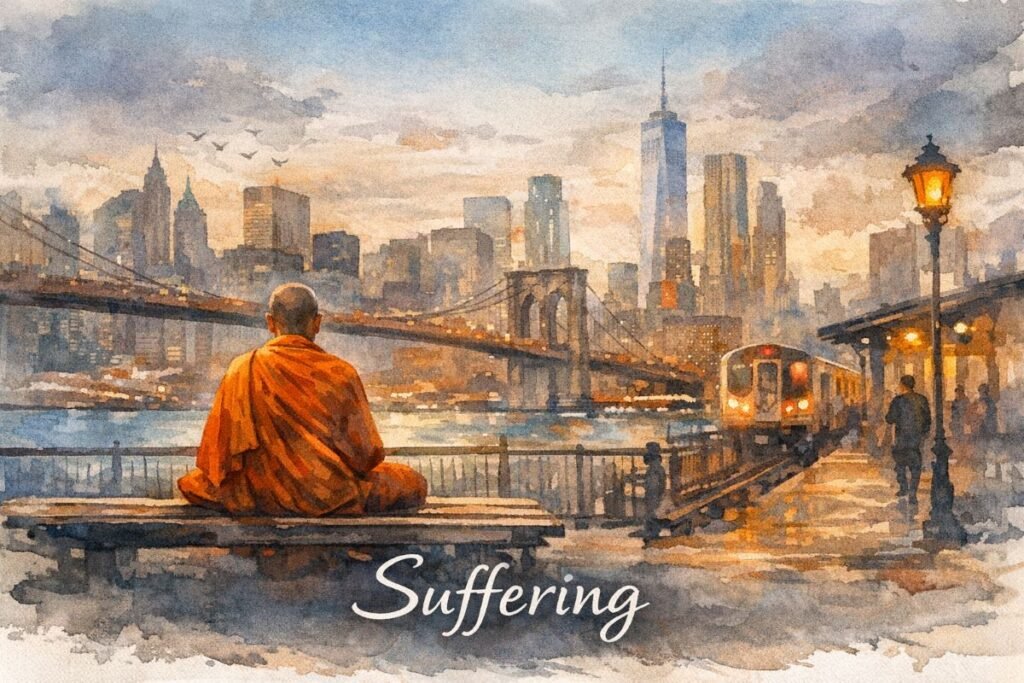
Suffering, Dukkha in Pāli, stands as the first and most foundational truth that the Buddha revealed to the world. The word itself carries profound meaning: traditionally, it is explained through the metaphor of a poorly fitting axle hole of a wheel, suggesting that which grinds and creaks as it turns, unable to run smoothly. While scholars note this etymology may be figurative rather than strictly philological, the metaphor beautifully illustrates the sense of friction, strain, and unsatisfactoriness that pervades conditioned existence. In his very first discourse, the Dhammacakkappavattana Sutta (SN 56.11), the Buddha declared: “In short, the five grasping aggregates are suffering.” This is not a pessimistic pronouncement but a clear-eyed diagnosis of the human condition.
The teaching of suffering is often misunderstood as a denial of happiness, yet the Buddha acknowledged that pleasure, joy, and contentment exist. The Sukha Sutta (SN 36.19) records the Buddha stating plainly that there is happiness in life. However, he identified that all conditioned happiness is impermanent, subject to change, and therefore incapable of providing ultimate satisfaction. This is the subtle meaning of dukkha, not that life contains no pleasure, but that whatever pleasure we experience inevitably slips through our fingers, leaving us grasping for more.
The Buddha analyzed dukkha into three overlapping categories, most explicitly taught in the Dukkhata Sutta (SN 45.165): the suffering of ordinary pain (dukkha-dukkha), the suffering inherent in change (vipariṇāma-dukkha), and the suffering of conditioned existence itself (saṅkhāra-dukkha). As the Salla Sutta (SN 36.6) elaborates, these dimensions reveal that even pleasant experiences contain the seed of future suffering because they are impermanent. Understanding this transforms our relationship with experience itself.
Far from being a morbid fixation, contemplation of suffering serves as the indispensable gateway to liberation. The Mahasatipatthana Sutta (DN 22) places the four noble truths at the culmination of mindfulness practice, emphasizing that one must first comprehend suffering before its origin can be abandoned, its cessation realized, and the path developed. As the Buddha explained in the Alagaddupama Sutta (MN 22), “Both formerly and now, monks, I teach only suffering and the cessation of suffering.” Everything he taught serves this single purpose.
The following 108 contemplations offer a comprehensive guide to understanding dukkha in all its dimensions, drawing from the canonical discourses of the Buddha. Each contemplation builds upon the last, creating a continuous thread of investigation that leads from the recognition of suffering, through understanding its causes, to the discovery of the deathless freedom that lies beyond all conditioned existence.
1–20: The Nature of Suffering (Dukkha-dukkha)
1. Birth itself is suffering, the gateway to all that follows.
The Dhammacakkappavattana Sutta (SN 56.11) begins its enumeration of suffering with birth (jāti). The moment we take embodiment, we become subject to all the discomforts that embodiment entails, the vulnerability of infancy, the pains of growth, and the inevitable decline that follows. Contemplating birth as suffering does not mean regretting existence but recognizing the price of embodiment.
2. Aging is suffering, the slow erosion of all we identify with.
The Pabbatopama Sutta (SN 3.25) compares aging to mountains rolling in from every direction, crushing all in their path. Gray hair appears, strength diminishes, faculties decline. The body that once served us becomes unreliable. This contemplation is not morbid but liberating—when we accept aging as natural, we stop fighting against reality.
3. Sickness is suffering, revealing the body’s fragile nature.
The Girimananda Sutta (AN 10.60) lists numerous diseases that afflict the body, from ailments of the eye to diseases of bile and phlegm. Health is a temporary reprieve, not a permanent possession. Reflecting on sickness cultivates compassion for the afflicted and gratitude for moments of wellness.
4. Death is suffering, the ultimate separation from all we hold dear.
The Maranassati Sutta (AN 6.19) encourages daily reflection on death’s inevitability. We will part from loved ones, possessions, achievements, and even this body we call “mine.” Contemplating death not as an abstract possibility but as certain removes the sting of denial and awakens urgency for practice.
5. Sorrow (soka) is suffering, the mind’s reaction to loss.
When we lose what we love, sorrow arises, a burning in the heart, a heaviness that will not lift. The Piyajalika Sutta (Ud 2.7) describes how sorrow springs from affection and attachment. Understanding this, we learn to love without clinging.
6. Lamentation (parideva) is suffering, the voice of grief crying out.
Tears, wailing, and expressions of anguish accompany profound loss. The Salla Sutta (SN 36.6) explains that the uninstructed worldling, when touched by pain, sorrows, grieves, and laments, —this is the second dart. The wise feel the first dart of pain but release the second.
7. Physical pain (dukkha) is suffering, the body’s warning signal.
Even the Buddha experienced physical pain, as recorded in the Mahaparinibbana Sutta (DN 16) when he suffered a severe illness after his meal at Cunda’s. Pain is unavoidable in a body; what matters is our relationship to it. The wise feel one dart, not two.
8. Mental displeasure (domanassa) is suffering, the mind’s resistance.
When experiences do not meet our expectations, mental displeasure arises, irritation, frustration, annoyance. The Cula Vedalla Sutta (MN 44) distinguishes between pleasant, painful, and neutral feelings, showing how mental displeasure conditions further reactivity.
9. Despair (upāyāsa) is suffering, the mind overwhelmed by loss.
When sorrow and lamentation become entrenched, despair sets in, a hopelessness that sees no way forward. The Mahadukkhakkhandha Sutta (MN 13) describes how sensual pleasures, when not obtained, lead to anguish and despair. Understanding this motivates renunciation.
10. Association with the disliked is suffering.
We must live, work, and interact with people, situations, and conditions we find unpleasant. The Piyajalika Sutta (Ud 2.7) shows how even those we love become sources of suffering when we must part from them, how much more so those we dislike whom we cannot avoid.
11. Separation from the liked is suffering.
Loved ones move away, relationships end, cherished circumstances change. The Upajjhatthana Sutta (AN 5.57) reminds us that separation from all that is dear and pleasant is inevitable. This contemplation softens the grip of attachment.
12. Not getting what we want is suffering.
We desire, we strive, we hope, and often we do not receive. The Sabbasava Sutta (MN 2) lists not getting what one wants among the sufferings that arise from unexamined views. This reflection reveals the futility of demanding that the world conform to our desires.
13. The five grasping aggregates are, in summary, suffering.
This most profound statement from the Dhammacakkappavattana Sutta (SN 56.11) encapsulates the first noble truth. Form, feeling, perception, mental formations, and consciousness, when grasped as “me” or “mine”, are inseparable from suffering. Liberation lies not in escaping the aggregates but in ceasing to grasp them.
14. Form (rūpa) as suffering: the body is not a reliable refuge.
The Anattalakkhaṇa Sutta (SN 22.59) examines form systematically: “Form is impermanent. What is impermanent is suffering. What is suffering is not-self.” Our bodies change constantly, get sick, age, and die. Seeking lasting happiness in form is like building a house on shifting sand.
15. Feeling (vedanā) as suffering: all feelings change.
The Vedana Sutta (SN 36.5) explains that pleasant feelings, painful feelings, and neutral feelings are all impermanent, conditioned, and subject to change. The uninstructed worldling does not understand this, while the noble disciple sees feelings as they truly are.
16. Perception (saññā) as suffering: our labels distort reality.
We perceive through the filter of concepts, which are conditioned and unreliable. The Potthapada Sutta (DN 9) discusses how perceptions arise and cease, shaping our experience of the world. Clinging to perceptions as permanent truths guarantees suffering when they inevitably shift.
17. Mental formations (saṅkhārā) as suffering: our volitions create dukkha.
All intentional activities: thoughts, emotions, habits, choices, are conditioned and conditioning. The Khandha Sutta (SN 22.48) explains how formations, whether wholesome or unwholesome, are impermanent and therefore incapable of providing lasting satisfaction.
18. Consciousness (viññāṇa) as suffering: awareness itself is conditioned.
The Phena Sutta (SN 22.95) compares consciousness to a magic show, insubstantial and deceptive. Even consciousness arises dependent on conditions and ceases when those conditions change. Seeing this, we cease to identify with the knower.
19. The body’s needs create constant discomfort.
Hunger, thirst, temperature extremes, itches, fatigue, the body perpetually demands attention. The Phena Sutta (SN 22.95) describes how the aggregates are like a lump of foam, insubstantial yet demanding. Contemplating this reduces identification with bodily demands.
20. Even pleasure contains the seed of future suffering.
The Salla Sutta (SN 36.6) explains that the uninstructed worldling, when feeling a pleasant feeling, lusts after it and grasps it, not understanding that it will change. This grasping after pleasure is itself suffering, and the eventual loss of pleasure brings more suffering.
21–40: The Suffering of Change (Vipariṇāma-dukkha)
21. Whatever is subject to arising is subject to ceasing.
The Uposatha Sutta (Ud 5.5) states this universal law in the context of the gradual training, comparing the Dhamma to the ocean that shelves gradually. Anything that begins must end. This applies to joyful experiences, loving relationships, periods of peace, and life itself. Accepting this truth at the deepest level transforms our relationship with change.
22. Happy experiences are suffering because they end.
The Sukha Sutta (SN 36.19) distinguishes between happiness and the attachment to happiness. The wise enjoy happiness while it lasts, knowing it will pass, whereas the unwise grasp at it and suffer when it inevitably fades.
23. Pleasant feelings change into neutral or painful ones.
Sit in any comfortable position long enough, and it becomes uncomfortable. Eat your favorite food past satiety, and pleasure becomes disgust. The Vedana Sutta (SN 36.5) teaches that seeing this truth is part of right view.
24. Youth inevitably gives way to aging.
The Rajja Sutta (AN 5.50) describes how youthful beauty, vitality, and freshness cannot be maintained. What we call “youth” is a temporary phase, not a permanent possession. This reflection reduces anxiety about aging.
25. Health inevitably gives way to sickness.
The Pathama Gilana Sutta (AN 4.122) reminds us that the body is subject to disease. The health we enjoy today is borrowed, not owned. Contemplating this cultivates gratitude for wellness and preparation for inevitable illness.
26. Life inevitably gives way to death.
The Maranassati Sutta (AN 6.19) encourages mindfulness of death at all times, whether breathing in or out, whether walking or standing. Not with fear, but with clear recognition that this breath could be our last.
27. Rising inevitably leads to falling.
Fame, success, wealth, status, all that rises must eventually fall. The Lokavipatti Sutta (AN 8.6) lists gain and loss among the eight worldly winds that blow through every life. The wise person is not elated by gain nor cast down by loss.
28. Meeting inevitably leads to parting.
The Visakha Sutta (Ud 8.8) states directly: “Those who are dear to us are of the nature to part from us.” Every encounter is a separation waiting to happen. This is not pessimism but invitation to love without clinging.
29. Accumulation inevitably leads to depletion.
We gather possessions, knowledge, relationships, and experiences, yet all will be depleted. The Dhana Sutta (AN 5.47) distinguishes between material wealth, which can be lost, and spiritual wealth, which cannot.
30. Construction inevitably leads to dissolution.
The Cula Suññata Sutta (MN 121) guides the meditator to see all constructed phenomena as empty of permanence. Buildings crumble, civilizations fall, galaxies disperse. All that is put together comes apart.
31. The impermanence of happiness makes it unsatisfactory.
The Bojjhanga Sutta (SN 46.16) explains that even the highest meditative joys are conditioned and therefore impermanent. If we seek lasting satisfaction in changing conditions, we will always be disappointed.
32. What we most cherish becomes the source of greatest grief.
The Piyajatika Sutta (MN 87) tells the story of a grieving father and demonstrates through multiple examples how sorrow, lamentation, pain, and despair are born from those we hold dear. The stronger the attachment, the sharper the pain of separation. The Piyajalika Sutta (Ud 2.7) similarly illustrates how affection for loved ones becomes the source of sorrow when they are lost.
33. All that is mine will eventually become not-mine.
The Upajjhatthana Sutta (AN 5.57) includes the reflection: “I am the owner of my actions, heir to my actions.” Everything else: possessions, relationships, even this body, is on loan. This reflection loosens possessiveness.
34. The suffering of change pervades even heavenly realms.
The Devaduta Sutta (MN 130) describes how even beings in heavenly realms, when their merit is exhausted, fall and are reborn elsewhere. No realm within conditioned existence offers permanent refuge.
35. Success today guarantees nothing about tomorrow.
The Cakkavatti Sutta (DN 26) traces the rise and fall of even wheel-turning monarchs, showing that all worldly success is fragile and temporary. This reflection cultivates humility in success and hope in failure.
36. Even spiritual attainments are subject to change.
The Anupada Sutta (MN 111) describes how the Buddha analyzed each meditative state as it arose and ceased. No jhana, no insight, no experience, however sublime, is permanent. The only refuge is the unconditioned.
37. The suffering of change teaches non-attachment.
The Anicca Sutta (SN 35.87) shows how seeing the changing nature of all phenomena leads naturally to dispassion. When we truly understand that everything changes, clinging becomes self-defeating.
38. Each moment of pleasure carries its own expiration date.
The Salla Sutta (SN 36.6) teaches that the wise person, feeling a pleasant feeling, understands its nature: it arises, it will cease. This understanding allows full enjoyment without the anxiety of grasping.
39. Anticipating loss poisons present happiness.
The Maranassati Sutta (AN 6.19) warns against the kind of mindfulness of death that leads to despair. The wise reflect on impermanence not to spoil joy but to deepen it, knowing that this moment is precious precisely because it will not last.
40. All conditioned existence shares this characteristic of change.
The Uppada Sutta (AN 3.136) states: “Whether Realized Ones arise or not, this element of nature persists, that all conditions are impermanent.” The suffering of change is not a punishment but a law of nature, impersonal and universal.
41–60: The Suffering of Conditioned Existence (Saṅkhāra-dukkha)
41. All conditioned things are inherently unsatisfactory.
The Dhammapada (Dhp 277) declares: “All conditioned things are suffering.” Not just painful ones, not just changing ones, all conditioned existence, by its very nature, cannot provide lasting satisfaction. This is the deepest meaning of dukkha.
42. The five aggregates themselves are dukkha.
The Phena Sutta (SN 22.95) describes the aggregates as foam, a bubble, a mirage, insubstantial and deceptive. The Yamaka Sutta (SN 22.85) records the monk Yamaka who initially held wrong views about an arahant, showing how misunderstanding the aggregates leads to suffering.
43. Being subject to birth is itself unsatisfactory.
The Accharasanghata Sutta (SN 20.6) describes the rarity of human birth. Yet even the most favorable birth cannot escape the fundamental unsatisfactoriness of existence. The very fact of being born means we have not solved the problem of dukkha.
44. Being subject to aging is itself unsatisfactory.
The Jara Sutta (SN 48.41) shows even the Buddha acknowledging the aging of his body. If aging were not inherently unsatisfactory, why would the fully awakened one note it as a change from youth? Yet for him, it is observed without aversion.
45. Being subject to sickness is itself unsatisfactory.
The Gilana Sutta (SN 46.14) records the Buddha teaching sick disciples while himself being subject to illness. The body’s vulnerability to disease is not a flaw in our particular body but the nature of embodiment itself.
46. Being subject to death is itself unsatisfactory.
The Maranassati Sutta (AN 6.19) encourages reflection not just on the event of death but on the fact of being subject to death. This condition applies to all beings everywhere, in all realms of existence.
47. The necessity of consuming to live is unsatisfactory.
The Ahara Sutta (SN 12.63) discusses how beings subsist on nutriment, physical food, contact, mental volition, and consciousness. We must constantly eat, drink, breathe, and seek comfort just to maintain this body. This dependency is itself a form of dukkha.
48. The need for constant protection and maintenance.
We guard our bodies from harm, our possessions from loss, our reputations from attack. The Cakkavatti Sutta (DN 26) describes how even kings must protect themselves. This vigilance is exhausting and ultimately futile.
49. The fundamental insecurity of all existence.
The Pabbatopama Sutta (SN 3.25) uses the simile of mountains rolling in from all directions, there is no escape, no place of safety within conditioned existence. True refuge must be sought elsewhere.
50. The endless cycle of seeking and not finding.
The Chiggala Sutta (SN 56.48) compares the rarity of human birth to a blind turtle surfacing once a century in a vast ocean, inserting its neck into a single yoke with a hole. Even with this rare opportunity, we continue seeking satisfaction where it cannot be found.
51. The unsatisfactoriness of all realms of existence.
The Devaduta Sutta (MN 130) describes heavenly, human, and hellish realms, each with their characteristic sufferings. No realm offers lasting peace because no realm transcends conditioning.
52. Even neutral feelings contain the seed of dukkha.
The Vedana Sutta (SN 36.5) explains that neutral feelings can be a basis for ignorance, as we fail to notice them and remain unaware of their conditioned nature. This unnoticed suffering is perhaps the most insidious.
53. The suffering inherent in having a body.
The Kayagatasati Sutta (MN 119) encourages contemplation of the body’s impurities and vulnerabilities. Not to disgust us, but to reveal that even a healthy body is a site of constant, low-grade unsatisfactoriness.
54. The suffering inherent in having a mind.
The Samyojana Sutta (SN 41.1) discusses how the mind is bound by fetters, sensual desire, ill will, conceit, ignorance, and the rest. This bondage is itself a form of dukkha.
55. The suffering of being separate.
The Nidana Sutta (SN 12.1) traces how consciousness depends on name-and-form, creating the illusion of a separate self. This sense of separation from others, from the world, from experience itself, is profoundly unsatisfying.
56. The suffering of having to choose.
The Cula Kammavibhanga Sutta (MN 135) describes how beings are heirs to their actions, constantly making choices that shape their future. The burden of this responsibility, when not understood wisely, creates anxiety.
57. The suffering of not knowing.
The Avijja Sutta (SN 45.1) identifies ignorance as the root of unwholesome states. Not understanding the nature of reality, we stumble through life, making decisions based on wrong assumptions, creating more suffering.
58. The suffering of conditioned responses.
The Sabbasava Sutta (MN 2) explains how unexamined views lead to habitual reactions that perpetuate suffering. We react automatically, driven by conditioning, believing we are choosing freely.
59. The unsatisfactoriness of all pursuits.
The Cula Dukkhakkhandha Sutta (MN 14) examines sensual pleasures, showing how the pursuit itself involves suffering, the possession brings anxiety, and the loss brings grief. No worldly pursuit leads to lasting satisfaction.
60. Only the unconditioned is free from this suffering.
The Nibbana Sutta (Ud 8.3) describes the unborn, unbecome, unmade, unconditioned. If there were not this, the Buddha says, there would be no escape from the conditioned. Saṅkhāra-dukkha points us toward the need for liberation.
61–80: The Origin of Suffering (Samudaya)
61. Craving (taṇhā) is the origin of suffering.
The Dhammacakkappavattana Sutta (SN 56.11) identifies craving as the noble truth of the origin of suffering, craving that leads to further becoming, accompanied by relish and greed, seeking delight now here now there.
62. Craving for sensual pleasures (kāma-taṇhā) creates suffering.
The Mahadukkhakkhandha Sutta (MN 13) details how the pursuit of sensual pleasures involves suffering in the seeking, suffering in the protecting, and suffering in the losing. The senses themselves are not the problem; craving for their objects is.
63. Craving for existence (bhava-taṇhā) creates suffering.
The Thanha Sutta (SN 22.94) discusses how craving for continued existence, for becoming this or that, for eternal life, drives the cycle of rebirth. Even the desire to be a better person, if rooted in craving, perpetuates dukkha.
64. Craving for non-existence (vibhava-taṇhā) creates suffering.
The Maha Salayatanika Sutta (MN 149) addresses the desire for annihilation, for escape through non-being. This craving, often arising from despair with existence, is still craving and still binds us to suffering.
65. Craving arises wherever there is delight.
The Samudaya Sutta (SN 22.106) explains that whatever one delights in, one clings to; whatever one clings to, one becomes. Delight is the seed of suffering.
66. The six sense bases are the playground of craving.
The Saḷāyatana Sutta (SN 35.23) defines the all—the six internal sense bases and their six external objects. Craving arises at each of these six doors, seeking gratification, avoiding pain, and ignoring the neutral.
67. Contact (phassa) conditions feeling; feeling conditions craving.
The Paccaya Sutta (SN 12.20) traces dependent origination: with contact as condition, feeling arises; with feeling as condition, craving arises. This chain reveals how suffering is produced moment by moment.
68. Ignorance (avijjā) underlies the entire process.
The Avijja Sutta (SN 45.1) identifies ignorance as the root. Not understanding the four noble truths, not seeing impermanence, suffering, and not-self, we continue generating craving and perpetuating dukkha.
69. The tendency to seek pleasure and avoid pain.
The Salla Sutta (SN 36.6) describes how the uninstructed worldling, feeling a pleasant feeling, lusts after it and grasps it. This automatic reaction is the engine of suffering.
70. The tendency to ignore what is neutral.
The Vedana Sutta (SN 36.5) explains that neutral feelings can be a basis for ignorance because we fail to attend to them, remaining unaware of their conditioned nature, and thus continuing the chain of suffering.
71. Clinging (upādāna) intensifies suffering.
The Khandha Sutta (SN 22.48) distinguishes between the aggregates and the grasping aggregates. It is the grasping that makes the aggregates suffering, not their mere existence.
72. Grasping at views creates suffering.
The Sabbasava Sutta (MN 2) lists the suffering that arises from holding tightly to views: “This alone is true; all else is false.” Such grasping creates conflict, both internally and externally.
73. Grasping at rules and observances creates suffering.
The Mahasihanada Sutta (MN 12) critiques those who believe that mere adherence to rituals or practices can lead to liberation. Such grasping, however well-intentioned, becomes another chain.
74. Grasping at self-doctrines creates suffering.
The Anattalakkhaṇa Sutta (SN 22.59) systematically dismantles the view of self. Grasping at “I am” is the deepest source of suffering, for it creates a self to be protected, promoted, and defended.
75. The three unwholesome roots—greed, hatred, delusion.
The Mula Sutta (AN 3.69) identifies greed (lobha), hatred (dosa), and delusion (moha) as the roots of all unwholesome action. Where these are present, suffering follows inevitably.
76. Greed creates suffering through endless wanting.
The Alagaddupama Sutta (MN 22) compares the person overcome by greed to one who grasps a snake, the more they hold, the more they are bitten. Wanting is a fire that consumes the wanter.
77. Hatred creates suffering through aversion and resistance.
The Kalahavivada Sutta (Snp 4.11) traces how quarrels and disputes arise from preference and aversion. Hatred never ends by hatred; by non-hatred alone does it cease.
78. Delusion creates suffering through misperception.
The Avijja Sutta (SN 45.1) shows how delusion conditions all unwholesome states. Not seeing things as they are, we act in ways that perpetuate suffering, both for ourselves and others.
79. The subtle craving behind all seeking.
The Thanha Sutta (AN 4.199) enumerates the 108 types of craving, showing how it spreads and entangles beings in its net. Even our spiritual seeking can be driven by craving, for attainment, for peace, for liberation itself.
80. The origin of suffering can be known and abandoned.
The Dhammacakkappavattana Sutta (SN 56.11) assigns three tasks to each noble truth. For the origin, the task is to abandon it. This is not despair but hope, what has arisen can be ceased.
81–100: The Cessation of Suffering (Nirodha) and the Path (Magga)
81. The complete cessation of craving is the end of suffering.
The Dhammacakkappavattana Sutta (SN 56.11) defines the third noble truth: the remainderless fading away and cessation of that same craving, the giving up and relinquishing of it, freedom from it, non-reliance on it.
82. Nibbāna is the unconditioned element, free from all suffering.
The Nibbana Sutta (Ud 8.3) describes the unborn, unbecome, unmade, unconditioned. If there were not this, there would be no escape from the born, become, made, conditioned. Nibbāna is that escape.
83. The deathless is realized in this very life.
The Arahanta Sutta (SN 22.76) describes the arahant as one who has directly known liberation, with taints destroyed and the burden laid down. The Mahaparinibbana Sutta (DN 16) declares that the Dhamma is visible here and now, timeless, inviting inspection, leading onward, to be experienced by the wise for themselves. This is not a promise for a future life but a reality accessible in this very existence.
84. The stilling of all formations is peace.
The Ratana Sutta (Snp 2.1) describes the goal as the stilling of all formations, the relinquishing of all acquisitions, the destruction of craving, dispassion, cessation, Nibbāna.
85. The arahant experiences feelings without being afflicted.
The Salla Sutta (SN 36.6) explains that the arahant feels one dart, not two. Physical sensations still occur, but the mental proliferation, the identification, the suffering, these have ceased. Physical pain may still arise, but the mental suffering rooted in craving and identification has ceased.
86. Sariputta declared nothing in the world could cause him sorrow.
The Sariputta Sutta (SN 21.2) records the arahant Sariputta stating: “There is nothing in the world whose change and alteration would cause sorrow, lamentation, pain, sadness, and distress to arise in me.” This is freedom while living.
87. The five aggregates are seen as not-self, not-mine.
The Anattalakkhaṇa Sutta (SN 22.59) shows that when the aggregates are seen with wisdom as they truly are—not-self—the mind becomes dispassionate and is liberated from the taints. This liberation is the end of suffering.
88. The noble eightfold path is the way to cessation.
The Dhammacakkappavattana Sutta (SN 56.11) presents the fourth noble truth: right view, right intention, right speech, right action, right livelihood, right effort, right mindfulness, right concentration.
89. Right view begins with understanding the four noble truths.
The Sammaditthi Sutta (MN 9) explains right view in detail: understanding what is unwholesome and the root of unwholesome, what is wholesome and the root of wholesome, this is right view.
90. Right intention is the thought of renunciation, goodwill, and harmlessness.
The Magga-vibhanga Sutta (SN 45.8) defines right intention as the intention of renunciation, the intention of non-ill will, and the intention of harmlessness. These intentions counter the craving that causes suffering.
91. Right speech, action, and livelihood form the foundation of ethical conduct.
The Sila Sutta (AN 5.179) explains that virtuous behavior is the foundation of the entire path. Without ethical restraint, the mind remains agitated and unable to penetrate the nature of suffering.
92. Right effort is the energy to abandon unwholesome states and develop wholesome ones.
The Sammappadhana Sutta (SN 45.8) defines right effort as the fourfold exertion: generating desire and striving to prevent unarisen unwholesome states, to abandon arisen unwholesome states, to develop unarisen wholesome states, and to maintain arisen wholesome states. The Padhana Sutta (AN 4.14) elaborates these same four exertions as guarding, abandoning, developing, and maintaining. This energy, applied wisely, transforms the mind and uproots the causes of suffering.
93. Right mindfulness is the four establishments of mindfulness.
The Satipatthana Sutta (MN 10) details the practice of contemplating body, feelings, mind, and phenomena. This direct observation reveals the nature of suffering, its origin, and its cessation.
94. Right concentration is the four jhānas.
The Anupada Sutta (MN 111) describes how Sariputta entered the jhānas and emerged to examine them as conditioned and impermanent. Concentration provides the stable platform for insight to arise.
95. All eight path factors work together, not sequentially.
The Maha-cattarisaka Sutta (MN 117) explains how right view leads right intention, right speech, and so on, with each factor supporting the others. The path is an integrated whole.
96. The path is to be developed; its fruit is cessation.
The Dhammacakkappavattana Sutta (SN 56.11) assigns three tasks to each truth. For the path, the task is to develop it. The path is not the goal but the means to the goal.
97. Stream-entry ends the first three fetters.
The Sotapatti Sutta (SN 55.5) describes the stream-enterer as one who has eradicated identity-view, doubt, and grasping at rules and observances. Such a person has seen Nibbāna and will not be reborn in lower realms.
98. Non-return ends sensual desire and ill will.
The Anagami Sutta (SN 48.53) describes the non-returner who has abandoned the five lower fetters and will be reborn in the pure abodes, there to attain final Nibbāna.
99. Arahantship is the complete ending of all defilements.
The Arahanta Sutta (SN 22.76) describes the arahant: “Their taints are destroyed, they have lived the spiritual life, done what had to be done, laid down the burden, reached their own true goal, utterly destroyed the fetters of existence, and are completely liberated through final knowledge.”
100. Even the path must eventually be relinquished.
The Alagaddupama Sutta (MN 22) compares the Dhamma to a raft: useful for crossing, but not for carrying on one’s head after crossing. When the goal is reached, even the path is let go.
101–108: Living with Wisdom and Compassion
101. The noble ones experience the world differently.
The Salla Sutta (SN 36.6) reveals the profound difference between the wise and the ignorant: both feel pleasant and painful sensations, but the wise are not afflicted by the mental suffering that follows. The first dart touches them; the second does not.
102. The arahant’s experience of pain is mere sensation.
The Sariputta Sutta (SN 21.2) shows that even a great arahant like Sariputta experienced physical pain, yet his mind remained free. The mental suffering rooted in craving and identification has ceased, though physical sensations may still arise.
103. The Buddha himself experienced physical pain.
The Mahaparinibbana Sutta (DN 16) records the Buddha suffering a severe illness after his meal at Cunda’s. He bore it mindfully, without complaint. This demonstrates that freedom is not about avoiding pain but about not being overcome by it.
104. Seeing suffering in all conditioned things leads to dispassion.
The Phena Sutta (SN 22.95) describes form as like foam, feeling as like a bubble, perception as like a mirage, formations as like a plantain trunk, consciousness as like a magic trick. Seeing this, one grows dispassionate toward the aggregates.
105. The end of suffering is not the end of experience.
The Itivuttaka 44 describes the Nibbāna element with remainder, where the five sense faculties remain and the arahant experiences pleasure and pain, and the Nibbāna element without remainder, where all experience ceases. Both are freedom, just at different stages.
106. Compassion arises from understanding suffering.
The Karaniya Metta Sutta (Snp 1.8) extends loving-kindness to all beings. This is possible only when we understand that all beings, like ourselves, wish to be free from suffering. Compassion is the natural response to this shared condition.
107. Wisdom of suffering leads to patient endurance.
The Kakacupama Sutta (MN 21) extols patience as a supreme virtue, using the simile of the saw. When we understand the nature of suffering, we can endure difficulties without adding the extra suffering of resistance and complaint.
108. The teaching of suffering is for liberation, not despair.
The Dhammacakkappavattana Sutta (SN 56.11) concludes with the Buddha’s declaration that he has fully understood suffering, abandoned its origin, realized its cessation, and developed the path. This is not pessimism but the most profound optimism possible, that suffering can end.
Glossary of Pāli Terms
| Pāli Term | English Translation |
|---|---|
| Anattā | Not-self, absence of permanent, independent self |
| Anicca | Impermanence, inconstancy |
| Arahant | One who has attained enlightenment, a fully awakened being |
| Avijjā | Ignorance, unawareness of the four noble truths |
| Bhava | Existence, becoming |
| Bojjhanga | Factors of enlightenment |
| Citta | Mind, heart, consciousness |
| Dhamma | The Buddha’s teachings; also the nature of reality |
| Dhammacakka | The Wheel of Dhamma, the Buddha’s first discourse |
| Domanassa | Mental displeasure, sadness |
| Dosa | Hatred, aversion, ill will |
| Dukkha | Suffering, unsatisfactoriness, stress, dissatisfaction |
| Dukkha-dukkha | The suffering of ordinary pain |
| Jāti | Birth |
| Jhāna | Meditative absorption |
| Kāma-taṇhā | Craving for sensual pleasures |
| Khandha | Aggregate, heap—the five components of existence |
| Lobha | Greed, attachment |
| Magga | Path, the noble eightfold path |
| Maraṇa | Death |
| Metta | Loving-kindness |
| Moha | Delusion, ignorance |
| Nibbāna | The unconditioned, liberation, freedom from suffering |
| Nirodha | Cessation, the third noble truth |
| Parideva | Lamentation, weeping |
| Phassa | Contact, sense impression |
| Rūpa | Form, materiality |
| Saṅkhāra | Conditioned phenomena, mental formations |
| Saṅkhāra-dukkha | The suffering of conditioned existence |
| Saññā | Perception, recognition |
| Sati | Mindfulness |
| Samudaya | Origin, the second noble truth |
| Soka | Sorrow, grief |
| Sutta | A discourse attributed to the Buddha |
| Taṇhā | Craving, thirst—the origin of suffering |
| Upādāna | Clinging, attachment, grasping |
| Upāyāsa | Despair |
| Vedanā | Feeling, sensation |
| Viññāṇa | Consciousness |
| Vipariṇāma-dukkha | The suffering of change |
Conclusion
The contemplation of suffering (Dukkha) is not an exercise in pessimism or self-flagellation. It is, rather, the most hopeful and liberating investigation a human being can undertake. The Buddha did not teach suffering to depress us but to free us, to reveal the nature of the problem so completely that the solution becomes self-evident. When we truly understand that all conditioned existence is marked by unsatisfactoriness, the mind naturally inclines toward the unconditioned. When we see that craving is the origin of our distress, we begin to release our grip. When we glimpse that cessation is possible, hope awakens. And when we walk the noble eightfold path, suffering loses its hold, step by step.
As the Phena Sutta (SN 22.95) reminds us, the aggregates are like foam, a bubble, a mirage, insubstantial and fleeting. Yet it is precisely through seeing this insubstantiality that liberation becomes possible. The arahant still feels physical sensations, as the Salla Sutta (SN 36.6) explains, but the mental dart of suffering no longer strikes. Physical pain may still arise, but the mental suffering rooted in craving and identification has ceased. This is the freedom that understanding dukkha makes possible.
May these 108 contemplations serve as a faithful guide on your journey from the recognition of suffering to its complete transcendence. May they illuminate the nature of dukkha so clearly that the mind turns away from grasping and toward freedom. May all beings, without exception, come to understand suffering, abandon its origin, realize its cessation, and develop the path that leads beyond all conditioned existence. May the deathless peace of Nibbāna be realized here and now, in this very life, for the welfare and liberation of all.
Sadhu, sadhu, sadhu.
(Well said, well practiced, well accomplished.)