Key Takeaways
- Taking things personally depends on a belief in a solid, unchanging self that can be wounded. When the self is seen as a fluid process rather than a fixed entity, the target of the insult loses its solidity.
- Other people’s behaviour often reflects their own conditioning, stress, and habitual patterns, but it can also contain useful information about our conduct. Learning to separate the useful signal from the emotional noise is a practical skill.
- The eight worldly winds of praise and blame, gain and loss, success and failure, and pleasure and pain constantly buffet us. Cultivating equanimity allows us to remain balanced amidst these inevitable fluctuations.
- Non-reactivity is not passivity. True balance supports clear, firm action and healthy boundaries without the distortion of personal hurt.
- Hurt feelings can become a doorway to compassion when we recognize that those who cause harm may themselves be suffering, while acknowledging that we cannot always know another person’s motives.
- Training the mind to pause between stimulus and response is the practical foundation of not taking things personally.
1. Introduction
In our modern, hyper-connected world, we are bombarded with opportunities to feel slighted. A message left on “seen” with no reply, a subtle eye-roll in a boardroom, a critical comment on a social media post, or a dismissive tone from a colleague can trigger a cascade of physiological stress and mental rumination. We describe this experience as “taking it personally,” but what is actually happening in the mind?
From a Buddhist perspective, taking something personally is a form of clinging [upādāna]. We are clinging to a specific image of ourselves and reacting with fear or anger when that image is threatened. This habit creates what might be called a sticky mind, one where external events snag on our internal insecurities, dragging us into cycles of defensiveness that exhaust our mental energy and obscure our natural clarity.
The Buddha’s teachings offer a radical alternative to this pattern. Rather than trying to control the external world, or endlessly defending our sense of self, we can investigate the very nature of that self. We can learn to see through the illusion of a solid, permanent identity and discover a more fluid, resilient way of being. We can understand the mechanics of cause and effect in human behaviour and recognize that others’ actions are often more about them than about us. We can cultivate equanimity [upekkhā], that mountain-like quality of mind that remains stable whether bathed in sunlight or lashed by storms.
This article explores the Buddhist architecture of non-reaction. It examines why we take things personally, how the teaching of non-self [anattā] deconstructs the target of our defensiveness, how understanding karma [kamma] liberates us from blame, and how the eight worldly winds [lokadhamma] provide a map for navigating life’s inevitable ups and downs. Throughout, we will ground these teachings in practical, modern-day examples that demonstrate how ancient wisdom applies to contemporary challenges.
The goal is not to become numb or indifferent. The goal is to develop a heart spacious enough to hold all of life’s experiences without being overwhelmed by them. The goal is to move from a life of defence to a life of presence, from reactivity to freedom. This is a path of inquiry, not a quick fix, and it rewards patient, sustained attention.
2. The Anatomy of the Personal Affront
To understand why we take things personally, we must first understand what is actually happening in the mind when we feel slighted. This requires looking closely at the mechanics of perception, feeling, and reaction.
The Sting of the Personal
When someone criticizes us, dismisses us, or ignores us, the immediate experience is often a physical sensation. The chest tightens. The face flushes. The stomach knots. This is the body’s stress response, the ancient fight-or-flight mechanism kicking into gear. But the physical sensation is only the beginning. Almost instantaneously, the mind constructs a story. “They think I’m incompetent. They don’t respect me. They never have. I’m going to get fired. My life is over.”
This story is the personal affront. The criticism itself is just words, just vibrations in the air or pixels on a screen. The suffering comes from the meaning we assign to those words. We interpret them as attacks on our identity, verdicts on our worth, threats to our security. We take them personally.
Clinging as the Root Cause
From a Buddhist perspective, this process is a form of clinging, which is the tendency to grasp at things, including ideas about ourselves, and to resist anything that threatens those things. We cling to an image of ourselves as competent, respected, or likable. When that image is challenged, we experience it as a personal attack.
This clinging creates what can be called a sticky mind. External events snag on our internal insecurities like Velcro. A neutral comment from a colleague becomes evidence of their hidden contempt. A delayed response to a message becomes proof of our unworthiness. The mind, caught in its sticky patterns, cannot let go. It ruminates, replays, and amplifies, turning a minor slight into a major source of suffering. Understanding how the mind repeats its patterns is the first step toward loosening their grip.
The Physical and Mental Toll
The cost of this clinging is significant. Physiologically, chronic reactivity keeps the body in a state of stress, which is associated with inflammation, cardiovascular problems, and weakened immune function. Mentally, it exhausts us. The energy spent defending our ego, replaying arguments, and imagining future confrontations is enormous. It drains vitality and leaves little room for creativity, joy, or genuine connection with others.
Spiritually, taking things personally keeps us trapped in a small, defensive mode of being. We become like a fortress under siege, constantly scanning the horizon for threats, unable to relax or open our gates to the world. We miss the vastness of life because we are so focused on protecting our small territory.
The good news is that this pattern is not fixed. It is a habit, learned and reinforced over time, and like all habits, it can be unlearned. The first step is understanding the mechanics of the habit. The second step is seeing through the illusion that makes it possible.
Why the Habit Persists
The habit of taking things personally persists because it seems to serve a purpose. It feels like self-protection. If we react strongly enough, perhaps we will deter future criticism. If we defend ourselves vigorously, perhaps we will preserve our standing. The mind constructs a logic of defence that appears rational but is actually driven by fear.
Yet this strategy rarely works. Reactivity tends to provoke more reactivity. Defensiveness invites more criticism. The very behaviour we adopt to protect ourselves often makes us more vulnerable. Recognizing this paradox is an important step in the process of change.
3. Deconstructing the Solid Self
The primary reason we take things personally is the deeply held belief in a permanent, unchanging self, a solid me that must be defended. We treat our identity like a fortress. Every criticism is a stone thrown at its walls. Every slight is a breach in its defences. The logic seems sound. If there is a me, then that me can be attacked. If that me can be attacked, then I must defend it. But what if the fortress is not what it seems? What if, upon closer inspection, there is no solid structure at all?
The Five Aggregates
Buddhism invites us to examine this question directly. It asks us to look at what we call the self and see what we find. When we look closely, we discover that the self is not a single, unified entity but a collection of constantly shifting processes. These are traditionally described as the five aggregates [khandhas].
- Form: This is the physical body and its sensory apparatus. It includes the eyes, ears, nose, tongue, and body, along with the objects they perceive. It is constantly changing, cells dying and being born, sensations arising and passing away. It is not a fixed entity but a flowing process.
- Feeling: This is the immediate tone of experience, the pleasant, unpleasant, or neutral quality that arises when the senses contact objects. It is automatic, pre-conceptual, and constantly shifting.
- Perception: This is the mental process of labelling and interpreting experience. It is how we recognize a red light as “red,” a sound as “music,” or a facial expression as “angry.” It is a constructed interpretation, not a direct perception of reality.
- Mental Formations: This is a broad category that includes thoughts, intentions, habits, emotions, and volitional impulses. It is the active, creative aspect of mind, the part that generates stories and reactions.
- Consciousness: This is the basic knowing of experience. It is not a permanent watcher but a series of moments of cognition, each arising and ceasing in dependence on conditions. Consciousness is conditioned and changing, not a neutral awareness standing apart from experience.
When someone criticizes you, what exactly is being criticized? They are labelling a perception or a mental formation. They are reacting to a pattern of behaviour or a spoken word. They are not attacking the form aggregate, because your body is not what is being critiqued. They are not attacking consciousness itself, because consciousness is not a thing that can be insulted. It is a process of knowing that arises and passes.
If you investigate closely, you realize that you are not those fleeting thoughts or labels. You are not the perceptions that arise and pass. You are not the feelings of pleasant or unpleasant. These are all phenomena that appear in awareness, but they are not the self. None of these processes holds still, and none can provide lasting satisfaction. This is what Buddhists mean when they describe the three marks of existence: impermanence, dissatisfaction, and non-self. What we call “me” is a process, not a thing.
The Sky and the Storms
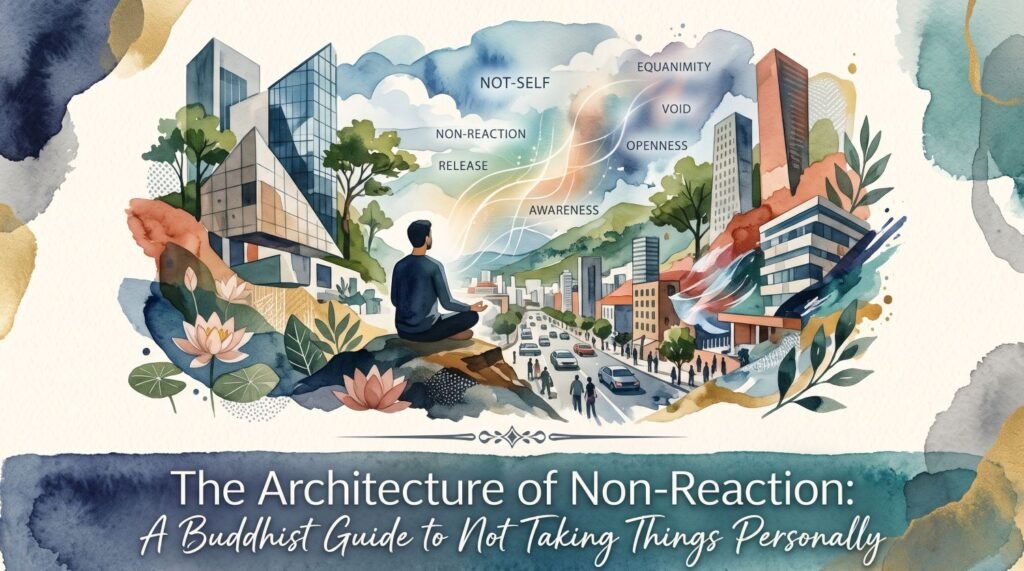
A useful way to work with this understanding is to use the image of the mind as a vast sky. Thoughts, feelings, and perceptions are like clouds, storms, and weather patterns. They arise, move across the sky, and pass away. The sky itself is not damaged by a storm. It is not improved by a rainbow. It simply is, vast and open, holding all weather without being defined by it.
This metaphor is a tool for observation, not a claim about an ultimate identity. The point is not to conclude that you are an unchanging sky, but to notice how identification with passing weather creates suffering. When you watch thoughts and feelings without clinging to them, you develop a capacity for spacious awareness. That capacity can be cultivated and strengthened. It is an experience to be explored, not a doctrine to be believed.
If you identify less with the clouds and more with the open space of awareness, criticism has less to land on. It is like throwing a stone into the sky. The sky does not take it personally because it has no solid centre to be bruised. The stone passes through and falls away, leaving no trace.
This is not to say that feelings of hurt do not arise. They do. A storm can be fierce. But when you recognize that the storm is not you, that it is a temporary weather pattern passing through the open space of awareness, it no longer has the same power to define you. You can watch it with curiosity rather than being swept away by it.
The Sticky Element of Self
The sticky element of self is the belief that there is something solid to defend. When we cling to the idea of a fixed identity, we create the conditions for suffering. We set ourselves up to be wounded because we believe there is a woundable thing. When we let go of this belief, we do not become invulnerable in a cold, defensive way. We become more open, more spacious, and more resilient.
This understanding is central to both Theravada and Mahayana Buddhism. The Theravada tradition emphasizes the analysis of the aggregates as a way to see through the illusion of self. The Mahayana tradition extends this analysis to all phenomena, teaching that all things are empty of inherent existence. Both traditions agree that clinging to a solid self is the root of suffering and that seeing through this illusion is the path to freedom. These are broad characteristics, and within each tradition there is considerable diversity of interpretation.
Practical Application: The Criticism at Work
Consider a workplace criticism. Your supervisor delivers a sharp critique of your project. The immediate reaction is a wave of heat in the chest, a flurry of defensive thoughts. “They think I’m incompetent. They’ve never liked me.”
Now, apply the wisdom of the aggregates. What is actually being criticized? A project, a set of decisions, a document. These are not the self. They are temporary products of temporary conditions. The supervisor’s words are not verdicts on your worth as a human being. They are information about a piece of work.
You can notice the physical sensation of hurt without believing it defines you. You can observe the defensive thoughts as mental formations, not as truth. You can watch the whole pattern rise and fall in the space of awareness. From this vantage point, you can evaluate the critique on its merits. Perhaps some of it is valid and useful. Perhaps some of it is the supervisor’s own stress and impatience. In either case, you are no longer defensive. You can respond thoughtfully rather than reactively.
This is the freedom that comes from deconstructing the solid self. It does not make you indifferent or uncaring. It makes you clearer. It allows you to engage with life fully without being as easily wounded by its inevitable storms.
4. The Law of Cause and Effect
One of the most liberating realizations in Buddhist psychology is that people often act out of their own internal states rather than in direct response to us. Every person is a complex intersection of upbringing, biological temperament, past traumas, current stress levels, and habitual patterns. When someone is rude, dismissive, or cruel, they are frequently manifesting their own mental and emotional condition. Their behaviour may have little to do with us and much to do with what is happening inside them.
Understanding Karma
This principle is captured in the teaching of karma, which points to intentional action and its consequences. Karma is not a system of cosmic punishment or reward. It is a description of how the mind works. When a person cultivates anger, they become more prone to anger. When they cultivate patience, they become more patient. The mind follows the grooves we carve into it.
When someone behaves badly toward you, they are generating unwholesome karma. They are reinforcing patterns of agitation and dissatisfaction [dukkha] in their own mind. One observable consequence is that they experience the immediate psychological effects of their own state: the tightness in the chest, the defensive posture, the agitation that accompanies anger. The fuller workings of karma across time are more complex and are said to ripen in ways that are not always immediately visible. What we can observe is that hostile behaviour tends to produce immediate internal discomfort for the person who acts in that way, and it tends to create conditions for further conflict.
The Bucket of Dye
Imagine you are standing by a lake. Someone, filled with their own turmoil, throws a bucket of red dye into the water. The water turns red, but the water did nothing wrong. The dye was not about the water. It was about the person holding the bucket.
When you stop seeing yourself as the cause of others’ behaviour, you stop being the victim of it. You begin to see their outbursts as data points regarding their own mental state rather than verdicts on your character. This is not to excuse harmful behaviour. It is simply to understand it more accurately.
The Person in Front of You
Consider the person who cuts you off in traffic. Your first thought might be that they are arrogant, aggressive, or disrespectful. But what is actually happening? They are experiencing a moment of urgency, frustration, or distraction. They may be rushing to a hospital, late for a meeting, or simply absorbed in their own thoughts. Their action reflects their state of mind, not a personal assault on you.
When you understand this, the personal sting of the event softens. You may still feel a flash of adrenaline, but you no longer need to construct a story about the other driver’s character or their opinions about you. You can let the event pass through you without turning it into a source of resentment.
Balancing Understanding with Accountability
It is important to qualify this understanding carefully. Other people’s reactions often reflect their own conditioning, but their criticism may also contain accurate information about our conduct. If a colleague says our work is sloppy, the comment may be delivered rudely, but it may also point to a genuine mistake. If a friend says we have been distant, the tone may be accusatory, but the observation may be fair.
The practice is to separate the useful signal from the emotional noise. We can ask ourselves: Is there something here I need to learn? Is there a pattern in my behaviour that warrants attention? At the same time, we do not need to accept every judgment as a verdict on our entire worth. We can take responsibility for our actions without collapsing into self-blame. We can learn from criticism without being defined by it.
This balance is essential. The goal is not to dismiss all feedback as “their stuff.” The goal is to develop the clarity to discern what is useful and the equanimity to hold both praise and blame without losing our footing.
The Transformative Power of Non-Blaming
This understanding is deeply transformative. When we stop personalizing others’ behaviour, we free ourselves from a tremendous amount of suffering. We no longer need to defend ourselves against imagined attacks. We can respond to difficult situations with clarity and equanimity rather than reactivity and resentment.
It is important to note that this does not mean we should tolerate harmful behaviour or abandon healthy boundaries. If someone is consistently unkind or exploitative, we may need to take action to protect ourselves or others. But we can do so without hatred. We can set boundaries without making the other person into a demon. We can see their actions as products of their conditioning and respond with wisdom and firmness rather than fear and anger.
The Weight of Judgments
Think of the ways you carry other people’s judgments in your mind. A critical comment from a friend. A dismissive gesture from a colleague. A disappointed look from a parent. These judgments often say more about the person who made them than about you. They reflect that person’s standards, insecurities, and worldview. They are the flavour of their own mind.
When you internalize this, the weight of those judgments lifts. You no longer need to prove yourself to everyone. You no longer need to defend your character against every misinterpretation. You can simply be who you are, knowing that others’ opinions are reflections of their own inner world rather than objective facts about yours. At the same time, you can remain open to feedback that is genuinely useful.
5. The Eight Worldly Winds
The Buddha taught that life is governed by four pairs of opposites known as the eight worldly winds. These are the inevitable fluctuations of human existence. They are not problems to be solved but realities to be navigated skillfully.
The four pairs are:
- Gain and loss
- Praise and blame
- Success and failure
- Pleasure and pain
Most people are like a blade of grass, blown violently back and forth by these winds. When we gain something, we are elated. When we lose it, we are devastated. When we are praised, we soar. When we are blamed, we crash. Our emotional well-being is completely dependent on external circumstances, which are inherently unstable.
Taking things personally is closely linked to the winds of praise and blame. We become attached to praise, which makes us vulnerable to blame. When someone criticizes us, we react as if our survival depends on regaining their approval. When someone ignores us, we feel as if our existence has been diminished.
Cultivating Equanimity
The antidote to this reactivity is equanimity. It is the mountain-like quality of mind that remains stable whether bathed in sunlight or lashed by storms. Equanimity does not mean indifference or apathy. It means developing a spacious heart that can hold both praise and blame without losing its balance.
You come to see that blame is just sound. Praise is just sound. Words can have real emotional effects, and it would be untrue to pretend otherwise. But praise and blame need not determine your sense of worth. You hear the words, you assess their truth or usefulness, and you respond appropriately. You do not internalize them as verdicts on who you are.
Imagine you are offered a position at an event where all who serve are greeted with a cup, praise, and adoration. You are then stripped of your role and chased out with curses and stones. The person who remains balanced in both moments has understood something about the nature of conditions and the emptiness [suññatā] of the drama itself. Praise and blame are dependent on circumstances. They arise and pass. They are not a reliable measure of your value. This understanding is not indifference. It is a clear seeing of how things are.
The Wheel of Fortune
Visualize the eight worldly winds as a wheel. It constantly turns. Sometimes you are at the top, enjoying gain, praise, success, and pleasure. Sometimes you are at the bottom, enduring loss, blame, failure, and pain. The wheel never stops turning.
The practice is not simply to loosen your grip on the wheel. It is to understand the changing conditions that turn it and to respond wisely. Equanimity involves seeing clearly how praise and blame arise from causes and conditions, how success and failure depend on many factors beyond your control, and how pleasure and pain are temporary visitors. With this understanding, you can engage fully with life without being enslaved by its ups and downs. You do not withdraw from meaningful responsibilities or pretend that painful events do not matter. You participate actively, but you hold the outcomes lightly.
Practical Application: The Social Media Storm
Social media is a particularly potent arena for the eight worldly winds. A post may receive hundreds of likes, filling you with a sense of validation. The next post may receive a critical comment, plunging you into self-doubt. The winds of praise and blame blow constantly in the digital world.
Practice equanimity by pausing before you engage. Notice the urge to check the number of likes. Notice the sting of a negative comment. Breathe. Remind yourself that these are just sounds, just pixels, just data points. They do not define you. You can participate in social media without being blown about by its winds.
6. Common Challenges and Nuanced Pitfalls
As you begin to practice not taking things personally, you will encounter obstacles. Understanding these pitfalls can help you navigate them more skillfully.
The Trap of Spiritual Bypassing
A common mistake is using Buddhist philosophy to numb out or avoid difficult emotions. If someone treats you poorly and you immediately say, “It’s okay, there is no self,” while your heart is actually breaking, you are practicing spiritual bypassing.
True practice requires you to feel the hurt first. Acknowledge it. “Right now, there is a feeling of being hurt.” Name it. Let it be there. Only after the feeling is acknowledged and held with kindness can wisdom step in to deconstruct the story behind it.
This is a crucial distinction. Non-reactivity is not suppression. It is a deep, embodied equanimity that includes the full range of human emotion. You are not trying to eliminate feelings. You are trying to see them clearly, to hold them without being overwhelmed by them, and to respond wisely rather than react blindly.
Equanimity Versus Apathy
People often fear that if they stop taking things personally, they will become doormats or stop caring about excellence. This is a misunderstanding. Non-reactivity is actually a position of greater clarity and strength.
When you are not blinded by personal hurt, you can see situations much more clearly. You can assess what needs to be done and take decisive action. You can set boundaries. You can say, “I will not be spoken to in that tone,” not because your ego is bruised, but because you recognize that the behaviour is unwholesome and needs to be addressed for the benefit of both parties.
Equanimity does not mean you do not care. It means you care without being attached to the outcome. You care without letting your emotions cloud your judgment. You care in a way that is clear, effective, and sustainable.
The Spiritual Ego
As you get better at not taking things personally, watch out for the thought, “I am so enlightened.” This is just the ego taking a new shape. If you feel superior to reactive people, you are still caught in the world of self and other.
True progress is marked by a quiet, humble ease, not a sense of achievement. When you are genuinely freer from reactivity, you do not need to announce it. You do not need to compare yourself to others. You simply respond to life with clarity and kindness, moment by moment.
The Challenge of Deep Wounds
Some emotional wounds are very old and very deep. If you have experienced significant trauma, the practice of deconstructing the self may be too destabilizing. It is important to work with a qualified teacher or therapist who understands both meditation and trauma. Sometimes the first step is building a sense of safety and self-compassion, not immediately deconstructing the self. Be gentle with yourself.
Assuming We Know Others’ Motives
Another common pitfall is assuming that everyone who behaves badly is suffering. While it is true that hostile behaviour often arises from distress, we cannot always know what is driving another person. A person may be distressed, insecure, careless, deliberately harmful, or acting for reasons we cannot determine. Compassion does not require diagnosing the person or excusing their behaviour. It requires a commitment to respond wisely and kindly, even when we do not understand why someone is acting as they are.
7. The Power of the Pause
To break the habit of personalizing, you must train the muscle of the pause. This is the space between stimulus and response, the moment where you can choose how to react rather than simply following the old patterns. A regular practice of mindfulness [sati] supports this capacity by strengthening our ability to notice what is happening in the present moment without immediately reacting.
A Step-by-Step Training
The following sequence can be used when you notice yourself taking something personally.
First, recognize the sting. The moment you feel slighted, label it. Say to yourself, “Sting.” This simple act creates a tiny bit of distance. You are no longer completely identified with the reaction. You are observing it.
Second, locate the sensation. Where is the hurt in your body? Is it a tightness in the throat? A pressure in the head? A knot in the stomach? Stay with the physical sensation for a few breaths. Breathe into it. Allow it to be there without trying to push it away.
Third, investigate the story. What is the ego saying? “They shouldn’t treat me this way.” “They always do this.” “I’m not good enough.” Recognize these thoughts as mental formations. They are not absolute truth. They are stories, narratives, constructs. You can hold them lightly, with curiosity rather than belief.
Fourth, expand the view. Look at the other person. What winds are blowing on them right now? What pain might be driving their behaviour? Remember that their actions may be expressions of their own internal state. At the same time, remain open to the possibility that their criticism contains something useful for you to consider.
Fifth, choose the response. From this place of space and clarity, ask yourself, “What is the most helpful response here?” Sometimes it is a firm boundary. Sometimes it is a compassionate silence. Sometimes it is a clear, direct conversation. Sometimes it is simply letting the moment pass without doing anything at all.
The Pause in Daily Life
The pause can be applied in any situation. When you open an email and feel your jaw tighten, pause. When you hear a criticism from a partner, pause. When you scroll past a comment on social media that makes your chest burn, pause.
The pause is not a luxury. It is a necessity. Without it, we are slaves to our reactivity, driven by patterns we did not choose and cannot control. With it, we become agents of our own lives, choosing our responses with awareness and wisdom. The awareness we build in formal practice carries over into ordinary activities.
The Benefits of Pausing
As you practice the pause, you will notice benefits accumulating. You will find that small irritations no longer derail your entire day. You will find that you have more energy because you are not spending so much on defensive thinking. You will find that your relationships improve because you are less reactive and more present. You will find that your mind becomes quieter, more spacious, more at ease.
The pause is the foundation of non-reaction. It is the hinge on which the door of freedom swings open.
8. The Alchemy of Compassion
Ultimately, the goal is to move beyond simply not being hurt to becoming a source of healing. When you stop taking things personally, you may begin to see that the person attacking you is often in pain. Their aggression may be a cry for help from a confused and suffering mind, though we cannot always know for certain what is driving another person.
Seeing the Suffering in Others
This is the transformative insight of compassion. Compassion is the quivering of the heart in response to the suffering of others. It is the desire to alleviate that suffering. When you see that the person who is criticizing you, dismissing you, or ignoring you may themselves be suffering, your reaction can change. Instead of anger, you may feel a tender concern. Instead of defensiveness, you may feel a wish for their well-being.
This does not mean you allow yourself to be harmed. It does not mean you agree with their behaviour. It means you hold them in your heart with kindness even as you set boundaries or take action. Compassion does not require diagnosing the person or excusing their behaviour. It requires a commitment to respond wisely and kindly, even when we do not understand why someone is acting as they are.
The Practice of Loving-Kindness
One powerful practice for cultivating this perspective is loving-kindness [mettā], the deliberate cultivation of goodwill toward all beings. The practice involves silently repeating phrases like, “May you be well. May you be happy. May you be free from suffering.”
Start with yourself. “May I be well. May I be happy. May I be free from suffering.” Then extend to someone you love. Then to a neutral person. Then to someone difficult. Then to all beings without exception.
When someone causes you difficulty, try offering them loving-kindness. See them as a fellow being who may be struggling, caught in their own confusion, doing the best they can with what they have. This does not excuse their behaviour, but it can dissolve your resentment. You stop taking them personally because you see them as a fellow traveller on the path of suffering, not as an enemy.
The Ultimate Shield
This is the ultimate shield. A heart so full of goodwill that there is no room for resentment to take root. A mind so vast that the stones of criticism disappear into its depths without a trace. A life so grounded in compassion that the inevitable slights and injuries of existence become opportunities for practice rather than sources of suffering.
Practical Application: The Difficult Family Member
Consider the difficult family member at a holiday gathering. They make a critical comment about your life choices. The old pattern would be to feel hurt, to defend yourself, to replay the comment for hours afterward. The new pattern is to see them clearly. They may be insecure, unhappy, or struggling with their own challenges. Their comment may be a reflection of their pain, not an accurate assessment of you.
You can breathe. You can feel the sting without being swept away by it. You can offer a silent wish for their happiness. You can respond with a kind word or a graceful deflection. You can maintain your peace while remaining engaged and present.
This is not always easy. It takes practice. But over time, the habit of compassion can become stronger than the habit of reactivity. And in that shift, a tremendous weight is lifted.
9. Building Resilience Through Understanding
The teachings on not taking things personally are not just about managing moments of discomfort. They are about building a fundamentally different relationship to life itself. They are about developing resilience, the capacity to bounce back from challenges and to maintain balance amid difficulty.
The Resilience of the Open Hand
Taking things personally is like trying to catch a gust of wind with a closed fist. The wind does not care. It simply blows. But the fist becomes tense, cramped, and frustrated. Not taking things personally is like opening your hand. The wind still blows, the sounds still happen, and people still act out of their own confusion, but it all passes through without leaving a mark.
This openness is not weakness. It is strength. It is the strength of flexibility, of adaptation, of flow. A tree that cannot bend in the wind breaks. A tree that bends survives. The open hand is the flexible tree.
The Ground of Awareness
As you practice, you may begin to rest more and more in the experience of awareness itself. You may discover that awareness is not easily affected by the content of experience. It is like the screen on which a movie plays. The movie may be a comedy or a tragedy, but the screen is unchanged. The movie may be loud or quiet, bright or dark, but the screen is unaffected.
This metaphor can be useful for observing thoughts without identifying with them. At the same time, it is important not to turn awareness into a new identity, a subtle self that stands apart from experience. The point is to notice how identification with passing phenomena creates suffering, not to conclude that there is a permanent, unchanging awareness that is your true nature. Awareness is better understood as a capacity that can be observed and cultivated, a quality of experience that becomes clearer with practice, rather than as an ultimate identity to be defended.
When you identify less with the content of experience, you may find a stability that is less easily shaken. You are less at the mercy of the eight worldly winds. You are less like a blade of grass blown about. You can hold all weather without being damaged by it, not because you are a fixed thing, but because you are more spacious and flexible than you realized. This insight sits within the larger framework of the four noble truths.
Resilience in Action
Resilience is not just a passive quality. It is an active capacity to engage with life skillfully. When you are not caught in reactivity, you can respond to challenges with creativity and wisdom. You can see options that were previously invisible. You can act with courage and compassion rather than fear and defensiveness.
When you are grounded in awareness, you can handle criticism without crumbling. You can face failure without despair. You can experience loss without being destroyed. You can feel pain without becoming bitter. You can live fully, with all its ups and downs, without being defeated by it.
The Gift of Non-Reaction
The gift of non-reaction is not a life without challenges. It is a life in which challenges lose their power to define you in the same way. It is a life in which you are freer to respond with wisdom rather than react from habit. It is a life in which you are less the victim of others’ opinions and less the slave of your own emotions.
This is the freedom that the Buddhist teachings point to. It is available to all who are willing to look closely at their own minds, to question their assumptions about themselves, and to practice the art of pausing before reacting. It is a path, not a destination. It is a journey, not an arrival. It is a practice, not a perfect state.
10. Conclusion
Taking things personally is a habit, deeply ingrained and reinforced by a culture that values individual identity and personal achievement. It seems natural, even necessary, to defend ourselves against criticism and to feel hurt when we are slighted. But the Buddhist teachings offer a different way. They invite us to see through the illusion of the solid self, to understand the mechanics of action and reaction, to cultivate equanimity in the face of life’s inevitable fluctuations, and to respond to difficulty with compassion rather than resentment.
This is not a state you reach overnight. It is a direction you travel. Each time you choose to pause, each time you choose to see the burden in another, each time you let go of a story about yourself, you are claiming a piece of your fundamental freedom. You are moving from a life of defence to a life of presence.
The path is not always easy. The old habits are strong, and the winds of the world blow fiercely. But with patience, persistence, and kindness toward yourself, you can learn to remain upright. You can learn to open your hand rather than clench your fist. You can learn to be more like the sky, vast and open, holding all weather without being damaged by it.
This is the architecture of non-reaction. It is not a building you construct but a space you uncover. It is not a skill you acquire but a capacity you develop over time. Beneath the layers of conditioning, beneath the stories and reactions, there is a possibility of clarity, a potential for peace, an openness that can be cultivated. This is not a permanent self to be defended but a way of being that can be explored and developed. None of this happens in isolation. Ethical conduct, meditation, and wisdom support one another as part of the eightfold path.
May this exploration of not taking things personally be of benefit. May it bring peace to your mind and freedom to your heart. May you walk through the world with an open hand and a spacious heart, less touched by the winds of praise and blame, more at ease amidst the storms of life.
Glossary of Key Terms
- Compassion [karuṇā]: The response of the heart to the suffering of others; the desire to alleviate that suffering.
- Dissatisfaction [dukkha]: The stress, suffering, or unsatisfactoriness that arises from clinging to impermanent things.
- Emptiness [suññatā]: The absence of independent, inherent existence in all phenomena; things arise dependently and lack a fixed essence.
- Equanimity [upekkhā]: Mental balance and stability amidst the fluctuations of experience.
- Karma [kamma]: Intentional action and its consequences; the Buddhist teaching that actions driven by intention produce results.
- Loving-Kindness [mettā]: The deliberate cultivation of goodwill and well-wishing toward all beings.
- Non-Self [anattā]: The teaching that phenomena, including what we call the self, lack a permanent, unchanging, independent essence.
- Self [attā]: The mistaken belief in a permanent, unchanging, separate identity that must be defended.
- Worldly Winds [lokadhamma]: The eight fluctuations of human life: gain and loss, praise and blame, success and failure, pleasure and pain.
Recommended Readings & Resources
- What the Buddha Taught by Walpola Rahula
- The Heart of the Buddha’s Teaching by Thich Nhat Hanh
- When Things Fall Apart by Pema Chödrön
- Buddhist psychology
- The three marks of existence
- The five aggregates
- Karma
- Equanimity
- Loving-kindness
- The eightfold path