With Sutta Central Links
Key Takeaways
- The five aggregates (form, feeling, perception, volitional formations, consciousness) are not a metaphysical theory of what a person is, but a practical framework for investigating lived experience and dismantling clinging.
- Clinging to the aggregates—not the aggregates themselves—is the root of suffering. The goal is the cessation of craving, not the annihilation of experience.
- Impermanence, unsatisfactoriness, and non-self are the three characteristics to be directly observed in each aggregate. Non-self (anattā) is a practical strategy of non-identification—”This is not mine, this I am not, this is not my self”—not a mere metaphysical denial of personhood.
- The eleven dimensions of analysis (past/future/present, internal/external, gross/subtle, inferior/superior, far/near) prevent subtle identification with any aspect of experience.
- Each aggregate is conditioned and interdependent—none exists independently. Consciousness and name-and-form rely on each other like two sheaves of reeds.
- Liberation is not the destruction of the aggregates but the full understanding (pariññā) of their nature, leading to the abandonment of craving and the realization of the Unfabricated (asaṅkhata).
Preamble & Scope Note
This guide presents a structured exploration of the five aggregates (pañcakkhandhā), drawing primarily from the early Buddhist discourses preserved in the Pāli Nikāyas (specifically the Khandha Saṃyutta of the Saṃyutta Nikāya).
In the early suttas, the five aggregates are not presented as an ultimate ontology or five physical components assembled to make a person. Rather, they serve as an analytical framework for investigating lived experience, recognizing the mechanisms of clinging (upādāna), and cultivating liberation.
Where traditional Theravāda Abhidhamma classifications (such as derived materiality) or modern pedagogical analogies are referenced, they are explicitly noted to distinguish canonical Nikāya doctrine from later scholastic taxonomy and contemporary illustrations. Anattā (non-self) is presented here not as a mere metaphysical theory asserting the absolute non-existence of a person, but as a practical strategy of non-identification: “This is not mine, this I am not, this is not my self.”
Section I: Foundational Principles of the Aggregates
1. The Fivefold Analytical Framework
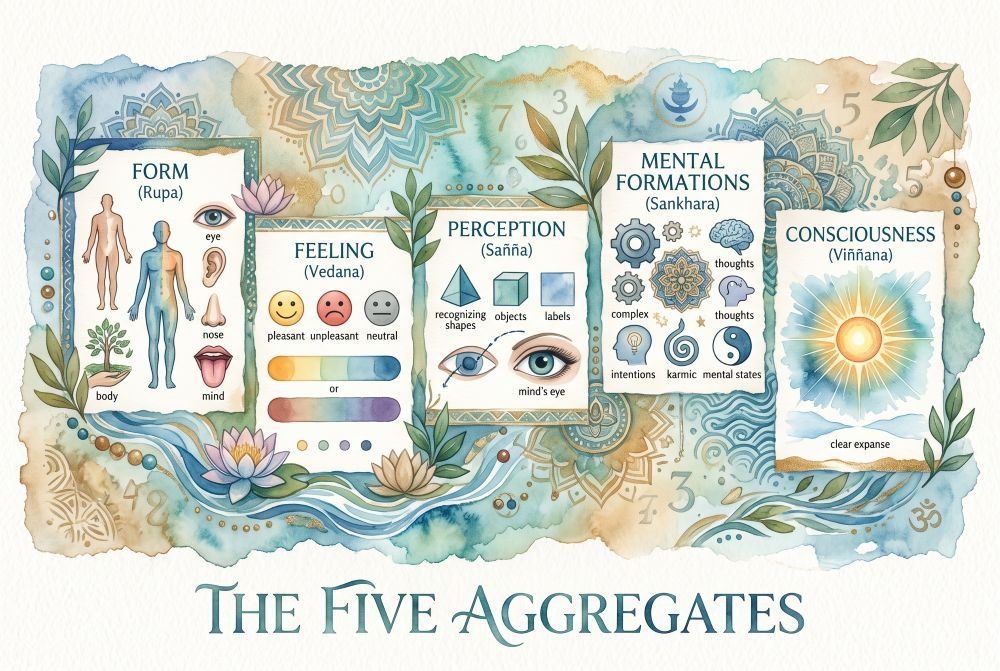
The Buddha categorized conditioned human experience into five aggregates (khandhā—literally “heaps” or “bundles”): form (rūpa), feeling (vedanā), perception (saññā), volitional formations (saṅkhārā), and consciousness (viññāṇa). This is one of several analytical tools, alongside the sense bases (āyatana) and elements (dhātu), used to examine experience rather than an exhaustive metaphysical taxonomy of existence.
2. Aggregates vs. Aggregates Subject to Clinging (SN 22.48)
In the Khandha Sutta, the Buddha explicitly distinguishes the five aggregates from the five aggregates subject to clinging (pañcupādānakkhandhā). The bare aggregates represent the conditioned phenomena of physical and mental life; suffering (dukkha) arises specifically when craving (taṇhā) and attachment (upādāna) adhere to them.
3. The First Noble Truth (SN 56.11)
In his first discourse, the Dhammacakkappavattana Sutta, the Buddha summarizes the First Noble Truth of suffering: “In brief, the five aggregates subject to clinging are suffering.” Suffering is embedded in the habit of grasping at impermanent bodily and mental processes.
4. The Burden and the Heavy Load (SN 22.22)
In the Bhāra Sutta, the five aggregates subject to clinging are described as the heavy burden (bhāra), craving as the taking up of the burden, and the complete fading away and cessation of craving as the laying down of the burden.
5. Impermanence (Anicca)
Every aggregate is impermanent. Form breaks down, feelings fluctuate, perceptions shift, volitions vanish, and consciousness arises and ceases from moment to moment. Because they are in constant flux, none of them can offer static security.
6. Unsatisfactoriness (Dukkha)
Because the aggregates are impermanent and subject to change, clinging to them expecting lasting happiness inevitably produces dissatisfaction and distress. What is in constant instability cannot serve as a foundation for unshakeable peace.
7. Non-Self (Anattā) (SN 22.59)
In the Anattalakkhaṇa Sutta, the Buddha demonstrates the canonical logic of non-self: What is impermanent is unsatisfactory; what is impermanent and unsatisfactory is fit to be regarded as: “This is not mine, this I am not, this is not my self.” Non-self is a practice of systematic relinquishment.
8. The Eleven Dimensions of Analysis (SN 22.48)
To prevent subtle identification, the suttas instruct practitioners to analyze each aggregate across eleven dimensions: whether past, present, or future; internal or external; gross or subtle; inferior or superior; far or near. None of these dimensions contains an enduring self.
9. Deconstructing Compactness (Ghanasaññā)
In later Theravāda commentarial literature, the illusion of a solid, unified person is said to be maintained by ghanasaññā (the perception of compactness). Mentally dissecting experience into the five aggregates dismantles this perceived unity into transient, conditioned components.
10. Conditionality and Interdependence
The aggregates do not exist as independent entities. Form requires physical conditions; feeling, perception, and mental formations depend on sense contact (phassa); and consciousness arises dependent on a sense organ and its object. They function as a web of conditioned phenomena.
11. The Four Nutriments (Āhāra) (SN 12.64)
Conditioned existence and the continuation of the aggregates are sustained by four nutriments: physical food (kabaḷīkārāhāra), sensory contact (phassāhāra), mental volition (manosañcetanāhāra), and consciousness (viññāṇāhāra).
12. The Twenty Modes of Identity View (Sakkāyadiṭṭhi)
Identity view consists of twenty ways of misapprehending the aggregates: regarding any of the five aggregates as self, self as possessing the aggregate, the aggregate as inside self, or self as inside the aggregate (4 modes × 5 aggregates = 20).
13. Causal Conditioning without Determinism
The present aggregates arise conditioned by past choices, environment, and physical laws. While past kamma conditions present possibilities, present awareness and choices retain agency to break reactive cycles.
14. Illumination Through the Threefold Training
Morality/ethics (sīla) stabilizes the mind; concentration (samādhi) stilling mental noise allows clear observation; wisdom (paññā) sees the true characteristics of the aggregates, leading to dispassion.
15. The Noble Eightfold Path as the Method
The Eightfold Path serves as the systematic training to comprehend the aggregates, weaken craving toward them, and realize their relinquishment.
16. The Simile of the Plantain Trunk (SN 22.95)
In the Pheṇapiṇḍūpama Sutta, the Buddha compares mental formations (saṅkhārā) to a banana tree trunk. A person peeling away layer after layer searching for solid heartwood finds nothing inside.
17. The Simile of the Executioner (SN 22.85)
In the Yamaka Sutta, Ven. Sāriputta explains that identifying with the aggregates as self is like trusting a murderer disguised as a devoted companion. Relying on impermanent processes for ultimate security leads to ruin.
18. To Be Fully Understood (Pariññā)
The Buddhist goal is not the annihilation of the physical body or mental functions, but the full understanding (pariññā) of their nature, which brings about the complete abandonment of craving and clinging.
Section II: Form / Materiality (Rūpa)
19. Definition of Form
Form (rūpa) refers to physical matter and material phenomena. Etymologically, the suttas define rūpa as that which is “afflicted” or deformed by physical variables such as cold, heat, hunger, thirst, and insect bites.
20. The Four Great Elements (Mahābhūta)
Physical matter is analyzed into four primary elemental qualities: earth (pathavī—solidity/extension), water (āpo—cohesion/fluidity), fire (tejo—heat/temperature), and wind (vāyo—motion/pressure).
21. The Earth Element (Pathavī-dhātu)
Contemplate the earth element as hard or soft physical matter—bones, teeth, skin, muscles, and organs. It provides structural extension but possesses no inherent selfhood.
22. The Water Element (Āpo-dhātu)
Contemplate the water element as the quality of cohesion and liquidity—blood, sweat, saliva, tears, and bodily fluids that bind physical structures together.
23. The Fire Element (Tejo-dhātu)
Contemplate the fire element as thermal energy—body warmth, metabolic heat, digestion, and the physical decay that accompanies aging.
24. The Wind Element (Vāyo-dhātu)
Contemplate the wind element as motion and pressure—the breath moving through the lungs, internal air currents, and physical movement across joints.
25. Derived Materiality (Upādā-rūpa)
In later Theravāda Abhidhamma analysis, rūpa is divided into the 4 primary elements and 24 categories of derived materiality (such as eye-sensitivity, ear-sensitivity, physical vitality, and nutritional value).
26. Internal and External Element Reflection (MN 140)
Reflect on the elements internally (within the body) and externally (in surrounding nature). The earth element in bones is the same physical matter as the earth outside. Neither internal nor external matter constitutes a personal self.
27. The Foam Simile (SN 22.95)
The Buddha compares the aggregate of form to a glob of foam floating down the Ganges River—unstable, hollow, and devoid of substance.
28. Anatomical Contemplation (32 Parts of the Body)
Mental dissection of the body into 32 constituent parts (hair, nails, teeth, skin, organs) undermines the unexamined perception of physical beauty and unity.
29. Cemetery Contemplations (Sīvathikā)
Reflecting on the stages of bodily decomposition reinforces the understanding that physical form is bound to decay, helping to sever attachment to the body.
30. Nutriment Contemplation
Viewing physical food not as a source of indulgence but as a material input necessary to sustain the body reduces attachment to physical sensations.
31. Mindfulness of Breathing (Ānāpānasati)
Observing the physical breath entering and leaving the body grounds awareness in the impermanent, conditioned nature of vāyo-dhātu.
32. Postures of the Body (Iriyāpatha)
Observing walking, standing, sitting, and lying down reveals that posture changes are mechanical adjustments driven by physical discomfort and volition.
33. Continuous Breakdown and Repair
The physical body is in a state of perpetual maintenance. Without constant inputs of air, water, food, and shelter, form rapidly degrades.
34. Dynamic Physical Impermanence
Just as modern biology describes the body as an ongoing exchange of cells and chemical processes, early Buddhist analysis emphasizes that form is a dynamic process rather than a static object.
35. Form as Unsatisfactory (Dukkha)
The physical body is susceptible to sickness, injury, aging, and fatigue. Depending on physical form for lasting happiness yields insecurity.
36. Form as Not-Self (Anattā)
Because you cannot command the body to never age, become ill, or die, physical form cannot be claimed as an autonomous, controlling self.
Section III: Feeling / Sensation (Vedanā)
37. Definition of Feeling
Feeling (vedanā) refers strictly to the raw affective tone of an experience. It is categorized into three primary tones: pleasant (sukha), painful (dukkha), or neutral/neither-painful-nor-pleasant (adukkhamasukha).
38. The Six Classes of Feeling
Feelings arise conditioned by contact at the six sense doors: feelings born of eye-contact, ear-contact, nose-contact, tongue-contact, body-contact, and mind-contact.
39. Pleasant Feeling (Sukha-vedanā)
Pleasant feeling brings agreeable physical or mental sensation. Its presence invites craving (taṇhā) if unobserved by mindfulness.
40. Painful Feeling (Dukkha-vedanā)
Painful feeling brings disagreeable physical or mental sensation. Its presence invites aversion (paṭigha) or resistance when unexamined.
41. Neutral Feeling (Adukkhamasukha-vedanā)
Neutral feeling is subtle and easily overlooked. When unobserved, it reinforces the underlying tendency toward ignorance (avijjā).
42. The Water Bubble Simile (SN 22.95)
The Buddha compares vedanā to a bubble forming on the surface of water during heavy rain—bursting almost as soon as it appears.
43. The Two Arrows (SN 36.6)
In the Salla Sutta, the Buddha explains that an uninstructed person struck by a physical pain suffers two arrows: physical pain and mental resistance. The wise practitioner experiences the first arrow (physical sensation) without inviting the second (mental distress).
44. Household vs. Renunciation Feelings (MN 137)
In the Saḷāyatanavibhaṅga Sutta, the Buddha distinguishes worldly feelings (sāmisa), derived from sense objects, from feelings based on renunciation (nirāmisa), arising from insight into impermanence and spiritual progress.
45. Mindfulness at the Feeling Tone
In dependent origination, contact conditions feeling (phassa-paccayā vedanā), and feeling conditions craving (vedanā-paccayā taṇhā). Mindfulness creates an opportunity to experience feeling without triggering craving.
46. Contemplation of Feelings (Vedanānupassanā)
Practicing satipaṭṭhāna on feelings involves noting sensations simply as “pleasant,” “painful,” or “neutral” without identifying as the owner of the feeling.
47. Underlying Tendencies (Anusaya) (MN 148)
Unwatched feelings activate latent tendencies: pleasant feelings provoke latency to greed, painful feelings to aversion, and neutral feelings to ignorance.
48. Transience of Sensations
No sensation persists indefinitely. Even intense physical pain or exquisite pleasure arises, peaks, decays, and vanishes.
49. Neutral Feeling as the Field of Delusion
Because neutral feeling lacks dramatic intensity, the unmindful mind drifts into dullness or distraction, missing its transient nature.
50. The Impermanence of Pleasant Feeling
Pleasant feeling is genuinely pleasant while it lasts, but because it is conditioned and impermanent, it changes. Distress arises when the mind demands permanence from transient sensations.
51. Cessation of Perception and Feeling
In the advanced attainment known as the cessation of perception and feeling (saññāvedayitanirodha), mental activity temporarily ceases altogether. Distinct from the four jhānas, this attainment illustrates that conscious experience can pause without destroying life.
52. Relinquishing Ownership of Feelings
Sensation occurs as a natural result of contact. Recognizing that “there is feeling” rather than “I am feeling” breaks the habit of personalizing pleasure and pain.
Section IV: Perception / Recognition (Saññā)
53. Definition of Perception
Perception (saññā) is the mental function of recognizing, marking, and identifying features of experience. It interprets raw sensory inputs based on past memory and learned categories.
54. The Six Classes of Perception
Perception functions across six doors: perception of forms, sounds, smells, tastes, tactile sensations, and mental concepts.
55. The Mirage Simile (SN 22.95)
The Buddha compares perception to a mirage at shimmering midday — appearing solid and real from a distance, but vanishing upon closer inspection.
56. Perception of Basic Qualities
Canonical texts describe saññā as that which recognizes color (blue, yellow, red, white) or shape, allowing the mind to distinguish one sensory object from another.
57. Perception of Marks (Nimitta)
Perception identifies the primary characteristics of an object, linking present experience to stored memories.
58. Perception of Secondary Features (Anubyañjana)
Beyond initial recognition, perception fills in secondary details, often triggering emotional reactions if unguided by mindfulness.
59. The Interpreting Function
Perception takes raw sensory contact and assigns labels (“friend,” “enemy,” “danger,” “desirable”), constructing a manageable cognitive map of reality.
60. Conditioned Perception
How an object is perceived depends heavily on past conditioning, culture, and views. Two people observing the same event construct different mental interpretations.
61. Perceptual Distortions (Saññā-vipallāsa)
Deluded perception misinterprets reality in four ways: perceiving the impermanent as permanent, the unsatisfactory as pleasant, the non-self as self, and the unlovely as lovely.
62. Correcting Distortions through Insight
Practicing insight replaces distorted perceptions with corrected perceptions: the perception of impermanence (anicca-saññā), unsatisfactoriness (dukkha-saññā), and non-self (anattā-saññā).
63. Conceptual Boundaries
Perception constructs cognitive boundaries around experiences. Recognizing these labels as useful mental shortcuts rather than absolute truths prevents conceptual rigidity.
64. Perception in Meditative Stilling
In meditation, coarse perceptions of sensory objects give way to refined meditative themes (such as the kasiṇas or breath signs), demonstrating the malleability of saññā.
65. Formless Attainments (Āruppa)
In advanced concentration, perception expands through refined spheres: infinite space, infinite consciousness, and nothingness.
66. Neither-Perception-Nor-Non-Perception
In the fourth formless attainment (nevasaññānāsaññāyatana), perception reaches a level of extreme subtlety where it can neither be characterized as functioning coarsely nor as completely absent.
67. Perception as Conditioned
Perception cannot function independently; it arises conditioned by sense organs, objects, and contact.
68. Transience of Interpretations
A perception can change instantly with new information. An object perceived as threatening is instantly reinterpreted when recognized as harmless.
69. Perception and Proliferation (Papañca) (MN 18)
In the Madhupiṇḍika Sutta, the Buddha traces how what one feels, one perceives; what one perceives, one thinks about; and what one thinks about, one mentally proliferates (papañceti).
70. Perception is Not Self
Labels, memories, and cognitive interpretations are transient mental tools. They do not constitute an enduring inner observer.
71. De-identifying from Concepts
Observing perception as a passing mental event allows one to use concepts when necessary without becoming imprisoned by them.
Section V: Mental Formations / Volition (Saṅkhāra)
72. Definition of Volitional Formations
Within the five aggregates, saṅkhārakkhandha refers to volitional formations, intentional choices, and active mental fabrications that shape action (kamma).
73. Context-Dependence of Saṅkhāra
The term saṅkhāra is context-dependent. Broadly, it refers to all conditioned phenomena (sabbe saṅkhārā aniccā). Specifically as an aggregate, it denotes the active, volitional mental forces.
74. Volition as Kamma (AN 6.63)
In the Nibbedhika Sutta, the Buddha explicitly states: “It is volition (cetanā), monks, that I call kamma. Having willed, one performs action through body, speech, or mind.”
75. Six Classes of Volition
Volitional formations operate across the six sense modalities: intentions regarding forms, sounds, smells, tastes, tactile sensations, and mental concepts.
76. Unwholesome Formations (Akusala-saṅkhāra)
Intentional mental states rooted in greed (lobha), hatred (dosa), and delusion (moha) generate unwholesome kamma and lead to suffering.
77. Wholesome Formations (Kusala-saṅkhāra)
Intentional mental states rooted in non-greed (alobha), non-hatred/loving-kindness (adosa/mettā), and non-delusion/wisdom (amoha/paññā) generate wholesome kamma and support mental peace.
78. The Three Fabrications (MN 44)
In the Cūḷavedalla Sutta, fabrications are categorized into bodily fabrication (in-and-out breathing), verbal fabrication (thought and evaluation), and mental fabrication (perception and feeling). Note that perception and feeling serve as mental fabrications in this specific framework while remaining distinct aggregates elsewhere.
79. Volition and Future Becoming
Intentional choices generate karmic momentum, contributing to the conditions through which future experience and renewed becoming arise.
80. The Plantain Trunk Review (SN 22.95)
Examining volitional choices reveals them to be constructed, temporary impulses lacking solid interior essence.
81. Conditioned Agency
Intentions arise based on past conditioning, present sensory inputs, and view. Human agency exists as a conditioned process rather than an unconditioned “free-standing will.”
82. Weakening Reactive Patterns
By observing volitional urges (such as anger or craving) with mindfulness rather than acting on them, the habitual momentum of unwholesome formations diminishes.
83. Impermanence of Intentions
An intention arises to accomplish a goal, executes its function, and disappears. It cannot be sustained as a permanent structure.
84. Formations as Unsatisfactory
Because volitional formations involve mental striving and construction, relying on constructed mental states for ultimate security brings restlessness.
85. Formations are Not Self
Volitions and habits are conditioned mental processes. You are not your habits; habits are repeating patterns of saṅkhāra.
86. Right Effort and Volitional Cultivation
The path utilizes wholesome volitions (Right Effort) to abandon unwholesome states and cultivate mindfulness and concentration, using constructed tools to reach the unconstructed.
87. Cultivating Non-Fashioning (Atammayatā)
Atammayatā—literally “not-made-of-that-ness”—refers to the stance of non-identification. It is the refusal to construct a self-identity out of sensory or mental experience.
88. Stillness of Formations (Saṅkhārasamatha)
As wisdom deepens, mental fabrication slows down. The calming of all formations (sabba-saṅkhāra-samatha) leads toward the peace of Nibbāna.
89. The Unfabricated (Asaṅkhata)
Nibbāna is designated as asaṅkhata—the Unfabricated or Unconditioned. Realizing it requires relinquishing craving for all constructed states.
90. Relinquishing the Path Itself
At the culmination of practice, even wholesome volitional fabrications (like the raft in the Raft Simile, MN 22) are let go once the far shore of liberation is reached.
Section VI: Consciousness (Viññāṇa)
91. Definition of Consciousness
Consciousness (viññāṇa) is the basic knowing or cognitive awareness of an object. It does not analyze or evaluate (functions of perception and formations), but provides the primary awareness of a sense object.
92. The Six Classes of Consciousness
Consciousness arises at six sense bases: eye-consciousness, ear-consciousness, nose-consciousness, tongue-consciousness, body-consciousness, and mind-consciousness.
93. The Magician’s Illusion Simile (SN 22.95)
The Buddha compares consciousness to a magician’s trick (māyā) — appearing to present a solid, independent observer, yet produced through rapid, transient conditions.
94. Conditioned Arising of Consciousness (MN 38)
In the Mahātaṇhāsaṅkhaya Sutta, the Buddha corrects the bhikkhu Sāti, who mistakenly held that the same consciousness runs and wanders through rebirths. The Buddha clarifies that consciousness arises solely dependent on conditions: dependent on eye and forms, eye-consciousness arises, and so on.
95. Mutual Dependence with Name-and-Form (SN 12.67)
In the Naḷakalāpī Sutta, Ven. Sāriputta uses the simile of two sheaves of reeds leaning against each other: consciousness and name-and-form (nāma-rūpa) are mutually dependent. If one falls, the other falls.
96. Role in Dependent Origination
Ignorance conditions volitional formations, which in turn condition consciousness (avijjā-paccayā saṅkhārā, saṅkhāra-paccayā viññāṇaṃ), driving the continuation of existence.
97. Avoiding the “Witnessing Soul” Fallacy
A common error is treating consciousness as a hidden, eternal “observing self.” Early Buddhism clarifies that consciousness is as impermanent, conditioned, and non-self as the objects it knows.
98. Momentary Cognition
Consciousness shifts constantly. Eye-consciousness arises and falls, replaced by mind-consciousness, then ear-consciousness, in rapid sequence.
99. Unestablished Consciousness (Appatiṭṭhita Viññāṇa) (SN 12.64)
In an arahant, because craving and delight have been severed, consciousness no longer “lands,” takes root, or becomes established in any realm of renewed becoming. (This refers to freedom from future rebirth, not the absence of sensory awareness during life.)
100. The Executioners with Raised Swords (SN 22.85)
In the Yamaka Sutta, identifying with consciousness (or any aggregate) as an enduring self is likened to walking with five executioners who conceal their intent until they strike.
101. The Empty Village and the Sense Bases (SN 35.238)
In the Āsīvisa Sutta, the six internal sense bases (which give rise to consciousness) are compared to an empty village, and external objects to village-plunderers, illustrating the absence of an enduring inhabitant within sensory cognition.
Section VII: Relinquishment, Dispassion, and Liberation
102. Laying Down the Load (SN 22.22)
In the Bhāra Sutta (SN 22.22), the Buddha identifies the abandonment of craving (taṇhā) as the laying down of the heavy burden of the five aggregates.
103. The Liberating Trajectory
The standard canonical sequence leads from investigation to liberation:
Investigation → Seeing Impermanence → Disenchantment (nibbidā) → Dispassion (virāga) → Liberation (vimutti)
104. Consciousness Without Feature (Viññāṇaṃ Anidassanaṃ) (DN 11)
Refers to the unestablished, unconditioned awareness of an awakened mind that no longer lands on or identifies with any manifest phenomenon across the five aggregates.
105. Realizing the Deathless (Amata)
The Deathless is realized not by preserving a soul, but through the complete cessation of craving and grasping toward the conditioned aggregates.
106. The Living Arahant
During life, an arahant continues to experience physical forms, feelings, perceptions, formations, and consciousness. However, because clinging (upādāna) has been destroyed, these processes occur without personal ownership or suffering.
107. Parinibbāna: Final Cessation
At the death of an arahant, the conditioned aggregates cease completely. Because all craving and fuel for renewed becoming have been permanently abandoned, no further rebirth occurs.
108. The Culmination of Non-Self (SN 22.59)
The path of the five aggregates culminates in the total realization of the Anattalakkhaṇa Sutta:
“All form, feeling, perception, volitional formations, and consciousness—whether past, present, or future; internal or external; gross or subtle; inferior or superior; far or near—should be seen as it really is with correct wisdom: ‘This is not mine, this I am not, this is not my self.’”
Conclusion
The five aggregates are not a dry philosophical category but a living map for liberation. This guide has walked through each aggregate — form, feeling, perception, volitional formations, and consciousness — not as isolated building blocks of a person, but as dynamic, conditioned processes that we habitually grasp as “me” and “mine.”
The teachings of the early suttas consistently point in one direction: suffering is not inherent in the aggregates themselves, but in our clinging to them. The path is not about destroying experience or escaping the body, but about seeing clearly — discerning impermanence where we expected permanence, unsatisfactoriness where we sought satisfaction, and non-self where we projected a self.
This seeing unfolds through a gradual training: morality provides the stable ground, concentration stills the mind for clear observation, and wisdom penetrates the true nature of the aggregates. The culmination is not annihilation but freedom — the ability to experience the full range of bodily and mental phenomena without being enslaved by craving, aversion, or delusion.
As the Anattalakkhaṇa Sutta concludes, when one sees each aggregate as it truly is — “This is not mine, this I am not, this is not my self”— one becomes disenchanted, dispassionate, and liberated. In that liberation, there is the knowledge: “Birth is ended, the holy life has been lived, what had to be done has been done, there is no more coming to any state of being.”
This is the deathless — not the preservation of a self, but the complete cessation of craving and the stilling of all conditioned formations. The five aggregates continue to function in the living arahant, but without the burden of ownership. And at the final breaking up of the body, even those conditioned processes cease, with nothing left to be reborn.
The 108 reflections offered here are not meant to be merely read, but contemplated, investigated, and directly observed in your own experience. Each reflection is an invitation to look — right now, in this moment — at the five aggregates as they actually are. In that looking, liberation is possible.