
Key Takeaways
- The Seven Stages of Purification [Satta Visuddhi] are explicitly named in the Rathavinīta Sutta (MN 24), an early Buddhist discourse that presents them as a sequence of purposes culminating in final liberation.
- Buddhaghosa, a fifth-century Indian monk, later developed these seven stages into a comprehensive framework in his manual, The Path of Purification [Visuddhimagga], where they became a major organizing structure for Theravāda meditation and insight practice.
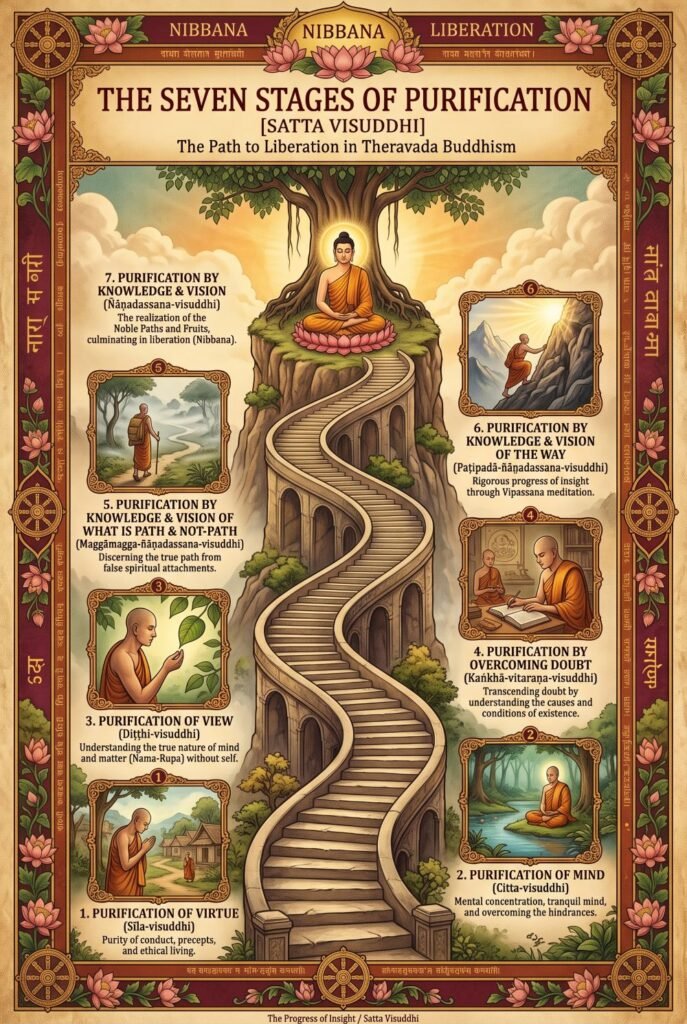
- The seven purifications map onto the three trainings: Stage 1 corresponds to virtue [sīla], Stage 2 to concentration [samādhi], and Stages 3 through 7 to wisdom [paññā].
- The framework is primarily associated with the Theravāda tradition and is a soteriological map directed toward liberation [Nibbāna], not a generic psychological-development ladder.
- In contemporary language, aspects of the framework can serve as a diagnostic map of ethical conduct, mental stability, and wisdom, but these applications should not be confused with the canonical purpose.
- The relay-chariot simile of MN 24 emphasizes that each purification is undertaken for the sake of the next, not as an ego achievement.
1. Introduction
In contemporary discussions of Buddhist practice, mental cultivation is sometimes presented as a form of therapy or personal development. While these framings may have practical value, they can obscure the traditional purpose of Buddhist practice: liberation from suffering and the cycle of rebirth. The Seven Stages of Purification [Satta Visuddhi] represent one of the most detailed maps of this path within the Theravāda tradition.
The purifications describe successive forms of training and insight that support progress toward liberation. These distortions, such as greed, hatred, and delusion, obscure the mind and create suffering. The Seven Stages provide a systematic method for removing these distortions. By following this curriculum, a practitioner moves from the coarse levels of physical conduct to the most subtle levels of meditative insight, eventually reaching liberation.
This article explores each stage in detail, providing background and connections to daily life. It also distinguishes between what the early Buddhist texts say about the seven purifications and how Buddhaghosa later developed them. This distinction is essential for understanding the framework accurately. The modern applications offered here are editorial interpretations, not canonical prescriptions.
2. The Buddhist Schools and Doctrinal Foundations
The Seven Stages of Purification are primarily associated with the Theravāda school of Buddhism.
The seven purifications are explicitly named in the Rathavinīta Sutta (MN 24), also known as the Discourse on the Relay Chariots. In this text, the monk Puṇṇa Mantāṇiputta explains to Sāriputta that the purifications are like a series of relay chariots. Each chariot takes the traveler one stage of the way, and each stage is necessary to reach the next. The simile emphasizes that each purification is undertaken for the sake of the next, and none of them is the final destination itself. The final destination is Nibbāna, reached without clinging.
Buddhaghosa, a fifth-century Indian monk who traveled to Sri Lanka, later developed these seven stages into a comprehensive system in his masterwork, The Path of Purification [Visuddhimagga]. In this manual, the seven purifications became a major organizing structure for the entire path. Buddhaghosa’s treatment is much more detailed than what appears in the early discourses, and it draws extensively on the Abhidhamma and commentarial literature.
While the seven-stage framework is central to Theravāda, other Buddhist traditions have different maps of the path. Mahāyāna schools, for example, often use the five paths [pañcamārga] and ten grounds [daśabhūmi] as their primary frameworks. These are not the same as the seven purifications, though they share the emphasis on ethics, concentration, and wisdom. For the purposes of this article, the focus will be on the Theravāda presentation.
3. The First Stage: Purification of Virtue
The foundation of the entire system is the Purification of Virtue [Sīla-visuddhi]. In the Buddhist curriculum, ethical conduct is not viewed as a set of commandments imposed from the outside. It is a practical necessity for mental cultivation. Without a foundation of ethical conduct, the mind remains agitated by guilt, fear, and conflict, making deeper concentration and insight difficult.
Understanding Virtue
Virtue [Sīla] involves the intentional restraint of actions that cause harm. For lay practitioners, this includes refraining from killing, stealing, sexual misconduct, lying, and the use of intoxicants that lead to heedlessness. These five precepts are training guidelines that help create a mind that is peaceful and free from remorse [avippaṭisāra]. When a person engages in harmful behaviors, the mind becomes agitated. When one abstains from harm, the mind becomes calm and clear.
The practice of virtue also includes positive actions, such as acts of kindness, generosity, and honesty. Virtue is not just about avoiding harm; it is about actively cultivating goodness. When we speak truthfully, act with integrity, and treat others with respect, we create a harmonious inner and outer environment.
In the Visuddhimagga, purification of virtue is treated in considerable detail. For monastics, it involves the full range of disciplinary rules. For lay practitioners, it involves the five precepts and other ethical commitments. The purpose of this purification is to establish a foundation of non-remorse, which then supports the development of concentration.
Contemporary Application
In daily life, the Purification of Virtue translates to integrity. It means being the same person in private as one is in public. When we practice right speech, avoiding gossip, harsh words, and divisive talk, we notice that our internal monologue becomes quieter. We are no longer managing lies or worrying about being caught. This simplicity of mind is a natural result of ethical conduct.
Consider the workplace. If you are honest with your colleagues and clients, you do not have to remember which story you told to whom. If you act with integrity, you do not carry the burden of hidden wrongdoing. This lightness of mind supports the deeper work of concentration and insight.
4. The Second Stage: Purification of Mind
Once ethical conduct is established, the practitioner moves to the Purification of Mind [Citta-visuddhi]. This stage is dedicated to the development of concentration [Samādhi].
The Training of Attention
The human mind is naturally prone to wandering. Purification of Mind involves training the attention to remain on a single object, such as the sensation of the breath [Ānāpānasati]. Ānāpānasati means mindfulness of breathing. This practice is not merely concentration on a single object; it is a structured set of trainings involving the body, feelings, mind, and mental qualities.
As the practitioner repeatedly brings the mind back to the object, the five hindrances begin to subside. The five hindrances are mental states that obstruct concentration and clarity:
- Sensual desire [Kāmacchanda]: The craving for pleasant sensory experiences.
- Ill-will or anger [Vyāpāda]: Aversion, resentment, or hostility.
- Sloth and torpor [Thīna-middha]: Dullness, lethargy, and lack of energy.
- Restlessness and worry [Uddhacca-kukkucca]: Agitation, anxiety, and regret.
- Skeptical doubt [Vicikicchā]: Uncertainty about the path, the teacher, or one’s own ability.
When these hindrances are suppressed, concentration may develop to access concentration [upacāra-samādhi] and, depending on the meditation vehicle and practitioner, to absorption [jhāna]. Access concentration is a threshold state in which the hindrances are temporarily subdued, but the mind has not yet reached full absorption. Jhāna is a deeper state of mental unification and tranquility.
It is important to note that access concentration and jhāna are not the same. The Visuddhimagga distinguishes between them. In the Visuddhimagga framework, access concentration provides a level of collectedness suitable for further development, while jhāna represents full absorption. Theravāda meditation traditions differ in how they understand the relationship between concentration and insight practice.
The Purpose of Concentration
The purpose of concentration is not to escape reality but to see it more clearly. A concentrated mind is like a still lake. When the water is calm, the bottom can be seen clearly. In the same way, when the mind is concentrated, the nature of reality can be observed without distortion.
In modern life, this translates to the ability to focus on a task without being pulled away by distractions. It is the capacity to remain calm under pressure and to respond rather than react.
5. The Third Stage: Purification of View
With a steady mind, the practitioner begins the work of wisdom [Paññā]. The Third Stage is the Purification of View [Diṭṭhi-visuddhi]. In the Visuddhimagga, this purification is defined as the correct seeing of mentality and materiality.
Discerning Mentality and Materiality
Most people operate under the assumption that there is a permanent, solid “I” at the center of their experience. Purification of View involves looking closely at what we call a “person” and seeing that it is composed of two interacting streams:
- Mentality [Nāma]: Mental phenomena involved in experience. The Visuddhimagga analyses these in considerable detail.
- Materiality [Rūpa]: The physical body and the material world perceived through the senses.
By observing these two streams, the practitioner realizes that there is no permanent, independent self underlying the processes conventionally described as a person. This is the beginning of the realization of non-self [Anattā]. Anattā means that phenomena are not-self, that they cannot be regarded as a permanent, independent self or as something that can be made to remain exactly as one wishes.
It is important not to overstate this realization. The point is not that there is literally nobody thinking or feeling. The point is that the processes we call “self” are conditioned, impermanent, and do not constitute a permanent, independent entity.
Contemporary Application
In daily life, this helps us stop taking our thoughts and emotions so personally. We see that “anger is arising” rather than “I am an angry person.” This subtle shift in perspective can be liberating. Instead of being defined by our emotions, we can observe them as temporary events that come and go.
Consider a moment when you feel anxious. Without the Purification of View, you might think, “I am an anxious person. This is who I am.” With the Purification of View, you can observe, “Anxiety is arising. It is a mental state conditioned by certain causes. It will pass.” This allows you to respond to the anxiety with wisdom rather than being overwhelmed by it.
6. The Fourth Stage: Purification by Overcoming Doubt
The Fourth Stage, Purification by Overcoming Doubt [Kaṅkhāvitaraṇa-visuddhi], builds on the previous stage by investigating the conditionality of mental and physical processes.
The Law of Conditionality
The practitioner begins to discern how mental and material phenomena arise dependent on conditions. This is the direct experience of conditionality [idappaccayatā]. The practitioner investigates how mentality and materiality arise through conditions, including conditions connected with kamma.
Kamma refers specifically to intentional action. In the canonical definition, intention [cetanā] is kamma. Kamma is not synonymous with general causality. It is one type of condition among many. The law of conditionality [paṭiccasamuppāda] is broader than kamma. It includes all the conditions that give rise to mental and physical phenomena.
By investigating how phenomena arise dependent on conditions, the practitioner develops a clearer understanding of conditionality and moves beyond uncertainty about the path. Doubts about the teachings, about the efficacy of the path, and about one’s own ability to progress are removed by direct experiential evidence.
Contemporary Application
In contemporary practice, this can be understood as developing a more careful understanding of the conditions underlying experience, rather than relying on speculation or assumption. This clarity allows us to make better choices in the present moment, knowing that our current intentions shape our future experiences.
In a modern analogy, this is like understanding the conditions that lead to a particular mood or reaction. By investigating the causes, we can begin to respond more wisely. This is not about blaming ourselves; it is about understanding the workings of conditionality in our own experience.
7. The Fifth Stage: Purification by Knowledge and Vision of What Is and Is Not the Path
As the practitioner’s insight deepens, they may encounter imperfections of insight [Vipassanūpakkilesa]. These are intense meditative phenomena that arise during deep insight practice. The Visuddhimagga lists ten such imperfections:
- Illumination [Obhāsa]
- Knowledge [Ñāṇa]
- Rapture [Pīti]
- Tranquility [Passaddhi]
- Bliss [Sukha]
- Resolution [Adhimokkha]
- Exertion [Paggaha]
- Mindfulness [Upaṭṭhāna]
- Equanimity [Upekkhā]
- Delight [Nikanti]
These experiences can be very convincing. A meditator might think they have attained enlightenment or that they are special. The Fifth Stage, Purification by Knowledge and Vision of What Is and Is Not the Path [Maggāmagga-ñāṇadassana-visuddhi], is the ability to recognize that these experiences, while pleasant, are not the goal. Many practitioners get stuck here, believing they have reached the final destination.
The Discernment
The purification consists of realizing that even these sublime states are impermanent [anicca] and conditioned. The practitioner resolves to keep going, distinguishing the true path of insight from the false path of chasing experiences.
Contemporary Application
In modern practice, this stage is akin to recognizing that a temporary high, such as a profound meditation retreat experience, is not the same as permanent liberation. It is pleasant, but it is not the end. This understanding prevents us from becoming complacent or arrogant. It encourages us to continue the practice with humility and perseverance.
8. The Sixth Stage: Purification by Knowledge and Vision of the Way
The Sixth Stage [Paṭipadā-ñāṇadassana-visuddhi] is the intensive phase of insight practice. It involves a series of insights that mature the practitioner’s understanding of reality.
The Three Characteristics
The focus here is on the three characteristics of existence:
- Impermanence [Anicca]: Seeing that all conditioned things are in a state of constant flux.
- Unsatisfactoriness [Dukkha]: Realizing that because things change, they cannot provide lasting security.
- Non-self [Anattā]: Seeing that all phenomena lack a permanent, unchanging core.
The Cycle of Insight
This stage often involves a period of disenchantment. As the mind sees the constant dissolution of everything it once held dear, it may experience fear or a desire for deliverance. The Visuddhimagga describes a sequence of insight knowledges leading toward equanimity regarding formations [saṅkhāra-upekkhā], where the mind becomes neutral and balanced toward all experiences. Within the Visuddhimagga’s framework, this represents the culmination of mundane insight before supramundane path knowledge.
The Anattalakkhaṇa Sutta (SN 22.59) is a primary text for understanding the three characteristics as applied to the five aggregates. It teaches that form, feeling, perception, mental formations, and consciousness are impermanent, unsatisfactory, and not-self.
Contemporary Application
In daily life, this stage manifests as a growing sense of non-attachment [virāga] toward the ups and downs of life. You still engage with the world, but you are less easily shaken by praise or blame, gain or loss, pleasure or pain. This is not indifference; it is a profound equanimity that allows you to respond to life with greater clarity and compassion.
9. The Seventh Stage: Purification by Knowledge and Vision
The final stage, Purification by Knowledge and Vision [Ñāṇadassana-visuddhi], is the transition from the mundane to the supramundane.
The Moment of Liberation
In the Visuddhimagga’s account, this stage concerns supramundane path and fruition knowledge associated with the realization of Nibbāna. In Theravāda interpretation, Nibbāna is the unconditioned [asaṅkhata], and liberation involves the complete ending of greed, hatred, and delusion. The roots of greed, hatred, and delusion are fundamentally severed.
The Visuddhimagga describes this stage in detail, including the four levels of awakening: stream-entry, once-returning, non-returning, and arahantship. Each level involves the cutting of specific fetters and the realization of Nibbāna.
The Purpose of the Path
While full liberation is a lofty goal, the Seventh Stage serves as a reminder of the ultimate aim of Buddhist practice. It suggests that it is possible to live in the world without being of the world, to engage with life fully while remaining inwardly free from the grip of suffering.
10. Integrating the Stages into Modern Life
Although the seven purifications belong to a liberation-oriented framework, aspects of the training can also be applied by lay practitioners in ordinary life. These applications should not be confused with the canonical purpose of the framework.
- Diagnostic Tool: If you feel stuck in your practice, ask which stage is missing. Are you trying to be calm while still being dishonest? Are you trying to understand your life without first observing your thoughts?
- Ethical Foundation: Stage 1 reminds us that our happiness is linked to how we treat others. Virtue is the foundation for non-remorse, which is the basis for concentration.
- Mindful Attention: Stage 2 encourages us to train our attention through practices like mindfulness of breathing. Even five minutes of daily practice can make a difference.
- Curiosity and Inquiry: Stages 3 and 4 invite us to investigate our experience with curiosity. Instead of assuming we know who we are, we can explore the nature of the self and the workings of cause and effect.
- Letting Go of Experiences: Stage 5 teaches us not to cling to pleasant meditative experiences. They are not the goal.
- Equanimity: Stage 6 cultivates a balanced mind that can meet life’s challenges with grace.
- Aspiration for Freedom: Stage 7 reminds us that freedom is possible. It is not a fantasy but a real potential of the human mind.
For a broader understanding of how these stages relate to the Buddha’s first teaching, refer to the Dhammacakkappavattana Sutta (SN 56.11). The seven purifications can be understood as a later Theravāda framework for organizing aspects of the path described in the Noble Eightfold Path, though the seven purifications themselves are not listed in SN 56.11. For those struggling with physical or mental pain, the Girimānanda Sutta (AN 10.60) provides ten perceptions to help navigate the later stages of purification.
11. Conclusion
The Seven Stages of Purification provide a comprehensive map of the Theravāda path toward liberation. By starting with the coarse and moving toward the subtle, this system ensures that spiritual growth is grounded, balanced, and sustainable. It moves us from a life of reactive confusion to a life of responsive clarity. Ultimately, however, it points beyond mere clarity, toward the unconditioned freedom of Nibbāna.
The path is not easy, but it is possible. Each stage builds on the previous one, creating a gradual but profound transformation. A mind that is purified expresses greater peace, compassion, and wisdom in the world.
For further study on the nature of consciousness and the cessation of suffering, the Poṭṭhapāda Sutta (DN 9) and the Satipaṭṭhāna Sutta (MN 10) are valuable resources.
Glossary
- Anattā: Non-self; the characteristic that phenomena lack a permanent, unchanging essence.
- Anicca: Impermanence; the fundamental law that all conditioned phenomena are in a state of constant change.
- Asaṅkhata: The unconditioned; a term for Nibbāna.
- Avippaṭisāra: Non-remorse; the mental state of freedom from regret that results from ethical conduct.
- Cetanā: Intention; the mental factor that is central to the definition of kamma.
- Citta: Mind or consciousness; the aspect of the mind that experiences and cognizes objects.
- Diṭṭhi: View or perspective; can refer to wrong view or right view.
- Dukkha: Suffering, stress, or unsatisfactoriness; the inherent friction in life caused by clinging to impermanent things.
- Idappaccayatā: Conditionality; the law that phenomena arise dependent on specific conditions.
- Jhāna: Meditative absorption; a state of deep concentration and tranquility.
- Kamma: Intentional action; in AN 6.63, the Buddha states that intention is kamma.
- Kaṅkhāvitaraṇa: Overcoming doubt; the fourth stage of purification.
- Maggāmagga: What is and is not the path; the fifth stage of purification.
- Nāma: Mentality; mental phenomena involved in experience.
- Ñāṇadassana: Knowledge and vision; the seventh stage of purification.
- Nibbāna: The unconditioned; liberation involving the ending of greed, hatred, and delusion.
- Paññā: Wisdom; the understanding of reality as it is.
- Pīti: Rapture; a pleasant mental factor that can arise in meditation.
- Rūpa: Materiality or form; the physical body and the material world.
- Samādhi: Concentration; the unification of mind on a single object.
- Saṅkhāra-upekkhā: Equanimity regarding formations; a balanced mind toward all conditioned phenomena.
- Satta Visuddhi: The Seven Stages of Purification.
- Sīla: Virtue or moral conduct; the practice of ethical restraint.
- Uddhacca-kukkucca: Restlessness and worry; one of the five hindrances.
- Upacāra-samādhi: Access concentration; a threshold state before full absorption.
- Vicikicchā: Skeptical doubt; one of the five hindrances.
- Virāga: Non-attachment or dispassion; freedom from craving.
- Vipassanūpakkilesa: Imperfections of insight; intense meditative phenomena that can be mistaken for the goal.
- Visuddhi: Purification; the process of cleansing the mind of defilements.
Recommended Resources
- Books: The Path of Purification (Visuddhimagga) by Bhadantācariya Buddhaghosa. This is the primary source for the detailed development of the Seven Stages.
- Books: The Progress of Insight by Mahasi Sayadaw. A modern classic on the practical application of these stages.
- Podcasts: Dharmaseed.org features thousands of talks by teachers who discuss these stages in detail.
- Websites: Buddhist Learning Articles for further exploration of Theravāda philosophy.
- Sutta References: Cūḷasuññata Sutta (MN 121) for a discourse on the progressive entry into emptiness.
- Sutta References: Upakkilesa Sutta (MN 128) for a detailed look at the obstructions to concentration and how to overcome them.