Key Takeaways
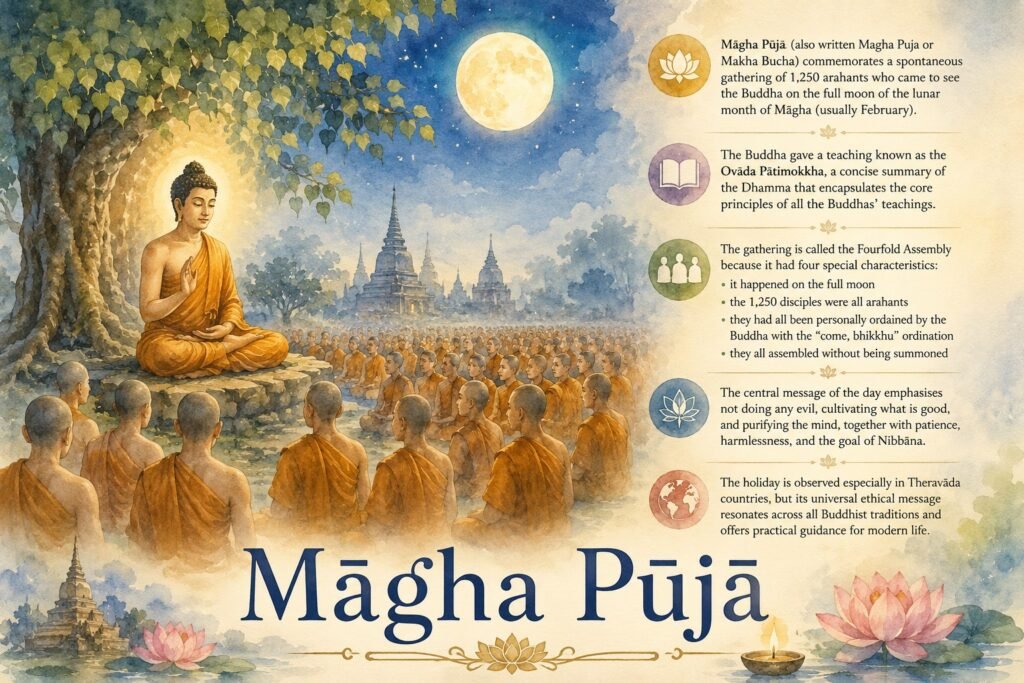
- Māgha Pūjā (also written Magha Puja or Makha Bucha) commemorates a spontaneous gathering of 1,250 arahants who came to see the Buddha on the full moon of the lunar month of Māgha (usually February).
- The Buddha gave a teaching known as the Ovāda Pāṭimokkha, a concise summary of the Dhamma that encapsulates the core principles of all the Buddhas’ teachings.
- The gathering is called the Fourfold Assembly because it had four special characteristics: it happened on the full moon, the 1,250 disciples were all arahants, they had all been personally ordained by the Buddha with the “come, bhikkhu” ordination, and they all assembled without being summoned.
- The central message of the day emphasises not doing any evil, cultivating what is good, and purifying the mind, together with patience, harmlessness, and the goal of Nibbāna.
- The holiday is observed especially in Theravāda countries, but its universal ethical message resonates across all Buddhist traditions and offers practical guidance for modern life.
1. Introduction
The full moon rises over Southeast Asia, and thousands of candles flicker in a slow procession around temple halls. This is Māgha Pūjā, one of the most important Buddhist holidays, second in significance only to Vesak in many Theravāda countries. The name Māgha comes from the third lunar month of the ancient Indian calendar, and pūjā means honour or veneration. Together, Māgha Pūjā means the offering of honour on the full moon of Māgha.
The event commemorated is not a birth, an enlightenment, or a passing away, but a unique assembly. On that night, according to the ancient texts and commentaries, 1,250 fully awakened disciples gathered around the Buddha without any prior arrangement. The Buddha saw that this was an extraordinary moment and gave them a teaching that distils the entire path into a few essential verses — a teaching known as the Ovāda Pāṭimokkha, the “Exhortation on the Fundamental Principles.” Dhammapada verse 183, in particular, has often been called the summary of Buddhism because it captures the complete training in a single line: cease from evil, do good, and purify the mind.
This article explores the origins, scriptural roots, spiritual meaning, and living traditions of Māgha Pūjā. Every Pāli and Sanskrit term is explained as it appears, and the teachings are presented in plain English. Whether you are a newcomer to Buddhism or a long‑time practitioner, you will find here an accessible guide to Sangha Day and the timeless wisdom it celebrates.
2. Origins and Historical Development
2.1 Scriptural Foundations
The primary account of the fourfold assembly and the Buddha’s exhortation does not appear in a single sutta of the Pāli Canon in the same narrative form as, for example, the First Sermon. Instead, the event is recorded in the commentarial tradition, particularly in the Dhammapada commentary (Dhammapada-aṭṭhakathā) and the Vinaya commentary. However, the verses the Buddha is said to have spoken on that occasion are deeply embedded in the canonical texts themselves.
The heart of what later tradition calls the Ovāda Pāṭimokkha is found in three famous verses of the Dhammapada (verses 183–185). The first and most widely quoted verse declares:
Dhammapada 183 – “Sabbapāpassa akaraṇaṃ, kusalassa upasampadā, sacittapariyodapanaṃ — etaṃ buddhāna sāsanaṃ.”
“Not doing any evil, undertaking what is good, purifying one’s own mind — this is the teaching of all the Buddhas.”
The second verse (Dhammapada 184) reads: “Khantī paramaṃ tapo titikkhā — nibbānaṃ paramaṃ vadanti buddhā.”
“Patience, endurance, is the highest austerity; Nibbāna is supreme, say the Buddhas.”
The third (Dhammapada 185) continues: “Na hi pabbajito parūpaghātī, samaṇo hoti paraṃ viheṭhayanto.”
“One who harms another is not a true renunciant; one who injures living beings is not a contemplative.”
These three verses encapsulate the ethical foundation, the mental training, and the ultimate goal of the Buddha’s path. They are recited in monasteries across the world on Māgha Pūjā day and serve as a compact spiritual charter for the entire Buddhist life. The Buddha’s statement that “this is the teaching of all the Buddhas” (etaṃ buddhāna sāsanaṃ) appears not only here but is also reflected in the Mahāpadāna Sutta (DN 14), which recounts how past fully awakened ones taught the same fundamental principles to their own assemblies.
The commentarial story tells us that the assembly occurred when the Buddha was staying at the Veḷuvana monastery in Rājagaha. The 1,250 monks had all been personally ordained by the Buddha using the simple formula “Come, bhikkhu” (ehi bhikkhu). They had all attained the fruit of arahantship, the complete extinguishing of all defilements. The confluence of these four factors on a full-moon day is why the event is known as the Cāturaṅgasannipāta — the Fourfold Assembly.
2.2 The Core Story
According to Theravāda tradition, the gathering occurred around nine months after the Buddha’s awakening, bringing together the fruits of his first year of teaching. By the time the first rain retreat had passed, many noble disciples had reached full awakening. Chief among them were the two great disciples, Sāriputta and Moggallāna, who had recently become arahants and were already the Buddha’s foremost assistants in teaching the Dhamma.
The 1,250 monks who gathered were not a random collection of followers. Traditional accounts identify them as two large groups that had recently been ordained. The first group comprised 1,000 former ascetics — the Jaṭilas, or matted‑hair fire‑worshippers — who had been converted together with their three leaders, the Kassapa brothers (Uruvela Kassapa, Nadī Kassapa, and Gayā Kassapa). The second group consisted of 250 former wanderers who had followed the teacher Sañjaya. When Sañjaya refused to meet the Buddha, his two chief disciples, Sāriputta and Moggallāna, went ahead with their own followers, heard the Dhamma, and attained stream‑entry and later arahantship. The merging of these two great cohorts — the 1,000 Jaṭilas and the 250 followers of Sāriputta and Moggallāna — made up the assembly of 1,250.
On the full-moon day of the month of Māgha, all 1,250 arahants, each ordained personally by the Buddha, found themselves simultaneously at the Veḷuvana monastery. The tradition emphasises that no summons was sent, no message was passed, and no arrangement was made. They simply assembled, and the coincidence of their presence became the occasion for the Buddha’s exhortation.
When the Buddha saw this gathering, he recognised its exceptional quality. He used the occasion to deliver a teaching that would serve as the foundational charter of the Sangha and as a concise statement of the path for all future generations. The Ovāda Pāṭimokkha, as it became known, was not a list of monastic rules — that detailed code, the Bhikkhu Pāṭimokkha, would be laid down gradually over many years in response to specific situations. Instead, this was a statement of principle, a distillation of the very purpose of the holy life.
The Fourfold Assembly (Cāturaṅgasannipāta) is named after its four special features:
- The day: It was the full moon of Māgha, a day already considered sacred for its clarity and natural power.
- The number: Tradition records that 1,250 arahants were present. Modern historians generally regard the exact number as part of the traditional narrative rather than something that can be independently verified, but its symbolic and spiritual significance within the tradition is profound.
- The ordination: Every single monk had received the “ehi bhikkhu” ordination directly from the Buddha. No disciple had been ordained by another disciple.
- The attainment: All 1,250 were arahants, fully liberated from all taints and no longer subject to any future rebirth.
This assembly was, therefore, not a random crowd of followers. It was a gathering of perfect purity, complete harmony, and unmediated connection to the teacher. According to Theravāda tradition, only two such assemblies are said to have occurred in the Buddha’s teaching career. The Buddha taught them the verses that would become the Ovāda Pāṭimokkha, and the night became the template for what a harmonious spiritual community can be.
2.3 Growth into a Calendar Festival
In the earliest centuries of Buddhism, the memory of this assembly was preserved in monasteries and passed down through the oral tradition. As the Buddhist calendar developed, the full moon of Māgha became a regular day of special observance, much like the full moons of Vesākha and Āsāḷha. In Theravāda countries, the day was set aside for making merit, listening to Dhamma talks, and performing symbolic acts of unity and purification.
In Thailand, Māgha Pūjā (Makha Bucha, มาฆบูชา) rose to national prominence during the reign of King Rama IV in the nineteenth century. The king, who had been a monk for many years before ascending the throne, was a scholar of Pāli and a reformer of Buddhist practice. He rediscovered the significance of the Fourfold Assembly in the ancient texts and formally established Māgha Pūjā as a royal and public holiday. From that point, the holiday spread in popularity and became one of the most important days on the Thai Buddhist calendar. The candle procession (wian tian), a central feature of the observance, became a national tradition.
In Sri Lanka, the full moon of the month of Navam (corresponding to Māgha) is observed as Navam Poya. The day primarily commemorates the appointment of Sāriputta as the first chief disciple and Moggallāna as the second, an event that tradition says also took place on the full moon of Māgha. Some traditions also associate Navam Poya with the Fourfold Assembly, though the connection is not universally emphasised across all Sri Lankan temples.
In Cambodia and Laos, the day is known as Meak Bochea and Boun Makha Bousa respectively, and it is marked by temple visits, alms‑giving, and evening candle‑lit processions. In Myanmar, the full moon of Tabaung is a major festival, but it is primarily associated with the building of sand pagodas and other merit‑making activities, rather than specifically the Fourfold Assembly.
Over time, Māgha Pūjā grew from a monastic commemorative day into a public festival that involves the entire lay community, reminding everyone of the fundamental teachings that unite the Sangha and the laity.
3. Spiritual Meaning and Central Teachings
3.1 The Main Dhamma Message
The Ovāda Pāṭimokkha is so brief that it can be memorised in a few minutes, yet it contains the whole Buddhist path in three short statements. The Buddha did not give a long discourse on that full-moon night. Instead, he spoke directly to the heart of what all the Buddhas teach.
Not doing any evil
The first instruction is a call to restrain from all unwholesome actions of body, speech, and mind. This is the foundation of sīla, ethical conduct. In practical terms, it means aligning one’s life with the five precepts: refraining from taking life, from stealing, from sexual misconduct, from false speech, and from intoxicants that cloud the mind. It also includes the subtler work of noticing when the mind leans toward ill will, greed, or cruelty, and choosing not to feed those impulses. “Not doing any evil” is not passive; it is an active, moment‑to‑moment discipline of harmlessness.
Undertaking what is good
The second instruction balances the first. It is not enough simply to avoid harm; the heart must be cultivated in generosity, kindness, compassion, and wisdom. In daily life, this means looking for opportunities to offer help, to speak words that uplift, and to develop qualities like patience, gratitude, and truthfulness. It encompasses the cultivation of wholesome qualities across the entire spectrum of practice, including generosity (dāna), ethical conduct (sīla), mental discipline (samādhi), and wisdom (paññā). The phrase “kusalassa upasampadā” literally means “the undertaking of the wholesome,” and it suggests that goodness is something we must deliberately take up, not something that happens by accident.
Purifying the mind
The third instruction points to the ultimate goal. Ethical living and good deeds are necessary, but they are not sufficient for complete liberation. The deepest freedom comes from purifying the mind of the three unwholesome roots: greed (lobha), hatred (dosa), and delusion (moha). This purification is the work of meditation and insight. Through mindfulness, concentration, and the direct seeing of impermanence, unsatisfactoriness, and selflessness, the mind gradually sheds its attachments. When purification is complete, the mind is radiant, peaceful, and free. This is Nibbāna.
Taken together, these three principles form a complete path: ethics, mental cultivation, and wisdom. The verse declares that this is the teaching of all Buddhas. Every fully awakened being of the past, present, and future teaches exactly this, because it is the universal law of spiritual growth.
Patience as the highest austerity
In the second verse, the Buddha added a striking statement: “Patience, endurance, is the highest austerity.” In the Buddha’s time, many ascetics practised severe physical penances — fasting, holding the breath, standing on one leg — believing that self‑torture would burn off past karma and lead to purity. The Buddha rejected this. He declared that the most powerful and difficult austerity is not physical but mental: the ability to endure hardship, insult, and the raw discomfort of existence without responding with anger, resentment, or self‑pity. Patience (khanti) is the quality that keeps the practitioner on the path when conditions are difficult, when progress seems slow, and when the world does not cooperate. In a modern context, patience is the capacity to pause before reacting, to tolerate the discomfort of being criticised, and to persist in wholesome habits even when they do not bring immediate pleasure.
Harmlessness and the true renunciant
The third verse clarifies that renunciation is not about outer appearance. A shaven head, robes, or the title of “monk” do not make one a true renunciant. What matters is conduct. One who harms others, whether by physical violence, harsh words, or cunning schemes, is not a true follower of the Buddha, regardless of their position or label. This teaching democratises spiritual life. The standard is not status but the consistent practice of non‑harming (ahiṃsā). Lay people and monastics alike are called to measure themselves by this simple, penetrating criterion.
3.2 Symbolism and Its Practical Lesson
Māgha Pūjā is rich with symbols that speak directly to the heart of modern practice.
- The Fourfold Assembly: The spontaneous gathering of 1,250 arahants represents the ideal of spiritual community — a group of people living in harmony, without conflict, all sharing the same goal and the same understanding. In daily life, this symbol invites us to build and nurture communities based on shared values, whether a meditation group, a service organisation, or a family that practises kindness together. The fact that the gathering was unplanned suggests that when each person does their inner work, the right conditions naturally arise.
- The full moon: The full moon of Māgha shines with a cool, clear light that banishes darkness. It symbolises a mind that has been thoroughly purified and is now radiant with wisdom. The monthly full moon becomes a regular checkpoint. Even in a busy urban life, the full moon can serve as a reminder to pause, to sit quietly, and to check the state of one’s inner sky. Because full‑moon days in Buddhism are Uposatha days — traditional occasions for intensified practice — the Māgha full moon connects the holiday with a rhythm of regular self‑renewal that runs throughout the Buddhist year.
- The ehi bhikkhu ordination: All the arahants present had been ordained by the Buddha with the simple phrase, “Come, bhikkhu.” This points to the directness of the spiritual path when the heart is ready. There was no elaborate ceremony, no waiting period, no committee. The readiness of the disciple and the compassion of the teacher were enough. This does not mean that formal ordination is unnecessary today, but it reminds us that the essence of spiritual commitment is a sincere turning of the heart.
- The Ovāda Pāṭimokkha as a banner: The three‑part teaching — avoid evil, do good, purify the mind — can be carried into any situation. It can be written on a card, placed on a desk, or quietly recited before a difficult meeting. It functions as a banner or a standard that the Sangha holds aloft, and it is just as relevant to a parent, a teacher, a nurse, or a programmer as it is to a monk.
- Candles and circumambulation: The candle‑lit walk around the temple hall, performed three times in honour of the Triple Gem, symbolises the practitioner’s commitment to keep the Dhamma at the centre of their life. The single flame of each candle represents the wisdom that is potential in every mind. As the procession moves, individual flames merge into a river of light, showing that personal practice and community are not separate.
3.3 Frameworks for Understanding
The Ovāda Pāṭimokkha can be mapped onto several key Buddhist frameworks that help us structure our understanding and practice.
The Threefold Training (tisso sikkhā): The three verses correspond to sīla (ethics), samādhi (concentration), and paññā (wisdom). “Not doing any evil” is sīla. “Undertaking what is good” involves the positive cultivation of wholesome states, encompassing generosity, morality, meditation, and wisdom. “Purifying the mind” is the work of paññā, the direct seeing that uproots defilements. On Māgha Pūjā, practitioners can review their own balance among these three trainings.
The Gradual Path: The Ovāda Pāṭimokkha follows a natural progression. First, stop the outflow of harm. Second, actively generate goodness. Third, purify the mind completely. This mirrors the gradual teaching (ānupubbikathā) that the Buddha often used: generosity, virtue, the heavens, the danger of sensual pleasures, and the blessing of renunciation, leading to the Four Noble Truths. The holiday thus serves as a condensed map of the whole path.
The Three Universal Truths: The ultimate purification of the mind comes from directly seeing the three characteristics of existence — impermanence (anicca), suffering (dukkha), and non‑self (anattā). The Ovāda Pāṭimokkha does not mention these explicitly, but its last line, “purifying the mind,” implies the deep insight that cuts the roots of defilement. Without that insight, purification is only temporary. Māgha Pūjā reminds us that the goal is complete liberation, not just a well‑behaved life.
Harmony in the Sangha: The Fourfold Assembly is often held up as the model of Sangha harmony (sāmaggi). The Buddha repeatedly praised harmony within the Sangha and also taught that admirable friendship is “the whole of the holy life” (Upaddha Sutta, SN 45.2). When a community of practitioners can resolve differences through dialogue, show mutual respect, and keep the Dhamma as their shared standard, they create the conditions for individual and collective awakening. Māgha Pūjā is sometimes called “Sangha Day” for this reason.
The Ovāda Pāṭimokkha and the Bhikkhu Pāṭimokkha: It is helpful to distinguish between the two. The Ovāda Pāṭimokkha is the concise, universal principle. The Bhikkhu Pāṭimokkha is the detailed code of 227 training rules for monks, recited every fortnight. The Buddha gave the Ovāda Pāṭimokkha first, as the spirit that should animate all the later rules. Māgha Pūjā thus emphasises the spirit of the law over the letter, and reminds all Buddhists that intention and heart‑quality are paramount.
4. How the Holiday Is Observed
4.1 Temple and Monastic Practices
In the days leading up to Māgha Pūjā, monasteries become hives of activity. In Thailand, temple compounds are cleaned and decorated with flags, flowers, and banners bearing the Ovāda Pāṭimokkha verses. Monks may spend extra hours preparing Dhamma talks, and the main hall (ubosot or vihāra) is prepared for the evening procession.
On the day itself, the monastic community gathers for the usual morning chanting and alms‑round. A special feature of Māgha Pūjā in many monasteries is the recitation of the Dhammapada verses 183–185, often followed by a talk explaining their meaning. In some temples, the entire Ovāda Pāṭimokkha is chanted in Pāli, with the lay community listening quietly.
Monks may also participate in a formal ceremony of recommitment to the monastic discipline. The abbot or a senior monk delivers a discourse on the ideal of the Fourfold Assembly, encouraging the Sangha to live in harmony and to embody the principles of the Ovāda Pāṭimokkha in their daily conduct. Because Māgha Pūjā falls outside the rains retreat (Vassa), there is no restriction on travel, and many lay people take the opportunity to visit monasteries further from home.
4.2 Lay Observances
For lay Buddhists, Māgha Pūjā is a day of concentrated merit‑making, listening to the Dhamma, and inner reflection.
- Morning alms‑giving (tak bat): In Thailand and other Theravāda countries, families rise early to prepare food and wait along the roads for monks to pass on their alms‑round. Offering food to the Sangha on this day is considered especially meritorious because it echoes the spontaneous gathering of the arahants.
- Taking the precepts: At the temple, lay people formally request the Three Refuges and the five precepts. Many choose to observe the eight precepts for the day, spending the entire day and night at the monastery in white clothing, abstaining from food after midday, and dedicating themselves to meditation and study.
- Listening to Dhamma talks: In the afternoon and evening, monks deliver teachings that unpack the Ovāda Pāṭimokkha. The talks often relate the three principles to contemporary issues — family life, work stress, social media ethics, and environmental care. The atmosphere is attentive and receptive; whole families sit together, and children are included in the learning.
- The candle‑light procession (wian tian): As dusk falls, the most iconic ceremony begins. Lay people and monks assemble outside the main hall. Each person holds a lighted candle, a stick of incense, and a flower — often a lotus bud. Led by a senior monk, the entire congregation walks clockwise three times around the temple hall, while chanting praises of the Buddha, Dhamma, and Sangha. The three circuits honour the Triple Gem. The candle symbolises wisdom, the incense symbolises the fragrance of virtue, and the flower symbolises the impermanence of all conditioned things. In the darkness, the slow procession of flickering lights creates a tangible sense of unity and devotion.
- Meditation and night‑long practice: After the procession, some temples continue with a night of meditation. Participants sit in silence, walk mindfully in the cloisters, or listen to further teachings. The day often ends with a final blessing from the monks, after which lay people return home with a sense of renewal.
4.3 Community and Family Customs
Māgha Pūjā, like other Buddhist holidays, spills from the temple into the home. In Thailand, it is a national holiday, and alcohol sales are banned for 24 hours. Families use the day to spend time together in a wholesome atmosphere. Parents may teach their children to recite the Ovāda Pāṭimokkha verses in Pāli and then explain the meaning in simple terms. Shared meals are prepared with extra care, and conversations are steered away from gossip and argument toward topics of gratitude and aspiration.
In villages, the temple becomes the centre of community life. People bring food to share not only with the monks but with each other, and the day often raises funds for temple maintenance or charitable projects. In some regions, there are also cultural performances — traditional music, dance, and storytelling — that dramatise the story of the Fourfold Assembly.
In Cambodia, the day (Meak Bochea) sees large crowds at the temples, and in Laos (Boun Makha Bousa), villages organise merit‑making ceremonies and candle processions. A unique feature in some Lao communities is the offering of “heaps of rice” (khao tom), sticky rice packets that are shared among neighbours and the poor, embodying the principle of “undertaking what is good.”
4.4 Liturgical Timing and the Lunar Calendar
Māgha Pūjā falls on the full moon of the third lunar month, which in the Gregorian calendar usually occurs in February, occasionally in late January or early March. The exact date varies each year according to the traditional Buddhist lunar calendar. For diaspora communities in the West, temples may observe the day on the exact lunar date or the nearest weekend.
The month of Māgha corresponds to a time when, in ancient India, the weather was mild and the roads were passable. This may have contributed to the ability of the 1,250 monks to travel and gather spontaneously. The full moon itself was already a traditional day for religious observances among the wanderers and ascetics of the Gangetic plain, and the Buddha and his Sangha continued and transformed that custom into a specifically Buddhist practice.
The full moon of every month is an Uposatha day in the Buddhist calendar — a day set aside for intensified practice, taking additional precepts, listening to Dhamma, and purifying the mind. Māgha Pūjā is therefore both a distinctive annual festival and a particularly significant instance of the monthly Uposatha rhythm that has structured Buddhist devotional life since the time of the Buddha.
5. Regional Expressions Across Buddhist Schools
5.1 Theravāda Traditions
In Theravāda countries, Māgha Pūjā is celebrated with considerable fervour, though its prominence varies.
- Thailand (Makha Bucha, มาฆบูชา): This is one of the most important public holidays. All government offices, schools, and banks close. Alcohol sales are prohibited by law. The candle procession is a universal feature, and iconic temples like Wat Phra Kaew in Bangkok and Wat Phra That Doi Suthep in Chiang Mai attract tens of thousands. Television and radio broadcast Dhamma talks by prominent monks. Many Thais use the three‑day weekend to visit their home provinces and make merit at local temples.
- Sri Lanka (Navam Poya): In Sri Lanka, Navam Poya primarily commemorates the appointment of Sāriputta and Moggallāna as chief disciples. Some traditions also associate Navam Poya with the Fourfold Assembly, though the connection is not universally emphasised across all temples. The famous Navam Perahera in Colombo, a grand pageant with elephants, dancers, and drummers, is held on this day and draws large crowds.
- Cambodia (Meak Bochea): In Cambodia, the day is a public holiday. People go to the pagoda to offer food to monks, listen to sermons, and participate in the candle procession. The Ovāda Pāṭimokkha is recited and explained. In the evening, large crowds gather for the procession, and the atmosphere is both festive and devout.
- Laos (Boun Makha Bousa): In Laos, the day is observed with merit‑making and candle processions. Because Lao Buddhism preserves many traditional folk elements, there may also be blessings of rice baskets and community feasts that express the spirit of “undertaking what is good” in a tangible way.
- Myanmar: The full moon of Tabaung is a major festival, but it is primarily associated with the building of sand pagodas and other merit‑making activities, rather than specifically the Fourfold Assembly. However, the Ovāda Pāṭimokkha verses are still well known and may be recited in sermons.
5.2 Mahāyāna Traditions
In the Mahāyāna traditions of East Asia, Māgha Pūjā as a named holiday is not widely celebrated. However, the principles of the Ovāda Pāṭimokkha are so fundamental that they are integrated into daily liturgy and ethical teaching. The verse “Do no evil, do good, purify the mind” is quoted in Chinese Buddhist texts and is often taught to children as the essence of Buddhism. Some Chinese and Vietnamese temples may hold a special service on the full moon of the first or second lunar month that echoes the spirit of Sangha unity and purification, though it is not called Māgha Pūjā.
In Japan, the ethical emphasis on non‑harming and mind‑purification is expressed through various cultural forms and in the Zen practice of mindfulness in daily life. While the historical Fourfold Assembly may not receive ritual commemoration, the values it embodies — harmony, patience, and the primacy of inner cultivation — are thoroughly present.
5.3 Vajrayāna Traditions
In Tibetan Buddhism, Māgha Pūjā is not a major festival on the annual liturgical calendar. The emphasis on sangha harmony and the purification of mind are deeply embedded in the Vajrayāna path, particularly in the observance of sojong (the twice‑monthly confession and restoration of vows) and in the cultivation of bodhicitta, the mind of enlightenment.
The principle of gathering merit on full‑moon days is strong in Tibetan practice, and the full moon of the month of Magha (which may fall at a different time due to the Tibetan lunar calendar) may be used for additional prayers, offerings, and dedication of merit. However, there is no nationwide festival equivalent to the Theravāda Māgha Pūjā.
5.4 The Holiday in Global and Western Contexts
As Buddhism has taken root in Western countries, Māgha Pūjā has been adapted in innovative ways. Many Western Buddhist centres, regardless of their primary tradition, observe “Sangha Day” near the February full moon. The format is often a day‑long retreat focusing on community, harmony, and the core teachings of the Buddha.
Activities may include:
- Joint sitting and walking meditation sessions.
- Study groups reading the Dhammapada verses 183–185 and discussing their application to modern life.
- Workshops on right speech and compassionate communication, tying the principle of “not harming” to personal relationships.
- Community potluck meals where participants practise generosity and mindful eating.
- Evening candle‑lit ceremonies, often in the centre’s shrine room or garden.
For immigrant communities, the temple remains the heart of celebration. Thai, Lao, Cambodian, and Sri Lankan temples in countries such as the United States, Canada, Australia, and the United Kingdom organise traditional Māgha Pūjā events, often serving as cultural bridges for younger generations. Some temples hold the observance on the nearest Saturday to enable working families to participate fully.
Online, live‑streamed Dhamma talks and guided meditations on Sangha Day make the teachings accessible worldwide. A digital “candle” procession can feel abstract, but many practitioners report that lighting a candle at home while joining a virtual gathering still evokes a sense of shared purpose.
6. Relevance for Modern Life and Daily Application
6.1 Cultivating the Holiday’s Quality at Home
Even without a nearby temple, anyone can honour the spirit of Māgha Pūjā through simple home practices.
- Read and reflect on the Ovāda Pāṭimokkha: Write down the three principles — avoid evil, do good, purify the mind — and place them somewhere visible. Spend ten minutes in the morning and evening reflecting on how each principle applied to the previous day and can guide the next.
- Take a personal precept day: Resolve to follow the five precepts with extra care.
- Perform intentional acts of goodness: Do three deliberate acts of kindness on the day — one for a family member, one for a stranger or neighbour, and one for yourself in the form of a healthy, nourishing practice. These acts cultivate “kusalassa upasampadā” in a tangible way.
- Evening candle meditation: Light a candle in a darkened room. Sit quietly and watch the flame. As you watch, reflect on the quality of your mind. Is it bright and steady, or flickering and smoky? Set an aspiration to purify the mind of one specific unwholesome tendency in the coming month.
- Practise patience: The Ovāda Pāṭimokkha elevates patience to the highest austerity. On this day, deliberately practise patience in a situation that normally irritates you — a slow queue, a difficult colleague, a noisy neighbour. Observe the impulse to react and choose, even for a few moments, to let it be without adding fuel.
6.2 Navigating Challenges with the Holiday’s Wisdom
The three principles of the Ovāda Pāṭimokkha offer a practical tool for navigating modern life’s complexities.
- When tempted to speak harshly: “Not doing any evil” applies to speech. Before speaking, pause and ask, “Is this true? Is it necessary? Is it kind? Is it the right time?” Right speech is a direct expression of the first principle and a powerful way to reduce conflict.
- When feeling morally adrift: “Undertaking what is good” can be a lifeline. In a morally confusing situation, look for one small, concrete good action that can be taken immediately — offering a sincere compliment, helping with a task, or simply listening without interrupting. These actions ground the mind in wholesomeness and create conditions for clearer wisdom to arise.
- When overwhelmed by inner turmoil: “Purifying the mind” is the long‑term project, but it begins in the present moment. Sit quietly and observe the turmoil without judgement. Name the defilement present — anger, fear, greed. Naming it without identifying with it loosens its grip. Then gently return attention to the breath or body. Even one minute of this practice is a step toward purification.
- In community or workplace disputes: The Fourfold Assembly models harmony. In a team or family conflict, the values of patience, non‑harming, and shared purpose can transform the atmosphere. Approaching a disagreement with the spirit of “how can we find a way forward that harms no one and benefits all?” shifts the conversation from blame to solution.
6.3 Social and Environmental Dimensions
The Ovāda Pāṭimokkha’s principles naturally extend beyond the personal sphere.
- “Not doing any evil” as an ethical baseline for business and policy: Companies and governments can adopt the principle of non‑harm. For a business, this means assessing supply chains, labour practices, and environmental impact. For a government, it means evaluating laws and policies against the standard of whether they protect beings from harm. While not all will use Buddhist language, the principle is universal.
- “Undertaking what is good” as a call to active citizenship: The holiday inspires volunteering, charitable giving, and advocacy. Organisations could make Māgha Pūjā a day of service — planting trees, cleaning public spaces, or supporting shelters. These actions embody the second principle and build community cohesion.
- Purifying the collective mind: The third principle can be applied to the cultural and information environment. Just as the individual mind can be clouded by defilements, the public discourse can be polluted by misinformation, hatred, and greed. Supporting media literacy, promoting calm and reasoned dialogue, and reducing one’s own consumption of toxic content are all ways of purifying the collective mind‑stream.
- Patience as a response to global crises: The great challenges of our time — climate change, inequality, conflict — demand long‑term effort. Patience, the highest austerity, is not passive resignation but the steady, persistent commitment to keep acting in wholesome ways even when results are not immediate. The Ovāda Pāṭimokkha reminds us that there is no shortcut; the path is walked one step at a time.
7. Common Misunderstandings and Clarifications
Even a holiday as straightforward as Māgha Pūjā can be subject to misunderstandings. Clarifying these helps keep the focus on its true significance.
- “It’s just a Thai holiday.” While Thailand has given Māgha Pūjā its most visible public expression, the event it commemorates is part of the shared Buddhist heritage. The Ovāda Pāṭimokkha belongs to all traditions, and the values of harmony and ethical living are universal.
- “The Fourfold Assembly is a historical event accepted by all scholars.” The assembly is primarily attested in the commentarial tradition. Academic historians may regard it as a hagiographical narrative rather than a literal event. Within the lived Buddhist tradition, however, its spiritual and symbolic importance does not depend on precise historical verification. The teaching it conveys is what matters.
- “The Ovāda Pāṭimokkha is just a summary for monks.” Although delivered to an assembly of arahant monks, the three principles apply to everyone. The Buddha explicitly said that this is the teaching of all Buddhas. There is no restriction based on lay or monastic status.
- “Purifying the mind means having no thoughts.” Purification refers to uprooting the defilements of greed, hatred, and delusion, not to the absence of all mental activity. A purified mind is still active, but it acts from wisdom and compassion rather than from craving and aversion.
- “Patience means letting people walk all over you.” Patience (khanti) in the Buddhist sense is not submissiveness. It is the strength to endure without hatred, combined with the wisdom to respond appropriately. It is fully compatible with setting boundaries and working for justice, as long as the inner state is free of ill will.
- “Māgha Pūjā is about worshipping the monks.” The holiday honours the ideal of the Sangha — the community of noble practitioners — not individual personalities. The candle procession honours the Triple Gem as a whole: Buddha, Dhamma, Sangha. The monks, as living members of the conventional Sangha, are respected as preservers and teachers of the Dhamma, not as objects of blind worship.
8. Conclusion
The full moon of Māgha shines the same light on a crowded city street as it did on the Veḷuvana monastery in ancient Rājagaha. The assembly of 1,250 arahants — the former fire‑worshippers and the followers of Sāriputta and Moggallāna — may belong to a distant past, but the teaching they heard — avoid evil, do good, purify the mind — is alive and urgent today.
Māgha Pūjā, Sangha Day, is a celebration of spiritual community and a call to return to basics. It does not ask for elaborate rituals or intellectual brilliance. It asks for a willing heart, a commitment to harmlessness, and a daily effort to cleanse the mind of whatever keeps it small and frightened. The Buddha’s exhortation strips away all unnecessary complexity and reveals a path that fits into every life, in every era.
As the candles circle the temple hall, each flame a small, brave point of light, the message is plain: no matter how dark the world seems, every mind holds the potential for purification, and every purified mind becomes a lamp for others. On the full moon of Māgha, that message is renewed, and the wheel of Dhamma turns once more, quietly and inexorably, toward peace.
Glossary
Ahiṃsā
Non‑harming or non‑violence, a core ethical principle in Buddhism.
Arahant
A person who has attained full awakening, completely extinguishing all defilements and bringing an end to the cycle of rebirth.
Cāturaṅgasannipāta
The Fourfold Assembly, referring to the gathering of 1,250 arahants with four special characteristics on the full moon of Māgha.
Dhamma (Sanskrit: Dharma)
The Buddha’s teachings; the truth about the nature of reality; the law of conditionality; the path to liberation.
Ehi bhikkhu
“Come, bhikkhu,” the simple formula the Buddha used to ordain the earliest monks.
Khanti
Patience, endurance, forbearance. In the Ovāda Pāṭimokkha, it is called the highest austerity.
Māgha
The third lunar month of the traditional Indian Buddhist calendar, corresponding roughly to February.
Nibbāna (Sanskrit: Nirvāṇa)
The extinguishing of greed, hatred, and delusion; the ultimate goal of Buddhist practice.
Ovāda Pāṭimokkha
The “Exhortation on the Fundamental Principles,” the concise teaching the Buddha gave at the Fourfold Assembly, with its core preserved in Dhammapada verses 183–185.
Pūjā
Honour, veneration, or devotional offering. The word for a religious ceremony or festival.
Sangha (Saṅgha)
The community of the Buddha’s disciples. In its highest sense, the noble Sangha of those who have attained direct insight; conventionally, the community of ordained monks and nuns, and by extension the wider Buddhist community.
Sīla
Ethical conduct, the foundation of Buddhist practice, typically expressed as the five precepts or the more extensive monastic code.
Triple Gem (Tiratana)
The three objects of refuge in Buddhism: the Buddha, the Dhamma, and the Sangha.
Uposatha
The fortnightly observance day falling on the full moon and new moon, dedicated to intensified practice, taking precepts, and listening to Dhamma.
Further Resources
- What the Buddha Taught by Walpola Rahula – A clear introduction to the core teachings that the Ovāda Pāṭimokkha summarises.
- The Dhammapada, translated by Acharya Buddharakkhita or Gil Fronsdal – Contains the three key verses (183–185) with accessible commentary.
- In the Buddha’s Words by Bhikkhu Bodhi – An anthology of suttas that provides the context for understanding the ethical and meditative dimensions of the path.
- The Heart of the Buddha’s Teaching by Thich Nhat Hanh – A gentle exploration of the Four Noble Truths, the Eightfold Path, and the essential practices of non‑harming and mind‑purification.
- Online: SuttaCentral offers free translations of the Dhammapada and many other suttas in multiple languages.
- Podcasts: Dhamma Talks from the Thai Forest Tradition and Heart Wisdom with Jack Kornfield often discuss the foundations of ethical living, patience, and community harmony in practical terms.