Key Takeaways
- Suffering (dukkha) is a universal feature of conditioned existence, not a sign of personal moral failure.
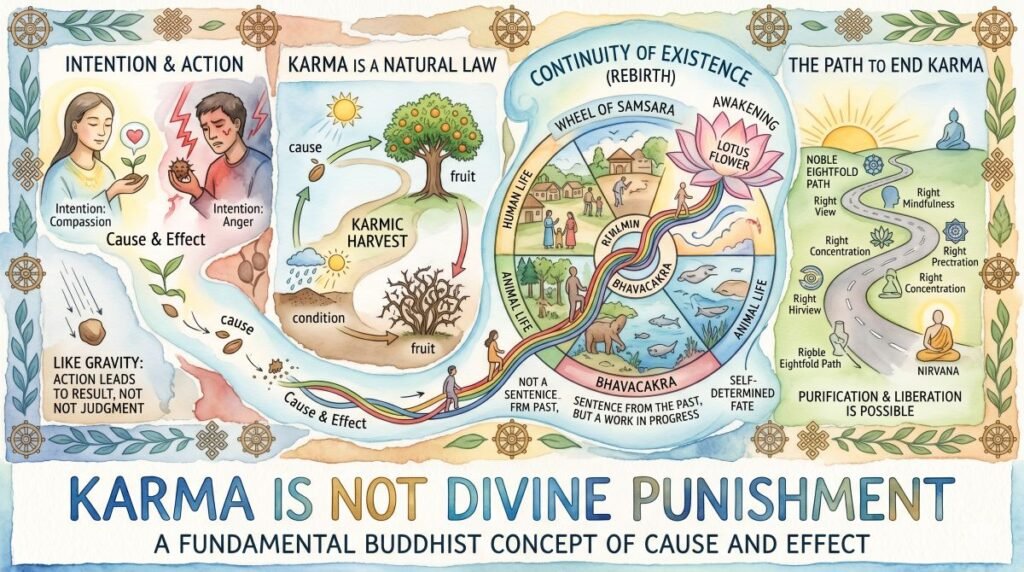
- Kamma is intentional action (cetanā), not fate. It operates as an impersonal law of moral causation, not divine reward or punishment.
- The Buddha explicitly rejected the fatalistic view that all experience is due to past kamma, listing biological, environmental, and circumstantial causes that lie outside its range.
- The apparent “injustice” of life is explained by kamma ripening across multiple lifetimes, the power of present actions, and causes entirely unrelated to kamma.
- Using kamma to justify social inequality, slavery, genocide, or mass atrocities is a profound misunderstanding of the teaching and a form of victim‑blaming unsupported by early Buddhist texts.
- Historical atrocities are best understood through systemic conditions: collective greed, hatred, and delusion, and the weighty kamma generated by perpetrators, not the imagined “past karma” of victims.
- The precise workings of kamma are declared by the Buddha to be ultimately acinteyya (inconceivable), warning us against obsessive speculation.
- For those living today, this teaching leads to an urgent call: refuse spiritual bypassing, cultivate a limitless heart, examine one’s own part in systems of harm, stand with the vulnerable, and act from compassion rather than hatred.
- Buddhism does not teach that suffering is morally deserved.
Introduction: The Problem of Unjust Suffering
Why do good people suffer while those who do harm appear to flourish? And how can any teaching of moral causation possibly account for the immense horrors of genocide, transatlantic slavery, and the indiscriminate slaughter of millions in war? These questions trouble anyone who honestly reflects on human life. In many religious traditions, the answer appeals to a divine plan, a final judgment, or a hidden wisdom that will be revealed only after death. Buddhism offers a fundamentally different perspective. The Buddha pointed to the natural law of kamma: a law of action and result built into the structure of existence, while simultaneously emphasising, with painstaking clarity, that not everything that happens to a person is the fruit of past deeds.
This teaching is not a justification for passive acceptance of injustice. It is a call to understand causality clearly, to abandon fatalism, and to act with wisdom and compassion in the only moment we truly possess: the present. In what follows we will explore the rich and nuanced Buddhist understanding of fortune, misfortune, and kamma, and then draw out what this means for us as practitioners living in a world still scarred by systemic violence, inequality, and suffering.
1. The Universal Nature of Suffering: Dukkha and the Two Darts
Before examining kamma in depth, it is essential to anchor our discussion in the First Noble Truth: dukkha— suffering, unsatisfactoriness, is an inherent characteristic of all conditioned existence. Birth, aging, illness, and death are unavoidable realities for every being, regardless of moral standing. Even the most virtuous person grows old, falls sick, and dies. Even the most generous society cannot shelter its members from loss, change, and impermanence.
The Buddha famously distinguished between two “darts” of suffering (see SN 36.6). The first dart is physical pain: the raw, unavoidable sensation that comes with having a vulnerable body. The second dart is the mental anguish we add through our reaction: aversion, clinging, grief, confusion. Much of what we call “misfortune” is simply the first dart: the built‑in instability of a world where everything we love and cherish is subject to change. Recognising this universal dimension prevents us from instantly interpreting every hardship as a personal punishment. It reminds us that pain is not an anomaly; it is part of the landscape of being alive. This understanding is the compassionate foundation on which all later reflections on kamma must rest.
2. Kamma as Intention: Cetanā and the Mechanics of Moral Causation
The Pāli word kamma (Sanskrit: karma) literally means “action.” The Buddha’s precise definition is foundational: “It is intention (cetanā), monks, that I call kamma; having willed, one performs an action through body, speech, or mind” (AN 6.63). Kamma is therefore not a mysterious cosmic force but the quality of volition that animates our deeds. This emphasis on intention immediately sets Buddhism apart from mechanical or fatalistic interpretations.
When an intentional action is performed, it leaves a potential (kamma) which, when the necessary conditions come together, ripens as a result (vipāka). The relationship between action and result is not immediate or linear. The tradition identifies four categories of kamma by time of ripening (see AN 4.232 and commentarial sources):
- Diṭṭhadhamma-vedanīya: kamma that ripens in this very life.
- Upapajja-vedanīya: kamma that ripens in the next life.
- Aparāpariya-vedanīya: kamma that ripens in some subsequent life.
- Ahosi-kamma: kamma that has been rendered defunct and will never ripen.
This classification alone shatters the simplistic notion that every present happiness or sorrow is the direct result of a recent action. The seeds of our actions are scattered across time, and their fruition depends on a vast network of supporting conditions.
Crucially, the Buddha did not teach that kamma is the only law governing events. In the formal Theravāda analysis, five niyāmas or orders of natural law are recognised (see the commentaries, e.g., Atthasālinī):
- Utu-niyāma: the physical inorganic order (seasons, weather, climate).
- Bīja-niyāma: the physical organic order (genetics, biology, seeds).
- Kamma-niyāma: the order of moral causation (intentions and their results).
- Citta-niyāma: the psychic order (laws of mind, thought processes).
- Dhamma-niyāma: the natural spiritual order (universal laws such as gravity, and the inevitability of enlightenment for a Buddha).
This framework explicitly reserves a slot for events like hurricanes, genetic conditions, or accidents that are not karmic in origin. Kamma is one strand in a tapestry of interdependent causality.
3. The Complex Causality of Kamma: Not All Is Due to Past Deeds
The most damaging misreading of kamma is the idea that everything a person experiences is the fruit of their past actions. The Buddha directly and repeatedly rejected this fatalistic view. In the Sivaka Sutta (SN 36.21), he lists several causes of feeling that operate independently of past kamma:
- Disorders of bile, phlegm, and internal winds (biological factors);
- Seasonal changes and environmental shifts;
- Uneven or careless conduct (accidents, overexertion);
- External disruptive circumstances, such as assault or being caught in the chaos of war.
To be struck by lightning, to die in an earthquake, or to be caught in a genocide is squarely within these “non‑karmic” categories.
Even sharper is the Tittha Sutta (AN 3.61), where the Buddha challenges those who claim “whatever a person experiences … all that is caused by past kamma.” He points out that if this were true, then the entire spiritual life would be meaningless, for no present effort could alter the inevitable. The Buddha explicitly classifies such determinism (pubbekata-hetu-vāda) as a wrong view that leads to inaction and the abandonment of moral responsibility.
Thus, from an orthodox perspective, it is simply incorrect to attribute every calamity to the personal kamma of those who suffer. The Buddha’s world is one of multiple causes, where physical nature, biology, and the actions of others all play their part.
4. Why Good Things Happen to Bad People (and Vice Versa): Delayed Ripening and Present Conditions
The classic puzzle of the wicked prospering while the righteous suffer finds its most coherent explanation in the law of delayed ripening. Kamma is like a seed: some bear fruit immediately, others lie dormant for lifetimes until conditions are right. A person who now enjoys wealth, health, and influence may be experiencing the ripening of generosity from a distant past life. A deeply virtuous person experiencing great hardship may be bearing the result of an unwholesome action from long ago that has finally met the necessary circumstances.
The Lonaphala Sutta (AN 3.100) deepens this understanding. The Buddha compares a lump of salt to a past negative deed. If you drop salt into a small cup of water, the water becomes undrinkable, the same way a narrow-hearted person, lacking virtue and spiritual development, can experience strong, painful results from even a minor past misdeed. But if you drop the same salt into the vast river Ganges, it remains drinkable: a person of boundless heart, cultivated virtue, and wisdom may feel only a light touch from the same deed. This sutta does not teach cancellation of kamma but that the experiential impact is radically shaped by one’s present inner vastness. The external event is not a fixed, pre‑determined punishment; the container that receives it matters profoundly.
This emphasis on present virtue as a potent force is central to the Buddha’s pedagogy. Far from being helpless products of the past, we constantly influence how old seeds ripen and which new seeds we plant.
5. Wealth, Poverty, and Social Status: Present Action Over Past Debt
In the Buddha’s time, some teachers argued that a person’s social position was the inescapable fruit of past actions, thereby justifying rigid caste hierarchies and economic oppression. The Buddha directly challenged this fatalism. He insisted that each human being possesses the capacity for free choice in the present moment, and that new, wholesome actions can fundamentally alter the course of a life.
Wealth, in Buddhist terms, can be a result of past generosity (dāna), but it is never a permanent reward. It is a temporary condition that can be used skillfully for further good or squandered through negligence and greed. Poverty, likewise, often arises from present social, economic, and environmental conditions rather than from a personal kammic deficit. The Buddha did not tell the poor to “accept their karma”; he urged them, and all of us, to cultivate virtue, generosity, and mental development here and now, recognising that present action is the true engine of change.
6. Kamma and Historical Atrocities: Rejecting Victim‑Blaming
One of the most damaging distortions of kamma is the idea that victims of genocide, slavery, or mass slaughter are simply experiencing the results of their own past actions. This view is spiritually destructive and philosophically untenable within the frame of early Buddhist teaching.
6.1 The Discontinuity of Identity
The Buddha’s teaching of anattā (not‑self) reveals that there is no permanent, unchanging self that transmigrates from life to life. What continues is a stream of consciousness (viññāṇa-sota) and a continuity of mental and physical processes conditioned by past actions. This means that the person suffering now is not the “same” entity that performed a past deed; there is no stable self that can be meaningfully described as “deserving” punishment. The commentarial tradition carefully explains how kamma bears fruit across lives without a permanent agent. Using this impersonal stream to assign moral “blame” to a present victim for deeds in a previous life is therefore a category error, it imports a notion of a fixed self that Buddhism explicitly dismantles.
6.2 The Rejection of Fatalism
As we have seen, the Buddha sharply criticised the view that all experience is due to past kamma. Such fatalism makes the path of liberation pointless and encourages passivity in the face of injustice. The entire Dhamma rests on the truth that present actions matter profoundly and that the mind can be trained, redirected, and liberated.
6.3 The Primacy of the Perpetrator’s Kamma
When we examine accounts of extreme violence, the Buddhist texts focus overwhelmingly on the catastrophic kamma being generated by the perpetrators, not on the past karma of the victims. Acts of deliberate slaughter, torture, and genocide are considered garuka kamma (weighty kamma) with immediate and devastating consequences for the future experience of those who commit them. In the Paṭhamasaṅgāmasutta (SN 3.15), the Buddha states: “The slayer gets a slayer in his turn; the conqueror gets one who conquers him.” This describes a self‑perpetuating cycle of violence within saṃsāra, not a justification for the suffering of the innocent. The emphasis is always on the immense suffering that violent actions plant for the doer, and on the urgent need to break the cycle through restraint and compassion.
7. Systemic Evil and Shared Consequences
While early Buddhism does not develop a formal technical category of “collective kamma” in the sense of a shared metaphysical account, it does provide powerful resources for understanding systemic suffering. The doctrine of interdependence (paṭiccasamuppāda) shows that our lives are deeply interwoven. The actions of groups, communities, and nations create widespread conditions that affect multitudes.
The Cakkavatti Sīhanāda Sutta (DN 26) offers a striking example. It traces societal collapse not to the “bad kamma” of the poor, but to the failure of the ruler to provide for the destitute. That systemic neglect breeds poverty, which in turn breeds theft, lies, and violence, eventually culminating in a “sword‑interval” where humans slaughter one another indiscriminately. The mass killing is explicitly presented as a result of collective moral decay and structural failure, not individual karmic retribution.
Later Buddhist traditions and many modern teachers thus speak of “collective kamma” to describe the way shared intentions (such as national greed, racial hatred, or ideological delusion) generate widespread consequences that affect entire societies. This is best understood not as a shared karmic “debt” equally owed by all, but as the natural result of mutually reinforcing unwholesome minds and systems. When a genocide occurs, it is the manifestation of deeply conditioned collective greed, hatred, and delusion, not the fated outcome for a particular group.
8. The Inconceivability of Kamma and the Limits of Speculation
As a crucial safeguard, the Buddha included the precise detailed workings of kamma among the four acinteyya, the “inconceivables” or “imponderables” that should not be made the object of obsessive speculation (AN 4.77). He warned that trying to trace out the exact kammic causes and effects of specific events can lead to madness and frustration. This teaching does not undermine the law of kamma; it humbles our attempts to use it as a forensic tool to explain every instance of suffering. When we cannot know, the appropriate response is not to fabricate explanations but to meet suffering with compassion and to focus on the wholesome actions we can take in the present.
9. The Suttas: A Deeper Look
For those who wish to study these principles directly, the following discourses are foundational:
- Sivaka Sutta (SN 36.21) — The Buddha lists causes of feeling that are not kammic, including biological humours, seasonal changes, and external disruptive circumstances.
- Tittha Sutta (AN 3.61) — The Buddha explicitly rejects the deterministic view that all experience is caused by past kamma, arguing that it destroys the possibility of spiritual practice.
- Cakkavatti Sīhanāda Sutta (DN 26) — A systemic analysis of societal collapse, showing how failure to care for the poor leads to mass violence.
- Lonaphala Sutta (AN 3.100) — The salt‑lump simile teaching that the same past action yields vastly different experiential results depending on one’s present spiritual development.
- Mallikā Sutta (SN 3.15) — The Buddha describes the self‑perpetuating cycle of violence.
- Kālāma Sutta (AN 3.65) — The famous discourse encouraging inquiry based on what is wholesome, and offering the “four consolations” for a virtuous life.
- Acinteyya Sutta (AN 4.77) — The warning that the precise workings of kamma are ultimately inconceivable and should not become objects of obsessive speculation.
- AN 6.63 — The definition of kamma as intention (cetanā).
10. What This Means for Us Today
In a world still convulsed by war, forced migration, systemic racism, and economic exploitation, what does this nuanced understanding of kamma mean for those of us trying to live a Buddhist life today?
First, it means refusing to weaponise spirituality. Using kamma to explain away the suffering of others is a form of spiritual bypassing that shields us from the discomfort of compassion. When we hear of a tragedy: a refugee camp, a school shooting, an ethnic cleansing, the Buddhist teaching does not ask us to speculate about what the victims “did in a past life.” It asks us to recognise suffering as suffering, to feel the natural arising of compassion, and to ask: What wholesome action can I take right now?
Second, it means understanding that systemic injustice is a manifestation of collective greed, hatred, and delusion. Structural racism, economic inequality, and militarism are not natural disasters; they are constructed by human minds and can be dismantled by human minds. The path of practice must therefore include the willingness to examine the unwholesome roots not only in our private hearts but in our institutions, our politics, and our economic habits.
Third, it means holding complexity without falling into apathy. The teaching on multiple causes protects us from simplistic blame. It also asks us to hold the tension between individual responsibility and collective conditioning. We are shaped by forces beyond our control: culture, education, economic circumstance, yet in every moment we have a choice: to strengthen the seeds of greed and hatred or to water the seeds of generosity and compassion.
Finally, it means acknowledging the limits of our understanding. The acinteyya warning frees us from the obsession with “why” and redirects our attention to “what now?” When we cannot fathom the kammic dimensions of a tragedy, we can still offer a hand, speak the truth, and refuse to let our hearts contract into hatred.
11. Core Actions to Cultivate
The understanding described above is not merely an intellectual exercise. It points toward a set of core actions that can be cultivated in daily life, both on and off the meditation cushion.
1. Investigate Your Views
Reflect honestly on any tendency to morally judge those who suffer, including yourself. When you catch yourself thinking “they must have done something to deserve this,” pause and bring to mind the Sivaka Sutta. Remind yourself that many conditions produce pain, and that the wisest response is always compassion, not diagnosis.
2. Cultivate the “Great Heart”
The Lonaphala Sutta encourages us to develop a limitless, immeasurable mind through practices like mettā (loving‑kindness), karuṇā (compassion), muditā (sympathetic joy), and upekkhā (equanimity). A heart that is vast does not deny suffering but meets it without being shattered. Daily meditation on the brahmavihāras is a direct method for expanding the heart.
3. Examine Shared Conditions in Your Own Life
Ask yourself: In what ways am I participating, even indirectly, in systems that cause harm? This includes the products we buy, the stories we tell, the votes we cast, and the silences we keep. Cultivating ethical consumption, fair trade, and mindful speech are practical ways to reduce one’s participation in unwholesome collective patterns.
4. Stand with the Vulnerable
The Buddha’s advice to rulers was to protect the poor and provide for the destitute. As citizens and practitioners, we can translate this into concrete action: supporting refugees, advocating for equitable policies, standing against racism and discrimination, and offering material help to those in need. The path of generosity (dāna) is not confined to temples; it extends into the marketplace, the voting booth, and the street.
5. Restrain Perpetrators and Protect Potential Victims
If we are in a position to do so, preventing harm is an act of compassion toward both the potential victim and the potential perpetrator, saving the latter from accumulating severe weighty kamma. This can mean intervening in disputes, supporting restorative justice, or engaging in non‑violent activism that seeks to stop oppression.
6. Do Not Hate the Hater
The Buddha’s teachings are radical in this respect: hatred is never justified as a response to hatred, even when facing immense wrongdoing. “In this world, hatred never ceases by hatred; only by non-hatred does it cease. This is an ancient law” (Dhp 5). This is not a call to weakness but to a strength of heart that refuses to become the mirror image of the oppressor. It is fiercely compassionate, holding the line against harm while refusing to dehumanise the doer.
7. Focus on the Kamma You Are Creating Now
Ultimately, the Buddha teaches that the most important kamma is the one being created in this very moment. Instead of obsessing over the unverifiable past, we can turn our attention to the quality of our present intentions. Are we acting from generosity or greed, compassion or cruelty, wisdom or delusion? This present‑moment focus is the engine of spiritual progress and the foundation of a life that truly benefits others.
12. Conclusion: Kamma as a Call to Awaken, Not an Explanation for Every Wound
The teaching of kamma was never meant to be a complete cosmological explanation for every sorrow. It is a practical and profoundly hopeful doctrine: our actions matter, and the direction of our lives can be changed. To use kamma to justify the suffering of millions, whether in the Shoah, the Maafa (the transatlantic slave trade), or the killing fields of modern war, is to distort it into a tool of the very cruelty it seeks to overcome.
Buddhism does not teach that suffering is morally deserved. It teaches that suffering is to be understood, its causes abandoned, and a path followed that leads to its end. The Buddha’s way asks us to meet suffering with boundless compassion, to oppose injustice with unwavering clarity, and to recognise that the most important kamma is the one we are creating right now. In the face of atrocity, the compassionate response is not to speculate about past causes but to protect the vulnerable, to restrain those bent on harm, and to cultivate a heart that steadfastly refuses to hate.
For those living today, this understanding frees us from the paralysis of judgment and the futility of fatalism. It places the responsibility, and the power, squarely in our own hands. Kamma is not a prison of predetermined fate; it is a teaching of liberation, an urgent invitation to awaken to our capacity for goodness, and to build, in this very life, a world where suffering is met not with explanation, but with love in action.