1. Key Takeaways
- Buddhist ethics divides all human action into three clear categories: what we do with our body, what we say with our speech, and what we think or intend with our mind (mano, also referred to as citta).
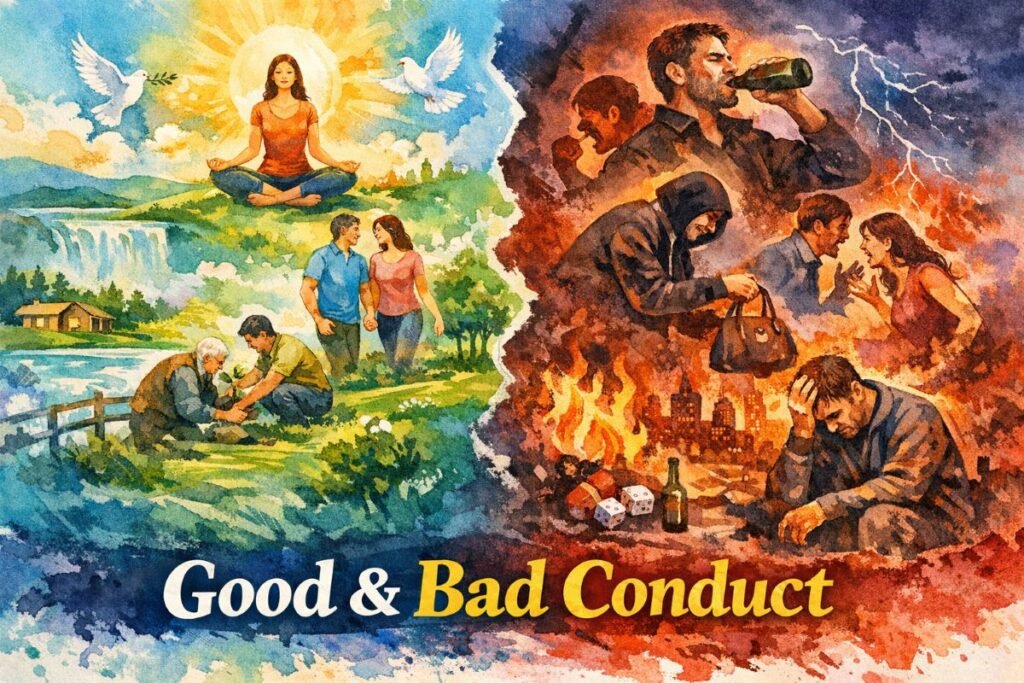
- Bad conduct (unwholesome or unskillful action) arises from greed, hatred, and delusion. It creates suffering for oneself and others.
- Good conduct (wholesome or skillful action) arises from generosity, loving-kindness, and wisdom. It creates well-being and supports spiritual progress.
- The traditional framework includes ten courses of action: three by body, four by speech, and three by mind.
- These teachings are not commandments but training principles. You are encouraged to observe their effects and take personal responsibility.
- This ethical framework is foundational across Buddhist traditions (Theravada, Mahayana, Vajrayana), though each school expands or interprets it in its own way.
- Understanding this system helps you cultivate positive karma, improve your relationships, and create a calm and focused mind for deeper meditation.
2. Introduction
In the rush of modern life, we often make quick decisions about what to do, say, or think without stopping to consider their impact. Buddhism offers a practical, time-tested framework for understanding the quality of our actions. This framework is not based on blind faith or obedience to an external God. Instead, it is based on a simple, observable principle: skillful actions lead to happiness and peace, while unskillful actions lead to suffering and regret.
The Buddha taught that our experience of life is shaped by three types of conduct: conduct by the body (kāya in Pali), conduct by speech (vācā in Pali), and conduct by the mind (mano in Pali; often also referred to as citta, the broader term for mind-heart-consciousness). This classification appears explicitly in the Saleyyaka Sutta (MN 41) and the Cunda Kammaraputta Sutta (AN 10.176), where the Buddha systematically outlines ten unwholesome and ten wholesome actions. Each of these three doors can be used in wholesome (good) ways or unwholesome (bad) ways. This article explores the “three ways of performing bad conduct” and the “three ways of performing good conduct” within these three categories. It provides the background, explains why these teachings are important, and offers detailed practical applications for daily life. No prior knowledge of Buddhism is assumed. All foreign terms are translated clearly, and we will always use the English term after its first introduction.
3. The Background: Why Conduct Matters in Buddhism
Before listing the specific actions, it is helpful to understand why Buddhist tradition places such a strong emphasis on ethical conduct. For the Buddha, ethics were not an afterthought or a set of social rules. They are the foundation of the entire spiritual path.
3.1 The Threefold Training
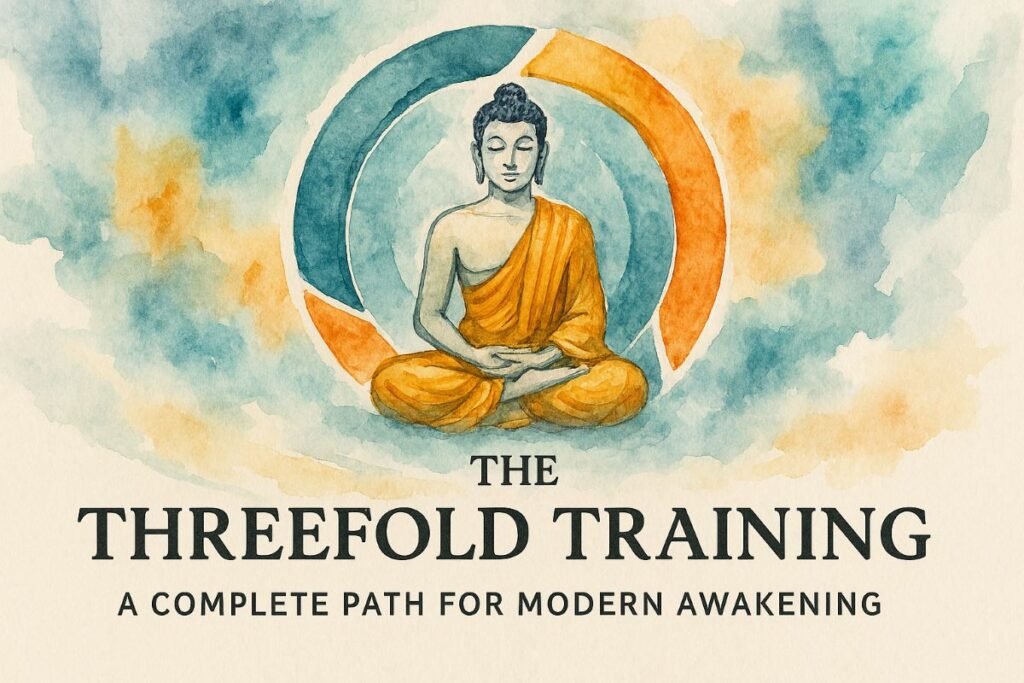
The Buddha’s path to liberation is often summarized as the Threefold Training (sikkhā in Pali). Think of it as a three-story building:
- Morality (Sīla): This is the ground floor. It involves training in right conduct by body, speech, and mind. A stable moral life creates the inner peace and freedom from remorse needed for the next step.
- Meditation (Samādhi): This is the first floor. With a foundation of ethical behavior, the mind becomes less agitated, less guilty, and less preoccupied with past mistakes. This allows you to develop concentration, focus, and mental calm.
- Wisdom (Paññā): This is the top floor. A calm and concentrated mind can then investigate the true nature of reality, leading to liberating insight.
If the ground floor of morality is shaky, the entire building is unstable. You cannot build lasting mental peace on a foundation of harmful actions, harsh speech, or obsessive greed. This is why understanding good and bad conduct by body, speech, and mind is not just about being a “good person.” It is a practical requirement for any deeper spiritual work.
3.2 The Principle of Karma
The concept of conduct is closely linked to karma (kamma in Pali), meaning intentional action and its natural consequences. Buddhism teaches that every intentional action, whether by body, speech, or mind, has an effect. This is not a system of punishment and reward controlled by a divine judge. It is a natural principle of conditionality, similar to the way a seed grows into a particular plant. A seed of mango (a wholesome action) will produce a mango tree (a pleasant result). A seed of a poisonous plant (an unwholesome action) will produce a poisonous plant (a painful result).
- Wholesome actions (good conduct) create tendencies toward happiness, peace, and favorable circumstances.
- Unwholesome actions (bad conduct) create tendencies toward suffering, conflict, and difficult circumstances.
The results may appear in this life, the next life, or in some distant future. The key point is that you are not a victim of fate. By understanding the three ways of performing bad conduct and the three ways of performing good conduct, you take control of your own karmic future, moment by moment.
4. The Three Categories of Bad Conduct

Bad conduct in Buddhism is called unwholesome or unskillful (akusala in Pali) action. These are actions motivated by the three “roots of evil”: greed (lobha), hatred (dosa), and delusion (moha). Greed is the desire to possess or cling. Hatred is the wish to harm or destroy. Delusion is ignorance of the true nature of reality, especially the principle of karma. These three unwholesome roots can express themselves through our body, our speech, or our mind. Note that the speech category contains four specific actions, while body and mind each contain three, making ten unwholesome courses of action in total.
4.1 Bad Conduct by Body (Three Actions)
The three ways of performing bad conduct by the body are physical actions that directly cause harm.
- Taking life: This means intentionally killing any living being, from an insect to a human being. The severity of the action depends on several factors: the object (a virtuous being vs. a less virtuous one), the perception (knowing it is a living being), the intention (deliberate wish to kill), the effort (how much force is applied), and the result (death actually occurring). This action is rooted in hatred or delusion.
- Taking what is not given (stealing): This includes theft, robbery, fraud, cheating, or taking something that belongs to another person without their consent, even if it is small. It also includes not returning borrowed items or using someone’s property without permission. This action is rooted in greed.
- Misconduct in sexual desires: For laypeople, this means sexual relations with persons who are under the protection of their parents, family, or spouse; with those who are betrothed to another; or with those who have taken a vow of celibacy. It also includes rape and any sexual act involving coercion or violence. For monastics, the rule is complete celibacy. This action is rooted in greed and often accompanied by hatred.
These three bodily actions are considered the most serious unwholesome acts because they directly violate the basic rights and well-being of other beings.
4.2 Bad Conduct by Speech (Four Actions)

Speech is incredibly powerful. A single sentence can make or break a relationship, start a war, or heal a deep wound. The Buddha identified four ways of performing bad conduct by speech. Avoiding these is known as practicing right speech (sammā vācā).
- False speech (lying): Saying something that is not true with the intention to deceive. This includes exaggerating, omitting important facts, or making false promises. The key is the intention to deceive.
- Malicious speech (slander or divisive speech): Speaking with the intention of creating discord or turning people against each other. This includes gossip that damages reputations, spreading rumors, or telling one person something another person said in order to create conflict.
- Harsh speech (rude or abusive language): Words spoken with a heart of anger, contempt, or cruelty. This includes yelling, name-calling, sarcasm intended to wound, insults, and any language that causes pain to another person.
- Idle chatter (frivolous or useless speech): Speaking without a purposeful or beneficial intention. In the canonical context, “idle” means speech that is “not connected with the goal” – the goal being liberation from suffering. This includes endless gossip about trivial matters, talking just to fill silence, and speech that distracts the mind from meaningful spiritual or practical purposes.
4.3 Bad Conduct by Mind (Three Actions)
The most subtle but perhaps most important category is conduct by the mind (mano). The Buddha said, “Mind is the forerunner of all actions” (Dhammapada, verse 1). Before you speak or act, a thought arises. If you can catch and transform unwholesome thoughts at the mental level, you prevent them from becoming harmful speech or action. The three primary ways of performing bad conduct by the mind are:
- Covetousness (greedy wanting): This is not merely appreciating something nice that belongs to another. It is an intense, selfish desire to possess what belongs to someone else. It is the thought, “May I become the owner of this,” accompanied by a sense of discontent with what you already have.
- Ill-will (hatred or malice): This is the intention to harm or cause suffering to another being. It includes thoughts of anger, revenge, resentment, and the wish, “May they be destroyed or suffer.” Even without acting on it, dwelling in ill-will burns your own mind and creates bad karma.
- Wrong view (moral nihilism or distorted understanding): This is the most fundamental mental unwholesomeness. It means holding beliefs that deny ethical causation. The canonical definition of wrong view (micchā-diṭṭhi) is specifically the nihilistic view (natthika-diṭṭhi): the belief that “there is nothing given, nothing offered, nothing sacrificed; no fruit or result of good and bad actions; no this world, no next world; no mother, no father; no beings who are reborn spontaneously.” In simpler terms, it is the denial that our intentional actions have moral consequences. This is different from mere materialism or atheism; it is the rejection of ethical causation itself. Without right view, a person has no reason to practice good conduct.
5. The Three Categories of Good Conduct
Good conduct is called wholesome or skillful (kusala in Pali) action. These are actions motivated by the three wholesome roots: non-greed (generosity and letting go), non-hatred (loving-kindness and compassion), and non-delusion (wisdom and understanding). Just as there are three doors for bad conduct (body, speech, mind), there are three doors for good conduct – again with four items under speech.
5.1 Good Conduct by Body (Three Actions)
The three ways of performing good conduct by the body are the direct opposites of the three bad bodily actions.
- Abstaining from taking life and actively protecting life: This means not killing any living being. But good conduct goes further. It includes actively protecting life, showing compassion to animals and people, and engaging in actions that promote health and safety.
- Abstaining from stealing and practicing generosity: This means not taking what is not given. More positively, it means respecting the property of others. The highest expression of this is the practice of giving (dāna): sharing your time, resources, knowledge, and possessions with others freely.
- Abstaining from sexual misconduct and practicing respectful relationships: This means not engaging in harmful sexual behavior as defined above. Positively, it means conducting your intimate relationships with respect, honesty, consent, and loyalty. For those who choose celibacy, it means protecting that commitment.
5.2 Good Conduct by Speech (Four Actions)
The four ways of performing good conduct by speech are the opposites of the four bad types of speech.
- Speaking truthfully: This means saying what is true, factual, and reliable. It means being an honest person whose words can be trusted. Before speaking, you might ask yourself: “Is this true?”
- Speaking harmoniously (reconciling speech): Instead of divisive speech, you speak words that bring people together, heal conflicts, and create understanding. If you hear a rumor, you do not repeat it. If you see two people arguing, you try to help them find common ground.
- Speaking gently (kind speech): Instead of harsh speech, you use words that are polite, warm, encouraging, and kind. This does not mean avoiding difficult truths, but it means delivering them with compassion and care, not with anger or contempt.
- Speaking purposefully (wise speech): Instead of idle chatter, you speak at the right time, about things that are beneficial, and with a useful purpose. Sometimes, the most skillful speech is silence. You learn to listen more and speak only when you have something meaningful to add, meaning that is connected to the goal of reducing suffering.
5.3 Good Conduct by Mind (Three Actions)
Cultivating wholesome mental states is the inner engine of all good conduct. The three ways of performing good conduct by the mind are:
- Non-covetousness (contentment and generosity of heart): This means not being consumed by greedy wanting. It involves cultivating appreciative joy (muditā), rejoicing in the good fortune of others instead of envying them. It means being content with what you have.
- Non-ill-will (loving-kindness and compassion): This is the opposite of ill-will. It means actively cultivating good will toward all beings. The primary practice here is loving-kindness meditation (mettā), where you systematically wish for the happiness and well-being of yourself, loved ones, neutral people, difficult people, and eventually all beings without exception.
- Right view (wisdom): This means understanding the principle of karma, the four noble truths, and the nature of impermanence, suffering, and non-self. A person with right view understands that their actions matter and that ethical living is the foundation of true happiness. Right view is the opposite of the moral nihilism described under wrong view.
6. Which Buddhist Schools Teach This?
The framework of three types of conduct (body, speech, mind) and the ten courses of action is foundational across all major Buddhist traditions, though each school interprets and expands it in its own way.
- Theravada Buddhism: This school, found mainly in Sri Lanka, Thailand, and Myanmar, preserves the earliest teachings. The analysis of conduct by body, speech, and mind appears directly in the Pali Canon, especially in the Saleyyaka Sutta (MN 41) and the Cunda Kammaraputta Sutta (AN 10.176). It is central to their monastic code and lay ethical training.
- Mahayana Buddhism: This school, dominant in China, Japan, Korea, and Vietnam, fully accepts this framework. Mahayana texts such as the Bodhisattva-bhūmi (a section of the Yogācārabhūmi Śāstra) and the Daśabhūmika Sūtra elaborate on the ten wholesome and unwholesome courses of action within the context of the bodhisattva path. The framework is also embedded in the Brahma Net Sūtra’s major and minor precepts. Mahayana reframes ethics within the bodhisattva vow to liberate all beings, but the fundamental categories of body, speech, and mind remain the same.
- Vajrayana Buddhism: This school, found in Tibet, Mongolia, and the Himalayan regions, also uses this framework as its foundation. Advanced practices like deity yoga and tantric rituals are always built upon a strong foundation of pure conduct by body, speech, and mind. The preliminary practices (ngöndro) include specific purifications for each of the three doors – for example, prostrations purify bodily misconduct, Vajrasattva recitation purifies verbal misconduct, and mind training (lojong) purifies mental misconduct.
No matter which tradition you encounter, you will find that ethical training in body, speech, and mind is the necessary starting point.
7. Practical Applications for Modern Daily Life
Understanding the theory is only the first step. The real power of these teachings emerges when you apply them to real situations: at work, at home, online, and alone with your thoughts.
7.1 Applying Good Bodily Conduct Today
- At work: Avoid stealing office supplies, taking credit for others’ work (a form of taking what is not given), or using company time for personal projects without permission. Practice generosity by helping a struggling colleague or sharing a useful resource.
- In traffic: Refrain from harmful driving (which can be a form of taking life or at least creating danger). Practice patience, follow traffic rules, and let others merge. Do not react with aggressive gestures.
- At home: Refrain from physical violence or intimidation. Practice gentleness in your physical interactions with family members and pets. Protect life by removing a spider carefully instead of killing it.
- Environmental conduct: Consider your consumption habits. Taking more than you need from the earth’s resources is a form of stealing from future generations and other species.
7.2 Applying Right Speech in the Digital Age
The four types of bad speech have found new power in social media and text messaging.
- Truthfulness online: Before sharing a news article or a quote, verify it. Do not spread misinformation, even if it supports your views. False speech online creates massive collective suffering.
- Avoiding divisive speech in group chats: Do not forward screenshots of private conversations to create drama. Do not gossip about a friend to another friend. If you have a problem with someone, speak to them directly, not about them.
- Replacing harsh speech with kind speech in comments: Before posting an angry comment on a forum or social media, pause. Ask yourself: “Is this necessary? Is it kind?” You can disagree without being abusive. Use “I feel” statements instead of “You are” attacks.
- Reducing idle chatter in meetings and conversations: Notice when you talk just to fill silence or show off your knowledge. Practice listening more. When you do speak, ask yourself if your words will improve upon the silence, whether they are connected to a meaningful goal.
7.3 Cultivating Wholesome Mental States in a Busy Mind
Our minds are constantly bombarded with impulses of greed, ill-will, and wrong view. You can train your mind like a muscle.
- Morning reflection: Each morning, spend two minutes setting an intention. Silently say: “Today, I will try to avoid harming any being by body. I will try to speak truthfully and kindly. I will try to let go of greedy thoughts and angry thoughts.”
- The “noting” practice (a method used in some meditation traditions, such as the Mahasi Sayadaw lineage): During the day, when you notice a greedy thought (“I want his car” or “I want more food”), simply note to yourself: “Greed, greed.” When you notice an angry thought (“I hate this noise”), note: “Anger, anger.” This simple labeling creates a pause and weakens the power of the unwholesome thought.
- Loving-kindness for difficult people: Think of someone who irritates you. Instead of rehearsing your complaints, silently repeat: “May you be happy. May you be safe. May you be healthy. May you live with ease.” This does not mean you agree with their actions. It means you are freeing your own mind from the prison of ill-will.
- Evening review: Before bed, review your day. Think of one action by body, one by speech, and one by mind that was wholesome. Rejoice in it. Then think of one unwholesome action in each category. Without guilt or shame, simply acknowledge it and resolve to do better tomorrow.
8. The Connection to the Noble Eightfold Path
The teachings on good and bad conduct by body, speech, and mind are not isolated rules. They are integrated into the Noble Eightfold Path, which is the Buddha’s practical guide to the end of suffering.
- Right Speech, Right Action, and Right Livelihood are the three factors of the path that deal directly with morality (sīla).
- Right Action is essentially the practice of good conduct by body (non-harming, not stealing, avoiding sexual misconduct).
- Right Speech is exactly the practice of good conduct by speech (truthful, harmonious, gentle, and purposeful speech).
- Right Livelihood extends these principles to your job, ensuring you are not making a living through harmful bodily actions (e.g., selling weapons or poison) or harmful speech (e.g., fraud or deceit).
When you practice the three ways of good conduct, you are simultaneously walking the Noble Eightfold Path. When you abandon the three ways of bad conduct, you are removing the major obstacles to the path.
9. Addressing Common Questions
9.1 “Isn’t this just guilt and repression?”
No. Buddhist ethics are not about obeying a rulebook out of fear. The idea is to investigate the consequences of actions. The Buddha said, “When you know for yourself that an action leads to harm for yourself or others, abandon it. When you know for yourself that an action leads to well-being, cultivate it.” You are the observer and the judge. There is no external punisher. If you find that harsh speech makes your relationships worse, you stop it not out of guilt, but out of wisdom and a genuine wish for happiness.
9.2 “What about intentions? Is an accident bad conduct?”
Intention is the key. The Buddha defined karma as intentional action. If you accidentally step on an insect without seeing it, there is no unwholesome karma because there was no intention to kill. If you deliberately step on it, that is bad conduct. This is why mindfulness of the mind is so important, you learn to see your intentions before they become actions.
9.3 “How can I possibly avoid all bad thoughts?”
The goal is not to have a perfectly pure mind tomorrow. That is impossible. The goal is to gradually reduce the frequency and intensity of unwholesome mental states. You start by noticing them after they have happened (review practice). Then you learn to notice them as they are happening (noting practice). Finally, with deep meditation, you can learn to prevent them from arising at all. This is a lifetime path, not a quick fix.
10. Further Resources
To deepen your understanding and practice of ethical conduct by body, speech, and mind, you may explore these resources.
Books
- In the Buddha’s Words: An Anthology of Discourses from the Pali Canon by Bhikkhu Bodhi (Wisdom Publications). Contains key suttas on the ten courses of action and right speech.
- The Noble Eightfold Path: The Way to the End of Suffering by Bhikkhu Bodhi. (Excellent chapter on Right Speech and Right Action.)
- Mindfulness, Bliss, and Beyond: A Meditator’s Handbook by Ajahn Brahm. (Includes practical advice on how morality supports meditation.)
- The Heart of the Buddha’s Teaching by Thich Nhat Hanh. (A Mahayana perspective on the precepts and ethical living.)
Podcasts
- Audio Dharma (from Insight Meditation Center). Offers many talks on the five precepts, right speech, and karma.
- The Buddhist Centre Podcast. Frequently discusses ethical living for laypeople.
- Secular Buddhism by Noah Rasheta. Episodes on karma and ethics in simple, modern language.
Online Resources
- Access to Insight (accesstoinsight.org): A vast library of Theravada suttas, including the Saleyyaka Sutta (MN 41) and Cunda Kammaraputta Sutta (AN 10.176).
- BuddhaNet (buddhanet.net): Provides basic Buddhist teachings on morality and the five precepts.
- Related articles on BuddhistLearning.org:
- For more on skillful speech, see: Mindful Communication for Healthier Relationships
- For ethics in professional life, see: The Role of Buddhist Ethics in Business and Leadership
11. Alphabetical Glossary of Key Pali Terms
| Pali Term | English Translation(s) | Detailed Explanation |
|---|---|---|
| Akusala | Unwholesome, unskillful, bad | Actions, thoughts, or mental states that lead to suffering and negative consequences. The opposite of kusala. |
| Citta | Mind, heart, consciousness | A broad term for the mind-heart complex. Often used alongside mano for the mental door of action. |
| Dāna | Generosity, giving | The practice of giving freely without expecting anything in return. The antidote to greed. |
| Dosa | Hatred, ill-will, aversion | One of the three unwholesome roots. Includes anger, fear, and resentment. |
| Kāya | Body | The physical form. The first door of action (bodily conduct). |
| Kamma (Skt: Karma) | Intentional action | The principle that intentional actions have corresponding results. Not fate or destiny. |
| Kusala | Wholesome, skillful, good | Actions, thoughts, or mental states that lead to happiness and spiritual progress. |
| Lobha | Greed, craving, attachment | One of the three unwholesome roots. The desire to hold onto or possess. |
| Mano | Mind (as door of action) | The mental faculty that initiates action. Often used interchangeably with citta in ethical contexts. |
| Mettā | Loving-kindness, goodwill | The sincere wish for the happiness and well-being of all beings. The antidote to hatred. |
| Moha | Delusion, ignorance | One of the three unwholesome roots. Not seeing the true nature of reality, especially karma and the four noble truths. |
| Muditā | Appreciative joy | Rejoicing in the happiness and good fortune of others. One of the four boundless qualities (brahmavihārās). |
| Paññā | Wisdom, insight | Deep understanding of reality. The third training in the Threefold Training. |
| Samādhi | Concentration, meditation, mental stillness | The focused, collected state of mind. The second training in the Threefold Training. |
| Sammā Vācā | Right speech | The fourth factor of the Noble Eightfold Path. The practice of truthful, harmonious, gentle, and purposeful speech. |
| Sīla | Morality, ethical conduct, virtue | The foundation of Buddhist practice. Training in right action, right speech, and right livelihood. |
| Sikkhā | Training, discipline | The Threefold Training (morality, meditation, wisdom) is the path to liberation. |
| Vācā | Speech | Verbal communication. The second door of action. |
This article is intended for educational purposes and reflects core Buddhist ethical teachings as understood across Theravada, Mahayana, and Vajrayana traditions. By understanding and practicing the three categories of good conduct and avoiding the three categories of bad conduct in body, speech, and mind, one can live a life aligned with these ancient principles, fostering peace, happiness, and spiritual growth in the midst of modern life.