Introduction
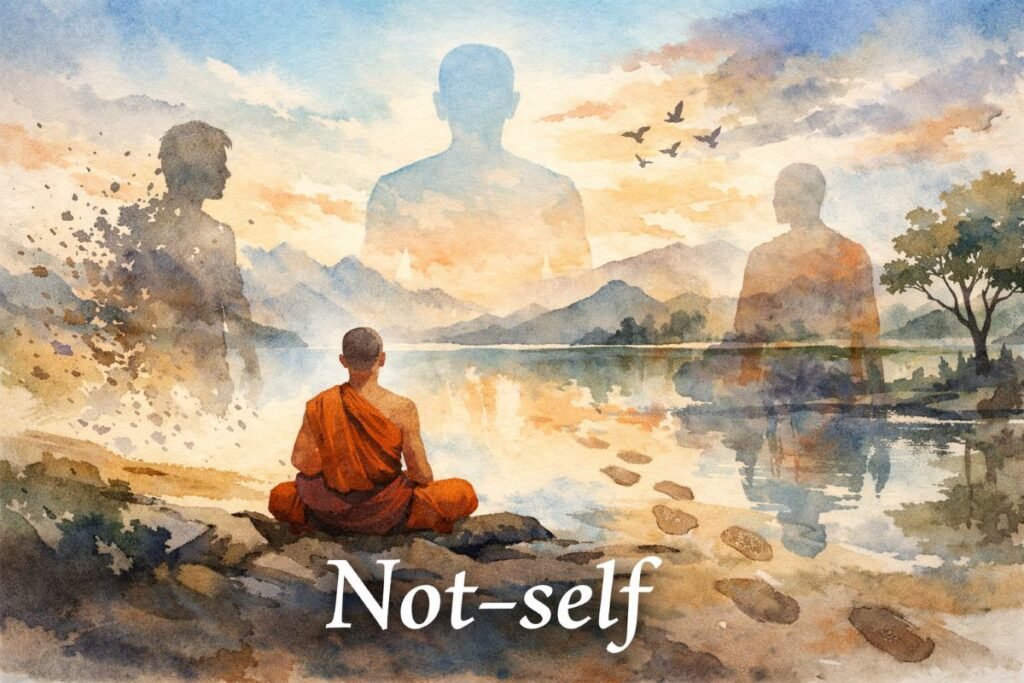
The Buddhist teaching of Not-self (Pāli: Anattā) stands as one of the most distinctive and transformative insights in the Buddha’s Dharma. Unlike many spiritual traditions that posit an eternal, unchanging soul or essence (Attā), Buddhism reveals that what we conventionally call “self” is actually a dynamic, ever-changing process devoid of any permanent, independent core. This teaching is not a philosophical abstraction but a practical tool for liberation, a scalpel to cut through the deepest roots of suffering.
The concept of Not-self is intimately connected with the Buddha’s analysis of experience into five aggregates (pañcakkhandhā): form, feeling, perception, mental formations, and consciousness. In his second discourse, the Anattalakkhaṇa Sutta (SN 22.59), the Buddha systematically demonstrates that each of these aggregates is impermanent, unsatisfactory, and unfit to be regarded as “mine,” “I am,” or “my self.” This teaching directly challenges the fundamental ignorance (avijjā) that mistakes what is not-self for self, leading to clinging and suffering.
Understanding Not-self is not about adopting a belief but about developing a way of seeing, a direct investigation into the nature of experience. The Mahā Nidāna Sutta (DN 15) explores how the sense of “I am” arises dependent on conditions, and how clinging to various conceptions of self perpetuates the cycle of becoming. When insight into Not-self deepens, the practitioner begins to loosen the grip of identification, seeing through the illusion of a separate, enduring self that must be protected and defended.
Why is contemplation on Not-self so valuable? Because the mistaken view of self (sakkāyadiṭṭhi) is the source from which all craving, aversion, and suffering flow. As long as we take the aggregates to be self, we remain entangled in the project of maintaining and protecting that self, a project doomed to fail because everything we identify with is impermanent. The Dhammapada (vv. 277-279) declares that all conditioned phenomena are impermanent, unsatisfactory, and not-self, and that seeing this with wisdom leads to disenchantment and liberation.
The following 108 contemplations invite you to investigate the teaching of Not-self from multiple angles: through the analysis of the five aggregates, the lens of dependent origination, practical applications in daily life, meditative investigations, and reflections on the nature of liberation itself. Each contemplation is designed to be a seed for direct inquiry, a pointer toward seeing through the illusion of self and awakening to the freedom that lies beyond clinging. May these reflections support your journey toward the realization of that which is unborn, unbecome, uncreated, and unconditioned.
Section One: Foundations of Not-self
1. The Second Discourse
The Buddha’s teaching on Not-self was first expounded to the group of five ascetics at the Deer Park in Isipatana, just days after they had understood the Four Noble Truths. In the Anattalakkhaṇa Sutta (SN 22.59), the Buddha directly challenged their assumption of a permanent self by examining each of the five aggregates, asking whether anything impermanent and subject to change could truly be called “mine” or “myself.”
2. Not Mere Philosophy
The teaching of Anattā is not a metaphysical doctrine to be believed but a practical instruction to be investigated. The Buddha consistently refused to answer speculative questions about the existence or non-existence of a self, as recorded in the Cūḷamālukya Sutta (MN 63), comparing such questions to a man wounded by a poisoned arrow who refuses treatment until he knows every detail about his attacker.
3. The Three Characteristics
Not-self is one of the three marks of existence (tilakkhaṇa), alongside impermanence (anicca) and suffering (dukkha). These three characteristics are not separate teachings but different angles on the same truth: whatever is impermanent is unsatisfactory, and because it is unsatisfactory and cannot be controlled, it is unfit to be regarded as “This is mine, this I am, this is my self.” The Dhammapada (vv. 277-279) calls these the footprints of all conditioned phenomena.
4. The Conventional and Ultimate
The Buddha made a clear distinction between conventional expression (vohāra) and ultimate meaning (paramattha). Conventionally, we speak of “I” and “you” for ease of communication, as acknowledged in the Vajirā Sutta (SN 5.10), where the nun Vajirā explains that just as “chariot” is a convenient designation for assembled parts, so too “being” is a convention for the assembled aggregates.
5. The Root of Suffering
Clinging to the idea of a self (attavādupādāna) is identified by the Buddha as one of the four kinds of clinging that sustain the cycle of rebirth. The Sabbāsava Sutta (MN 2) teaches that the destruction of the taints depends on understanding and abandoning this clinging through direct insight into the nature of phenomena.
6. The Middle Way
The teaching of Not-self avoids two extremes: eternalism (sassatavāda), the belief in an everlasting self, and annihilationism (ucchedavāda), the belief that death is complete extinction. The Kaccānagotta Sutta (SN 12.15) presents the Buddha’s middle way as seeing that the world arises and ceases dependently, without clinging to views of existence or non-existence.
7. The Simile of the Foam
The aggregates are like foam, bubbles, a mirage, a plantain trunk (which has no core), and a magical illusion, each lacking any substance or essence. The Pheṇapiṇḍūpama Sutta (SN 22.95) uses these powerful similes to reveal that nowhere within the aggregates can any permanent self be found.
8. The Burden of Self
The Buddha declared that the five aggregates of clinging (pañcupādānakkhandhā) are a heavy burden, and that craving (taṇhā) is the bearer of this burden. In the Bhāra Sutta (SN 22.22), he teaches that understanding the burden, its origin, its cessation, and the way to its cessation is the path to freedom from the oppressive sense of self.
9. Not-Self, Not Nihilism
Some fear that Anattā implies non-existence or meaninglessness. Yet the Buddha taught that realizing Not-self leads not to nihilism but to a freedom more profound than any self could imagine. The Dhammapada (v. 279) states that when all phenomena are seen as not-self, one transcends suffering, this is the purest peace.
10. The Unanswered Questions
When the wanderer Vacchagotta asked directly whether there is a self or not, the Buddha remained silent. Later, explaining to Ānanda in the Ānanda Sutta (SN 44.10), he said that answering either “there is a self” or “there is no self” would have led to further confusion and clinging. The teaching must be experienced, not merely believed.
11. The Mirror of Dharma
Just as a mirror reflects the face without distortion, the teaching of Not-self reflects the true nature of experience. The Mahāli Sutta (SN 22.60) explains that one who sees the aggregates as they truly are—impermanent, suffering, and not-self—no longer identifies with them and is liberated from future becoming.
12. The Gradual Training
Understanding Not-self does not happen overnight. The Buddha taught a gradual path, as outlined in the Sāmaññaphala Sutta (DN 2), beginning with generosity and ethical conduct, then progressing to meditation, and finally to the wisdom that penetrates the true nature of phenomena. Each stage prepares the mind for deeper insight.
13. The Salt Crystal
A small crystal of salt dropped into a cup of water makes the water undrinkable, but the same crystal dropped into the Ganges River has no noticeable effect. Similarly, the sense of self is only problematic when the mind is small and confined. The Lonaphala Sutta (AN 3.99) uses this simile to show how even small unwholesome actions can have great effect in an underdeveloped mind, while a developed mind is less afflicted.
14. The Empty Village and Bandits
The Buddha compared the senses to an empty village and sense objects to village-plundering bandits. In the Āsīvisa Sutta (SN 35.238), he teaches that the wise person sees that there is no self behind the senses directing experience, just as one sees that an empty village contains no inhabitants to be attacked or defended.
15. The Raft of Dharma
All teachings, including the doctrine of Not-self, are like a raft used to cross a river. In the Alagaddūpama Sutta (MN 22), the Buddha warns against clinging even to the Dharma itself. Once the far shore of liberation is reached, even the raft of Not-self is left behind—it is a tool for crossing, not a possession to be carried forever.
16. The Heartwood of Practice
Just as one seeking heartwood does not stop at collecting branches and leaves, the sincere practitioner does not stop at intellectual understanding of Not-self. The Pheṇapiṇḍūpama Sutta (SN 22.95) urges direct investigation, comparing form to foam, feeling to bubbles, perception to a mirage, formations to a plantain trunk (which has no core), and consciousness to a magical illusion.
17. The Unfinding
The more one searches for a self within the aggregates, the more elusive it becomes. This is not because something is hidden, but because the search itself is based on a mistaken premise. The Nakulapitā Sutta (SN 22.1) records the householder Nakulapitā being told that an instructed noble disciple does not regard anything as self, and thus is not agitated when things change.
18. The Two Darts
Physical pain is inevitable, but mental suffering is optional. The Sallatha Sutta (SN 36.6) explains that the uninstructed worldling, when touched by painful feeling, reacts with aversion, thus being struck by the second dart of mental suffering. Understanding Not-self removes the second dart by undercutting the “I,” “me,” and “mine” that feel personally attacked by pain.
19. The Skillful Use of “I”
The Buddha himself used the word “I” in conventional speech, saying “I” will teach the Dharma, “I” attained awakening. This shows that the teaching of Not-self does not abolish conventional communication but transforms the relationship to it. The Poṭṭhapāda Sutta (DN 9) explains that the Tathāgata uses such expressions without clinging to them.
20. The Invitation to Investigate
The Buddha did not demand belief in Not-self but invited investigation. “Come and see” (ehipassiko) is the invitation of the Dharma. The Kālāma Sutta (AN 3.65) encourages testing the teachings against one’s own experience: when qualities are seen to lead to harm and suffering, they should be abandoned; when they lead to benefit and peace, they should be cultivated.
Section Two: The Five Aggregates as Not-self
21. Form as Not-self
The body (rūpa) is constantly changing, cells die and regenerate, aging progresses regardless of our wishes. The Anattalakkhaṇa Sutta (SN 22.59) asks: if form were self, would it lead to affliction? Could we command it, “May my form be thus, may it not be thus”? Since we cannot control even our own bodies, they cannot truly be called self.
22. Feeling as Not-self
Feelings (vedanā) arise and pass away moment by moment, pleasant, painful, and neutral. They depend on contact and conditions, not on any self’s command. The Cūḷavedalla Sutta (MN 44) explains that feeling is not self because it is impermanent, conditioned, and dependently arisen.
23. Perception as Not-self
Perception (saññā) labels and recognizes experiences, yet perceptions change constantly. What we perceive in one moment differs from the next. The Khandha Sutta (SN 22.48) teaches that all perception, whether past, future, or present, internal or external, should be seen with right understanding: “This is not mine, I am not this, this is not my self.”
24. Mental Formations as Not-self
Mental formations (saṅkhāra) include volition, attention, thoughts, and countless mental factors. They arise based on conditions and shape our experience, yet they are not under our complete control. The Saṅkhāra Sutta (SN 22.56) explains that because formations are impermanent and unsatisfactory, they cannot be considered self.
25. Consciousness as Not-self
Consciousness (viññāṇa) knows objects through the sense doors, yet it changes constantly depending on what it contacts. Eye-consciousness differs from ear-consciousness; moments of consciousness arise and pass in rapid succession. The Mahātaṇhāsaṅkhaya Sutta (MN 38) emphasizes that consciousness is dependently arisen and not a permanent self or soul.
26. The Bundle of Reeds
Just as a bundle of reeds stands by mutual support, so too the five aggregates condition each other. The Nāḷakalāpī Sutta (SN 12.67) uses this simile to show that no single aggregate stands alone as a self; they exist only in dependence on one another.
27. The Chariot and Parts
When the nun Vajirā was asked about the existence of a being, she replied that just as “chariot” is a convention for assembled parts, so “being” is a convention for the aggregates. The Vajirā Sutta (SN 5.10) reveals that in the ultimate sense, only the aggregates arise and cease, no being is found.
28. Not Yours, Let It Go
The Buddha taught that whatever is not yours should be abandoned. What is not yours? The aggregates. In the Anattā Sutta (SN 22.33), he explains that abandoning them leads to welfare and happiness, just as one would remove leaves and branches gathered from this park, they were never truly one’s own.
29. The Fever of Self
Clinging to the aggregates as self is like a fever that distorts perception. The Yamaka Sutta (SN 22.85) tells of the monk Yamaka who initially held wrong views about the Tathāgata, but was corrected by Sāriputta, who explained that even the Tathāgata cannot be found in the aggregates or apart from them in this very life.
30. The Simile of the Ocean’s Depth
King Pasenadi asked the nun Khemā whether the Tathāgata exists after death. She replied by asking about the depth of the ocean: one cannot measure it or say it is this or that. The Khemā Sutta (SN 44.1) uses this simile to show that the liberated one is freed from all reckoning in terms of the aggregates.
31. The Leper’s Cautery
A leper burning his limbs over a fire pit feels relief, mistaking the pain for pleasure because of his diseased perception. The Magandiya Sutta (MN 75) uses this simile to show how we mistake the aggregates for self because we view them through the disease of craving and ignorance.
32. The Deceitful Friend
The aggregates are like a murderer wearing a friendly guise, they appear to offer security and selfhood but inevitably betray us through change and dissolution. The Khandha Saṃyutta (SN 22) contains numerous passages emphasizing that the wise person sees the aggregates as dangerous, understanding their true nature.
33. The Four Graspings
Clinging to the aggregates takes four forms: clinging to sense pleasures (kāmupādāna), clinging to views (diṭṭhupādāna), clinging to rules and rituals (sīlabbatupādāna), and clinging to a doctrine of self (attavādupādāna). The Mahā Nidāna Sutta (DN 15) shows how each form of clinging depends on the mistaken sense of self.
34. The Five Heaps
The Pāli word khandha literally means “heap” or “mass.” Just as a heap of grain is merely a collection of individual grains, each aggregate is a collection of momentary phenomena. The Pheṇapiṇḍūpama Sutta (SN 22.95) emphasizes that these heaps contain no essence, no core, nothing to hold onto as self.
35. The Arising and Ceasing
Each aggregate arises due to conditions and ceases when those conditions change. The Uppāda Sutta (SN 22.37) states that the arising of the aggregates is the arising of suffering, and their cessation is the cessation of suffering, not the arising or ceasing of a self.
36. The Mirror of Wisdom
Just as one sees one’s face clearly in a well-polished mirror, the wise person sees the aggregates clearly with the mirror of wisdom. The Mahāli Sutta (SN 22.60) teaches that seeing the aggregates as impermanent, unsatisfactory, and not-self is the direct path to liberation.
37. The Five Destinations
Clinging to the aggregates as self leads to rebirth in five destinations: hell, animal realm, ghost realm, human realm, and heavenly realms. The Khandha Sutta (SN 22.48) explains that each destination is characterized by the same five aggregates, showing that the cycle continues as long as clinging persists.
38. The Noble Search
The noble search is the quest for what is truly unborn, unbecome, uncreated, unconditioned. The Ariyapariyesanā Sutta (MN 26) recounts the Buddha’s own search, which led him to abandon identification with the aggregates and realize Nibbāna, the end of all conceivings about self.
39. The Three Knowledges
On the night of his awakening, the Buddha gained three knowledges: recollection of past lives, understanding of beings’ passing away and rebirth according to their kamma, and the destruction of the taints. The Bhayabherava Sutta (MN 4) describes these three knowledges, which reveal the nature of existence as a dependently arisen process, no permanent self travels through lives, only the continuity of cause and effect.
40. The Final Teaching
On his deathbed, the Buddha urged his disciples to be islands unto themselves, taking refuge in the Dharma, not in anything as self. The Mahāparinibbāna Sutta (DN 16) records his final words: “All conditioned things are subject to vanish, strive on with diligence.” This is the practical application of Not-self: neither clinging to conditions nor seeking a self to protect.
Section Three: Practical Applications of Not-self
41. The End of Striving
When one sees clearly that there is no self to protect or promote, the compulsive striving for approval, success, and security begins to unwind. The Taṇhā Sutta (SN 22.105) explains that understanding Not-self leads to the abandoning of craving, not by suppressing desire, but by seeing through its very foundation.
42. Compassion Without Center
Compassion flows freely when not constrained by self-concern. The Mettā Sutta (Sn 1.8) describes boundless loving-kindness extended to all beings without distinction, a love that is possible precisely because there is no fixed self to limit its reach.
43. The Relaxation of Defense
Much of our energy goes into defending a self that exists only as a concept. When insight into Not-self deepens, the walls of defense become unnecessary. The Salla Sutta (Sn 3.8) speaks of the sage who has removed the dart of sorrow and dwells at peace, not scorched by grief.
44. Skillful Means in Relationships
Understanding Not-self does not mean withdrawing from relationships but engaging in them more skillfully. The Sigālovāda Sutta (DN 31) offers detailed guidance on relationships, showing that the Buddha taught ethical conduct within the conventional framework while pointing beyond it to ultimate freedom.
45. The End of Comparison
When the sense of self is strong, we compare ourselves to others, superior, inferior, or equal. All three comparisons are forms of conceit (māna). The Sallekha Sutta (MN 8) teaches that abandoning conceit comes from seeing that all beings are constituted by the same impermanent aggregates, with no fixed self to compare.
46. Work as Practice
In any activity, we can investigate the sense of “I am doing this.” Who is the doer? Where is the self that works? The Ānāpānasati Sutta (MN 118) includes contemplation of impermanence as part of mindfulness of breathing, seeing the arising and passing of all phenomena, including the sense of self.
47. Receiving Blame
When criticized, the self feels wounded and defensive. Yet what is it that is actually wounded? The Kakacūpama Sutta (MN 21) teaches the simile of the saw: even if bandits were to sever you limb from limb, if you gave rise to anger you would not be following the Buddha’s teaching. This extreme example points to the complete deconstruction of self-protectiveness.
48. Receiving Praise
Praise can be as dangerous as blame when it reinforces the sense of self. The Dhammapada (vv. 393-395) reminds us that one is not a true brahmin by birth but by having abandoned all clinging, including clinging to praise and reputation.
49. The Mirror of Mindfulness
Mindfulness practice reveals the moment-to-moment construction of self. In the Satipaṭṭhāna Sutta (MN 10), the Buddha teaches contemplation of body, feelings, mind, and phenomena, each contemplation revealing that what we take as self is actually a flow of impersonal processes.
50. The Deathless
The Buddha called Nibbāna the “deathless” (amata) precisely because it is not subject to birth and death, and therefore cannot be identified with anything that arises and ceases. The Kevaddha Sutta (DN 11) points to consciousness that is non-manifesting, beyond the reach of the aggregates.
51. The Unfindable Self
The more one searches for a self, the more it eludes discovery. This is not a failure of search but its fulfillment. The Rādha Sutta (SN 23.2) records the Buddha telling Rādha that “being” is a designation for desire, and that when desire is abandoned, the being is no longer findable.
52. The Four Types of Attachment
There are four types of attachment to self: attachment to sense pleasures as “mine,” attachment to views as “mine,” attachment to practices as “mine,” and attachment to the idea of a self as “mine.” The Mahā Nidāna Sutta (DN 15) shows how each form of attachment conditions further becoming.
53. The Skillful Teacher
A wise teacher does not impose the idea of Not-self but guides students to investigate for themselves. The Ānanda Sutta (SN 44.10) shows the Buddha’s pedagogical skill in knowing when and how to address the question of self.
54. The Danger in Views
Even the view “there is no self” can become a clinging if held as a fixed belief. The Aṭṭhakavagga (Sn 4) repeatedly warns against clinging to any view, emphasizing that the sage does not take up either side in debates about existence or non-existence.
55. The Simile of the Snake
Just as a snake caught by the tail will turn back and bite, so too the Dharma grasped wrongly leads to harm. The Alagaddūpama Sutta (MN 22) warns against grasping the teaching of Not-self in a way that leads to nihilism or confusion.
56. The Liberating View
Right view (sammā diṭṭhi) includes understanding Not-self, but it is a view that leads beyond all views. The Mahācattārīsaka Sutta (MN 117) explains that right view is the forerunner of the path, yet the noble disciple who has developed the path has gone beyond clinging to views altogether.
57. The Taint of Views
The Buddha identified view as one of the four taints (āsava) that keep beings bound to saṃsāra. The Sabbāsava Sutta (MN 2) teaches that taints are abandoned by seeing, by restraining, by using, by tolerating, by avoiding, by removing, and by developing—never by simply adopting a new view.
58. The Release from “I-making”
The ultimate freedom is release from the activities of “I-making” and “mine-making” (ahaṅkāra-mamaṅkāra). The Mūlapariyāya Sutta (MN 1) describes how the Tathāgata directly knows all phenomena without conceiving in terms of self or ownership, the complete uprooting of these fundamental conceivings.
59. The Cessation of Becoming
Clinging to self sustains the process of becoming (bhava). The Upanisa Sutta (SN 12.23) traces the causal chain from suffering to faith, joy, and eventually knowledge of cessation, showing that the end of self-clinging is the end of becoming.
60. The Peace Beyond
The peace of Nibbāna is not the peace of a self that has found satisfaction, but peace that comes from no longer seeking or protecting a self. The Rāhula Sutta (Sn 2.11) advises contemplating that all formations are not-self, thereby passing beyond the dominion of Māra, the tempter who represents the forces of self-clinging.
Section Four: Not-self and Dependent Origination
61. The Deep Law
Dependent origination (paṭiccasamuppāda) is the deep teaching that reveals how all phenomena, including the sense of self, arise through conditions. The Mahā Nidāna Sutta (DN 15) calls this law deep and appearing deep, and explains that not understanding it keeps beings bound to saṃsāra.
62. The Twelve Links
The twelve links of dependent origination show how ignorance conditions formations, which condition consciousness, and so on through birth, aging, and death. Each link is empty of self, yet the process continues. The Paccaya Sutta (SN 12.20) explains that whether Tathāgatas arise or not, this law of conditionality stands.
63. The Cessation of “I Am”
The sense “I am” (asmimāna) arises dependent on the aggregates. In the Khemaka Sutta (SN 22.89), the monk Khemaka explains that even when one no longer regards any aggregate as self, a subtle remnant of the conceit “I am” may remain, like the scent of a flower after the flower is removed, until full awakening.
64. The Simile of the Oil Lamp
Just as an oil lamp burns dependent on oil and wick, so consciousness arises dependent on conditions. When the oil and wick are removed, the lamp ceases. The Assutavā Sutta (SN 22.94) uses this simile to show that consciousness is not a self that continues unchanged, but a process that ceases when its conditions are removed.
65. The Cycle of Conditions
The cycle of dependent origination involves the interplay of defilements, actions, and results. The Vibhaṅga Sutta (SN 12.2) defines each of the twelve links, while the commentarial tradition further elucidates how ignorance, craving, and clinging are the defilements that drive the cycle, a process that perpetuates without any self directing it.
66. The Consuming of Aggregates
The aggregates “consume” their objects and are themselves consumed by impermanence. The Khajjanīya Sutta (SN 22.79) explains that form is called form because it is deformed, feeling because it is felt, perception because it perceives, formations because they form the conditioned, and consciousness because it cognizes, all arising and ceasing dependent on conditions.
67. The Unfinding of the Agent
If one searches for an agent behind the actions of body, speech, and mind, none is found, only the actions themselves, conditioned by previous actions. The Cūḷakammavibhaṅga Sutta (MN 135) explains how different actions lead to different results, without any permanent self passing from life to life.
68. The River of Becoming
The continuity from life to life is like a river: not a single drop remains, yet the flow continues. The Mahātaṇhāsaṅkhaya Sutta (MN 38) refutes the idea of a permanent consciousness that transmigrates, explaining that consciousness arises dependent on conditions in each life.
69. The Seed and the Fruit
Just as a mango seed produces a mango tree that bears fruit containing new seeds, so kamma produces results that condition new kamma. The Bīja Sutta (SN 22.54) uses this agricultural simile to show how consciousness takes root in the soil of the aggregates, perpetuating the cycle without any self directing it.
70. The Unfindable First Cause
The Buddha declared that a first beginning of saṃsāra cannot be discerned. The Anamatagga Saṃyutta (SN 15) contains numerous discourses emphasizing that beings have wandered through countless lives, driven by ignorance and craving, with no self to be found in any of them.
71. The Cessation of Ignorance
When ignorance ceases through knowledge, the entire chain of dependent origination ceases. The Paṭhamabodhi Sutta (Ud 1.1) describes the Buddha’s contemplation of dependent origination immediately after his awakening, emphasizing how the cessation of ignorance leads to the cessation of the entire mass of suffering.
72. The Middle Way of Conditionality
The teaching of dependent origination is the middle way between eternalism and annihilationism. The Kaccānagotta Sutta (SN 12.15) states that right view sees the world as arising and ceasing dependently, without veering into either extreme view of self.
73. The Empty World
The Buddha declared that “empty world” refers to the emptiness of self and anything pertaining to self. In the Suñña Sutta (SN 35.85), Ānanda asks what it means to say the world is empty, and the Buddha replies that it is empty because it is devoid of self and what belongs to self.
74. The Simile of the City
The path to Nibbāna is like an ancient city that has been overgrown but is rediscovered. The Nagara Sutta (SN 12.65) uses this simile to describe how the Buddha rediscovered the ancient path of dependent origination and its cessation.
75. The Dependently Arisen
All conditioned phenomena are dependently arisen, and whatever is dependently arisen is not-self. The Loka Sutta (SN 12.44) explains that the world (loka) arises and ceases through the six sense bases, and there is no self apart from this dependently arisen process.
76. The Three Lifetimes
The twelve links are sometimes explained as spanning three lifetimes: ignorance and formations belong to the past life; consciousness, mentality-materiality, sense bases, contact, and feeling belong to the present life; craving, clinging, and becoming belong to the present life’s kamma; birth, aging, and death belong to the future life. The Paṭiccasamuppāda Sutta (SN 12.1) presents this framework without positing any self that moves between lives.
77. The Kamma and Its Fruit
Kamma is intention (cetanā), and its fruit ripens in accordance with conditions. The Nibbedhika Sutta (AN 6.63) explains that intention is kamma, and that kamma produces results, yet no doer apart from the intending exists, and no receiver apart from the experiencing exists.
78. The Simile of the Echo
Just as an echo arises dependent on a sound but is not the same sound, so the results of kamma arise dependent on previous actions but are not the same as those actions. The Cūḷakammavibhaṅga Sutta (MN 135) illustrates how actions condition results without any self being transferred.
79. The Unfindable Being
When all aggregates are seen as impermanent, suffering, and not-self, what is left to call a being? The Vajirā Sutta (SN 5.10) answers: just as the word “chariot” is a convention for assembled parts, so “being” is a convention for the aggregates, in ultimate truth, no being is found.
80. The End of the World
One cannot reach the end of the world by traveling, but without reaching the end of the world, there is no end to suffering. The Rohitassa Sutta (AN 4.45) explains that the end of the world is found right in this fathom, long body with its perceptions and consciousness, by understanding the aggregates as they truly are, one ends the world of suffering.
Section Five: Meditation and Insight into Not-self
81. The Direct Path
Mindfulness meditation is called the direct path (ekāyana magga) for the purification of beings. In the Satipaṭṭhāna Sutta (MN 10), contemplation of phenomena includes investigating the five aggregates, seeing their arising and passing, and understanding that none of them constitute a self.
82. The Three Characteristics in Meditation
In meditation, one directly observes the three characteristics: impermanence as phenomena arise and pass, suffering as the mind struggles against change, and not-self as the realization that none of this can be controlled or owned. The Dvedhāvitakka Sutta (MN 19) describes how the Buddha cultivated this investigation before his awakening.
83. The Investigation of States
The quality of investigation (dhammavicaya) is one of the seven factors of awakening. In the Bojjhaṅga Sutta (SN 46.5), investigation means contemplating phenomena as impermanent, suffering, and not-self—not as philosophical concepts but as directly observed realities.
84. The Simile of the Lute
When the monk Sona was striving too intensely, the Buddha gave him the simile of the lute: strings too tight or too loose produce no music. In the Soṇa Sutta (AN 6.55), the Buddha taught that balanced effort leads to insight, including the realization that even the meditator is not a fixed self to be found.
85. The Five Aggregates as Objects
In meditation, form is observed as bodily sensations and physical phenomena; feeling as pleasant, unpleasant, and neutral tones; perception as the recognition of objects; formations as thoughts, intentions, and mental states; consciousness as the knowing of each object. The Mahāhatthipadopama Sutta (MN 28) uses the simile of the elephant’s footprint to show how all phenomena are encompassed by the four noble truths and the aggregates.
86. The Cessation of “I Am”
With deepening insight, the sense of “I am” begins to fade. The Khemaka Sutta (SN 22.89) tells of the monk Khemaka who, though not yet an arahant, no longer regarded any aggregate as self, yet still had a lingering sense of “I am”, like the smell of a flower that lingers after the flower is removed.
87. The Simile of the Snake’s Shed Skin
Just as a snake sheds its old skin and continues on, so the practitioner sheds identification with the aggregates. The Alagaddūpama Sutta (MN 22) uses this simile to show that one who understands Not-self no longer clings to any aspect of body or mind as “mine.”
88. The Three Doors of Liberation
The three doors to liberation are contemplation of impermanence leading to the signless, contemplation of suffering leading to the desireless, and contemplation of not-self leading to emptiness. The Mahāvedalla Sutta (MN 43) discusses these liberations, showing how each contemplation can lead to stream-entry, once-return, non-return, or arahantship.
89. The Wisdom of Disenchantment
When one sees clearly that all aggregates are not-self, disenchantment (nibbidā) arises naturally. This is not depression but a profound letting go. The Nibbidā Sutta (SN 22.27) states that one who understands the gratification, danger, and escape regarding the aggregates becomes disenchanted and liberated.
90. The Fading of Delight
Delight in the aggregates is what keeps beings bound. When insight into Not-self matures, delight fades. The Rādha Sutta (SN 23.2) explains that a “being” (satta) is so called because it is fettered by desire and delight in the aggregates, when this fetter is cut, one is no longer reckoned as a being.
91. The Simile of the Burning House
Just as one would abandon a burning house without looking back, the wise practitioner abandons identification with the aggregates, seeing that they are perpetually on fire with the flames of birth, aging, and death. The Āditta Sutta (SN 35.28) records the Buddha’s teaching that everything is burning, and that seeing this, one becomes dispassionate.
92. The Knowledge of Equanimity
As insight deepens, equanimity (upekkhā) toward all formations arises. The Upekkhā Sutta (SN 22.90) describes how a monk with developed insight regards all aggregates with equanimity, neither clinging to nor rejecting them, understanding them as not-self.
93. The Path to the Unconditioned
The unconditioned (asaṅkhata) is directly experienced when all conditioned phenomena are seen as not-self. In the Asaṅkhata Saṃyutta (SN 43), the Buddha repeatedly states that the path to the unconditioned is mindfulness of body, feelings, mind, and phenomena, ach contemplation revealing the conditioned nature of experience and pointing beyond.
94. The Four Stages of Liberation
Stream-enterers have abandoned personality view (sakkāyadiṭṭhi), doubt, and clinging to rules and rituals. Once-returners have weakened sensual desire and ill will. Non-returners have abandoned these five lower fetters entirely. Arahants have abandoned all ten fetters, including conceit (māna), the subtle sense of “I am” regarding the aggregates. The Saṅgīti Sutta (DN 33) lists these stages and their corresponding abandonings.
95. The Simile of the Raft Revisited
The teaching of Not-self is itself a raft to be abandoned once the far shore is reached. The Alagaddūpama Sutta (MN 22) emphasizes that even the Dharma must be let go of, like a raft left behind after crossing a river—how much more so the wrong views one started with.
96. The Liberated One
Of the Tathāgata, the one who has thus gone, it cannot be said that he exists after death, does not exist, both, or neither. The Aggivacchagotta Sutta (MN 72) uses the simile of a fire that has gone out: just as one cannot say where the fire has gone, so the liberated one is freed from all reckoning in terms of the aggregates.
97. The End of Reckoning
As long as one is reckoned by the aggregates, one remains in the realm of Māra. When all aggregates are seen as not-self, reckoning ceases. The Satta Sutta (SN 23.2) explains that one who has abandoned desire for the aggregates is no longer reckoned as a being in any realm.
98. The Supreme Peace
Nibbāna is described as the supreme peace because it is the stilling of all formations, including the formation of self. In the Nibbāna Sutta (Ud 8.1), the Buddha declares that there is an unborn, unbecome, unmade, unconditioned, without which there would be no escape from the born, become, made, and conditioned.
99. The Island Within
The Buddha’s final exhortation was to be islands unto yourselves, taking refuge in the Dharma. The Mahāparinibbāna Sutta (DN 16) explains that this means dwelling with mindfulness of body, feelings, mind, and phenomena, contemplating their impermanent, unsatisfactory, and not-self nature. This island is not a self but a way of seeing.
100. The Deathless Realized
When a monk or nun realizes the deathless, they know directly that “rebirth is ended, the spiritual life has been lived, what had to be done has been done, there is no more coming to any state of being.” This knowledge, repeated throughout the Suttas, is the fruit of fully understanding that no self was ever there to be reborn.
Section Six: Living the Teaching of Not-self
101. The Selfless Life
Living with the understanding of Not-self does not mean becoming passive or indifferent. Rather, it means acting with full engagement while knowing there is no actor to be found. The Dhammapada (vv. 277-279) teaches that all conditioned things are impermanent, suffering, and not-self, and that when one sees this with wisdom, one turns away from suffering. This is the path of liberation.
102. The Compassion That Remains
When self-view is abandoned, compassion remains, not compassion for “me” and “mine,” but boundless compassion for all beings, seen clearly as fellow travelers in saṃsāra, bound by the same conditions, subject to the same suffering. The Mettā Sutta (Sn 1.8) expresses this love without boundaries, a love possible precisely because it is not limited by self-concern.
103. The Unburdened Heart
The heart that no longer carries the burden of self is light, free, and responsive. It can meet each moment freshly, without the weight of past identifications and future anxieties. The Salla Sutta (Sn 3.8) speaks of the sage who has removed the dart, who goes beyond sorrow, who is not scorched by the fires of grief.
104. The Natural Ethics
Ethical conduct flows naturally from insight into Not-self. When there is no self to protect and promote, the motivations for harming others, greed, aversion, delusion, lose their foundation. The Sīla Sutta (AN 4.195) describes how one with developed virtue naturally refrains from harm, not from fear or compulsion but from understanding.
105. The Dance of Phenomena
Life becomes a dance of phenomena, not a drama of self. Pleasant feelings arise and pass; unpleasant feelings arise and pass; thoughts, perceptions, intentions—, all arise and pass. None of them touch or tarnish the heart that knows them as not-self. The Nibbāna Sutta (Ud 8.4) describes such a one as “neither coming nor going, not established, not passing away, without support”, utterly free.
106. The Great Liberation
Full liberation is the total uprooting of the conceit “I am” (asmimāna) in all its subtle forms. Even the most refined sense of being a knower or witness is seen through. The Mūlapariyāya Sutta (MN 1) describes how the Tathāgata directly knows earth as earth, but does not conceive himself as earth, does not conceive himself in earth, does not conceive himself apart from earth, does not conceive earth as “mine,” does not take delight in earth, and so with all phenomena.
107. The Heart’s True Home
The heart’s true home is not a place or a self but the freedom that comes from no longer seeking a home in any conditioned thing. The Pabbajita Sutta (Sn 3.1) speaks of going forth from the household life, a going forth that ultimately means abandoning the household of self-view, taking up no abode in any of the aggregates.
108. The Unshaken Mind
The mind that has seen through self is like a mountain peak, unshaken by winds, —unshaken by praise and blame, gain and loss, pleasure and pain, fame and disrepute. The Lokavipatti Sutta (AN 8.6) teaches that the noble disciple understands these eight worldly winds and remains unshaken, knowing that what is touched is just the aggregates—not me, not mine, not myself.
Glossary of Pāli Terms
| Pāli Term | English Translation |
|---|---|
| Ahaṅkāra | I-making, the activity of constructing a sense of self |
| Anattā | Not-self, absence of permanent, independent self |
| Anicca | Impermanence, inconstancy |
| Ariya | Noble, one who has attained awakening |
| Asaṅkhata | Unconditioned, Nibbāna |
| Asmimāna | The conceit “I am,” even after view of self is abandoned |
| Attā | Self, soul, permanent essence |
| Attavādupādāna | Clinging to a doctrine of self |
| Avijjā | Ignorance, fundamental not-knowing |
| Bhava | Becoming, the process of continued existence |
| Cetanā | Intention, volition |
| Dhamma | Teaching, phenomenon, truth |
| Diṭṭhi | View, opinion |
| Dukkha | Suffering, unsatisfactoriness, stress |
| Ekāyana magga | Direct path, one-way path |
| Kamma | Action, volitional activity with moral results |
| Khandha | Aggregate, heap, group—the five constituents of existence |
| Mamaṅkāra | Mine-making, the activity of claiming phenomena as “mine” |
| Māna | Conceit, comparison, measuring self against others |
| Māra | The tempter, personification of death and self-clinging |
| Nibbāna | Liberation, extinguishment of greed, hatred, and delusion |
| Nibbidā | Disenchantment, weariness with conditioned phenomena |
| Pañcakkhandhā | The five aggregates |
| Pañcupādānakkhandhā | The five aggregates of clinging |
| Paṭiccasamuppāda | Dependent origination, conditioned co-arising |
| Phala | Fruit, result of the path |
| Rūpa | Form, materiality, body |
| Sakkāyadiṭṭhi | Personality view, identifying with the aggregates as self |
| Saṃsāra | The cycle of birth, death, and rebirth |
| Saṅkhāra | Mental formations, volitional activities, conditioned things |
| Saññā | Perception, recognition |
| Sotāpanna | Stream-enterer, one who has entered the path to liberation |
| Taṇhā | Craving, thirst |
| Tilakkhaṇa | The three characteristics: impermanence, suffering, not-self |
| Upādāna | Clinging, grasping, fuel |
| Upekkhā | Equanimity, balanced mind |
| Vedanā | Feeling—pleasant, unpleasant, or neutral |
| Viññāṇa | Consciousness |
| Vohāra | Conventional expression, common usage |
Conclusion
The contemplation of Not-self (Anattā) is not merely an intellectual exercise but a profound path of liberation. Throughout these 108 reflections, we have explored how the Buddha’s teaching on Not-self penetrates every aspect of existence, from the five aggregates that constitute our experience to the deepest insights of dependent origination and the ultimate peace of Nibbāna. Each contemplation has invited direct investigation, encouraging us to see for ourselves that what we take to be a permanent, independent self is actually a dynamic flow of conditioned phenomena.
Understanding Not-self transforms our relationship to life itself. It loosens the grip of identification, reduces suffering, and opens the heart to boundless compassion. When the burden of self is set down, we are free to respond to each moment with wisdom and kindness, unencumbered by the constant need to protect and promote an illusory “me.” The path of Not-self leads not to nihilism or passivity but to the most engaged and compassionate way of being, for when there is no self to defend, there is no barrier to love.
May all beings understand the true nature of existence. May all beings be free from the suffering that comes from clinging to self. May all beings realize the peace of Nibbāna, where all conceiving of “I” and “mine” has come to an end. May these contemplations serve as a guide on the path to that supreme freedom.
Sadhu, sadhu, sadhu.