Key Takeaways
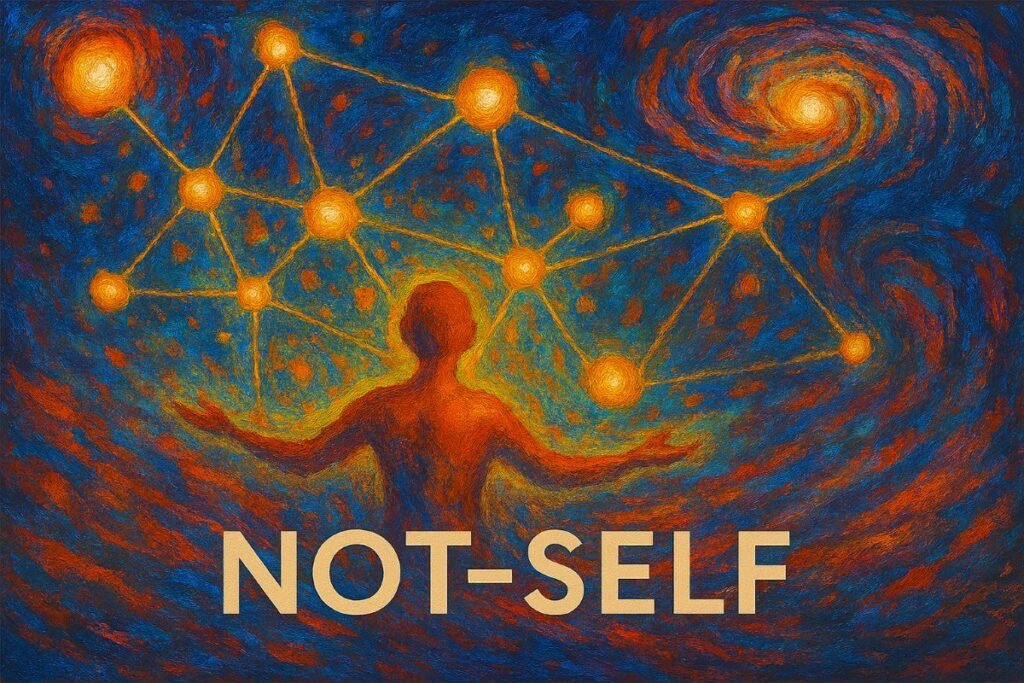
- The Buddhist teaching of “no-self” (Anatta) is not a statement of non-existence, but an insight into the fluid, conditioned, and interconnected nature of what we call “me.”
- It posits that what we experience as a solid, permanent self is actually a dynamic process composed of five constantly changing aggregates: body, feelings, perceptions, mental formations, and consciousness.
- Clinging to the idea of a fixed, separate self is identified as a primary source of suffering, anxiety, and conflict.
- Understanding no-self helps reduce ego-driven reactions, deepens compassion, and fosters a profound sense of peace and equanimity.
- This insight is directly applicable to modern life through mindfulness, reflective inquiry, and a shift in how we relate to our thoughts, emotions, and relationships.
- The teaching is central to all major Buddhist schools, though its exposition and complementary concepts may vary.
1. Introduction: The Question at the Heart of Our Experience
Who are you? If you pause and ask yourself this question, answers likely arise: your name, your profession, your roles as a parent or partner, your personality traits, your memories, your body. We navigate life with a deep-seated feeling of an “I” that is the thinker of thoughts, the feeler of feelings, and the center of our universe. This sense of self feels so intrinsic, so obvious, that to question it seems strange.
Yet, this very assumption is what the Buddha’s teaching of “no-self” (Anatta in Pali) invites us to gently and thoroughly examine. This is not a philosophical game or a nihilistic denial of your existence. Instead, it is a practical, liberating insight into the true nature of your experience. It is a cornerstone of the Buddha’s path to the end of suffering.
On a website dedicated to Buddhist learning, exploring “no-self” is essential because it cuts to the core of our most fundamental misunderstanding about reality. This article will guide you through what “no-self” means, why it is so important across Buddhist traditions, how to clear up common misunderstandings, and, most crucially, how you can work with this profound teaching in your own daily life to find greater peace, resilience, and freedom. We will approach this with clear, simple language, focusing on your direct experience.
2. What Is “No-Self”? Deconstructing the Illusion of a Fixed “I”
2.1 The Core Definition: Not a Thing, But a Process
The teaching of “no-self” states that within the entire field of our physical and mental experience, there is no permanent, unchanging, independent core or essence that can rightly be called a “self” or “soul.” What we habitually take to be our self is, upon close investigation, a temporary, ever-changing assemblage of interconnected processes.
To make this clear, the Buddha analyzed human experience into five categories, known as the Five Aggregates of Clinging. These are the components we mistakenly glue together and identify as “me” and “mine.”
1. Form (Rūpa): This is the physical or material aspect. It includes your body with all its parts, as well as the external material world you perceive (sights, sounds, etc.). It is constantly changing: cells regenerate, you age, you digest food, your energy levels fluctuate.
2. Feeling (Vedanā): This is the initial, simple tone of any experience. Is it pleasant, unpleasant, or neutral? When you sip coffee, a pleasant feeling arises. When you hear a harsh noise, an unpleasant feeling arises. These are not yet emotions; they are the basic “hedonic tone” of every moment of contact.
3. Perception (Saññā): This is the mental function of recognizing, labeling, and categorizing. It’s what allows you to see a collection of shapes and colors and recognize it as a “cup,” or to hear a sequence of sounds as a “word.” Perception creates the conceptual map of our world.
4. Mental Formations (Saṅkhāra): This is a broad category encompassing all volitional, thought-forming activities of the mind. It includes:
- Thoughts and ideas
- Emotions (like love, anger, joy, fear) which are more complex than basic “feeling”
- Habits, tendencies, and biases
- Will, intention, and choice
- Attention and concentration
This aggregate is the engine of karma, as it involves our intentional actions.
5. Consciousness (Viññāṇa): This is the bare awareness of a sense object. It is differentiated by sense door: eye-consciousness (seeing), ear-consciousness (hearing), nose, tongue, body, and mind consciousness (thinking). It is the cognizing factor that arises dependent on a sense organ and a sense object.
The Crucial Point: The Buddha asked us to look at each of these aggregates, both individually and collectively, and ask: “Is this permanent or impermanent?” Since they are all impermanent and in constant flux, he then asked: “Is that which is impermanent, stressful, and subject to change fit to be regarded as ‘This is mine, this I am, this is my self’?” The clear answer is “no.” You cannot find a stable, lasting “self” in any of these parts or in their totality. They are a flowing process, not a solid entity.
2.2 Translation and Interpretation: “Not-Self” vs. “No-Self”
The Pali term Anatta is often translated as “no-self” or “non-self.” The prefix “an-” means “not.” A more helpful and precise translation is often “not-self.” This is not merely semantic; it points to a method of practice.
“No-self” can sound like a blanket metaphysical statement: “There is no self anywhere.” This can lead to confusion and the misunderstanding of nihilism.
“Not-self” is an invitation to investigation. It is a practical instruction: see all phenomena—body, feelings, thoughts, even high spiritual states, as “not me, not mine, not my self.” It is a tool for letting go, not a final dogmatic position. For the purpose of daily practice, we can use these terms understanding they point to the same insight: the absence of a findable, permanent essence within our experience.
3. Buddhist Traditions and the Teaching of No-Self
The teaching of no-self is fundamental to all schools of Buddhism, as it is directly linked to the understanding of suffering and its cessation. However, its presentation and the concepts used to elaborate it can differ.
3.1 Theravāda Buddhism: Analysis and Direct Insight
The Theravāda tradition, the oldest existing school, places strong emphasis on the analytical understanding of no-self through the framework of the Five Aggregates and Dependent Origination (the detailed chain of cause-and-effect that shows how suffering arises). The primary method is Vipassanā (Insight Meditation), where practitioners closely observe the rising and passing away of the aggregates in their own experience. Through sustained, mindful observation, one sees directly the impermanent, unsatisfactory, and not-self nature of all conditioned phenomena. This direct seeing leads to wisdom and liberation.
3.2 Mahāyāna Buddhism: Emptiness and Interdependence
Mahāyāna Buddhism fully embraces no-self but expands its scope through the profound doctrine of Emptiness (Śūnyatā in Sanskrit). Emptiness means that all things,not just the person, lack inherent, independent existence. Everything exists dependently, arising based on causes, conditions, and parts. A cup is “empty” of a separate “cup-ness”; it exists only in dependence on clay, a potter, fire, water, the concept “cup,” and so on. Similarly, the “self” is empty. This view intensifies the understanding of interconnectedness and is central to texts like the Heart Sutra (“Form is emptiness, emptiness is form”). The Bodhisattva ideal in Mahāyāna, the vow to liberate all beings, is fueled by the realization that the boundary between self and other is ultimately not solid.
3.3 Zen Buddhism: Direct Pointing and Experience
Zen (a school of Mahāyāna) approaches no-self less through philosophical analysis and more through direct experience and paradoxical inquiry. Zen uses meditation (Zazen), dialogues (koans), and the teacher-student relationship to shatter conceptual thinking, including the concept of a separate self. A famous koan, “What was your original face before your parents were born?” points the student toward a realization beyond names, forms, and the constructed identity. The goal is a direct, non-conceptual awakening to one’s true nature, which is often described in terms of boundless, interconnected awareness rather than a small, separate self.
4. Why Is Understanding No-Self So Important for Modern Life?
This 2,500-year-old teaching is not an abstract relic. It offers powerful antidotes to the very stressors that define modern existence.
4.1 It Directly Addresses the Root of Suffering
The Buddha identified craving and clinging as the cause of suffering. But what is the base of all clinging? It is the sense of “I,” “me,” and “mine.” We crave pleasant experiences for me. We cling to possessions, opinions, status, and even our own bodies as mine. We fear what threatens me. When we see through the illusion of a solid, separate self, the fuel for this clinging is diminished. We suffer less because we have less to protect and less of a central character to feel offended, deprived, or threatened.
4.2 It Reduces Ego-Driven Stress and Anxiety
Much of our stress stems from the ego’s endless projects: defending itself, enhancing itself, comparing itself, worrying about its future. “Will I succeed?” “What do they think of me?” “I must protect my reputation.” Seeing these thoughts as impersonal mental formations, weather patterns in the mind, rather than absolute truths about “who I am,” allows us to relate to them with more space and less reactivity. This reduces anxiety, anger, and defensiveness.
4.3 It Fosters Genuine Compassion and Connection
If the sense of a separate, solid self is an illusion, then the wall between “self” and “other” becomes more porous. The suffering of another is not happening to a completely separate entity in a disconnected universe. Understanding that others, like us, are composed of changing aggregates and are driven by the same desires and fears, naturally gives rise to empathy and compassion. Kindness becomes a more spontaneous response, not a moral obligation.
4.4 It Supports Wise Action and Ethical Living
When we act from a solidified sense of self, our actions are often selfish. When we see the interdependent, empty nature of self, our actions naturally align with wisdom. We understand that harmful actions (rooted in greed, hatred, and delusion) reinforce the very illusion that causes suffering. Ethical conduct (Sila) becomes the natural expression of clear seeing, creating harmony rather than conflict.
4.5 It Cultivates Equanimity and Peace
Life is change. When we are tightly identified with impermanent things, our youthful body, a certain relationship, a job title, change feels like a personal assault. The insight of no-self helps us to be in the flow of change without desperately trying to anchor ourselves to it. We can experience joy without desperate clinging, and pain without complete identification. This balanced, open-hearted state is equanimity, a profound source of peace amidst life’s inevitable ups and downs.
5. Clearing Up Common Misunderstandings
This teaching is subtle and easily misunderstood. Clarifying these points is essential.
5.1 It Is Not Nihilism: You Exist, But Not as You Think
The most common fear is that “no-self” means you don’t exist or that life is meaningless. This is incorrect. The Buddha never denied conventional, functional existence. You have a name, a body, a history, and responsibilities. The teaching addresses the nature of that existence; it is dependent, fluid, and without a permanent core. It denies a specific type of self (permanent, independent), not functional, conventional reality. Meaning is found in the quality of your experience and actions, not in an imaginary permanent soul.
5.2 It Does Not Deny Responsibility or the Law of Karma
Some ask: “If there’s no self, who does the actions? Who experiences the results?” The Buddha used the analogy of a flame: Is the flame that burns at midnight the “same” flame as the one that burns at dawn? It is not the same, but it is not utterly different either. There is causal continuity. Similarly, there is a continuity of mental and physical processes (the five aggregates) that flows from moment to moment, life to life. Intention (in the Mental Formations aggregate) sets the causal chain in motion, and results manifest within that stream of continuity. You are responsible, but not to an unchanging “you.”
5.3 It Is Not a Psychological Annihilation or Passivity
Realizing no-self is not about becoming a blank, passive zombie with no personality. Your unique combination of habits, knowledge, and skills remains. In fact, your personality may become more vibrant, compassionate, and flexible as it is liberated from the constraints of rigid self-definition. It is about freedom from the tyrannical, narrow story of self, not freedom from functionality.
5.4 The Difference from Western Psychological Concepts
Western psychology often aims to build a “healthy ego” or a “cohesive self.” Buddhism agrees that a relatively stable, functional personality is necessary for navigating the world. However, it goes a step further. It suggests that even a healthy ego, if seen as ultimate reality, is a source of underlying tension. Buddhism offers tools to see through the ego construct itself, finding peace that is not contingent on the ego’s status or story.
6. Practical Applications: Living with the Insight of No-Self
This is the heart of the matter. How do you bring this from philosophy into your lived experience? Here are provided practical methods.
6.1 Foundational Practice: Mindfulness (Satī)
Mindfulness is the essential ground for seeing no-self. It is the non-judgmental, present-moment awareness of phenomena.
- How to Practice: In daily life, practice “noting” or “naming” your experience. When you feel stress, instead of thinking “I am stressed,” try noting, “feeling of tension is present,” or “thinking about a problem is happening.” This subtle linguistic shift moves you from being the subject of the experience to being the aware space in which the experience is occurring.
- Daily Activity: Choose a routine activity; washing dishes, showering, walking. Commit to being fully present with the sensations (Form), the pleasant/unpleasant/neutral tone (Feeling), and the thoughts that arise (Mental Formations) without getting lost in a story about “me” doing them.
6.2 Meditation for Direct Investigation
Formal meditation provides the quiet container to look deeply.
- Body Scan Meditation: Slowly move attention through the body. Observe sensations (tingling, pressure, warmth, ache). Ask gently: “Is this sensation ‘me’? Is it permanent? Is it ‘mine’ or is it just a passing phenomenon?” See if you can find an owner of the sensation.
- Thought-Watching Meditation: Sit quietly and watch thoughts arise and pass. See them like clouds drifting across the sky of awareness. Notice the impulse to claim a thought: “That’s my clever thought,” or “That’s my awful worry.” Practice seeing thoughts simply as events in the mind (Mental Formations), not as definitions of you.
- Observing the Aggregates: During meditation, periodically “take inventory.” Notice: What is the predominant physical sensation (Form)? What is the current feeling-tone (Vedanā)? What is being perceived (Saññā)? What thoughts or emotions are present (Saṅkhāra)? What type of consciousness is predominant (Viññāṇa)? Observe them as interdependent, impersonal processes.
6.3 Reflective Inquiry in Daily Situations
Use challenging moments as your laboratory.
- During Conflict: When you feel offended or angry, pause. Ask: “What is being threatened here? Is it the body? A belief (Mental Formation)? A self-image?” Observe the feeling of anger as a temporary surge of energy and thought, not as “my righteous anger.” This creates space to respond wisely instead of reacting.
- When Clinging to Pleasure: When you are enjoying something greatly; a meal, praise, or success, pause to observe the experience. See the pleasant feeling (Vedanā), the perception of it as “good” (Saññā), and the craving to make it last (Saṅkhāra). Notice the subtle suffering within the pleasure: the fear of its end. See it all as a fleeting process.
- When Identifying with Roles: You are a parent, employee, artist, etc. When you feel stressed by a role, ask: “Is this role ‘me’? If I lost this role, what would remain?” See the role as a set of conditions and activities, not your core identity.
6.4 Cultivating Compassion Through Interconnection
- Metta (Loving-Kindness) Meditation: Start by wishing well for yourself. Then extend it to a loved one, a neutral person, a difficult person, and finally all beings. As you practice, notice how the sense of “self” and “other” softens. The well-wishing becomes less about “me” sending love to “you” and more about a universal intention for freedom from suffering.
- Seeing Others as Processes: When someone acts unskillfully, instead of labeling them “a jerk,” try to see them as a collection of aggregates in a certain configuration: they are acting from their own confusion, pain, and conditioning (Mental Formations). This perspective fosters patience and reduces personal resentment.
6.5 Embracing Impermanence (Aniccā) as a Gateway
No-self is deeply linked to impermanence. Make reflection on change a daily habit.
- Look at old photos and contemplate the change in your body (Form).
- Notice how a strong emotion, left unattended, dissipates on its own.
- Observe how your opinions and interests have changed over years.
This constant flux is not a tragedy; it is the nature of conditioned existence. Relaxing into it is freedom.
7. Challenges and Integration: A Lifelong Journey
Understanding no-self intellectually is one thing; deeply embodying it is a lifelong path. It is normal to encounter resistance. The mind, conditioned over a lifetime, will repeatedly reconstruct the sense of self. This is not failure.
- Be Patient and Kind to Yourself: Use the insight of not-self to be gentle with your own process. When you notice yourself clinging to a self-view, meet it with mindful curiosity, not self-criticism.
- Seek Community and Guidance: Exploring these teachings with a group or under the guidance of a qualified teacher (in any Buddhist tradition) can provide invaluable support, clarification, and encouragement.
- Focus on the Benefits: Notice the moments of freedom. The moment you don’t take an insult personally. The moment a loss doesn’t devastate your whole world. The spontaneous feeling of connection with a stranger. These are the fruits of the practice, confirming its value in your own life.
8. Conclusion: The Freedom of No Fixed Point
The teaching of no-self is ultimately a teaching of profound freedom. It is the freedom of a river flowing, not a rock resisting the current. It is the freedom of being able to experience life fully without being imprisoned by a rigid story of who you are.
By investigating our experience through mindfulness and wisdom, we begin to loosen the tight knot of self-identification. We start to live more lightly, with more compassion, resilience, and peace. We discover that what we truly are is more vast, open, and interconnected than the small, separate self we imagined. It is not about becoming nobody; it is about becoming free; free to be fully, compassionately, and wisely engaged with this ever-changing, precious human life.
Glossary of Key Terms
| English Term | Pali/Sanskrit Term | Explanation |
|---|---|---|
| Aggregates, Five | Khandha (Pali) / Skandha (Sanskrit) | The five categories that constitute human experience: Form, Feeling, Perception, Mental Formations, and Consciousness. They are the components mistakenly taken as a self. |
| Consciousness | Viññāṇa (Pali) / Vijñāna (Sanskrit) | The awareness or cognizing faculty that arises dependent on a sense organ and its object (e.g., eye-consciousness seeing form). |
| Dependent Origination | Paṭicca-samuppāda (Pali) | The fundamental Buddhist doctrine explaining how all phenomena arise and cease based on causes and conditions. It details the process by which ignorance leads to suffering, and how suffering ceases. |
| Emptiness | Śūnyatā (Sanskrit) | The Mahāyāna teaching that all phenomena, including the self, lack inherent, independent existence. They exist only in dependence on other causes and conditions. |
| Feeling | Vedanā (Pali/Sanskrit) | The initial, bare sensation of an experience as pleasant, unpleasant, or neutral. It is not yet a full emotion. |
| Form | Rūpa (Pali/Sanskrit) | The physical or material aggregate, including the body and external material objects. |
| Impermanence | Aniccā (Pali) / Anitya (Sanskrit) | The universal characteristic of all conditioned phenomena: they are in constant flux, arising and passing away. |
| Mental Formations | Saṅkhāra (Pali) / Saṃskāra (Sanskrit) | The volitional, constructive activities of the mind, including thoughts, emotions, habits, and intentions. This aggregate is the primary source of karma. |
| Mindfulness | Satī (Pali) / Smṛti (Sanskrit) | The practice of paying deliberate, non-judgmental attention to the present moment. The foundation for insight into no-self. |
| No-Self / Not-Self | Anatta (Pali) / Anātman (Sanskrit) | The core Buddhist doctrine that there is no permanent, unchanging, independent self or soul within the five aggregates. |
| Perception | Saññā (Pali) / Saṃjñā (Sanskrit) | The mental function of recognizing, labeling, and interpreting sensory and mental input. |
References and Further Learning
Books:
- “The Heart of the Buddha’s Teaching” by Thich Nhat Hanh. A clear, beautiful, and practical explanation of core Buddhist teachings, including no-self and interbeing.
- “What the Buddha Taught” by Walpola Rahula. A classic introductory text that explains the Four Noble Truths, the Eightfold Path, and no-self with clarity and depth.
- “Seeing That Frees: Meditations on Emptiness and Dependent Arising” by Rob Burbea. An advanced but exceptionally clear guide for meditators exploring emptiness and no-self.
- “Buddhism Plain and Simple” by Steve Hagen. A no-nonsense, direct introduction to Buddhist practice and philosophy, focusing on seeing the nature of reality.
Web Articles and Resources:
- Access to Insight (www.accesstoinsight.org): A vast online library of Theravada Buddhist texts, including suttas (discourses) where the Buddha teaches about Anatta. Search for the “Anatta-lakkhana Sutta” (The Discourse on the Not-Self Characteristic).
- Buddhist Learning.org’s own archives: Explore articles on Mindfulness, Impermanence, and Dependent Origination for related foundational concepts.
YouTube and Podcasts:
- YouTube: Ajahn Brahm. A Theravada monk known for his humorous and accessible talks. Search for his talks on “Anatta” or “Letting Go.”
- YouTube: Thich Nhat Hanh. Search for his talks on “Interbeing” and “No Self,” which present the Mahayana perspective in a gentle, poetic way.
- Podcast: “The Secular Buddhism Podcast” with Noah Rasheta. Episodes often discuss no-self, emptiness, and their practical application in a modern, secular context.
- Podcast: “Buddhist Geeks” (Archives). Features interviews with Buddhist teachers and scholars on a wide range of topics, including deep dives into no-self and emptiness from various traditions.
Disclaimer: This article is intended as an educational guide. It is not a substitute for personal instruction from a qualified teacher or for one’s own sincere practice.