Key Takeaways
- The wish to improve oneself can quietly become clinging [upādāna], reinforcing the very sense of self that Buddhist practice examines.
- Craving [taṇhā], especially the urge to become someone better, calmer, or more spiritual, is a subtle source of unease.
- Effort matters, but it functions like a raft, useful for crossing and not for carrying on one’s head.
- Clear seeing [vipassanā] is not the same as self-fixing, though the two are easily confused.
- The spiritual ego can turn insight itself into a possession, creating a more refined prison.
- Ethics, emotional balance, and healthy habits are real goods, but they are not the final aim of practice.
- Theravada and Mahayana both examine attachment to self, though their understandings of not-self, emptiness, and the path are not identical.
- The peace that practice points toward is found in the ending of clinging to becoming, not in the successful completion of a self-improvement project. Beneficial aspiration and ethical development remain valuable supports along the way.
1. Introduction
Modern life has made a project of personal improvement. Books, courses, apps, and coaching programs promise better habits, sharper focus, calmer moods, and a more successful version of the person using them. Many of these tools are genuinely helpful. They can reduce stress, support health, and make daily life more manageable. Yet within the language of improvement there is a question that Buddhist practice invites us to ask: who exactly is being improved, and what is the improvement for?
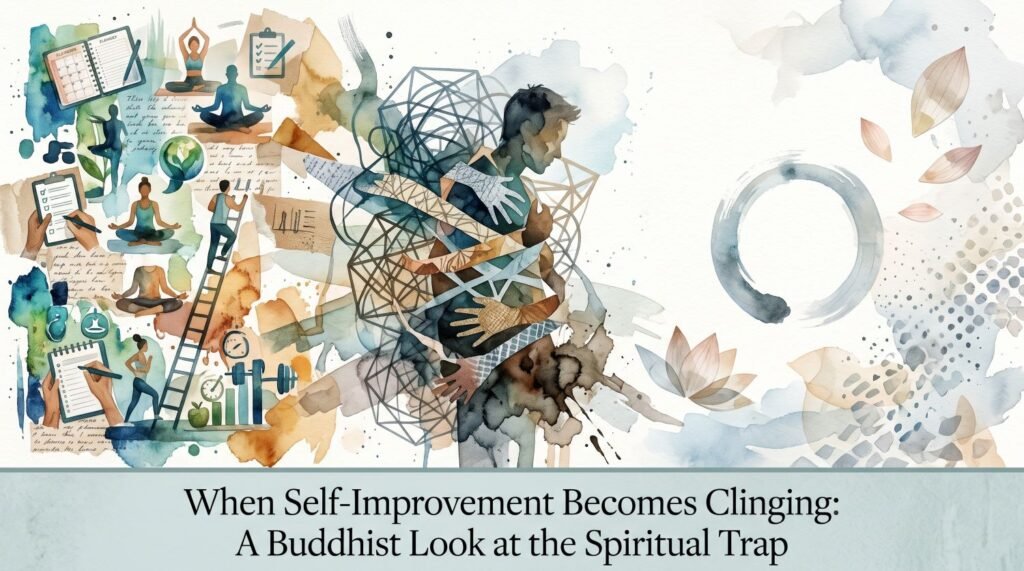
This is not a question designed to produce guilt or to dismiss the real benefits of self-care. It is a question about direction. When improvement becomes the central purpose of practice, the mind can quietly turn liberation into a performance. The self that Buddhism describes as fluid, conditioned, and not ultimately ownable becomes the project manager, the scorekeeper, and the future destination of the entire spiritual life. The result can look like progress while remaining a form of bondage.
The trap is not obvious. It rarely announces itself as clinging. It usually appears as sincerity. A person begins meditating to become less reactive, and soon the meditation becomes a measure of personal worth. A person studies Buddhist ideas to understand suffering, and soon the ideas become a way to feel superior to those who have not studied them. A person adopts ethical guidelines to live more harmoniously, and soon the guidelines become a standard for judging the self and others. None of these developments is entirely bad, but each contains a subtle movement of grasping.
Buddhist teaching names this pervasive dissatisfaction [dukkha], a term that also carries the senses of stress, unease, and suffering. Dissatisfaction is not simply the presence of unpleasant feelings. It is the deeper sense that conditioned experience cannot provide lasting security, even when it is pleasant. The self-improvement project often promises to solve this dissatisfaction through better performance, better habits, or better states of mind. Buddhist practice suggests that the dissatisfaction cannot be solved by improvement alone, because the craving that drives the improvement is part of what sustains the dissatisfaction.
This article explores how self-improvement can become clinging, why the Buddhist analysis of craving and becoming is so relevant to contemporary wellness culture, and how practice can shift from building a better self to seeing through the project of self altogether. It draws on general Buddhist teachings rather than any single text, and it relates these teachings to both the Theravada and Mahayana streams of Buddhism where that is useful. The aim is not to reject effort or ethics, but to locate them within a larger understanding of what practice is for.
2. The Architecture of the Self-Improvement Trap
The Owner, the Measurer, and the Goal
A useful way to see the trap is to notice the structure of the self-improvement project rather than its content. In the ordinary improvement model, the self occupies three roles at once. It is the owner of the practice, the one who possesses the meditation session, the diet, the exercise routine, or the insight. It is the measurer, the one who compares present experience with an ideal and asks whether progress has been made. And it is the goal, the future version of the self that all this effort is meant to produce.
This structure feels natural because it fits the way modern culture teaches us to think about almost everything. We set goals, track outcomes, and evaluate performance. But when this structure is applied to the Buddhist path, it installs the self at the center of a process that is meant to reveal the self as dependently arisen and not ultimately possessable. The practitioner becomes a project manager of liberation, and liberation becomes another item on the achievement list.
Consider a simple example. A person downloads a meditation app and decides to meditate for ten minutes each day. At first, the practice is simply ten minutes of sitting. Then a streak counter appears. Then the person begins to feel mild anxiety about breaking the streak. Then the meditation becomes a way to feel disciplined, and the discipline becomes part of a self-image. The original intention, to become more present, has been quietly absorbed into a new identity: the kind of person who meditates. The practice has not disappeared, but it now serves the construction of a self rather than the investigation of one.
A similar pattern appears in fitness and health. Someone begins walking daily because they want to feel stronger. Soon a step counter becomes a judge. A day below the target produces a small sense of failure. The walk is no longer simply a walk. It is evidence about whether the person is disciplined, healthy, or good enough. The activity remains beneficial, but it has been recruited into a project of self-validation. Buddhist practice does not ask the person to stop walking. It asks them to notice the extra weight that has been added to the walk.
Improvement Without a Self to Improve
Buddhist teaching does not say that there is no conventional person, no body, no history, and no capacity for change. It says that what we call the self is a dynamic process, a collection of changing phenomena that we habitually label and identify with. The five aggregates [khandhā] of form, feeling, perception, mental formations, and consciousness are a traditional way of describing this process. When clinging arises, these aggregates become the material from which a sense of me and mine is built.
The problem with the self-improvement project is not that it tries to change behavior. The problem is that it often treats the self as a solid owner of the change and a solid beneficiary of the change. It assumes that there is a permanent someone behind the practice who will eventually arrive at a permanent state of having been improved. Buddhist practice questions both assumptions. It asks whether the one who practices is anything more than a stream of intentions, sensations, and mental events, and it asks whether the improved self is anything more than another set of mental events.
This does not mean that effort is pointless. It means that effort can be undertaken without the added weight of self-making. One can practice generosity without turning generosity into an identity. One can practice patience without turning patience into a badge. One can meditate without turning meditation into a personal label. The activity remains, and the quality can deepen over time, but the identity-building around the activity begins to loosen. The difference is subtle, but it changes the entire flavor of practice. Effort becomes lighter. Setbacks become less personal. Progress becomes less necessary as a source of self-worth.
A parent might notice this in daily life. They want to be more patient with their children. They read books, try techniques, and remind themselves to breathe. At some point the patience becomes a standard they must meet in order to be a good parent. The inevitable moments of irritation then feel like evidence of failure. Buddhist practice would not ask the parent to abandon patience. It would ask them to notice the identity that has formed around being patient, and to see the irritation as a conditioned event rather than a verdict on the self.
The Subtle Shift from Practice to Project
The shift from practice to project is often invisible in the moment. It can be detected by noticing what happens when the practice does not go as planned. If a meditation session is restless, does the mind treat that as information about conditions, or does it treat it as a personal failure? If an ethical commitment is broken, does the mind see a conditioned habit, or does it see a damaged self-image? If a retreat is less peaceful than expected, does the practitioner investigate the experience, or does the practitioner feel cheated out of a promised result?
These reactions reveal whether practice is being used as a project of self-validation. When the practice becomes a project, the inevitable ups and downs of training are no longer simply ups and downs. They become evidence about the worth of the self. The result is a familiar cycle: hope, effort, disappointment, self-criticism, renewed hope, and more effort. The cycle can be very sincere, and it can also be very painful.
The shift can also be detected in speech. A practitioner who is caught in the project may talk about their practice in terms of achievement. They may mention how many minutes they sat, how many retreats they attended, or how much calmer they have become. None of this is necessarily wrong, but the tone reveals whether the practice is being offered or displayed. When practice is offered, there is less need to report it. When practice is displayed, the self is seeking confirmation.
3. Craving for Becoming and the Wellness Mask
Three Directions of Craving
Buddhist psychology describes craving as having several directions. One is craving for sensory pleasure, the ordinary pull toward pleasant sights, sounds, tastes, and sensations. Another is craving for non-existence, the wish to escape, to disappear, or to annihilate experience. Between these is craving for becoming [bhava-taṇhā], the restless drive to be something, to maintain a solid identity, and to ensure that the self continues in a satisfying form.
Craving for becoming is the domain in which the self-improvement trap operates most clearly. It is not simply the wish to feel better. It is the wish to be someone. One common expression of this craving is the subtle feeling that I am not enough as I am, and therefore I must become something else in order to be worthy. This feeling can attach itself to almost any goal: health, wealth, status, relationships, creativity, or spiritual awakening. It is not the only form that craving for becoming takes, but it is one that is especially common in contemporary wellness culture. When it attaches to spiritual practice, it becomes especially difficult to see, because the goal appears to be noble.
The wellness industry has learned to speak the language of this craving with great fluency. It offers transformation, optimization, healing, and awakening as products. It promises that the right combination of practices will produce a new and improved self. Some of these promises are partly true in a conventional sense. Exercise can improve mood, meditation can reduce reactivity, and therapy can support emotional health. Many wellness providers are sincere and helpful. The concern here is not with every product or teacher, but with a cultural pattern in which practice is marketed as a way to secure a better identity. The deeper promise, that a solid self can finally be made secure through enough improvement, is a promise that no conditioned thing can keep.
The Feeling of Not Being Enough
At the heart of craving for becoming is a feeling of lack. This feeling is not necessarily dramatic. It may be a low background hum of dissatisfaction, a sense that something is missing even when life is objectively good. Buddhist teaching points out that this feeling is not solved by acquiring more objects or more experiences. It is solved by seeing through the craving that generates the sense of lack in the first place.
The wellness mask makes this feeling harder to see because it reframes lack as a problem to be solved through self-optimization. Instead of questioning the assumption that one must become something else, it offers a new program for becoming. The practitioner may then spend years working on the self without ever questioning the project. The project feels like the solution, but it may also be the most refined expression of the problem.
Social media intensifies this pattern. A person scrolls through images of others who seem calmer, fitter, more productive, or more spiritually advanced. The mind quietly concludes that it is falling behind. The solution appears to be more effort, more discipline, more practice. What is not questioned is the comparison itself, or the assumption that life is a race toward a better version of oneself. Buddhist practice invites a different question: who is comparing, and what is being compared?
Spiritual Identity and Status
Craving for becoming also operates in Buddhist communities. A practitioner may begin to identify with a spiritual identity: the calm one, the insightful one, the one who understands impermanence, the one who is not attached. This identity can become a source of status and comparison. The practitioner may feel subtly superior to those who are still caught in worldly pursuits, or may feel inadequate in the presence of those who seem more advanced.
This dynamic is not limited to any one tradition. In Theravada contexts, it can appear as attachment to retreat experience, to meditation attainments, or to a particular teacher. In Mahayana contexts, it can appear as attachment to the bodhisattva ideal, to compassion, or to the language of emptiness. The specific content differs, but the structure is the same: practice becomes a new basis for self-definition, and self-definition becomes a new basis for suffering.
The Mahayana tradition has a particularly strong vocabulary for this problem. Its teachings on emptiness [śūnyatā] extend the analysis of not-self [anattā] to all phenomena, including the path itself. The path is not a possession, and the practitioner is not a solid entity who accumulates spiritual capital. Different Mahayana schools express these themes in different ways, and the language of emptiness is not used identically across them, but the general direction is to loosen the grip of self-identification. Compassion is cultivated not to make the self feel good, but because suffering is understood as shared and because responsiveness to others is part of awakening. This perspective can loosen the grip of spiritual identity, though it can also be appropriated by the spiritual ego and turned into a new badge of sophistication.
4. Effort, the Raft, and the Difference Between Crossing and Clinging
The Necessity of Effort
One common misunderstanding of the critique of self-improvement is that it leads to passivity. If improvement is a trap, why bother with ethical commitments, meditation, or study? Why not simply do whatever feels natural? This misunderstanding misses the distinction between clinging and effort. Buddhist practice does not reject effort. It rejects the grasping that turns effort into a project of self-validation.
The traditional image of the raft is helpful here. A person who needs to cross a river builds a raft from branches and grass, uses it to cross, and then leaves it behind. The raft is necessary. Without it, the crossing is impossible. But the raft is not the destination. If the traveler carries the raft on the head after reaching the far shore, the raft becomes a burden rather than a support. In the same way, Buddhist practice, ethical discipline, and meditation are means of crossing the river of suffering. They are not ends in themselves, and they are not possessions to be admired. Yet they remain necessary and valuable for as long as the crossing is incomplete. The point is not to discard the raft prematurely, but to use it wisely and to remember what it is for.
This image has important implications for the self-improvement trap. The problem is not that the practitioner builds a raft. The problem is that the practitioner begins to decorate the raft, reinforce its hull, and show it to others, all while forgetting that the point is to cross the river. Practice can become an object of pride. It can become a way to feel superior. It can become a way to avoid the actual crossing. The raft is still useful, but it is being used for the wrong purpose.
The path includes ethical conduct, concentration, and wisdom, and these are developed through sustained effort. Concentration, mindfulness [sati], compassion, and wisdom are cultivated. This cultivation is not opposed to the critique of clinging. It is the raft. The question is whether the practitioner remembers that the raft is for crossing. When the answer is yes, effort becomes a support for release. When the answer is no, effort becomes another form of bondage.
The Difference Between Wholesome Desire and Craving
Buddhist teaching makes a careful distinction between craving and wholesome desire [chanda]. Craving is the demanding, compulsive quality of mind that insists reality must comply with its wishes. Wholesome desire is the interest, enthusiasm, and intention that support beneficial action. The difference is not always easy to detect, but it can be noticed by examining the mind’s relationship to the outcome.
When wholesome desire is present, there is room for flexibility. One can act with energy and care without needing the result to confirm anything about oneself. When craving is present, the outcome carries an extra weight. The self feels threatened or validated by what happens. A meditation session becomes proof of competence. A generous act becomes proof of goodness. A philosophical insight becomes proof of depth. The activity may look the same from the outside, but the inner architecture is different.
For practitioners, this distinction is practical. It invites a gentle question before, during, and after practice: is this effort fueled by interest and care, or is it fueled by the need to be someone? The question itself can become a moment of clear seeing. It does not require a perfect answer. It only requires honesty.
A teacher might notice this distinction in a student. One student practices because they are curious about the mind and want to suffer less. Another student practices because they want to be seen as a serious practitioner. Both may sit for the same amount of time. Both may read the same books. But the first student’s practice is more likely to loosen clinging, while the second student’s practice is more likely to reinforce it. The difference is not in the activity but in the motivation.
The Path as Subtraction
Buddhist practice is often described as a path of letting go rather than a path of acquisition. This does not mean that nothing is developed. Concentration, ethics, compassion, and wisdom are cultivated. But the underlying movement is one of release. The path is better understood as the ending of ignorance, craving, and clinging than as the construction of a permanent spiritual identity. Traditions describe that ending in different ways, and the language of attainment is used in various contexts, but the essential point is that liberation is not a possession to be acquired.
This is why the self-improvement model can be so misleading. It trains the mind to think in terms of addition: more calm, more insight, more virtue, more progress. But the path is also a process of subtraction: less grasping, less aversion, less confusion, less self-making. The two movements are not entirely opposed. One does cultivate positive qualities. But if the cultivation is not accompanied by release, it can become another form of bondage.
A practitioner might spend years developing concentration and still remain caught in the subtle conceit of being a concentrated person. A practitioner might study Buddhist philosophy for decades and still remain caught in the subtle conceit of being a knowledgeable person. The path of subtraction asks whether these identities are worth carrying. It asks whether the raft is being used for crossing or for display.
5. Clear Seeing Versus Self-Fixing
Fixing and Witnessing
The difference between self-improvement and clear seeing can be described simply, though the two are not mutually exclusive. Self-improvement often begins with an act of fixing. Clear seeing begins with an act of witnessing. When the mind is restless, the fixing approach asks how to make it calm. The witnessing approach asks what conditions are present, how restlessness feels, how it changes, and whether it is owned by anyone. The first approach seeks to change the content of experience. The second approach seeks to understand its nature.
These two approaches are complementary rather than opposed. Buddhist practice does cultivate beneficial states, and it does encourage ethical and mental training. But it also asks the practitioner to understand the nature of experience, including the experience of cultivation. If calm becomes the only acceptable state, then practice becomes a struggle against experience. The mind is divided into the part that wants to be calm and the part that is restless. The practitioner identifies with the first part and rejects the second. The result is tension, not freedom.
Clear seeing is the practice of observing experience as it is, without immediately trying to manipulate it into a preferred shape. This does not mean passivity. It means seeing clearly before acting. When anger arises, clear seeing notices the physical sensations, the thoughts, and the story. It notices how the anger depends on conditions. It notices that the anger is not a solid thing owned by a solid self. From that seeing, a more skillful response may arise naturally. The response may involve calming the mind, or it may involve setting a boundary, but it arises from understanding rather than from reactivity.
The Five Aggregates as Not Self
The traditional analysis of the five aggregates supports this shift. Form, feeling, perception, mental formations, and consciousness are examined and seen as changing processes rather than as a self. Form is the body and material experience. Feeling is the pleasant, unpleasant, or neutral tone of experience. Perception is the labeling and recognition of experience. Mental formations include intentions, habits, and emotional patterns. Consciousness is the knowing of an object.
When these are observed closely, they are seen to arise and pass away. They are conditioned. They do not obey the command of a central controller. The body changes without permission. Feelings arise before there is time to decide whether to have them. Thoughts appear and disappear. Consciousness depends on contact and conditions. None of these processes is a permanent, independent self.
This is a way of describing dependent origination [paṭicca samuppāda], the principle that phenomena arise in dependence on conditions and cease when those conditions cease. The point is not to deny conventional identity but to loosen the grip on it. The practitioner can still use the word I and can still take care of the body and mind. But the word I is no longer treated as a pointer to a solid thing. It becomes a convenient label for a process. With this loosening of self, the need to improve the self loses some of its urgency. The self is not a thing to be perfected. It is a process to be understood.
The Better Me as a Mental Formation
In the light of clear seeing, the future self that the self-improvement project wants to become is revealed as a mental formation. It is a thought, an image, a concept. It may be a useful concept for planning and goal-setting, but it is not a destination that will permanently satisfy. The better self is always in the future, and the present moment is always being sacrificed to it.
A practitioner may notice this pattern during meditation. A thought arises about becoming more peaceful, more insightful, or more compassionate. The thought is pleasant. It promises a future reward. But if it is examined closely, it is just a thought. It has no power to secure lasting satisfaction. The mind that clings to it is the same mind that clings to any other object. The better self is another cloud in the sky, not a permanent identity.
This does not mean that aspirations are useless. Aspiration can point the mind in a beneficial direction. But when aspiration becomes clinging, it produces the very agitation it hopes to remove. The practitioner learns to hold aspirations lightly, as intentions rather than as identities. The intention to be kind can remain. The identity of being a kind person can be released. The intention to meditate can remain. The identity of being a meditator can be released.
6. The Spiritual Ego and the Subtle Prison
Pride in Progress
One of the most subtle forms of clinging is pride in spiritual progress. A practitioner may begin to feel that they have seen through something that others have not. They may feel calmer than their friends, more aware than their colleagues, or more deeply understanding than the people around them. This feeling can be very quiet, but it is a form of self-making.
The spiritual ego is not necessarily loud or arrogant. It can be gentle, humble, and well-spoken. It can use the language of non-attachment while being deeply attached to its own image as a non-attached person. It can criticize others for being egotistical while building a subtle identity around the critique. The critique itself becomes a possession, and the possession becomes a new room in the same prison.
This is why the critique of self-improvement must be handled carefully. It is easy to turn the critique into a new identity: the one who sees through self-improvement, the one who is not caught in the trap, the one who understands the raft. If that happens, the critique has become another raft to carry. The only way out is to include oneself in the diagnosis. The trap is not something that other people fall into. It is a tendency of the mind that appears in one’s own practice.
The Critique as a New Clinging
The spiritual ego can also attach itself to the idea of not clinging. A practitioner may become proud of being detached, proud of not needing anything, proud of seeing through the illusions that others still believe in. This is a particularly refined form of clinging because it uses the language of release to reinforce a sense of superiority.
Buddhist teachings on emptiness and not-self are meant to undercut this move. If all phenomena are empty of fixed essence, then the critique of self-improvement is also empty. It is a useful tool, not a final truth to be defended. The practitioner who understands this can hold the critique lightly. It can be used to illuminate experience, and then it can be released.
Mahayana teachings on compassion are also relevant here. When the spiritual ego arises, it tends to separate the practitioner from others. It creates a subtle hierarchy of the wise and the unwise, the advanced and the beginner. Compassion can weaken this hierarchy by encouraging responsiveness to suffering and by reminding the practitioner that suffering is shared. This is not a metaphysical claim that separation does not exist. It is a practical orientation that makes self-centred comparison less compelling. The spiritual ego wants to be special. Compassion wants to be helpful. The two motivations are very different, even when they use the same words.
Humility and Humor
The antidote to the spiritual ego is not self-hatred. It is humility and humor. Humility means recognizing that the mind is always capable of self-deception, including in its spiritual life. Humor means not taking the project too seriously. The practitioner can notice the ego’s maneuvers with a gentle smile rather than a harsh judgment.
This is not a technique for becoming a better person. It is a way of seeing the comedy of self-making. The mind tries so hard to be something, and the effort is often quite funny. When this is seen, the clinging loosens. The practitioner does not need to perfect the self in order to be free. They only need to see the self-making as it happens.
A practitioner might notice this in conversation. They may hear themselves explaining a Buddhist idea with a slight tone of superiority. Instead of collapsing into shame, they can notice the tone, smile at it, and let it go. The noticing is the practice. The smile is the release. The moment of humility is more valuable than the performance of wisdom.
7. Goodwill, Ethics, and the Relative Goods of Improvement
Real but Partial Goods
None of this means that the benefits of self-improvement are worthless. Less stress, better emotional regulation, healthier habits, and kinder relationships are real goods. They make life more bearable for oneself and others. They can provide a stable foundation for deeper practice. A person who is constantly overwhelmed by anxiety may need to develop some calm before insight can arise. A person who is trapped in destructive habits may need to develop ethical discipline before the mind can settle.
The error is not in pursuing these goods. The error is in making them the ultimate point. When relative goods are treated as final goals, they become sources of clinging. When they are treated as supports for a larger process of awakening, they remain useful. The distinction is not always easy to maintain, but it can be checked by noticing whether the pursuit of improvement is increasing or decreasing the sense of self-importance.
Ethics is a particularly important example. Buddhist ethical guidelines are not primarily a system of self-purification. They are a training in non-harming, which reduces the agitation and remorse that obstruct clear seeing. When ethics becomes a project of becoming a good person, it can produce rigidity, pride, and judgment. When ethics is understood as a support for peace, it becomes more flexible and more compassionate.
The same applies to generosity. Giving can be a genuine expression of care, and it can also become a way to feel superior or to secure a reputation. The act may look the same, but the inner movement is different. Buddhist practice encourages generosity because it loosens grasping, and over time it can become a settled quality of heart, but the point is not to build a better identity around it.
Attention Is Not for Productivity
Mindfulness is frequently presented as a tool for productivity, focus, and stress reduction. These benefits can be real, but they are not the purpose of mindfulness in the Buddhist context. Mindfulness is a quality of attention that supports clear seeing. It is not a technique for making the ego more efficient.
When mindfulness is stripped of its ethical and liberating context, it can become a way to tolerate a dysfunctional situation without questioning it. A person may use mindfulness to remain calm in an oppressive workplace, but the calm may serve to maintain the oppression rather than to challenge it. This is not to say that calm is bad. It is to say that calm without wisdom can be co-opted. Mindfulness is most useful when it is paired with ethical awareness and an understanding of suffering.
The Mahayana tradition emphasizes that wisdom and compassion are inseparable. Mindfulness that is not connected to compassion can become cold and self-serving. Compassion that is not connected to wisdom can become sentimental and exhausting. The two together provide a better guide. Attention without care can become a tool of control. Care without attention can become scattered and ineffective. The path brings them together.
The Middle Way Between Nihilism and Grasping
The critique of self-improvement can easily tip into nihilism. If improvement is a trap, why try? Why practice ethics? Why meditate? This is a misunderstanding of the middle way. The middle way does not reject effort. It rejects the extremes of indulgence and self-mortification, and it also rejects the extreme of clinging to the results of effort.
A useful way to hold this is to practice with intention but without attachment to the outcome. One can set a time to meditate, sit down, and pay attention. One can act ethically because it reduces harm. One can study teachings because they illuminate experience. But one does not need to make the results into a measure of personal worth. The effort is offered, and the outcome is released.
This is a training in itself. It is not easy, and it does not happen all at once. The mind will repeatedly grasp at results. The practitioner will repeatedly notice the grasping and let it go. Over time, the grasping becomes less compelling. The practice becomes lighter. The self becomes less solid. The peace that was being sought through improvement is found, paradoxically, in the ending of the project of improvement.
It is also important to avoid the opposite error, which is using the critique of self-improvement as an excuse for carelessness. The critique is not a license to abandon ethical conduct or to stop cultivating beneficial qualities. It is an invitation to hold those qualities more lightly. The path still requires effort. It simply does not require the construction of a spiritual identity around the effort.
8. Conclusion
The self-improvement trap is not a reason to abandon practice. It is an invitation to see practice more clearly. The desire to become better can be sincere, and it can produce real benefits. But when that desire becomes the central purpose of the spiritual life, it turns liberation into a project of self-making. The self becomes the owner, the measurer, and the goal, and the path becomes another arena for grasping.
Buddhist teachings offer a different way. They invite the practitioner to examine the self that is supposedly being improved. They point to the five aggregates as a process rather than a thing. They distinguish between craving and wholesome desire. They use the image of the raft to show that effort is a means, not an end. They encourage clear seeing rather than self-fixing. And they warn that even the critique of self-improvement can become a new identity if it is held too tightly.
The path is not about becoming a perfect person. It is about seeing through the illusion of the person who needs to be perfect. This does not mean that ethical development, emotional balance, and personal growth are opposed to practice. They can be genuine supports. The point is that they are not the final aim, and they do not need to be carried as identities. One can cultivate goodness without turning it into a label. One can develop calm without turning it into a badge. One can study the teachings without turning them into a status.
Theravada and Mahayana both critically examine attachment to self, though their frameworks differ. Theravada places strong emphasis on ethical conduct, concentration, and wisdom as interconnected aspects of practice, with insight into the nature of experience as a central element. Mahayana, across its diverse schools, places strong emphasis on the emptiness of all phenomena and on compassion as inseparable from wisdom, though it expresses these themes in varied ways. Both traditions point beyond the project of becoming to a peace that is not manufactured by self-improvement. That peace is found in the ending of clinging to becoming, not in the successful completion of a self-improvement project.
The invitation, then, is not to stop practicing. It is to practice without making practice into a possession. To sit without needing to become a meditator. To act ethically without needing to become a good person. To understand the teachings without needing to become an expert. To use the raft for crossing, and then to let it go.
Recommended Readings & Resources
Website Topics
- Clinging and letting go
- When healthy aspiration becomes craving
- The five aggregates
- Understanding not-self
- The raft metaphor
- The four foundations of mindfulness
- Loving-kindness in action
- Generosity and letting go
- Dependent origination
Books
- What the Buddha Taught by Walpola Rahula offers a clear introduction to core teachings.
- Mindfulness in Plain English by Bhante Henepola Gunaratana provides practical meditation guidance.
- The Wise Heart by Jack Kornfield explores Buddhist psychology and its application to modern life.
- Buddhism Without Beliefs by Stephen Batchelor presents a secular and agnostic approach to the teachings.
- When Things Fall Apart by Pema Chödrön offers guidance on working with groundlessness and uncertainty.
Podcasts
- Insight Hour with Joseph Goldstein explores Buddhist practice and psychology in depth.
- Tricycle Talks features conversations with Buddhist teachers and scholars on contemporary issues.
- Deconstructing Yourself examines meditation, mindfulness, and the nature of self from multiple perspectives.
Glossary of Key Terms
- Becoming [bhava]: The process of coming to be, or the drive to exist in a particular way. It is the general movement of conditioned existence, while craving for becoming is the specific craving that drives it.
- Clear seeing [vipassanā]: The practice of observing experience as it is, without grasping or aversion, in order to understand its conditioned and impermanent nature.
- Clinging [upādāna]: The mind’s act of grasping onto experience, identity, views, or possessions as though they could provide lasting security.
- Craving [taṇhā]: The thirst or compulsive desire for sensory pleasure, for becoming, or for non-existence; a primary condition for suffering.
- Craving for becoming [bhava-taṇhā]: The restless drive to be something, to maintain a solid identity, and to ensure that the self continues in a satisfying form.
- Dependent origination [paṭicca samuppāda]: The principle that all phenomena arise in dependence on conditions and cease when those conditions cease.
- Dissatisfaction [dukkha]: The pervasive unease, stress, or unsatisfactoriness inherent in conditioned experience.
- Emptiness [śūnyatā]: The absence of fixed, independent essence in all phenomena; a Mahayana teaching that supports release from clinging to self and views.
- Five aggregates [khandhā]: The five categories of experience, form, feeling, perception, mental formations, and consciousness, which are examined to reveal the absence of a fixed self.
- Mindfulness [sati]: The quality of present-moment attention and recollection that supports clear seeing and ethical awareness.
- Not-self [anattā]: The teaching that phenomena, including what we call the self, lack a permanent, independent essence.
- Wholesome desire [chanda]: Interest, enthusiasm, or intention directed toward beneficial action; distinguished from craving when it is not fused with grasping.