The Buddha: The Life, Teachings, and Everlasting Legacy of the Awakened One
For over 2,500 years, the story of a prince who renounced his throne to solve the riddle of human suffering has captivated hearts and minds. Siddhartha Gautama, the historical Buddha, stands not as a deity to be worshiped, but as a profound teacher and a radical humanist. His journey from sheltered luxury to unconditional freedom offers a timeless map for navigating life’s inevitable challenges with wisdom and compassion. This deep dive explores the complete arc of his life, the transformative depth of his teachings, and the practical, enduring relevance of his path for our modern world.
Part 1: The Man Who Would Be Buddha – Siddhartha’s Formative Years
The Royal Birth and a World of Illusion
Around 563 BCE, in the lush gardens of Lumbini (in modern-day Nepal), Queen Mahamaya gave birth to a son, Siddhartha Gautama, of the Shakya clan. Legends speak of auspicious signs at his birth, foretelling he would become either a Universal Monarch or a fully enlightened being. His father, King Suddhodana, fervently chose the former path. Determined to steer his son toward secular power, the king constructed a world of perfected beauty within the palace walls. Young Siddhartha was surrounded by exquisite pleasures, attended by constant entertainment, and shielded from any encounter with life’s harsh realities: sickness, old age, death, or spiritual striving. This curated existence was designed to saturate his senses and anchor his identity to a world of permanence and delight.
The Four Catalytic Encounters: Cracks in the Palace Walls
Despite his father’s efforts, Siddhartha’s innate curiosity propelled him to explore beyond the gates. During a series of chariot rides, he witnessed what are traditionally called the Four Sights, which shattered his sheltered worldview:
- An Old Man: His first encounter with the inescapable reality of aging and physical decay.
- A Sick Person: A direct confrontation with vulnerability, pain, and the fragility of the body.
- A Corpse: The stark, undeniable truth of mortality and the end of all worldly pursuits.
- A Wandering Ascetic: A man of serene demeanor who had renounced the world in search of spiritual truth.
This final sight provided the crucial counterpoint. It planted the seed of possibility: there might be a path that led beyond the suffering inherent in the first three sights. These encounters ignited a deep existential crisis within the prince, transforming his perfect world into a gilded cage of ignorance.
The Great Renunciation: A Courageous Departure
At the age of 29, despite the recent birth of his son, Rahula, and the profound attachments of family and kingdom, Siddhartha made an audacious decision. The pull to understand the nature of existence and to find release from universal suffering outweighed all worldly bonds. One night, he left behind his sleeping family, his royal status, and his princely robes. This “Great Renunciation” was not an act of abandonment born of coldness, but one of immense compassion—a conviction that the ultimate service to his family and all beings was to find the answer to suffering itself.
Part 2: The Quest for Truth – Asceticism, Austerity, and the Middle Way
The Years of Extreme Austerity
Siddhartha immersed himself in the fierce ascetic traditions of his time. For six years, he studied under renowned teachers, mastering advanced states of meditative concentration. He then pushed the limits of physical endurance, practicing severe self-mortification, subsisting on minimal food, exposing himself to harsh elements, and holding arduous postures, until he was mere skin and bone. The prevailing belief was that punishing the body purified the spirit and led to liberation.
The Turning Point: Rejection of Extremes
Nearing death from starvation, Siddhartha had a pivotal realization. This path of extreme denial had not brought him wisdom or freedom, only physical ruin and mental torment. He recalled a childhood moment of spontaneous, serene concentration under a rose apple tree and understood that awakening must be approached with a mind and body that were clear, balanced, and healthy. He accepted a simple meal of milk-rice from a village woman named Sujata, symbolizing his rejection of self-torture as a valid spiritual path.
Embracing the Middle Way
This insight gave birth to the foundational principle of the Middle Way (Majjhima Patipada). He saw that both the sensual indulgence of his palace life and the self-punishment of asceticism were two sides of the same coin: both were rooted in clinging to extremes. True liberation, he realized, lay in a path that avoided these dual pitfalls—a path of balanced effort, mindful awareness, and mental cultivation. Fortified by this understanding, he resolved to sit in unwavering meditation until he discovered the truth.
Part 3: The Enlightenment – Victory Under the Bodhi Tree
The Final Obstacles and Unshakable Resolve
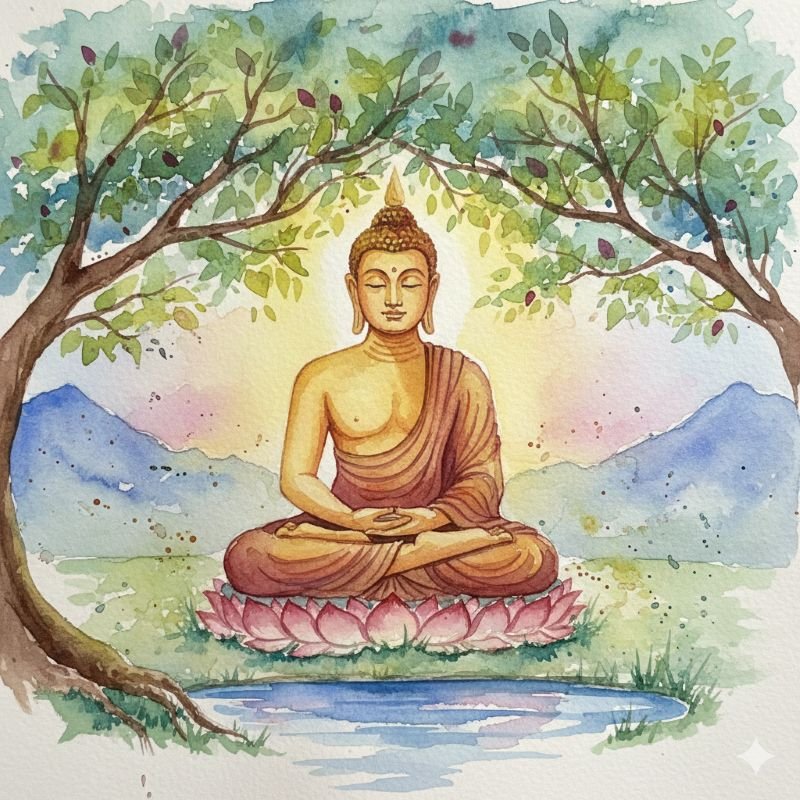
Siddhartha seated himself beneath a sacred fig tree (later known as the Bodhi Tree) in Bodh Gaya, vowing not to rise until he had attained supreme awakening. As he descended into ever-deeper states of concentration, he was assailed by the personified forces of his own mind. The tempter Mara, representing doubt, fear, desire, and death, launched his final assault. He challenged Siddhartha’s right to be there, sent armies of demons, and his beautiful daughters to seduce him. Siddhartha responded not with violence, but by touching the earth, calling it as his witness to the lifetimes of virtue that had led him to this seat. This gesture, the Earth-Touching Mudra, symbolizes unshakeable truth and the grounding of enlightenment in reality itself.
The Three Watches of the Night and Supreme Awakening
Through the night, his insight deepened in three profound stages, known as the Three Watches:
- Knowledge of Past Lives: He recollected his countless previous existences, understanding the endless cycle of birth, death, and rebirth (Samsara).
- Knowledge of the Arising and Passing of Beings: He perceived with divine sight how beings are reborn according to their karma—the moral law of cause and effect.
- Knowledge of the Destruction of the Taints: He fully comprehended the Four Noble Truths, uprooting the fundamental defilements of ignorance, craving, and clinging. At dawn, he attained Nirvana—the extinguishing of the fires of greed, hatred, and delusion. He was now the Buddha, the Awakened One.
Part 4: The Core Teachings – A Framework for Liberation
The Four Noble Truths: The Heart of the Dharma
The Buddha’s enlightenment crystallized into a framework of unparalleled psychological insight: the Four Noble Truths. They are not dogmatic beliefs but a diagnosis and prescription, akin to a physician identifying an illness, its cause, its cure, and the treatment.
- The Truth of Dukkha: Life is marked by dukkha—often translated as suffering, but more accurately as stress, unsatisfactoriness, or inherent insecurity. This encompasses obvious pain and also the subtle discontent that underpins even pleasant experiences, because they are impermanent.
- The Truth of the Origin (Samudaya) of Dukkha: The cause of dukkha is tanha—craving or thirst. This is the relentless desire for sensory pleasure, for becoming, or for non-existence. It is fueled by avijja (ignorance), the fundamental misperception of the nature of reality.
- The Truth of the Cessation (Nirodha) of Dukkha: There is an end to dukkha. The fading and cessation of this craving leads to Nirvana, a state of liberation, peace, and freedom that is unconditioned and beyond suffering.
- The Truth of the Path (Magga) Leading to the Cessation of Dukkha: The way to achieve this cessation is the Noble Eightfold Path.
The Noble Eightfold Path: The Practical Guide
This path is the comprehensive training regimen for awakening, divided into three essential divisions of practice:
- Wisdom (Prajna):
- Right View: Understanding the Four Noble Truths and the nature of reality.
- Right Intention: Cultivating intentions of renunciation (non-grasping), goodwill, and harmlessness.
- Ethical Conduct (Sila):
- Right Speech: Abstaining from lying, divisive, harsh, and idle speech.
- Right Action: Abstaining from killing, stealing, and sexual misconduct.
- Right Livelihood: Earning a living in a way that does not cause harm or suffering.
- Mental Discipline (Samadhi):
- Right Effort: Cultivating wholesome states of mind and abandoning unwholesome ones.
- Right Mindfulness: Developing clear, moment-to-moment awareness of body, feelings, mind, and phenomena (the Four Foundations of Mindfulness).
- Right Concentration: Developing the ability to unify the mind in deep, stable, focused meditation (jhana).
Key Philosophical Insights: Impermanence, Non-Self, and Dependent Origination
- Impermanence (Anicca): The Buddha observed that all conditioned phenomena, from galaxies to emotions, are in constant flux. Nothing remains static. Recognizing this undermines our futile attempts to hold onto experiences and possessions.
- Non-Self (Anatta): Perhaps his most revolutionary teaching. The Buddha analyzed the human being and found no permanent, unchanging soul or self. What we call “I” is a dynamic, interdependent process of five aggregates: form, feeling, perception, mental formations, and consciousness. Understanding anatta releases the deep-seated clinging that is the root of suffering.
- Dependent Origination (Paticca-samuppada): This profound doctrine explains the conditional, interconnected nature of all things. It describes a twelve-linked chain showing how ignorance leads to suffering, and how, by removing ignorance, the entire chain of suffering unravels. It encapsulates the non-accidental, cause-and-effect nature of reality.
Part 5: The Buddha’s Ministry and Final Days
The Decision to Teach and the First Sermon
After his awakening, the Buddha hesitated, wondering if the profound truth he realized could be communicated. Persuaded that some beings with “little dust in their eyes” would understand, he set out to teach. At Deer Park in Sarnath, he delivered his first discourse, “Setting in Motion the Wheel of the Dharma,” to his five former ascetic companions. In this sermon, he outlined the Middle Way and the Four Noble Truths, establishing the Buddhist Sangha (monastic community).
A Life of Wandering and Teaching
For 45 years, the Buddha walked the dusty roads of northeastern India, teaching people from all castes and walks of life—kings and courtesans, merchants and murderers, farmers and philosophers. His teachings were pragmatic, tailored to the understanding of his listeners. He used parables, dialogues, and reasoned argument. He established a thriving monastic order of monks and nuns, providing a dedicated environment for practicing the path to its fullest.
The Final Nirvana (Parinirvana)
At age 80, in the town of Kushinagar, the Buddha lay down between two sal trees. His final words were, “All conditioned things are of a nature to decay. Strive on with diligence.” He then passed into Parinirvana—the final, complete Nirvana beyond the cycle of rebirth. His death was a powerful teaching on impermanence, urging his followers to take responsibility for their own liberation.
Part 6: The Brahmaviharas – Cultivating the Divine Abodes
Central to applying the Buddha’s teachings are the Four Brahmaviharas or “Divine Abidings,” the sublime heart-qualities that are both the means and the fruit of practice.
- Loving-Kindness (Metta): Unconditional, inclusive friendliness. It is the deliberate cultivation of the wish for happiness for oneself and all beings, without exception. Metta meditation systematically breaks down barriers of resentment, ill-will, and prejudice.
- Compassion (Karuna): The quivering of the heart in response to suffering. It is not pity, but the active intention to alleviate suffering where possible, coupled with the courage to bear witness to pain without being overwhelmed.
- Sympathetic Joy (Mudita): The antidote to envy and resentment. It is the ability to rejoice in the good fortune, success, and happiness of others, seeing their joy as one’s own.
- Equanimity (Upekkha): A balanced, composed mind. It is not indifference, but a spacious, peaceful acceptance of the ever-changing flow of life—pleasure and pain, gain and loss, praise and blame. It provides the stable ground from which the other three qualities can operate wisely.
Part 7: The Buddha’s Enduring Relevance for the Modern World
The Buddha’s teachings offer profound tools for contemporary challenges:
- For Mental Well-being: Mindfulness (sati), a core component of his path, is now a mainstream psychological tool for managing stress, anxiety, and depression, validating the Buddha’s ancient map of the mind.
- For Ethical Living: In an interconnected world, the principles of Right Speech, Right Action, and Right Livelihood provide a framework for personal integrity, social justice, and environmental responsibility.
- For Navigating Change: The teachings on impermanence help us accept loss, transition, and uncertainty with greater resilience and less resistance.
- For Social Harmony: The Brahmaviharas offer a direct method to cultivate empathy, bridge societal divides, and build communities rooted in goodwill rather than fear.
The Buddha’s legacy is not a finished scripture but a living invitation—a call to investigation. He urged his followers: “Come and see.” His life demonstrates that awakening is a human potential. His teachings provide a practical, testable path out of suffering and toward a life of profound peace, wisdom, and compassionate action. In a world hungry for meaning and peace, the figure of the Awakened One remains a timeless beacon, showing that true freedom is found not in the outer world, but in the unwavering clarity and boundless compassion of a heart that has understood its own nature.
References & Further Exploration
Documentaries & Video Resources:
- The Buddha – PBS Documentary (Narrated by Richard Gere)
https://www.youtube.com/watch?v=Vc7_VyVXDLs - BBC – The Buddha: Genius Of The Ancient World
https://www.youtube.com/watch?v=ochIScvzcyg - Freedom From Suffering (Documentary)
https://www.youtube.com/watch?v=b0X3ibZCPLw - The Ancient Teachings Of Theravāda Buddhism
https://www.youtube.com/watch?v=4xSBmYJmegs - Understanding the Second Brahmavihara: Compassion in Buddhism
https://www.youtube.com/watch?v=1ALvpAd-H1Q - Metta and Karuna, the “most important” Buddhist practices of Love and Compassion — Zasep Rinpoche
https://www.youtube.com/watch?v=xS4U3nf4In8 - The Paradox of Buddhism: A Religion That’s Not a Religion
https://www.youtube.com/watch?v=gQXe72p73yE
Core Texts & Reading:
8. Access to Insight: “The Dhammapada: The Buddha’s Path of Wisdom”
https://www.accesstoinsight.org/tipitaka/kn/dhp/dhp.intro.budd.html
9. Buddhanet: “The Four Immeasurables” by Master Hsing Yun (PDF)
https://www.buddhanet.net/pdf_file/miao_yun.pdf
10. Lumen Learning: “Buddha’s Teachings | Survey of World Religions”
https://courses.lumenlearning.com/suny-hccc-worldreligion/chapter/buddhas-teachings/
Practical Guides & Articles:
11. Spirit Rock Meditation Center: “The Teachings of the Buddha”
https://www.spiritrock.org/practice-guides/teachings-of-the-buddha
12. The Pursuit of Happiness: “Buddha”
https://www.pursuit-of-happiness.org/history-of-happiness/buddha/
Podcast:
13. “1 – What is Buddhism?” from The Buddhist Society of Western Australia
https://podcasts.apple.com/au/podcast/1-what-is-buddhism/id1546528865?i=1000507073060