
Key Takeaways
- The Buddhist path is a structured, gradual training of the heart and mind, explicitly designed to be undertaken from within the complexities of ordinary life. It is a practical toolkit for reducing suffering here and now.
- The universal framework across all traditions is the Threefold Training in ethical conduct (Sīla), meditative concentration (Samādhi), and liberating wisdom (Paññā). These are sequential and interdependent, like building a house from foundation to roof.
- Different schools offer unique maps and emphases: Theravāda provides a clear, step-by-step gradual training; Mahāyāna expands the motivation to universal compassion via the Bodhisattva’s Six Perfections; Vajrayāna employs transformative methods to recognize the enlightened nature already present.
- Progress is tangible and measurable in daily life: reduced reactivity, greater emotional resilience, a natural increase in kindness, and a shift from being ruled by habits to responding with mindful choice.
- A critical, often overlooked component is wise friendship and community (Kalyāṇamittatā). Practicing alongside others provides indispensable support, inspiration, and corrective feedback.
- The path requires balancing samatha (calm abiding) and vipassanā (insight). One needs both the serene stillness of a settled mind and the clear, investigative light of wisdom to see reality truly.
- For lay practitioners, the entire path is accessible through intentional, consistent micro-practices woven into existing routines. The transformation happens not in spite of your daily life, but precisely through it.
1. Introduction: Why a Gradual Path for a Lay Life?
The image of a Buddhist practitioner is often that of a serene monk in robes, seated in deep meditation in a quiet forest monastery. While this is a venerable and powerful ideal, it can inadvertently suggest that the profound peace of the Dharma is inaccessible to those of us with careers, mortgages, family responsibilities, and the incessant ping of digital notifications. Nothing could be further from the truth.
The Buddha himself taught a path that was, in its very essence, gradual (anupubba). He frequently used metaphors of gradual training: the sea deepens gradually, the slope of the shore inclines gradually, a craftsman slowly becomes skilled. This gradualism is not a concession; it is the fundamental law of spiritual development. It acknowledges that deep, lasting change, the rewiring of our deepest mental and emotional habits, cannot be forced in a single leap. It requires patient, systematic training.
This article is a starter guide for that training, specifically tailored for those of us who walk the path within the lay life. We will move beyond theory into the “how-to,” providing concrete examples, addressing common obstacles, and showing how the classical stages of the path manifest in the school run, the boardroom, the supermarket, and the quiet moments before sleep. The goal is to demonstrate that your life, exactly as it is, contains all the raw material, the joys, the irritations, the relationships, the losses, necessary for profound awakening.
A Note on Language: This guide primarily uses Pali terms, as they are the language of the earliest recorded Buddhist texts and provide a common foundation. Sanskrit terms, which are central to Mahāyāna and Vajrayāna traditions, will be provided in parentheses where they differ significantly or are the more commonly used form in that context (e.g., Paññā [Pali] / Prajñā [Sanskrit]).
2. The Indispensable Foundation: The Threefold Training in Depth
Before exploring different traditions, we must fully understand the core framework that unites them all: the Threefold Training (Tisikkhā). This is the non-negotiable sequence. Attempting to bypass it is like trying to grow a mighty oak in thin, rocky soil.
2.1 Ethical Conduct (Sīla): Cultivating a Blameless Life

What It Really Is: Sīla is often translated as “morality” or “virtue,” which can sound rigid or moralistic. A more helpful understanding is “intentional harmony.” It is a voluntary commitment to live in a way that minimizes the creation of internal and external conflict. The precepts are not commandments from a deity but training rules agreed upon by anyone seeking peace. They work because they are pragmatic: actions rooted in greed, hatred, or delusion (lobha, dosa, moha) inevitably lead to agitation, fear, guilt, and social discord, which poison the mind and make stillness impossible.
The Five Precepts as a Daily Practice Framework:
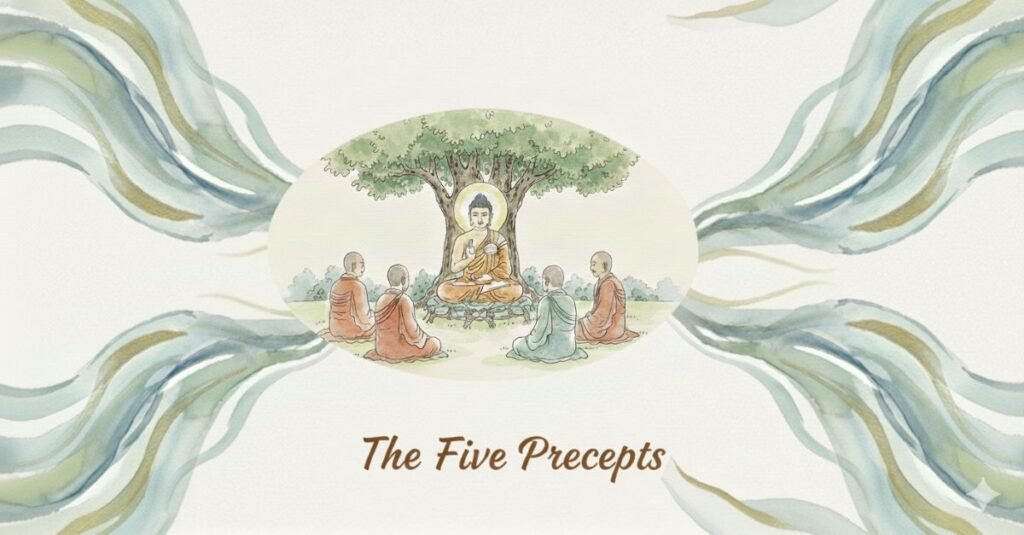
- Refraining from destroying life: This trains in reverence for life and active kindness. It starts with not killing but matures into protecting life. Daily Application: Choosing not to swat a spider but gently relocating it. Not participating in harsh gossip that “kills” someone’s reputation. Consuming food with gratitude and awareness of its origins. In a conflict, pausing before speaking to ensure your words aren’t violently damaging.
- Refraining from taking the not-given: This trains in generosity, contentment, and trustworthiness. It’s about respecting boundaries. Daily Application: Not taking office supplies for personal use. Not wasting a colleague’s time in a meeting (taking their time, which was not given for that). Being scrupulously honest on tax returns. Cultivating gratitude for what you have, which directly weakens the urge to take.
- Refraining from sexual misconduct: This trains in respect, responsibility, and fidelity in relationships. It’s about not using others as objects for personal gratification. Daily Application: Being fully present and respectful with your partner. Avoiding flirtation that could mislead or harm others. Consuming media mindfully, noticing if it stirs up objectification or dissatisfaction. Creating relationships built on trust, not exploitation.
- Refraining from false speech: This trains in truthfulness, reliability, and harmonious communication. Daily Application: The simple, powerful practice of pausing before you speak. Ask: Is it true? Is it kind? Is it necessary? Avoiding exaggeration to make a story better. Having the courage to give honest, gentle feedback rather than gossiping behind someone’s back. Not making promises you can’t keep.
- Refraining from intoxicants that lead to heedlessness: This trains in mindfulness and clarity. It’s about protecting your most precious tool—your mind. Daily Application: Observing how even one glass of wine changes your mindfulness and patience. Noticing if you use social media, Netflix, or busywork as an “intoxicant” to numb difficult feelings. Choosing activities that nourish clarity rather than cloud it.
Why Sīla is Non-Negotiable for Lay Practitioners: Imagine trying to calm your mind in meditation while dreading a confrontation at work because you lied, or feeling a knot of guilt over a harsh word to your child. These unresolved ethical disturbances create a background noise of anxiety and shame that meditation cannot penetrate. Sīla clears the field. When you live with basic integrity, you can sit down to meditate with a mind that is not haunted. You develop a quiet self-respect that becomes the bedrock of your practice.
2.2 Meditative Concentration (Samādhi): Cultivating a Unified Mind
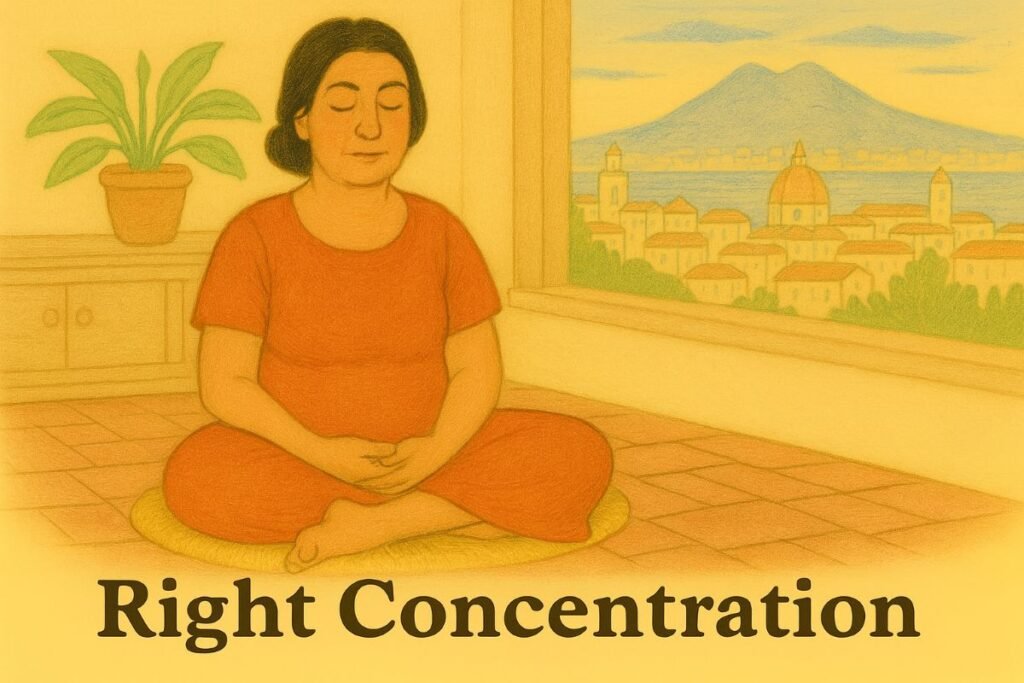
What It Really Is: Samādhi is the collected, steady, pliable state of mind developed through meditation. It is not a trance or a blank void. It is a mind that can stay. When a beautiful or disturbing thought arises, the concentrated mind can observe it without being swept away. This quality is often called “one-pointedness” (ekaggatā).
The Two Wings of Mental Development: Samādhi is developed through two primary, interlinked practices:
- Samatha (Calm Abiding): The development of deep tranquility and stability. The primary method is focusing single-pointedly on an object like the breath (ānāpānasati). The mind becomes quiet, joyful, and still, like a clear, placid lake.
- Vipassanā (Insight): The clear seeing into the true nature of phenomena. While often practiced formally, insight is the wisdom that arises when a calm mind investigates experience. We will explore this under Wisdom.
For lay practitioners, developing Samādhi often begins with samatha to provide the necessary stability.
Detailed Daily Application for Building Samādhi:
- Formal Sitting (The “Mental Gym”):
- Time: Start with 15 minutes. The consistency of daily practice is infinitely more important than the duration. Lock it into your routine like brushing your teeth—perhaps right after waking or just before bed.
- Posture: Sit comfortably upright on a chair or cushion. The spine should be like a stack of coins, upright but not rigid. Hands rest gently in the lap. This posture signals alertness to the mind.
- Object: The natural breath at the nostrils or the rising/falling of the abdomen. Feel the physical sensations. Don’t control it.
- The Simple Instruction: When you notice the mind has wandered (to a plan, a memory, a worry), gently acknowledge it (“thinking,” “planning,” “remembering”) and softly return attention to the breath. This moment of noticing and returning is not a failure; it is the entire practice. It is a rep for your “attention muscle.”
- Example: You’re focusing on the breath. Suddenly, you’re mentally drafting an angry email to a coworker. You notice: “Ah, planning, and there’s anger.” Without berating yourself, you let the thought go and feel the next in-breath. This is a moment of profound freedom, you are no longer lost in the story.
- Informal Practice (Weaving Mindfulness into the Day):
- Mindful Walking: Feel the sensations of your feet touching the ground from your car to the office, or while walking the dog.
- Mindful Listening: In your next conversation, try to listen 100%. Don’t formulate your reply while the other person is talking. Just listen to their words, tone, and presence.
- Mindful Pausing: Set random phone reminders to “pause.” When they chime, stop for three breaths. Feel your body. Notice your mood. This breaks the autopilot.
The Result for Lay Life: The fruit of Samādhi is not just peace on the cushion. It is emotional regulation. When your boss criticizes you, instead of the old cascade of rage and defensiveness, there is a space. In that space, you can feel the heat of the reaction in your body, and you can choose a wiser response. You become less reactive and more responsive.
2.3 Wisdom (Paññā): Cultivating Liberating Insight

What It Really Is: Paññā is not intellectual knowledge. It is direct, experiential understanding of the fundamental characteristics of existence, known as the Three Marks:
- Impermanence (Anicca): All conditioned things; thoughts, feelings, relationships, seasons, life itself, are in constant flux.
- Unsatisfactoriness (Dukkha): Clinging to anything impermanent as if it were permanent leads to stress, disappointment, and a feeling of being off-balance.
- Non-Self (Anattā): Upon close investigation, no permanent, independent, controlling “self” can be found within our ever-changing flow of body and mind.
How Wisdom is Cultivated: Wisdom is born from the marriage of a calm mind (samādhi) and investigative observation (vipassanā). You use your stabilized attention to look deeply at your own experience.
Concrete Practices for Developing Wisdom in Daily Life:
- Investigation of Feeling Tone (Vedanā): Throughout the day, notice the “flavor” of each experience: pleasant, unpleasant, or neutral. The moment your coffee tastes good, note “pleasant.” The moment you hear a harsh noise, note “unpleasant.” The moment you feel the keyboard under your fingers, note “neutral.” This simple practice reveals how much of our life is a blind chase for the pleasant and a blind push-away of the unpleasant. Seeing this chain reaction is wisdom.
- Observing the Rise and Fall: When a strong emotion arises, anxiety before a presentation, joy at good news, don’t get lost in the story. Turn your attention to the physical sensations in the body. Where is the anxiety? A tight chest? Butterflies? Watch these sensations as you would watch clouds pass in the sky. You will see they are not solid; they intensify, change, and eventually dissolve. This is direct experience of anicca and anattā (you are not the anxiety; it is a passing condition).
- Questioning the “Self”: In a moment of insult, the story is “I am hurt!” Wisdom practice asks: What is this “I”? Is it the body? The body changes. Is it the feeling of hurt? The feeling fades. Is it the thought “I am disrespected”? The thought passes. By not finding a solid, permanent victim, the sting of the insult loses its power. This is not a philosophical denial but an experiential inquiry.
The Result for Lay Life: Wisdom transforms your relationship with reality. Losing a job is still painful, but you understand it as part of the impermanent nature of conditions, not a personal failure etched in stone. An argument with a spouse is seen as the clash of two changing sets of conditions (moods, stresses, past hurts), not a war between two fixed, solid selves. This perspective brings immense relief and freedom.
3. The Theravāda Path: The Gradual Training (Anupubbasikkhā) in Detail
The Theravāda tradition, preserved in the Pali Canon, offers the most explicit blueprint of the gradual path, beautifully laid out in discourses like the Samaññaphala Sutta (The Fruits of the Contemplative Life).

3.1 The Sequential Stages for a Household Practitioner
Let’s walk through these stages with a modern lay practitioner, “Elena,” a project manager and mother of two.
- Hearing the True Teaching and Gaining Confidence (Saddhā): Elena feels stressed and perpetually busy. She stumbles upon a Buddhist podcast about mindfulness. The teaching on stress having a cause and a path to its end resonates logically. She feels a spark of trust; not blind faith, but a reasoned confidence that this path might work. This is the essential starting point.
- Taking Refuge and Undertaking the Precepts: Inspired, Elena finds a local meditation group. During a session, she formally “takes refuge“, she aligns her inner compass with the Buddha (the potential for awakening), the Dhamma (the teachings/path), and the Sangha (the community). She also consciously adopts the Five Precepts as her ethical guidelines. This formalizes her intention.
- Cultivating Contentment and Guarding the Senses: Now Elena begins internal work. Contentment means she consciously appreciates what she has; a safe home, her health, reducing the background anxiety of “not enough.” Guarding the senses is crucial. When she scrolls social media and sees a friend’s vacation photos, she feels a pang of envy (pleasant feeling leading to craving). Her practice is to notice the visual input, notice the feeling, and not pursue the mental storyline (“My life is boring, I need a holiday…”). She gently disengages the mind from the tempting bait. This is not repression; it is wise restraint, saving immense mental energy.
- Mindfulness and Clear Comprehension in All Activities: This becomes Elena’s main daily practice. Mindfulness (Sati) is her watchful presence. Clear Comprehension (Sampajañña) has four aspects she applies:
- Purpose: “Am I doing this for a skillful purpose?” (e.g., Am I checking email to be productive or to avoid a difficult task?)
- Suitability: “Is this action suitable for the path?” (e.g., Is this gossip I’m about to share helpful or harmful?)
- Domain: “Can I stay mindful in this ‘domain’ of activity?” (e.g., Can I remain aware of body and mind while cooking dinner for my hungry, arguing kids?)
- Non-delusion: Seeing the action with wisdom, “This typing is just a mind directing a body. This irritation is just a fleeting mental state.”
- Overcoming the Five Hindrances for Deep Meditation: When Elena sits to meditate, she meets the classic obstacles:
- Sensual Desire: Craving for a nice meal, a distraction.
- Ill-will: Replaying an argument.
- Sloth & Torpor: Dullness, sleepiness.
- Restlessness & Worry: Mental agitation about future tasks.
- Doubt: “Is this working? Maybe I’m not cut out for this.”
Her practice is to recognize each hindrance by name. For restlessness, she might tighten her focus on the breath. For ill-will, she might briefly practice loving-kindness toward the person she’s arguing with. She learns these are not personal failings, but universal mental states to be understood and gently set aside.
- Developing the Jhānas (Meditative Absorptions): With the hindrances subdued, Elena’s mind can access deeper states of calm, joy, and unified focus. While full jhāna often requires dedicated retreat time, lay practitioners can experience glimpses, moments of profound stillness and inner light during a calm sit. These states provide a powerful antidote to the weariness of daily life and a profound proof that happiness can be independent of external conditions.
- Realizing Insight and the Stages of Enlightenment: Using her calm, bright mind, Elena turns insight (vipassanā) on her own experience. She sees directly the impermanence of all her thoughts and moods, the stress in clinging, and the illusory nature of a fixed “Elena.” A moment of deep realization might occur when, in a traffic jam, she suddenly sees her rage as an impersonal storm of energy, not “her” rage. This is a moment of stream-entry. The path then deepens through further stages as these insights become unshakable.
3.2 Theravāda Practice for the Modern Householder: A Week in the Life
- Morning (6:00 AM): 20-minute sitting meditation, focusing on breath to calm the mind for the day. Sets an intention: “Today, I will practice patient speech.”
- Commute (8:00 AM): Mindful driving. Feeling the hands on the wheel. When cut off, noticing the anger flare and fade in the body, choosing not to fuel it with horn or curse.
- Work (10:00 AM): Difficult meeting. Practicing clear comprehension: “My purpose is to solve a problem, not win an argument.” Listening mindfully.
- Lunch (1:00 PM): Eating mindfully, savoring three bites. Reflecting on the source of the food with gratitude.
- Home (6:00 PM): “Domain” practice. Being fully present with family, even amidst chaos. Not retreating mentally to work emails.
- Evening (9:00 PM): 10-minute reflection. Reviewing the day with kindness. Where was she patient? Where was she reactive? Learning, not judging.
- Weekend: One hour of dedicated meditation. A longer walk in nature, observing impermanence in the clouds and leaves. Reading a sutta or Dharma book.
4. The Mahāyāna Path: The Vast Motivation of the Bodhisattva

The Mahāyāna path encompasses traditions like Zen, Pure Land, and Tibetan Buddhism (before its Vajrayāna elements). Its radical re-framing lies in the motivation: the aspiration to attain full awakening (buddhahood) for the sake of all sentient beings. This is Bodhicitta (Sanskrit).
4.1 Understanding Bodhicitta: The Two Stages
- Aspirational Bodhicitta: The heartfelt wish, “May I become a Buddha to liberate all beings from suffering.” This is the compass direction.
- Engaged Bodhicitta: The actual engagement in the practices of the Six Perfections (Pāramitās, Sanskrit) to realize that wish. This is walking the path.
For a layperson like “David,” a software engineer, generating Bodhicitta means his long commute, his debugging sessions, and his family dinners are no longer mundane. They are the field for cultivating the perfections to benefit his colleagues, users, and family.
4.2 The Six Perfections: A Lay Bodhisattva’s Training Manual
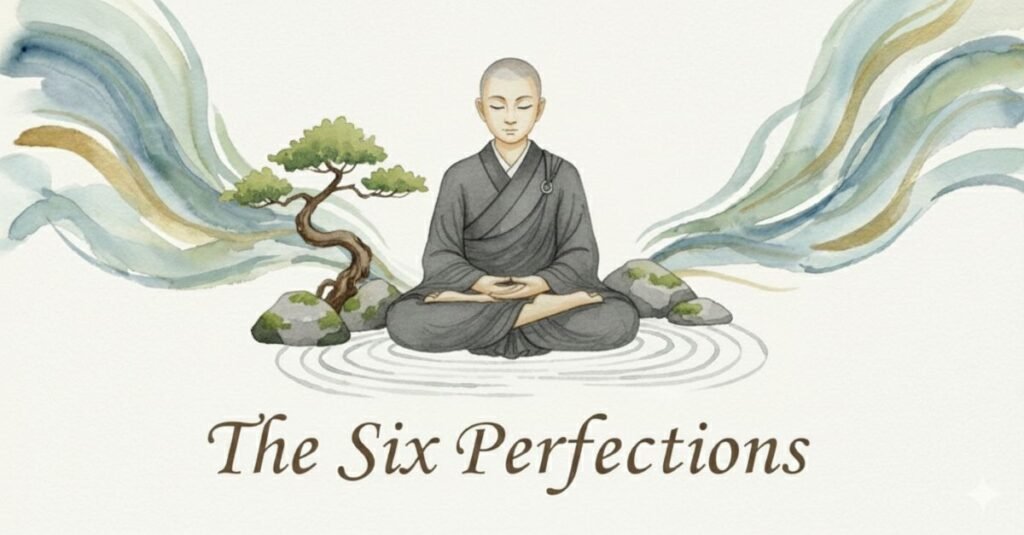
Let’s explore each perfection with David’s life as our example:
- Generosity (Dāna):
- Material: Donating to a charity, buying lunch for a stressed coworker.
- Fearlessness: Calming a frightened child, offering emotional support to a friend.
- Dharma: Sharing a helpful teaching or a moment of mindful listening.
- David’s Practice: He volunteers to mentor a junior colleague (giving time/Dharma). When his partner is anxious, he simply listens without trying to fix it (giving fearlessness).
- Ethical Discipline (Śīla, Sanskrit): This includes the basic precepts but is supercharged by Bodhicitta. It becomes actively benefiting others and avoiding harm. David practices this by writing clean, well-documented code (not causing confusion for others), by refusing to participate in deceptive business practices, and by being impeccably honest and kind in his code reviews.
- Patience (Kṣānti, Sanskrit):
- Patience with Others: When a teammate misses a deadline, David works on responding with constructive help rather than irritation.
- Patience with Hardship: When his project is canceled, he practices accepting the disappointment without falling into bitterness.
- Patience with the Dharma: He is patient with his own slow progress in meditation, understanding the path is gradual.
- David’s Practice: In a traffic jam, he uses the time to listen to a Dharma talk (transforming the hardship). He patiently endures the “heat” of his own anger without acting on it.
- Joyful Effort (Vīrya, Sanskrit): This is not grim endurance but enthusiastic perseverance in virtue. It’s finding joy in the practice itself. David finds joy in his morning meditation ritual. He tackles a difficult programming problem with the spirit of a Bodhisattva mastering a perfection. He guards his mind against the “inner laziness” of endless scrolling by recalling his Bodhicitta vow.
- Meditative Concentration (Dhyāna, Sanskrit): David’s meditation practice includes samatha but also specific Mahāyāna methods:
- Loving-Kindness (Mettā) Meditation: Systematically sending wishes for happiness to himself, a friend, a neutral person, a difficult person, and all beings. This directly erodes his self-centeredness.
- Exchanging Self and Other (Tonglen, Tibetan): On the in-breath, he visualizes taking in the stress and confusion of his overworked team. On the out-breath, he sends them relief, clarity, and peace. This is a radical, heart-opening practice.
- Wisdom (Prajñā, Sanskrit): In Mahāyāna, the ultimate wisdom is realizing Emptiness (Śūnyatā, Sanskrit), that all phenomena, including his “self,” his “code,” and his “problems,” lack inherent, independent existence. They exist like a movie, appearing vividly but ultimately composed of interdependent, fleeting parts (causes, conditions, perceptions).
- David’s Application: When he receives harsh criticism, instead of solidifying into a wounded “self,” he investigates: The criticism is just words (empty). The feeling of hurt is a fleeting sensation (empty). The critic is a person acting from their own causes and conditions (empty). This doesn’t make the situation irrelevant, but it deflates the solid, painful story around it, allowing for a wiser, less defensive response.
4.3 Zen and Pure Land: Paths within Mahāyāna
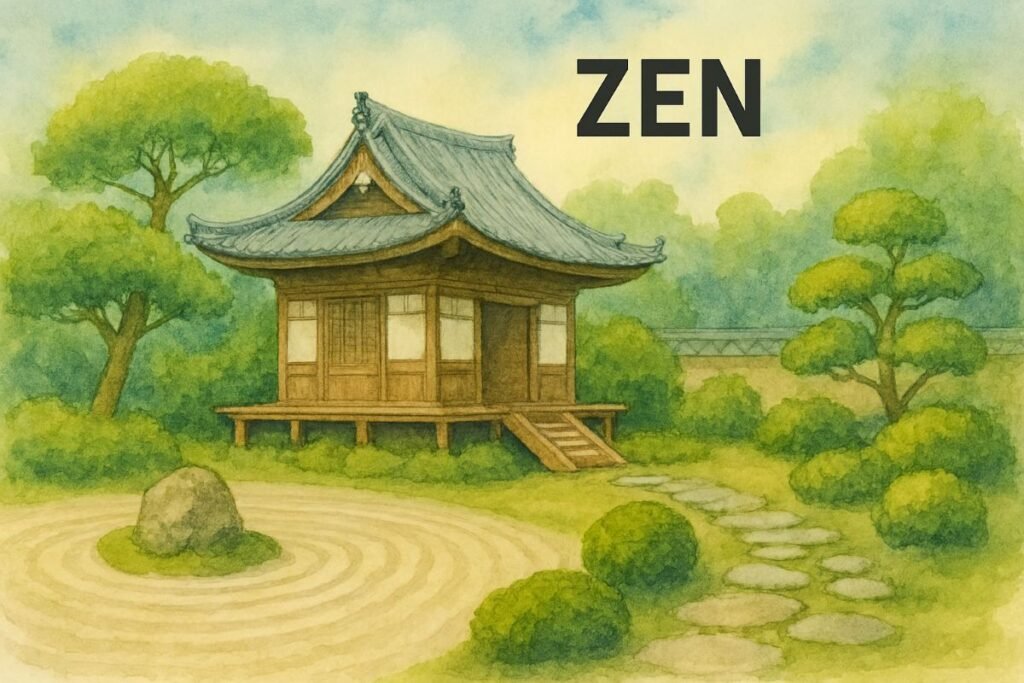
- Zen (Chán): Emphasizes direct insight into one’s true nature, often through silent sitting (zazen), paradoxical dialogues (koans), and mindful simple work (samu). For a lay practitioner, Zen manifests as bringing total, undivided attention to the present task; washing a cup, writing a line of code, hearing the rain. “When walking, just walk. When sitting, just sit.” This utter presence is the door to wisdom.
- Pure Land: Emphasizes faith in and devotion to Amitabha Buddha, who presides over a “Pure Land”, a realm conducive to awakening. The core lay practice is the mindful recitation of Amitabha’s name (Nianfo in Chinese, Nembutsu in Japanese). This practice, done throughout the day, is a powerful method to concentrate the mind, cultivate gratitude and humility, and align one’s heart with boundless compassion. For a busy parent, reciting the name while folding laundry or driving transforms chores into devotional practice.
5. The Vajrayāna Path: The Path of Transformation with Crucial Caveats
Vajrayāna, the tantric vehicle found in Tibetan Buddhism, is a subset of Mahāyāna. It uses “skillful means” to achieve the Mahāyāna goal of buddhahood, but with methods designed for rapid transformation. Its core premise is that enlightenment is not something to be achieved in the future, but the innate nature (buddha-nature) of our present mind, obscured by temporary adventitious stains.
A REQUIRED WARNING: Authentic Vajrayāna practice is guru-centric, requires formal initiation (empowerment or wang), and precise guidance. It is a profound but potentially misleading path if practiced incorrectly. This section is for understanding only. Practice must come from a qualified teacher.
5.1 The Unique View: Pure Perception
While Theravāda and Mahāyāna often frame practice in terms of renouncing impurity, Vajrayāna emphasizes transforming perception. Our ordinary body, speech, and mind are seen as already being, in their essential nature, the body, speech, and mind of a Buddha. The path is about recognizing this.
- Our impure perception: We see a ordinary world, our flawed body, our confused emotions.
- The pure reality: These are, in nature, a mandala of enlightened beings, a deity’s form, and displays of wisdom energy.
5.2 Practices Accessible to the Committed Lay Practitioner
For a layperson like “Anya” who has connected with a genuine teacher and lineage, the entry point is almost always:
1. The Preliminary Practices (Ngöndro, Tibetan): These are not mere prerequisites; they are the foundation and, for many, the main practice for years. They systematically purify obstacles and accumulate the merit and wisdom needed for higher practices.
- Prostrations: Physical prostrations while reciting a refuge prayer. This purifies pride, cultivates humility, and aligns body, speech, and mind with the enlightened lineage.
- Vajrasattva Mantra: Recitation of a 100-syllable mantra for purification of negative karma and broken vows.
- Mandala Offerings: Symbolically offering the entire universe to the enlightened beings to accumulate merit and cultivate generosity.
- Guru Yoga: The heart of the practice. Merging one’s mind with the enlightened mind of the guru, seen as the living embodiment of the Buddha, Dharma, and Sangha.
Anya’s Practice: She wakes up an hour early to complete a session of prostrations and mantra before her family wakes. This becomes her anchor. The physicality of prostrations works with her energy. The mantra recitation during her subway commute transforms that time. She sees her teacher not as an ordinary person, but as the doorway to her own buddha-nature.
2. Integrating the View in Daily Life: Even without formal deity yoga, a layperson can practice the transformative view.
- When anger arises: Instead of “I am angry,” the Vajrayāna practitioner might think, “This intense energy, in its essential nature, is the clear, penetrating wisdom of mirror-like awareness. It is not good or bad. Can I recognize its empty, luminous nature?” This is a complete re-framing.
- Perceiving the Environment: Walking through the city, one can briefly contemplate that everything perceived, the buildings, the people, the noise, is, in its true nature, a radiant display of emptiness and compassion, like a dream or a hologram. This loosens solid, stressful perceptions.
5.3 The Centrality of the Guru and the Need for Discernment
The guru-student relationship is the cornerstone of Vajrayāna. The guru is the guide, the conduit of blessing, and the living example of the fruition of the path. This makes the careful, patient discernment in choosing a teacher the most important practice of all. A student must observe a potential teacher for years, checking their alignment with the Dharma, their ethical conduct, their students’ well-being, and the authenticity of their lineage.
For the Interested Layperson: Your practical step is not to seek out tantric initiations. It is to study the foundational Mahāyāna teachings (Bodhicitta, emptiness), cultivate a daily sitting practice, and if drawn to this path, begin to look for a genuine community and teacher with extreme care, patience, and discernment.
6. Synthesis and Practical Integration: Building Your Lay Path
The stages from all traditions point to a unified process of maturation. Here is how to build your personal path.
6.1 The Essential First Steps (Months 1-6)
- Establish a Motivation: Start with simple, honest motivation: “I want to be less stressed and more kind.” Gradually nurture it toward Bodhicitta: “May my practice benefit others too.”
- Commit to the Precepts: Take the Five Precepts seriously as a daily mindfulness experiment. Observe how keeping them affects your inner peace.
- Start Formal Meditation: 15 minutes daily, focusing on the breath. Use an app or timer. The goal is not special states, but consistency.
- Find Community: Join a local sitting group, an online sangha, or a course. This provides support and answers questions.
6.2 Deepening the Practice (Year 1 and Beyond)
- Extend Mindfulness: Practice mindfulness in one daily routine activity—showering, drinking tea, walking to your car.
- Study the Dharma: Read one book a month. Start with introductory books by respected teachers like Thich Nhat Hanh, Pema Chödrön, or the Dalai Lama.
- Go on Retreat: A weekend or week-long silent retreat is transformative. It provides immersion to deepen samādhi and insight.
- Incorporate Heart Practices: Add 5 minutes of loving-kindness (mettā) meditation at the end of your sitting.
- Find a Mentor/Teacher: As questions deepen, seek out more experienced guidance.
6.3 Navigating Common Lay Challenges
- Irregular Schedule: Have a non-negotiable minimum. Even 5 minutes of mindful breathing is better than zero. Have a “portable practice” like mindful listening or walking for chaotic days.
- Family Skepticism: Don’t preach. Practice quietly. The best teaching is your increased patience, kindness, and presence. Let them ask questions.
- Doubt and Dry Spells: Every practitioner experiences them. See them as hindrances to be understood, not as signs of failure. Return to the basics: precepts, breath, kindness. Trust the process.
- Integrating Practice at Work: Use your work as the field for perfections: patience with colleagues (Kṣānti), diligent effort (Vīrya), honest speech (Śīla). Before a meeting, take one mindful breath. Use your lunch break for a short walk or silent eating.
6.4 The Role of Joy and Equanimity
The path is not a grim austerity. The Buddha called it “ehipassiko“, “come and see.” It invites you to discover a happiness not dependent on conditions (sukha). As wisdom deepens, it matures into equanimity (upekkhā)—a balanced mind that meets the eight worldly winds (pleasure/pain, gain/loss, fame/disrepute, praise/blame) with steadiness. You learn to enjoy life’s pleasures without clinging and to bear its pains without collapsing. This unshakable balance is the ultimate fruit of the gradual path for a lay practitioner, allowing you to engage fully in the world with a heart that is, at last, truly at home.
Glossary of Key Terms
| English Term | Pali/Sanskrit/Tibetan Term | Explanation |
|---|---|---|
| Bodhicitta | Bodhicitta (Skt) | The “Awakening Mind,” the heartfelt aspiration to attain enlightenment for the benefit of all beings. The entry point to the Mahāyāna path. |
| Bodhisattva | Bodhisattva (Skt) | A being who has generated Bodhicitta and trains in the perfections, aiming for buddhahood to liberate all sentient beings. |
| Dukkha | Dukkha (Pali) / Duḥkha (Skt) | Unsatisfactoriness, stress, suffering. The inherent instability and inability of conditioned phenomena to provide lasting satisfaction. |
| Equanimity | Upekkhā (Pali) / Upekṣā (Skt) | Mental balance, impartiality, and calmness. The ability to remain centered amidst life’s ups and downs, free from craving and aversion. |
| Five Hindrances | Nīvaraṇa (Pali) | The five mental states that obstruct meditation and wisdom: sensual desire, ill-will, sloth & torpor, restlessness & worry, and doubt. |
| Five Precepts | Pañca-sīla (Pali) | The basic ethical training for lay Buddhists: to refrain from killing, stealing, sexual misconduct, false speech, and intoxication. |
| Jhāna | Jhāna (Pali) / Dhyāna (Skt) | States of deep meditative absorption characterized by profound stillness, joy, and one-pointedness. |
| Kalyāṇamittatā | Kalyāṇamittatā (Pali) | Spiritual friendship. Association with wise, virtuous, and supportive companions on the path, considered essential for progress. |
| Loving-Kindness | Mettā (Pali) / Maitrī (Skt) | Unconditional, friendly goodwill and benevolence towards all beings. Cultivated through specific meditation practices. |
| Ngöndro | Ngöndro (Tibetan) | The preliminary practices in Vajrayāna Buddhism, including prostrations, mantra, mandala offerings, and guru yoga. |
| Pāramitā | Pāramitā (Skt) | “Perfection.” The six (or ten) transcendent qualities cultivated by a Bodhisattva: generosity, ethics, patience, joyful effort, concentration, and wisdom. |
| Samatha | Samatha (Pali) / Śamatha (Skt) | “Calm abiding.” Meditation practices aimed at developing deep tranquility, concentration, and mental stability. |
| Sangha | Saṅgha (Pali/Skt) | The spiritual community. Broadly, all practitioners; more specifically, the community of ordained monastics. |
| Tonglen | Tonglen (Tibetan) | “Sending and Taking.” A Mahāyāna meditation where one visualizes taking in the suffering of others on the in-breath and sending them happiness on the out-breath. |
| Vipassanā | Vipassanā (Pali) / Vipaśyanā (Skt) | “Insight.” The clear, direct seeing into the true nature of reality (impermanence, suffering, non-self). Often developed on the foundation of samatha. |
References & Further Resources
Books
- For a Comprehensive Overview: The Heart of the Buddha’s Teaching by Thich Nhat Hanh. A crystal-clear, practical guide to core concepts.
- For the Theravāda Gradual Training: In the Buddha’s Words edited by Bhikkhu Bodhi. An anthology of key suttas from the Pali Canon, with excellent commentary.
- For the Mahāyāna Bodhisattva Path: The Way of the Bodhisattva (Bodhicaryāvatāra) by Shantideva. The timeless classic. The translation and commentary by the Padmakara Translation Group is superb.
- For Practical Lay Integration: After the Ecstasy, the Laundry by Jack Kornfield. A wise and compassionate guide to the long-term path, including family, work, and community.
- For Vajrayāna Foundations: The Words of My Perfect Teacher by Patrul Rinpoche. The definitive guide to the preliminary practices and the entire Tibetan Buddhist path view.
Websites & Articles
- Access to Insight: A massive, free library of Theravāda scriptures and modern commentaries. Essential for primary source study.
- Lion’s Roar Magazine: Offers contemporary Buddhist teachings, interviews, and advice from all traditions, highly relevant to modern lay life.
- Dharma Seed: A vast archive of freely downloadable Dharma talks from respected teachers across Theravāda and Insight Meditation traditions.
- Buddhist Learning Center: Explorea site that interests you for more articles on specific practices like meditation, loving-kindness, and working with emotions.
Audio & Video
- YouTube: Ajahn Brahmali: Offers deeply insightful and scholarly yet accessible talks on Theravāda doctrine and practice.
- Podcast: Metta Hour with Sharon Salzberg: Focuses on loving-kindness, meditation, and interviews with teachers, emphasizing practical application.
- YouTube: Yongey Mingyur Rinpoche: A Tibetan teacher who excels at explaining meditation, neuroscience, and dealing with anxiety in an accessible, joyful manner.
- Audio: Tara Brach’s Website: Hosts hundreds of free talks and guided meditations that blend Buddhist psychology with Western therapeutic understanding, ideal for lay practitioners.