Key Takeaways
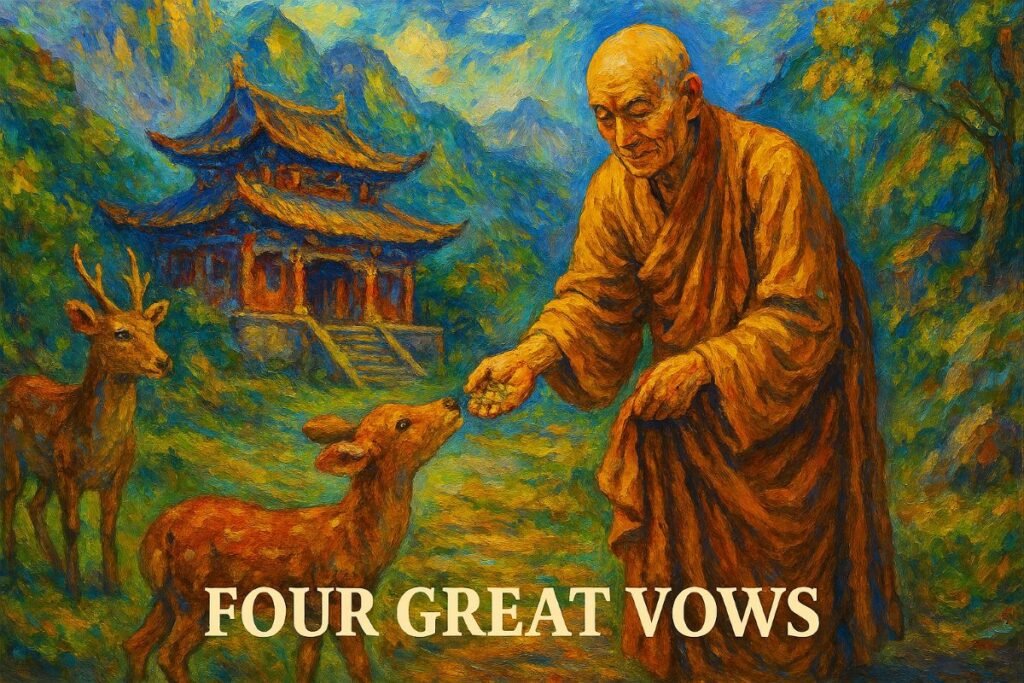
- The Four Great Bodhisattva Vows (Catur-mahā-pranidhāna in Sanskrit) are the central ethical and motivational framework of Mahayana Buddhism, expressing the radical aspiration to attain enlightenment for the benefit of every living being.
- They transform the spiritual path from a personal project of liberation into a communal, compassionate mission, emphasizing that wisdom and compassion are inseparable.
- The vows are intentionally vast and seemingly impossible, designed to cultivate boundless intention, humble perseverance, and a lifelong orientation away from self-centeredness.
- They are deeply connected to the core Buddhist teachings of the Four Noble Truths and are actualized through practices like the Six Perfections (generosity, ethical conduct, patience, joyful effort, meditation, and wisdom).
- Practical application involves “living by vow” in daily life, using these commitments as a lens through which to view our actions, speech, and thoughts, turning ordinary moments into opportunities for awakening.
- Common misunderstandings include seeing the vows as literal, completable tasks or believing Bodhisattvas selfishly delay enlightenment, rather than understanding them as an expression of enlightened activity itself.
- Engaging with these vows can bring profound meaning, resilience, and a sense of interconnected purpose to modern life, applicable for anyone seeking to live with greater compassion and awareness.
1. Introduction: An Infinite Promise in a Finite World
In a world often measured by quarterly results, completed to-do lists, and personal achievement, the Four Great Bodhisattva Vows stand as a majestic and humbling counterpoint. They are not goals to be checked off but a direction in which to orient one’s entire being. Belonging to the heart of Mahayana Buddhism, these vows represent the solemn commitment of a Bodhisattva, a being dedicated to attaining enlightenment not for solitary peace, but for the liberation of all sentient beings from suffering.
Imagine standing on the shore of an endless ocean, vowing to empty it using only a single spoon. The act is not one of folly, but of profound orientation. The vow redefines the meaning of the spoon and every movement of your arm. Similarly, these vows redefine the purpose of a human life. They are a compass that points always toward compassion, a commitment that turns everyday actions into steps on a sacred path. This article will explore the depth, history, practical application, and transformative power of these four great promises, making their ancient wisdom accessible for our modern lives.
2. What Are the Four Great Bodhisattva Vows?
The vows are most commonly recited in the following form in East Asian Zen, Chan, and Pure Land traditions. Their poetic simplicity belies a universe of meaning:
- Sentient beings are numberless; I vow to save them all.
- Delusions are inexhaustible; I vow to end them all.
- Dharma gates are boundless; I vow to enter them all.
- The Buddha Way is unsurpassable; I vow to attain it.
(Note: Some Mahayana traditions may present the vows in a different order, such as placing the vow to master teachings before the vow to end delusions. The essential meaning and commitment remain unchanged.)
At first glance, they can seem overwhelming, even illogical. How can one person save numberless beings? This is precisely the point. The vows are designed to shatter our limited, goal-oriented mindset and introduce us to a perspective of boundless capacity and infinite time, the perspective of what is called Bodhicitta [Sanskrit], the awakened heart-mind of compassion and wisdom. They are less about accomplishment and more about the quality of one’s intention and the direction of one’s effort.
3. Origin and Historical Context: The Flowering of the Bodhisattva Ideal
3.1 The Mahayana Tradition
The Four Great Vows are a definitive expression of the Mahayana (“Great Vehicle”) Buddhist tradition, which began to emerge as a distinct movement around the 1st century BCE to 1st century CE. Mahayana Buddhism distinguishes itself by centering its path on the Bodhisattva ideal as the universal spiritual vocation, rather than focusing on the Arhat ideal of personal liberation. The Bodhisattva’s path is characterized by two central motivations: great compassion (mahakaruna) for all beings and wisdom (prajna) that sees the true nature of reality.
3.2 Scriptural and Liturgical Development
The standard four-line formulation likely crystallized within Chinese Buddhism between the 5th and 7th centuries CE. Their essence is deeply rooted in earlier Mahayana scriptures, particularly the Avatamsaka Sutra (Flower Ornament Scripture) and the vast Perfection of Wisdom (Prajnaparamita) literature. The latter includes texts like the Heart Sutra and the Diamond Sutra, which elaborate on the Bodhisattva’s journey of cultivating the Six Perfections (Paramitas). The four vows serve as a succinct, vow-based summary of this vast path.
They became a standard part of Mahayana liturgy, particularly within Chan (Chinese) and Zen (Japanese) Buddhism. The great Sixth Zen Patriarch, Hui Neng, offered a profound interior interpretation in the Platform Sutra, emphasizing that “the sentient beings to be saved are within your own mind.” This teaches that the “numberless beings” also represent our own endless streams of greedy, hateful, and confused thoughts, which we vow to liberate through wisdom. Today, the vows are recited daily in monasteries and practice centers across Zen, Pure Land, and other East Asian Mahayana schools. In Tibetan Vajrayana Buddhism, equivalent aspirations form the core of the Bodhisattva vow ceremony as systematized by masters like Asanga and Atisha, though the precise four-line formula is less common.
3.3 Connection to the Four Noble Truths
The vows are not a standalone teaching but are profoundly linked to the Buddha’s first and most fundamental teaching: the Four Noble Truths. This connection, often taught in commentaries, provides a powerful framework for understanding the vows’ logic:
- First Noble Truth (The truth of suffering): Corresponds to the First Vow. Recognizing the universality of suffering (dukkha) in “numberless sentient beings” is what motivates the vow to save them.
- Second Noble Truth (The truth of the cause of suffering): Corresponds to the Second Vow. The “inexhaustible delusions” are the craving and ignorance that cause suffering, which the Bodhisattva vows to end.
- Third Noble Truth (The truth of the cessation of suffering): Corresponds to the Fourth Vow. “The unsurpassable Buddha Way” is the state of Nirvana, the cessation of suffering, which is vowed to be attained.
- Fourth Noble Truth (The truth of the path): Corresponds to the Third Vow. The “boundless Dharma gates” are the innumerable teachings and methods that comprise the path to the end of suffering.
Thus, the vows can be seen as an active, personal commitment to engage with the foundational truths of existence.
4. Why Are These Vows Important? From Philosophy to Heartfelt Compass
Their importance is multifaceted, touching the ethical, motivational, and psychological dimensions of practice.
1. They Provide an Ethical North Star: In complex moral landscapes, the first vow, “I vow to save all beings”, acts as a guiding princ iple. Before acting, speaking, or even thinking, one can ask: “Does this contribute to the welfare of others? Does it alleviate suffering or add to it?” This frames ethics not as a set of rigid rules, but as a flowing, context-sensitive expression of care.
2. They Cultivate Boundless Intention (Bodhicitta): The vows are the primary method for generating and sustaining Bodhicitta. By repeatedly aspiring for the impossible, the heart-mind stretches beyond its self-referential limits. We move from “I hope I feel better” to “May all beings be free from suffering.” This shift is the very engine of the Mahayana path.
3. They Foster Humility and Patience: Facing the infinite scope of the vows naturally dissolves arrogance and instills a patient, persevering attitude. One learns to find joy in the effort itself, in the next act of kindness, the next moment of mindfulness, rather than in a distant, final achievement. This aligns with the teaching of non-attachment to results.
4. They Integrate Wisdom and Compassion: The second and third vows (ending delusions, mastering teachings) emphasize wisdom and understanding. The first and fourth vows emphasize compassionate action and ultimate liberation. Together, they ensure the path is balanced. As expressed throughout the Perfection of Wisdom literature, the essence of the Bodhisattva is the union of compassionate concern for all beings with the wisdom that sees the empty, non-dual nature of reality.
5. Common Confusions and Misunderstandings
Misunderstanding 1: The Vows Are Literal, Achievable Goals.
- Clarification: Interpreting the vows as finite tasks leads to inevitable frustration and burnout. They are aspirational and directional. Their function is to establish a “setting” for one’s life, like setting the sails on a boat. You may never reach the horizon, but the setting determines your entire journey. The Zen teacher Robert Aitken called them a “magnet” that draws us forward.
Misunderstanding 2: Bodhisattvas Selfishly Delay Their Own Enlightenment.
- Clarification: This is a profound distortion. The Bodhisattva path is not about postponing enlightenment (Bodhi) but about realizing its true nature: that enlightenment is inseparable from compassionate activity. The Vimalakirti Nirdesa Sutra powerfully states that because samsara (the cycle of suffering) and nirvana (liberation) are not different, a Bodhisattva can remain active in the world without being stained by it. The vow to attain the unsurpassable Buddha Way is a vow to realize this non-dual wisdom.
Misunderstanding 3: “Saving” Beings Implies a Savior Complex.
- Clarification: The Chinese character used for “save” (du) means “to ferry across.” The Bodhisattva is not a superhero plucking beings from danger. She is more like a guide, showing the path, providing the tools (the Dharma), and offering encouragement. The actual “crossing” is done by each being through their own effort and understanding. As the Diamond Sutra reminds us, a true Bodhisattva helps countless beings without harboring the concept of a “being” who is being helped.
6. A Deep Dive into Each Vow: Meaning and Modern Application
6.1 First Vow: Sentient beings are numberless; I vow to save them all.
- Core Meaning: This is the vow of great compassion (mahakaruna). “Sentient beings” refers to all life forms with consciousness and the capacity to feel suffering and happiness. “To save” (du) means to help them cross from the shore of suffering, confusion, and cyclic existence (samsara) to the shore of liberation, wisdom, and peace (nirvana). As Hui Neng pointed out, this also applies internally: we vow to liberate the numberless afflicted mental states within our own mind.
- Practical Application: This vow moves compassion from a feeling into a principled commitment. It asks us to actively look for opportunities to reduce suffering.
- Example: Maya, a project manager, notices a new intern, Leo, is overwhelmed and isolated. An unskillful response, driven by busyness, might be to ignore him. A skillful response, aligned with the first vow, would be for Maya to take five minutes to check in, offer clear guidance, or introduce him to the team. She is “ferrying” a moment of Leo’s confusion towards clarity and connection. On a larger scale, this vow informs choices about career, consumption, and citizenship, steering us toward roles and actions that benefit the wider community and ecology.
6.2 Second Vow: Delusions are inexhaustible; I vow to end them all.
- Core Meaning: This is the vow of wisdom and self-purification. “Delusions” (kleshas in Sanskrit) are the mental afflictions that cloud our mind and cause harmful actions: greed, hatred, arrogance, doubt, and most fundamentally, ignorance (avidya), the mistaken belief in a separate, permanent self. The vow is to uproot these not just in their surface manifestations, but at their core.
- Practical Application: This vow is practiced through mindful self-awareness and ethical discipline. It’s about catching the arising of a delusion and applying an antidote.
- Example: David is cut off in traffic. The initial, unskillful reaction is a surge of anger (the delusion of hatred), followed by thoughts of revenge. Remembering the second vow, David practices a skillful response. He notices the anger as a physical sensation (“heat in my chest”), labels it mentally (“anger arising”), and does not fuel it with more stories. He might even use the moment to reflect: “The other driver is probably suffering from hurry or distraction, just as I have been. This anger is a poison in my mind right now.” This mindful pause, as taught in the Satipatthana Sutta (MN 10), the Discourse on the Foundations of Mindfulness, is the process of “ending” that particular manifestation of the delusion.
6.3 Third Vow: Dharma gates are boundless; I vow to enter them all.
- Core Meaning: This is the vow of lifelong learning and skillful means. “Dharma gates” are the countless entry points into understanding the truth: meditation methods, philosophical teachings, ethical guidelines, rituals, and even art or nature. No single teaching is sufficient for all beings, so the Bodhisattva vows to be endlessly curious and adaptable, mastering many methods in order to help others according to their needs.
- Practical Application: This counters spiritual rigidity. It encourages study, dialogue, and the humble acknowledgment that we always have more to learn.
- Example: Priya, a long-time meditation practitioner, struggles to help her skeptical brother, Sam, who is dealing with anxiety. Just telling him to “watch his breath” doesn’t work. Honoring the third vow, Priya explores other “Dharma gates.” She learns about mindful movement from yoga, finds accessible books on Buddhist psychology, and discovers Sam responds well to metaphors from science. She skillfully uses these different “gates” to offer him tools he can connect with, rather than insisting on her preferred method.
6.4 Fourth Vow: The Buddha Way is unsurpassable; I vow to attain it.
- Core Meaning: This is the vow of ultimate aspiration and perseverance. “The Buddha Way” is the complete path to perfect, unsurpassable enlightenment, the full flowering of wisdom, compassion, and ability to benefit others. This vow provides the ultimate direction and ensures the motivation remains pure and lofty, not settling for minor spiritual comforts or psychic experiences.
- Practical Application: This vow is the deep, long-term commitment that sustains practice through difficulties. It’s the “why” behind the “what.”
- Example: Elena has been practicing for years. She hits a period of stagnation, where meditation feels dry and her motivation wanes. The daily irritations of life start to dominate her mind. The fourth vow acts as her anchor. She reflects: “My aim is not just momentary peace, but to fundamentally understand reality and be of genuine service. This ‘plateau’ is part of the long path.” This reflection, inspired by the Buddha’s own perseverance as recounted in texts like the Ariyapariyesana Sutta (MN 26), the Discourse on the Noble Search, renews her dedication. She returns to her cushion and her daily interactions not with expectation, but with a renewed sense of purpose.
7. How to Apply the Vows in Daily Life: Living by Vow
The true power of the vows is realized when they move from a recitation at the temple to an operating system for daily life. This is often called “living by vow instead of by karma,” meaning living by conscious intention rather than by habitual, conditioned reactions.
A Practical Framework for the Day:
- Morning Setting: Upon waking, briefly recall the four vows. Set a simple intention: “Today, I will look for one way to help someone (Vow 1). I will watch for my reactive anger or greed (Vow 2). I will be open to learning something new (Vow 3). I will remember my deepest purpose (Vow 4).”
- Mindful Check-ins: During the day, use moments of transition (waiting for a computer to load, at a red light) as prompts. Ask: “What vow is alive for me right now?” Is there a being to help (a colleague, a family member)? Is a delusion present (impatience, worry)? Is there a Dharma gate opening (a chance to listen, to be patient, to learn)?
- Evening Reflection: Before sleep, review the day without harsh judgment. Where did you align with the vows? Where did you forget? Gently acknowledge both, using the vows as a gentle guide for growth, not a stick for self-punishment.
Integrating with the Six Perfections (Paramitas):
The vows are the aspiration; the Six Perfections are the daily training. Each vow is enacted through these qualities:
- To save beings, practice Generosity (dana) and Ethical Conduct (sila).
- To end delusions, practice Patience (kshanti) and Meditative Concentration (dhyana).
- To master teachings, practice Joyful Effort (virya) and Wisdom (prajna).
- To attain the Buddha Way, practice all six in an integrated, balanced way.
8. The Role of the Vows in the Broader Bodhisattva Path
The Four Great Vows are the engine of the Bodhisattva path, which is mapped in stages (bhumis). They are what propel a practitioner from the initial awakening of compassion through increasingly profound levels of realization and service, over not just one lifetime but countless lifetimes (a metaphorical way of expressing the vastness of the undertaking). They are the thread of continuity, ensuring that every act of generosity, every session of meditation, and every moment of patience is connected to the ultimate goal of universal liberation.
9. Translation and Language Notes: Navigating the Nuances
Understanding key terms deepens practice:
- Save/Liberate: The Pali/Sanskrit root often relates to “crossing over” (tar-). It implies a journey from one shore to another, facilitated by the Dharma as the raft and the Bodhisattva as the guide.
- Sentient Beings (Sattva in Sanskrit): Any being with mind (citta); characterized by consciousness, feeling, and the experience of dukkha (stress/suffering).
- Delusions/Afflictions (Kleshas in Sanskrit): Often translated as “defilements” or “poisons.” The three primary ones are greed/attachment (raga), hatred/aversion (dvesha), and ignorance/delusion (moha).
- Dharma Gates (Dharma-mukha): “Dharma” here means teaching or truth. “Gate” implies an entrance or method. Every skillful means to awakening is a Dharma gate.
- Buddha Way (Buddha-marga): The path and the fruition of a Buddha—complete awakening characterized by the perfection of all enlightened qualities.
- The Four Great Vows (Catur-mahā-pranidhāna in Sanskrit; Si Hong Shi Yuan 四弘誓願 in Chinese): The collective name for these commitments, emphasizing their greatness (maha) and solemn resolve (pranidhana).
10. Conclusion: The Endless Path of a Single Step
The Four Great Bodhisattva Vows invite us into a radical reimagining of what a life can be. They ask us to trade a finite self for an infinite commitment, to find our deepest fulfillment in the welfare of others, and to see our own confusion as the very raw material for wisdom. They are not a burden, but a liberation from the small concerns of a self-centered life.
In a world facing division, ecological crisis, and pervasive anxiety, these ancient vows offer a timeless and urgently needed framework: a commitment to universal care, relentless self-honesty, endless learning, and unwavering hope. We start not by emptying the ocean, but by picking up the spoon with a compassionate heart. We may never complete the vow, but with each sincere action, we fulfill its purpose: our own heart expands, and the world, in some small way, is ferried toward peace.
Glossary of Key Terms
| English Term | Pali/Sanskrit Term | Explanation |
|---|---|---|
| Bodhicitta | Bodhicitta (Sanskrit) | The “awakened heart-mind”; the altruistic intention to attain enlightenment for the benefit of all beings. |
| Bodhisattva | Bodhisattva (Sanskrit) | A being who has generated Bodhicitta and is on the path to Buddhahood, primarily motivated by compassion. |
| Buddha Way | Buddha-marga (Sanskrit) | The path and ultimate attainment of perfect, complete enlightenment. |
| Compassion | Karuna (Sanskrit/Pali) | The heartfelt wish for others to be free from suffering and its causes. |
| Delusions/Afflictions | Kleshas (Sanskrit) | Mental states that disturb peace and lead to unskillful actions: greed, hatred, ignorance, pride, doubt, etc. |
| Dharma Gates | Dharma-mukha (Sanskrit) | The many teachings, methods, and entry points into the understanding of truth. |
| Four Great Vows | Catur-mahā-pranidhāna (Skt) | The collective term for the four vows discussed, meaning “Four Great Resolves.” |
| Mahayana | Mahayana (Sanskrit) | The “Great Vehicle” Buddhist tradition that emphasizes the Bodhisattva path and universal liberation. |
| Paramita | Paramita (Sanskrit) | “Perfection” or “that which has reached the other shore.” The Six Perfections are the core practices of a Bodhisattva. |
| Sentient Being | Sattva (Sanskrit) | Any living being with consciousness and the capacity to experience suffering and happiness. |
| Vow | Pranidhana (Sanskrit) | A solemn, heartfelt resolve or aspiration that guides one’s actions on the spiritual path. |
References & Further Exploration
Books:
- The Way of the Bodhisattva (Bodhicharyavatara) by Shantideva. Translated by the Padmakara Translation Group. (Shambhala Publications). The classic 8th-century text on the Bodhisattva path.
- The Heart of the Buddha’s Teaching by Thich Nhat Hanh. (Parallax Press). Accessibly explains core teachings like the Four Noble Truths and the Bodhisattva ideal.
- The Zen Teachings of Master Lin-Chi. Translated by Burton Watson. (Shambhala Publications). Contains dynamic teachings on the lived experience of Zen, including the spirit of the vows.
Web Articles:
- The Four Great Vows on Lion’s Roar magazine. A concise article exploring their meaning in Zen practice.
- Bodhisattva Vows on Tricycle: The Buddhist Review. Offers an introductory overview of the vows and their context.
Online Dharma Talks (Audio/Video):
- Zen Mountain Monastery: Search for “Four Great Vows” on their Dharma Talk. Offers practical, down-to-earth teachings.
- Thich Nhat Hanh: Search on YouTube for “Thich Nhat Hanh Bodhisattva Vows” for gentle, profound talks on engaged compassion.
- The Buddhist Society (UK): Their YouTube channel often features talks on Mahayana topics from various teachers.
(Note: All links were verified for accessibility at the time of writing. If a link is inactive, searching the title of the recommended work in a reputable online bookstore or Dharma center website will yield resources.)