
Introduction to Compassion in Buddhism
Compassion (Karuna in Pāli) stands as one of the most essential and transformative qualities in the entire Buddhist path. It is the heartfelt yearning for all beings to be free from suffering, coupled with the active intention to alleviate that suffering wherever possible. Unlike ordinary pity, which can create distance and a sense of superiority, genuine compassion arises from a deep recognition of our shared vulnerability and conditionality. The Buddha taught that compassion is not merely a sentimental feeling but a powerful force for spiritual awakening, one that purifies the mind and opens the heart to the boundless suffering and joy of existence.
Within the framework of Buddhist teachings, compassion occupies a central place as one of the Four Divine Abodes (Brahmavihāras), alongside loving-kindness (Mettā), sympathetic joy (Muditā), and equanimity (Upekkhā). These four qualities are called “divine abodes” because they represent the very mind-states in which the awakened beings dwell. The Buddha consistently emphasized that the cultivation of compassion is inseparable from the development of wisdom (Paññā), for true compassion must be guided by clear understanding of the causes and conditions that give rise to suffering. The Karaṇīya Mettā Sutta (Sn 1.8), while primarily teaching loving-kindness, establishes the boundless attitude that equally characterizes genuine compassion, the wish for all beings to be well and free from harm. In this famous discourse, the Buddha instructs practitioners to extend boundless goodwill to all beings, using the powerful simile of a mother protecting her only child at the risk of her own life, though scholars note this metaphor primarily concerns guarding the meditation object itself.
The practice of compassion begins with the recognition of the First Noble Truth, that suffering (Dukkha) is universal. Every being we encounter, whether human or non-human, friend or foe, carries their own burden of pain, fear, and dissatisfaction. This recognition is not meant to overwhelm us but to awaken our innate capacity for empathy and responsive action. The Buddha himself was called the “Compassionate One” (Kāruṇiko) because his entire teaching mission was motivated by the wish to liberate beings from suffering. As recorded in the Ariyapariyesanā Sutta (MN 26), after his awakening, the Buddha surveyed the world with his enlightened vision and was moved by compassion to teach, seeing that some beings had little dust in their eyes and would benefit from the Dharma. This moment of compassionate resolve, also described in the Brahmāyācana Sutta (SN 6.1), set in motion forty-five years of teaching for the welfare of many.
Compassion in Buddhism is never passive. It is not merely feeling sad about another’s pain but actively engaging with wisdom to determine the most beneficial response. This active quality distinguishes Buddhist compassion from mere empathy, which can sometimes lead to emotional overwhelm and burnout. The Buddha taught that compassion must be balanced with equanimity, as explained in the Saḷāyatana Vibhaṅga Sutta (MN 137), where he describes how a practitioner dwells with a mind that is both compassionate and balanced, not clinging to outcomes while still responding to suffering. This delicate balance between engagement and non-attachment is what makes compassion a sustainable spiritual practice rather than a cause of exhaustion.
The following 108 contemplations on compassion are offered as a systematic exploration of this profound quality. They move from foundational understandings through practical cultivation, address the challenges that arise, and finally open into the boundless expression of compassion that characterizes full awakening. Each contemplation is rooted in the Buddha’s own words from the Suttas, providing both inspiration and practical guidance for integrating compassion into every aspect of life. May these reflections deepen your understanding and awaken the natural compassion that already dwells within your heart.
The Karaṇīya Mettā Sutta primarily teaches loving-kindness (mettā), though its boundless quality equally applies to compassion. The mother simile, according to scholars like Thanissaro Bhikkhu, emphasizes guarding the meditation object with the same dedication a mother guards her child.
The four sights (aging, sickness, death, and the renunciant) that traditionally inspired the Bodhisatta’s renunciation are found in the Mahāpadāna Sutta (DN 14) concerning the Buddha Vipassī. For Gotama Buddha, the canonical account in MN 26 emphasizes his compassionate motivation to teach after awakening.
Section One: The Nature and Foundation of Compassion (1–20)
1. Compassion is the Heart’s Response to Suffering
Compassion (Karuna) is not a concept to be understood intellectually but a quality of heart to be cultivated. It arises when we encounter suffering and our heart responds with the wish for that suffering to cease. The Buddha taught in the Metta Sutta (AN 4.125) that those who dwell in compassion and the other divine abodes develop minds that are vast, expansive, and immeasurable, a natural response to the recognition of universal suffering.
2. Compassion Recognizes the Universality of Suffering
Before compassion can flower, we must acknowledge that suffering is not unique to ourselves or those we love. Every being, without exception, experiences the pain of birth, aging, sickness, and death. The Dhammacakkappavattana Sutta (SN 56.11), the Buddha’s first discourse, establishes the recognition of suffering (Dukkha) as the First Noble Truth, the very foundation upon which the entire path is built.
3. Compassion is One of the Four Divine Abodes
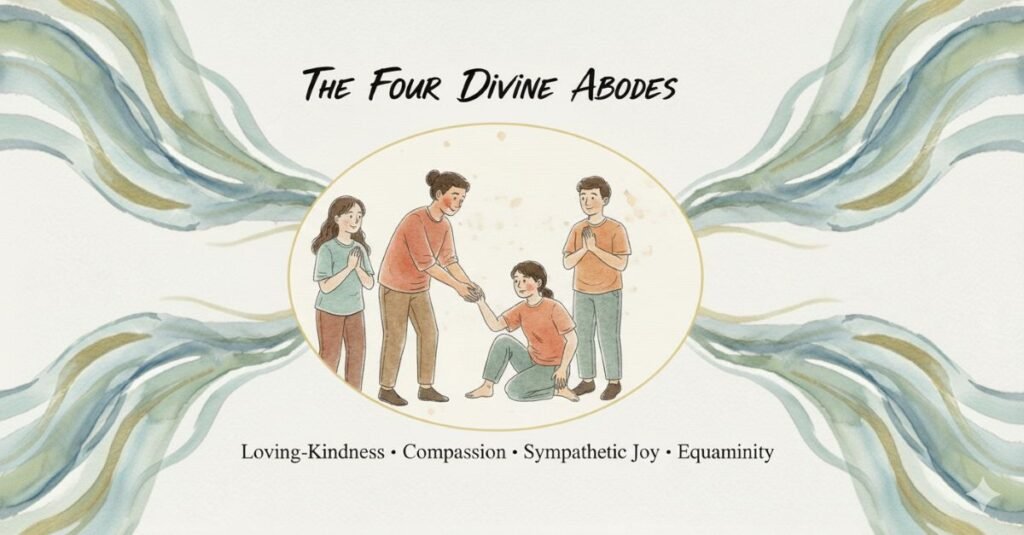
The Buddha taught four sublime attitudes (Brahmavihāras) that, when cultivated, lead to rebirth in divine realms and, more importantly, support the development of awakening. Compassion is the second of these, following loving-kindness. The Subha Sutta (MN 99) explains that these four qualities are the path to fellowship with the divine and the foundation for liberation.
4. Compassion is Distinct from Loving-Kindness

While loving-kindness (Mettā) is the wish for beings to be happy, compassion (Karuna) is the wish for beings to be free from suffering. These two qualities support each other like two wings of a bird. The Vitakkasaṇṭhāna Sutta (MN 20) describes how different wholesome thoughts can be used to overcome unwholesome ones, and compassion specifically counteracts thoughts of cruelty and harm.
5. Compassion Arises from Seeing Our Shared Condition
When we truly see that all beings wish to be happy and avoid suffering, just as we do, compassion naturally awakens. This recognition of fundamental equality is emphasized throughout the Buddha’s teachings. The Sabbāsava Sutta (MN 2) teaches that wise attention (Yoniso Manasikāra) to the nature of existence transforms how we relate to ourselves and others.
6. Compassion Requires Courage, Not Weakness
Some mistake compassion for weakness, but the Buddha taught it as a strength. To remain present with suffering, our own and others’, requires tremendous courage. The Kakacūpama Sutta (MN 21), the “Simile of the Saw,” teaches the extraordinary strength required to maintain compassion even toward those who harm us.
7. Compassion is Rooted in the Second Noble Truth
The Second Noble Truth identifies craving (Taṇhā) as the origin of suffering. Compassion, understanding this, does not merely wish suffering away but seeks to address its root causes. The Sacca Vibhaṅga Sutta (MN 141) elaborates on how understanding the origin of suffering informs wise and compassionate action.
8. Compassion Understands Conditionality

All suffering arises in dependence on conditions. Compassion, guided by wisdom, recognizes that alleviating suffering requires working with these conditions skillfully. The Paccaya Sutta (SN 12.20) explains dependent origination (Paṭiccasamuppāda), the very framework through which compassion understands how to respond effectively.
9. Compassion is the Antidote to Cruelty
The mind inclined toward cruelty or indifference can be transformed through the systematic cultivation of compassion. The Byākaraṇa Sutta (AN 10.176) lists cruelty as an unwholesome action to be abandoned, and compassion as the quality that naturally replaces it when cultivated.
10. Compassion Includes Oneself as Well as Others
Many practitioners mistakenly believe compassion should be directed only outward, but the Buddha taught that we must include ourselves in its scope. The Dhammapada verse 157 states: “If one holds oneself dear, one should diligently guard oneself”, a recognition that self-care and care for others are not opposed but complementary. The Attahita Sutta (AN 4.99) further describes how working for others’ welfare is inseparable from working for one’s own.
11. Compassion is Not Self-Sacrifice
The Buddha distinguished between compassion and self-destructive sacrifice. The Dhammapada verse 166 states that one should first establish oneself in what is beneficial before teaching others, emphasizing that true compassion includes caring for one’s own well-being.
12. Compassion is Supported by Ethical Conduct
Ethical conduct (Sīla) provides the foundation upon which compassion can safely arise and be expressed. When we live ethically, we cause less suffering to others and create the conditions for compassion to flourish. The Sīla Sutta (AN 10.1) explains how ethical conduct leads to freedom from remorse, which in turn supports concentration and the development of wholesome qualities.
13. Compassion Sees Beyond Appearances
Outward appearances can deceive, but compassion looks deeper. The Verañjaka Sutta (SN 42.8), concerning the conch-trumpet blower, teaches that we must look beyond beings’ external behavior to understand the conditions that shape their actions, responding with discernment rather than snap judgment.
14. Compassion is a Form of Protection
The Buddha taught that loving-kindness and compassion protect both the one who gives and the one who receives. The Mettānisamsa Sutta (AN 11.15) lists eleven benefits of cultivating loving-kindness, including sleeping peacefully, being dear to humans and non-humans, and protection from harm, benefits that apply equally to the cultivation of compassion.
15. Compassion is Developed Through Systematic Practice
Like any skill, compassion must be cultivated through consistent practice. The Mahā Rahulovāda Sutta (MN 62) shows the Buddha giving his son Rāhula detailed instructions for developing the mind, including specific contemplations for cultivating the four divine abodes.
16. Compassion is Boundless
True compassion knows no limits of geography, species, or relationship. The Tevijja Sutta (DN 13) describes the practitioner dwelling with a mind imbued with compassion, extending it to all beings everywhere, without exclusion or preference.
17. Compassion Recognizes the Suffering of All Beings
From the smallest insect to the mightiest deity, all beings experience suffering. The Saṃyutta Nikāya contains numerous passages where the Buddha emphasizes that all beings tremble at punishment and fear death, establishing the foundation for compassionate treatment of all.
18. Compassion is Taught Throughout All Stages of the Path
From the most basic ethical teachings to the most advanced meditation instructions, compassion appears throughout the Buddha’s discourses. The Saṅkhittamedhāvī Sutta (AN 8.63) provides instructions for developing the divine abodes as part of the gradual training, showing how compassion is integrated at every stage.
19. Compassion Understands the Causes of Suffering
Merely wishing suffering away is not enough. Compassion must be joined with wisdom that understands how suffering arises and ceases. The Mahā Satipaṭṭhāna Sutta (DN 22) provides the framework for this understanding through the Four Noble Truths and dependent origination.
20. Compassion is the Heart of the Buddha’s Teaching
Some have called compassion the essence of Buddhism. The Dhammapada verse 5 states that hatred never ceases by hatred, but by love alone, a principle that lies at the very heart of the compassionate path taught by the Buddha.
This sutta appears as AN 11.15 on SuttaCentral and AN 11.16 in some other editions. The eleven benefits are explicitly for mettā (loving-kindness), but by extension apply to compassion as a related divine abode.
Section Two: Cultivating Compassion in Meditation and Daily Life (21–40)
21. Formal Compassion Meditation Establishes the Foundation

The systematic cultivation of compassion begins with formal meditation. The Kāyagatāsati Sutta (MN 119) describes how establishing mindfulness of the body provides the foundation for developing all wholesome qualities, including compassion.
22. Include Oneself in the Scope of Compassion
Compassion meditation traditionally includes oneself in its scope, wishing: “May I be free from suffering.” The Paṭisambhidāmagga, a canonical analytical text of the Khuddaka Nikāya traditionally attributed to Sāriputta, elaborates on how compassion toward oneself naturally extends to others through systematic cultivation.
23. Extend Compassion to a Benefactor
From oneself, compassion is extended to a benefactor, someone who has been kind to us. The Anumāna Sutta (MN 15) shows how reflecting on those who have helped us naturally awakens gratitude and the wish for their well-being.
24. Include Loved Ones in the Circle of Compassion
Next, compassion is extended to those we love, family and friends. The Velāma Sutta (AN 9.20) emphasizes that even great material gifts cannot compare with developing a mind of compassion toward all beings.
25. Extend Compassion to Neutral Persons
Those we neither like nor dislike deserve our compassion as well. The Karaṇīya Mettā Sutta (Sn 1.8) instructs us to extend boundless goodwill to all beings without distinction, a principle that applies equally to compassion.
26. Include Difficult Persons in Compassion
Perhaps most challenging is extending compassion to those who have harmed us. The Kakacūpama Sutta (MN 21) sets the highest standard: maintaining compassion even if one is attacked by bandits with a two-handled saw.
27. Radiate Compassion to All Beings Without Exception
Finally, compassion is extended in all directions to all beings everywhere. The Tevijja Sutta (DN 13) describes the mind imbued with compassion as vast, expansive, and immeasurable, free from enmity and ill will.
28. Compassion Meditation Uses Direct Reflection
One method of cultivating compassion is to reflect directly on beings’ suffering. The Salla Sutta (Sn 3.8), the “Arrow Sutta,” describes how all beings are struck by the arrow of suffering, a powerful contemplation for awakening compassion.
29. Visualizing Suffering Awakens Compassion
The Buddha sometimes used powerful imagery to awaken compassion. The Lokavipatti Sutta (AN 8.6) describes the eight worldly conditions that affect all beings, helping us see the universal vulnerability that calls for compassionate response.
30. Compassion is Strengthened Through Recollection of the Buddha’s Example
Remembering the Buddha’s own compassion inspires our practice. The Ariyapariyesanā Sutta (MN 26) describes how the Buddha, after his awakening, was moved by compassion to teach the Dharma for the welfare of many.
31. Daily Life Offers Countless Opportunities for Compassion
Every interaction with another being is an opportunity to practice compassion. The Saṅgīti Sutta (DN 33) lists compassion as one of the qualities to be cultivated in all postures and activities.
32. Mindful Speech Expresses Compassion

How we speak can either alleviate or increase suffering. The Subhāsita Sutta (Sn 3.3) teaches that well-spoken speech is timely, true, gentle, beneficial, and spoken with a mind of goodwill, all expressions of compassion.
33. Compassionate Listening is a Profound Practice
Truly hearing another’s suffering without judgment or the urge to fix is a deep expression of compassion. The Piyajātika Sutta (MN 87) shows the Buddha’s own example of patient listening to those in distress.
34. Compassion Transforms Work into Practice
Whatever our livelihood, we can infuse it with compassionate intention. The Vanijja Sutta (AN 5.177) lists trades that are harmful and should be avoided, implicitly encouraging work that reduces rather than increases suffering.
35. Compassion Guides Ethical Decision-Making
When faced with difficult choices, asking “What action will alleviate suffering?” provides clear guidance. The Āditta Sutta (AN 4.128) describes how the wise person considers the welfare of all beings when acting.
36. Compassion Includes Animals and All Sentient Beings
The Buddha explicitly included animals in the circle of compassion. The Dhammapada verse 129 states: “All tremble at violence; all fear death. Comparing others with oneself, one should neither kill nor cause to kill.”
37. Compassion Extends to Those Who Cause Harm
Even those who commit harmful actions deserve compassion, though their actions must be skillfully addressed. The Aṅgulimāla Sutta (MN 86) powerfully illustrates this principle through the story of the bandit Aṅgulimāla, who was transformed by the Buddha’s compassion.
38. Compassion Includes Forgiving Ourselves
When we fail to live up to our ideals, self-forgiveness allows us to learn and move forward rather than becoming stuck in guilt. The Dvedhāvitakka Sutta (MN 19) describes how the Buddha himself, before awakening, learned to distinguish wholesome from unwholesome thoughts without self-condemnation.
39. Compassion is Strengthened by Community
Practicing with others who value compassion supports our own development. The Udāna contains numerous stories of monastics supporting each other in compassionate practice, providing inspiration for community-based cultivation.
40. Regular Reflection Deepens Compassion
Setting aside time regularly to reflect on compassion ensures its continued growth. The Bhaddekaratta Sutta (MN 131) encourages dwelling in the present moment with awareness, a state in which compassion naturally arises when encountering suffering.
Section Three: Compassion in Relationship to Other Spiritual Qualities (41–60)
41. Compassion and Loving-Kindness Support Each Other
Loving-kindness wishes beings well; compassion wishes them free from suffering. These two qualities work together, each strengthening the other. The Indriyabhāvanā Sutta (MN 152) describes how developed practitioners maintain both qualities in all circumstances.
42. Compassion and Sympathetic Joy Are Complementary

Sympathetic joy (Muditā) rejoices in others’ happiness, while compassion responds to their suffering. Together, they keep the heart balanced and open to all of life’s experiences. The Saṅkhārupapatti Sutta (MN 120) describes how these qualities lead to favorable rebirths and support the path.
43. Compassion Requires Equanimity to Be Sustainable

Without equanimity, compassion can lead to burnout and despair. The Upekkhā Sutta (AN 4.124) explains how equanimity, when properly developed, provides the balanced foundation from which compassion can function effectively without becoming overwhelmed. This balance prevents compassion’s “near enemy”, pity, which creates distance, while its “far enemy” of cruelty is kept at bay.
44. Wisdom Guides Compassion’s Expression
Wisdom (Paññā) understands what will truly help in any situation. The Mahācattārīsaka Sutta (MN 117) describes right view as the forerunner of all wholesome qualities, including compassion, ensuring that compassionate action is truly beneficial.
45. Compassion Grounds Wisdom in the Heart

Wisdom without compassion can become cold and detached. The Mahā Taṇhāsaṅkhaya Sutta (MN 38) shows the Buddha combining profound wisdom with deep compassion in his teachings, never separating the two.
46. Faith and Trust Support Compassionate Action
Faith (Saddhā) in the possibility of liberation and trust in the Buddha’s path provide the confidence needed to act compassionately even in difficult circumstances. The Kesaputtiya Sutta (AN 3.65) (Kālāma Sutta) encourages a reasoned faith that supports compassionate living.
47. Compassion and Generosity Arise Together
Genuine compassion naturally expresses itself as generosity (Dāna). The Dāna Sutta (AN 8.31) lists the motivations for giving, with compassion being the most noble, giving because the recipient is in need.
48. Ethical Conduct Is Compassion in Action
When we live ethically, we naturally cause less suffering to others. The Cunda Kammāraputta Sutta (AN 10.176) emphasizes that ethical conduct is not just about following rules but about actively purifying the mind and reducing harm in all our interactions.
49. Compassion Requires Effort and Diligence
Compassion is not passive but requires active effort (Vīriya) to maintain and express. The Padhāna Sutta (AN 4.14) describes the four right efforts, including developing wholesome states like compassion that have not yet arisen.
50. Patience Allows Compassion to Deepen

Patience (Khanti) enables us to remain present with suffering without rushing to premature solutions. The Khanti Sutta (AN 5.217) describes patience as a quality that protects both oneself and others.
51. Truthfulness Is Essential to Compassion
Compassion does not mean telling people what they want to hear but what is true and beneficial. The Vācā Sutta (AN 5.198) describes well-spoken speech as that which is timely, true, gentle, beneficial, and spoken with goodwill, all qualities that express compassion.
52. Determination Strengthens Compassion
The determination (Adhiṭṭhāna) to remain compassionate even in difficult circumstances builds spiritual strength. The Cūḷa Dukkhakkhandha Sutta (MN 14) shows the Buddha’s determination to find the path to liberation, motivated by compassion for all beings.
53. Loving-Kindness Prepares the Ground for Compassion
The systematic cultivation of loving-kindness softens the heart and makes it receptive to suffering without becoming hardened. The Mettā Sutta (AN 4.125) describes how developing loving-kindness leads to rebirth in heavenly realms, but more importantly, prepares the mind for deeper compassion.
54. Compassion and Renunciation Work Together
Renunciation (Nekkhamma) is not about rejecting the world but about letting go of what causes suffering, for ourselves and others. The Pabbajjā Sutta (Sn 3.1) describes the Buddha’s own renunciation as motivated by compassion for all beings trapped in suffering.
55. Mindfulness Supports Compassionate Response
Mindfulness (Sati) allows us to notice suffering as it arises and respond skillfully rather than reactively. The Satipaṭṭhāna Sutta (MN 10) provides the framework for developing the kind of awareness that makes compassionate response possible.
56. Concentration Stabilizes Compassion
Concentration (Samādhi) provides the mental stability needed to remain present with suffering without becoming overwhelmed. The Ānāpānasati Sutta (MN 118) describes how mindfulness of breathing leads to the development of the seven factors of awakening, which include qualities that support and are supported by compassion.
57. Gratitude Nourishes Compassion
Reflecting on the kindness we have received naturally awakens the wish to be kind to others. The Kataññū Sutta (AN 2.31-32) describes gratitude as a quality that protects the world and supports all wholesome states.
58. Compassion and Humility Are Intertwined
True compassion recognizes that we are not separate from those we seek to help. The Māna Sutta (SN 22.86) describes how overcoming conceit opens the heart to genuine connection with all beings.
59. Compassion Understands the Limits of Control
Compassionate action does not demand specific outcomes. The Loka Sutta (SN 35.116) teaches that the world is unstable and beyond our complete control, a wisdom that allows compassion to act without attachment to results.
60. All Wholesome Qualities Support and Are Supported by Compassion
Compassion stands at the center of the spiritual life, supported by and supporting every other wholesome quality. The Bodhipakkhiyā Sutta (SN 48.51) describes the thirty-seven factors of enlightenment, all of which are infused with compassionate intention when properly developed.
Section Four: Deepening Compassion Through Understanding Suffering (61–80)
61. Understanding the Many Forms of Suffering Deepens Compassion
The Buddha analyzed suffering into many categories: physical pain, mental distress, the suffering of change, and the suffering inherent in conditioned existence. The Saccavibhaṅga Sutta (MN 141) details these categories, providing a comprehensive map for compassionate response.
62. Birth Itself Is Suffering
Every being enters the world through the pain of birth. The Mahādukkhakkhandha Sutta (MN 13) includes birth in the enumeration of suffering, reminding us that even the happiest moments are preceded and followed by pain.
63. Aging Brings Inevitable Decline
No being escapes aging. The Jarā Sutta (SN 48.41) describes the Buddha himself acknowledging the reality of aging, teaching us to meet this universal experience with compassion for ourselves and others.
64. Sickness Affects All Beings
Health is temporary; sickness is universal. The Gilāna Sutta (SN 36.7) describes how the Buddha, when ill, responded with mindfulness and compassion, an example for us when facing our own sickness or that of others.
65. Death Comes to All Without Exception

The certainty of death and the uncertainty of its timing is a fundamental suffering. The Maraṇasati Sutta (AN 6.19) encourages mindfulness of death as a practice that deepens compassion for all beings facing this inevitable end.
66. Separation from What We Love Causes Suffering
All beings experience the pain of parting from those and what they love. The Piyajātika Sutta (MN 87) explores this universal sorrow, revealing how compassion recognizes this shared experience.
67. Association with What We Dislike Causes Suffering
Being forced to endure what we hate or fear is another form of universal pain. The Aṭṭhakanāgara Sutta (MN 52) includes this among the sufferings to be understood through direct investigation.
68. Not Getting What We Want Causes Suffering
Frustrated desire is a constant feature of human experience. The Anusaya Sutta (AN 7.11) lists the latent tendencies, including desire for sensual pleasures, that perpetuate this suffering.
69. The Five Aggregates Themselves Are Suffering
Simply having a body and mind, as long as we cling to them, is suffering. The Khandha Sutta (SN 22.48) explains how the five aggregates (Khandhas): form, feeling, perception, mental formations, and consciousness, are the very basis of suffering when grasped.
70. Subtle Forms of Suffering Escape Ordinary Notice
Beyond obvious pain lies the subtle suffering of conditioned existence itself, the fact that all phenomena are impermanent and cannot provide lasting satisfaction. The Anicca Sutta (SN 22.45) points to this deeper dimension of suffering.
71. Understanding Suffering’s Origin Guides Compassion
The Second Noble Truth identifies craving (Taṇhā) as the origin of suffering. Compassion, understanding this, addresses not just symptoms but root causes. The Samudaya Sutta (SN 56.11) presents this teaching as essential for effective compassionate action.
72. Understanding Cessation Inspires Compassion
The Third Noble Truth, that suffering can cease—gives hope. Compassion shares this hope with others. The Nirodha Sutta (SN 38.1) records a wanderer asking about the cessation of suffering, showing that this hope is universal.
73. The Path Itself Is Compassionate Action

The Fourth Noble Truth, the Eightfold Path, is the most compassionate gift the Buddha offered. The Magga Vibhaṅga Sutta (SN 45.8) details this path, which is itself the expression of ultimate compassion.
74. Understanding Not-Self Deepens Compassion

When we see that there is no permanent, independent self, the sense of separation between self and other diminishes. The Anattalakkhaṇa Sutta (SN 22.59), the Buddha’s second discourse, establishes this teaching, which transforms compassion from a duty into a natural expression of conditionality.
75. Dependent Origination Reveals Conditionality
All beings arise in dependence on conditions; no being exists independently. The Mahānidāna Sutta (DN 15) provides a detailed analysis of dependent origination (Paṭiccasamuppāda), revealing the profound conditionality that makes compassion the only reasonable response to suffering.
76. Understanding Kamma Supports Compassion

Beings suffer because of their actions, but this understanding does not lead to indifference. The Cūḷakammavibhaṅga Sutta (MN 135) explains how actions lead to results, but does so to encourage wise and compassionate action, not judgment.
77. The Three Characteristics Deepen Compassion
Impermanence (Anicca), suffering (Dukkha), and not-self (Anattā) characterize all conditioned existence. Contemplating these universal characteristics naturally awakens compassion for all beings caught in this conditioned realm. The Lakkhaṇa Sutta (SN 22.79) explores these characteristics in depth.
78. The Suffering of Others Is Connected to Our Own
When we harm others, we harm ourselves; when we help others, we help ourselves. The Attahita Sutta (AN 4.99) describes how working for others’ welfare is inseparable from working for our own.
79. The Bodhisatta’s Example Shows the Path of Compassion
The Buddha’s own journey, spanning countless lifetimes as a Bodhisatta, was motivated by compassion. The Acchariya-abbhuta Sutta (AN 4.127) describes marvelous qualities of the Bodhisatta’s last existence, while numerous Jātaka stories illustrate how compassion guided his development over innumerable lifetimes.
80. Full Understanding of Suffering Leads to Perfect Compassion
As understanding deepens, compassion matures. The Dasuttara Sutta (DN 34) presents a progressive framework for understanding, showing how each stage of insight supports the development of qualities like compassion.
Section Five: Overcoming Obstacles to Compassion (81–100)
81. Aversion Blocks Compassion
Hatred and aversion are the direct opposites of compassion. The Āghātapaṭivinaya Sutta (AN 5.161) provides five methods for overcoming anger when it arises, each a compassionate strategy for protecting the mind.
82. Fear Can Paralyze Compassionate Response
Fear of getting involved, fear of being overwhelmed, fear of consequences, all can block compassion. The Bhaya Sutta (SN 35.102) analyzes fear and its causes, providing the understanding needed to move beyond it.
83. Sloth and Torpor Are Obstacles
When the mind is sluggish and dull, compassion cannot arise. The Āhāra Sutta (SN 46.51) identifies conditions that nourish sloth and torpor, and those that starve them, essential knowledge for maintaining the energy compassion requires.
84. Self-Centeredness Limits Compassion
Preoccupation with our own concerns narrows the heart. The Sakkāya Sutta (SN 22.105) explores identity-view, the sense of “I” and “mine” that creates the illusion of separation from others.
85. Judgment and Condemnation Harden the Heart
When we judge others harshly, we close ourselves to their suffering. The Akkoṣaka Sutta (SN 7.2) shows the Buddha’s response to abuse, teaching that receiving anger without returning it preserves compassion.
86. Burnout Results from Imbalanced Compassion
Compassion without equanimity leads to exhaustion. The Gilāna Sutta (AN 5.122) advises on caring for the sick with balance, a principle applicable to all compassionate activity.
87. Attachment to Outcomes Causes Suffering
When we become attached to seeing results from our compassionate efforts, we set ourselves up for disappointment. The Sīha Sutta (AN 8.12) shows the Buddha teaching that the quality of the action, not its outcome, is what matters.
88. Personal Bias Limits Compassion’s Scope
We naturally feel more compassion for those close to us. The Karaṇīya Mettā Sutta (Sn 1.8) directly addresses this, instructing us to extend compassion without distinction or preference.
89. Cultural Conditioning Can Create Blind Spots
Unrecognized assumptions about who deserves compassion can limit its expression. The Vāseṭṭha Sutta (MN 98) challenges the caste-based assumptions of the Buddha’s time, demonstrating that compassion transcends all social categories.
90. Despair Arises When Suffering Seems Overwhelming
The vastness of suffering in the world can lead to despair. The Sīsapāvana Sutta (SN 56.31) offers the Buddha’s teaching on what he knows versus what he teaches, a reminder to focus on what is immediately helpful.
91. Impatience Undermines Compassionate Action
Wanting suffering to end immediately can lead to unskillful responses. The Kodhana Sutta (AN 7.64) describes the dangers of anger and impatience, implicitly advocating for patience in all compassionate endeavors.
92. Perfectionism Can Block Compassion
Waiting until we can act perfectly may mean never acting at all. The Padhāna Sutta (Sn 3.2) describes the Bodhisatta’s effort, which was steady and persistent rather than perfect from the start.
93. Guilt Over Past Failures Hinders Present Compassion
When we dwell on past failures to be compassionate, we miss present opportunities. The Aghātavinaya Sutta (AN 5.162) offers methods for overcoming remorse, freeing us to act compassionately now.
94. Comparing Our Compassion to Others’ Is Unhelpful
Measuring our compassion against others’ leads either to pride or discouragement. The Tittha Sutta (AN 3.61) warns against measuring spiritual progress by comparison with others.
95. Romanticizing Compassion Distorts It
Compassion is not always gentle; sometimes it requires firmness. The Sallekha Sutta (MN 8) describes compassion as including the willingness to point out others’ faults when appropriate and beneficial.
96. Avoiding Difficult Situations Limits Compassion
Natural as it is to avoid pain, this avoidance can mean abandoning those who need us. The story of the monk with severe skin disease, found in the Dhammapada commentary, shows the Buddha caring for one whom others avoided—an example of compassion that does not shrink from difficulty.
97. Intellectualizing Compassion Without Feeling It
Understanding compassion intellectually is not the same as feeling it in the heart. The Cūḷa Māluṅkya Sutta (MN 63) warns against getting lost in intellectual speculation at the expense of direct practice.
98. Spiritual Bypassing Uses Compassion Concepts to Avoid Real Engagement
Sometimes we use spiritual language to avoid genuine engagement with suffering. The Āneñjasappāya Sutta (MN 106) emphasizes direct experience over conceptual understanding.
99. Over-Identifying with Others’ Suffering Causes Harm
Taking on others’ suffering as if it were entirely our own helps no one. The Mahā Hatthipadopama Sutta (MN 28) uses the simile of the elephant’s footprint to show how understanding the nature of experience prevents such unhealthy identification.
100. Recognizing Obstacles Is Itself Compassionate
Seeing clearly what blocks compassion is the first step to removing those blocks. The Nīvaraṇa Sutta (SN 46.40) identifies the five hindrances and their antidotes, providing a practical map for overcoming obstacles to all wholesome states, including compassion.
Section Six: The Boundless Expression of Compassion (101–108)
101. Compassion Becomes Spontaneous with Practice
When compassion is deeply cultivated, it arises naturally without effort. The Bhāvanā Sutta (AN 4.125) describes how the four divine abodes, including compassion, become the mind’s default state when properly developed.
102. Perfect Compassion Responds Unerringly with Skillful Means
The fully awakened being’s compassion is not a general attitude but a precise response to each unique situation, guided by wisdom and skillful means (Upāya). The Samaṇamaṇḍikā Sutta (MN 78) describes the Tathāgata as one who acts perfectly for the welfare of all beings.
103. Compassion Embraces Harmonious Community
Boundless compassion expresses itself in harmonious relationships and community life. The Cūḷa Gosiṅga Sutta (MN 31) describes three monks living in such perfect harmony and mutual compassion that the Buddha declared their community a true inspiration, a model of compassion in action.
104. Compassion Recognizes the Potential for Awakening in All
Every being has the capacity for awakening; compassion nurtures that potential. The Mūlapariyāya Sutta (MN 1), though complex, points to the Buddha’s direct perception of how beings relate to experience, including their potential for liberation.
105. Compassion and Emptiness Are Realized Together
Deep realization understands that all phenomena are empty of independent existence, yet compassion for beings who do not realize this arises spontaneously. The Suñña Sutta (SN 35.85) records the Buddha’s teaching on emptiness, which when realized does not diminish but rather perfects compassion.
106. The Bodhisatta Ideal Embodies Perfect Compassion
The aspiration to attain awakening for the sake of all beings represents compassion at its most profound. While the term “Bodhisatta” is associated with countless lifetimes of compassionate striving, the Acchariya-abbhuta Sutta (AN 4.127) describes the marvelous qualities of the Bodhisatta’s last existence, showing how compassion shaped even his final birth.
107. Compassion Is the Heart of the Buddha’s Legacy
The Buddha’s teachings survive because they were offered from compassion. The Mahāparinibbāna Sutta (DN 16), recounting the Buddha’s final days, shows his compassionate concern for the future of the Dharma and the welfare of all beings.
108. Perfect Compassion Rests in Peace While Active in the World
The culmination of compassion is not frenetic activity but peaceful engagement, acting from a place of deep stillness. The Kāya Sutta (SN 47.4) describes how the developed practitioner dwells observing the body, feelings, mind, and phenomena, including with compassion, yet remains undisturbed—the very model of compassionate presence in the world.
Glossary of Pāli Terms
| Pāli Term | English Translation |
|---|---|
| Adhiṭṭhāna | Determination, resolution |
| Anattā | Not-self, absence of permanent, independent self |
| Anicca | Impermanence, inconstancy |
| Anupubbikathā | Gradual instruction, progressive teaching |
| Bhāvanā | Mental cultivation, meditation |
| Bodhi | Awakening, enlightenment |
| Bodhisatta | One destined for awakening, Buddha-to-be |
| Brahmavihāra | Divine abode, sublime attitude |
| Dāna | Generosity, giving |
| Dukkha | Suffering, unsatisfactoriness, stress |
| Jātaka | Birth story (of the Bodhisatta) |
| Kamma | Volitional action, karma |
| Karuna | Compassion |
| Khandha | Aggregate, heap (the five aggregates) |
| Khanti | Patience, forbearance |
| Mettā | Loving-kindness, goodwill |
| Muditā | Sympathetic joy, appreciative joy |
| Nekkhamma | Renunciation, going forth |
| Nibbāna | Unbinding, liberation, the unconditioned |
| Nīvaraṇa | Hindrance (to meditation) |
| Paññā | Wisdom, discernment |
| Paṭiccasamuppāda | Dependent origination |
| Saddhā | Faith, confidence |
| Samādhi | Concentration, collectedness |
| Sati | Mindfulness |
| Sīla | Ethical conduct, morality |
| Taṇhā | Craving, thirst |
| Tathāgata | “Thus-gone,” epithet of the Buddha |
| Upāya | Skillful means |
| Upekkhā | Equanimity, balance |
| Vīriya | Effort, energy, diligence |
| Yoniso Manasikāra | Wise attention, appropriate attention |
Conclusion
These 108 contemplations on compassion reveal a quality that is at once profoundly simple and infinitely deep. Compassion begins with the recognition of suffering, our own and others’, and unfolds through systematic cultivation into a boundless response that embraces all beings without exception. The Buddha’s teachings, preserved in the Suttas, provide both the theoretical framework and the practical instructions for this cultivation, from the simplest acts of kindness in daily life to the most profound meditative realizations. What emerges from this exploration is the understanding that compassion is not merely one quality among many but stands at the very heart of the Buddhist path, inseparable from wisdom and essential for liberation.
Throughout this contemplation, we have seen how compassion must be balanced with equanimity to remain sustainable, guided by wisdom to remain effective, and supported by all other wholesome qualities to reach its full expression. We have also seen the obstacles that arise; aversion, fear, self-centeredness, despair, and the practical methods the Buddha taught for overcoming them. The path of compassion is not always easy, but it is always available, always accessible, always possible in this very moment.
As we conclude this contemplation, may we take inspiration from the Buddha’s own example of boundless compassion. May we remember that every being we encounter, whether friend or foe, human or non-human, carries the same burden of suffering and the same wish for happiness. And may we commit ourselves, in whatever ways are available to us, to alleviating suffering and supporting the conditions for all beings to find genuine peace. The path of compassion is open to all who choose to walk it, and every step taken in compassion benefits not only ourselves but the entire web of conditioned existence.
Sadhu, sadhu, sadhu. (Well said, well practiced, well accomplished.)