Key Points at a Glance
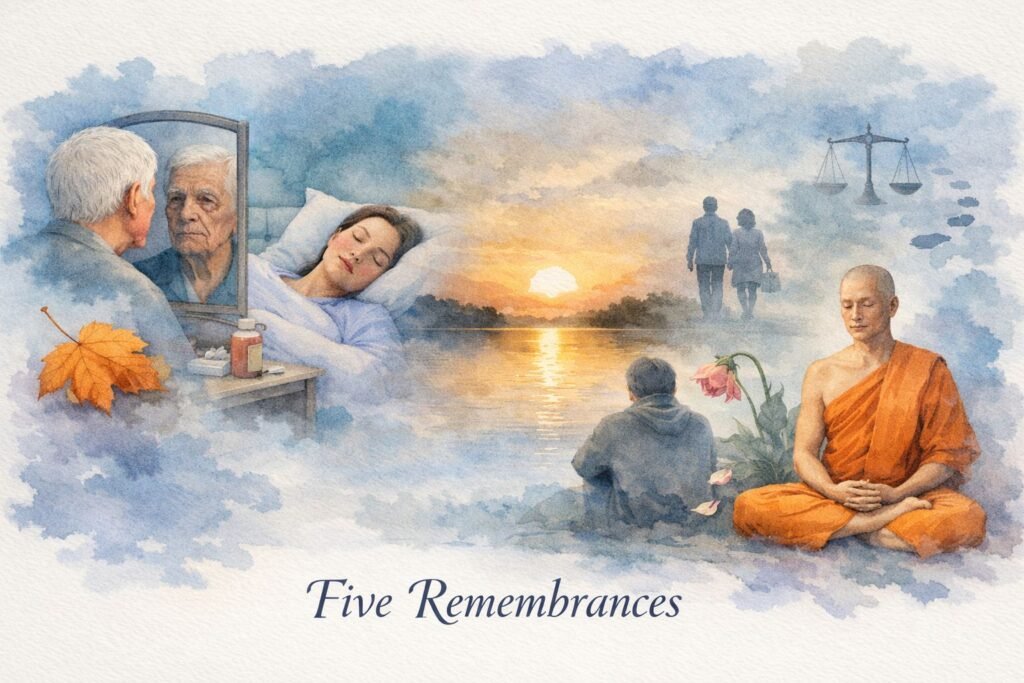
- Universal Realities: The Five Remembrances are five inescapable truths – aging, illness, death, separation from all that is dear, and the ownership of one’s actions (karma). These are not beliefs but observable facts of conditioned existence.
- Psychological “Reality Check”: They directly counter modern cultural illusions of permanence, such as the promise of youth: extending cosmetics, anti-aging medicine, and digital immortality projects.
- Healthy Urgency & Peace: Regular, balanced reflection on these truths generates saṃvega – a spiritual “shock of awakening” that motivates practice – while simultaneously cultivating upekkhā (equanimity) and reducing existential dread.
- Agency Through Karma: Unlike the first four remembrances which highlight what we cannot control, the fifth remembrance places power back in our hands: our intentional actions of body, speech, and mind are our only true belongings.
- Daily Contemplation Practice: Traditionally recited each morning or evening, this practice gradually reshapes habitual mental patterns of denial, procrastination, and anxious clinging.
- Clinical Relevance: Modern mindfulness-based therapies, including Mindfulness-Based Stress Reduction (MBSR) and Acceptance and Commitment Therapy (ACT), use similar exposures to mortality and impermanence to treat death anxiety, health anxiety, and complicated grief.
- Cross-Traditional Resonance: Comparable teachings appear in Stoicism (memento mori), Christian monasticism (“Remember death”), Sufism, and Indigenous wisdom traditions worldwide.
Introduction to Buddhist Psychology and the Upajjhatthana Sutta
Buddhist psychology is not an abstract academic discipline. It is a practical, lived framework for understanding how the mind creates suffering through its habitual resistance to the natural flow of reality. While many Western psychologies emphasize biography, personality formation, and developmental conditioning, Buddhist psychology focuses more centrally on universal, impersonal processes – clinging (upādāna), aversion (dosa), and delusion (moha) – that bind all sentient beings to cycles of discontent.
At the heart of this training lies the Upajjhatthana Sutta (AN 5.57), a short but extraordinarily potent discourse in which the Buddha directly instructs both laypeople and monastics on “five topics that should often be reflected upon by a woman or a man, by a householder or one gone forth.” The Pali phrasing points to five subjects (ṭhānāni) for constant recollection and reflective contemplation (paccavekkhaṇa) – a term that captures the iterative, returning quality the practice requires.
The sutta’s stated purpose is precise. The Buddha explains that human beings suffer from three deep psychological intoxications – mada in Pali – that cloud judgment and fuel misconduct: intoxication with youth (yobbana-mada), intoxication with health (ārogya-mada), and intoxication with life itself (jīvita-mada). It is these blind spots of pride and complacency that lead us to behave recklessly and to avoid the truths that could liberate us. Contemplating the first three remembrances is designed to directly dissolve these specific intoxications.
Crucially, the sutta’s contemplation does not stop at the personal level. For each remembrance, the Buddha instructs the practitioner to pivot from self-concern to universal recognition: “I am not the only one subject to aging… wherever there are beings coming and going, all beings are subject to aging.” This shift – from egocentric dread (“Why is this happening to me?”) to existential kinship (“This is what it means to be a sentient being”) – is the precise psychological mechanism that transforms fear into compassion and personal anxiety into saṃvega, the energizing urgency of the path.
Like many societies across time, ancient India also contained strong currents of status-seeking, ritualism, and concern with health, longevity, and legacy. Against this background, the Buddha offered a radical alternative: direct, unflinching, daily contemplation of life’s boundaries as the very door to peace.
These remembrances are often misunderstood as pessimistic. In practice, however, those who commit to them report a surprising lightness, increased appreciation for small joys, and a dramatic reduction in trivial anxieties. As the modern Thai forest master Ajahn Chah famously said: “If you haven’t cried deeply a number of times, your meditation hasn’t really begun.”
While the sutta itself frames the practice in terms of overcoming mada and abandoning misconduct (duccarita), modern Buddhist psychology often applies these five truths to systematically weaken the five mental hindrances (pañca nīvaraṇāni) that block clarity and peace. This mapping is a practical application rather than a direct claim about the sutta’s own language:
| Hindrance (Pali) | How the Remembrances Counter It |
|---|---|
| Sense desire (kāmacchanda) | Seeing aging and death contextualizes sensual pleasures as fleeting, reducing obsessive grasping. |
| Ill-will (byāpāda) | Accepting universal suffering (illness, loss) softens the “why me?” reaction and opens compassion. |
| Sloth & torpor (thīna-middha) | The urgency of death energizes practice; procrastination becomes less appealing. |
| Restlessness (uddhacca-kukkucca) | Contemplating impermanence settles the frantic search for security in unstable things. |
| Doubt (vicikicchā) | Direct, repeated reflection builds experiential confidence in the Buddha’s diagnosis of suffering. |
This practice transforms the mind from a state of fearful clinging to one of deep appreciation for what the tradition calls the “precious human birth” – the rare confluence of circumstances allowing for spiritual awakening. It provides a clear, practical path for working with mental states in daily life, from workplace stress and relationship disappointments to the profound questions of meaning that arise in midlife and elderhood.
The Five Remembrances: Deep Contemplation and Practical Application
1. The Inevitability of Aging
“I am of the nature to grow old. I have not gone beyond aging.”
Aging is not a single event but a relentless, moment-by-moment process of cellular decay, metabolic slowdown, and gradual fading of youth, beauty, and vitality. In Buddhist psychology, the suffering associated with aging does not stem from the physical changes themselves but from our deep attachment to a fixed, unchanging identity – the “I” that imagines it will forever look thirty-five.
Psychological Mechanisms: The fear of aging is largely a fear of social irrelevance, loss of control, and the confrontation with death that visible aging represents. By acknowledging daily that we cannot escape old age, we learn what Thich Nhat Hanh called “aging beautifully” – directing our energy toward inner qualities of wisdom, patience, and joy rather than dispersing it in a futile, expensive, and ultimately disappointing struggle to remain young.
Practical Exercise: Take three minutes each morning to look honestly in a mirror. Note the changes – gray hairs, lines, sagging. Instead of judging, say softly: “This is the nature of the body. I am not separate from this.” Then turn your mind to one quality of character you have developed over the years (patience, kindness, perspective). Let that quality feel more real than your reflection.
Inline teaching link: Our Real Home: A Talk to an Aging Lay Disciple Approaching Death , Ajaan Chah, translated from the Thai by The Sangha at Wat Pah Nanachat
2. The Inevitability of Illness
“I am of the nature to have ill health. I have not gone beyond illness.”
The body is not a possession. It is a collection of physical processes (rūpa) – five aggregates in constant flux – subject to conditions far beyond our total control: genetics, environmental toxins, accidents, pathogens, and the simple wear of use. The Buddha repeatedly described the body as fragile, unstable, and vulnerable to decay – like foam on water (SN 22.95), like a dewdrop on a blade of grass, like a clay pot that shatters at the slightest blow.
The “Second Arrow” Teaching (SN 36.6): A healthy person who has never reflected on illness experiences two arrows when sickness arises – the physical sensation of pain (first arrow) and the mental anguish of “Oh no, not me!” “Why is this happening?” “I can’t handle this” (second arrow). The practitioner who has deeply internalized this remembrance still feels the first arrow (pain is inevitable) but radically reduces or eliminates the second arrow of psychological resistance.
On Illness and Spiritual Practice: Some later Buddhist traditions, particularly in Tibetan medicine, have interpreted illness as potentially connected to karmic maturation or as an opportunity for purification and compassion practice. Early Buddhist texts, however, generally avoid simplistic one-to-one explanations for illness, and this framing should not be read as blaming the sick. What the tradition consistently affirms is that serious illness has been known to open the heart to compassion, simplify life’s priorities, and deepen spiritual practice in ways that comfortable health rarely does.
Practical Exercise: The next time you have even a minor headache or cold, pause for ten seconds. Instead of automatically reaching for a distraction or pill, breathe gently and say: “This is illness. It is the nature of this body. Many beings are in far greater pain right now.” Allow a moment of kinship with the sick everywhere.
Inline sutta link: SN 36.6 – The Arrow (Salla Sutta), trans. Bhikkhu Bodhi
3. The Inevitability of Death
“I am of the nature to die. I have not gone beyond death.”
Mindfulness of death (maraṇasati) is arguably the most powerful single practice in the entire Buddhist path. It is not morbid rumination but a precise, liberating attention to the one certainty every human shares. In the commentarial tradition, the Buddha is recorded as saying that just as the elephant’s footprint is the largest of all animal footprints, mindfulness of death is supreme among meditative recollections – a teaching elaborated in the Visuddhimagga (VIII.1) and reflected in the paired Maraṇassati Suttas (AN 6.19–20).
Why Death Meditation Reduces Fear: Many people avoid thinking about death precisely because they fear it. But as the existential psychotherapist Irvin Yalom noted (and the Buddha anticipated by 2,500 years), “Though the physicality of death destroys us, the idea of death saves us.” When we fully accept that this life will end – perhaps today, perhaps in sixty years – trivial concerns (traffic jams, social slights, cosmetic imperfections) drop away. What remains is what truly matters: love, integrity, presence, and the quality of our actions.
The Critical Transition Point: In many Buddhist traditions (especially Tibetan), the final moments of life are understood to have a disproportionate influence on the trajectory of rebirth or the quality of one’s final consciousness. A mind trained in maraṇasati is better prepared to maintain a calm, clear, virtuous state during this transition, just as a seasoned soldier remains steady in battle.
Practical Exercise – The Five Minute Death Meditation: Sit quietly. Bring to mind someone you love. Imagine saying goodbye to them before you die today. Notice what feelings arise – tenderness, regret, urgency. Then turn to yourself: “If I were to die at the end of this meditation, have I lived today in a way I would be proud of?” Let any regret guide your next action, not your next year.
Inline sutta link: AN 6.19–20 – Mindfulness of Death (Maraṇassati Suttas), trans. Bhikkhu Bodhi
4. The Reality of Separation from All That Is Dear
“I will be separated and parted from all that is dear and beloved to me.”
This remembrance addresses the inherent instability of all conditioned things – relationships, possessions, status, health, youth, even one’s own body and mind. What we most cherish often becomes the source of our greatest grief, not because love is wrong, but because we add grasping to love. The Buddhist term for this is taṇhā (thirst) – a desperate, clinging quality that poisons genuine appreciation.
The “Loan” Analogy: A common teaching metaphor suggests viewing everything we love as “on loan” from the universe – our children, partners, homes, even our eyesight. We are caretakers, not owners. When a loan period ends (as it inevitably must), grief is natural, but despair is optional. Despair arises only when we believed the loan was a permanent gift.
Practical Implications for Parents and Partners: Parents who have internalized this remembrance do not love their children less; they love them more skillfully. They are less likely to be paralyzed by anxiety about their child’s safety because they have accepted that no one can guarantee safety. They are more present, more appreciative, and paradoxically, better protectors – because they are not distractedly trying to control the uncontrollable.
Practical Exercise: Choose one object or relationship you are deeply attached to (your phone, your partner, your pet). For thirty seconds, whisper to yourself: “One day, this will end. I do not know when. Because it will end, I will be fully here for it now.” Then spend two minutes interacting with that person or object with total, loving attention.
Inline sutta link: MN 87 – Piyajātika Sutta: From the Beloved (trans. Bhikkhu Ñāṇamoli and Bhikkhu Bodhi)
5. The Law of Karma: Agency and Responsibility
“I am the owner of my actions, heir to my actions, born of my actions, related through my actions, and have my actions as my arbitrator. Whatever I do, for good or for evil, to that will I fall heir.”
This is the turning point of the entire practice. The first four remembrances could, if taken alone, lead to despair or nihilism. The fifth remembrance rescues us from that danger by shifting attention from what we cannot control to what we can – our intentional actions of body, speech, and mind.
What Karma Is (and Is Not): In popular Western culture, karma is often misunderstood as fatalism (“It’s my karma, so I can’t change it”) or cosmic punishment (“Bad things happen because you were bad in a past life”). Both are distortions. In the Buddha’s original teaching, kamma means intentional action. Its results are not fixed destiny but consequences that shape future conditions, always leaving room for new choices. A seed planted in soil will grow in that direction, but you can always dig it up, replant it, or water it differently.
The Only True Belongings: When you die, you leave behind your money, titles, relationships, and body. In Buddhist thought, no permanent self transmigrates – yet the ethical and psychological momentum of intentional actions conditions future experience. The accumulated patterns of generosity, greed, kindness, cruelty, mindfulness, or distraction are the “heirs” that kamma produces. This realization empowers us to take radical responsibility for our lives, fostering a commitment to ethical conduct (sīla) and spiritual cultivation (bhāvanā) not out of fear but out of wise self-interest and compassion.
Practical Exercise – The Kamma Journal: Each evening, note three actions you took today (even small ones: a kind word, a moment of patience, a small lie, a harsh thought). For each, ask: “What seeds did I plant? What kind of future am I watering?” Do not judge. Just observe. Within weeks, you will notice your behavior shifting naturally.
Inline sutta link: AN 5.57 – Upajjhatthana Sutta: Subjects for Contemplation (trans. Thanissaro Bhikkhu)
The Five Remembrances and the Three Marks of Existence
The Five Remembrances are not isolated psychological observations. They are direct expressions of the three marks of existence (tilakkhaṇa) – the fundamental characteristics the Buddha taught as pervading all conditioned phenomena.
Impermanence (anicca): The first four remembrances are, at their core, contemplations of impermanence. Aging, illness, death, and separation are not catastrophes that befall an otherwise stable world; they are the natural texture of conditioned existence. To see this clearly is not pessimism but precise perception.
Unsatisfactoriness (dukkha): The suffering embedded in these truths arises not from the facts themselves but from our resistance to them – our insistence that the body should stay young, the health should be permanent, the beloved should never leave. When we stop demanding that conditioned things behave like unconditioned ones, much of our habitual suffering loses its grip.
Non-self (anattā): The fifth remembrance completes the picture. If there is no fixed self to protect or preserve, then the actions we take – rather than the identity we maintain – are the locus of meaning. Kamma replaces ego as the axis of a well-lived life.
These three marks are also connected through dependent origination (paṭiccasamuppāda): because things arise dependently on causes and conditions, they are inherently unstable, unable to provide lasting satisfaction, and empty of independent selfhood. The remembrances invite us to see this not as a philosophical proposition but as a lived reality confirmed by direct contemplation.
A Note on Balance: The Buddha did not teach contemplation of death and loss in isolation. The Five Remembrances are motivational contemplations that support the path, not the entirety of it. They are meant to work in concert with practices of loving-kindness (mettā), gratitude, serenity, and joy (pīti) that balance the intensity of existential reflection. The full path includes not only clear seeing but warmth of heart, and practitioners are encouraged to alternate death contemplation with mettā practice to cultivate a complete and stable mind.
Common Misunderstandings About the Five Remembrances
“It’s Morbid and Depressing”
Many people, when first encountering the Five Remembrances, recoil: “Why would anyone voluntarily think about death and aging every day? That sounds like depression training.” In reality, practitioners consistently report the opposite effect. After several weeks of daily recollection, they find themselves more alive, more joyful, and less anxious. Why? Because most anxiety is rooted in the fear of future loss. When you fully accept that loss is inevitable, the anxious mind runs out of fuel. As Thich Nhat Hanh put it: “Thanks to impermanence, everything is possible.”
“It’s Nihilistic – Nothing Matters”
This misunderstanding arises from confusing the Buddhist teaching of anattā (non-self) with annihilation. The Buddha never said “you don’t exist.” He said “you are not a fixed, separate, permanent self.” That’s liberating, not depressing. When you see yourself as a constantly changing stream of experiences, you are no longer paralyzed by the need to protect an unchanging ego. Compassion, love, and ethical action become more meaningful, not less, because there is no eternal soul to “bank” them – they matter right now, in this moment of connection.
“It’s Passive or Fatalistic”
Some critics argue that contemplating the inevitability of death and loss leads to passivity: “Why bother doing anything if I’m going to die anyway?” This ignores the fifth remembrance entirely. Kamma is the Buddha’s answer to nihilism. You bother doing good things because your actions shape your experience now and in the future. The path and the quality of one’s actions matter profoundly precisely because life is impermanent. A beautiful sunset is not meaningless because it ends.
“Buddhists Are Obsessed with Suffering”
The Five Remembrances are only one part of a much larger path. The Buddha also taught the end of suffering (the Third Noble Truth) and the Eightfold Path to achieve that end (the Fourth Noble Truth). Contemplation of these five truths is a tool to uproot suffering, not an end in itself. Think of a surgeon who must look closely at a wound before treating it. The looking is not pessimism; it is skillful diagnosis.
Modern Applications of the Five Remembrances
Hospice, Chaplaincy, and End-of-Life Care
The Five Remembrances are foundational training for Buddhist chaplains and for many secular end-of-life caregivers. Frank Ostaseski, founder of the Zen Hospice Project in San Francisco and author of The Five Invitations, explicitly adapted these remembrances into a contemporary language for dying patients and their families. His five invitations are: (1) Don’t wait, (2) Welcome everything, push away nothing, (3) Bring your whole self to the experience, (4) Find a place of rest in the middle of things, (5) Cultivate “don’t know” mind. Each maps directly onto the traditional Upajjhatthana reflections.
Clinical Data: Research in contemplative psychology and terror management theory suggests that when people are gently prompted to contemplate their own death, they often become less defensive and more compassionate, unless they are already highly anxious. Regular, low-intensity exposure to death thoughts – exactly what the Five Remembrances provide – appears to reduce death anxiety more effectively than avoidance.
Parenting and Equanimity
Parents who practice the fourth remembrance (separation from the dear) report being able to love their children more freely. Instead of constantly catastrophizing (“What if they get sick?” “What if they make dangerous choices?”), they recognize the limits of their control while remaining fully available for support. The fifth remembrance helps parents remember that their children have their own kamma – their own actions will shape their lives. This is not cold detachment; it is wise love that does not drown the beloved in the parent’s anxiety.
Corporate and Workplace Settings
Forward-thinking companies have begun offering “impermanence workshops” or “death literacy” sessions as part of resilience training. While the full Five Remembrances may be too explicitly Buddhist for some corporate environments, their core insights – accept what you cannot control, focus on your actions, cherish the present – are increasingly recognized as antidotes to burnout and perfectionism.
Example Practice for Teams: At the start of a meeting, each person silently reflects for thirty seconds: “One day, this project will end. One day, this team will no longer exist. Given that, what truly matters in our time together right now?” Teams report shorter, more focused, and more meaningful meetings.
Counteracting the Anti-Aging Industry
Global spending on anti-aging products exceeded $60 billion in 2024 – much of it driven by the same fear of aging that the first remembrance addresses. Practitioners of the Five Remembrances are not immune to wanting to look healthy and feel good, but they are far less likely to spend their savings on unproven “longevity hacks” or to experience depression when the first wrinkles appear. The practice serves as a continuous “fact check” against societal investments in cosmetics, plastic surgery, and immortality narratives that perpetuate the very suffering they claim to solve.
Inline resource: Larry Rosenberg, Living in the Light of Death (Shambhala Publications)
Links to the Original Dharma Suttas and Commentaries
The Upajjhatthana Sutta (AN 5.57) is the primary source. However, the Five Remembrances are woven throughout the Pali Canon and later Mahāyāna texts. For those wishing to study further, the following inline links provide direct access to authoritative translations:
- Upajjhatthana Sutta: Subjects for Contemplation (AN 5.57), trans. Thanissaro Bhikkhu – The root text with concise notes. Also available on SuttaCentral with Bhikkhu Bodhi’s translation.
- Satipatthana Sutta: The Four Foundations of Mindfulness (MN 10) – Includes detailed body contemplations that complement the remembrances.
- Anattalakkhaṇa Sutta: The Characteristic of Non-Self (SN 22.59) – The Buddha’s second discourse, analyzing the five aggregates to demonstrate non-self.
- Dhammacakkappavattana Sutta: Setting the Wheel of Dhamma in Motion (SN 56.11) – The first discourse, introducing the Four Noble Truths and the nature of suffering.
- Maraṇassati Suttas: Mindfulness of Death (AN 6.19–20) – Two discourses on how to contemplate death skillfully.
- The Tibetan Book of the Dead (Bardo Thodol), trans. Chogyam Trungpa & Francesca Fremantle – A later Vajrayāna text expanding death contemplation into a guide for the transitional state between lives.
Alphabetical Glossary of Key Buddhist Terms
- Anattā (Pali) / Anātman (Sanskrit): Non-self; the insight that no permanent, unchanging, independent self or soul exists in any phenomenon. Often misunderstood as nihilism, but actually a liberating recognition of interdependence and change.
- Anicca (Pali): Impermanence; the inherent instability of all conditioned phenomena. The first of the three marks of existence.
- Bhāvanā: Mental cultivation or meditation; literally “bringing into being.” Any practice that develops wholesome mental qualities.
- Dukkha: Suffering, unsatisfactoriness, stress, or discontent. The first Noble Truth – not that everything is miserable, but that conditioned existence, even at its best, cannot provide lasting satisfaction.
- Kamma (Pali) / Karma (Sanskrit): Intentional action of body, speech, or mind. The ethical law that wholesome actions lead to pleasant results and unwholesome actions lead to painful results – not as reward/punishment but as natural causality.
- Mada (Pali): Intoxication or pride; specifically the three blind spots the Buddha identifies as motivating misconduct: intoxication with youth (yobbana-mada), with health (ārogya-mada), and with life itself (jīvita-mada). The first three remembrances are explicitly designed to dissolve these.
- Maraṇasati: Mindfulness of death. A specific meditation practice on the inevitability and imminence of death.
- Paṭiccasamuppāda: Dependent origination; the teaching that all conditioned phenomena arise in dependence on causes and conditions. Because things arise dependently, they are impermanent, incapable of lasting satisfaction, and without fixed inherent selfhood.
- Paññā (Pali) / Prajñā (Sanskrit): Wisdom; direct, transformative insight into the true nature of reality, especially the three marks of existence. Distinguished from mere intellectual knowledge.
- Saṃvega: A sense of spiritual urgency, or “chastened dismay,” that arises when one truly confronts the precariousness of conditioned existence. Far from depression, saṃvega is the motivation that propels one toward liberation.
- Sati: Mindfulness; the quality of keeping the mind attentively present with clear awareness, without distortion or forgetting. The seventh factor of the Noble Eightfold Path.
- Sīla: Ethical conduct or virtue; the second division of the Eightfold Path (right speech, right action, right livelihood). Traditionally the foundation for concentration and wisdom.
- Taṇhā (Pali) / Tṛṣṇā (Sanskrit): Thirst, craving, or clinging. The second Noble Truth identifies this as the origin of suffering. Three types: craving for sensual pleasures, craving for existence, craving for non-existence.
- Upādāna: Clinging or attachment; a stronger, more sustained form of craving. The condition that leads to becoming (bhava) and rebirth.
- Upekkhā (Pali) / Upekṣā (Sanskrit): Equanimity; the ability to bear difficulty non-reactively and maintain mental balance in the face of the eight worldly winds (gain/loss, praise/blame, fame/disrepute, pleasure/pain).
Conclusion: From Fear to Freedom
The Five Remembrances are not a call to despair. They are a doorway to living fully, honestly, and compassionately. By embracing the reality of change and the power of our actions, we can move from a life of anxious grasping – chasing more money, more security, more praise – to a life of genuine wisdom and beauty. As Thich Nhat Hanh taught, impermanence is what makes everything possible. Without impermanence, a seed could never become a sprout; a child could never become an adult; a wound could never heal; anger could never transform into forgiveness.
The daily recitation of these five lines is short – less than thirty seconds. But done with sincerity, over years, it gradually reshapes habitual patterns of mind, softens the heart, and reorients the entire trajectory of a human life. You will still grow old. You will still get sick. You will still lose what you love. And you will still die. But you will not suffer unnecessarily from these truths. Instead, you will meet them with open eyes, open hands, and an open heart – which is, in the Buddha’s definition, the very meaning of liberation.
Final Practice Instruction: Recite the Five Remembrances each morning, either aloud or silently. Then go about your day. In the evening, review: “How did today’s awareness of aging, illness, death, separation, and kamma shape my choices?” Do not demand immediate transformation. Trust the slow, deep work of water on stone.
Recommended Reading and Further Resources
- Living in the Light of Death by Larry Rosenberg – A practical, week-by-week meditation guide based directly on the Upajjhatthana Sutta.
- The Five Invitations by Frank Ostaseski – A hospice teacher’s adaptation of the remembrances for end-of-life care and daily living.
- No Death, No Fear by Thich Nhat Hanh – An accessible exploration of impermanence and non-fear from the Zen tradition.
- Advice for Future Corpses (and Those Who Love Them) by Sallie Tisdale – A no-nonsense, compassionate, and often funny guide to dying and caregiving, grounded in Buddhist psychology.
- Making Friends with Death by Judy Lief – A Tibetan Buddhist guide to using death contemplation to wake up in this life.
- The Tibetan Book of Living and Dying by Sogyal Rinpoche – A modern classic bridging Tibetan death practices and Western audiences. Note: the author has faced serious allegations; readers should be aware of this context.
Inline audio resource: Ajahn Amaro: Talk on the Five Remembrances (Amaravati Buddhist Monastery)
May these reflections serve you not as a burden but as a release. May you meet all that arises with wisdom and compassion. May you be free from unnecessary suffering.