Key Takeaways
- Buddhist minimalism is a practical lifestyle philosophy merging core Buddhist teachings with minimalist principles to reduce suffering and cultivate peace.
- It is grounded in the Middle Way, advocating for balance over extreme austerity or indulgence, and is supported by concepts like non-attachment, impermanence, and mindfulness.
- The practice is deeply connected to several Buddhist schools, particularly Theravada and Zen (Chan), which emphasize simplicity, meditation, and direct experience.
- Its importance lies in addressing modern stressors like consumerism and clutter, offering a path to mental clarity, ethical living, and spiritual growth.
- Practical application involves mindful decluttering, intentional consumption, simplifying daily routines, and cultivating gratitude and generosity.
1. Introduction to Buddhist Minimalism
In a world often characterized by excess, speed, and constant acquisition, many seek a sense of peace and purpose. Buddhist minimalism offers a profound and practical framework for this search. While “Buddhist minimalism” is a modern expression, its principles arise naturally from classical Buddhist teachings on non-attachment, contentment, and the Middle Way. It is not merely an interior design trend but a holistic approach to living that integrates ancient wisdom with intentional simplicity.
At its heart, Buddhist minimalism is about freedom: freedom from the burdens of physical clutter, the anxiety of unmet desires, and the distraction of incessant mental chatter. It is a conscious choice to prioritize what truly matters: inner peace, compassion, wisdom, and meaningful connection, by letting go of what does not serve that purpose. This article will explore the roots, principles, and practical applications of Buddhist minimalism, demonstrating how this timeless philosophy can provide clarity and contentment in modern life.
2. The Core Philosophy: Where Buddhism Meets Minimalism
Buddhist minimalism emerges naturally from the core teachings of Buddhism. To understand it, we must first briefly explore the foundational problems Buddhism aims to solve and how minimalism becomes a tool for that solution.
2.1. The Starting Point: Understanding Dukkha
The Buddha’s primary teaching begins with the truth of dukkha. This Pali word is often translated as “suffering,” but its meaning is more nuanced, encompassing dissatisfaction, stress, unease, and the inherent incompleteness of conditioned existence. We experience dukkha when we cling to things that are inherently impermanent: be it possessions, relationships, status, or even our own ideas.
Modern life amplifies dukkha through consumer culture, which promises happiness through the next purchase, and through digital clutter, which overwhelms our attention. The minimalist instinct to reduce possessions directly addresses one major source of this unease: the physical and mental weight of excess.
2.2. The Cause and the Cure: Tanha and Letting Go
The Buddha identified the cause of dukkha as tanha, meaning “craving,” “thirst,” or “attachment.” This is the relentless wanting for pleasant experiences, possessions, and states of being, and the equally strong desire to avoid unpleasant ones.
Buddhist minimalism directly works with tanha. The practice of evaluating what we own and buy is a practice of observing our cravings. Choosing to simplify is an active exercise in letting go of attachment. It is not a punishment or a denial of joy, but a strategic release of weights that anchor us in cycles of dissatisfaction.
2.3. The Guiding Principle: The Middle Way
Perhaps the most important concept for Buddhist minimalism is the Middle Way (Majjhima Patipada). After experiencing both extreme luxury as a prince and extreme asceticism as a mendicant, the Buddha realized liberation was found in a balanced path that avoids both extremes.
For the modern practitioner, this means Buddhist minimalism is not about moving into a tiny house with only one bowl (unless that truly serves you). It is about consciously finding your own point of balance between the extreme of mindless accumulation and the extreme of rigid, self-punishing deprivation. It asks: “What amount of possessions, commitments, and digital engagement allows me to live with clarity, purpose, and ease?” The answer is personal and flexible.
3. Buddhist Schools and the Tradition of Simplicity
While the impulse towards simplicity is universal in Buddhism, certain schools have particularly emphasized practices and philosophies that align closely with minimalist living.
3.1. Theravada Buddhism: The Path of the Monastic Ideal
The Theravada tradition, prevalent in Southeast Asia, maintains the earliest recorded teachings of the Buddha. Its monastic code, the Vinaya, requires monks and nuns to live with extreme simplicity. They own only a few essential robes, an alms bowl, and other sanctioned items. This ascetic lifestyle, or nekkhamma (renunciation), is designed to eliminate distractions and attachment, allowing for total dedication to meditation and study.
For lay followers, Theravada emphasizes the practice of dana (generosity), often directed toward supporting the monastic community. This creates a beautiful symbiotic relationship where laypeople practice non-attachment by giving, and monastics provide a living example of simplicity. Theravada’s focus on individual liberation through disciplined practice makes its approach to minimalism structured and principled.
3.2. Zen (Chan) Buddhism: Simplicity as Direct Expression
The Zen school (Chan in China), prominent in East Asia, is perhaps the tradition most visually associated with minimalism. Zen values direct experience over intellectual knowledge, and its aesthetics reflect its philosophical core.

- Zazen (Seated Meditation): The central practice is unadorned, simple sitting, aiming to see the nature of one’s own mind without distraction.
- Kanso (Simplicity): This Japanese design principle, influenced by Zen philosophy, eliminates clutter and ornamentation to reveal the essential nature of things. It is evident in Zen gardens, tea ceremonies, and temple architecture.
- Wabi-Sabi: This Japanese aesthetic concept, deeply influenced by Zen, finds beauty in imperfection, impermanence, and asymmetry. It appreciates a mended bowl, weathered wood, or a simple, rustic object. This teaches contentment with what is, naturally discouraging the pursuit of shiny, perfect, and new possessions.
For Zen practitioners, minimalism is not a separate discipline; it is the natural outward expression of an inward clarity. A clean, uncluttered space mirrors and supports an uncluttered mind.
3.3. Other Traditions
Tibetan Vajrayana Buddhism, while often rich with ritual objects and art as skillful means for transformation, also contains strong ascetic traditions, particularly within retreat contexts where practitioners isolate themselves with minimal provisions. Secular Buddhism and Engaged Buddhism adapt these ancient principles to modern life, often focusing on ethical consumption and mindful living as forms of minimalism that reduce personal and ecological harm.
4. Essential Buddhist Concepts for a Minimalist Life
To practice Buddhist minimalism effectively, understanding these key concepts provides a powerful framework.
4.1. Impermanence (Anicca)
Everything is in a constant state of change. Your car will rust, your favorite shirt will fade, your phone will become obsolete, and even your relationships will evolve. Clinging to things as if they will last forever is a recipe for suffering. Minimalism embraces anicca. When you declutter, you are practicing a tangible acknowledgment of impermanence, letting items go because their role in your life has changed. This practice prepares you for life’s bigger changes and losses with greater resilience.
4.2. Non-Attachment and the Insight of Not-Self
Non-attachment is a practical attitude and conscious practice of not clinging to possessions, outcomes, or identities. It is fostered by the deeper, liberating insight of anatta, often translated as “not-self.” This is the understanding that what we consider a solid, independent “self” is a changing collection of physical and mental processes.
Insight into anatta naturally weakens attachment, because when there is no solid, permanent “self,” there is nothing that can ultimately own or be owned by things. In daily practice, this means you can enjoy and use possessions without believing they are fundamental to your identity or lasting happiness. You own your belongings; they do not own you.
4.3. Right Livelihood and Mindful Consumption
The Eightfold Path, the Buddha’s guide to ethical and mental development, includes Right Livelihood, meaning earning a living in a way that does not cause harm. Buddhist minimalism extends the spirit of this principle into the realm of Mindful Consumption. While not a formal path factor, this reflects the spirit of Right Livelihood and Right Intention. It encourages asking:
- Was this product made ethically, without exploiting workers?
- Is its production harming the environment?
- Do I really need this, or is this purchase driven by a momentary craving?
This shifts minimalism from a self-centered pursuit of neatness to an engaged, compassionate practice.
4.4. Contentment (Santutthi)
Contentment (santutthi in Pali) is repeatedly praised by the Buddha as a great wealth. It is the conscious cultivation of satisfaction with what is sufficient—such as being content with simple food, shelter, and clothing. Minimalism creates the conditions for santutthi by removing the constant visual reminders of what you lack (the next trendy item) and allowing you to appreciate the sufficiency and utility of what you already possess. It is the antidote to restless wanting.
4.5. Mindfulness (Sati)
Mindfulness is the cornerstone practice. It is the awareness that arises from paying attention, on purpose, in the present moment, non-judgmentally. Every act of minimalist practice is an opportunity for mindfulness:
- Mindfully sorting through a closet, noticing the memories and desires attached to each item.
- Mindfully pausing before an online purchase, observing the impulse in your body and mind.
- Mindfully cleaning a clear space, appreciating the sensation of order and space.
5. The Practical Application: Buddhist Minimalism in Daily Life
The philosophy comes alive through concrete action. Here is how to apply Buddhist minimalism across different domains of your life.
5.1. Mindful Decluttering: A Meditation in Action
Do not view decluttering as a chore, but as an active meditation on impermanence and non-attachment.
- Start Small: Begin with a single drawer or shelf. Success builds momentum.
- Hold Each Item: Feel its weight. Ask mindful questions: “Does this serve a purpose in my current life? Does it bring genuine joy or utility? Am I holding this out of fear (‘I might need it someday’), guilt (‘It was a gift’), or identity (‘This represents the old me’)?”
- Thank and Release: Acknowledge the item’s past service. Thank it. Then, let it go responsibly through donation, recycling, or gifting. This ritual honors the object and your intention.
- Focus on Space, Not Stuff: The goal is not to have empty rooms, but to create calm, functional space. Appreciate the emptiness and breathability that appears.
5.2. Cultivating Intentional Consumption
This is the practice of building a mindful firewall between desire and acquisition.
- Implement a Waiting Period: For any non-essential item, institute a mandatory 24-hour to 30-day waiting period. Often, the craving will pass.
- Practice the “One In, One Out” Rule: When you bring a new item in, commit to letting one similar item go. This maintains equilibrium.
- Ask the Deeper Questions: Before buying, inquire: “How many hours of my life (work) did this cost? What is the true environmental and social cost of this product? Where will this live in my home?”
5.3. Simplifying Your Digital and Mental Space
Physical clutter is only one layer. Digital and mental clutter can be even more draining.
- Digital Decluttering: Unsubscribe from promotional emails. Unfollow social media accounts that trigger comparison or craving. Organize digital files. Designate tech-free times.
- Scheduling with Space: Do not pack your calendar. Intentionally leave white space for rest, reflection, and spontaneous connection. Learn to say “no” to obligations that do not align with your core values.
- Mindfulness Meditation: This is the direct training for managing mental clutter. Even 10 minutes a day of watching your breath helps you disentangle from distracting thoughts and compulsive desires.
5.4. Creating a Supportive Environment
Design your living space to support your minimalist and mindful intentions.
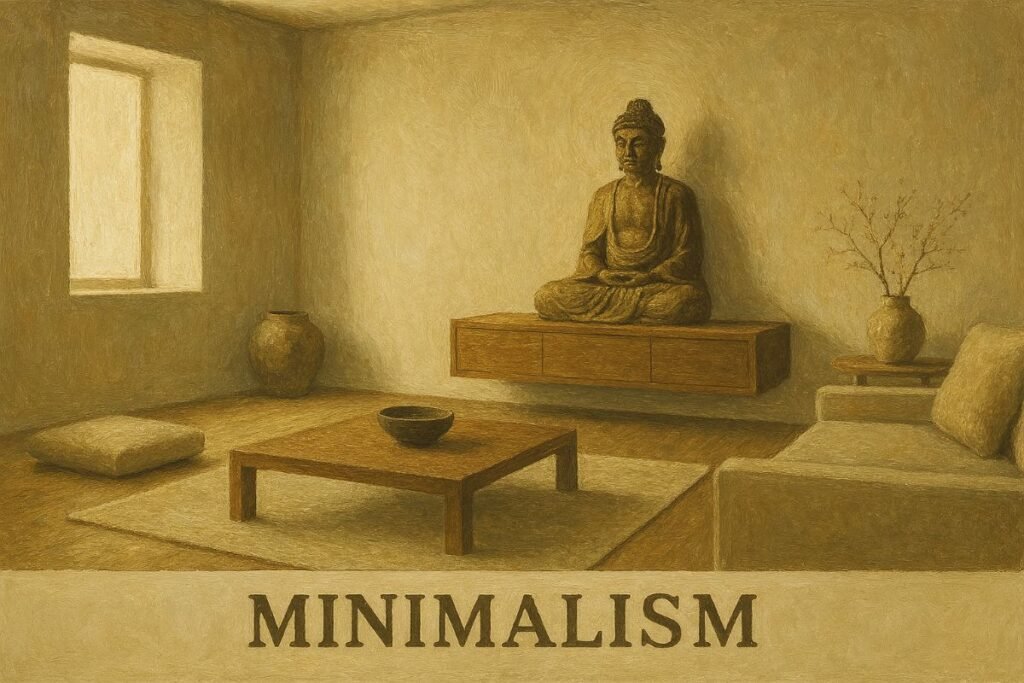
- Create a Dedicated Meditation Corner: A simple cushion, a small table, perhaps a candle or a single flower. This sacred spot reinforces your daily practice.
- Embrace “Kanso” (Simplicity): Choose decor that is functional and calming. Keep surfaces clear. Let natural light in. A simple space reduces sensory overload and makes it easier to focus and relax.
- Incorporate Nature: A plant, a view of the sky, or natural materials like wood and stone remind us of the effortless simplicity and beauty of the natural world.
5.5. The Practice of Generosity (Dana)
Minimalism should not become hoarding of space or a sterile, closed-hearted attitude. Its natural partner is generosity.
- Give Freely: As you declutter, give items away to people or organizations that need them. See it as an act of kindness, not disposal.
- Share Your Time and Skills: Generosity with non-material resources is equally important. Offer your attention, help, or expertise.
- Experience the Joy: Notice the light feeling that comes from giving without expectation. This reinforces the truth that happiness comes more from letting go than from holding on.
6. Common Challenges and Mindful Responses
The path is not always smooth. Here are common obstacles and how a Buddhist minimalist might approach them.
- Challenge: “But I might need it someday!”
- Mindful Response: Acknowledge the fear behind this thought. Reflect on anicca (impermanence)—your future needs are unpredictable. Trust in your ability to meet future needs when they arise. You can often borrow, rent, or find a simple alternative if a rare need occurs. The cost of storing and managing the “just in case” item often outweighs the benefit.
- Challenge: Sentimental Attachment to Objects
- Mindful Response: Honor the memory, not the object. Take a photo of the item. Write about the memory it represents. Then, consider if you can let the physical object go, knowing the memory lives within you. For a few truly core items, keep them mindfully, display one quilt from a grandmother, don’t store ten in boxes.
- Challenge: Social and Family Pressure
- Mindful Response: Practice Right Speech and compassion. You do not need to preach minimalism. Simply model it. When receiving gifts, express genuine gratitude for the thought. If asked, explain your choices simply: “I’m trying to live with less clutter so I can feel more calm and present.” Suggest experiential gifts (a shared meal, a class) instead of objects.
- Challenge: Falling Back into Old Habits
- Mindful Response: Apply mindfulness and self-compassion. There is no “perfect minimalist.” Notice the slip without self-judgment. What triggered the impulse buy or the clutter buildup? Use it as a learning opportunity. The path is a continuous practice, not a fixed destination.
7. A Glossary of Key Terms
| English Term | Pali/Sanskrit Term | Detailed Explanation |
|---|---|---|
| Suffering/Unsatisfactoriness | Dukkha (Pali) | The fundamental condition of stress, unease, and dissatisfaction inherent in life, often caused by clinging to impermanent things. |
| Impermanence | Anicca (Pali) | The core teaching that all conditioned phenomena—thoughts, feelings, objects, relationships—are in a constant state of flux and will eventually cease. |
| Not-Self | Anatta (Pali) | The liberating insight that there is no permanent, independent, unchanging soul or self. What we call “self” is a temporary, interdependent collection of changing processes. |
| Craving / Attachment | Tanha (Pali) | The “thirst” or desire for sensory pleasure, for existence, and for non-existence. It is identified as the root cause of dukkha. |
| Contentment | Santutthi (Pali) | The virtue of being easily satisfied, praised by the Buddha as a great wealth. It is the cultivated satisfaction with sufficient material conditions like food, shelter, and robes. |
| The Middle Way | Majjhima Patipada (Pali) | The path of practice taught by the Buddha, which avoids the extremes of sensual indulgence and severe self-mortification. |
| Mindfulness | Sati (Pali) | The faculty of attentive, non-judgmental awareness of present-moment experience, developed through meditation. |
| The Eightfold Path | Ariya Atthangika Magga (Pali) | The practical path to the end of suffering, consisting of Right View, Right Intention, Right Speech, Right Action, Right Livelihood, Right Effort, Right Mindfulness, and Right Concentration. |
| Generosity | Dana (Pali) | The virtue of giving, practiced without any expectation of reward or return. It is the foundational training in letting go of attachment. |
| Compassion | Karuna (Pali/Sanskrit) | The heartfelt wish for others to be free from suffering, accompanied by a readiness to help. |
8. Conclusion: The Journey of Simple Abundance
Buddhist minimalism is far more than a cleaning method. It is a transformative journey towards freedom. It uses the tangible realm of our possessions and schedules as a training ground for the mind, teaching us the profound Buddhist truths of impermanence, non-attachment, and mindful presence.
By letting go of the non-essential, we make space in our homes, our schedules, and most importantly, our hearts and minds. This space is not empty; it is filled with the potential for deeper awareness, genuine connection, and sustained peace. It allows us to engage with the world from a place of choice and compassion, rather than compulsion and reaction.
Start where you are. Hold one object mindfully. Pause before one purchase. Sit in meditation for five minutes. In these small, conscious acts, you begin to walk the Middle Way of Buddhist minimalism, discovering that a life of less clutter can indeed be a life of more meaning.