Caring for Parents and Children Without Losing Yourself
Key Takeaways
- The sandwich generation involves caring for ageing parents while also raising or supporting children, often creating competing demands on time, energy and emotional resources.
- Buddhism does not teach us to escape family responsibilities, but rather to meet them with wisdom (paññā) and compassion (karuṇā).
- Clinging (upādāna) to particular outcomes — such as parents staying healthy or children making certain choices — can turn love and responsibility into anxiety, resentment and suffering (dukkha).
- Impermanence (anicca) becomes especially tangible as parents age and children grow toward independence, offering powerful opportunities for reflection.
- Compassion does not mean doing everything for everyone; it includes recognising your own limits and acting wisely.
- Equanimity (upekkhā) helps us care without believing that we can control every outcome.
- Mindfulness (sati) involves remembering and maintaining clear awareness of what is occurring, with attention directed appropriately to the body, feelings, mind and phenomena.
- Buddhist practice can help transform family obligations from a source of exhaustion into an opportunity for cultivating generosity, patience and wisdom.
1. Introduction: When Everyone Needs You
1.1 What Is the Sandwich Generation?
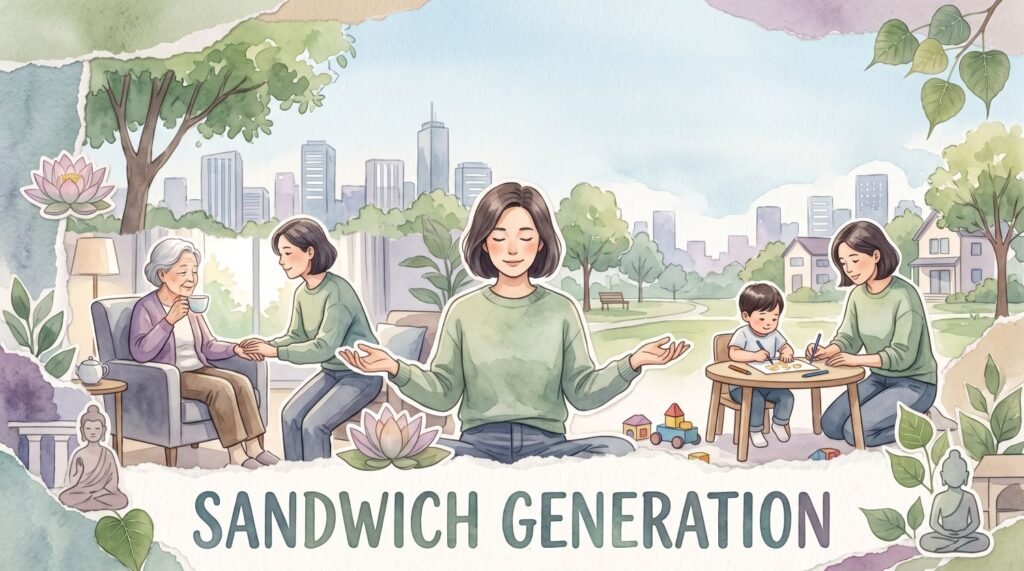
The term “sandwich generation” describes adults who find themselves caring for their ageing parents while simultaneously raising or supporting their own children. Like the filling between two slices of bread, these individuals are pressed between the needs of two generations. This is not merely a financial or logistical challenge; it is deeply emotional and often spiritually demanding.
In contemporary society, this situation has become increasingly common. People are living longer, and many adults delay having children or find that adult children remain at home longer than previous generations. The result is that many people in their forties, fifties and sixties are supporting both elderly parents and dependent children — sometimes simultaneously, sometimes sequentially, but often with significant demands on their time, energy and emotional reserves.
1.2 Caring for Ageing Parents While Raising Children
The dual responsibility of caring for parents and children is not new, but it has become more pronounced in modern times. Medical advances mean that parents may live for many years with chronic conditions that require ongoing care. At the same time, economic pressures mean that adult children may need financial or practical support well into their twenties or even thirties.
For many, this creates a life structured around medical appointments, school runs, financial planning, and the emotional labour of supporting people at very different stages of life. The needs of elderly parents and growing children are often in tension: a parent may need help with daily tasks just as a child needs guidance through a difficult phase of adolescence or early adulthood.
1.3 The Feeling of Being Pulled in Every Direction
One of the most common experiences reported by people in the sandwich generation is the feeling of being pulled in multiple directions at once. There is never enough time, never enough energy, and never enough of oneself to go around. This can lead to a persistent sense of being stretched thin, of always falling short in one area or another.
This feeling is not simply about busyness. It is about the emotional weight of knowing that multiple people depend upon you, and that your choices affect the well-being of those you love most deeply. When a parent needs care and a child needs attention, choosing one over the other can feel like a betrayal — regardless of which choice you make.
1.4 When Love Becomes Exhaustion
Love is the foundation of family care. We care for our parents because we love them; we care for our children because we love them. But love, when combined with unrelenting demands, can become exhaustion. The very devotion that motivates us to give can also deplete us.
Many people in the sandwich generation describe feeling that they have nothing left for themselves. Their identity becomes defined by what they do for others. Their sense of self-worth becomes tied to how well they meet the needs of those around them. When they cannot do enough, they feel inadequate. When they try to set boundaries, they feel guilty. When they resent the demands placed upon them, they feel ashamed.
1.5 A Buddhist Perspective on an Ordinary Human Problem
From a Buddhist perspective, the challenges of the sandwich generation are not unusual or exceptional. They are expressions of universal human experiences: ageing, illness, change, loss, responsibility, love, clinging and the desire for things to be other than they are. The Buddha’s teachings (Dhamma) address these experiences directly.
Buddhism does not offer a quick fix or a way to escape family responsibilities. It does not promise that mindfulness will make caregiving easy or that equanimity will eliminate difficult emotions. Rather, Buddhism offers a framework for understanding why these situations cause suffering and how we can meet them with greater wisdom, compassion and peace.
This article draws primarily on early Buddhist teachings preserved in the Nikāya tradition, while also recognising that Buddhist traditions have developed diverse approaches to family life, compassion and practice. It explores how Buddhist teachings can be applied to the specific challenges of the sandwich generation, offering both doctrinal grounding and practical guidance.
2. Why the Sandwich Generation Can Become a Source of Suffering
2.1 Too Many Responsibilities, Too Little Time
The First Noble Truth concerns dukkha — the suffering, stress and unsatisfactoriness that characterise conditioned existence. The sandwich generation experiences this truth in very concrete ways. There are simply more responsibilities than there are hours in the day, more demands than there is energy to meet them.
This is not a personal failing. It is a structural reality of modern life. Recognising this can help reduce the tendency to blame oneself for feeling overwhelmed.
2.2 The Pressure to Be a Good Parent and a Good Child
Cultural expectations around family are powerful. We are taught that good parents give their children everything they need, and that good children care for their parents in old age. These are noble ideals, but they can become sources of suffering when they are impossible to fulfil perfectly.
When a person cannot give their children everything they want, or cannot provide the level of care they believe their parents deserve, they may experience shame or guilt. The gap between the ideal and the reality becomes a source of pain.
2.3 Guilt When You Cannot Do Everything
Guilt is one of the most persistent emotions in the sandwich generation. It arises when we feel we are not doing enough for someone we love. It can be triggered by a parent’s disappointed look, a child’s unmet need, or simply the awareness that we cannot be everywhere at once.
From a Buddhist perspective, guilt can be understood as a form of clinging (upādāna) — clinging to an image of ourselves as the perfect caregiver, or clinging to the belief that we can and should control the well-being of those we love. When reality does not match this image, we suffer.
2.4 Resentment When Others Depend Upon You
Resentment is another common emotion in the sandwich generation. It arises when we feel that others are taking too much from us, that we are giving more than we receive, or that others are not doing their fair share. This resentment can be directed toward parents, children, siblings, or even ourselves for feeling resentful in the first place.
Resentment is a form of aversion (dosa) — one of the three root poisons in Buddhist psychology, along with greed (lobha) and delusion (moha). It is a natural response to feeling overwhelmed, but it also adds another layer of suffering to an already difficult situation.
2.5 Fear of Losing Those You Love
As parents age, the reality of their mortality becomes increasingly present. Watching a parent decline can evoke profound fear — fear of losing them, fear of what life will be like without them, fear of one’s own ageing and death. Similarly, as children grow and become more independent, there is fear of them leaving, fear of them making mistakes, fear of them being hurt by the world.
Fear (bhaya) can arise in connection with clinging. The more we cling to someone, the more we fear losing them. The sandwich generation is caught between the fear of losing parents to age and the fear of losing children to independence.
2.6 The Desire to Control What Cannot Be Controlled
Underlying much of the suffering in the sandwich generation is the desire to control. We want to control our parents’ health, our children’s choices, the timing of events, the outcomes of difficult situations. But life is inherently uncontrollable. Ageing, illness and death cannot be controlled. Other people’s choices cannot be controlled. Even our own emotions cannot be fully controlled.
The Buddha taught that craving (taṇhā) is the origin of suffering. From a contemporary Buddhist perspective, the desire to control outcomes can be understood as one expression of craving: wanting experience to conform to what we wish it to be. When we cannot control what happens, we suffer. This is a central part of the Buddhist diagnosis of the sandwich generation’s challenges.
3. Buddhism and the Reality of Family Responsibility
3.1 Buddhism Does Not Teach Indifference
A common misunderstanding is that Buddhism teaches detachment from family and worldly responsibilities. This is not accurate. The Buddha did not teach people to abandon their families or to be indifferent to the suffering of loved ones. He taught monks and nuns to renounce household life, but he also taught laypeople how to live ethically and compassionately within their families and communities.
The path of renunciation is one option, but it is not the only path. The majority of the Buddha’s followers were laypeople who maintained families, worked for a living and cared for their relatives. The teachings for laypeople are extensive and practical, addressing precisely the kinds of challenges faced by the sandwich generation.
3.2 Compassion and Responsibility
Compassion (karuṇā) is one of the core Buddhist virtues. It is the wish for others to be free from suffering. In the context of family care, compassion motivates us to help our parents and children. It is not a burden but a natural expression of our interconnection with others.
However, compassion must be balanced with wisdom (paññā). Wisdom helps us understand what is truly helpful and what is not. It helps us recognise our limits and act in ways that are sustainable. Compassion without wisdom can become self-sacrifice that harms both ourselves and those we care for.
3.3 The Buddhist Value of Caring for Parents
The Buddha explicitly taught the importance of caring for parents. In the Sigālovāda Sutta (DN 31), the Buddha describes the duties of children toward their parents. A child should: support parents who once supported them, do their duties, maintain the family lineage, behave in a way that is worthy of their inheritance, and offer gifts in honour of departed relatives.
This is not a distant or abstract teaching. It is a practical guide to how children should relate to their parents. The principle is one of reciprocity: parents care for children when they are young, and children care for parents when they are old. This is not about obligation in a cold sense, but about gratitude and love expressed through action.
The Kataññu Sutta (AN 2.33) teaches that it is impossible to fully repay one’s parents for all they have done. The Buddha said that even carrying one’s parents on one’s shoulders for a hundred years would not repay the debt of gratitude owed to them. This teaching does not create guilt; it acknowledges the depth of the parent-child relationship and encourages gratitude as a foundation for care.
3.4 Supporting Children With Wisdom and Compassion
Just as Buddhism values caring for parents, it also values caring for children. The same Sigālovāda Sutta (DN 31) describes the duties of parents toward their children: restraining them from evil, supporting them in doing good, teaching them a skill or profession, finding them a suitable partner, and giving them their inheritance at the proper time.
These teachings can be understood as emphasising parental guidance and responsibility rather than unlimited control over a child’s life. Parents are to teach, support and provide — but ultimately, children must live their own lives. This is a crucial insight for the sandwich generation, where the line between supporting adult children and controlling them can become blurred.
3.5 Generosity, Service and Family Life
Generosity (dāna) is another foundational Buddhist virtue. In the context of family life, generosity takes the form of giving time, attention, care and material support to family members. This is not merely a duty but a spiritual practice. Each act of care for a parent or child is an opportunity to cultivate generosity.
Service to family members is also recognised as a form of practice. The Buddha taught that caring for one’s parents is one of the highest blessings. In the Mahāmaṅgala Sutta (Snp 2.4), supporting one’s parents is listed among the greatest blessings in life. For a contemporary Buddhist practitioner, this can provide a different way of viewing family care — not simply as a burden, but as an opportunity to practise gratitude, generosity and responsibility.
3.6 Responsibility Without Possessiveness
A key distinction in Buddhist ethics is between responsibility and possessiveness. Responsibility involves doing what is skilful and helpful for others. Possessiveness involves treating others as extensions of ourselves, as objects to be controlled.
When we care for parents possessively, we may try to control their choices, disregard their autonomy, or make decisions based on our own fears rather than their well-being. When we care for children possessively, we may try to live through them, prevent them from making their own mistakes, or keep them dependent on us.
Buddhism encourages responsibility without possessiveness. We can care deeply without clinging. We can help without controlling. This is one of the most important lessons for the sandwich generation.
3.7 The Family Is Not a Permanent Refuge
We naturally seek security in our family relationships. Yet Buddhism reminds us that parents age, children change, relationships change, and eventually separation comes. Family can be a field of love and care without being a permanent refuge from change.
This is not a pessimistic teaching but a realistic one. Recognising that family cannot provide permanent security helps us appreciate what we have while we have it, and prepares us to let go when the time comes. It also helps us avoid the disappointment that comes from expecting more from family relationships than they can realistically provide.
3.8 The Reality of Kamma and Its Implications
The Buddhist teaching on kamma (karma in Sanskrit) offers a crucial perspective for the sandwich generation. The principle that beings are the owners of their kamma, heirs to their kamma, born of their kamma, related through their kamma, and have kamma as their refuge is a profound recognition that each person ultimately walks their own path.
This teaching does not mean we should abandon those we love or refuse to help them. Rather, it means that while we can offer compassion, support and wise guidance, we cannot live another person’s life or guarantee the results of their actions. Each person remains responsible for their own intentional actions and their consequences.
This perspective provides a doctrinal foundation for the equanimity discussed in Section 9 and the practice of letting go explored in Section 14. When we recognise that each person is responsible for their own actions and their consequences, we are freed from the impossible burden of trying to control outcomes for others. We can offer our care and support, but we cannot determine what will come of it.
4. Impermanence: The Parents We Have Today Will Not Always Be Here
4.1 Ageing Is Part of Life
Impermanence (anicca) is one of the three marks of existence in Buddhist teaching. Everything changes; nothing remains the same. Ageing is the most visible manifestation of impermanence in our parents and in ourselves. The bodies that once carried us, fed us and protected us are now slowing down, weakening and breaking down.
From a Buddhist perspective, ageing is not an aberration or injustice imposed upon us; it is part of the nature of conditioned life. When we accept ageing as natural, we can meet it with greater equanimity.
4.2 Watching Our Parents Change
Watching parents change can be profoundly unsettling. The strong, capable people we once knew may become frail, forgetful or dependent. Their personalities may shift. They may lose abilities that once defined them. This can evoke grief, even while they are still alive.
Buddhism does not tell us to suppress this grief. It tells us to acknowledge it, to understand it, and to respond to it with compassion — for ourselves as well as for our parents. Grieving the loss of who our parents once were is a natural response to impermanence.
4.3 The Pain of Anticipating Loss
Many people in the sandwich generation experience anticipatory grief — the pain of anticipating the loss of their parents. This can be as painful as actual loss, and it can go on for years. The fear of losing parents can colour every interaction, every decision, every moment spent together.
The Buddha’s teaching on impermanence does not eliminate this pain, but it can transform it. When we know that our time with our parents is limited, we can appreciate each moment more fully. The awareness of impermanence can deepen our appreciation rather than simply increasing our anxiety.
4.4 Children Also Change
Impermanence applies to children as well. The child who once needed us for everything is now becoming independent. The adolescent who once shared everything is now keeping secrets. The young adult who once lived at home is now building a life elsewhere.
This can be as difficult as watching parents age, though in a different way. The loss of a child’s dependence can feel like a loss of connection. But just as with parents, impermanence in children is natural and inevitable. Clinging to the way things used to be only creates suffering.
4.5 Nothing Stays as It Is
The Buddha’s teaching on impermanence applies to everything: our relationships, our circumstances, our own bodies and minds. The situation we are in today will not be the same tomorrow, next month or next year. This can be frightening, but it can also be liberating.
When we accept that nothing stays as it is, we stop wasting energy trying to hold things in place. We stop expecting our parents to remain healthy, our children to remain dependent, our circumstances to remain stable. We learn to meet each moment as it is, rather than as we wish it to be.
4.6 Impermanence Can Deepen Appreciation
Paradoxically, the awareness of impermanence can deepen our appreciation for the people we love. When we know that our time with our parents is limited, we may become more patient, more present, more grateful. When we know that our children will not always need us in the same way, we may cherish the moments we have with them more fully.
The Upajjhatthana Sutta (AN 5.57) contains the Five Remembrances, which are to be recited regularly:
- I am of the nature to grow old; I cannot avoid ageing.
- I am of the nature to become ill; I cannot avoid illness.
- I am of the nature to die; I cannot avoid death.
- All that is dear to me will change and be separated from me.
- My actions are my only true belongings; I cannot escape the consequences of my actions.
In the Sutta, these reflections are not merely exercises in appreciating the present; they are intended to undermine intoxication with youth, health and life and support the development of the path. They are reminders to live wisely, to appreciate what we have while we have it, and to let go of what we cannot keep.
5. Clinging, Love and the Desire to Control
5.1 Love Is Not the Same as Clinging
Buddhist teachings distinguish wholesome goodwill and loving-kindness from clinging. Mettā refers to benevolent goodwill, while upādāna refers more specifically to clinging or grasping. This distinction helps us understand how love for parents and children can coexist with attachment to particular outcomes.
We can love our parents and children without clinging to them. This is not coldness; it is freedom. When we love without clinging, we can care for others without demanding that they be a certain way. We can support them without trying to control them. We can let them go without ceasing to love them.
5.2 Wanting Our Parents to Stay Healthy
It is natural to want our parents to stay healthy. But when this desire becomes clinging, it turns into anxiety. We worry constantly about their health. We try to control their diet, their exercise, their medical care. We become upset when they make choices that we believe are unhealthy.
At times, what appears to be compassion can actually be fear expressed as care. The desire for our parents to be healthy is understandable, but the clinging to that outcome causes suffering. We cannot control our parents’ health. We can support them, encourage them, and help them — but ultimately, their bodies will age and decline regardless of what we do.
5.3 Wanting Our Children to Make the Right Choices
Similarly, it is natural to want our children to make good choices. But when this becomes clinging, it turns into control. We try to guide every decision, prevent every mistake, protect them from every disappointment. We become anxious when they deviate from our expectations.
When concern becomes an inability to tolerate our children’s choices, fear and clinging may be operating beneath the surface. Children must learn to make their own choices and face their own consequences. Our role is to support and guide, not to control. The more we try to control our children’s choices, the more we create suffering for ourselves and for them.
5.4 When Concern Becomes Control
Concern becomes control when we cannot tolerate the possibility that others might make different choices from the ones we prefer. Concern is open and receptive; control is rigid and demanding. Concern listens; control dictates. Concern trusts; control fears.
The sandwich generation faces many situations where concern can easily become control: when parents resist help, when children make choices we disagree with, when family members have different views about care. Recognising the difference between concern and control is essential for reducing suffering.
5.5 “I Know What Is Best for You”
The thought “I know what is best for you” is one of the most common sources of family conflict. It may be true that we have more experience or more information in some situations. But it is also true that others have their own wisdom, their own preferences, their own right to make choices.
Buddhism teaches humility. We do not know everything. We cannot see all the consequences of our choices or others’ choices. The belief that we know what is best for others is a form of clinging— clinging to our own views, our own preferences, our own sense of control.
5.6 Letting Others Have Their Own Lives
Letting others have their own lives is one of the most difficult aspects of family relationships, especially for the sandwich generation. While some families have long practiced independence, many operate on older patterns where parents guide and children defer. But as parents age and children grow, these dynamics must inevitably shift.
Buddhism teaches that each person is ultimately responsible for their own path. We can support, encourage, and help — but we cannot live others’ lives for them. Adapting to these changing circumstances by letting go of the need to control them is a profound spiritual practice.
5.7 Caring Without Clinging
The goal is not to stop caring, but to care without clinging. We can be fully present, fully engaged, fully loving — without demanding that things be a certain way. We can do everything we can for our parents and children — without believing that we can control the outcomes.
This is the path of the wise caregiver: doing what is skilful, letting go of what is beyond control, and resting in the peace of having done what one can.
6. The Second Arrow: When Family Difficulties Become Mental Suffering
6.1 The First Arrow: The Difficult Situation
The Buddha used the simile of two arrows to explain how suffering works. The first arrow is the difficult situation itself: a parent’s illness, a child’s struggle, financial pressure, exhaustion. This arrow is painful, but it is also inevitable. Life contains difficulties.
The second-arrow teaching from the Sallatha Sutta (SN 36.6) provides a useful Buddhist way of understanding how a difficult situation can be compounded by the mind’s reactions.
6.2 The Second Arrow: What the Mind Adds
The second arrow is the mental suffering we add to the situation: worry, guilt, resentment, fear, self-blame. The additional mental suffering is not inevitable; Buddhist practice aims to understand and relinquish the reactions that add to the original pain.
The Buddha taught that an untaught person feels both arrows: the pain of the situation and the pain of their reaction. A wise person feels only the first arrow. They experience the difficulty without adding unnecessary mental suffering.
6.3 “I Should Be Doing More”
One common second arrow is the thought “I should be doing more.” This thought arises when we compare ourselves to an impossible ideal. It adds guilt and self-criticism to an already difficult situation. The first arrow is the actual need. The second arrow is the belief that we are failing to meet it perfectly.
6.4 “My Children Should Appreciate What I Do”
Another second arrow is the thought “My children should appreciate what I do.” This thought arises when we expect gratitude and do not receive it. The first arrow is the effort we make. The second arrow is the disappointment when others do not respond as we wish.
6.5 “My Parents Should Listen to Me”
The thought “My parents should listen to me” is another common second arrow. It arises when we believe we know what is best and our parents disagree. The first arrow is the disagreement. The second arrow is the frustration, anger and resentment that follow.
6.6 “I Can’t Cope With This”
The thought “I can’t cope with this” is a particularly painful second arrow. It adds despair to difficulty. The first arrow is the challenge. The second arrow is the belief that we are unable to meet it. This belief may or may not be true — but even if it is true, the despair does not help.
6.7 Responding Without Adding Another Layer of Suffering
The practice is to recognise the second arrow and let it go. This does not mean suppressing emotions or pretending not to feel. It means observing the mind’s reactions without being caught by them. It means seeing thoughts like “I should be doing more” as thoughts, not as facts.
When we can respond to family difficulties without adding mental suffering, we become more effective caregivers. We have more energy, more clarity and more compassion. We are less likely to burn out and more able to be present for those who need us.
7. Compassion Without Exhaustion
7.1 Compassion Does Not Mean Doing Everything
Compassion is the wish for others to be free from suffering. It does not require us to do everything for everyone. Sometimes the most compassionate thing we can do is to say no, to set a boundary, or to let someone face the consequences of their own choices.
This is a crucial distinction. Many people in the sandwich generation equate compassion with self-sacrifice. They believe that if they are truly compassionate, they will give until they have nothing left. This is not compassion; it is exhaustion disguised as virtue.
7.2 The Difference Between Compassion and Self-Sacrifice
Compassion is sustainable. It comes from a place of inner resource and is balanced by wisdom. Self-sacrifice is often unsustainable. It comes from a place of guilt, fear or a need for approval. It depletes the caregiver and can even harm those being cared for, who may become dependent or resentful.
The Buddhist principle of avoiding extremes can be applied to caregiving: neither neglecting those who depend upon us nor assuming that compassion requires limitless self-sacrifice.
7.3 Recognising Your Own Limits
Recognising our own limits is an act of wisdom, not weakness. We are human beings with finite energy, time and emotional capacity. Pretending otherwise is not noble; it is delusion.
When we recognise our limits, we can make wiser choices about how to allocate our resources. We can ask for help. We can say no. We can take breaks. We can accept that we cannot do everything.
7.4 Saying No Without Hatred
Saying no is often difficult for caregivers, especially when the request comes from someone we love. But saying no does not mean we do not care. It means we recognise our limits and are acting wisely.
The key is to say no without hatred. We can say no with kindness, with explanation, with an offer of alternatives. We can say no without closing our hearts. We can say no and still love.
7.5 Asking Others to Share the Responsibility
Many people in the sandwich generation try to carry everything alone. They do not ask for help because they do not want to burden others, or because they believe they should be able to manage, or because they do not trust others to do things properly.
Asking for help is not a sign of failure. It is a recognition that caregiving is often more than one person can manage alone. Sharing responsibility with siblings, partners, friends or professional caregivers can reduce the burden and improve the quality of care.
7.6 Caring for Yourself Without Making the Self the Centre
The Buddhist tradition does not require us to understand care for ourselves and care for others as opposing duties. In the Sedaka Sutta (SN 47.19), the Buddha explains that protecting oneself protects others, and protecting others protects oneself. This is not about selfishness but about interdependence. When we care for ourselves, we are better able to care for others. When we care for others, we also care for ourselves.
7.7 Compassion for Everyone Involved
Compassion in the sandwich generation should extend to everyone involved: parents, children, partners, siblings — and ourselves. We often forget to include ourselves in the circle of compassion. We give compassion to others but not to ourselves.
Extending compassion to ourselves means acknowledging our own suffering, our own limits, our own needs. It means treating ourselves with the same kindness we would offer a friend in a difficult situation. This is not indulgence; it is wisdom.
8. Patience When Family Life Becomes Difficult
8.1 When Parents Become Difficult
As people age, they may become more difficult. They may be forgetful, stubborn, irritable or demanding. They may resist help, make poor decisions or say hurtful things. This can be incredibly challenging for those who care for them.
Patience (khanti) is one of the core Buddhist virtues. It is the ability to endure difficulty without becoming angry or discouraged. Patience does not mean accepting harmful behaviour, but it does mean responding with equanimity rather than reactivity.
8.2 When Adult Children Do Not Listen
Adult children may also be difficult. They may not listen to advice, make choices we disagree with, or seem ungrateful for our support. This can trigger frustration, disappointment and even anger.
Patience with adult children means recognising that they are on their own path. They must make their own mistakes and learn their own lessons. Our role is to support, not to control. Patience allows us to do this without resentment.
8.3 Anger, Irritation and Resentment
Anger, irritation and resentment are natural responses to difficult family situations. But they are also sources of suffering. They harm us as much as they harm others. They cloud our judgment, strain our relationships and drain our energy.
Buddhism does not tell us to suppress anger. It tells us to understand it, to see its causes, and to respond skilfully. Anger is a signal that something is wrong — but it is not always an accurate guide to what to do about it.
8.4 Pausing Before Speaking
One of the most practical applications of patience is pausing before speaking. When we are angry or frustrated, we often say things we regret. A pause, even a single breath, can create space between the impulse and the action.
The Buddha described well-spoken speech as truthful, timely, affectionate, beneficial and spoken with goodwill. A pause helps us assess whether what we are about to say meets these criteria. It is a small practice with large consequences.
8.5 Right Speech Within the Family
Right speech (sammāvācā) is one of the factors of the Noble Eightfold Path. It involves speaking truthfully, kindly and helpfully. In the context of family life, right speech is essential.
Right speech means avoiding lies, harsh words, divisive speech and idle chatter. It means speaking in ways that build understanding rather than conflict. It means listening as much as speaking. In families where tensions run high, right speech can be a powerful tool for reducing conflict.
8.6 Patience Does Not Mean Accepting Harmful Behaviour
Patience should not be confused with passivity. Patience does not mean accepting harmful behaviour or allowing others to mistreat us. It means responding to difficulty with equanimity rather than reactivity, but it does not preclude taking action to protect ourselves or others.
If a parent is being abusive or a child is being destructive, patience may involve setting firm boundaries or seeking outside help. Patience is about how we respond internally, not about what actions we take.
9. Equanimity: Caring Without Trying to Control Everything
9.1 What Equanimity Means in Buddhism
Equanimity (upekkhā) is a quality of mind that remains balanced in the face of life’s ups and downs. It is not indifference or coldness. It is the ability to meet experiences, pleasant and unpleasant, with a steady, peaceful mind.
Equanimity is one of the four divine abodes (brahmavihāras), along with loving-kindness (mettā), compassion (karuṇā) and sympathetic joy (muditā). It is also one of the seven factors of awakening (bojjhaṅgā). It is a quality to be cultivated, not a natural given.
9.2 Equanimity Is Not Indifference
A common misunderstanding is that equanimity means not caring. This is not accurate. Equanimity means caring deeply without being destabilised by the outcomes. We can care about our parents’ health, our children’s well-being and our own circumstances, but we do not have to be thrown into distress when things do not go as we wish.
Equanimity is the balance point between clinging and indifference. It allows us to be fully engaged with life without being controlled by it.
9.3 You Cannot Control Your Parents
You cannot control your parents’ health, their choices or their eventual death. You can influence some things, but you cannot control them. Recognising this is the foundation of equanimity in caring for parents.
The teaching on kamma reinforces this understanding. Each person is the owner of their actions and their results. While we can offer support and guidance, we cannot determine the outcome of our parents’ lives. When you accept that you cannot control your parents, you free yourself from the burden of trying. You can do what you can, and you can let go of the rest. This does not mean abandoning them; it means caring for them without the illusion of control.
9.4 You Cannot Fully Control Your Children
Similarly, you cannot fully control your children. You can guide them, support them and provide for them — but ultimately, they must make their own choices and live their own lives. The principle of kamma reminds us that children, like all beings, are heirs to their own actions. Trying to control them will only create suffering for everyone involved.
Recognising that children have their own path is liberating. It allows us to relate to them as separate beings, not as extensions of ourselves. It allows us to support them without suffocating them.
9.5 You Cannot Control Ageing, Illness or Death
Ageing, illness and death are part of life. They cannot be controlled, no matter how much we try. We can delay some effects of ageing, treat some illnesses and postpone death — but we cannot stop them.
Accepting this reality is not pessimism. It is wisdom. When we accept that ageing, illness and death are inevitable, we can stop wasting energy fighting them. We can focus instead on what we can do: being present, offering care, and appreciating the time we have.
9.6 Doing What You Can and Releasing What You Cannot
The practice of equanimity involves doing what we can and releasing what we cannot. We can take practical steps to help our parents and children. We can offer our time, energy and resources. But once we have done what we can, we must let go of the outcome.
This is not passive resignation. It is active acceptance. We act with full effort, and then we release clinging to the results. This is the heart of skilful action in Buddhism.
9.7 The Peace of Knowing You Have Done What You Can
There is a deep peace that comes from knowing you have done what you can. When you have cared for your parents as best you could, supported your children as best you could, and acted with compassion and wisdom — you can rest in that knowledge, regardless of the outcomes.
This peace is not dependent on everything turning out well. It is dependent on acting in alignment with your values and your wisdom. It is a peace that cannot be taken away by circumstances.
10. Mindfulness in the Middle of Family Life
10.1 What Mindfulness Means in Buddhism
Mindfulness (sati) involves remembering and maintaining clear awareness of what is occurring, with attention directed appropriately to the body, feelings, mind and phenomena. In the context of family life, mindfulness means being fully present with whoever we are with. When we listen to a parent or child, we listen with full attention, not with our minds elsewhere.
Mindful listening is a gift. It communicates that we care, that we value the other person, that we are not distracted. It also helps us understand what is really being said, beyond the words.
10.2 Mindfulness During Difficult Conversations
Difficult conversations are common in the sandwich generation: discussing care arrangements, finances, living situations, end-of-life decisions. These conversations can be emotionally charged and stressful.
Mindfulness during difficult conversations means staying present with our own emotions and with the other person. It means noticing when we are becoming defensive, angry or overwhelmed, and pausing before reacting. It means listening fully, even when we disagree.
10.3 Noticing Anger Before Speaking
One of the most powerful applications of mindfulness is noticing anger before it leads to speech. When we are mindful, we can feel the energy of anger arising in the body — the tension, the heat, the urge to speak harshly. We can pause and choose how to respond.
This pause is the difference between reacting and responding. Reacting is automatic and often harmful. Responding is conscious and often helpful. Mindfulness creates the space for responding.
10.4 Being Present Rather Than Mentally Rehearsing the Future
Many people in the sandwich generation spend a great deal of time mentally rehearsing the future: worrying about what might happen, planning for contingencies, imagining worst-case scenarios. This is a form of mental suffering that takes us away from the present moment.
Mindfulness brings us back to the present. It reminds us that the future is uncertain and the past is gone. This moment is where life happens.
10.5 One Conversation at a Time
When we are overwhelmed, it is easy to feel that we are dealing with everything at once. But in reality, we are always dealing with one thing at a time. Mindfulness helps us focus on what is in front of us, rather than being scattered across all our concerns.
When you are talking to your parent, be with your parent. When you are helping your child, be with your child. When you are taking a break, be with the break. One thing at a time. This can help us remain grounded amid competing demands.
10.6 Finding Moments of Stillness in an Ordinary Day
Mindfulness does not require special meditation sessions (though those are helpful). It can be practised in ordinary moments: while washing dishes, walking from one room to another, waiting for an appointment. These small moments of stillness can be anchors in a busy day.
Finding moments of stillness is not about adding another task to our to-do list. It is about bringing awareness to what we are already doing. It is about being present, even in the midst of activity.
11. When You Feel Guilty
11.1 “I Am Not Doing Enough”
Guilt is one of the most persistent emotions in the sandwich generation. The feeling of not doing enough, of failing those we love, of being inadequate. This guilt can be paralysing and exhausting.
From a Buddhist perspective, guilt is often based on unrealistic expectations. We have an image of the perfect caregiver — and we fall short. But the image is not real. It is a construct of our minds. Letting go of the image can let go of the guilt.
11.2 The Guilt of Leaving Parents Alone
Many people feel guilty when they leave their parents alone, even for short periods. They worry about what might happen, about their parents feeling lonely or neglected. This guilt can prevent them from taking necessary breaks or attending to their own needs.
Guilt about leaving parents alone is often based on fear. It is the fear that something terrible will happen, and that we will be responsible. But we cannot be with our parents every moment. We must trust that they can manage, or that others will help, or that we can return when needed.
11.3 The Guilt of Not Giving Children Enough Attention
Similarly, many people feel guilty about not giving their children enough attention. They worry that their children are being neglected, that they are not providing enough support, that their children will suffer as a result.
This guilt is often based on an idealised image of perfect parenting. But perfect parenting does not exist. Children do not need perfect parents; they need parents who love them, who are present when they can be, and who are honest about their limits.
11.4 You Cannot Give Everyone Everything
The reality is that you cannot give everyone everything. You cannot meet every need of every person who depends on you. This is not a failure; it is a fact of being human.
Accepting this reality is liberating. It allows us to make choices without guilt. We can choose what is most important, what is most urgent, what we can realistically do — and let go of the rest.
11.5 Wise Responsibility Versus Unproductive Guilt
There is a difference between wise responsibility and unproductive guilt. Wise responsibility involves doing what we can, making thoughtful choices, and acting with compassion. Unproductive guilt involves feeling bad about what we cannot do, about not being perfect, about not meeting impossible standards.
Wise responsibility is helpful; it motivates us to act. Unproductive guilt is harmful; it drains our energy and clouds our judgment. Learning to distinguish between the two is an important skill.
11.6 Learning to Let Go of the Ideal Parent or Child
Much of our guilt comes from holding onto ideals: the ideal parent we should be, the ideal child we should be, the ideal family we should have. These ideals are not real. They are fantasies that cause suffering.
Letting go of these ideals does not mean lowering our standards. It means accepting reality as it is: our parents as they are, our children as they are, ourselves as we are. From this acceptance, we can act wisely and compassionately—without the burden of guilt.
12. When Resentment Arises
12.1 “Why Is Everything My Responsibility?”
Resentment often arises from the feeling that everything is our responsibility. We are the ones who make the appointments, manage the finances, provide the emotional support, solve the problems. Others seem to contribute less or not at all.
This feeling is understandable. But resentment does not help. It adds to our suffering and can damage our relationships. The challenge is to acknowledge the feeling without being consumed by it.
12.2 Resentment Toward Parents
Resentment toward parents can arise when they are demanding, ungrateful, or resistant to help. It can also arise from unresolved issues from childhood — old wounds that are reopened by the caregiving relationship.
Acknowledging resentment toward parents does not make us bad people. It makes us human. The practice is to see the resentment, understand its causes, and respond with wisdom rather than acting it out.
12.3 Resentment Toward Children
Resentment toward children can arise when they seem ungrateful, when they do not appreciate our sacrifices, or when they make choices we disagree with. It can also arise when adult children remain dependent longer than we expected.
Again, acknowledging this resentment is important. Suppressing it does not make it go away; it only makes it fester. Seeing it clearly allows us to address the underlying issues.
12.4 Resentment Toward Siblings or Other Family Members
Resentment toward siblings or other family members is common when care responsibilities are unevenly distributed. One person does most of the work while others contribute little or nothing. This can be a major source of frustration and conflict.
Addressing this resentment requires clear communication and boundary-setting. It may also require accepting that others will not change, and finding ways to care for ourselves regardless.
12.5 Understanding the Conditions Behind Resentment
Resentment does not arise from nowhere. It arises from specific conditions: feeling overburdened, feeling unappreciated, feeling that others are not doing their share, feeling that we have no choice. Understanding these conditions helps us respond skilfully.
When we see the conditions that give rise to resentment, we can address them directly. We can ask for help. We can set boundaries. We can change our expectations. We can choose to let go of the resentment rather than holding onto it.
12.6 Responding With Wisdom Rather Than Suppression
The Buddhist approach to resentment is not to suppress it but to respond with wisdom. This means acknowledging the feeling, understanding its causes, and choosing a skilful response. It does not mean pretending we are not resentful.
Wisdom might involve having a difficult conversation, setting a boundary, or simply accepting that the situation is what it is. The key is to respond consciously rather than reacting automatically.
12.7 Loving-Kindness Without Pretending Everything Is Fine
Loving-kindness (mettā) is the practice of wishing well for all beings, including those we resent. But mettā does not require pretending that everything is fine. We can wish for others to be happy while also acknowledging our own feelings and setting appropriate boundaries.
Mettā is not about being a doormat. It is about maintaining an open heart even when we are setting limits. It is about wishing well for others without sacrificing our own well-being.
13. Family Conflict and Right Speech
13.1 Speaking Truthfully Without Cruelty
Right speech (sammāvācā) is one of the factors of the Noble Eightfold Path. It involves speaking truthfully, but also kindly. Truth without kindness can be cruel. Kindness without truth can be misleading.
In family conflicts, we often struggle with this balance. We may speak harshly in the name of honesty, or we may avoid difficult truths in the name of kindness. Right speech offers a middle way: speak what is true, but speak it with care.
13.2 When Parents Resist Help
Many parents resist help from their children. They want to maintain their independence. They may feel that accepting help is a sign of weakness. This can be frustrating for children who want to help.
Right speech in this situation involves acknowledging the parent’s feelings while also expressing concern. It means listening to their perspective, respecting their autonomy, and offering help in ways that they can accept. It may also mean accepting that they will not accept help, and letting go of the need to control the outcome.
13.3 When Children Resist Guidance
Similarly, adult children may resist guidance from their parents. They want to make their own decisions. They may feel that their parents are interfering or controlling.
Right speech in this situation involves offering guidance without demanding compliance. It means sharing our perspective while respecting their autonomy. It means trusting that they will make their own choices, and being there for them regardless.
13.4 Avoiding Blame
Blame is a common feature of family conflicts. We blame others for problems. We blame ourselves. Blame creates defensiveness and closes down communication. It is rarely helpful.
Right speech avoids blame. It focuses on the situation rather than on assigning fault. It uses “I” statements rather than “you” statements. It seeks to understand rather than to accuse.
13.5 Listening Before Responding
Listening is as important as speaking. In family conflicts, we often listen only enough to formulate our response. We do not truly hear what the other person is saying.
Right speech involves listening fully before responding. It means being present with the other person, understanding their perspective, and responding from that understanding. This does not mean agreeing; it means understanding.
13.6 Knowing When Silence Is Wiser
Sometimes the wisest response is silence. When emotions are high, when we are too angry to speak wisely, when the other person is not ready to hear, silence can be the most skilful choice.
Silence is not avoidance. It is a conscious choice to wait, to let emotions settle, to create space for wiser speech later. Knowing when to speak and when to be silent is a mark of wisdom.
14. The Buddhist Practice of Letting Go
14.1 Letting Go Does Not Mean Abandoning People
Letting go is often misunderstood as abandoning people or ceasing to care. This is not what Buddhism means by letting go. Letting go means releasing clinging, not releasing responsibility.
We can let go of our clinging to outcomes while still caring deeply. We can let go of our need to control while still offering support. We can let go of our expectations while still being present. Letting go is about our internal relationship to the situation, not about external withdrawal.
14.2 Letting Go of Expectations
Much of our suffering comes from expectations. We expect our parents to be grateful, our children to be appreciative, our efforts to be recognised. When reality does not match these expectations, we suffer.
Letting go of expectations is liberating. It allows us to act without demanding a particular response. It allows us to give freely, without clinging to the outcome. It allows us to accept people as they are, not as we wish them to be.
14.3 Letting Go of the Belief That We Can Control What Is Not Within Our Control
Our belief that we can control what is not within our control can itself become a source of suffering. This is one of the most difficult practices for the sandwich generation. We want to control our parents’ health, our children’s choices, our own circumstances. But the reality is that much of life lies beyond our control.
The teaching on kamma reinforces this understanding. Each person is the heir to their own actions. We cannot determine the outcomes for others, no matter how much we love them or how hard we try. Letting go of the belief that we can control what is not within our control does not mean doing nothing. It means doing what we can and releasing the rest. It means acting with full effort while accepting that we cannot determine the outcome. This is the essence of skilful action.
14.4 Letting Go of the Past
The past can weigh heavily on us: past mistakes, past conflicts, past regrets. We may dwell on things we should have done differently, things we wish we had said, things we wish we had not said.
Letting go of the past is not about forgetting. It is about releasing the emotional charge. It is about learning from the past without being imprisoned by it. It is about being present in this moment, not trapped in memories.
14.5 Letting Go of the Future We Imagined
We all have images of the future: how our parents will age, how our children will grow, how our lives will unfold. When reality does not match these images, we suffer.
Letting go of the future we imagined is not about giving up hope. It is about accepting that the future is uncertain, and that our images are just images. It is about being open to whatever comes, rather than clinging to a particular vision.
14.6 Allowing People to Be Who They Are
One of the most powerful forms of letting go is allowing people to be who they are. This means accepting our parents as they are, not as we wish them to be. It means accepting our children as they are, not as we wish them to be. It means accepting ourselves as we are, not as we wish to be.
Allowing people to be who they are is not passive resignation. It is active acceptance. It is the recognition that people have their own paths, their own journeys, their own ways of being. Our role is to support, not to shape.
14.7 Meeting This Moment as It Is
Ultimately, letting go is about meeting this moment as it is. Not as we wish it to be. Not as we fear it might be. Not as it was in the past. But as it is, right now.
Meeting experience clearly without being driven by craving and aversion is one important dimension of Buddhist practice. When we can meet each moment as it is, we find freedom — even in the midst of difficulty.
15. Practical Buddhist Practices for the Sandwich Generation
15.1 A Three-Breath Pause
When you feel overwhelmed, take three conscious breaths. Breathe in slowly, breathe out slowly. Notice the sensation of the breath. This simple practice creates space between the stimulus and your response. It is simple, immediately available and can create a little space between an emotional impulse and your response.
15.2 Mindful Listening
When you are with a family member, practise mindful listening. Give them your full attention. Do not interrupt. Do not plan your response. Just listen. This is a gift to them and a practice for you.
15.3 Loving-Kindness for Family Members
Practise loving-kindness (mettā) for your family members. Sit quietly and repeat phrases like: “May you be well, may you be happy, may you be free from suffering.” Start with yourself, then extend to your parents, your children, and all family members.
This practice softens the heart and reduces resentment. It reminds us that we wish well for those we love, even when they are difficult.
15.4 The Five Remembrances
Recite the Five Remembrances from the Upajjhatthana Sutta (AN 5.57) regularly:
- I am of the nature to grow old.
- I am of the nature to become ill.
- I am of the nature to die.
- All that is dear to me will change and be separated from me.
- My actions are my only true belongings.
These remembrances help us accept impermanence and live with greater wisdom.
15.5 Reflecting on Impermanence
Take a few moments each day to reflect on impermanence. Notice how things change: the weather, your mood, your body, your relationships. This reflection helps us appreciate what we have while we have it, and let go when it is time.
15.6 Walking Meditation During a Difficult Day
When you are feeling overwhelmed, try walking meditation. Walk slowly and deliberately, paying attention to the sensation of each step. This is a form of mindfulness that can be done anywhere, even in a busy hospital corridor or a crowded home.
15.7 Evening Reflection
At the end of each day, take a few moments to reflect: What did I do well today? What could I have done differently? What am I grateful for? This reflection helps us learn from our experience and cultivate gratitude.
15.8 Asking: “What Is Actually Needed Right Now?”
In moments of confusion or overwhelm, ask yourself: “What is actually needed right now?” This question cuts through the noise and helps us focus on what is truly important. Often, the answer is simpler than we think.
15.9 Asking: “What Is Within My Control?”
Another helpful question: “What is within my control?” This question helps us distinguish between what we can change and what we cannot. We can focus our energy on what is within our control and let go of the rest.
15.10 Ending the Day Without Carrying Everything Into Tomorrow
Before you sleep, practise letting go of the day. Acknowledge what happened, learn what you can, and then release it. You do not need to carry today’s burdens into tomorrow. Tomorrow will bring its own challenges. Rest now.
16. Difficult Situations
16.1 When an Elderly Parent Refuses Help
Many elderly parents refuse help, even when they clearly need it. This can be frustrating and frightening for adult children. The key is to respect their autonomy while continuing to offer support.
You might try: offering specific, limited help rather than open-ended assistance; involving a third party (such as a doctor or trusted friend); accepting that they may refuse help and focusing on what you can do.
16.2 When a Parent’s Needs Become Increasingly Demanding
As parents age, their needs often increase. This can be overwhelming, especially when combined with other responsibilities. The key is to recognise your limits and seek additional support.
You might try: involving other family members; hiring professional caregivers; exploring residential care options; accepting that you cannot do everything yourself.
16.3 When Adult Children Remain at Home
Many adult children remain at home longer than previous generations. This can create tension, especially when parents are also caring for elderly relatives. The key is to maintain clear boundaries and expectations.
You might try: having honest conversations about expectations; setting timelines and goals; encouraging independence; accepting that the situation may be temporary.
16.4 When Children Need Financial Support
Adult children may need financial support, especially in difficult economic times. This can strain family resources and create tension. The key is to give what you can without sacrificing your own well-being.
You might try: setting clear limits on financial support; helping children develop financial skills; accepting that you cannot solve all their problems.
16.5 When Siblings Do Not Contribute Equally
Unequal contribution among siblings is a common source of resentment. The key is to communicate clearly and accept what you cannot change.
You might try: having a direct conversation about responsibilities; acknowledging that different siblings have different capacities; accepting that you cannot control others’ choices; focusing on what you can do rather than what others are not doing.
16.6 When Family Members Disagree About Care
Family members often disagree about how to care for ageing parents. These disagreements can be deeply painful. The key is to communicate with respect and seek common ground.
You might try: listening to all perspectives; focusing on the parent’s well-being; involving a neutral third party; accepting that you may not reach full agreement.
16.7 When You Are Angry With Someone You Love
Anger toward loved ones is painful. The key is to acknowledge the anger without acting on it destructively.
You might try: taking a pause before speaking; expressing your feelings calmly and clearly; seeking to understand the other person’s perspective; practising loving-kindness for yourself and the other person.
16.8 When You Simply Feel Exhausted
Exhaustion is a common experience in the sandwich generation. The key is to recognise it and respond with self-compassion.
You might try: taking breaks when you can; asking for help; accepting that you cannot do everything; practising mindfulness to restore energy; remembering that this phase will not last forever.
16.9 When You Cannot Afford to Provide Everything
Financial limitation is itself an important part of the sandwich-generation problem. Many people simply cannot afford the care their parents need or the support their children require.
You might try: being honest about your financial limits; exploring community resources and government support; involving other family members in financial planning; accepting that you cannot provide everything and letting go of the guilt.
16.10 When You Wish Your Parent’s Suffering Would End
One of the most painful situations a caregiver can face is watching a parent experience prolonged and unrelenting suffering — whether through terminal illness, advanced dementia, severe debilitation, or another condition that substantially diminishes their quality of life. In such circumstances, a thought may arise: “It would be better if they died.” For a loving son or daughter, such a thought can be deeply distressing and may lead to shame or guilt.
From a Buddhist perspective, the arising of such a thought does not by itself make someone cruel or uncaring. The mind can produce thoughts under conditions of grief, exhaustion, fear, helplessness and compassion, often without our consciously choosing them. What matters is how we understand the thought, what intention lies behind it, and how we respond to it.
Sometimes the thought is primarily a wish for suffering to end rather than a wish for the person to die. At other times, the motivations may be mixed. Compassion, exhaustion, fear, grief and aversion can coexist. Buddhism therefore encourages us to examine the mind honestly rather than immediately condemning ourselves.
Acknowledge the Thought Without Immediately Judging Yourself
A thought is not the same thing as an action or an intention deliberately chosen and acted upon. When a painful thought arises, there is little value in adding another layer of suffering through immediate self-condemnation.
You might simply recognise:
This is a painful thought arising in a painful situation.
The practice is not to pretend that the thought does not exist, nor to justify every thought that arises. It is to observe it carefully and understand the conditions that have given rise to it.
A caregiver may be exhausted after months or years of watching someone deteriorate. They may feel helpless, frightened about what lies ahead, or unable to bear seeing someone they love suffer. Recognising these conditions does not make harmful intentions wholesome, but it allows them to be examined with greater honesty and wisdom.
Examine the Intention Behind the Thought
Early Buddhist teaching places great importance on intention (cetanā). When a thought such as “I wish this suffering would end” arises, it is worth asking what lies behind it.
Is there compassion — the wish that another person be free from suffering?
Is there helplessness — the feeling that nothing can be done?
Is there fear about what lies ahead?
Is there exhaustion from prolonged caregiving?
Is there aversion to witnessing pain and decline?
Or is there an actual intention to cause harm?
These motivations are not necessarily separate. Several may be present at once.
The Buddhist practice is to recognise them without either romanticising or condemning them. Compassion can be cultivated, while anger, aversion and harmful intentions can be understood and abandoned.
Distinguish Compassion From Causing Harm
Compassion does not mean deliberately causing another person’s death.
In early Buddhist ethics, intentionally taking life is contrary to the first precept. The compassionate wish for someone to be free from suffering therefore needs to be distinguished from an intention to cause their death.
This distinction does not mean that caregivers must attempt to prevent death at all costs or reject appropriate medical and palliative care. Caring for someone who is dying, providing pain relief, respecting their wishes, and allowing the natural course of a terminal illness to unfold are different ethical questions from intentionally taking a life.
Where difficult medical or end-of-life decisions arise, those decisions should be discussed with appropriate medical, palliative-care and other professional advisers rather than being resolved through private speculation about what another person’s life or death should be.
Accept That You Cannot Know Everything
We cannot know with certainty what is best for another person.
We cannot completely know another person’s inner experience. We cannot see all the causes and conditions shaping their life. Nor can we determine another person’s karmic circumstances simply by observing their suffering.
Buddhist wisdom therefore encourages humility about judgments concerning another person’s life and death.
This does not mean becoming passive or indifferent. It means recognising the limits of our knowledge while doing what can reasonably be done to provide care, comfort and protection.
Remain With What Is Happening Now
Much of the anguish surrounding prolonged illness comes from projecting suffering into an imagined future:
How long will this continue?
How much worse will it become?
Can I cope with another year of this?
What will happen when I can no longer manage?
These questions may sometimes need practical answers, but repeatedly living in an imagined future can add considerable suffering to the present.
Mindfulness offers another possibility: attending to what is actually happening now.
Today may require a doctor’s appointment. Tonight may require sitting beside a parent. At another moment it may simply mean preparing food, helping with personal care, listening, or sitting quietly together.
Mindfulness does not eliminate the larger uncertainty. It helps prevent the mind from becoming completely overwhelmed by everything that has not yet happened.
Offer What Comfort You Can
A caregiver cannot cure every illness, prevent every decline or control the moment of death.
But there is much that can still be offered.
Presence matters. So does kindness. So does listening. So does helping someone remain comfortable and dignified. Sometimes compassion consists of very ordinary acts performed patiently over a long period of time.
The inability to fix a person’s suffering does not make those acts meaningless.
Buddhist practice does not require us to become capable of controlling conditions that are inherently beyond our control. It asks us to respond to those conditions as wisely and compassionately as we can.
Let Go of the Need to Make Everything Better
Caregiving can create a powerful sense of responsibility. When someone we love is suffering, we may feel that we should somehow be able to make things better.
But illness, ageing and death cannot ultimately be controlled by our efforts.
The Upajjhaṭṭhāna Sutta (AN 5.57), which presents the Five Remembrances, asks us to reflect that we are subject to ageing, illness and death, that we will be separated from what is dear to us, and that we are owners and heirs of our actions.
These reflections are not intended to make us indifferent. They help us understand the conditions of human existence more realistically.
We can care deeply for someone while recognising that we cannot prevent their ageing, illness or death.
Listen to Your Parent When Possible
If a parent is able to communicate, listen to what they want.
Ask what matters to them. Ask what they fear. Ask what provides comfort. Where possible, respect their wishes concerning their care and treatment within the appropriate medical and legal framework.
This recognises something important: your parent is not merely someone you are caring for. They remain a person with their own preferences, values, fears and dignity.
Compassion does not require us to decide everything on another person’s behalf simply because we love them.
Find Support for Yourself
Watching a parent suffer can be emotionally and physically exhausting. Caregivers can experience grief, frustration, anger, helplessness and exhaustion, sometimes simultaneously.
Seeking help is not a failure of compassion.
Family members, trusted friends, counsellors, support groups, medical professionals, palliative-care teams and, where appropriate, Buddhist teachers or spiritual advisers can provide valuable support.
A caregiver who is overwhelmed may need care too.
Compassion should not be understood as requiring one person to destroy themselves in the attempt to save another.
Meet Guilt With Understanding
Guilt about wishing for a parent’s suffering to end can become a second source of suffering.
Rather than immediately concluding “I am a terrible son” or “I am a terrible daughter,” examine the experience more carefully.
What conditions gave rise to the thought?
Was there exhaustion?
Fear?
Grief?
Helplessness?
Compassion?
Anger?
Aversion?
Something else?
Recognising the causes and conditions surrounding a thought is more useful than simply condemning ourselves for having experienced it.
If the thought contains compassion, cultivate compassion. If it contains aversion or anger, recognise those states and work with them. If it reflects exhaustion, acknowledge the need for support. If there is a genuine intention to harm, take that seriously and seek appropriate help.
The goal is not to achieve a mind that never produces a difficult thought. The goal is to develop the wisdom to understand difficult thoughts and the discipline not to turn harmful intentions into harmful actions.
Accept That There May Be No Easy Answer
End-of-life situations rarely provide complete certainty.
There may be competing responsibilities, difficult medical information, disagreements within families and decisions for which no outcome feels entirely satisfactory.
Buddhist practice does not necessarily remove that uncertainty.
Instead, it offers a way of meeting it: with mindfulness rather than panic, compassion rather than indifference, wisdom rather than assumption, and equanimity rather than the demand that circumstances be different from what they are.
You may love your parent deeply and still sometimes wish that their suffering would end.
You may feel exhausted and still care.
You may experience thoughts that disturb you without choosing to act upon them.
These realities are not necessarily contradictions.
The task is to meet them honestly, examine the intentions behind them, care for your parent as wisely as possible, care for yourself as well, and accept the limits of what any human being can control.
In the face of suffering, Buddhism does not offer an easy way out. It offers a way of meeting suffering without adding unnecessary suffering of our own.
17. A Buddhist Framework for the Sandwich Generation
17.1 See Clearly
The first step is to see clearly. See the situation as it is, not as you wish it to be. See your own limits. See the needs of others. See what is within your control and what is not. Clear seeing is the foundation of wise action.
17.2 Accept What Is Present
The second step is to accept what is present. Accept your parents’ ageing. Accept your children’s independence. Accept your own limitations. Acceptance is not resignation; it is the recognition of reality. From acceptance, wise action becomes possible.
17.3 Do What Is Skillful
The third step is to do what is skilful. Act in ways that are helpful, compassionate and wise. Give what you can. Support where you can. Set boundaries where needed. Skilful action is action that reduces suffering for yourself and others.
17.4 Speak With Care
The fourth step is to speak with care. Use right speech: truthful, timely, affectionate, beneficial and spoken with goodwill. Speak in ways that build understanding rather than conflict. Listen as much as you speak. Words have power; use them wisely.
17.5 Give What You Can
The fifth step is to give what you can. Give your time, your attention, your care, your resources. Give generously, but not beyond your means. Giving is a source of joy and meaning.
17.6 Know Your Limits
The sixth step is to know your limits. Recognise when you are reaching your capacity. Ask for help. Take breaks. Care for yourself. Knowing your limits is not weakness; it is wisdom.
17.7 Release What You Cannot Control
The seventh step is to release what you cannot control. Release clinging to outcomes. Release the need to control others. Release the belief that you can make everything right. Releasing is not giving up; it is letting go of what is not yours to carry.
17.8 Return to the Present
The eighth step is to return to the present. Again and again, come back to this moment. This is where life happens. This is where peace is found. This is where you can be fully present with those you love.
18. A Short Daily Reflection
Consider asking yourself these questions each day:
- What is needed from me today?
- What is within my control?
- What am I trying to control that is not mine to control?
- Am I acting from compassion or fear?
- Am I clinging to an expectation?
- Can I speak with greater patience?
- Can I care without carrying everything?
These questions are not meant to be answered perfectly. They are meant to guide your reflection, to bring awareness to your experience, and to help you act with greater wisdom and compassion.
19. Conclusion: Caring Without Clinging
19.1 You Cannot Stop Ageing
Ageing is inevitable. Your parents will age, and so will you. No amount of care, worry or control can stop this. Accepting this reality is the beginning of wisdom.
19.2 You Cannot Make Your Children’s Choices for Them
Your children must make their own choices and live their own lives. You can guide, support and love them — but you cannot choose for them. The teaching on kamma reminds us that each person is the heir to their own actions. Letting go of this control is an act of love.
19.3 You Cannot Carry Everyone’s Suffering
You cannot carry everyone’s suffering. You can be present with those who suffer, you can offer comfort and support, but you cannot take away their pain. Trying to carry what is not yours to carry only exhausts you and does not help anyone.
19.4 But You Can Choose How You Meet Each Moment
What you can do is choose how you meet each moment. You can meet difficulty with patience, loss with equanimity, love with gratitude, and uncertainty with trust. You can choose to be present, compassionate and wise.
19.5 Turning Family Responsibility Into Buddhist Practice
The challenges of the sandwich generation are not obstacles to spiritual practice; they are the practice itself. Caring for ageing parents and growing children is an opportunity to cultivate patience, compassion, generosity, equanimity and wisdom. It is an opportunity to see impermanence directly, to let go of clinging, and to live with greater awareness.
The goal is not to escape responsibility. It is to learn how to carry responsibility without allowing clinging, fear, resentment and the belief that we can control what is not within our control to consume the mind. When we can care for our parents and children without clinging, we find freedom — even in the midst of the most demanding circumstances.
Recommended Readings and Resources
Books
- The Heart of the Buddha’s Teaching by Thich Nhat Hanh – A clear introduction to Buddhist teachings, including the Four Noble Truths, the Noble Eightfold Path, and practical applications for daily life.
- Being Peace by Thich Nhat Hanh – A short but powerful book on mindfulness, compassion and peace in everyday life.
- The Art of Living by Thich Nhat Hanh – A guide to living with mindfulness, including teachings on impermanence, letting go and finding joy in the present moment.
- Mindfulness: A Practical Guide to Awakening by Joseph Goldstein – A comprehensive exploration of mindfulness and its applications, drawing on the early Buddhist teachings.
- Loving-Kindness: The Revolutionary Art of Happiness by Sharon Salzberg – A practical guide to cultivating loving-kindness (mettā) in everyday life.
Podcasts
- Dharma Talks (dharmaseed.org) – A vast collection of talks from teachers in the Theravada tradition, including many on family life, compassion and equanimity.
- Heart Wisdom with Jack Kornfield – Talks on Buddhist practice, including practical guidance for daily life and relationships.
- The Zen Studies Podcast – Episodes on Buddhist teachings and their application to modern life, including family relationships.
- 10% Happier with Dan Harris – Interviews with Buddhist teachers and practitioners on applying mindfulness and compassion in everyday situations.
Online Resources
- SuttaCentral.net – A comprehensive, searchable database of early Buddhist texts in multiple languages.
- AccessToInsight.org – A collection of translations of the Pali Canon, including many suttas on family life and ethics.
- PlumVillage.org – Resources on mindfulness and Buddhist practice from the tradition of Thich Nhat Hanh.
- BuddhistLearning.org – Articles and resources on applying Buddhist teachings to modern life.
Glossary
Anicca (Pali; Sanskrit anitya) – Impermanence. The teaching that all conditioned phenomena are in a constant state of change. One of the three marks of existence.
Bojjhaṅgā (Pali) – Factors of awakening. Seven qualities that lead to enlightenment: mindfulness, investigation of phenomena, energy, joy, tranquillity, concentration and equanimity.
Brahmavihāra (Pali; Sanskrit brahmavihāra) – Divine abodes. Four qualities of mind to be cultivated: loving-kindness (mettā), compassion (karuṇā), sympathetic joy (muditā) and equanimity (upekkhā).
Dāna (Pali; Sanskrit dāna) – Generosity. The practice of giving, considered the foundation of Buddhist ethics and a means of cultivating non-clinging.
Dhamma (Pali; Sanskrit dharma) – The teachings of the Buddha; also, the nature of reality, the truth of how things are.
Dosa (Pali; Sanskrit dveṣa) – Aversion. One of the three root poisons, along with greed (lobha) and delusion (moha). It manifests as anger, hatred, resentment and ill-will.
Dukkha (Pali; Sanskrit duḥkha) – A term encompassing suffering, stress, dissatisfaction and the unsatisfactory nature of conditioned existence. The First Noble Truth identifies dukkha as something to be understood.
Karuṇā (Pali; Sanskrit karuṇā) – Compassion. The wish for others to be free from suffering. One of the four divine abodes (brahmavihāras).
Khanti (Pali; Sanskrit kṣānti) – Patience. The capacity to endure difficulty without losing composure or giving way to anger. It is an active quality of forbearance and steadiness, not mere passivity. One of the perfections (pāramīs).
Lobha (Pali; Sanskrit lobha) – Greed. One of the three root poisons, along with aversion (dosa) and delusion (moha). It manifests as craving, clinging and desire.
Mettā (Pali; Sanskrit maitrī) – Loving-kindness. The wish for all beings to be happy and well. One of the four divine abodes (brahmavihāras).
Moha (Pali; Sanskrit moha) – Delusion. One of the three root poisons, along with greed (lobha) and aversion (dosa). It manifests as ignorance, confusion and not seeing things as they are.
Muditā (Pali; Sanskrit muditā) – Sympathetic joy. The ability to rejoice in the happiness and success of others. One of the four divine abodes (brahmavihāras).
Paññā (Pali; Sanskrit prajñā) – Wisdom. The discernment that sees things as they truly are, including the direct experiential understanding of impermanence, suffering and non-self. It is developed through study, reflection and meditation, and goes beyond mere intellectual comprehension.
Sammāvācā (Pali; Sanskrit samyagvāc) – Right speech. One factor of the Noble Eightfold Path. Speech that is truthful, timely, affectionate, beneficial and spoken with goodwill.
Sati (Pali; Sanskrit smṛti) – Mindfulness. The quality of remembering and maintaining clear awareness of what is occurring, with attention directed appropriately to the body, feelings, mind and phenomena. One of the factors of the Noble Eightfold Path and the foundation of meditation practice.
Taṇhā (Pali; Sanskrit tṛṣṇā) – Craving. The second noble truth: craving is the origin of suffering. It manifests as craving for sensory pleasure, craving for existence and craving for non-existence.
Upādāna (Pali; Sanskrit upādāna) – Clinging, grasping or appropriation. The mind’s taking hold of objects, views, experiences or identity. A deeper form of craving (taṇhā) that leads to suffering.
Upekkhā (Pali; Sanskrit upekṣā) – Equanimity. A balanced mind that remains steady in the face of life’s ups and downs. One of the four divine abodes (brahmavihāras) and one of the factors of awakening (bojjhaṅgā).