Key Takeaways
- A daily 30‑minute routine provides a stable and spacious container for Buddhist practice without demanding impossible hours from a busy modern life.
- The routine belongs to the Theravada Buddhist tradition and centres on two foundational meditations: mindfulness of breathing (ānāpānasati) and loving‑kindness (mettā).
- Half an hour allows you to cultivate both calm, collected awareness (samatha) and clear seeing into experience (vipassanā) in a balanced, unhurried way.
- Every term is explained clearly and simply, no prior knowledge is required.
- Over weeks and months, the practice helps reduce reactive stress, build emotional resilience, and naturally nurture a kinder, wiser relationship with yourself and others.
- Consistency is more important than intensity. A daily 30‑minute sit is a powerful act of self‑care that gradually re‑shapes the mind.
Introduction
You started with a ten‑minute daily meditation. It was manageable, a tiny oasis in a busy schedule. The mind settled a little, the timer rang, and you stepped back into the day. But now, a quiet voice asks: “What would happen if I gave this more time?” Perhaps you feel the practice plateauing, the mind barely settled before the bell. This article answers that call. It offers a complete 30‑minute routine grounded in the oldest recorded Buddhist teachings, a natural next step that deepens calm, insight, and kindness without asking you to abandon your life. Half an hour a day is still profoundly realistic, yet it gives the mind enough space to go beyond surface stillness and taste genuine transformation.
The routine presented here belongs to the Theravada school of Buddhism, which preserves the early discourses of the Buddha recorded in the Pali language. The practice is directly drawn from two key texts: the Satipaṭṭhāna Sutta (the Discourse on the Foundations of Mindfulness) and the Karaṇīya Mettā Sutta (the Discourse on Loving‑Kindness). While 10 minutes is a beautiful starting point, 30 minutes allows the mind to settle more deeply, to work skilfully with hindrances, and to cultivate loving‑kindness across a broader spectrum of relationships. The extra time is not a burden, it is a gift you give to your own wellbeing.
Whether you have already tasted a shorter practice and wish to extend it, or you are ready from the outset to dedicate half an hour, this guide provides everything you need. Every term is explained, every step is practical, and the tone is grounded in the plain, investigative spirit of the early teachings.
1. What Does It Mean to Start a Buddhist Practice?
A Buddhist practice is a complete training of the heart and mind. In the Theravada tradition, this training is often summarised as three mutually supportive areas: ethical conduct (sīla), collectedness of mind (samādhi), and wisdom (paññā). The 30‑minute routine you are about to learn primarily strengthens samādhi and wisdom, yet it also gently encourages ethical sensitivity because you see more clearly how your inner states ripple out into your actions.
Starting a practice does not require you to label yourself a Buddhist. The Buddha famously encouraged a spirit of open investigation. In the Kālāma Sutta, he advised people not to rely on hearsay, tradition, or mere reasoning, but to know for themselves: “When you yourselves know: ‘These things are wholesome, these things are blameless, these things are praised by the wise, and when undertaken and observed, these things lead to welfare and happiness,’ then enter on and abide in them.” Your 30‑minute daily sit is precisely this kind of personal laboratory.
You are not starting from zero. You already possess a mind that can pay attention, a body that breathes, and a heart capable of care. Buddhist practice organises these natural capacities deliberately. Think of the 30 minutes as a daily rehearsal: you are intentionally cultivating qualities, steady attention, patience, loving‑kindness, clear comprehension, that you want to bring into every corner of your life. When a difficult conversation arises or a wave of anxiety hits, the mind has a better chance of responding from that rehearsed steadiness rather than from blind habit.
What starting a practice does not mean is equally important. It does not mean emptying the mind of all thought, achieving permanent bliss, or escaping from the realities of life. These are unrealistic expectations that lead to discouragement. Instead, consider the practice a daily bath for the mind. You do not stay physically clean forever after one shower, you wash off the dust of the day. In the same way, 30 minutes of meditation cleanses some of the accumulated mental agitation, confusion, and emotional residue, leaving you fresher and clearer.
2. The Buddhist School Behind This Routine
This article explicitly presents a routine from the Theravada tradition, meaning “the Teaching of the Elders.” Theravada is the oldest continuously existing school of Buddhism and is widely practised today in Sri Lanka, Thailand, Myanmar, Laos, and Cambodia. Its scriptural foundation is the Pali Canon, a vast collection of the Buddha’s discourses, monastic rules, and philosophical texts. The two core suttas that inform this routine are the Satipaṭṭhāna Sutta (the Discourse on the Foundations of Mindfulness) and the Ānāpānasati Sutta (the Discourse on Mindfulness of Breathing). These texts give direct, practical instruction on how to establish mindfulness and develop collectedness.
Why does the school matter? Because different Buddhist traditions sometimes offer different meditation methods, and clarity about the source helps you practise with confidence. Mahayana traditions might emphasise visualisation of buddhas and bodhisattvas, mantra recitation, or devotional practices. Vajrayana adds complex esoteric techniques. All of these are profound in their own right, but they lie outside the scope of this simple, foundational routine. The approach here is deliberately stripped back to the very basics recorded in the early texts, making it portable, transparent, and free of cultural requirements. You will not need a special cushion, a bell, incense, or any belief system beyond a willingness to observe your own experience for half an hour.
The two meditation subjects we use, mindfulness of breathing (ānāpānasati) and loving‑kindness (mettā), appear repeatedly in the Pali discourses. They are recommended for both laypeople and monastics and are said to be suitable for all personality types. This makes them an ideal pair for anyone establishing a modern daily practice.
3. The Core Teachings That Support a Daily Practice
Before you sit for the first 30‑minute session, it is helpful to understand three Buddhist frameworks that will quietly guide your time on the cushion. They are not abstract theories, they are practical lenses through which you can understand your own mind.
3.1 The Two Wings: Samatha and Vipassanā
The Pali term samatha is often translated as calm, tranquillity, serenity, or calm abiding. It describes a mind that has settled down, is unified, and is no longer scattered by every passing impulse. Picture a glass of muddy water left to stand, gradually the mud sinks and the water becomes clear. Samatha practice is the patient act of letting that mud settle. It is cultivated by repeatedly, patiently returning attention to a single object, here, the breath. With practice, samatha manifests as inner stillness, clarity, and a sense of the mind being workable, like softened clay, rather than brittle or rigid. Importantly, calm is not dullness. A calm mind is bright, awake, and still, like a clear forest pool that perfectly reflects the sky.
Vipassanā is commonly translated as insight, clear seeing, or penetrative understanding. It refers to seeing the nature of experience directly: that all conditioned things are impermanent (anicca), that clinging to them brings dissatisfaction (dukkha), and that they lack a permanent, independent self (anattā). Vipassanā is not about thinking these truths, it is about observing them so intimately that they reshape your lived experience. In your 30‑minute routine, vipassanā occurs naturally each time you notice a thought drifting and choose to return to the breath, you are witnessing impermanence and the impersonal nature of mental events.
In Theravada meditation, samatha and vipassanā are likened to two wings of a bird. A bird needs both wings to fly. If you only cultivate calm, you might feel peaceful but still be caught in subtle attachments. If you only strain for insight without a calm mind, you can become restless, conceptual, or overwhelmed. The 30‑minute routine weaves the two together skilfully: focusing on the breath builds calm (samatha), and from that settled space, you observe mental and emotional patterns with increasing clarity (vipassanā). The longer session allows this interweaving to deepen naturally.
Mindfulness (sati) is the faculty that holds attention on the meditation object and recognises what is happening in the present moment. It is the tool that makes both samatha and vipassanā possible. A classic analogy is a gatekeeper at a city gate: alert, aware of who enters and leaves, but not chasing people down the street. Sati stays at the gate of the senses, knowing what arises, and holds the meditation subject in mind.
3.2 The Five Hindrances
In the Pali discourses, the Buddha frequently spoke of the Five Hindrances (pañca nīvaraṇāni), the mental obstacles that cloud the mind and weaken wisdom. They are: sensory desire (kāmacchanda), ill‑will (vyāpāda), sloth and torpor (thīna‑middha), restlessness and worry (uddhacca‑kukkucca), and sceptical doubt (vicikicchā). You do not need to memorise the Pali, but knowing the English terms is useful because these visitors will arrive in your meditation again and again.
Recognising a hindrance is not a sign of failure, it is exactly the work of vipassanā. When you notice, “Ah, this is restlessness,” you are already seeing clearly. The hindrances are not enemies to be destroyed, they are natural mental weather patterns. The 30‑minute routine provides enough time to recognise a hindrance, apply a skilful antidote, and return to the meditation object, without feeling rushed. Over time, this skill transfers to daily life, where the same hindrances appear as procrastination, irritation, mental fog, anxiety, and indecision.
3.3 The Brahmavihāras
The second half of the routine uses loving‑kindness, which belongs to a set of four qualities called the Brahmavihāras, often translated as the sublime abodes or divine dwellings. The four are: loving‑kindness (mettā), compassion (karuṇā), appreciative joy (muditā), and equanimity (upekkhā). Mettā is a sincere, unconditional wish for oneself and others to be well and happy. The English phrase “loving‑kindness” can sound soft or sentimental, but mettā is a powerful, steady quality. It does not depend on whether you like a person or how they treat you. It is the disposition of a true friend (the Pali word is related to mitta, “friend”). You begin with yourself not out of selfishness but because a cup must be full before it can overflow for others. Over time, mettā practice gradually erodes the habits of resentment, envy, and isolation, replacing them with a fundamental, non‑negotiable goodwill.
4. Preparing for Your 30‑Minute Routine
A little preparation ensures that the half hour feels spacious and nourishing rather than squeezed or restless. None of these steps are mandatory, but they create favourable conditions.
- Choose a regular time. A 30‑minute block is significant enough that it needs a consistent slot. Many practitioners find early morning ideal, before the day’s demands flood in. Others prefer an afternoon break or a quiet evening window. The key is regularity, the mind begins to anticipate the sit and settles more quickly.
- Protect your space. Find a quiet corner where you will not be disturbed. This might be a spare room, a cleared section of your bedroom, or even a spot in a garden or park. Let those you live with know that for this half hour you are unreachable. Treat the time as a non‑negotiable appointment with your own wellbeing.
- Settle your posture. You can sit cross‑legged on a cushion, kneel on a meditation bench, or sit in a straight‑backed chair with feet flat on the floor. The spine should be upright but not stiff, the hands resting comfortably in the lap, the chin slightly tucked. The eyes can be gently closed or left slightly open with a soft downward gaze. The body should feel both alert and relaxed, neither slouching into sleep nor rigid with tension. If sitting upright is painful due to chronic pain or mobility issues, you may lie down on your back with the body straight, remaining alert to avoid sleep.
- Set a gentle timer. Use a quiet alarm sound, perhaps a soft bell or a chime. Knowing the timer will signal the end frees the mind from clock‑watching. Thirty minutes is long enough to feel substantial and short enough to be entirely manageable, even during a busy phase of life.
- Let go of perfectionism. Every sit will be different. Some days the mind will be calm and bright, other days it will feel like a storm. Both are perfectly valid meditation sessions. The practice is the act of showing up, gently following the instructions, and beginning again when the mind wanders. There is no such thing as a failed meditation when you have made the sincere effort.
5. Step‑by‑Step: The 30‑Minute Practice
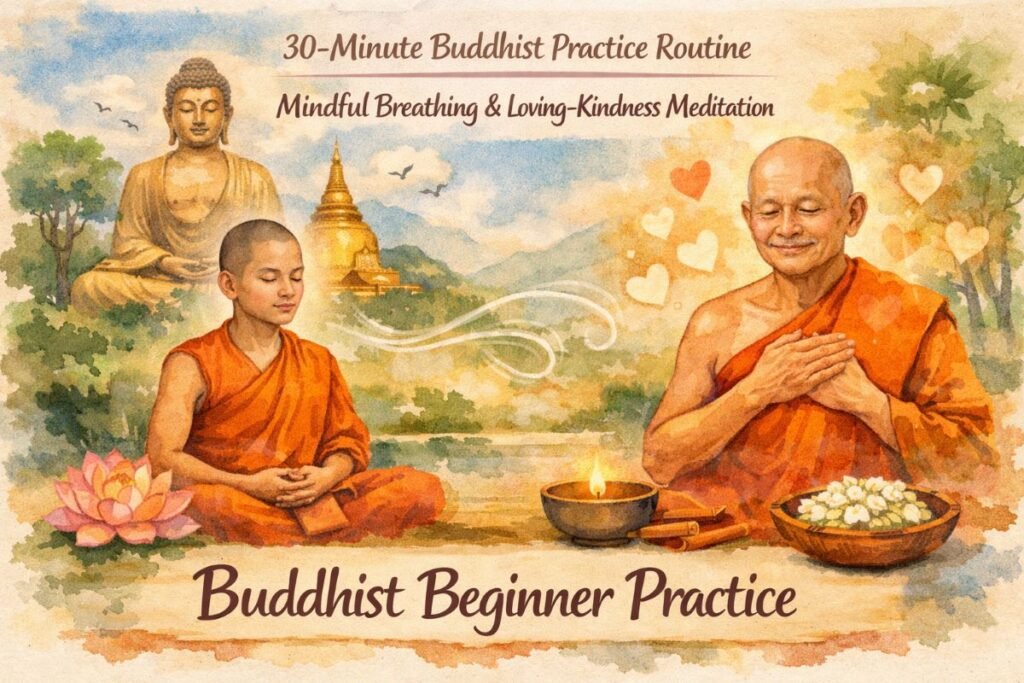
The routine is divided into four phases. The suggested timings are flexible, but the structure has been refined to balance calm and insight within half an hour.
Phase 1: Arriving (about 3 minutes)
Settle into the body.
Close your eyes if comfortable. Bring your awareness fully into the body, sensing the physical sensations of sitting. Notice the weight pressing into the chair or cushion, the contact at the soles of the feet, the backs of the legs, the hands resting in the lap. Do this without trying to change anything. Simply acknowledge the body’s presence, settling in like you would settle into a comfortable chair.
Take five conscious breaths.
Breathe in through the nose, feeling the coolness of the air at the nostrils, and breathe out through the mouth, letting each exhale be a little longer, like a gentle sigh. With each out‑breath, imagine you are setting down the luggage you have been carrying: the unfinished to‑do lists, the conversations, the worries, the plans. After the final deep breath, let the breathing return to its natural rhythm. This phase signals to your entire being: “Now, we are entering a period of practice. Everything else can wait.”
Phase 2: Mindfulness of Breathing, Ānāpānasati (about 12 minutes)
Anchor on the natural breath.
Bring your attention to the unforced flow of the breath. Do not control it. Let the body breathe itself. Identify the area where the breath feels most distinct, the tip of the nostrils, the rise and fall of the chest, or the movement of the abdomen. Commit to that one area for the entire session.
Follow the whole breath cycle.
After a few minutes, begin to notice the entire breath cycle. Sense the beginning of the in‑breath, its middle, and its end. Sense the brief pause, then the beginning, middle, and end of the out‑breath. This is the simple, direct knowing of “long breath” and “short breath” mentioned in the Ānāpānasati Sutta. You are not judging or controlling, just observing the varying lengths and textures.
Calm the bodily formation.
Gently incline the mind toward calming the breath. The sutta’s third step says, “Experiencing the whole body (of breath), I shall breathe in … calming the bodily formation, I shall breathe out.” Practically, this means allowing the breath to become softer, smoother, more subtle, naturally. With each out‑breath, let go of tension a little more. This deepens samatha markedly.
When the mind wanders, gently return.
Your mind will wander into planning, remembering, judging, or random songs. The moment you realise you have been lost in thought, that very moment is mindfulness (sati). There is no failure. Acknowledge where the mind went without criticism, and with immense gentleness, escort the attention back to the breath. Imagine training a puppy: you do not shout at it, you simply pick it up and carry it back to the paper, again and again.
Optional: As the mind settles, you can gently notice the arising and passing of sensations, thoughts, or emotions, seeing their impermanent nature. Always let the breath remain the primary anchor, the home base to which you return.
Phase 3: Loving‑Kindness, Mettā (about 12 minutes)
Transition: drop into the heart centre.
Take one deep, conscious breath to release the strict focus on the nostrils. Allow your awareness to drop down into the centre of your chest. Feel the area around your heart. This physical shift helps the mind transition from samatha’s precision to the spacious, warm quality of the Brahmavihāras.
Offer mettā to yourself.
Bring to mind a sense of your own presence, here and now. You might picture yourself as a young child or simply sense the living being that you are. Silently offer well‑wishes using phrases that feel genuine. Traditional phrases, or simple modern English, work equally well:
- May I be safe.
- May I be peaceful.
- May I be healthy.
- May I live with ease. (You may also use “May I be happy” as the first phrase if that resonates more naturally.)
Repeat each phrase one at a time, connecting it with the felt sense of the body. Do not worry if no special feeling arises. Mettā is an intention, a direction of the heart, not a manufactured emotion. You are planting seeds. Spend about three minutes here.
Extend mettā to a benefactor.
Bring to mind a person who easily inspires warmth and gratitude, someone who, when you think of them, naturally brings a smile. Picture them clearly and offer the same phrases, replacing “I” with “you”:
- May you be safe.
- May you be peaceful.
- May you be healthy.
- May you live with ease.
Allow any natural warmth to be present, but do not strain. Spend about two minutes.
Extend mettā to a neutral person.
Now bring to mind a neutral person, someone you encounter in daily life but do not know well: a cashier, a bus driver, a neighbour you see but never speak with. Offer them the same wishes. This step trains the heart to care beyond the narrow circle of personal preference. Spend about two minutes.
If suitable, include a difficult person.
With gentleness, bring to mind a person with whom you have some mild difficulty, someone who irritates or annoys you, not someone who has caused deep trauma. If this feels too challenging today, stay with the neutral person or return to yourself. If you are ready, offer them the same simple, sincere wishes. You are not condoning harmful behaviour. You are recognising that this person, like you, wishes to be happy and free from suffering, even if their methods are confused. This step releases the poison of resentment. Spend up to three minutes, adjusting as needed.
Radiate mettā to all beings.
Finally, expand the field of mettā without limit. Use a phrase such as: “May all beings, without exception, live with ease.” Imagine your goodwill radiating in all directions, like the light of a lamp touching every living thing. Rest in this boundless intention for the remaining two minutes. This dissolves the boundaries of self and other.
Phase 4: Closing and Dedication (about 3 minutes)
Rest in open awareness.
Let go of all phrases and all effort. Simply rest in open, receptive awareness. Do not try to focus on anything. If thoughts come, let them float by like clouds in a vast sky. If there is calm, rest in the calm. This transition allows the practice to integrate.
Dedicate the merit.
In the Theravada tradition, it is common to share the positive energy (puñña) generated by practice. Silently reflect: “May any goodness, any understanding, any peace cultivated here benefit all beings.”
Return to the body.
Very gently, bring attention back to the physical body. Wiggle your fingers and toes. Slowly open your eyes if they were closed. Carry the quality of awareness forward into the rest of your day.
6. Applying the Practice to Modern Life Situations
The true value of the 30‑minute routine reveals itself not only on the cushion but in the middle of a hectic day. Here are practical ways the skills transfer.
- Before a difficult conversation: Take a short “arriving” moment. Sense your feet on the floor, breathe one conscious breath, and silently run the first mettā phrase, “May I be at ease.” This micro‑intervention disrupts the stress cascade and centres you.
- When anxiety spirals at night: Switch into ānāpānasati mode. Instead of wrestling with anxious thoughts, bring kind attention to the physical sensation of the breath in the belly. Note “rising, falling.” Each time the mind dives back into worry, patiently return to the belly. This starves rumination not by solving every problem, but by withdrawing the fuel of compulsive attention.
- During a frustrating commute: Transform it into a neutral‑person mettā session. Look at other drivers or passengers without judgment and inwardly wish, “May you be well.” This shifts the entire atmosphere from competition and irritation to quiet, dignified connection.
- When self‑criticism attacks: You have been practising offering goodwill to yourself for several minutes each day. When the harsh inner critic appears, deliberately replace the toxic script with the phrase, “May I be peaceful,” even if it feels hollow. Repeating a positive intention is like watering a seed in dry soil, over weeks, it softens the ground and eventually sprouts.
- Navigating digital overwhelm: The entire routine strengthens the attention muscle. Every time you resist the urge to check your phone and instead take three mindful breaths, you are training the brain’s capacity for intentional focus. The hindrance of restlessness (uddhacca‑kukkucca) is recognised and gently set aside, not with force, but with the patient, non‑judgmental awareness you have cultivated in meditation. Gradually, you become the chooser of where your attention goes, rather than a puppet of every notification.
7. Common Obstacles and Skilful Responses
Every practitioner encounters challenges. Knowing them in advance prevents you from interpreting them as personal failure.
- “I can’t stop thinking.” This is the number one report. The aim is never to stop thinking. The aim is to change your relationship to thoughts. Imagine sitting by a river watching leaves float by. Thoughts are the leaves. You are not trying to dam the river. You are learning not to jump onto every leaf and be carried away. When you notice “thinking,” you are already back on the bank. Celebrate that noticing.
- Sleepiness or dullness (thīna‑middha). If you are genuinely sleep‑deprived, a short nap before meditation may be skilful. But if dullness is a recurring fog, try opening your eyes slightly, straightening your spine more vigorously, standing for a minute, or bringing to mind a bright light. Mentally noting “sleepy, sleepy” can also brighten awareness.
- Restlessness and agitation (uddhacca‑kukkucca). This feels like buzzing energy, a need to move, or a mind jumping like a monkey. First, acknowledge it: “Ah, restlessness.” Then, bring attention very carefully into the body, especially the soles of the feet or the contact of the seat. Breathe slowly, counting the breaths from one to ten, then back from ten to one. This gives the discursive mind a simple, calming task.
- Sceptical doubt (vicikicchā). The mind whispers, “This isn’t working,” “I’m doing it wrong,” “What’s the point?” Doubt masquerades as rational thought but is often a flavour of aversion. Treat doubt as another thought‑leaf on the river. Label it “doubting” and return to the breath. To counter it, reflect on past moments of peace or the benefits the practice has brought you over time. This reflection is itself an antidote. Remind yourself that the proof of the practice is cumulative, not in any single session. Trust the process enough to complete the 30 minutes.
- Feeling nothing during mettā. Many people initially feel numb or awkward repeating “May I be happy.” This is normal. Mettā is an intentional training, not an emotional performance. You are exercising the muscle of goodwill. Sometimes you feel warmth, sometimes emptiness, sometimes resistance. All are valid. The instruction is simply to continue with gentle persistence, like watering a plant that has not yet sprouted above the soil.
8. Deepening Your Practice Over Time
A 30‑minute daily routine is a robust foundation, but the path continues to unfold. Here are ways to deepen without losing the simplicity.
- Extend duration naturally if it calls you. After months of consistent 30‑minute sits, you might feel drawn to longer sessions, perhaps 45 minutes or an hour. Increase gradually, adding five minutes per week. You can also experiment with dedicating more time to walking meditation (cankamana) between sitting periods.
- Weave micro‑practices through the day. Use “transition moments” (waiting for the kettle, before opening an email, stopping at a red light) to take three mindful breaths. This bridges formal practice and daily life, making mindfulness continuous.
- Study the original texts. Read a modern translation of the Satipaṭṭhāna Sutta and the Karaṇīya Mettā Sutta. Hearing the Buddha’s own words can profoundly inspire and clarify your practice. The “Further Resources” section below suggests accessible translations and commentaries.
- Connect with a community. Many Theravada monasteries and insight meditation centres offer online sits, day retreats, and longer residential retreats. Practising with others, even virtually, reinforces commitment and provides access to experienced guidance. Look for centres associated with the Insight Meditation Society, Spirit Rock, Amaravati, or local Theravada temples.
- Investigate the Brahmavihāras fully. Once mettā is stable, you can begin to explore the other three sublime abodes: compassion (karuṇā), appreciative joy (muditā), and equanimity (upekkhā). Many teachers offer guided instructions that build on the mettā foundation you have already established.
- Reflect daily on the Five Precepts. The ethical foundation (sīla) of not harming, not stealing, being honest, not misusing sexuality, and avoiding intoxicants that cloud the mind directly supports your meditation. A clear conscience is a powerful aid to a settled mind.
Glossary (Alphabetical)
- Ānāpānasati [Pali]: Mindfulness of breathing. The practice of keeping attention on the in‑breath and out‑breath.
- Brahmavihāras [Pali]: The four sublime abodes: loving‑kindness (mettā), compassion (karuṇā), appreciative joy (muditā), and equanimity (upekkhā).
- Dukkha [Pali]: Often translated as suffering, unsatisfactoriness, or stress. The inherent discomfort or unreliability of all conditioned experience.
- Mettā [Pali]: Loving‑kindness, benevolence, or goodwill. A sincere wish for oneself and others to be well and happy.
- Paññā [Pali]: Wisdom, understanding, or insight. Seeing clearly the true nature of reality, especially impermanence, suffering, and non‑self.
- Samādhi [Pali]: Collectedness, concentration, or unification of mind. A state of stable, undistracted awareness.
- Samatha [Pali]: Calm, tranquillity, or serenity. The quality of a settled, peaceful mind.
- Sati [Pali]: Mindfulness, awareness, or remembering. The faculty that keeps a chosen object in mind and knows what is occurring.
- Sīla [Pali]: Ethical conduct, virtue, or morality. Living in a way that does not harm oneself or others.
- Theravada [Pali]: “Teaching of the Elders.” The oldest existing school of Buddhism, based on the Pali Canon.
- Vipassanā [Pali]: Insight, clear seeing, or penetrative understanding. Directly observing the impermanent, unsatisfactory, and selfless nature of experience.
Further Resources
- Books
- Mindfulness in Plain English by Bhante Henepola Gunaratana. A classic, warm, and utterly accessible introduction to ānāpānasati and vipassanā from a Theravada monk.
- Loving‑Kindness: The Revolutionary Art of Happiness by Sharon Salzberg. A deep exploration of mettā practice, rooted in Theravada teachings, with practical exercises.
- The Heart of the Buddha’s Teaching by Thich Nhat Hanh. While the author is from the Mahayana tradition, this book beautifully explains core Buddhist concepts including the Noble Eightfold Path and the Brahmavihāras in simple language.
- In the Buddha’s Words: An Anthology of Discourses from the Pali Canon edited by Bhikkhu Bodhi. A direct window into the original texts, with helpful introductions.
- Podcasts and Audio
- Insight Hour with Joseph Goldstein. Deep, systematic Dharma talks from a senior Theravada‑trained teacher, covering satipaṭṭhāna, mettā, and the hindrances.
- AudioDharma (audiodharma.org). A vast free library of talks and guided meditations from a range of respected insight meditation teachers.
- Deconstructing Yourself (Michael Taft). For those interested in a modern, secular, but deeply practice‑based conversation that often draws on Buddhist frameworks.
- Online Retreat Centres and Websites
- Insight Meditation Society (IMS), Barre, Massachusetts. Offers online courses and residential retreats.
- Spirit Rock Meditation Center, California. Extensive online programme of classes and retreats.
- Amaravati Buddhist Monastery, UK. A Theravada monastery in the Thai Forest tradition, offering teachings, guided meditations, and retreat information.
- SuttaCentral.net. A free, searchable collection of early Buddhist texts in multiple translations. An invaluable resource for self‑study.