Introduction to the Four Divine Abodes
The Four Divine Abodes, known in Pali (the language of early Buddhist texts) as the Brahmavihāras, are a central teaching in Buddhist practice concerning the cultivation of a healthy, stable, and compassionate heart and mind. The term itself offers insight into their purpose. Brahma translates to “highest,” “sublime,” or “divine.” Vihāra means “dwelling,” “abode,” or “mode of living.” Therefore, the Brahmavihāras are the “sublime dwellings” or the “highest ways of living”, states of heart and mind that one can cultivate and eventually inhabit as a natural way of being.
These four qualities are not presented as mystical or unattainable emotions, but as trainable capacities available to every person. They form a complete framework for emotional intelligence and ethical living, offering a path to transform how we relate to ourselves, to others, and to the inevitable challenges of life.
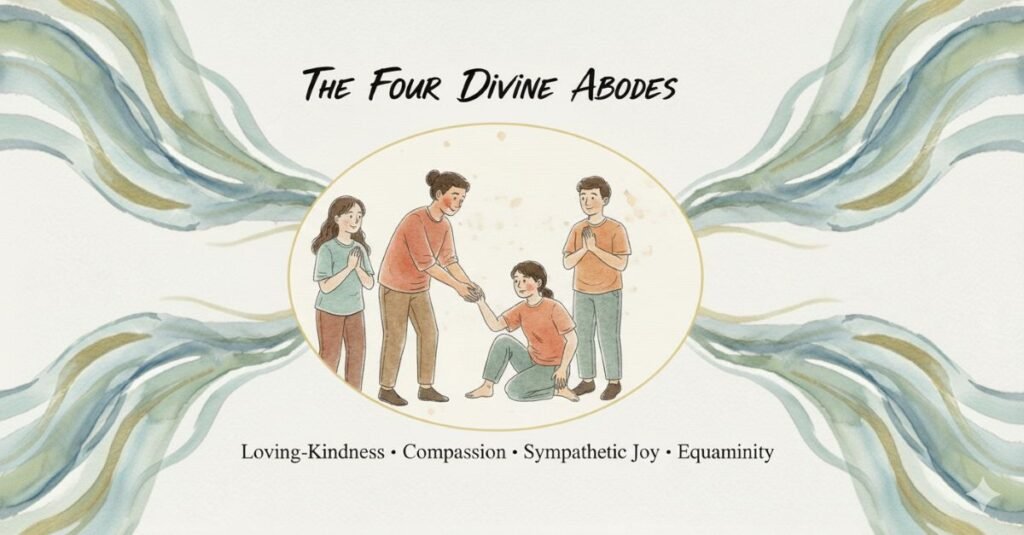
The four qualities are:
- Loving-Kindness (Mettā in Pali)
- Compassion (Karuṇā in Pali)
- Sympathetic Joy (Muditā in Pali)
- Equanimity (Upekkhā in Pali)
This guide will explore each of these “abodes”. For each one, we will examine what it truly means, why it is considered important for personal well-being and social harmony, and most crucially, how we can apply it in our daily lives through specific practices and mindful adjustments to our perspective. The goal is to provide a practical understanding of how these ancient teachings can serve as tools for modern living, fostering greater peace, resilience, and connection.
1. Loving-Kindness (Mettā)
What It Is
Loving-Kindness, or Mettā, is the sincere, heartfelt wish for the happiness and well-being of oneself and others. It is often described as unconditional friendliness, benevolent goodwill, or a non-possessive, warm regard. It is important to understand what Loving-Kindness is not. It is not romantic love, which can be exclusive and attached. It is not sentimental fondness or mere politeness. It is also not an approval of all behaviors; you can wish for someone’s fundamental well-being without agreeing with their actions.
The core of Mettā is a radical inclusivity, a wish for safety, health, happiness, and ease that can be extended to all beings simply because they exist. It begins with the often-challenging practice of directing this wish toward oneself and then systematically extends outward: to a loved one, a neutral person, a difficult person, and finally to all beings without distinction. This progression is a training to break down the walls of “us” and “them” that the mind habitually constructs.
Why It Is Important
Cultivating Loving-Kindness is fundamentally important because it serves as a direct antidote to some of the most common and destructive states of mind: hatred, ill-will, aversion, and resentment. When we harbor anger or hostility, it is we ourselves who experience the immediate turmoil, stress, and contraction. Loving-Kindness practice offers a way to release that inner friction.
Psychologically, regular practice of Mettā has been linked in modern studies to reduced depression and anxiety, decreased chronic pain, and increased feelings of social connection and purpose. It softens the heart that has become hardened by disappointment or defensiveness. On a social level, it is the foundation for ethical behavior; it is harder to act in harmful ways toward someone for whom you are actively cultivating a wish for their well-being. It builds the foundation for patience, forgiveness, and true tolerance.
How to Apply It to Our Daily Lives
Applying Loving-Kindness is a two-fold practice: formal meditation and informal integration throughout the day.
Formal Meditation Practice:
This is often called “Mettā meditation.” One sits quietly and uses silent, repetitive phrases to direct the intention of goodwill. The classic progression is as follows:
- Toward Yourself: Begin by offering the phrases to yourself. This is not selfish; it is essential. You cannot genuinely offer from an empty cup. Common phrases are: “May I be safe. May I be healthy. May I be happy. May I live with ease.” Repeat these slowly, allowing the intention to sink in.
- Toward a Benefactor: Think of someone who has been unconditionally kind to you, a mentor, teacher, or friend. Visualize them and offer the phrases: “May you be safe. May you be healthy…” Feel the natural gratitude and warmth you have for them as a vehicle for the practice.
- Toward a Beloved Friend: Think of a dear friend or family member you easily care for. Offer them the same phrases.
- Toward a Neutral Person: Think of someone you see regularly but have no strong feelings about, a neighbor, a local shopkeeper, a colleague you don’t know well. This step is crucial; it trains the heart to extend care beyond its automatic preferences. Offer them the phrases.
- Toward a Difficult Person: Think of someone with whom you have minor conflict or tension. Important: Do not start with your greatest adversary. The goal is not to force a feeling of affection, but to recognize their humanity and wish for them to be free from the suffering that likely fuels their difficult behavior. The phrase can be, “May you be free from anger. May you find peace.”
- Toward All Beings: Finally, expand the wish outward in all directions: “May all beings in my home be happy… in my city… in my country… on all continents… above, below, and all around. May all beings, without exception, be safe, healthy, happy, and live with ease.”
Practical Examples
- During Commuting: While driving or taking public transport, instead of feeling competitive or irritated with other drivers or passengers, silently wish them well. “May you get to your destination safely. May you be free from stress.”
- Before a Difficult Interaction: If you have a challenging meeting or conversation ahead, spend two minutes in your office or car offering Mettā to the other person. “May you be at ease. May this conversation go well for both of us.” This can dramatically shift your own energy and defensiveness.
- Dealing with Internal Criticism: When you make a mistake and your inner critic is loud, place a hand on your heart and offer yourself the Mettā phrases. “It’s okay. May I be kind to myself. May I accept this moment.”
- Online Engagement: Before posting a comment or reply on social media, pause and mentally offer a brief wish for the well-being of the person you’re engaging with. This simple act can filter out reactive and harsh communication.
2. Compassion (Karuṇā)
What It Is
Compassion, or Karuṇā, is the heartfelt response to the suffering of others (and oneself), coupled with the genuine desire to alleviate that suffering. If Loving-Kindness is the wish for happiness, Compassion is that same friendly heart turning toward pain. It is the natural extension of Mettā when it encounters difficulty.
Compassion has two key components that distinguish it from related emotions:
- Empathetic Resonance: The ability to recognize and feel with the suffering of another (“This person is hurting”).
- Active Alleviation: The movement of the heart that wants to help, to ease, to comfort (“May this suffering be relieved”).
It is critical to distinguish Compassion from pity and from empathetic distress. Pity looks down from a position of superiority (“Poor you”). Compassion sees from a position of shared humanity (“This is hard, and I care”). Empathetic distress is when we become so overwhelmed by another’s pain that we absorb it and become paralyzed or burned out. True Compassion seeks to hold suffering with care while maintaining enough equilibrium to be of actual help.
Why It Is Important
Compassion is the bridge between feeling goodwill and taking ethical, caring action in the world. It is the motivator for kindness, generosity, and support. Without Compassion, Loving-Kindness can remain a passive, abstract wish. Compassion moves us to engage.
On a personal level, developing Compassion, particularly self-compassion, is strongly linked to resilience. It allows us to meet our own failures and pains with kindness rather than harsh judgment, which in turn reduces anxiety and promotes healing. It counters the tendencies of cruelty, indifference, and heartlessness. Socially, a compassionate response is the foundation for healing conflict, providing care, and building supportive communities. It recognizes that suffering is universal and that a response to it connects us rather than isolates us.
How to Apply It to Our Daily Lives
The practice of Compassion involves both cultivating the internal response and learning to express it skillfully in action.
Formal Meditation (Compassion Meditation):
Similar to Mettā practice, one uses phrases to cultivate the compassionate response.
- Start by bringing to mind someone who is visibly struggling or in pain; a sick friend, a person experiencing hardship.
- Acknowledge their suffering softly. “I see you are having a hard time.”
- Offer the compassionate phrases: “May you be free from this suffering. May you find peace. May you hold this pain with kindness.”
- Gradually extend this practice to other categories of beings: loved ones, neutrals, difficult persons (wishing them freedom from the inner suffering that drives their outer actions), and finally all beings who suffer.
- Self-Compassion Break: A vital standalone practice. When you notice you are in pain; stressed, ashamed, afraid, place a hand on your heart. Acknowledge the pain: “This is a moment of suffering.” Connect it to common humanity: “Suffering is a part of life. Others feel this way too.” Then offer yourself a kind phrase: “May I be kind to myself. May I give myself the compassion I need.”
Informal Daily Practice:
This involves shifting your mental and emotional posture when you encounter suffering.
- The Pause: When you see someone in distress, pause your automatic reaction (which might be to look away or offer an immediate fix). First, simply recognize, “This person is suffering.”
- Wish First, Act Second: Let your first internal response be a compassionate wish: “May you find relief.” This orients your heart. Then decide on the skillful action: offering a kind word, practical help, or simply respectful space.
- Listen with Compassion: In conversations, practice listening not to reply, but to understand the other person’s experience. Your silent intention can be, “I am here with you in this.”
Practical Examples
- With a Distressed Colleague: A coworker is overwhelmed and snaps at you. Instead of snapping back, recognize their stress (Compassion’s first step). Silently think, “This must be really hard for them right now.” Your subsequent response will more likely be, “You seem really stressed. Is there anything I can do to help?” rather than escalating conflict.
- In the Face of Personal Failure: You make a significant error at work. Instead of spiraling into self-flagellation (“I’m so stupid!”), apply self-compassion. Hand on heart: “This is really tough. I’m really embarrassed. It’s human to make mistakes. May I learn from this kindly.”
- Responding to Negativity: When someone is rude or angry in public, instead of taking it personally or returning anger, consider: “Something is causing them pain to act this way. May they find peace.” This protects your own peace and de-escalates the situation internally.
- Volunteering and Giving: Frame acts of service not as obligations or ways to feel superior, but as natural expressions of Compassion. As you donate or volunteer, connect to the wish: “May this act help alleviate some difficulty.”
3. Sympathetic Joy (Muditā)
What It Is
Sympathetic Joy, or Muditā, is the wholesome, uplifting pleasure we feel at the success, good fortune, happiness, and joy of another person. It is the ability to rejoice with others. It is the opposite of envy (issā in Pali) and resentment, and the antidote to the comparing mind that feels diminished when someone else shines.
This is often considered the most challenging of the four abodes to cultivate in a culture prone to comparison and competition. We are socially conditioned to see life as a zero-sum game: if you win, I lose. Muditā uproots this delusion by revealing that joy, like love, is not a finite resource. Another’s good fortune does not take away from our own; in fact, by appreciating it, we can increase our own capacity for joy.
Sympathetic Joy is not about feigned enthusiasm or forced congratulation. It is a genuine, uncontrived gladness that arises when we let go of our self-centered reference point. It is the happiness a teacher feels for a student’s achievement, or a parent feels for a child’s success, extended to all beings.
Why It Is Important
Cultivating Sympathetic Joy is crucial for personal happiness and healthy relationships. Envy and resentment are corrosive emotions that poison our own well-being. They create inner turmoil and distance us from others. Muditā frees us from this prison of comparison.
Psychologically, it fosters a mindset of abundance rather than scarcity. It builds emotional resilience because our happiness becomes less dependent solely on our own personal victories and more connected to the well-being of our wider community. Socially, it is the glue of friendship and community. Celebrating others strengthens bonds, fosters generosity, and creates an atmosphere of mutual support instead of silent competition. It allows us to be truly happy for friends, partners, and colleagues, which is the foundation of trust and love.
How to Apply It to Our Daily Lives
The practice of Sympathetic Joy involves consciously re-training our reflexive mental and emotional habits.
Formal Meditation Practice:
- Begin by thinking of someone who is easily happy, perhaps a naturally joyful child or a contented friend. Notice their joy and allow yourself to feel glad about it. Use phrases like: “I am happy for your happiness. May your good fortune continue. I rejoice in your joy.”
- Progress to thinking of a friend who has had a recent success or windfall; a promotion, a new relationship, a personal achievement. Contemplate their success and actively rejoice in it. If envy arises, acknowledge it gently (“There’s that feeling of comparison”) and return to the phrase, “Your success does not diminish me. I share in your joy.”
- Gradually extend this practice to neutral people, difficult people, and finally to all beings everywhere who are experiencing happiness.
Informal Daily Practice:
This is about catching the mind in the act of comparison and consciously shifting its stance.
- Celebrate Actively: Make a habit of offering genuine, specific congratulations. Instead of a generic “good job,” say, “I was so impressed by how you handled that presentation. I’m really happy for you!”
- Social Media Reframe: When scrolling and you see a post about a friend’s vacation, achievement, or happy family moment, pause. Instead of the automatic, unconscious comparison (“Why isn’t my life like that?”), consciously think, “How wonderful that they are experiencing this joy! May their happiness continue.”
- Practice Gratitude for Others’ Joy: In a gratitude journal, include entries like, “Today I felt happy for my sister because she aced her exam,” or “I felt joy for my neighbor who finally sold their house.”
Practical Examples
- Workplace Success: A colleague gets the promotion you also wanted. The natural reaction might be jealousy. The Muditā practice is to find them, look them in the eye, and say sincerely, “Congratulations. I know how hard you worked for that, and you deserve it.” This action, even if initially difficult, liberates you from bitterness.
- A Friend’s Good News: A friend shares exciting personal news while you might be going through a hard time. Instead of deflecting (“That’s nice…” while thinking about your own problems), practice Muditā by giving them your full, delighted attention. “Tell me all about it! I am so thrilled for you!” Sharing in their joy can briefly lift your own spirits.
- For Parents: When your child excels at something that was never your own strength, feel pure joy for their unique talent, without injecting your own unmet ambitions.
- In Artistic or Athletic Communities: Applaud the superb performance of a rival team or a fellow artist. Appreciate the excellence itself, feeling joy that such beauty or skill exists in the world.
4. Equanimity (Upekkhā)
What It Is
Equanimity, or Upekkhā, is a state of mental balance, composure, and even-mindedness. It is the ability to remain steady, clear, and non-reactive in the face of life’s inevitable “eight worldly winds”: praise and blame, gain and loss, fame and disrepute, pleasure and pain. It is the stabilizing wisdom that allows the other three heart qualities to be sustainable.
This is the most misunderstood of the Brahmaviharas. Equanimity is not indifference, aloofness, or cold detachment. Indifference is a withdrawal of care; it is unconcerned. True Equanimity is a spacious, engaged balance. It cares deeply but without clinging to a specific outcome. It is the poise of a grandparent who loves their grandchild deeply but does not try to control their life choices. It is the calm of a surgeon who cares immensely about the patient’s outcome but remains steady and focused during the operation.
Equanimity is grounded in wisdom, specifically, the understanding of impermanence (anicca) and the law of cause and effect (kamma). It recognizes that all conditions change, and that beings are the primary agents of their own experience through their choices and actions. This understanding allows one to be fully present and caring, while letting go of the exhausting need to control the uncontrollable.
Why It Is Important
Without Equanimity, Loving-Kindness can turn into clinging attachment, Compassion can lead to burnout and empathetic distress, and Sympathetic Joy can become manic over-excitement. Equanimity provides the emotional and mental stability that makes boundless care possible. It is the factor of balance that prevents us from being knocked off center by every success or failure, every compliment or criticism.
In daily life, Equanimity is the essence of resilience. It allows us to navigate stress, loss, and conflict with greater clarity and less suffering. It protects our well-being so we can be of genuine service to others for the long term. It fosters wise decision-making because choices are not made from a place of reactive fear or desperate desire. It is the foundation for true peace.
How to Apply It to Our Daily Lives
Cultivating Equanimity involves both reflective wisdom and moment-to-moment mindfulness.
Formal Meditation and Reflection:
- Reflection on Cause and Effect: Sit and reflect: “All beings are the owners of their actions (kamma). Their happiness and suffering depend on their actions, my wishes for them are one condition among many. I can care, but I cannot ultimately control.” This is not cold; it is a realistic acceptance that respects others’ autonomy.
- Reflection on Impermanence: Observe how all experiences, pleasant, unpleasant, and neutral, arise and pass away. The pleasant lunch ends, the stressful meeting concludes, the neutral mood shifts. Practice watching these changes from a slightly detached, observational stance during meditation.
- Equanimity Meditation Phrases: Use phrases like: “All beings are the owners of their actions. May I accept things as they are. May I find balance. May I meet all moments with a steady heart.”
Informal Daily Practice:
This is about applying balanced awareness in the midst of activity.
- The “And” Practice: Hold two truths together. “I love this person deeply, and I cannot make their choices for them.” “I am doing my very best in this situation, and the outcome is uncertain.”
- The Pause Before Reacting: When triggered by strong news (good or bad), institute a conscious pause. Take three breaths. Feel your feet on the ground. During this pause, simply acknowledge the rising feeling without immediately acting on it. This space is Equanimity in action.
- Practice with Small Annoyances: Use minor irritations, a delayed train, spilled coffee, a rude email, as training grounds. Notice the urge to react with frustration, and instead say to yourself, “This is what is happening now. Reacting with anger will not un-spill the coffee. Let me handle this with balance.”
Practical Examples
- Parenting a Teenager: A parent practices Equanimity by setting clear, kind boundaries and offering guidance, while simultaneously releasing the need to control the teenager’s every decision or emotional state. They care deeply but are not thrown into despair by every conflict.
- In a Crisis at Work: When a project fails or a client leaves, instead of panicking or blaming, the balanced response is: “This has happened. What are the causes? What can we learn? What is the wise next step?” This is Equanimity fostering clear-headed problem-solving.
- Receiving Criticism and Praise: When praised, one appreciates it without letting it inflate the ego. When criticized (even unfairly), one listens for useful feedback without being crushed by it. The inner sense of worth remains steady, not dependent on external validation.
- Caregiver Sustainability: A nurse or family caregiver practices Equanimity by offering full, compassionate presence to a patient, while also taking care of their own needs and accepting the limits of what medicine or care can achieve. They do not confuse their role with being the sole determinant of the patient’s health.
Integration: The Four Abodes as a Unified Practice
While each Divine Abode can be practiced individually, their greatest power is revealed when they are developed together as an integrated system. They balance and support one another like the legs of a sturdy table.
- Loving-Kindness provides the foundational warmth and goodwill.
- Compassion ensures that warmth is responsive to suffering.
- Sympathetic Joy ensures the heart remains open and generous, able to celebrate life.
- Equanimity provides the steady ground, preventing the heart from burning out, clinging, or being knocked off balance.
In a single moment, they can work in concert. For example, when a friend shares a problem:
- Loving-Kindness underlies your care for them.
- Compassion feels their struggle and wishes to help.
- Sympathetic Joy might remember and appreciate their strengths that will help them through.
- Equanimity allows you to listen patiently without rushing to fix them, respecting their process while maintaining your own calm.
The practice is lifelong and gradual. One does not perfect one quality before moving to the next. Instead, we might focus on one for a period (a month, a season) as a “theme,” while noticing how the others are naturally involved. When Compassion practice leads to fatigue, we consciously strengthen Equanimity. When Equanimity feels cold, we re-ignite it with Loving-Kindness.
Conclusion: A Path of Heart Cultivation
The Four Divine Abodes offer a profound yet practical map for cultivating a resilient, kind, and balanced heart. They are not about attaining a perfect, unfeeling state, but about training our capacity to meet the full spectrum of human experience with wisdom and care. The journey begins with simple, sincere intentions: the wish for well-being, the wish for relief from suffering, the wish to share in joy, and the wish for steady clarity.
By incorporating the formal meditations and daily life practices, one can gradually make these “sublime abodes” more familiar territories of the heart. The benefits are both personal, greater peace and emotional freedom, and interpersonal, more harmonious and genuine relationships. It is a path that acknowledges the difficulties of life while providing tangible tools to navigate them with increasing grace, leading to a life that is not merely endured, but genuinely inhabited with an open and steady heart.