Key Takeaways
- For some devotion to a teacher is a vital part of the Buddhist path, but it must be a balanced trust (saddhā) built on personal investigation, not blind faith or idealization.
- A good teacher acts as a kalyāṇa-mitta (spiritual friend), guiding with ethical conduct (sīla), wisdom (paññā), compassion (karuṇā), and skillful means (upāya).
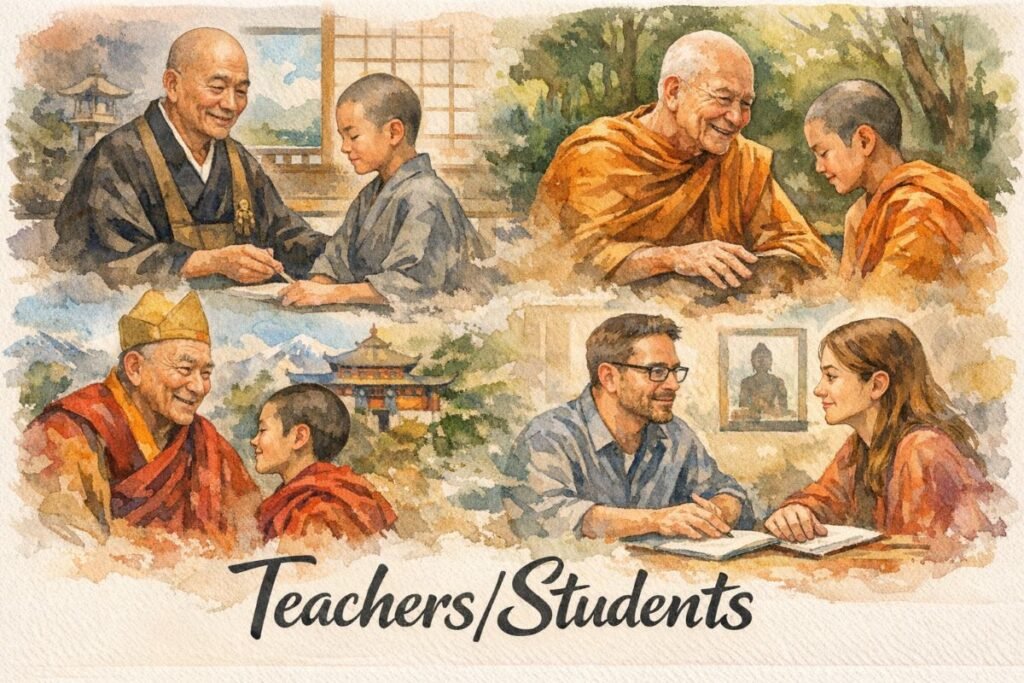
- Teachers hold a central role across all Buddhist traditions: Theravāda, Mahāyāna, and Vajrayāna, as living links to the Dharma and guides who tailor the path to the individual student.
- Proper training for a teacher is a lifelong process involving deep study, sustained meditation practice, direct realization, and ongoing ethical self-reflection.
- A teacher’s primary skills are the abilities to communicate clearly, adapt teachings to the student’s capacity, and inspire confidence without creating dependency.
- The root motivation for a teacher must be genuine compassion and the altruistic intention to benefit others, free from attachment to reputation or gain.
- A teacher’s success is measured by the gradual transformation of their students: growth in ethical living, wisdom, and the lessening of suffering.
- Teachers cultivate non-attachment by letting go of ego, avoiding favoritism, and encouraging students to find the teacher within, their own inner wisdom.
- Students should carefully observe and evaluate a potential teacher’s conduct, compassion, and alignment with the core teachings before entering into a relationship. In Vajrayana traditions, this process of mutual examination is considered essential before any formal commitment is made.
- A wise teacher skillfully accounts for different student needs, varying in knowledge, motivation, and ability, by using a range of methods and personalized guidance.
- A supportive environment, a healthy community (sangha), adequate time for practice, and cultural sensitivity, is crucial for the teacher-student relationship to flourish.
1. Introduction: The Sacred Trust Between Teacher and Student
The path of the Buddha begins with a recognition of suffering and a sincere wish to find a way beyond it. While the Buddha himself is our ultimate guide, his physical presence is no longer with us. In his absence, the Dharma and Vinaya have been passed down through generations of practitioners. Among the living vehicles of this tradition, the role of the teacher has become central to Buddhist practice. This relationship between teacher and student is one of the most profound and delicate on the spiritual journey. It is a sacred trust, a dynamic interplay of guidance and personal exploration that can either accelerate one’s progress toward liberation or, if mismanaged, lead to confusion and harm.
This relationship is built on a foundation of saddhā. Often translated as faith, saddhā in the Buddhist context is more accurately described as a trusting confidence. It is not a blind acceptance of dogma, but a conviction that grows from one’s own initial experience. As the Buddha taught in the Kalama Sutta (AN 3.65), we are not to accept something simply because it is spoken by a revered teacher. Instead, we are to investigate, to test, and to know for ourselves. This principle is the bedrock of a healthy student-teacher dynamic. The teacher is not an authority to be obeyed, but a guide to be verified.
When this trust is placed in a teacher who genuinely embodies the Dharma, it becomes a powerful source of inspiration. The teacher’s own peace, clarity, and compassion act as a living testament to the teachings, igniting the student’s own aspiration. However, this very reverence can tip over into idealization. This is the tendency to project perfection onto the teacher, seeing them as infallible and beyond human error. This tendency to project perfection onto spiritual authorities robs the student of their own discerning intelligence and can set the stage for profound disappointment or even harm. For those new to this topic, understanding the teacher’s role in Buddhist practice provides essential context for what follows.
We will explore this crucial balance throughout this article, delving into what makes a genuinely good teacher across the main Buddhist schools, the lifelong training they undergo, and how they practice the art of non-attachment. For the student, we will offer guidance on what to look for, how to relate to a teacher wisely, and how to navigate the inevitable challenges. The goal is to illuminate a path of devotion that is grounded in wisdom, fostering a relationship that leads not to dependency, but to the ultimate freedom that both teacher and student seek. This guide draws primarily from Pali terms, the language of the earliest Buddhist texts, while also including Sanskrit terms from the Mahāyāna and Vajrayāna traditions to provide a comprehensive view.
2. Inspiration vs Idealization: The Two Faces of Devotion
2.1 Inspiration: The Confidence That Moves the Heart (Saddhā)
Inspiration is the gentle, steady flame of saddhā. It is the confidence that arises when we encounter someone who embodies the peace we seek. This is not a command to believe, but an invitation to explore. A truly inspiring teacher does not ask for followers, but cultivates fellow explorers. They encourage the student to test the teachings in the laboratory of their own life. When a student sees a teacher respond to a difficult situation with patience rather than anger, or with generosity rather than clinging, the teaching on non-attachment moves from an abstract concept to a living possibility. This lived example is what fuels genuine inspiration.
The Buddha himself pointed to this quality in a teacher. In the Dhammapada (verse 76), he states that if one finds a wise companion, a virtuous and steadfast friend, one should walk with them, overcoming all dangers, happy and mindful. This kind of inspiration supports the student during periods of doubt and difficulty, acting as a steady reminder of why they chose this path. It is a confidence that is self-correcting; as the student practices and sees results for themselves, their saddhā deepens, becoming an unshakable internal quality rather than a dependence on the external teacher. This is the kind of faith in Buddhism that leads to liberation, a faith that is verified by one’s own experience rather than imposed by authority.
2.2 Idealization: The Projection That Blinds
Idealization is rooted in a complex mixture of ignorance (avijjā), craving (taṇhā), and the tendency to project our own unmet needs for perfection, safety, and certainty onto another human being. We want the teacher to be perfect because it makes the path seem simpler. If they have all the answers, we do not have to grapple with the uncertainty of our own practice. This dynamic is fraught with risk. When we idealize a teacher, we stop seeing them clearly. We may overlook signs of ethical misconduct, explain away unkind words, or rationalize behavior that contradicts the teachings. This makes us vulnerable.
The Sigalovada Sutta (DN 31) offers a powerful framework for healthy relationships, including the one between teacher and pupil. It describes that a student should show respect to a teacher, but it also outlines the duties of a teacher toward the student: to train them well, to teach them thoroughly, and to introduce them to their friends and associates. The sutta implies a reciprocal, grounded relationship, not one of blind worship. When idealization takes over, this reciprocal clarity is lost. The teacher is placed on a pedestal, and the student’s duty to discern is abandoned. This can lead to spiritual bypass, where the student uses devotion to avoid their own shadow work, or worse, to situations where the teacher’s power is unchecked and misused. Understanding these dynamics is essential for anyone on the path.
2.3 The Middle Path of Wise Devotion
How then, do we walk the middle path between cold skepticism and naive adoration? It begins with clarity of intention. The purpose of the relationship is not to worship the teacher, but to use their guidance to free ourselves. Wise devotion, therefore, has several key characteristics. It is discerning. The student observes the teacher over time, in various settings, noticing how the teacher treats those who can do nothing for them. They ask questions and pay attention to whether the teacher encourages inquiry or demands compliance. A teacher who is a true kalyāṇa-mitta will always point the student back to their own experience and to the Dharma, not to the teacher’s own personality. This kind of discernment is a skill that can be developed through practice and study. When finding a Buddhist teacher, patience and careful observation are the student’s greatest allies.
3. What Makes a Good Teacher in Buddhism? The Inner Qualities
A good teacher is not defined by their title, robes, or number of students, but by the qualities they embody. The Buddha was very clear about the characteristics of a spiritual guide one can trust. These qualities form a holistic picture of a teacher who is fit to lead others on the path. The great Tibetan scholar Jamgon Kongtrul, in his writings on the teacher-student relationship, emphasized that the root of all good qualities is devotion to a fully qualified spiritual friend, and he provided extensive lists of the qualities students should look for in their teacher. What to look for in a Buddhist teacher begins with understanding these inner qualities.
3.1 Unshakable Ethical Conduct (Sīla)
The absolute foundation of a trustworthy teacher is sīla. This is not merely following a list of rules, but a deep, internalized purity of action, speech, and livelihood. The teacher’s life is their primary teaching. A teacher with strong sīla inspires confidence because they are predictable in their integrity. They do not harm living beings, they do not take what is not given, they speak truthfully and kindly, they maintain celibacy if monastics or uphold sexual integrity if lay, and they avoid intoxicants that cloud the mind. The Samaññaphala Sutta (DN 2) describes the visible fruit of the contemplative life, beginning with this very foundation of ethical conduct. A teacher who is lacking in this area, no matter how charismatic or knowledgeable, cannot be trusted to guide others safely. This is the non-negotiable foundation. The qualities of a great Buddhist spiritual teacher always begin with unshakable ethical integrity.
3.2 Deep Wisdom (Paññā)
Wisdom, or paññā, is the teacher’s direct understanding of the Four Noble Truths and the nature of reality. This is not just intellectual knowledge gathered from books, but a wisdom born from personal, meditative investigation. The teacher has seen for themselves the truth of impermanence (anicca), the unsatisfactory nature of clinging (dukkha), and the absence of a permanent, independent self (anattā). This wisdom allows them to diagnose the root cause of a student’s suffering and prescribe the appropriate remedy. In the Satipatthana Sutta (MN 10), the Buddha outlines the direct path to this kind of liberating wisdom. A teacher with wisdom does not just repeat what they have heard; they speak from their own experience, and their words carry the weight of authentic realization. This quality of experiential wisdom is what distinguishes a true spiritual guide from a mere scholar.
3.3 Active Compassion (Karuṇā)
Karuṇā is the quality that animates a teacher’s willingness to work with students. It is not a sentimental feeling, but an active, engaged response to the suffering of others. A compassionate teacher is patient with a student’s repeated mistakes, kind in the face of confusion, and firm when necessary to prevent harm. They take joy in the student’s progress, without jealousy or possessiveness. This compassion is the natural expression of wisdom. When a teacher sees that all beings are trapped in suffering by their own ignorance, compassion arises spontaneously as the desire to help them find freedom. The Karaniya Metta Sutta (Snp 1.8) beautifully expresses the boundless quality of this loving-kindness, which forms the basis of true compassion. A teacher without this active compassion may have knowledge but lack the warmth that makes the Dharma accessible and healing.
3.4 Skillful Means (Upāya)
Skillful means, or upāya, is the teacher’s ability to adapt the teaching to the unique needs of each student. It is the art of knowing what to say, when to say it, and how to say it. What works for one student may confuse another. A student overwhelmed by grief may need a different teaching than a student who is intellectually arrogant. A teacher with skillful means recognizes these differences and tailors their guidance accordingly. They might use a direct instruction, a story, a challenging question, or even silence, depending on what the situation calls for. The Lotus Sutra is famous for its emphasis on upāya, showing how the Buddha adapted his teachings to lead all beings toward awakening. This adaptability is a hallmark of a truly skilled teacher, and it requires deep attunement to the student’s present moment experience.
3.5 The Qualities of a Spiritual Friend
Beyond these four main qualities, the Buddha also described a good teacher, or kalyāṇa-mitta, as someone who is endearing, respected, estimable, a speaker, and one who patiently endures speech. They are accessible and willing to teach. They do not look down on others and do not act out of favoritism. This complete picture of a spiritual friend is found in several suttas, including the Upaddha Sutta (SN 45.2), where Venerable Ananda states that spiritual friendship is half of the holy life, and the Buddha corrects him, saying it is the whole of the holy life. This emphasizes just how central the right teacher is to the entire path. The meaning of spiritual friendship in Buddhism goes far beyond ordinary friendship, it is a relationship specifically oriented toward awakening.
4. The Importance of Teachers Across Buddhist Traditions
While the core qualities of a good teacher remain consistent, the role and emphasis placed on the teacher can vary across the major Buddhist traditions. Understanding these differences can help students appreciate the rich diversity of approaches.
4.1 Theravāda: The Teacher as Exemplar and Guide
In the Theravāda tradition, the teacher is often a monastic, a bhikkhu or bhikkhuni, who has dedicated their life to practicing and preserving the Dhamma. The relationship is one of deep respect and mutual support. The teacher provides guidance on meditation, ethical conduct, and study of the Pali Canon. They are seen as an exemplar, someone whose life demonstrates the fruits of the practice. Students offer material support to the teacher, and in return, the teacher offers the gift of the Dhamma. This relationship is beautifully illustrated in the Maha-parinibbana Sutta (DN 16), where the Buddha, on his deathbed, reminds his disciples that they must be islands unto themselves, but he also shows how a teacher prepares his students for independence. The emphasis is on learning the Dhamma from the teacher and then practicing it diligently oneself. The role of the teacher in Theravada Buddhism is fundamentally that of an exemplar whose life demonstrates the fruits of the practice.
4.2 Mahāyāna: The Teacher as Embodiment of Bodhisattva Qualities
In Mahāyāna Buddhism, the teacher is often viewed as embodying bodhisattva qualities, one who has vowed to postpone their own final liberation until all beings are freed. The teacher’s compassion is therefore boundless, and their motivation is rooted in the altruistic intention to achieve enlightenment for the benefit of all. The teacher-student relationship is infused with this vast perspective. The teacher encourages the student to generate bodhicitta, the mind of enlightenment, and to see all beings as their mother. Teachings on emptiness (śūnyatā) are central, and the teacher skillfully guides the student to understand that all phenomena, including the teacher and student themselves, are empty of inherent existence. It is important to note that not all Mahāyāna teachers are formally regarded as bodhisattvas, some are lineage holders, scholars, monastics, or ritual specialists. However, the aspiration to embody compassion and wisdom is central to the tradition. The Vimalakirti Nirdesa Sutra offers a profound example of a lay teacher whose wisdom surpasses even the arhats, demonstrating that enlightenment is not confined to any particular form.
4.3 Vajrayāna: The Teacher as Guru and Root of the Path
In the Vajrayāna tradition, the role of the teacher, or guru, reaches its most profound expression. The guru is seen not just as a guide, but as the very root of the path. Devotion to the guru is considered essential for progress, as the guru is the living link to the lineage of enlightened masters. The student is encouraged to see the guru as a Buddha, the embodiment of all enlightened qualities. This is a powerful and potentially dangerous teaching. For this reason, Tibetan scholars have always emphasized the importance of careful, prolonged examination of a guru before entering into a formal relationship. When properly understood and preceded by thorough discernment, devotion allows the student to receive blessings and transmissions that can accelerate their awakening. When entered into hastily or without examination, it can lead to the worst forms of idealization and abuse. The guru-disciple bond in Vajrayana is understood as a symbiotic relationship, requiring mutual trust and commitment. As some teachers explain, there are outer, inner, and secret levels of the guru. The outer, physical guru helps us begin to find an inner relationship with our essential nature. Eventually we must move toward the inner guru and finally open to the ultimate meaning of guru, the secret guru, which is the innate pristine nature of our own mind.
5. The Lifelong Training of a Buddhist Teacher
Becoming a teacher in the Buddhist tradition is not a matter of receiving a certificate or completing a course. It is a lifelong process of training, practice, and self-cultivation.
5.1 Foundational Study and Scriptural Mastery
The first stage of training involves deep and systematic study of the Buddhist scriptures. A future teacher must become intimately familiar with the teachings of their tradition. For a Theravāda teacher, this means years of study of the Pali Canon, including the Vinaya (monastic discipline), Suttas (discourses), and Abhidhamma (philosophical psychology). For a Mahāyāna or Vajrayāna teacher, this involves mastering the vast corpus of sutras and tantras, as well as the commentaries of great masters. This study is not merely academic; it is a form of practice that shapes the mind and develops right view.
5.2 Sustained Meditative Practice and Realization
Intellectual knowledge alone is insufficient. The teacher must have direct, personal experience of the truths they teach. This requires years of sustained meditation practice. They must develop the deep concentration (samādhi) that comes from consistent practice, as outlined in the Anapanasati Sutta (MN 118). They must use that concentration to investigate the nature of reality, gaining insight (vipassanā) into impermanence, suffering, and not-self. The teacher’s realization is not a single event, but a deepening understanding that unfolds over decades. It is this realization that gives their words authority and their presence power.
5.3 Ethical Purification and Vinaya Training
For monastics, training in the Vinaya is a central part of their preparation. The hundreds of rules are not just restrictions; they are a framework for living a life of simplicity, harmony, and ethical purity. This training develops mindfulness in every action and sensitivity to the impact of one’s behavior on others. For lay teachers, a commitment to the five or eight precepts provides a similar foundation. This ongoing ethical purification is essential for building the trust that the teacher-student relationship requires.
5.4 Continuous Self-Reflection and Humility
A good teacher never stops being a student. They engage in continuous self-reflection, examining their own motivations, acknowledging their limitations, and learning from their mistakes. They remain humble, recognizing that the Dharma is vast and their own understanding is small. They are open to feedback from their peers, their community, and even their students. This humility protects them from the inflation and corruption that can come with being in a position of authority.
6. Essential Skills for Guiding Students
Beyond their inner qualities and training, a good teacher also cultivates specific skills that enable them to effectively guide their students.
6.1 The Skill of Clear and Adapted Communication
The teacher must be able to communicate complex teachings in a way that is clear, accessible, and relevant to the student’s life. They must be a good listener, able to hear what the student is saying and also what they are struggling to express. They use language that is appropriate to the student’s level, avoiding jargon when speaking to beginners and offering deeper, more precise teachings when the student is ready. They know when to speak and when to remain silent, allowing the student to find their own answers.
6.2 The Skill of Assessing and Adapting to the Student
This skill is closely related to upāya. The teacher must be able to accurately assess a student’s temperament, capacity, and current challenges. A student who is prone to doubt needs encouragement. A student who is intellectually grasping needs to be directed back to direct experience. A student who is overly self-critical needs to develop kindness toward themselves. The teacher’s guidance is not a one-size-fits-all formula, but a personalized prescription tailored to the individual. This requires deep observation and intuitive understanding.
6.3 The Skill of Inspiring Confidence and Effort
A good teacher knows how to inspire students to make their own effort. They do not do the work for the student, but they create the conditions that make effort joyful and rewarding. They celebrate the student’s small victories and offer encouragement during periods of stagnation. They hold a vision of the student’s potential that the student may not yet see for themselves. This kind of inspiration comes from the teacher’s own genuine enthusiasm for the path.
6.4 The Skill of Leading by Example
Ultimately, the most powerful teaching is the teacher’s own life. A teacher who speaks of compassion but acts with selfishness will never inspire genuine trust. A teacher who teaches non-attachment but is clearly attached to their reputation will be seen through by perceptive students. The teacher must walk the walk. Their conduct in daily life, their relationships with others, and their way of handling difficulties are all part of their teaching. The Maha-assapura Sutta (MN 39) describes the gradual training of a monk, showing how conduct, practice, and wisdom develop together to produce a person who is a true contemplative and a fit guide for others.
7. The Teacher’s Pure Motivation: Beyond Worldly Concerns
What truly drives a teacher to teach? The answer to this question reveals their authenticity. The Buddha identified eight worldly concerns that bind beings to suffering: gain and loss, status and disgrace, praise and blame, pleasure and pain. A teacher whose motivation is pure is not motivated by any of these. They do not teach to gain wealth, fame, or followers. They do not teach to be praised or to avoid blame. They teach from a single, pure motivation: compassion for beings who are suffering and a desire to share the path to freedom.
This motivation is rooted in bodhicitta, the mind of awakening. In Mahāyāna Buddhism, this is the heartfelt wish to achieve enlightenment not for oneself alone, but in order to be of ultimate benefit to all beings. A teacher with this motivation is inexhaustible in their efforts. They are patient with difficult students, generous with their time, and joyful in the success of others. They are not threatened by a student who surpasses them, for the student’s awakening is the very goal of their teaching. This selfless motivation is the purest expression of the Dharma in action.
8. How Does a Teacher Know They Are Successful?
This is a subtle and important question. If a teacher measures their success by the number of students, the size of their center, or the amount of donations they receive, they are caught in the very worldly concerns they should be transcending. A teacher with genuine wisdom measures success differently.
They see success in the gradual transformation of their students. Is the student becoming more kind, more patient, more generous? Is their ethical conduct improving? Are they less controlled by anger, greed, and jealousy? Is their understanding of the Dharma deepening? Are they developing the confidence to stand on their own two feet? These are the true signs of successful teaching. A student who has learned to rely on the Dharma rather than on the teacher is the greatest testament to a teacher’s skill. The teacher’s ultimate success is to work themselves out of a job, guiding the student to become their own refuge, just as the Buddha encouraged his disciples to be islands unto themselves in the Maha-parinibbana Sutta (DN 16).
9. The Practice of Non-Attachment for Teachers

A teacher must be a living example of the teachings, and non-attachment is central to those teachings. How does a teacher practice non-attachment in their role?
First, they do not attach to their identity as a teacher. They recognize that “teacher” is a temporary role, not a fixed self. They are comfortable being a student, being a beginner, being wrong. They do not need to be seen as special or enlightened. Second, they are not attached to their students. They do not see students as possessions or as a source of validation. They do not play favorites or create dependency. They encourage all students equally and rejoice when a student finds inspiration from another teacher or from their own practice. Third, they are not attached to outcomes. They offer the teachings and guidance, but they do not cling to the results. They understand that each student’s path unfolds in its own time and in its own way. They practice equanimity, meeting success and failure, praise and blame, with a balanced mind. This non-attachment is not cold indifference; it is a spacious and open-hearted presence that allows students the freedom to grow.
10. What Should a Student Look for in a Teacher?
For a student seeking guidance, this is the most important question. It requires patience, discernment, and self-honesty. The great Tibetan teacher Jamgon Kongtrul emphasized that the teacher-student relationship is created and nurtured in two steps: first, careful mutual examination by both teacher and student, and only then should they enter into a relationship. If a relationship is begun with an unqualified teacher or student, both will break their commitments and have many problems.
10.1 Observe Conduct Over Time
Do not rush into a relationship with a teacher. Observe them over an extended period, in different settings. Listen to their public talks. Notice how they interact with students, with staff, with people who disagree with them. Pay attention to their lifestyle. Is it consistent with the teachings? Do they live simply and ethically? The Vinaya provides a framework for this kind of observation, emphasizing the importance of a teacher’s conduct as the foundation for trust.
10.2 Assess Their Ethical Integrity
This is non-negotiable. Does the teacher consistently uphold the precepts? Are there any signs of ethical lapses, such as dishonesty, financial impropriety, or sexual misconduct? If you see anything that raises concern, take it seriously. A teacher with weak ethics cannot be trusted, no matter how impressive their meditation experiences or their intellectual knowledge may seem.
10.3 Evaluate Their Teaching Style
https://buddhistlearning.org/critical-thinking-intellectual-knowledge-buddhist-wisdom/Does the teacher encourage questions and critical thinking, or do they demand unquestioning obedience? Do they explain the teachings clearly and adapt them to the audience, or do they speak in a way that is confusing or overly simplistic? Do they emphasize personal practice and investigation, or do they encourage students to rely solely on the teacher’s authority? A good teacher will always point you back to your own experience.
10.4 Sense Their Compassion
Does the teacher seem genuinely concerned for the welfare of their students? Are they approachable and kind? Do they take time for those who are struggling? A teacher without compassion is like a doctor without a bedside manner; they may have the knowledge, but they lack the ability to connect with and truly help the patient.
10.5 Check Alignment with the Dharma
Do the teacher’s teachings align with the core principles of Buddhism as you understand them from the suttas and from other reputable sources? A teacher who contradicts the fundamental teachings on impermanence, suffering, and not-self, or who encourages harmful behavior, is not a reliable guide. A student must develop their own understanding of the Dharma as a touchstone for evaluating a teacher.
10.6 Consider Different Levels of Teachers
It is helpful to recognize that not all teachers are at the same level, and different teachers may be appropriate for different stages of one’s practice. There are Buddhism professors who convey information from a scholarly perspective, Dharma instructors who teach from personal experience, and spiritual mentors who have genuine realization and can guide disciples on the full path. A beginner may benefit from a Dharma instructor, while a more advanced practitioner may need a fully qualified spiritual mentor. Understanding these distinctions can help students find the right teacher for their current needs.
11. Environmental Factors That Support the Relationship
The teacher-student relationship does not exist in a vacuum. It is supported or hindered by the environment in which it takes place.
A healthy community of fellow practitioners, or sangha, is an essential support. The sangha provides a container for the teachings, a place to practice with others, and a network of relationships that can offer feedback and support. The Buddha emphasized the importance of the sangha as one of the three refuges. A teacher who isolates students from the broader community may be creating an unhealthy environment.
Cultural context also matters. A teacher from one culture may present teachings in ways that are unfamiliar to students from another culture. Wise teachers are sensitive to these differences and adapt their approach without losing the essence of the Dharma. They also pay attention to practical factors like the physical environment for practice, the availability of time for retreats, and the overall health and well-being of the community.
12. Skillfully Accounting for Different Student Needs
A wise teacher recognizes that no two students are the same. They come to the path with different levels of:
- Skill: Some students are naturally adept at meditation; others struggle to sit still for five minutes.
- Knowledge: Some have studied Buddhism for years; others are complete beginners.
- Motivation: Some are seeking relief from acute suffering; others are drawn to the philosophical depth of the teachings.
- Interest: Some are primarily interested in meditation; others in study, or in applying the Dharma to social action.
The teacher uses skillful means to meet each student where they are. They might offer a struggling meditator a simpler practice, like mindfulness of breathing or walking meditation. They might give a knowledgeable student a challenging text to study. They might encourage a student with strong motivation to go on a retreat. They might help a student with intellectual interests connect their study to direct practice. This personalized approach is the hallmark of a truly skilled teacher. They see the unique potential in each student and guide them accordingly, without comparing them to others or pushing them into a mold.
13. Practical Examples from Daily Life
13.1 Example 1: The Student Who Feels Stuck
Sarah had been meditating for two years but felt she was making no progress. She approached her teacher, Ajahn Somchai, feeling discouraged. Ajahn Somchai did not offer her a new, advanced technique. Instead, he asked her to describe her practice in detail. He noticed that she was pushing herself very hard, trying to force her mind to be calm. He smiled gently and said, “Sarah, the mind is like a clear forest pool. If you keep stirring up the mud, it will never settle. Just sit on the bank and let it be.” He encouraged her to relax her effort and simply notice whatever was present with a kind and accepting awareness. This simple shift in approach, tailored to her tendency to strive, transformed her practice.
13.2 Example 2: The Student Who Idealizes the Teacher
David was a devoted student of Lama Tenzin. He hung on the lama’s every word and tried to spend as much time with him as possible. He began to see the lama as perfect, beyond any human flaw. Lama Tenzin noticed this and became concerned. One day, David came to him with a problem. Instead of giving him advice, the lama said, “David, you are putting me on a pedestal. But I am just a human being, like you. I have my own struggles and my own imperfections. If you see me as a Buddha, you will miss the real teaching, which is to find the Buddha within yourself. I am just a finger pointing at the moon. Do not mistake the finger for the moon.” This was a loving but firm correction, designed to break through David’s idealization and point him back to his own practice.
13.3 Example 3: The Teacher’s Non-Attachment
Maya had studied with her teacher, Ruth, for over a decade. She had grown tremendously in wisdom and compassion. One day, Maya told Ruth that she felt called to study with another teacher, a woman who specialized in a different lineage. A less secure teacher might have felt threatened or abandoned. But Ruth’s eyes lit up with joy. “That is wonderful, Maya!” she said. “The Dharma is vast, and there is so much to learn from different teachers. I am so happy that your practice is leading you to explore new depths. Go with my full blessing.” Ruth’s response was a perfect example of non-attachment. Her joy was in her student’s growth, not in her own position as the teacher.
13.4 Example 4: The Teacher Who Cultivates Future Teachers
A senior teacher, Bhante Gunasiri, noticed that one of his students, James, had a natural ability to explain the Dharma clearly and to support other practitioners. Bhante began to give James small teaching responsibilities: leading a discussion group, giving a short talk to newcomers. He also encouraged James to spend more time in meditation and to study certain texts deeply. Over several years, Bhante mentored James, pointing out both his strengths and his blind spots. When James was finally ready to teach on his own, Bhante gave his full blessing.
14. Conclusion
The relationship between teacher and student in Buddhism is a profound and sacred journey. It is a dance between inspiration and idealization, between devotion and discernment. A good teacher is a kalyāṇa-mitta, a spiritual friend who embodies ethical conduct, wisdom, compassion, and skillful means. They guide not by demanding blind faith, but by inspiring confident trust and pointing each student back to their own direct experience. They train for a lifetime, practice non-attachment, and measure their success by the liberation of their students.
For the student, the path requires patience, discernment, and honesty. By carefully observing a teacher’s conduct, assessing their alignment with the Dharma, and trusting their own inner wisdom, a student can find a guide who will genuinely support their awakening. Together, teacher and student form a partnership dedicated to the highest goal: the end of suffering and the realization of freedom. May all who seek find such a guide, and may all who guide do so with wisdom, compassion, and boundless humility.
Glossary of Key Terms
| English Term | Pali/Sanskrit Term | Explanation |
|---|---|---|
| Spiritual Friend | Kalyāṇa-mitta (Pali) | A virtuous friend or teacher who supports and guides one on the path to awakening. |
| Trust / Confidence | Saddhā (Pali) | A quality of faith or trust that is born from experience and investigation, not blind belief. |
| Ethical Conduct | Sīla (Pali) | Moral discipline and virtuous behavior, the foundation of the entire path. |
| Wisdom | Paññā (Pali) | Insight into the true nature of reality, particularly the understanding of impermanence, suffering, and not-self. |
| Compassion | Karuṇā (Pali) | The heartfelt wish for all beings to be free from suffering; an active, engaged concern for others. |
| Skillful Means | Upāya (Sanskrit) | The ability to adapt teachings and methods to the unique needs and capacities of different beings. |
| Ignorance | Avijjā (Pali) | Not knowing the Four Noble Truths and the true nature of reality; the root cause of suffering. |
| Craving | Taṇhā (Pali) | Thirst or desire that leads to clinging and suffering. |
| Non-Attachment | Virāga (Pali) / Alobha (Pali) | Freedom from clinging; dispassion. |
| Meditative Stability | Samādhi (Pali) | The collected, focused, and calm state of mind developed through meditation. |
| Insight | Vipassanā (Pali) | Direct meditative vision into the true nature of phenomena. |
| Community | Sangha (Pali/Sanskrit) | The community of Buddhist practitioners; one of the Three Refuges. |
| Mind of Awakening | Bodhicitta (Sanskrit) | The compassionate wish to attain enlightenment for the benefit of all beings. |
| Emptiness | Śūnyatā (Sanskrit) | The Mahāyāna teaching that all phenomena are empty of inherent, independent existence. |
| Spiritual Teacher | Guru (Sanskrit) | A term for a spiritual teacher, particularly in the Vajrayāna tradition, seen as the root of the path. |
Useful Resources
Sutta References (All Links Open in New Tabs)
- Kalama Sutta (AN 3.65) – The Buddha’s famous discourse on investigating teachings for oneself.
- Dhammapada (verse 76) – On the value of a wise and virtuous friend.
- Sigalovada Sutta (DN 31) – The Buddha’s advice on lay ethics and relationships.
- Samaññaphala Sutta (DN 2) – The visible fruits of the contemplative life, beginning with ethical conduct.
- Satipatthana Sutta (MN 10) – The Buddha’s foundational discourse on mindfulness meditation.
- Karaniya Metta Sutta (Snp 1.8) – The discourse on loving-kindness.
- Upaddha Sutta (SN 45.2) – The discourse on spiritual friendship as the whole of the holy life.
- Maha-parinibbana Sutta (DN 16) – The Buddha’s final discourse and passing away.
- Anapanasati Sutta (MN 118) – The discourse on mindfulness of breathing.
- Maha-assapura Sutta (MN 39) – The gradual training of a monk.
- Vinaya Pitaka (Kd 1) – The monastic disciplinary code.
- Lotus Sutra – A key Mahāyāna sutra on skillful means.
- Vimalakirti Nirdesa Sutra – A Mahāyāna sutra on the wisdom of a lay bodhisattva.
Trusted Buddhist Websites
- Access to Insight – Theravāda suttas and teachings
- Lotsawa House – Tibetan Buddhist texts and commentaries
- Tricycle – Buddhist magazine with contemporary articles
- Lion’s Roar – Buddhist teachings for everyday life
- Buddhistdoor Global – News and features from all traditions
- Buddhanet – General Buddhist information and resources
Books for Further Reading
- In the Buddha’s Words by Bhikkhu Bodhi
- The Heart of the Buddha’s Teaching by Thich Nhat Hanh
- The Way of the Bodhisattva by Shantideva
- Zen Mind, Beginner’s Mind by Shunryu Suzuki
- The Teacher-Student Relationship by Jamgon Kongtrul (translated by Ron Garry)