Key Takeaways
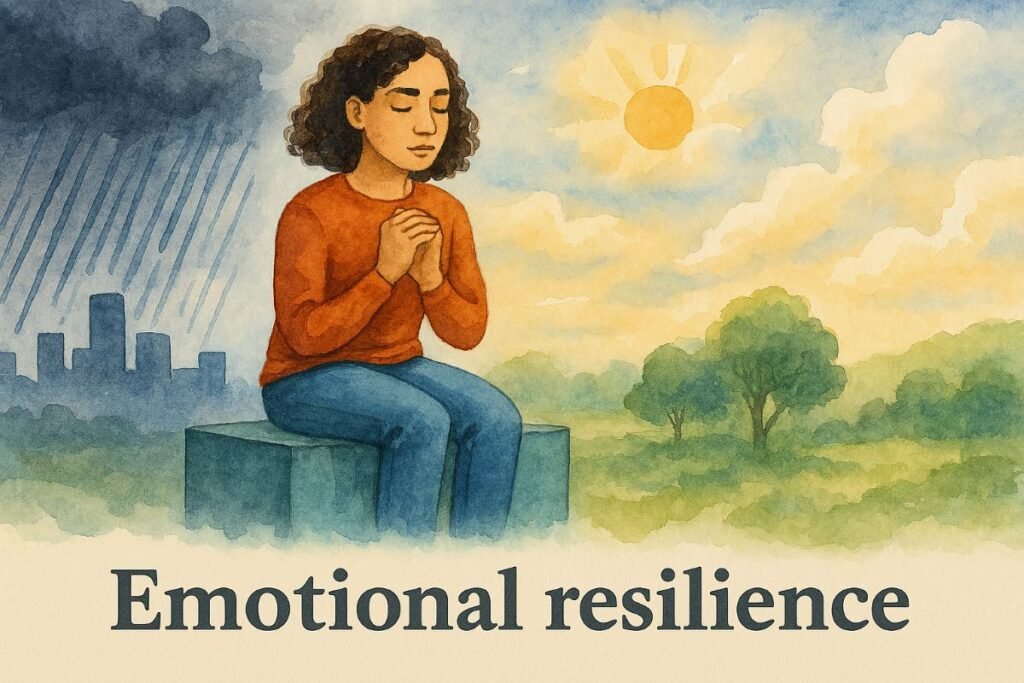
- Emotional resilience is the capacity to meet life’s challenges with balance, wisdom, and compassion, not to become immune to difficulty.
- Buddhism frames this capacity as a set of character qualities that can be developed through intentional practice, known as the Perfections or pāramīs.
- Core teachings like impermanence (anicca), the Four Noble Truths, and mindfulness (sati) provide the practical tools to understand and transform our relationship with emotional distress.
- The path to resilience involves cultivating wholesome qualities such as loving-kindness (mettā), patience (khanti), and equanimity (upekkhā), which are emphasized across all major Buddhist schools, including Theravāda and Mahāyāna.
- A common misunderstanding is that Buddhism aims to eliminate emotions; instead, it offers ways to experience them without being overwhelmed, leading to greater freedom and peace.
- Daily practices like meditation, mindful reflection, and conscious action in relationships are the practical ways to build this resilience.
- Developing emotional resilience is not about achieving a perfect state but about learning to navigate the inevitable ups and downs of life with greater skill and a steadier heart.
1. Introduction
Life, by its very nature, presents us with a continuous stream of experiences. There are moments of joy, connection, and ease, and there are moments of loss, frustration, and pain. Our ability to navigate this entire spectrum, to bend without breaking, to recover from setbacks, and to learn and grow from difficulty, is what we call emotional resilience. It is not a fixed trait we are born with, but a dynamic capacity that can be learned, cultivated, and strengthened.
Buddhism, with its approximately 2,500-year-old tradition of exploring the human mind, offers a profound and practical roadmap for this very task. It does not promise a life without problems, but it provides the tools to face problems with a steadier mind, a more open heart, and deeper wisdom. At its core, Buddhism is a training in resilience: learning to relate to the inevitable dukkha (stress, suffering, dissatisfaction) of life in a way that leads to greater peace and freedom. As the Buddha repeatedly emphasized in the early discourses, “Both formerly and now, monks, I declare only stress and the cessation of stress” (Majjhima Nikaya 22). This singular focus makes the Dhamma a complete manual for understanding and transforming our emotional world.
This article explores how core Buddhist teachings and practices can be directly applied to modern life to build authentic emotional resilience. We will look at the foundational concepts, clarify common misunderstandings, and offer clear, practical examples of how to work with anger, loss, stress, and criticism in a more skillful way.
2. Understanding Emotional Resilience Through a Buddhist Lens
2.1 What is Emotional Resilience?
In everyday terms, emotional resilience is our ability to adapt and recover when things go wrong. It involves:
- Flexibility: Bending with life’s challenges rather than snapping.
- Recovery: Being able to return to a state of balance after emotional upheaval.
- Sustained Effort: Continuing to engage with life and our values even when we feel discouraged.
- Learning: Gaining wisdom and strength from difficult experiences.
2.2 The Buddhist Foundation: The Four Noble Truths
The Buddha’s entire teaching framework, the Four Noble Truths, is essentially a diagnosis and treatment plan for suffering, making it the ultimate guide to resilience. This foundational teaching is laid out in the Buddha’s first sermon, the Dhammacakkappavattana Sutta (Setting the Wheel of Dhamma in Motion).
- The Truth of Suffering (Dukkha): This is the honest acknowledgment that life involves stress, disappointment, and discomfort. Resilience begins with this truth, not with denial. The sutta describes dukkha as including birth, aging, death, sorrow, lamentation, pain, distress, and despair, as well as not getting what one wants.
- The Truth of the Cause of Suffering (Samudaya): The Buddha pointed to craving and clinging as the primary causes. We cling to pleasurable experiences, we push away painful ones, and we crave things to be different than they are. This constant tension is what wears down our resilience.
- The Truth of the Cessation of Suffering (Nirodha): It is possible to end this cycle of clinging and stress. There is a state of well-being that is not dependent on conditions, a liberation of the heart. This truth gives the path its direction and hope.
- The Truth of the Path (Magga): This is the practical method, the Eightfold Path, which provides a step-by-step guide to living wisely and cultivating the mental qualities that lead to peace.
2.3 Impermanence (Anicca): The Bedrock of Resilience
The concept of anicca is not just a philosophical idea; it is a direct observation that can radically change our relationship with difficulty. Everything that arises, a feeling of anger, a critical email, a stubbed toe, will also pass away. The Buddha used powerful similes to illustrate this, comparing all conditioned phenomena to a lump of foam, a bubble, a mirage, a plantain trunk with no heartwood (Samyutta Nikaya 22.95). When we are in the middle of a strong emotion, it feels solid and permanent. Mindfulness allows us to see it as a series of changing sensations, thoughts, and impulses. Seeing this flux firsthand creates a mental “space” where we are no longer completely identified with the emotion. We can say to ourselves, “Ah, this is anger arising. It will not last.” This simple recognition is a powerful act of resilience.
The Lokavipatti Sutta (The Eight Worldly Conditions) directly addresses this, teaching us to contemplate the inevitable pairs of opposites: gain and loss, fame and disrepute, praise and blame, pleasure and pain. This contemplation is a direct training in resilience.
3. Buddhist Schools and the Path to Resilience
3.1 Theravāda Buddhism: The Path of Purification
Theravāda, the “Teaching of the Elders,” emphasizes individual practice and insight into the true nature of reality. The core tools for emotional resilience here are:
- Mindfulness (Sati): The unwavering attention to the present moment, as taught in the Satipatthana Sutta (The Four Establishments of Mindfulness). By watching the body, feelings, mind, and mental phenomena, we see the impersonal process of emotions arising and passing. The sutta calls this the “direct path” for the purification of beings, for overcoming sorrow and lamentation.
- The Five Hindrances: These are specific mental states that block resilience: sense desire, ill-will, sloth-and-torpor, restlessness-and-worry, and doubt. In the Saṅgārava Sutta (Samyutta Nikaya 46.55), the Buddha explains how each hindrance clouds the mind’s ability to see clearly, using vivid water similes:
- Sense desire is like a bowl of water mixed with colorful dyes, one cannot see one’s own reflection clearly.
- Ill-will is like boiling water, turbulent and churning.
- Sloth-and-torpor is like water covered with algae and water plants, stagnant and overgrown.
- Restlessness-and-worry is like wind-agitated water, rippling and unsteady.
- Doubt is like turbid, muddy water placed in the dark, murky and obscured.
The practice is to recognize these hindrances clearly and apply the appropriate antidote, for example, using loving-kindness to calm ill-will, or generating energy to overcome sloth.
- The Ten Perfections (Pāramīs): are character qualities prominently developed in later Theravāda tradition as the path to awakening. They include generosity (dāna), virtue (sīla), renunciation (nekkhamma), discernment (paññā), persistence (viriya), patience (khanti), truthfulness (sacca), determination (adhiṭṭhāna), good-will (mettā), and equanimity (upekkhā). Each perfection directly builds a facet of resilience.
3.2 Mahāyāna Buddhism: The Bodhisattva Ideal
Mahāyāna Buddhism expands the focus from personal liberation to the liberation of all beings. This ideal profoundly shapes the understanding of resilience.
- Compassion (Karuṇā) and the Four Immeasurables: Resilience is not just for our own benefit. It is the strength that allows us to stay present with the suffering of others without burning out. The Karaniya Metta Sutta (The Discourse on Loving-Kindness), while from the Pali Canon, beautifully describes this boundless, protective state of heart. Cultivating these qualities provides a vast, open-hearted foundation from which to meet the world’s pain.
- Skillful Means (Upāya-kauśalya): This is the compassionate wisdom to know how to respond in any given situation. The parable of the poisoned arrow, found in the Cula Malunkyovada Sutta (Majjhima Nikaya 63), illustrates a pragmatic, results-oriented approach: the man shot with a poison arrow must have it removed immediately, not waste time asking about its origins. Resilience isn’t about applying a rigid formula; it’s about having the flexibility and presence of mind to choose the response that will truly help in that unique moment.
4. Why Cultivate Emotional Resilience? The Buddhist Perspective
Developing resilience is not an end in itself but a crucial support for the entire spiritual path.
- To Stay on the Path: The path is not always easy. Without resilience, we are likely to give up when faced with difficulties in practice or in life. The Padhana Sutta (The Great Exertion) depicts the Buddha’s own unshakeable determination by the Nerañjarā River during his great striving before enlightenment, facing the armies of Mara. His example shows that persistence and resolve are the fuels that keep us going.
- To Deepen Compassion: A weak and overwhelmed heart cannot truly help others. The Kakacupama Sutta (The Simile of the Saw) gives the most demanding instruction on patience and compassion: even if one is attacked with a saw, one should not give in to hatred. This extreme example shows the profound resilience required to maintain a heart of goodwill, a resilience that allows us to be a steady, calming presence for others.
- To Realize Freedom: Ultimately, resilience is a byproduct of wisdom. As we see that all conditioned things are impermanent and not-self, we cling less. With less clinging, we are less easily knocked off balance. We develop an unshakeable peace that is not dependent on the world going our way. This is the equanimity (upekkhā) that is the fruit of the path.
5. Common Misunderstandings About Buddhism and Emotions
Before exploring practices, it’s vital to clear up some common misconceptions.
5.1 “Buddhism is about suppressing emotions.”
This is perhaps the most common myth. The goal is not to suppress or deny emotions but to understand their nature. The Chappāṇa Sutta (The Six Animals) offers a powerful image: six animals with different territories (a snake, crocodile, bird, dog, jackal, and monkey) are tied together with a leash. Each pulls toward its own domain. They are eventually tethered to a strong post or pillar. The six animals represent the six sense bases (eyes, ears, nose, tongue, body, mind), each pulling toward its objects. The strong post is mindfulness of the body. This tether doesn’t suppress the animals but holds them steady, just as mindfulness doesn’t suppress experience but keeps awareness grounded and balanced, preventing us from being dragged helplessly by every sense impression. Suppression requires energy and leads to an explosion later. The Buddhist approach is one of recognition, acceptance, and investigation.
5.2 “Equanimity means not caring.”
Equanimity (upekkhā) is often confused with indifference. True equanimity is not a withdrawal from life but a balanced engagement with it. It is the quality of mind that remains steady amidst the “eight worldly winds”: gain and loss, status and disgrace, praise and blame, pleasure and pain (Lokavipatti Sutta). It cares deeply but is not tossed about by the changing tides of fortune. It is the calm at the center of the storm, not the absence of the storm.
5.3 “You have to be a monk or nun to be resilient.”
The core practices for building resilience, mindfulness, kindness, patience, are universal human qualities that can be cultivated by anyone, anywhere. The Sigalovada Sutta (The Discourse to Sigala) is a comprehensive guide to lay ethics, covering relationships, work, and community. It shows that the layperson’s life, with its complex relationships and responsibilities, is an ideal training ground for developing these strengths.
6. Practical Applications: Building Resilience in Daily Life
Here is how to translate these teachings into action, using the framework of the Ten Perfections.
6.1 Cultivating Patience (Khanti)
The Situation: Sarah is in a long line at the grocery store. The person in front of her is taking forever, fumbling with coupons and arguing with the cashier. Sarah feels her jaw tighten, her stomach clench, and irritation flare up. Her habitual response is to sigh loudly, check her phone obsessively, and mentally berate the other customer, leaving herself feeling drained and angry.
The Skillful Response:
- Mindfulness: Sarah notices the tightness in her jaw and the heat of irritation in her chest. She doesn’t judge the feeling; she just notes, “Ah, anger is here.”
- Reframing with Patience: She recalls that patience (khanti) is not about passive resignation but about bearing difficulty without generating inner turmoil. She sees this moment as an opportunity to practice, not as an inconvenience.
- Applying an Antidote: Instead of feeding the anger with thoughts of “This is so unfair,” she might reflect on impermanence (“This feeling, this line, will pass”) or even generate a whisper of loving-kindness: “May this person be at ease.” This is not about condoning difficult behavior, but about freeing her own mind. She recalls the Buddha’s advice to his son Rahula in the Ambalatthika-rahulovada Sutta: reflect on your actions, speech, and thoughts before, during, and after doing them. In this moment, she is reflecting on her thoughts, choosing not to let them become unskillful.
- The Outcome: Sarah still waits in line, but her inner experience is transformed. She leaves the store with her energy intact, having strengthened her “patience muscle” rather than reinforcing her habit of irritation.
6.2 Working with Loving-Kindness (Mettā)
The Situation: David is struggling with harsh self-criticism. He made a mistake at work, and for days his inner voice has been relentlessly telling him he’s incompetent, stupid, and unreliable. This inner turmoil is eroding his confidence and making him withdrawn.
The Skillful Response:
- Starting with Intention: David decides to formally practice loving-kindness meditation (mettā bhāvanā). He sits quietly and begins by directing kind wishes towards himself, a being who is suffering. He silently repeats phrases from the Karaniya Metta Sutta adapted for himself: “May I be happy. May I be safe. May I be free from inner torment.” At first, the words feel hollow, but he persists gently.
- Extending Outward: After a few minutes, he extends the same wishes to others: a friend who is also struggling, the colleague who had to correct his mistake, and finally to all beings everywhere. This practice shifts his focus from his isolated sense of failure to a shared human experience of difficulty.
- The Outcome: Over time, this practice creates a new inner baseline. The harsh inner critic softens. David still feels the sting of his mistake, but it is now held in a larger space of kindness and common humanity. He is more resilient to his own self-attacks.
6.3 The Power of Determination (Adhiṭṭhāna)
Determination is the perfection that gives direction and staying power to all the others. It is the conscious resolve to prioritize long-term well-being over short-term gratification.
The Situation: Maria has committed to a daily 15-minute mindfulness practice. One evening, she feels exhausted and just wants to watch television. Her old habit would be to skip the practice, telling herself, “I’ll do double tomorrow.”
The Skillful Response:
- Applying Discernment: Maria pauses and reflects. She discerns two courses of action: the pleasant one (watching TV) that leads to short-term ease but reinforces a habit of giving up, and the less immediately pleasant one (meditating) that supports her long-term goal of a calmer, more aware mind.
- Making the Resolve: She consciously makes the determination: “I will sit for just 15 minutes.” She isn’t forcing herself to do an hour; she is simply honoring her commitment. This small act of keeping one’s word to oneself is immensely powerful. The verse from the Kassaka Sutta (Samyutta Nikaya 1.5) captures this: “Let a person with wisdom establish himself in virtuous conduct, then train in the ways of heightened awareness.” Establishing oneself in a commitment is the foundation for all further training.
- The Outcome: She sits. The meditation might not be “good,” but she did it. She has proven to herself that she can follow through. This builds self-trust and mental strength, layer by layer. This is the essence of determination.
6.4 Practicing Equanimity (Upekkhā) in Relationships
The Situation: Tom’s adult child is making life choices that Tom strongly disagrees with and worries about. His attempts to advise and intervene have only led to arguments and distance.
The Skillful Response:
- Distinguishing Caring from Controlling: Tom reflects on the perfection of equanimity. He realizes his “caring” has become intertwined with a desire to control the outcome. His peace of mind is dependent on his child making different choices.
- Finding the Balance: He practices equanimity, not by ceasing to care, but by recognizing the limits of his control. He reflects on the teaching that beings are owners of their actions (kamma), as expressed in the Upajjhatthana Sutta (Anguttara Nikaya 5.57): “I am the owner of my actions, heir to my actions, born of my actions, related through my actions, and have my actions as my arbitrator. Whatever I do, for good or for evil, to that will I fall heir.” This applies equally to his child. He makes a determination: “I will hold my child in my heart with loving-kindness, and I will be available if they need support. I will refrain from giving unsolicited advice.” He cultivates the wisdom to discern between what he can influence (his own love and availability) and what he cannot (his child’s choices).
- The Outcome: The relationship with his child becomes less tense. Tom experiences less anxiety and worry because he is no longer clinging to a specific outcome. His love is now offered freely, without the strings of expectation. This is a profound and liberating form of resilience in relationships.
7. Challenges on the Path
7.1 The Need for Discernment
As the Ten Perfections stress, discernment (paññā) is the quality that keeps all other perfections on track. For example, equanimity is not always the right response. In the face of injustice, compassionate action may be the skillful means. Patience does not mean tolerating abuse. The Kalama Sutta (Anguttara Nikaya 3.65) famously encourages a spirit of inquiry and personal verification. Wisdom is needed to know the difference between a situation that asks for our patient endurance and one that asks for our assertive action.
7.2 Integrating with Professional Help
Buddhist practice is a powerful tool for mental well-being, but it is not a substitute for professional medical or psychological care. For conditions like clinical depression, trauma, or severe anxiety, working with a qualified therapist is essential. Buddhist practice can be a wonderful complement to such treatment, providing additional resources for grounding and self-compassion.
8. Conclusion
Emotional resilience, from a Buddhist perspective, is not about building an impervious armor. It is about cultivating a heart and mind that are flexible, strong, and wise. It is the capacity to meet the full range of human experience, the beautiful and the difficult, with presence, compassion, and balance. Through the systematic cultivation of qualities like mindfulness, patience, loving-kindness, and determination, we train ourselves not to be victims of our circumstances, but to be active participants in our own liberation.
The path is built moment by moment: in the choice to take one conscious breath when we want to scream, in the gentle wish for happiness for ourselves when we fail, in the patient endurance of a long line, in the courageous determination to sit one more time. Each of these moments is a brick in the foundation of an unshakeable peace. The Buddha taught that while hunger and conditioned things bring suffering, the highest happiness is found in the peace of Nibbāna, and the greatest wealth is a heart content with what is. This is the promise of the path: not a life free from all difficulty, but the deep and lasting freedom that comes from meeting each moment with wisdom and a steady, kind heart (Dhammapada 203-204).
Glossary of Key Terms
| English Term | Pali Term | Explanation |
|---|---|---|
| Compassion | Karuṇā | The heartfelt wish to alleviate the suffering of others; it is the quivering of the heart in response to pain. |
| Determination | Adhiṭṭhāna | The resolute commitment to follow the path and cultivate wholesome qualities, especially in the face of difficulty. |
| Discernment | Paññā | Wisdom or clear understanding; the ability to see things as they truly are, to distinguish skillful from unskillful. |
| Equanimity | Upekkhā | Even-mindedness and mental balance, especially in the face of life’s ups and downs; a balanced engagement, not indifference. |
| Impermanence | Anicca | The universal law that all conditioned phenomena—thoughts, feelings, things, beings—are constantly arising and passing away. |
| Loving-Kindness | Mettā | The quality of unconditional goodwill and friendliness toward oneself and all beings. |
| Mindfulness | Sati | The non-judgmental awareness of the present moment; remembering to pay attention to what is arising. |
| Patience | Khanti | The capacity to endure difficulty, delay, or provocation without becoming upset or agitated; a form of inner strength. |
| The Five Hindrances | Pañca Nīvaraṇāni | Five qualities that hinder the mind from seeing clearly and resting in calm: sense desire, ill-will, sloth-torpor, restlessness-worry, and doubt. |
| The Four Noble Truths | Cattāri Ariya Saccāni | The Buddha’s core teaching: the truth of suffering, its origin, its cessation, and the path leading to its cessation. |
| The Ten Perfections | Dasa Pāramīyo | The ten qualities of character cultivated on the path to awakening: generosity, virtue, renunciation, discernment, persistence, patience, truthfulness, determination, loving-kindness, and equanimity. |
For Further Exploration
Web Articles
- Access to Insight: A vast archive of Theravāda suttas and teachings. The study guide on “The Ten Perfections” is an excellent starting point.
- LionsRoar.com: A leading magazine and website featuring Buddhist teachings from various traditions, with many practical articles on applying Buddhism to modern life.
- Tricycle.org: Another premier Buddhist magazine offering dharma talks, articles, and beginner’s guides on a wide range of topics.
YouTube Channels
- Yuttadhammo Bhikkhu: Offers clear, simple video answers to questions about Theravāda practice and daily life.
- Plum Village App Channel: The official channel of Thich Nhat Hanh’s community, featuring many gentle, guided meditations and teachings on mindfulness and compassion.
- Study Buddhism: Presents a vast range of Tibetan Buddhist topics in a clear, structured, and accessible way.
Podcasts
- Audio Dharma: Talks given at the Insight Meditation Center in Redwood City, CA, offering practical and insightful guidance on Insight Meditation.
- Secular Buddhism: Hosted by Noah Rasheta, this podcast breaks down Buddhist concepts and teachings and applies them to everyday life in a non-religious, practical way.
- The Wisdom Podcast: Interviews with leading Buddhist teachers and scholars from various traditions, offering deep dives into specific topics.
Books
- “Mindfulness in Plain English” by Bhante Henepola Gunaratana: A classic, straightforward guide to Vipassanā meditation.
- “The Heart of the Buddha’s Teaching” by Thich Nhat Hanh: A clear and accessible introduction to the core teachings of Buddhism, including the Four Noble Truths and the Eightfold Path.
- “Loving-Kindness: The Revolutionary Art of Happiness” by Sharon Salzberg: A profound and practical guide to cultivating mettā.
- “When Things Fall Apart: Heart Advice for Difficult Times” by Pema Chödrön: A beloved book offering practical wisdom from the Tibetan Buddhist tradition for navigating pain and uncertainty.