Key Takeaways
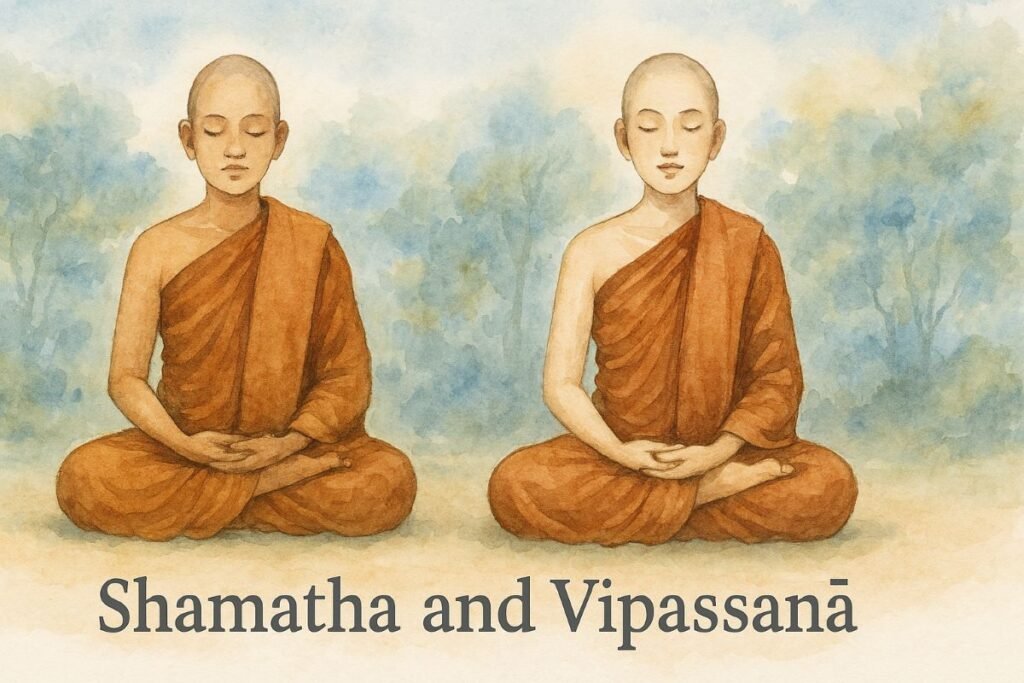
- Shamatha (Calm Abiding) is the practice of developing deep, stable concentration and a calm, peaceful mind by focusing single-pointedly on an object like the breath.
- Vipassanā (Insight Meditation) is the practice of cultivating clear seeing and penetrating wisdom into the true nature of all experience, specifically the three marks of existence: impermanence, unsatisfactoriness, and non-self.
- They are Complementary and Interdependent. Shamatha provides the stable, clear, and pliant mind necessary for effective Vipassanā. Vipassanā uses that stable mind to investigate reality and uproot the causes of suffering. One without the other is incomplete.
- They Belong to All Buddhist Traditions. These practices form the core of mental development in Theravāda, Mahāyāna, and Vajrayāna schools, though emphasis and methods may vary.
- They Are Practical Tools for Daily Life. Shamatha helps manage stress, anxiety, and distraction. Vipassanā helps us relate wisely to change, loss, and our own self-narratives, reducing reactivity and fostering peace.
- The Goal is Liberation, Not Just Relaxation. While calm is a beneficial byproduct, the ultimate aim of these practices combined is awakening (bodhi)—freedom from suffering through profound understanding.
1. Introduction: The Essential Pair for a Peaceful and Wise Life
In a world of constant stimulation, fragmented attention, and underlying anxiety, the ancient practices of Buddhist meditation offer profound refuge and transformation. At the heart of this transformative path lie two foundational types of meditation: Shamatha (Calm Abiding) and Vipassanā (Insight Meditation). Often misunderstood as separate or even opposing practices, they are, in truth, inseparable partners on the journey to inner peace and wisdom.
Imagine trying to examine the intricate details of a gemstone in a churning, muddy river. The water is too turbulent to see clearly. First, you must calm the waters and let the sediment settle. Only then can you observe the gem’s true characteristics: its facets, flaws, and brilliance. Shamatha is the process of calming and stabilizing the mind. Vipassanā, from the Pali vi (meaning “in a special way” or “through”) and passanā (“seeing”), is the special, clear seeing and investigation that becomes possible once the mind is still.
This guide will explore these two wings of meditation in depth. We will define them, explore their roles in major Buddhist schools, clarify common misunderstandings, and, most importantly, provide practical ways to integrate them into modern daily life. Through detailed examples, scriptural references, and clear explanations, we aim to demystify these practices and show how, together, they form a complete path for healing, clarity, and genuine freedom.
2. Understanding Shamatha (Calm Abiding)
2.1 Definition, Etymology, and Purpose
Shamatha (Pali: samatha; Sanskrit: śamatha) is most commonly translated as “calm abiding,” “tranquility,” or “serenity.” It comes from the root śam, meaning “to pacify” or “to become quiet.” The purpose of Shamatha is to develop samādhi—concentration, collectedness, or one-pointedness of mind.
The goal is not to enter a trance or blank out, but to cultivate a mind that is stable, clear, flexible, and undisturbed by distractions. It’s about training the mind to abide peacefully with its chosen object. The Buddha described a mind developed through concentration as “steady, settled, unified, and concentrated” (e.g., DN 2, Sāmaññaphala Sutta). This quality of mind is the indispensable foundation for all deeper spiritual work.
2.2 The Role of Shamatha Across Buddhist Schools
- Theravāda: In the Theravāda tradition, mental development is traditionally framed as the cultivation of samatha and vipassanā, often developed through forty traditional meditation subjects (kammaṭṭhāna), and may culminate in deep states of absorption known as jhānas.
- Mahāyāna: Mahāyāna texts, such as those by the master Asaṅga, elaborate on Shamatha as a prerequisite for Vipassanā. The cultivation of Shamatha is often mapped through the Nine Stages of Mental Abiding, a system detailing the progressive pacification of the mind. It is seen as the method for achieving a “pliant” mind, which can then be directed toward the realization of emptiness (śūnyatā).
- Vajrayāna (Tibetan Buddhism): Here, Shamatha is considered a critical foundation. In many Tibetan lineages, a stable Shamatha practice is emphasized as a foundation before or alongside advanced practices such as Mahāmudrā or Dzogchen. It is said that without Shamatha, one’s Vipassanā is like a butter lamp in a storm, the flame of insight is easily extinguished by the winds of distraction.
2.3 Core Technique: Anchoring the Mind
The fundamental method of Shamatha is simple in description but profound in practice:
- Choose a Single Object: The most universal and accessible object is the natural breath, felt at the nostrils or the rise and fall of the abdomen. Other objects include a visualized image, a mantra (a sacred sound or phrase), or a physical sensation.
- Gently Place Attention: Direct your attention to the chosen object. With the breath, you might silently note “in” on the inhalation and “out” on the exhalation.
- Sustain and Return: The mind will inevitably wander. The core of the practice is the moment you notice it has wandered. Without judgment, gently release the distraction and return your attention to the object. This act of noticing and returning is the rep that builds the “muscle” of concentration.
2.4 The Progression of Developing Shamatha
The classical texts describe a progression from initial effort to effortless stability:
- Initial Engagement: You repeatedly place the mind on the object.
- Continuous Attention: You sustain attention for longer periods, though distraction is still frequent.
- Recognition and Return: You quickly recognize distraction and return to the object.
- Close Placement: Attention remains mostly on the object, with only subtle distractions.
- Pacification & Full Pacification: Effort decreases as the mind settles naturally into the object. Dullness and agitation are subdued.
- Single-Pointedness & Balanced Placement: The mind rests effortlessly and vividly on the object. This is a state of deep calm and mental unification.
2.5 Practical Example: Shamatha as Foundational Mental Training
Situation: Leo is a police officer. His work subjects him to unpredictable shifts between prolonged vigilance and sudden, high-stakes crisis. The psychological toll manifests as a background tension that persists off-duty, a fragmented attention span, and a reactive mental state where threat assessment can override clearer judgement. He recognizes that to perform his duty with wisdom and restraint, to de-escalate rather than react, he needs more than tactical training; he needs training for his mind.
Skillful Shamatha Application:
Leo understands that mental stability, like physical fitness, requires dedicated, formal practice. He commits to a daily, uninterrupted 30-minute session of Shamatha meditation, viewing it as non-negotiable mental maintenance. This formal practice is the core training ground.
- The Formal Practice – Building the Foundation: Each morning, Leo sits in a quiet space. Using the sensation of the breath at his nostrils as his exclusive object, he engages in the fundamental discipline of Shamatha. When his mind is inevitably pulled away, into a memory of a previous call, into anxiety about the coming shift, into general planning, he practices the crucial move: he recognizes the distraction, gently disengages from the thought stream without self-criticism, and returns his attention to the next breath. This cycle of focus-wandering-return is the essential repetition. He is not trying to stop thoughts, but to change his relationship to them, cultivating a mind that is less identified with its content and more capable of steady, intentional awareness. This builds samādhi—unified, pliant concentration.
- Integration – The Fruit of Practice in the Field: The calm and focus cultivated during these formal sessions naturally permeate his duty. The brief, conscious pauses he takes are not the meditation itself, but expressions of the mental discipline he has been training.
- In the Patrol Car: During a quiet moment, he might consciously rest his awareness on the breath for a minute. This is not a “mini-meditation” but a deliberate application of his trained ability to anchor his attention, clearing the mental static to refresh his situational awareness.
- Pre-Engagement Pause: Before exiting his vehicle for a call, he takes three conscious breaths. This utilizes his trained skill to create a moment of space between stimulus and response, allowing him to approach the situation from a centered clarity rather than from pure reaction.
- Post-Incident Regulation: After a tense encounter, the familiar anchor of the breath provides a physiological and mental tool to down-regulate his nervous system, a skill built directly in his formal practice.
Result: The transformation occurs in the deep structure of his attention. The daily, formal practice of Shamatha develops a underlying mental stability, a “steady mind” (ṭhita citta) as referenced in the Anguttara Nikaya. This cultivated steadiness allows him to encounter volatile situations without his internal state becoming equally volatile. His perceptions can be clearer, his listening more attentive, and his decisions less contaminated by unchecked reactivity. He is building, through disciplined practice, the very foundation of mindful presence: a calm and unified mind from which skillful, compassionate, and precise action can arise.
3. Understanding Vipassanā (Insight Meditation)
3.1 Definition, Etymology, and Purpose
Vipassanā (Pali: vipassanā; Sanskrit: vipaśyanā) is translated as “clear seeing,” “insight,” or “special seeing.” The prefix vi- implies “in a special way,” “through,” or “deeply,” and passanā means “seeing.” It is the seeing through of illusion. Vipassanā is the cultivation of wisdom (paññā in Pali, prajñā in Sanskrit).
Its purpose is to see directly, not intellectually, but experientially, the fundamental characteristics of all conditioned existence (Three Marks Of Existence):
- Impermanence (Anicca): All phenomena are in constant flux, arising and passing away.
- Unsatisfactoriness (Dukkha): Clinging to what is impermanent inherently leads to stress, disappointment, and suffering.
- Non-Self (Anattā): There is no permanent, independent, controlling “self” to be found within the ever-changing flow of mental and physical processes.
Seeing these truths directly dismantles the misperceptions that cause suffering.
3.2 The Role of Vipassanā Across Buddhist Schools
- Theravāda: Vipassanā is the defining practice of the path to liberation (nibbāna). In modern Theravāda movements, especially in the traditions of Mahasi Sayadaw and S.N. Goenka, it is often taught as a standalone practice based on moment-to-moment mindfulness of body and mind.
- Mahāyāna: Vipassanā is directed toward realizing emptiness (śūnyatā), the understanding that all phenomena are empty of inherent, independent existence. This insight, detailed in texts like the Prajñāpāramitā (Perfection of Wisdom) Sutras, is coupled with the compassionate motivation of the bodhisattva vow to liberate all beings.
- Vajrayāna: Insight here often involves recognizing the nature of mind itself, luminous, empty, and aware, through the stable platform of Shamatha. Practices like Mahāmudrā and Dzogchen point directly to this innate awareness.
3.3 Core Technique: Mindful Investigation
While Shamatha focuses the mind, Vipassanā opens the field of awareness to investigate:
- Establish Mindfulness (Sati): Using the stability of Shamatha as a base, you open your awareness to the changing flow of experience. The classic framework is the Four Foundations of Mindfulness (Satipaṭṭhāna Sutta): body, feelings, mind states, and mental qualities.
- Observe the Three Characteristics: You note sensory and mental phenomena (dhammas) as they arise. You observe their changing nature (anicca), the tension or release that comes with clinging or aversion to them (dukkha), and the fact that they arise due to conditions, not from a commander “self” (anattā).
- Cultivate Equanimity (Upekkhā): The practice is to see all experiences with balance, not getting pulled into liking or disliking, but simply knowing them as they are.
3.4 Practical Example: Vipassanā in Daily Li3.4 Practical Example: Vipassanā in the Midst of Long-Term Grief
Situation: Anil’s father is living with advanced dementia. Their relationship has undergone a painful reversal; Anil is now the caregiver for the man who once cared for him. Visits are emotionally complex: sometimes his father is peaceful, sometimes agitated, often he does not recognize Anil. Anil is navigating a continuous, ambiguous grief, mourning the loss of the parent he knew while still caring for the person in front of him. He is often flooded with sadness, guilt (“Am I doing enough?”), helplessness, and moments of sharp resentment about the unfairness of the disease, which is then followed by more guilt.
Skillful Vipassanā Response:
Anil has established a formal Vipassanā practice, typically 30 minutes daily, where he cultivates silent, non-judgmental observation of the changing flow of bodily and mental phenomena. This formal training is the ground from which his in-the-moment insight arises. He does not use the practice to change his feelings, but to see their true nature clearly.
- Mindful Pause in the Midst of Sorrow: During a visit, his father becomes confused and angrily asks, “Who are you? Where is my son?” A powerful wave of grief and rejection hits Anil. Instead of being swept into the narrative (“He’s gone, I’ve lost him forever”), he turns his attention to the direct, somatic experience. He feels the specific physical sensations: a constriction in his throat, a heavy pressure in his chest, a sinking feeling in his abdomen. He mentally notes, “tightening, pressure, sinking.” He observes these sensations not as a personal tragedy, but as impersonal physical events that intensify, fluctuate, and gradually subside. This is direct observation of feeling (vedanā) and body (kāya).
- Seeing Impermanence in the Process: Through this repeated practice, Anil gains direct insight into impermanence (anicca). He observes that even within a single difficult visit, his father’s agitation subsides into a moment of quiet. Crucially, he sees that his own emotional pain is not a solid wall, but a series of waves, the crushing feeling of grief peaks, changes into a numb exhaustion, which then gives way to a moment of simple focus on a practical task. He recognizes that every element of this experience: his father’s mood, his own feelings, even the thought “this is unbearable”, arises due to conditions and passes away. This insight into constant flux frames the entire situation within a universal law, lessening the sense of being trapped in a fixed, solid state of suffering.
- Investigating the “Self” Story: When the thought arises, “I am a failing son,” he applies his trained investigative awareness. He first notes the feeling-tone that accompanies the thought: the unpleasant, contracting quality of guilt. Then he observes the thought itself as a mental event, a series of words repeating in the mind. He sees it arise based on conditions (fatigue, a cultural ideal of filial piety), persist for a few moments, and pass away when his attention shifts to the sound of his father’s breathing. He does not need to conceptually ask “Who am I?”; instead, through sustained observation, he sees that the sense of a “failing self” is itself a temporary, conditioned phenomenon, not a permanent entity. This is the insight into non-self (anattā) emerging from seeing the impermanent, empty nature of all mental formations.
Result: The dementia does not vanish, and the heartache does not disappear. However, by applying Vipassanā, Anil’s relationship to his suffering transforms. He is less identified with and imprisoned by the stories of guilt and failure. The space created by mindful observation allows for a purer, more compassionate presence. He can be with his father’s confusion without as quickly being consumed by his own personal devastation. He begins to respond to the fluid needs of the moment, offering a calm presence during agitation, sharing a simple touch, rather than reacting blindly from a reservoir of accumulated grief. The practice helps him bear the unbearable by revealing its nature as a series of changing mental and physical events, none of them a permanent self. This is the insight of Vipassanā: seeing things as they are (yathābhūtaṁ), which, paradoxically, is the foundation for genuine peace.
4. The Vital Synergy: Why Shamatha and Vipassanā Must Work Together
The Buddha frequently used similes to describe their interdependence, emphasizing they are “yoked together” (yuganaddha):
“Just as when a lamp is touched by wind, its light is unsteady and quivers… but when the lamp is not touched by wind, its light does not quiver… In the same way, when a monk’s mind is seized by agitation… his mind does not become concentrated for the destruction of the taints. But when his mind is not seized by agitation… it becomes concentrated. Then he fully understands by direct knowledge those things which are to be fully understood by direct knowledge…” (SN 46.53, Upakkilesa Sutta, The Simile of the Lamp).
4.1 Shamatha Without Vipassanā
A mind that is calm but not insightful is like a perfectly still, clear pond in a dark cave. It is peaceful but sees nothing. One can attain deep states of tranquil absorption (jhāna), which are blissful and peaceful, but upon leaving them, the underlying mental defilements: ignorance, craving, aversion, remain untouched. One has serenity but not liberation. The Buddha called this “peaceful abiding in the here and now,” but not the final goal (AN 4.94).
4.2 Vipassanā Without Shamatha
Trying to cultivate insight with an untrained, agitated mind is like trying to perform delicate surgery with a shaky, blunt instrument. The mind jumps from observation to observation, often getting lost in thought or overpowered by the intensity of emotions it is trying to observe. While some traditions describe a path of “dry insight” (sukkha-vipassanā), most masters recommend a balanced approach to avoid mental burnout and ensure the insight is stable and integrated.
4.3 The Integrated Practice: Samatha-Vipassanā
The mature practice is a fluid integration. You begin a session by calming the mind with Shamatha (focusing on the breath). As the mind settles, you naturally become more aware of subtler sensations, feelings, and thoughts. You then gently shift emphasis to Vipassanā, observing these very phenomena with clarity, noting their impermanent nature. If the mind becomes too agitated or lost, you return to the stabilizing anchor of the breath. This dance creates a powerful synergy: calm deepens insight, and insight deepens calm by revealing the transient nature of distractions.
5. Shamatha vs. Vipassanā: A Quick Comparison
| Feature | Shamatha (Calm Abiding) | Vipassanā (Insight) |
|---|---|---|
| Primary Goal | Stability, Tranquility & Concentration | Wisdom, Understanding & Realization |
| Core Method | Single-pointed focus on an object | Open, investigative awareness of phenomena |
| Key Insight Developed | The mind can be peaceful, steady, and unified. | The nature of reality is impermanent, unsatisfactory, and not-self. |
| Primary Obstacle | Agitation & Dullness | Delusion & Misperception |
| Developed Faculty | Samādhi (Concentration) | Paññā (Wisdom) |
| Common Analogy | A steady, windless candle flame. | The clear light that reveals the contents of the room. |
| Temporal Emphasis | Abiding in the present moment. | Seeing the change within the present moment. |
6. Common Misunderstandings and Clarifications
- “Vipassanā is about noting everything quickly.” While some modern techniques use rapid noting, the essence of Vipassanā is the quality of seeing: clear, penetrating, and wise, not the speed of labeling. Forcing rapid noting can itself become a distraction from true insight.
- “Shamatha is just for relaxation.” While relaxation is a beneficial side effect, Shamatha is a rigorous training in concentration that builds profound mental power and stability for a higher purpose: to serve as the foundation for liberating insight.
- “They are completely separate paths.” This is perhaps the most persistent error. The early texts consistently show the Buddha taught them as yoked together. While different modern retreats may emphasize one, the classical path integrates both.
- “I have to master Shamatha first.” While a degree of stability is needed, for most lay practitioners, the two develop in tandem. You can start with a period of calm-focus (Shamatha) and then open to mindful awareness (Vipassanā) in the same session. They support each other from the beginning.
7. A Practical Guide to Cultivating Both Practices
7.1 Getting Started: A Basic Integrated Session
- Posture: Sit comfortably, with a dignified, upright spine. This signals alertness to the mind.
- Intention (5 mins): Set a clear, kind intention for your practice. “May this time be for cultivating peace and understanding.”
- Shamatha Phase (10-15 mins): Bring full attention to the physical sensation of the breath. Be with the entire cycle. Use “in/out” as a gentle guide if helpful. When distracted, patiently return.
- Vipassanā Phase (10-15 mins): Once the mind feels somewhat settled, gently widen your awareness. Notice sounds, bodily sensations, or the feeling-tone (pleasant, unpleasant, neutral) of the present moment. Observe them as passing events. If you get lost, return to the breath to re-stabilize.
- Closing (5 mins): Return to just the breath for a few minutes. Then, dedicate the merit of your practice: “May the peace and insight from this practice benefit myself and all beings.”
7.2 Applying the Synergy Throughout Your Day
- In Conversation: Use Shamatha to truly listen, focus your attention single-pointedly on the speaker’s words. Use Vipassanā to be aware of your own mental reactions (agreement, impatience, planning a response) without letting them control you.
- In Stress: When stress hits, first use Shamatha: take three deep, conscious breaths to ground yourself. Then, use Vipassanā: observe the stress as a constellation of physical sensations and thoughts, watching it change moment by moment.
- In Enjoyment: When experiencing pleasure, practice Vipassanā by noticing its impermanent nature. This isn’t to ruin the joy, but to appreciate it without the anxiety of clinging, leading to a more pure and relaxed enjoyment.
8. Conclusion: The Path of Peace and Understanding
Shamatha and Vipassanā are not mere historical techniques but living pathways to a sane and free heart. Shamatha answers our deep need for stability and peace in a chaotic world. Vipassanā answers our profound need for understanding and freedom from the inner patterns that cause suffering.
By cultivating Calm Abiding, we build a home for the mind, a place of refuge. By cultivating Insight, we learn to see the true nature of that home and of all experience, which ultimately leads to fearlessness. Together, as the Buddha taught, they form the direct path for the purification of beings, for the overcoming of sorrow and lamentation, for the disappearance of pain and grief, for the attainment of the true way, for the realization of liberation (MN 149).
Start where you are. Use the breath to find a moment of calm. Use that calm to see more clearly. In this simple, profound practice, you nurture both wings that will allow your life to soar toward genuine peace and wisdom.
Glossary of Key Terms
| English Term | Pali / Sanskrit Term | Explanation |
|---|---|---|
| Non-Self | Anattā (Pali) / Anātman (Sanskrit) | The doctrine that there is no permanent, unchanging, independent self or soul within the flow of mental and physical processes. |
| Impermanence | Anicca (Pali) / Anitya (Sanskrit) | The fundamental characteristic that all conditioned phenomena are in a constant state of arising, changing, and passing away. |
| Aspiring Enlightened Being | Bodhisatta (Pali) / Bodhisattva (Sanskrit) | In Mahāyāna Buddhism, a being who compassionately delays their own final enlightenment to work for the liberation of all sentient beings. |
| Truth / Phenomenon / Teaching | Dhamma (Pali) / Dharma (Sanskrit) | 1) The ultimate truth or law of reality, as taught by the Buddha. 2) A phenomenon, a mental or physical event. 3) The teachings of the Buddha. |
| Unsatisfactoriness / Stress / Suffering | Dukkha (Pali) / Duḥkha (Sanskrit) | The inherent unsatisfactoriness, stress, or inability to provide lasting satisfaction in conditioned existence. |
| Equanimity | Upekkhā (Pali) / Upekṣā (Sanskrit) | A state of mental balance, calmness, and impartiality. It is not indifference, but a wise, non-reactive openness to all experience. |
| Insight | Vipassanā (Pali) / Vipaśyanā (Sanskrit) | “Clear seeing.” The direct, experiential understanding of the three marks of existence (impermanence, unsatisfactoriness, non-self). |
| Meditative Absorption | Jhāna (Pali) / Dhyāna (Sanskrit) | States of deep meditative absorption characterized by profound stillness, joy, and one-pointedness, developed through advanced Shamatha. |
| Mindfulness | Sati (Pali) / Smṛti (Sanskrit) | The mental faculty of awareness, attention, and recollection of the present moment. The foundation of both Shamatha and Vipassanā. |
| Concentration / Collectedness | Samādhi (Pali/Sanskrit) | The state of unified, stable, focused attention developed through Shamatha. |
| Calm Abiding / Tranquility | Samatha (Pali) / Śamatha (Sanskrit) | The practice of developing deep, stable concentration and a pacified mind. |
| Emptiness | Suññatā (Pali) / Śūnyatā (Sanskrit) | The Mahāyāna teaching that all phenomena are empty of inherent, independent existence; they exist only in dependence on causes and conditions. |
| Wisdom | Paññā (Pali) / Prajñā (Sanskrit) | The deep understanding of the true nature of reality, cultivated through insight meditation. |
References and Further Learning
Books
- The Heart of Buddhist Meditation by Nyanaponika Thera. A classic work that clearly explains the Satipaṭṭhāna (mindfulness) method, integrating calm and insight.
- The Mind Illuminated by Culadasa (John Yates). A detailed, stage-by-stage manual merging modern cognitive science with the traditional Shamatha-Vipassanā path.
- Satipaṭṭhāna: The Direct Path to Realization by Bhikkhu Analayo. A thorough, academic, yet accessible exploration of the primary sutta on mindfulness, showing the interplay of calm and insight.
- The Art of Happiness by His Holiness the Dalai Lama and Howard Cutler. While not a meditation manual, it beautifully connects the goals of Buddhist practice (calm and insight) to the pursuit of everyday happiness.
Online Articles and Websites
- Access to Insight: A vast, free library of translated Theravāda Buddhist texts (suttas), including all those referenced in this article.
- Shamatha and Vipashyana: The Two Main Forms of Meditation on Lion’s Roar. A clear introductory article.
- What is Vipassana? on the official website of S.N. Goenka’s Vipassana tradition. Explains one prominent modern interpretation.
Audio and Video
- Bhante Gunaratana’s Guided Meditation on Mindfulness of Breath and Loving-Kindness. A gentle, wise guidance from a beloved Theravāda teacher, combining elements of calm and insight.
- The Wisdom Podcast: Joseph Goldstein on “Mindfulness: A Practical Guide to Awakening“. A leading Western teacher discusses the integrated path.
- Yongey Mingyur Rinpoche’s “How to Meditate” series on YouTube. A brilliant Tibetan teacher offers accessible, joyful instructions on Shamatha and the nature of mind (Vipassanā).