1. Introduction: What Is Zen?
Zen is a school of Mahayana Buddhism that emphasizes direct, experiential insight into the nature of existence. At its heart, Zen is not a belief system or a philosophy to be studied, but a practice to be embodied. The word “Zen” is the Japanese pronunciation of the Chinese word “Chan,” which itself derives from the Sanskrit term “dhyāna,” meaning meditation or profound contemplation.
Unlike paths that rely heavily on scriptures, Zen is often described as “a special transmission outside the scriptures, not dependent on words and letters.” It points directly to the human mind, encouraging practitioners to see their own true nature and thereby become Buddhas. For the modern seeker, Zen offers a disciplined yet flexible framework for cultivating clarity, compassion, and a deep, abiding peace amidst the complexities of daily life.
2. A Detailed Historical Journey: From India to the World
The history of Zen is a story of adaptation and transmission, where core insights traveled across cultures, taking root in new forms.
2.1 Indian Origins and the Legend of Bodhidharma
The foundations lie in the teachings of the historical Buddha, Siddhartha Gautama (c. 5th century BCE), for whom meditation (dhyāna) was the essential path to awakening. Centuries later, Zen traces its symbolic lineage to the semi-legendary Indian monk Bodhidharma.
- The Journey to China: Tradition holds that Bodhidharma arrived in China around the 5th or 6th century CE. He is depicted as a fierce, bearded master who brought a potent and direct form of Buddhist practice.
- The Encounter with Emperor Wu: A foundational story recounts Bodhidharma’s meeting with Emperor Wu, a great patron of Buddhism. When the emperor asked how much merit he had earned from building temples, Bodhidharma replied, “No merit.” He then explained that true spiritual work was “vast emptiness, nothing holy.” This story establishes Zen’s iconoclastic spirit, valuing inner realization over outward piety and ritual.
- Wall-Gazing at Shaolin: Bodhidharma is said to have spent nine years in meditation facing a cave wall at the Shaolin Temple. This legend underscores the absolute priority given to intense, seated meditation (zazen) in Zen practice.
2.2 The Golden Age of Chan in China
In China, Indian Buddhist meditation met indigenous Daoist and Confucian thought, giving birth to Chan. This period (7th-13th centuries) was its creative zenith.
- The Sixth Patriarch, Huineng: The single most influential figure in Chan. An illiterate woodcutter, his profound understanding of the Diamond Sutra led him to monastery life. His status was cemented when he composed a verse demonstrating that awakening is not a gradual polishing of the mind, but a sudden recognition of one’s inherently pure Buddha-nature. His teachings, compiled in the Platform Sutra, shifted Chinese Buddhism toward a more sudden, direct, and accessible path.
- The Flourishing of the Five Houses: Following Huineng, Chan diversified into “Five Houses” or schools, each with unique teaching styles. The Linji school (Japanese: Rinzai) used shouts and blows to shock students out of conceptual thinking. The Caodong school (Japanese: Soto) emphasized quiet, sustained meditation. Though these styles differed, their goal was identical: awakening.
- Koans and Recorded Sayings: This era produced the great collections of koans (public cases) and recorded dialogues between masters and students. Texts like The Blue Cliff Record and The Gateless Gate were not scriptures for worship, but training tools designed to short-circuit the logical mind.
2.3 Transmission to Japan and the Founding of Japanese Zen Schools
Zen entered Japan in the late 12th and 13th centuries, finding ready patrons in the samurai class and deeply influencing Japanese culture.
- Eihei Dogen (1200-1253): Founder of Soto Zen: After traveling to China and experiencing profound awakening, Dogen returned to Japan to establish the Soto school. His monumental work, the Shobogenzo (Treasury of the True Dharma Eye), is a deep philosophical and practical exposition of Zen. He emphasized shikantaza,”just sitting”, as the supreme practice, where meditation itself is the simultaneous expression and realization of enlightenment.
- Myoan Eisai (1141-1215): Pioneer of Rinzai Zen: Earlier, Eisai also traveled to China and brought back the Linji (Rinzai) tradition. He established the first Zen temple in Japan and promoted Zen alongside the esoteric Buddhism of the time. Rinzai Zen, with its use of koans and rigorous interview (dokusan) with a teacher, became particularly associated with samurai discipline and the arts.
- Cultural Integration: Zen principles of simplicity, directness, and total presence profoundly shaped Japanese aesthetics, seen in:
- The Tea Ceremony (Sado or Chado): A ritual of mindful preparation and service.
- Ink Wash Painting (Sumi-e): Capturing the essence of a subject with spontaneous, minimal brushstrokes.
- Poetry (Haiku): A 17-syllable form that points directly to a moment of perception.
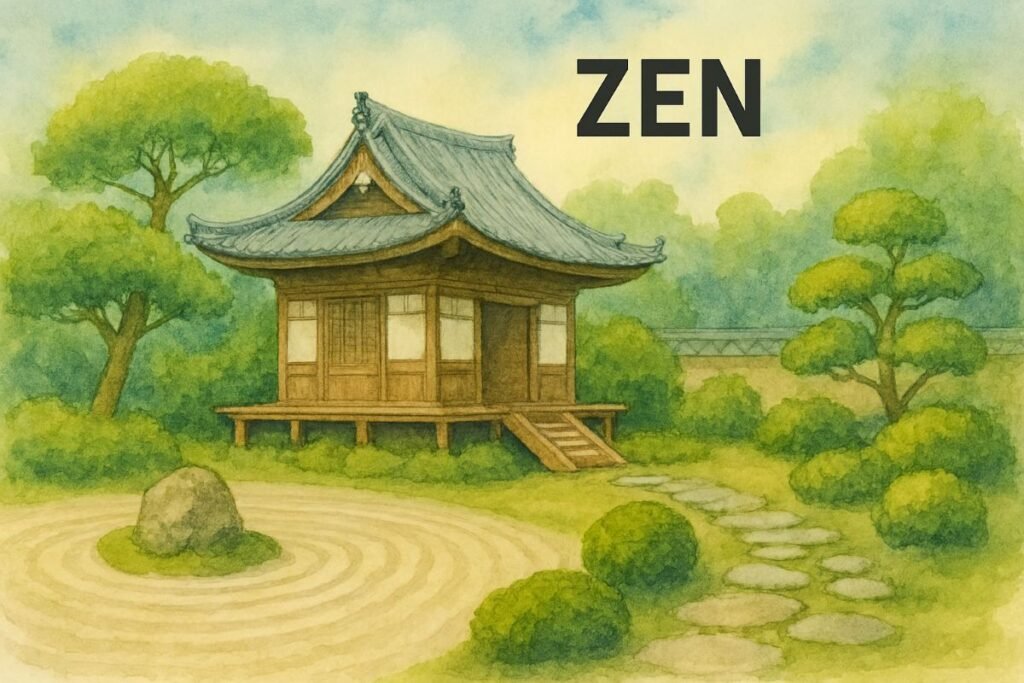
- Gardening (Karesansui, dry landscape): Rock and sand gardens that invite contemplation.
2.4 Zen in the Modern West
Following World War II, Zen gained significant attention in the West.
- Key Transmitters: Scholars like D.T. Suzuki and monks like Shunryu Suzuki (no relation) played pivotal roles. Shunryu Suzuki’s book Zen Mind, Beginner’s Mind remains a foundational text, demystifying practice for Western audiences.
- Secular Integration: The core practice of mindfulness (sati) was extracted and secularized in programs like Mindfulness-Based Stress Reduction (MBSR), creating a bridge between Zen meditation and contemporary psychology and medicine.
- Modern Challenges and Forms: Western Zen centers often adapt traditional forms, grappling with issues of hierarchy, gender equality, and integrating practice with lay life, while striving to maintain the essential depth of the tradition.
3. Core Philosophy: The Unique View of Zen
Zen philosophy is minimalist and experiential. It pares away metaphysical complexity to point to what is directly knowable.
3.1 Buddha-Nature: Your Original Face
A central tenet is that all beings possess Buddha-nature—the inherent, luminous capacity for awakening. It is not something to be acquired, but realized. As Dogen said, “To study the Buddha Way is to study the self. To study the self is to forget the self. To forget the self is to be actualized by the myriad things.” The practice is one of uncovering, not building.
3.2 Nonduality: Beyond Separation
Zen sees the fundamental delusion as the sense of a separate, enduring self (“I”) confronting an external world (“that”). This split is the root of craving, aversion, and suffering. Awakening involves seeing through this illusion to the nondual nature of reality, where subject and object, self and other, are understood as interdependent aspects of one seamless whole. The 13th-century master Daito expressed this upon his awakening: “I came to realize clearly that Mind is no other than mountains, rivers, and the great wide earth, the sun and the moon and the stars.”
3.3 Impermanence and Suchness
Zen fully embraces the Buddhist teaching of impermanence (mujo). All phenomena are in constant flux. Rather than causing despair, Zen teaches that directly experiencing this flux leads to freedom. Each moment, just as it is, is complete. This is suchness (tathata), seeing things in their “thusness,” without the filter of our preferences and judgments.
3.4 The Useleness of Concepts
While not anti-intellectual, Zen is deeply skeptical of conceptual thought’s ability to capture truth. Words and ideas are seen as maps, not the territory. The practice aims for direct perception, knowing reality as one knows the taste of tea by drinking it, not by reading a description. This is why art became such a vital expression of Zen understanding.
4. Schools and Practice Methods: The Soto and Rinzai Paths
The two main surviving schools of Japanese Zen offer distinct, yet complementary, approaches to the same goal.
4.1 Soto Zen: The Practice of Just Sitting
- Core Method: Shikantaza. This is objectless meditation. One does not count breaths, visualize, or contemplate a koan. One simply sits with upright, dignified posture, allowing thoughts, sensations, and sounds to arise and pass without interference, grasping, or aversion. It is a profound practice of non-doing and letting things be as they are. Dogen taught that in shikantaza, practice and realization are one; the act of sincere sitting is itself the manifestation of enlightenment.
- Teacher’s Role: The Soto teacher (roshi or sensei) offers guidance on posture and attitude, and may give informal talks (teisho), but the primary emphasis is on the student’s own sustained, silent practice.
4.2 Rinzai Zen: The Dynamic Path of the Koan
- Core Method: Koan Introspection. A koan is a paradoxical story, question, or statement that cannot be solved by logic. Classic examples include “What is the sound of one hand clapping?” or “What was your original face before your parents were born?” The student is assigned a koan and must “present” their understanding to the teacher in a private interview (dokusan or sanzen). The process is designed to generate the “great doubt,” a ball of intense, existential inquiry that, if pursued fully, can shatter the conceptual mind and lead to awakening (kensho).
- Teacher’s Role: The Rinzai teacher is essential as a strict examiner and guide through the koan curriculum, which can consist of hundreds of cases. They validate authentic insight and prevent students from becoming stuck in intellectual or spiritual conceit.
A Comparison in Practice:
| Aspect | Soto Zen (via Shikantaza) | Rinzai Zen (via Koan Study) |
|---|---|---|
| Primary Focus | Cultivating a continuous, calm, and non-grasping awareness in all activities. | Generating and resolving intense doubt to breakthrough to direct insight. |
| Meditation Method | “Just sitting” with no object; awareness itself is the practice. | Concentrating fiercely on a koan to penetrate its meaning. |
| Role of the Teacher | A guiding example and source of encouragement for sustained practice. | An essential examiner and validator of understanding in private interview. |
| Expression of Awakening | Often gradual and seamless, expressed as steady maturity and composure. | Often dramatic and sudden, followed by a period of integration. |
| Cultural Influence | Deeply influenced the arts of quiet observation (poetry, gardening). | Influenced the dynamic arts and samurai discipline. |
5. The Practice of Zen: A Practical Framework
Zen practice is built on a tripod of meditation, ethical living, and wisdom. Here is how to approach it.
5.1 Zazen: The Heart of the Matter
This is the formal practice of seated meditation.
- Posture: The foundation is an upright, stable, and alert posture. This aligns the body and mind.
- Full Lotus (kekkafuza): Each foot on the opposite thigh. (Advanced)
- Half Lotus (hankafuza): One foot on the opposite thigh.
- Burmese: Both legs folded in front, feet on the mat.
- Seiza: Kneeling on a bench or cushion.
- Chair Sitting: Sitting forward on a chair, feet flat, spine away from the back. This is a completely valid and respected option.
- Hand Position (mudra): Hands form the “cosmic mudra.” Left hand rests palm-up on right hand, thumbs lightly touching, resting in the lap. This creates a sense of equilibrium.
- Eyes: Keep eyes slightly open, gazing softly downward about 2-3 feet ahead. This prevents drowsiness and maintains connection with the environment.
- Breath: Breathe naturally through the nose. Focus attention on the gentle rise and fall of the lower abdomen (hara). The breath is not manipulated, but used as an anchor to the present moment.
5.2 Bringing Mindfulness to Daily Life
Zen is not confined to the cushion. The aim is to cultivate mindfulness (nen) throughout the day.
- Mindful Work: Whether typing, cooking, or cleaning, give the task your full attention. The task itself becomes the object of meditation.
- Mindful Eating: Eat silently and slowly, appreciating the colors, smells, textures, and tastes of the food. Recognize the interconnected effort (farmers, sun, rain) that brought it to your bowl.
- Mindful Walking (Kinhin): Practice slow, deliberate walking between sitting periods, coordinating steps with breath. This can be adapted to walking anywhere.
5.3 Working with a Teacher and Community
- The Teacher: A qualified teacher provides essential guidance, helps you avoid pitfalls (like mistaking quietness for insight), and offers personal instruction tailored to your temperament.
- The Sangha: Practicing with a community (sangha) provides mutual support, encouragement, and a shared container of discipline, especially during intensive retreats (sesshin).
6. Key Concepts Explained in Simple Terms
- Kensho / Satori: Kensho means “seeing nature,” an initial glimpse of one’s true nature. Satori is often used for a deeper, more permanent awakening. Both refer to the direct, non-conceptual realization of reality.
- Mushin: “No-mind.” A state of pure awareness and action without self-conscious thought or hesitation, often cited in martial arts and tea ceremony. The mind is clear, fluid, and perfectly responsive to the present.
- Bodhisattva Ideal: The vow to postpone one’s own full enlightenment until all beings are liberated. This channels insight into compassionate action in the world.
- Beginner’s Mind (Shoshin): An attitude of openness, eagerness, and lack of preconceptions. As Shunryu Suzuki said, “In the beginner’s mind there are many possibilities, in the expert’s mind there are few.”
7. Why Practice Zen Today? Relevance in the Modern World
In an age of distraction, anxiety, and fragmentation, Zen offers timeless tools.
- Countering Digital Overload: The practice of single-tasking and sustained attention is a direct antidote to the fractured focus demanded by modern technology.
- Managing Stress and Anxiety: By training you to meet thoughts and emotions with non-reactive awareness, Zen reduces the cycle of worry and catastrophic thinking.
- Cultivating Ethical Clarity: Mindfulness creates a gap between impulse and action, allowing for more compassionate and considered responses in relationships and work.
- Finding Meaning Beyond Consumption: Zen’s emphasis on simplicity and appreciating the present moment challenges the notion that fulfillment comes from external acquisition.
8. Common Misunderstandings and Pitfalls
- Zen is NOT about becoming a blank mind. Thoughts are natural. The practice is to see their transient nature without getting lost in their stories.
- Zen is NOT a quick fix for happiness. It is a lifelong path of training that involves confronting one’s own habits and conditioning. It can be challenging.
- Zen practice is NOT separate from ethical behavior. The precepts against harming, stealing, lying, etc., form the essential foundation for a calm mind capable of deep meditation.
- Avoid “Zen Spiritual Materialism”: The danger of turning practice into a project to acquire “enlightenment” as another ego-possession. True practice involves letting go, not acquiring.
9. How to Begin a Sustainable Practice
- Start Small: Commit to 5-10 minutes of daily zazen. Consistency is infinitely more important than duration.
- Focus on Posture: In the beginning, prioritize establishing a stable, alert, and relaxed sitting posture.
- Be Kind to Your Wandering Mind: Every time you notice your mind has drifted and you gently return to the breath, that is the practice. It is a “rep” of mental training.
- Find Support: Read a beginner’s book, listen to talks from reputable teachers, and if possible, visit a local Zen center or group for introductory instruction.
- Integrate Mindfully: Choose one daily activity (like drinking your morning coffee) to do with your full, silent attention.
10. Conclusion: The Continuous Path
Zen is not a destination but a continuous, engaged path of waking up. It begins with the simple, courageous act of sitting down, stopping, and paying close attention. Whether through the serene openness of Soto’s “just sitting” or the dynamic inquiry of Rinzai’s koans, Zen practice invites you to investigate the deepest questions of who you are and how you live. It offers the possibility of seeing the extraordinary within the ordinary, and finding, in the words of the old masters, “nothing special”, which is, in itself, the most profound and liberating discovery of all.
Glossary of Key Terms
| English Term | Japanese Term | Simple Explanation |
|---|---|---|
| Zazen | 坐禅 | Seated meditation; the core formal practice of Zen. |
| Shikantaza | 只管打坐 | “Just sitting”; Soto Zen meditation with no object or technique. |
| Koan | 公案 | A paradoxical anecdote or question used in Rinzai Zen to provoke insight beyond logic. |
| Satori / Kensho | 悟り / 見性 | Awakening; direct experiential realization of one’s true nature. |
| Dokusan / Sanzen | 独参 / 参禅 | A private interview between a Zen student and teacher to present understanding. |
| Roshi | 老師 | “Old teacher”; a title for an accomplished Zen master. |
| Sesshin | 接心 | An intensive Zen meditation retreat, typically lasting multiple days. |
| Kinhin | 経行 | Mindful walking meditation, usually performed between periods of zazen. |
| Mushin | 無心 | “No-mind”; a state of pure awareness without self-conscious thought. |
| Shoshin | 初心 | “Beginner’s Mind”; an attitude of openness and lack of preconception. |
| Buddha-Nature | 仏性 | The inherent potential for awakening present in all beings. |
| Teisho | 提唱 | A formal Dharma lecture given by a Zen teacher. |
| Sangha | 僧伽 | The community of Buddhist practitioners. |