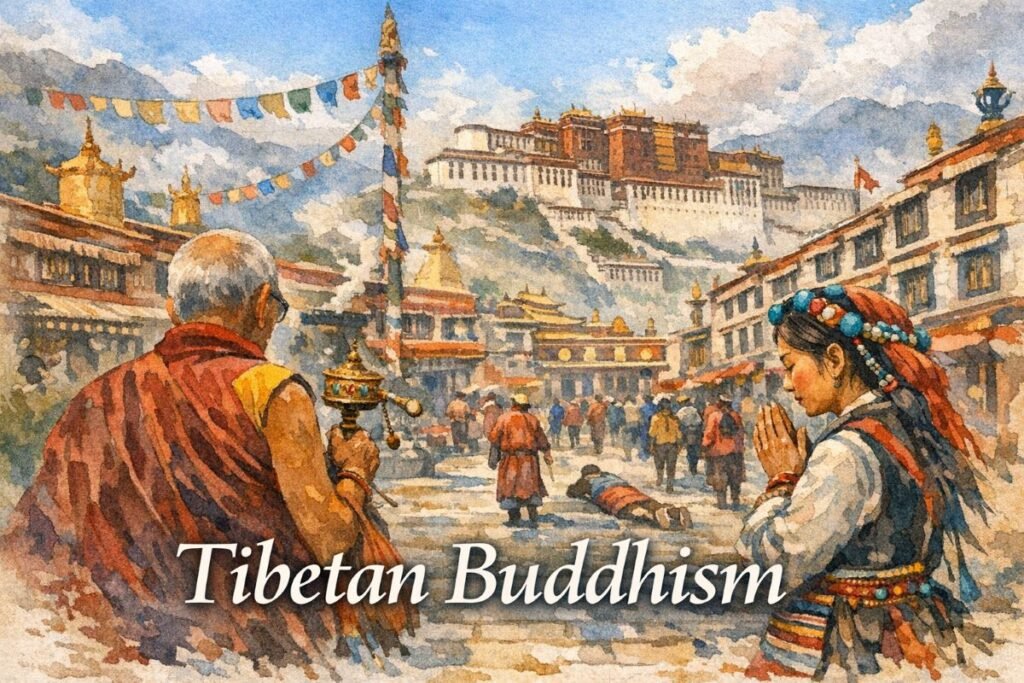
Tibetan Buddhism represents one of the great living traditions of human spiritual culture, a complete path of transformation that has been preserved and developed in the Himalayas for over a thousand years. It weaves together the philosophical depth of Mahayana Buddhism with the esoteric methods of Vajrayana, creating a rich tapestry of teachings aimed at nothing less than the liberation of all sentient beings from suffering. What makes this tradition so remarkable is not only its profound philosophical insights but also its practical, systematic approach to transforming the mind from its ordinary confused state into the fully awakened awareness of Buddhahood.
The tradition preserves the complete Buddhist canon as it was transmitted from India to Tibet. Of the three principal Buddhist canons: Pali, Chinese, and Tibetan, the most striking feature that differentiates the Tibetan canon lies in its extensive sections of tantras and Vajrayāna treatises, while the Chinese Tripiṭaka contains only some outer tantras, and the Pali Canon none at all. The Tibetan canon is divided into the Kangyur, or Translation of the Word, consisting of the Buddha’s own teachings numbering 1,169 texts, and the Tengyur, or Translation of Treatises, consisting of commentaries by Indian masters running to approximately 3,400 texts.
The Buddhist Digital Resource Center, founded in 1999 by E. Gene Smith, is a nonprofit organization dedicated to seeking out, preserving, organizing, and disseminating Buddhist literature. Joining digital technology with scholarship, BDRC ensures that the ancient wisdom and cultural treasures of the Buddhist literary tradition are not lost, but are made available for future generations. Working alongside them, the 84000 translation project is engaged in the monumental task of rendering the entire Kangyur and Tengyur into English. Their mission is to translate the Tibetan Buddhist canon and to make it freely accessible, aiming to complete the Kangyur by 2035 and the Tengyur by 2110. When the project began in 2009, it was estimated that only five percent of the Tibetan Buddhist canon had ever been translated into a modern language; today that figure has risen to twelve percent.
For those seeking direct access to translations of specific works, Lotsawa House began in 2004 with just a handful of translations in English but has since grown into a large repository containing thousands of texts in nine different languages, including the original sources. The ADARSHAH app is part of the DHARMA TREASURE project, which operates under the editorial guidance of the 17th Karmapa and other senior Tibetan teachers, making the Kangyur and Tengyur available for digital searching and reading. The Library of Tibetan Works and Archives in Dharamsala continues its essential preservation work.
Part One: The Historical Journey of the Dharma to Tibet
The Indian Buddhist Inheritance
Before the first Buddhist texts were translated into Tibetan, the teachings of the Buddha had already evolved through several great phases in India. The early schools, particularly the Sarvāstivāda and Mahāsāṃghika lineages, preserved the Buddha’s discourses and monastic discipline with remarkable fidelity. The Sarvāstivāda tradition developed a sophisticated Abhidharma philosophy that analyzed experience into its constituent moments and factors, providing the analytical foundation upon which later philosophers would build. It is this Mūlasarvāstivāda Vinaya lineage that is still followed in Tibetan monasteries today, an unbroken tradition spanning more than two thousand years.
Between the first century BCE and the second century CE, a profound new vision of the Buddhist path emerged. The Mahayana, or Great Vehicle, introduced teachings that would transform the understanding of what liberation could mean. The Prajñāpāramitā sutras revealed that all phenomena, including nirvana itself, are empty of any independent existence. This was not nihilism but rather the recognition that things exist only in dependence upon causes, conditions, and conceptual designation. The Heart Sutra’s famous declaration that form is emptiness, emptiness itself is form became the cornerstone of a new philosophical tradition. Along with this came the bodhisattva ideal, the vow to attain Buddhahood for the liberation of all beings. Śāntideva’s Bodhicaryāvatāra became the classic expression of this path.
From the seventh century onward, Buddhist practice in India developed the powerful methods of the tantras. The Vajrayana offered techniques for working directly with the subtle energies of the body and mind, transforming ordinary perception into the direct experience of enlightened awareness. The tantras themselves, such as the Guhyasamāja and Chakrasamvara, mapped out a complex inner landscape of energy channels, winds, and drops, providing a systematic path to awakening that could be accomplished in a single lifetime by those with the capacity and dedication to practice it. It was this complete inheritance, Sutra, Mahayana philosophy, and Tantra, that would be transmitted to Tibet.
The Early and Later Disseminations
The establishment of Buddhism in Tibet unfolded in two main waves, known as the early dissemination and later dissemination. The early dissemination began in the seventh century with King Songtsen Gampo, whose two Buddhist wives from Nepal and China built the first temples in Lhasa. The Jokhang and Ramoche temples still stand today as monuments to this initial planting of the Dharma. A century later, King Trisong Detsen invited the greatest masters of India to Tibet. The tantric adept Padmasambhava, known to all Tibetans as Guru Rinpoche, used his profound powers to subdue the local spirits who opposed the Dharma, converting them into protectors. Together with the great abbot Śāntarakṣita, he founded Samye Monastery, the first Buddhist monastery in Tibet, completed around 779 CE. The first seven Tibetan monks were ordained there, establishing the Sangha in the Land of Snows.
The later dissemination began in the tenth century after a period of persecution had disrupted the monastic lineages. From bases in eastern Tibet and the western kingdom of Guge, a new generation of translators traveled to India, returning with armloads of texts and fresh transmissions. The most important figure of this era was the Bengali master Atiśa, who arrived in Tibet in 1042. His Lamp for the Path to Enlightenment organized the entire Buddhist path into a graduated structure accessible to practitioners of all capacities. This Lamrim system became the foundation for all subsequent Tibetan traditions.
The Development of the Schools
From the twelfth through the sixteenth centuries, the four main schools emerged as distinct traditions. The Nyingma carried forward the ancient translations from the early dissemination. The Kagyu lineages, tracing back to the great translator Marpa and his disciple Milarepa, emphasized direct meditation instruction passed from master to student. The life and songs of Milarepa are preserved in numerous translations. The Sakya developed a renowned scholastic tradition centered on the Lamdré teachings. And the Gelug, founded by the great reformer Tsongkhapa in the fifteenth century, emphasized rigorous monastic discipline and philosophical study while preserving the full richness of tantric practice.
Part Two: The Four Schools
Nyingma
The Nyingma tradition is the oldest school, tracing its origins directly back to Padmasambhava and the early dissemination. According to the Nyingma tradition, Dzogchen, the Great Perfection, points directly to the primordial nature of awareness as already and always enlightened. The Nyingma tradition classifies tantra into nine categories and has two methods of lineage transmission: the long lineage stemming from teacher to student in an unbroken tradition, and the short lineage of receiving transmission from terma, or revealed teachings.
Among the most important figures in the Nyingma lineage is Longchen Rabjam (1308-1364), who systematized the Dzogchen teachings in works of extraordinary depth and clarity. His Finding Comfort and Ease in the Nature of Mind remains a foundational text. Another pivotal figure was Patrul Rinpoche (1808-1887), whose Words of My Perfect Teacher is one of the most beloved and widely studied texts on the foundational practices of the Nyingma tradition. The preliminary practices of the Longchen Nyingtik, a terma cycle revealed by Jigme Lingpa, are widely practiced within this tradition.
Kagyu
The Kagyu school traces its history back to the Indian mahasiddhas Tilopa and Naropa, and then to the Tibetan translator Marpa (1012-1097), his disciple Milarepa (1052-1135), and Gampopa (1079-1153) who formally established the tradition. It includes the lineage of Karmapas and places special emphasis on the Mahamudra system of meditation teachings. Mahamudra, the Great Seal, is achieved through progressive stages of meditation that culminate in the direct realization of the nature of mind.
The Kagyu tradition is known for its emphasis on meditation practice over scholarly study, though both are valued. Gampopa synthesized the Kadam teachings on the graduated path with the Mahamudra instructions he received from Milarepa. His Jewel Ornament of Liberation remains a foundational text, available in an English translation by Herbert Guenther. The teachings on the Six Yogas of Naropa, including inner heat, illusory body, dream yoga, clear light, intermediate state, and transference of consciousness, are central to the Kagyu tradition.
Sakya
The Sakya tradition traces its origins to the Indian yogi Virupa. Their characteristic meditative system is the Lamdré, or the path and its result, which synthesizes the entire Buddhist path from the initial vow to the final fruition of Buddhahood. The tradition has five founding fathers: Sachen Kunga Nyingpo, Sonam Tsemo, Drakpa Gyaltsen, Sakya Pandita (1182-1251), and Chogyal Pakpa.
Sakya Pandita was one of the most brilliant scholars in Tibetan history, renowned for his mastery of logic, epistemology, and the five Buddhist sciences. His works set standards that influenced all subsequent Tibetan scholarship. The Sakya tradition emphasizes both the Hevajra Tantra and the Naro Kachoma form of Vajrayogini as central practices.
Gelug
The Gelug school was founded by the great reformer Tsongkhapa (1357-1419), who placed special emphasis on monastic training and study as the foundation for practice. The Gelug tradition combines the essential teachings from the Kadam lineage together with Sakya and Kagyu doctrines, presenting the Lamrim or Graduated Stages of the Path to Enlightenment first espoused by Atiśa.
Tsongkhapa’s magnum opus, the Great Treatise on the Stages of the Path, remains one of the most comprehensive and systematically organized presentations of the Buddhist path ever composed. His Praise of Dependent Arising eloquently expresses the Madhyamaka view of emptiness. His writings on tantra, particularly his commentaries on the Guhyasamāja and Chakrasamvara tantras, clarified many obscure points and established a unified approach to tantric practice. The Gelug school’s monastic universities—Ganden, Drepung, and Sera, produced some of Tibet’s greatest philosophers, whose works continue to be studied today.
Part Three: Core Doctrines
The Two Truths
All Buddhist philosophy rests on the distinction between conventional and ultimate truth. Conventional truth encompasses our everyday experience of the world, tables and mountains, people and places, all functioning according to causal laws. Ultimate truth reveals that none of these phenomena possess any independent, permanent essence. They exist, but only in dependence upon causes, conditions, and conceptual designation. This is emptiness, not as nothingness but as the true nature of all things. The realization that these two truths are not contradictory but complementary lies at the heart of the Middle Way philosophy.
The Madhyamaka school, founded by Nāgārjuna (c. 150-250 CE), developed this insight with unparalleled rigor. Nāgārjuna’s Root Verses on the Middle Way (Mūlamadhyamakakārikā) systematically deconstructs all possible positions regarding the nature of reality, showing that everything from causality to the Four Noble Truths is empty of inherent existence. Yet emptiness is not a nihilistic void; it is precisely the dependent arising of phenomena that constitutes their ultimate nature.
Buddha-Nature
Alongside emptiness, Tibetan Buddhism emphasizes the teaching of Buddha-nature. Every sentient being possesses the innate potential for awakening, a luminous and pure nature that is temporarily obscured by adventitious defilements. The Ratnagotravibhāga (Uttaratantra) presents the luminous nature of mind as empty of defilements yet replete with enlightened qualities, a unity of emptiness and awareness that is present in all beings from the very beginning.
In the Nyingma and Kagyu traditions, this luminous ground is identified with the nature of mind realized in Dzogchen and Mahāmudrā. The Third Karmapa, Rangjung Dorje (1284-1339), composed a profound prayer on Buddha-nature that is still recited daily in Kagyu monasteries, affirming that this nature is present in all beings and can be recognized through the blessings of the guru and the practice of meditation.
The Bodhisattva Path
The Mahayana path is defined by bodhicitta, the compassionate mind of enlightenment. The bodhisattva vows to attain Buddhahood for the liberation of all beings. In the Gelug tradition, this compassion is often cultivated through the practice of lojong (mind training), which includes the meditation that all beings have been one’s mother in past lives. The bodhisattva cultivates the six perfections: generosity, ethical discipline, patience, joyful effort, meditation, and wisdom, perfecting each in service of the welfare of others.
Śāntideva’s Bodhicaryāvatāra remains the most beloved and widely studied text on the bodhisattva path. Its ninth chapter, on wisdom, presents a rigorous Madhyamaka analysis of emptiness, while its final chapter expresses the spontaneous dedication of all virtue to the welfare of beings. Tibetan masters of all schools have composed commentaries on this text, and it is regularly taught in monasteries and dharma centers throughout the world.
The Vajrayana Approach
What distinguishes Vajrayana is its use of the result as the path. Rather than gradually cultivating the causes of enlightenment, the practitioner identifies directly with the enlightened state through techniques such as deity yoga. Visualizing oneself as a fully awakened Buddha form, in a pure mandala environment, transforms the ordinary perception of self and world. The relationship with the guru is essential, providing the living transmission of blessing and instruction.
In Anuttarayoga Tantra, the practitioner engages in the generation stage and completion stage. In the generation stage, one visualizes the deity and mandala in intricate detail, purifying ordinary perception and cultivating divine pride, the confidence that one is already the enlightened deity. In the completion stage, one works with the subtle body’s channels, winds, and drops to bring the mind to its most fundamental state of clear light. The union of bliss and emptiness realized in this practice is the culmination of the Vajrayana path.
Part Four: The Living Tradition in Practice
The Guru-Disciple Relationship
At the heart of Tibetan Buddhist practice lies the relationship between guru and disciple. This is not merely a teacher-student dynamic but a profound spiritual connection through which the blessings of the lineage are transmitted. The guru is seen as the embodiment of the Buddha, the Dharma, and the Sangha, the root of all attainments.
The great masters have written extensively on the qualities of a genuine guru and the proper attitude of a disciple. Patrul Rinpoche in his Words of My Perfect Teacher describes the guru as the one who shows us the nature of mind, without whom we would wander endlessly in samsara. The disciple must approach the guru with faith, respect, and an open mind, while also carefully examining the guru’s qualities before making a commitment.
The Six Yogas of Naropa
Among the most profound practices of Tibetan Buddhism are the Six Yogas of Naropa, a system of completion stage practices transmitted through the Kagyu lineage. These six yogas include inner heat, illusory body, dream yoga, clear light, intermediate state, and transference of consciousness. Each works with the subtle energies of the body to bring the mind to its most fundamental state.
The practice of inner heat, or tummo, generates a blissful warmth in the body that melts the subtle energies and allows them to enter the central channel. Dream yoga allows the practitioner to maintain awareness during sleep and transform dreams into opportunities for practice. The intermediate state practices prepare one for death, enabling recognition of the clear light at the moment of dying. These profound teachings require close guidance from a qualified master and years of dedicated practice.
Death and Dying
Perhaps no tradition has explored the territory of death and dying as thoroughly as Tibetan Buddhism. The teachings on death are not morbid but practical, based on the understanding that death is not an end but a transition. By familiarizing oneself with the process of dying while alive, one can approach death without fear and even use it as an opportunity for awakening.
The Tibetan Book of the Dead, or Bardo Thödöl, describes the experiences that arise after death, the peaceful and wrathful deities, the lights of various colors, the sounds and visions, as projections of one’s own mind. By recognizing these experiences as what they are, the practitioner can attain liberation in the bardo, the intermediate state between death and rebirth.
Monastic Life and Education
The great monasteries of Tibet were among the largest and most sophisticated educational institutions in human history. The curriculum focused on the five great treatises: Pramana (Buddhist logic), Madhyamaka (Middle Way philosophy), Abhidharma (Buddhist psychology), Prajñāpāramitā (Perfection of Wisdom), and Vinaya (monastic discipline). Monks would spend twenty years or more mastering these subjects, culminating in the geshe degree.
The practice of debate is central to monastic education. Monks gather in the debate courtyard to engage in rigorous philosophical inquiry, challenging one another’s understanding of concepts such as emptiness, Buddha-nature, and the path. This dynamic practice sharpens the mind, clarifies understanding, and prepares monks for the real work of meditation.
Part Five: Tibetan Buddhism in the Modern World
The Diaspora and Preservation
The mid-twentieth century brought tremendous upheaval to Tibet. Following the Tibetan uprising of 1959, His Holiness the 14th Dalai Lama and tens of thousands of Tibetans fled into exile in India, Nepal, and Bhutan. This could have been the end of Tibetan Buddhism. Instead, it became the beginning of its global dissemination.
In exile, the Tibetan community rebuilt its institutions with remarkable resilience. The Library of Tibetan Works and Archives was established in Dharamsala in 1971 to preserve and share Tibetan culture. Major monasteries were reestablished in South India, continuing the full curriculum of monastic education and preserving the lineages of study and practice for future generations.
The Spread to the West
Tibetan Buddhism began to attract Western interest in the 1960s and 1970s, as the first generation of exiled lamas began teaching in Europe and North America. Chögyam Trungpa Rinpoche founded Naropa University in Boulder, Colorado, the first Buddhist-inspired university in the West. The Foundation for the Preservation of the Mahayana Tradition, founded by Lama Thubten Yeshe and Lama Zopa Rinpoche, grew into one of the largest international networks of Tibetan Buddhist centers.
Dialogue with Science
One of the most remarkable developments in modern Tibetan Buddhism has been its engagement with Western science. His Holiness the Dalai Lama has been a leading figure in this dialogue, sponsoring conferences and research collaborations through the Mind and Life Institute. Neuroscientists have studied the brains of long-term meditators, discovering that meditation produces measurable changes in brain structure and function.
This dialogue has been genuinely mutual. Tibetan Buddhist teachers have offered scientists new perspectives on the nature of mind and consciousness. The Dalai Lama has encouraged the integration of scientific findings into Buddhist understanding, reflecting the tradition’s fundamental commitment to truth, wherever it may be found.
Digital Preservation
Today, the textual heritage of Tibetan Buddhism is being made accessible through major digital initiatives. The Buddhist Digital Resource Center has assembled the largest collection of Tibetan Buddhist texts in existence. The 84000 translation project is systematically translating the Kangyur and Tengyur into English, with many texts already available online. Lotsawa House offers thousands of translations freely available, and the ADARSHAH app provides digital tools for reading and searching the canon.
Conclusion
Tibetan Buddhism is a living tradition, not a relic of the past. It continues to evolve and adapt while maintaining an unbroken connection to its sources. The vast textual heritage preserved in the Kangyur and Tengyur is now being translated into modern languages, making these ancient teachings accessible to a global audience. The meditation practices refined over centuries are being taught worldwide, offering practical methods for transforming the mind.
What makes Tibetan Buddhism unique is its integration of all aspects of the path. It offers ethics for beginners and philosophy for scholars, simple meditation for the busy householder and advanced tantric practices for the dedicated yogi. All of these are seen not as separate paths but as complementary aspects of a single journey toward awakening.
At the heart of this tradition is a simple, profound message: the nature of mind is luminous and empty, blissful and aware. This nature is not something to be created but something to be recognized. It is present in every being, in every moment. The path is simply the process of removing the obscurations that prevent us from seeing what has always been there. And the purpose of this recognition is not personal escape but universal benefit. The bodhisattva vows to attain Buddhahood for the sake of all beings.
As His Holiness the Dalai Lama often says, his religion is kindness. This is the essence of Tibetan Buddhism: the wisdom that sees the true nature of reality and the compassion that responds to the suffering of beings. In a world of increasing complexity and uncertainty, this ancient wisdom is more relevant than ever. It offers not escape but engagement, not denial but transformation, not despair but the confident knowledge that awakening is possible for all.
The great masters of the past—Nāgārjuna and Asaṅga, Padmasambhava and Atiśa, Milarepa and Tsongkhapa, Longchenpa and Patrul Rinpoche, passed their realization to their disciples, who passed it to theirs, in an unbroken lineage reaching to the present day. Today, that lineage is in our hands. The gift they preserved through centuries of effort is now available to anyone with the interest to seek it. May all beings benefit.