1. Introduction: A Dialogue of Depth and Evidence
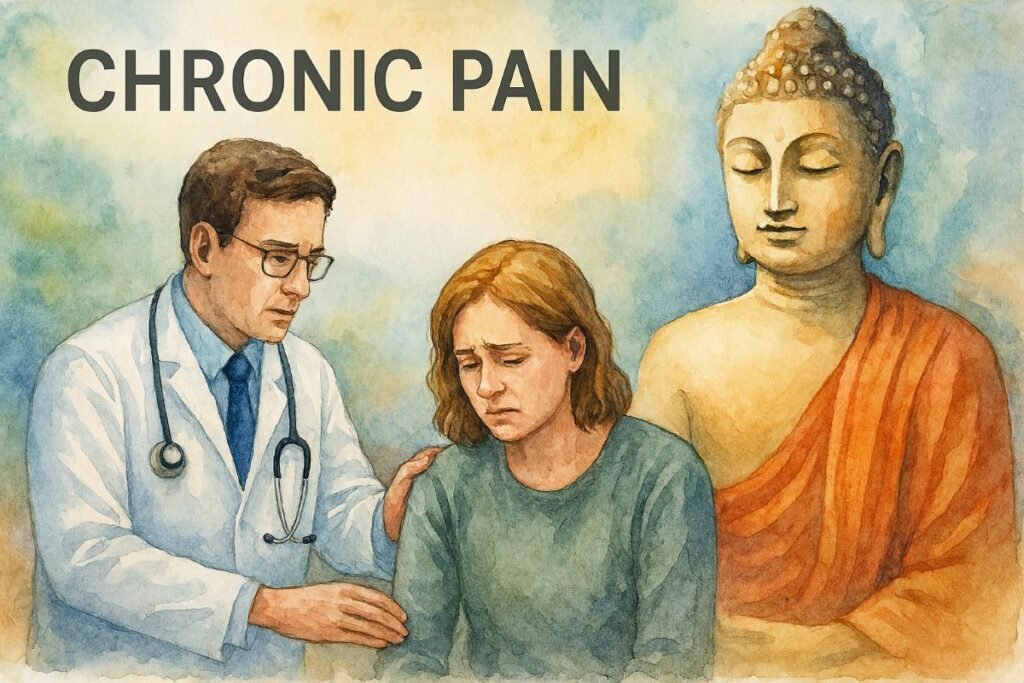
The convergence of Buddhist philosophy and modern science represents one of the most significant developments in holistic healthcare over the past half-century. This is not a superficial fusion of trends but a deepening dialogue between a 2,500-year-old systematic exploration of the human mind and contemporary empirical methods. For individuals navigating the complex reality of chronic pain, this dialogue offers a nuanced, evidence-informed path forward. It moves beyond the simplistic promise of a “cure” to provide a robust framework for managing suffering and enhancing quality of life. This analysis examines this integration, honoring the depth of Buddhist tradition, critically appraising the scientific evidence, and presenting a balanced “Middle Way” approach for practical application.
2. Foundational Frameworks: Two Lenses on Suffering
2.1. The Modern Medical and Scientific Lens
Modern medicine excels in acute care, diagnostics, and pharmacological and surgical intervention. Its evidence-based paradigm is built on randomized controlled trials (RCTs), physiological measurement, and statistical analysis. However, its traditional model has struggled with subjective, multifactorial conditions like chronic pain, where biological markers often fail to correlate with reported suffering. The emerging biopsychosocial model represents medicine’s evolution toward a more integrated view, creating an intellectual opening for mind-body approaches.
2.2. The Buddhist Lens: A Path of Phenomenological Inquiry
Buddhism is best understood as a detailed phenomenology of suffering (dukkha) and a path to its cessation. It posits that our automatic cognitive and emotional reactions—aversion, craving, identification—amplify primary discomfort into sustained suffering. The core practice of mindfulness (sati), therefore, is not mere relaxation but a disciplined training in awareness and insight. As philosopher Jay L. Garfield clarifies, it involves both sustained attention and “introspective vigilance,” forming a foundation for ethical living and wisdom.
3. The Imperative for Integration: Addressing the Whole Person
Chronic pain is a classic condition where the biomedical model reveals its limits. When pain becomes persistent, the nervous system can undergo maladaptive changes (central sensitization), and psychological factors like catastrophizing, fear, and depression become central drivers of disability. Here, Buddhism’s age-old diagnosis, that our reaction is a primary source of suffering, finds a strong parallel in modern pain neuroscience. This convergence creates a powerful rationale for integrating mindfulness-based strategies to address the affective and cognitive dimensions that pure biomedicine cannot reach.
4. The Scientific Evidence: A Critical Appraisal
The secularization of mindfulness into standardized protocols like Mindfulness-Based Stress Reduction (MBSR) has enabled a flood of research. A balanced view requires acknowledging both the supportive evidence and the field’s limitations.
4.1. Summary of Key Research Findings and Strength of Evidence
The following table synthesizes the current state of evidence for mindfulness in chronic pain management:
| Area of Impact | Key Research Findings | Level of Evidence & Important Nuances |
|---|---|---|
| Pain Intensity & Distress | Meta-analyses show consistent, modest reductions in pain intensity and significant reductions in pain-related distress and interference. | Moderate. Effects on distress are typically stronger than on raw sensation. Mindfulness appears to change the emotional appraisal of pain. |
| Psychological Co-morbidities | Strong evidence for reducing symptoms of depression and anxiety in chronic pain populations. MBCT is specifically effective in preventing depressive relapse. | Strong. Effect sizes are comparable to established psychotherapies. This is one of the most robustly supported areas. |
| Brain Structure & Function | Neuroimaging studies associate mindfulness with increased gray matter density in the prefrontal cortex (PFC) and anterior cingulate cortex (ACC), and reduced amygdala reactivity. | Correlational, but compelling. These changes align with improved emotional regulation. Causation and direct clinical translation require more study. |
| Quality of Life & Function | RCTs demonstrate improvements in self-reported quality of life, acceptance of pain, and engagement in valued activities. | Moderate to Strong. The shift from “pain elimination” to “valued living” is a primary therapeutic outcome. |
| Mechanisms of Action | Proposed mechanisms include: reduced catastrophizing, improved attentional regulation, enhanced body awareness with less avoidance, and fostered self-compassion. | Theoretical & Evolving. Multiple, non-exclusive mechanisms are likely at work. No single pathway is definitively proven. |
4.2. Acknowledging Limitations and Open Questions
- Methodological Constraints: Many studies have limitations: small samples, lack of active controls (making it hard to distinguish “mindfulness-specific” effects from general group support or expectation), and difficulty with blinding.
- The “Hype” vs. Reality: Benefits, while statistically significant, are often modest at the individual level. Mindfulness is not a panacea and requires consistent practice.
- Potential for Adverse Effects: For some, turning attention inward can initially increase anxiety or uncover traumatic memories. Guidance from a qualified instructor is crucial.
- Secularization’s Trade-off: Clinical mindfulness programs often extract technique from Buddhism’s ethical (sila) and wisdom (panna) frameworks. Some scholars argue this risks losing depth and context.
5. Core Buddhist Concepts as Practical Therapeutic Tools
5.1. The Four Noble Truths: A Clinical Framework
This framework provides a profound structure for therapeutic psychoeducation:
- Truth of Suffering (Dukkha): Validating the patient’s full experience of pain and frustration.
- Truth of Origin (Samudaya): Investigating, without blame, the mental habits (worry, resistance, fear) that compound physical sensation.
- Truth of Cessation (Nirodha): Introducing the hopeful possibility of freedom from added suffering, even if pain persists.
- Truth of the Path (Magga): Offering the Eightfold Path, with Right Mindfulness and Right Effort as accessible starting points for practice.
5.2. The “Middle Way” as a Principle of Integrative Care
The Buddha’s principle of avoiding extremes is the key to ethical and effective integration:
- Extreme to Avoid: Sole Reliance on Biomedicine. Ignoring the mind’s role and expecting pills or procedures to solve existential suffering.
- Extreme to Avoid: Dismissal of Biomedicine. Rejecting medical diagnosis, physiotherapy, or necessary pharmacology in favor of meditation alone.
- The Middle Way: Informed, Balanced Integration. Using medical science to treat pathophysiology and mindfulness training to manage the psychological and emotional sequelae, thereby empowering the patient within a collaborative care model.
6. Practical Integration: A Balanced Protocol for Daily Life
This integrated approach translates theory into a sustainable daily practice.
6.1. Foundational Mindfulness Practices (The “Skill Drill”)
- Focused Attention (Breath Awareness): Trains the mind to stabilize and return from distraction. Practical Tip: Start with 5 minutes, focusing on the physical feel of the breath. Gently guide attention back when it wanders to pain or worry.
- Open Monitoring (Body Scan): Cultivates a decentered, observational relationship to bodily sensation. Practical Tip: Systematically scan the body with curiosity. When finding pain, explore its qualities (heat, pressure, vibration) as neutral data, softening avoidance.
6.2. Buddhist Psychology in Action (The “Game Strategy”)
- Deconstructing “Pain”: Use mindfulness to separate the primary sensation from the secondary layers of emotional reaction (fear, anger) and narrative (“This is unbearable”). This is the direct application of the “second arrow” teaching.
- Cultivating Mettā (Loving-Kindness): Directly counters the self-blame, isolation, and anger common in chronic pain. Practical Tip: Silently repeat phrases like “May I be kind to myself in this moment” during flare-ups.
6.3. The Integrated Weekly Protocol – Example only
| Day | Medical/Physical Focus | Mindfulness/Buddhist Psychology Focus | Middle Way Integration Goal |
|---|---|---|---|
| Monday | Perform prescribed physiotherapy exercises. | Practice 10-min Body Scan after exercises, bringing curiosity to any new sensations. | Pair movement with mindful awareness to reduce fear and improve proprioception. |
| Wednesday | Take medication as scheduled. | Practice 5-min Breath Awareness before medication, observing the anxiety/ craving for relief. | Separate the biochemical effect from the psychological dependency, using mindfulness to manage anticipatory anxiety. |
| Friday | Attend medical appointment. | Practice Mettā toward oneself and the clinician in the waiting room. | Foster self-compassion and a collaborative (not adversarial) patient-provider relationship. |
| Daily | Pacing activities; respecting rest. | Use micro-mindfulness: pause for 3 breaths before an activity, check in with the body during. | Infuse daily life with mindful check-ins to honor the body’s signals and avoid the boom-bust cycle. |
6.4 Foundational Imperative: Seeking Qualified Medical Advice
This mindfulness-based approach is explicitly designed as a complementary adjunct to professional medical care, not an alternative to it. Before beginning any new practice for pain management, consulting with qualified healthcare providers is a non-negotiable first step. The “Middle Way” integration begins with modern medicine.
- Accurate Diagnosis is Crucial: Persistent pain can be a symptom of underlying conditions (e.g., neurological issues, autoimmune diseases, injuries) that require specific medical diagnosis and treatment. Mindfulness does not diagnose. A physician must investigate the source of pain to rule out serious pathology and establish an appropriate baseline treatment plan, which may include medication, physical therapy, or other interventions.
- Safety and Appropriateness: A healthcare professional can assess whether mindfulness practices are suitable for your specific condition. While generally safe, turning attention inward can be challenging for some individuals with certain trauma histories or psychiatric conditions. A doctor or clinical psychologist can provide guidance and may recommend working with a therapist trained in mindfulness-based therapies.
- Establishing the Integrated Protocol: The collaborative model outlined in this article requires a medical foundation. Your treatment plan from qualified professionals defines the “Medical/Physical Focus” column of your personal protocol. Mindfulness then becomes the tool to manage the distress, improve coping, and support the psychological resilience needed to engage fully with that medical plan. Mindfulness is a tool for managing your relationship to pain and illness; it is not a treatment for the disease or injury itself.
In short: Always seek and follow the guidance of your doctor. Use mindfulness to skillfully navigate the journey they help you chart.
7. Conclusion: Toward a Wise and Evidence-Informed Partnership
The intersection of Buddhist practice and modern medicine is not about replacing one paradigm with another. It is about forging a wise partnership. The preponderance of scientific evidence, while still evolving, robustly supports the conclusion that mindfulness-based interventions are a safe and effective adjunctive therapy for improving psychological well-being and functional quality of life in chronic pain. The most profound application occurs when this evidence-based tool is informed by the depth of its original context—the ethical framework, the understanding of impermanence, and the principle of the Middle Way.
For the person living with pain, this integrated path offers empowerment. It does not promise the false hope of eradication but provides a realistic set of skills to reduce the volume of suffering, engage more fully with life, and navigate the healthcare system with greater agency and resilience. The future of this dialogue lies in continued rigorous research, clinician education, and the respectful translation of ancient wisdom into accessible, ethical, and effective modern practice.