
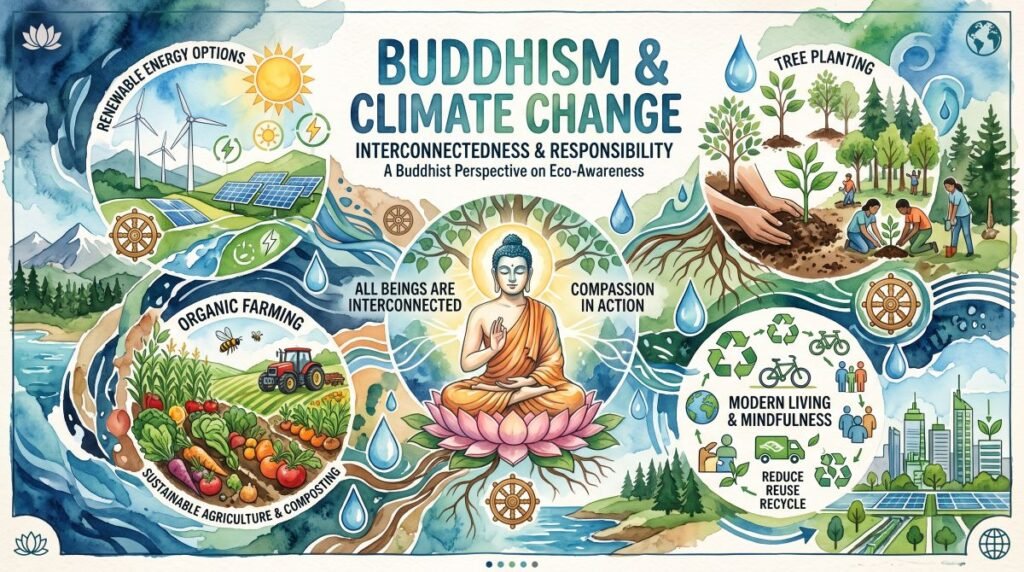
Key Takeaways
- Buddhist teachings emphasize the deep connection between all living beings and their environment, suggesting that environmental harm ultimately contributes to harm experienced by ourselves and other beings.
- The root causes of ecological crisis can be understood through the lens of greed, hatred, and delusion, which drive overconsumption and the exploitation of natural resources.
- Practicing mindfulness and ethical conduct provides a framework for reducing personal and collective environmental impact.
- Compassion for all sentient beings motivates active engagement with climate science and international policy to protect the planet.
- Both major traditions, the School of the Elders and the Great Vehicle, offer resources for developing a contemporary Buddhist response to environmental challenges.
- Understanding the mind’s role in creating suffering, both personal and ecological, is essential for lasting change.
- Community engagement and collective action amplify individual efforts toward environmental protection.
1. Introduction
The modern world faces an unprecedented challenge in the form of climate change, a phenomenon that threatens the stability of ecosystems and the well-being of all inhabitants on Earth. The scientific consensus is unequivocal. The Intergovernmental Panel on Climate Change, the United Nations body responsible for assessing climate science, has found that human activities have caused approximately 1.1 degrees Celsius of warming since pre-industrial times, and that climate risks will become increasingly complex and difficult to manage with further warming. Rising global temperatures, increasingly severe weather events, melting polar ice, and the degradation of natural habitats present challenges that transcend national boundaries and political ideologies.
While scientific bodies provide the data and evidence required to understand this crisis, Buddhist philosophy offers a profound ethical and psychological framework that can inform our response to its underlying causes. By examining the relationship between the human mind and the natural world, these teachings suggest that the environmental crisis is not merely an external problem of technology or policy, but also a reflection of internal states of being.
At the heart of this perspective is the understanding that nothing exists in isolation. Every action, thought, and choice ripples through a vast web of existence, affecting the climate, biodiversity, and the lives of others. This recognition is not merely abstract philosophy but has direct implications for how we live, consume, and relate to the world around us. This article explores how wisdom regarding the nature of reality, ethics, and mental cultivation can be applied to modern environmental challenges, providing a path toward a more balanced and compassionate way of living.
The Buddhist approach to climate change does not dismiss the importance of scientific understanding or policy intervention. Rather, it complements these efforts by addressing the psychological and ethical dimensions that often hinder effective action. By understanding how greed, hatred, and delusion operate in the human mind, we can begin to dismantle the systemic forces that drive environmental destruction. By cultivating mindfulness and compassion, we can sustain the personal and collective commitment needed to address this global crisis.
2. The Principle of Interdependent Connection
One of the most fundamental concepts in Buddhist thought is the idea that all things arise in dependence on other factors. This principle, known as interdependent origination [paṭicca-samuppāda] (also known as dependent origination), describes how phenomena come into being through a complex web of causes and conditions. Phenomena do not arise independently but depend upon conditions. This understanding can inform a contemporary reflection on the interconnected causes and consequences involved in environmental harm. In the context of climate change, this means that the health of the atmosphere, the oceans, and the forests is inseparable from human activity. The actions of one community, one industry, or one nation inevitably affect the whole.
The Web of Life
When we understand this deep connection, we begin to see that the environment is not just a backdrop for human life, but an extension of ourselves. The air we breathe, the water we drink, and the food we eat all come from the natural world. When the environment suffers, we suffer. When ecosystems collapse, human well-being is threatened. This recognition is not sentimentality but a clear-eyed acknowledgment of how reality functions.
In the Great Vehicle tradition, this is often expressed through the idea that all beings share a potential for awakening. The distinction between self and other becomes less rigid when we recognize our fundamental interdependence. If the earth is suffering, we are suffering. This realization shifts the motivation for environmental protection from a sense of duty or obligation to a natural expression of self-care and care for others. Protecting the planet becomes as natural as protecting one’s own body.
The School of the Elders tradition also emphasizes interdependence, though often with a focus on how clinging to a separate self leads to suffering. When we believe ourselves to be isolated individuals, we fail to see how our actions affect others. This ignorance allows us to exploit resources without concern for consequences. Understanding interdependence breaks down this isolation and reveals the ethical implications of our choices.
Practical Application
In daily life, recognizing this connection might involve reflecting on the origin of the products we use. A simple cup of coffee involves the soil, the rain, the labor of farmers, and the fuel used for transport. A cotton shirt involves fields of plants, water for irrigation, chemicals for processing, and ships to carry it across oceans. By acknowledging these links, we become more aware of how our consumption patterns contribute to carbon emissions and habitat loss, leading to more conscious and sustainable choices.
The evidence for the scale of this impact is stark. According to the Global Carbon Project, global carbon dioxide emissions from fossil fuels reached a record 37.4 billion tonnes in 2024, an increase of approximately 0.8% from 2023. Concentrations of carbon dioxide in the atmosphere are now 52 percent above pre-industrial levels. These are not abstract figures. They represent the cumulative result of billions of individual and collective choices, choices that Buddhist teachings suggest arise from a failure to see the interconnected nature of reality.
This reflection can extend to all areas of life. When we purchase food, we can consider whether it was grown locally or transported from far away. When we choose transportation, we can consider the emissions associated with different options. When we use energy in our homes, we can consider its source and efficiency. None of this requires perfection or guilt, but rather a growing awareness that our choices matter and that they are connected to a larger whole.
Understanding interdependence also helps us respond to climate change with wisdom rather than despair. When we recognize that everything is connected, we understand that our individual actions, while small, contribute to larger patterns. This insight encourages us to act with intention and responsibility, knowing that even small efforts can have far-reaching effects. Our actions, when multiplied across communities and nations, can create significant positive change.
3. Addressing the Root Causes of Environmental Harm
Buddhist psychology identifies three primary mental states that lead to suffering and harmful actions. These are often called the three poisons: greed [lobha], hatred [dosa], and delusion [moha]. When these states dominate human behavior, they may manifest as the systemic exploitation of the planet. Understanding these root causes is essential for addressing climate change effectively, because without addressing the underlying psychological drivers, technological and policy solutions will always be incomplete. A deeper exploration of how the mind creates suffering can be found in teachings on Buddhist psychology.
Greed and Overconsumption
Greed is the relentless desire for more, often driven by the mistaken belief that material possessions will bring lasting satisfaction. This is one of the most fundamental misunderstandings in human psychology. We believe that acquiring more things, achieving more status, and consuming more resources will make us happy. Yet experience repeatedly shows that this is not the case. The satisfaction from acquiring something new is temporary and soon fades, leading to the desire for something else.
In modern society, this manifests as a culture of endless growth and consumption, which places an unsustainable burden on the earth’s resources. Economies are measured by gross domestic product, which increases as more goods are produced and consumed, but this measure says nothing about well-being or sustainability. Advertising and marketing constantly create new desires, convincing people that they need things they never knew they wanted. This cycle of desire and consumption drives resource extraction, manufacturing, and waste, all of which contribute to climate change.
The teachings suggest that true happiness comes from contentment [santuṭṭhi] and the cultivation of inner qualities rather than the accumulation of external goods. Contentment does not mean never striving for improvement or rejecting all comforts. Rather, it means finding a sense of sufficiency, a recognition that one has enough to live a good life. When we are content, we are less vulnerable to the manipulations of consumer culture. We can choose to consume less, not out of deprivation, but out of wisdom. This inner shift is essential for reducing the personal and collective carbon footprint.
Hatred and Delusion
Hatred can manifest as an aggressive stance toward nature, viewing the environment as something to be conquered or subdued. This attitude has deep historical roots in certain strands of Western thought, which saw nature as a resource to be exploited for human benefit. The natural world was often seen as wild, dangerous, and in need of control. This perspective has justified the destruction of forests, the pollution of rivers, and the extraction of minerals without regard for consequences.
Hatred can also manifest between human groups, as competition for resources leads to conflict. The Intergovernmental Panel on Climate Change has warned that climate-driven food insecurity and supply instability are projected to increase with warming, interacting with non-climatic factors such as competition for land, pandemics, and conflict. Addressing hatred through the cultivation of compassion and understanding is therefore not only an ethical matter but also a practical one. Peaceful cooperation is essential for addressing shared environmental challenges.
Delusion, perhaps the most subtle of the three, is the failure to see the reality of our interconnectedness. It is the ignorance that allows us to believe we can damage the environment without facing the consequences ourselves. We might think that pollution in one part of the world does not affect us, or that future generations will somehow manage. This delusion is a form of denial, a refusal to look clearly at the consequences of our actions.
The data on climate vulnerability illustrates the cost of this delusion with painful clarity. The Intergovernmental Panel on Climate Change estimates that between 3.3 and 3.6 billion people live in contexts that are highly vulnerable to climate change. Between 2010 and 2020, human mortality from floods, droughts, and storms was 15 times higher in highly vulnerable regions compared to regions with very low vulnerability – [Report]. These are not distant statistics. They represent human beings, communities, and cultures suffering the consequences of a warming world, often those who contributed least to the problem.
By addressing these mental states through understanding the mind, individuals can begin to dismantle the psychological drivers of the climate crisis. This is not to suggest that individual change alone is sufficient, but rather that collective change depends on individuals who understand their own minds and motivations. By seeing how greed, hatred, and delusion operate within us, we become more capable of choosing wiser responses.
Applying This Understanding
In practice, addressing the three poisons involves both introspection and action. Introspection means honestly examining our own minds to see where these states arise. Do we feel a constant need to acquire more? Do we harbor resentment or hostility toward others? Do we avoid looking at uncomfortable truths about the environmental situation?
Action means making choices that counteract these tendencies. When we notice the arising of greed, we can choose to be content with what we have. When we notice hatred, we can practice compassion. When we notice delusion, we can cultivate wisdom by learning about the world and facing uncomfortable facts. Over time, these small choices accumulate into significant changes in our lives and in the world.
4. Ethical Conduct and Non-Harming
The foundation of a spiritual life in Buddhism is ethical conduct [sīla]. This involves a commitment to living in a way that does not cause harm to others. The principle of non-harming [ahiṃsā] concerns avoiding harm to living beings and can inform broader contemporary reflection on the environmental conditions on which those beings depend. Ethics is not simply a matter of following rules but of cultivating a way of being in the world that is guided by wisdom and compassion.
The Five Training Rules
For many practitioners, this commitment is expressed through the five precepts, which include abstaining from taking life and from taking what is not given. These rules are not commandments imposed from outside but guidelines for training the mind and body toward greater harmony. They reflect a deep respect for the well-being of all beings and form a practical basis for ethical living.
In the context of climate change, many contemporary Buddhists are exploring how these precepts might inform environmental ethics. The first precept, abstaining from taking life, raises questions about how our actions contribute to the destruction of ecosystems and the extinction of species. While the traditional precept concerns intentional killing, some practitioners extend its spirit to encompass the indirect harms caused by our consumption patterns and carbon emissions. This is not a straightforward equation but an area of ongoing ethical reflection.
Similarly, the second precept, abstaining from taking what is not given, invites consideration of how we use resources. Some contemporary Buddhists see the over-extraction of resources and the burden placed on future generations as raising important questions about justice and fairness. Again, this represents an extension of the precept’s spirit rather than a direct application of its traditional formulation.
Environmental Ethics in Different Traditions
The School of the Elders emphasizes personal responsibility and the cultivation of a simple, disciplined lifestyle to minimize harm. Monastic discipline includes rules about not destroying plants and not wasting resources. Lay practitioners are encouraged to live simply and mindfully, reducing their consumption and avoiding unnecessary harm. This emphasis on personal practice provides a solid foundation for environmental responsibility.
In contrast, the Great Vehicle tradition emphasizes the vow to work for the liberation of all beings, which many contemporary practitioners see as including protecting the planet from ecological collapse. The ideal of the awakening being [bodhisattva], who seeks awakening for the benefit of all beings and engages in compassionate activity, provides a powerful motivation for environmental engagement. Practitioners in this tradition are encouraged to see environmental activism as a form of spiritual practice, a way of expressing compassion for all beings.
Both traditions agree that ethical living is essential for a stable and peaceful world. They differ in emphasis but share a common recognition that our actions have consequences and that we have a responsibility to act wisely. For anyone concerned about climate change, these ethical frameworks provide guidance and inspiration for living in a way that respects the earth and all its inhabitants.
Practical Ethical Choices
Living ethically in the context of climate change involves making choices about consumption, transportation, energy use, and political engagement. It means asking not only what is convenient or comfortable but also what is right. This might involve reducing meat consumption, using public transportation or cycling instead of driving, conserving energy at home, and supporting policies that address climate change.
Ethical living also involves recognizing that we cannot be perfect. We live in a world shaped by systems that make sustainable living difficult. We cannot always avoid contributing to harm. The point is not to achieve purity but to move in the direction of greater awareness and responsibility. Each choice is an opportunity to align our actions with our values.
5. Mindfulness as a Tool for Ecological Awareness
Mindfulness [sati] is the practice of maintaining awareness of the present moment and attending appropriately to what is happening within and around us. In the Buddhist context, mindfulness involves remembering to keep the teachings in mind and applying them to our experience. When applied to the environment, it becomes a powerful tool for recognizing the immediate impact of our actions. Mindfulness is not about escaping from reality but about seeing it more clearly. It helps us understand our own minds and the world around us with greater precision.
Conscious Consumption
Through mindfulness, we can observe the arising of desire for a new product and choose not to act on it, recognizing that the temporary pleasure of a purchase does not outweigh the environmental cost. This practice helps to break the cycle of impulsive consumption that fuels climate change. It allows us to live more simply, finding joy in the present moment rather than in the acquisition of things.
Mindful consumption involves pausing before we buy, eat, or use something to consider its origins and consequences. Where did this come from? How was it produced? What will happen to it when I am done with it? These questions help us make more informed choices and reduce our impact on the environment. They also help us understand the hidden costs of our consumption, costs that are often borne by distant communities and future generations.
Awareness of the Natural World
Mindfulness also fosters a deeper appreciation for the natural world. By paying close attention to the changing seasons, the growth of plants, and the behavior of animals, we develop a sense of wonder and respect for life. This emotional connection is often a stronger motivator for environmental action than abstract data alone.
When we spend time in nature with mindfulness, we begin to see the beauty and complexity of the ecosystems around us. We notice the intricate relationships between plants and animals, the cycles of growth and decay, and the resilience of life. This direct experience of nature’s value can deepen our commitment to protecting it. It is one thing to know about climate change from news reports, but it is another to feel it in your bones as you witness the loss of species or the degradation of landscapes you love.
Practicing mindfulness in daily life helps bridge the gap between knowing about climate change and taking meaningful action. It transforms abstract concern into embodied awareness, making the issue personal and immediate. This awareness can sustain our commitment to change even when the problem feels overwhelming.
Mindfulness in Action
Mindfulness can be practiced not only in meditation but in everyday activities. Walking to the store, cooking a meal, or washing dishes can all become opportunities for awareness. By bringing attention to our actions, we reduce mindlessness and increase the likelihood of choosing wisely. We become more aware of waste and inefficiency in our lives and can take steps to reduce them.
Mindfulness also helps us manage the difficult emotions that arise when facing climate change. Feelings of anxiety, grief, and anger are natural responses to the threat we face. Mindfulness allows us to acknowledge these emotions without being overwhelmed by them. We can observe them arising and passing, making space for wise action rather than reactive despair.
6. Compassion and Climate Justice
Compassion [karuṇā] is the heartfelt wish for others to be free from suffering. As climate change disproportionately affects the poor, the marginalized, and non-human species, compassion becomes a driving force for climate justice. Justice is not simply a matter of fairness but of compassion in action, ensuring that the burdens of environmental change are not borne unfairly by those who contributed least to the problem.
Protecting the Vulnerable
A compassionate response to climate change involves advocating for policies that protect those most at risk. This includes supporting international efforts to provide aid to climate refugees and ensuring that the transition to a green economy is fair and inclusive. It means recognizing that communities in developing countries, who have historically contributed little to greenhouse gas emissions, are often the most vulnerable to the effects of climate change.
The Intergovernmental Panel on Climate Change has documented that the largest adverse impacts of climate change are observed in Africa, Asia, Central and South America, least developed countries, small islands, and the Arctic, and globally for Indigenous peoples, small-scale food producers, and low-income households. Climate and weather extremes are increasingly driving displacement, with small island states being disproportionately affected relative to their small population size. These findings provide a contemporary context for applying Buddhist compassion to the suffering of those affected by climate change.
In the Great Vehicle tradition, the ideal of the awakening being is one who seeks awakening for the benefit of all beings and engages in compassionate activity in the world. This ideal inspires practitioners to work for the benefit of others, even when the work is difficult and the results are uncertain. The awakening being does not seek liberation only for themselves but remains engaged with the world out of compassion for all beings.
Climate justice also involves listening to the voices of those affected by climate change. Indigenous peoples, who have often been marginalized in environmental decision-making, possess traditional knowledge that can inform sustainable practices. Their struggles are a reminder that the fight against climate change is also a fight for justice and equity.
Loving-Kindness and the Earth
The practice of loving-kindness [mettā] involves radiating well-wishes to all beings in all directions. Traditionally, this practice is directed toward living beings, beginning with oneself and extending to loved ones, acquaintances, strangers, and even those we find difficult. Some contemporary practitioners have explored extending the spirit of this practice to include a protective and nurturing attitude toward the environment. While this represents a modern adaptation rather than a traditional Buddhist practice, it can support a sustained commitment to compassionate action, ensuring that our efforts to combat climate change are grounded in care rather than anger or despair.
This practice also helps us avoid burnout and despair. Environmental work can be draining, and the scale of the problem can feel overwhelming. By cultivating loving-kindness, we replenish our inner resources and maintain our capacity for sustained effort. We act not from fear or anger but from genuine care and concern. This practice is one of the four divine abodes, a framework for cultivating a healthy and stable heart.
Compassion in Action
Compassion is not passive. It moves us to act. This can take many forms: volunteering with environmental organizations, supporting sustainable businesses, advocating for policy change, or simply living more mindfully. Whatever form it takes, compassionate action is grounded in the recognition that all beings suffer and that we have the capacity to reduce that suffering.
Compassionate action also involves self-care. We cannot care for others if we are depleted ourselves. This means setting boundaries, taking time to rest and reflect, and cultivating our own well-being. By taking care of ourselves, we are better able to care for the world.
7. Engagement with Science and Policy
While Buddhism provides an ethical “why,” science provides the technical “how.” Many Buddhist leaders and organizations actively engage with the Intergovernmental Panel on Climate Change, the United Nations body responsible for assessing climate science, to ensure their advocacy is grounded in evidence. Buddhist teachings encourage a respect for truth and a willingness to look at things as they really are. This means accepting the overwhelming scientific evidence for human-induced climate change and supporting the recommendations of international bodies. By combining spiritual values with scientific rigor, the Buddhist community contributes to a holistic approach to climate governance. This engagement is a form of engaged Buddhism, where spiritual practice meets social responsibility.
Supporting Evidence-Based Action
The Intergovernmental Panel on Climate Change has stated clearly that there are multiple, feasible, and effective options to reduce greenhouse gas emissions and adapt to human-caused climate change, and that they are available now. This is a message of hope grounded in evidence. The question is not whether solutions exist, but whether the collective will exists to implement them.
At the international level, the Paris Agreement represents the most significant collective effort to address climate change. Its long-term goals include holding the increase in the global average temperature to well below 2 degrees Celsius above pre-industrial levels and pursuing efforts to limit the increase to 1.5 degrees Celsius. The agreement also aims to achieve a balance between emissions by sources and removals by sinks of greenhouse gases in the second half of the century. These goals are ambitious but necessary, and they align with the Buddhist recognition that our actions have consequences that extend far beyond our immediate circumstances.
This willingness to face reality is a form of courage. It can be tempting to deny or minimize the problem, to hope that it will somehow resolve itself. But Buddhist practice encourages us to face uncomfortable truths with equanimity and resolve. By looking clearly at the situation, we can respond more effectively.
Engaging with science also means supporting research and innovation. Technological solutions alone will not solve the climate crisis, but they are an important part of the response. By supporting science and encouraging ethical technological development, Buddhist practitioners can contribute to a comprehensive approach to the problem.
The Role of Community
The spiritual community [saṅgha] serves as a model for collective action. By working together to reduce the carbon footprint of temples and centers, and by participating in global climate advocacy, the community demonstrates that spiritual practice is not a retreat from the world, but a way to engage with it more effectively. This collective effort is vital for influencing government approaches and fostering systemic change.
Community also provides support and encouragement for individual efforts. It is easier to maintain sustainable habits when others around us are doing the same. Community can provide practical support, such as shared resources and collective projects, as well as emotional support, helping members cope with the anxiety and grief that climate change can provoke.
The community also amplifies individual voices. When practitioners come together, they can advocate more effectively for policy change. They can engage with local and national governments, participate in public consultations, and support candidates who prioritize environmental protection. By acting collectively, they can influence the systemic changes needed to address climate change.
Engaging with Policy
Buddhist engagement with policy is not new. Historically, Buddhist leaders have advised rulers and advocated for just governance. Today, this tradition continues as Buddhist organizations speak out on environmental issues. They call for policies that reduce emissions, protect biodiversity, and promote sustainable development.
Major government approaches provide concrete examples of what this engagement can look like. The European Green Deal, for instance, is a roadmap for Europe becoming a climate-neutral continent by 2050. The EU Climate Law makes legally binding a target of reducing emissions by 55 percent by 2030 and achieving climate neutrality by 2050. This represents one of the most comprehensive policy frameworks in the world.
In the United States, the Inflation Reduction Act of 2022 made historic investments in climate action, with projections that its measures would reduce U.S. greenhouse-gas emissions by approximately 40 percent below 2005 levels by 2030. The legislation included tax credits for clean energy, grants for climate-pollution reduction, and funding for environmental and climate justice initiatives. However, several of its clean-energy incentives and funding provisions were subsequently modified, terminated, or rescinded under legislation enacted in 2025.
China, the world’s largest annual CO₂ emitter, has committed to reaching peak carbon dioxide emissions before 2030 and achieving carbon neutrality before 2060. The country has established a comprehensive “1+N” policy framework for reducing carbon emissions and has built the world’s largest renewable-energy system, with renewable capacity continuing to expand rapidly. These policies and investments illustrate the scale at which national governments can deploy climate and clean-energy measures, while questions remain about the pace of emissions reductions and the implementation of longer-term neutrality goals [Report].
Engaging with policy can feel distant from spiritual practice, but it is an extension of ethical commitment. Policy shapes the systems in which we live, and those systems can either support or hinder our efforts to live sustainably. By engaging with policy, we work to create conditions that make sustainable living easier for everyone.
8. Conclusion
The Buddhist approach to climate change is one of profound responsibility and hope. By recognizing our interdependent connection with all life, we move away from a mindset of exploitation and toward one of stewardship. Addressing the root causes of greed, hatred, and delusion within our own minds allows us to live more simply and contentedly, reducing our impact on the planet.
Ethical conduct, mindfulness, and compassion provide the practical tools needed to navigate the ecological crisis. These values, shared by both the School of the Elders and the Great Vehicle, offer a framework for environmental action that transcends cultural and religious boundaries. As we align our lives with these principles, we not only contribute to the healing of the earth but also find a deeper sense of peace and purpose within ourselves.
The evidence is clear and the stakes are high. Global carbon dioxide emissions from fossil fuels reached a record 37.4 billion tonnes in 2024. Atmospheric concentrations of carbon dioxide are 52 percent above pre-industrial levels. Between 3.3 and 3.6 billion people live in contexts that are highly vulnerable to climate change. These are not reasons for despair but for urgent, sustained action. The Intergovernmental Panel on Climate Change has stated that effective options to reduce emissions and adapt to climate change are available now. The Paris Agreement provides a framework for international cooperation. The European Green Deal, the Inflation Reduction Act, and China’s carbon neutrality pledge demonstrate that governments can act when the will exists.
The path forward requires both the wisdom to understand our connection to the world and the compassion to act for the benefit of all beings. It requires individual effort and collective action, inner transformation and outward engagement. It requires patience, perseverance, and the willingness to face difficult truths. But it also offers the possibility of a more sustainable, just, and peaceful world.
Buddhist teachings do not promise quick fixes or easy solutions. They recognize that the problems we face are deeply rooted in the human mind and in the systems that have evolved from our collective greed, hatred, and delusion. Transforming these systems and these minds is the work of a lifetime, perhaps many lifetimes. But that long view is not a reason for delay. The teachings on impermanence make clear that conditions change, often faster than we expect, and that the present moment is the only one in which we can act. Every year of inaction adds to the suffering already being experienced by vulnerable communities, species, and ecosystems. The choice before us is not whether to engage, but how quickly and how seriously. Change is possible, and it begins now, with the decisions we make today, the habits we shift this week, and the collective pressure we bring to bear this year. By acting with urgency rather than complacency, and with persistence rather than despair, we can move toward a world in which all beings can flourish.
The earth is our home, and its well-being is inseparable from our own. As we care for the earth, we care for ourselves and for all who share this planet. This provides one way of applying the Buddhist understanding of interdependence to the climate crisis, and it is the foundation of a Buddhist response to climate change.
Recommended Readings & Resources
- The Nature of Buddhist Ethics
- Dependent Origination
- The Four Foundations of Mindfulness
- Compassion
- Engaged Buddhism
- The Three Poisons
- Buddhist Psychology
- Intergovernmental Panel on Climate Change
- United Nations Framework Convention on Climate Change
- EcoDharma: Buddhist Teachings for the Ecological Crisis by David Loy
- The World We Have: A Buddhist Approach to Peace and Ecology by Thich Nhat Hanh
- Green Buddhism: Practice and Compassionate Action in the Age of Climate Change by Stephanie Kaza
- Being Peace by Thich Nhat Hanh
- The Great Awakening: A Buddhist Social Theory by David Loy
Glossary of Terms
- Awakening being [bodhisattva]: An individual who seeks awakening for the benefit of all sentient beings and engages in compassionate activity.
- Compassion [karuṇā]: The desire to remove the suffering of others.
- Contentment [santuṭṭhi]: Being satisfied with what one has.
- Delusion [moha]: Ignorance or a lack of understanding regarding the true nature of reality.
- Dissatisfaction [dukkha]: The inherent suffering or stress found in life.
- Ethical conduct [sīla]: The practice of moral discipline and non-harming.
- Great Vehicle [Mahāyāna]: A major branch of Buddhism that emphasizes the bodhisattva path and the liberation of all beings.
- Greed [lobha]: Intense desire or attachment to material things.
- Hatred [dosa]: Ill-will, anger, or aversion toward others or situations.
- Interdependent origination [paṭicca-samuppāda]: The Buddhist teaching that phenomena arise and cease in dependence upon conditions.
- Loving-kindness [mettā]: Unconditional goodwill and friendliness toward all.
- Mindfulness [sati]: Present-moment awareness and attentiveness.
- Non-harming [ahiṃsā]: The principle of not causing injury to living beings.
- School of the Elders [Theravāda]: The only surviving school of the early Buddhist traditions, emphasizing individual practice and the cultivation of wisdom.
- Spiritual community [saṅgha]: The assembly of practitioners following the Buddhist path.
- Well-being [sukha]: A state of happiness, ease, or lasting satisfaction.