
Have a topic you’d like us to cover? Share your suggestions with us at request@buddhistlearning.org.
Buddhist Advice for Navigating Life’s Challenges: Family, Friends, Work, Time Management, Stress, and Change

This article offers practical guidance drawn from Theravada and Mahayana Buddhist teachings for navigating common modern challenges, including stress, relationship dynamics, work-life balance, and personal change. It provides concrete frameworks and mindful practices to help cultivate resilience, compassion, and clarity in daily life, presenting ancient wisdom as accessible tools for contemporary living.
Buddhism and Your Mental Health Journey (Backed by Science)
This article examines the intersection of Buddhist philosophy and contemporary mental well-being. It outlines core principles like mindfulness, compassion, and the nature of suffering, and details the practical meditation techniques derived from them. The discussion includes a review of relevant scientific research on how these practices affect the brain and emotional regulation, and notes their integration into modern therapeutic models. The article also considers important limitations and appropriate applications of these practices within a comprehensive approach to mental health.
Transforming Anger: Buddhist and Scientific Approaches

This guide integrates traditional Buddhist psychology and modern science to examine the nature of anger. It outlines anger as a destructive emotional pattern (klesha) in Buddhism and as a physiological stress response in science. Practical methods are presented for recognizing, understanding, and transforming anger through mindfulness, patience (khanti), loving-kindness (metta), and compassion (karuna). The material is structured to provide a framework for applying these principles in daily life.
Buddhism & Ambition

This article explores the relationship between professional ambition and Buddhist practice, examining how drive and competition can be guided by ethics. It addresses common friction points like envy and pressure to compromise, using frameworks like the Noble Eightfold Path and the Ten Perfections. The discussion provides a practical perspective on cultivating meaningful success through qualities such as right livelihood, sympathetic joy, and compassionate determination.
A Practical Guide to Coping with Stress: Buddhist Wisdom for Modern Life

Buddhist teachings frame stress as dukkha, a fundamental quality of existence encompassing suffering, anxiety, and pervasive dissatisfaction. The path to coping is found in the Four Noble Truths, which diagnose the origin of stress in craving and attachment, and prescribe the Noble Eightfold Path, a practical guide of ethical living, mental discipline, and wisdom. This approach does not seek to eliminate life’s difficulties, but to transform one’s relationship to them through mindful awareness, equanimity, and insight into the impermanent nature of all experience.
The Foundation of Wisdom: Understanding Right View in Buddhism

Right View, or Samma Ditthi, is the first and foundational element of the Buddhist Noble Eightfold Path. It represents a clear, correct understanding of reality, primarily framed by the Four Noble Truths: the nature of stress, its cause, its cessation, and the path to that cessation. This perspective serves as an essential guide for ethical living and mindful practice, helping to align one’s actions and intentions with wisdom and compassion.
The Guiding Compass of the Heart: Understanding Right Intention in Buddhism

Right Intention, or Samma Sankappa, is the second factor of the Buddhist Noble Eightfold Path. It involves the deliberate cultivation of three wholesome mental qualities: the intention of renunciation (letting go of craving), the intention of goodwill (non-hostility and kindness), and the intention of harmlessness (compassion and non-violence). This practice transforms the motivation behind thoughts, speech, and actions, serving as the essential link between wisdom and ethical conduct.
The Practice and Power of Right Speech in Buddhism

Right Speech, or Samma Vaca, is a core element of the Buddhist Noble Eightfold Path, focusing on ethical and mindful communication. It is defined by abstaining from false, divisive, harsh, and idle speech, while actively cultivating truthful, harmonious, kind, and meaningful expression. This practice serves as a foundation for personal integrity, healthy relationships, and social harmony, applying ancient wisdom to modern interactions both in person and online.
The Embodiment of Ethics: Understanding Right Action in Buddhism

Right Action, or Samma Kammanta, is the fourth factor of the Buddhist Noble Eightfold Path, concerned with ethical bodily conduct. It is traditionally defined by abstaining from harming living beings, taking what is not given, and sexual misconduct. This practice forms the foundational moral discipline that transforms wisdom and intention into tangible behavior, creating personal integrity and social harmony while establishing the necessary peace of mind for deeper spiritual development.
Right Livelihood in Buddhism: A Core Guide to Ethical and Mindful Work

Right Livelihood, or Samma Ajiva, is the Buddhist principle of earning a living in an ethical and harmless way. It is the fifth factor of the Noble Eightfold Path, guiding individuals to align their work with mindfulness, compassion, and integrity, thereby avoiding occupations that cause suffering and contributing to personal and collective well-being.
Right Effort in Buddhism

Discover Right Effort (Sammā Vāyāma), the balanced energy practice of Buddhism’s Noble Eightfold Path. Learn the Four Great Efforts; prevent, abandon, cultivate, maintain, and apply them to daily life, mental discipline, and holistic well-being, with insights on integrating mindfulness, health, and wise effort.
Right Mindfulness: Its Meaning, Tradition, Importance, and Practice

This article explores Right Mindfulness, a core practice of the Noble Eightfold Path in Buddhism. It explains the meaning of Sati, details the Four Foundations of Mindfulness, and provides a clear, practical guide for integrating this purposeful awareness into daily life to cultivate clarity and reduce suffering.
Right Concentration: The Heart of Meditative Practice
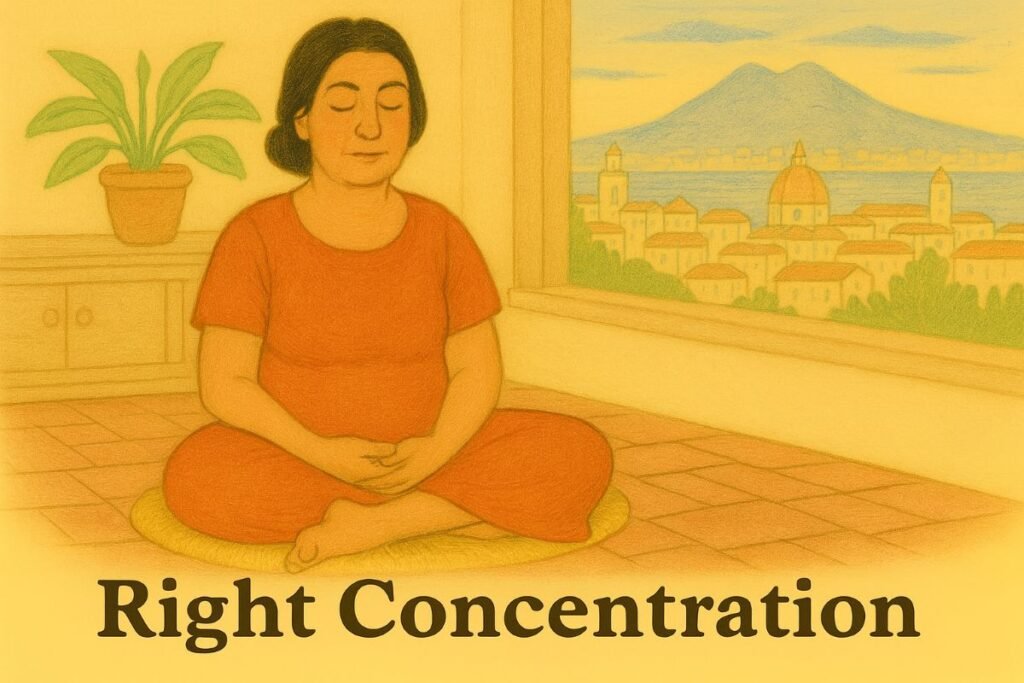
This article explores Right Concentration, or Sammā Samādhi, the eighth factor of the Buddhist Noble Eightfold Path. It provides a clear explanation of this meditative discipline, its role in developing insight, and practical guidance for cultivating steady, peaceful awareness in both formal practice and daily life.